
Introduction to Project Management Chapter 1 Presentation Outline

- Slides: 58
Introduction to Project Management Chapter 1
Presentation Outline • • • Defining Project Examples of Project PMI and PMBOK Project management Evolution of Project management framework Project Life cycle Project Scope Role of Project Manager Management by Objectives Cases Study-1
1. Defining Project • A project is a pre-determined set of activities with a definite beginning and a definite end. • A project requires an organized set of work efforts. • Projects require a level of detail that is progressively elaborated upon as more information is discovered. • Projects are subject to limitations of time and resources such as money and people. • A project has a unique combination of stakeholders. “PMBOK Guide” by the Project Management Institute (PMI) defines a project as “A temporary endeavor undertaken to create a unique product, service, or result. ”
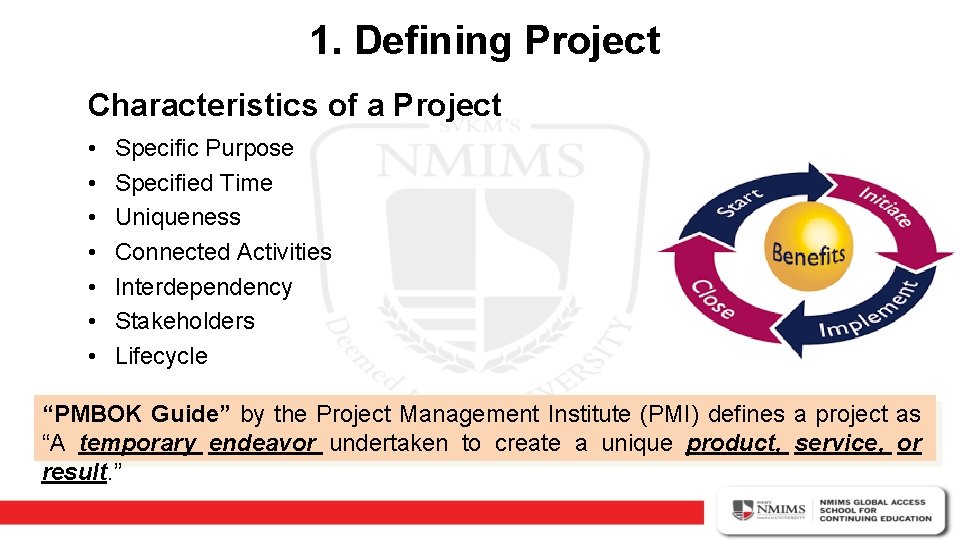
1. Defining Project Characteristics of a Project • • Specific Purpose Specified Time Uniqueness Connected Activities Interdependency Stakeholders Lifecycle “PMBOK Guide” by the Project Management Institute (PMI) defines a project as “A temporary endeavor undertaken to create a unique product, service, or result. ”
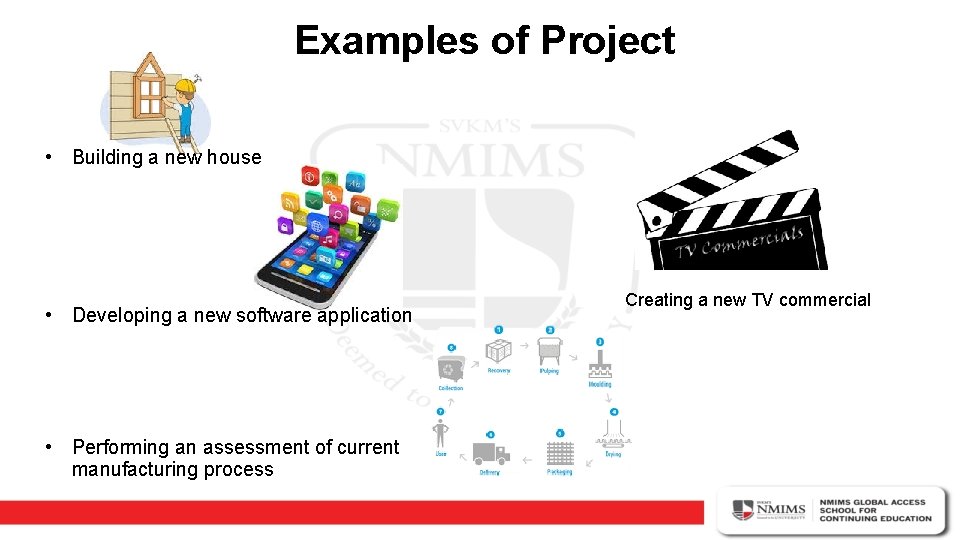
Examples of Project • Building a new house • Developing a new software application • Performing an assessment of current manufacturing process Creating a new TV commercial
Project Management Institute (PMI) • PMI was founded in 1969. • It is the largest non-profit membership association for project management professionals. • Over 450, 000 members worldwide and over 280 local chapters. • In India it has 8 chapters Bangalore Chapter , Chennai Chapter , Mumbai Chapter, North India Chapter, Pearl City, Hyderabad Chapter, Pune-Deccan India Chapter, Trivandrum Chapter, West Bengal Chapter. • It plays an important role in developing standards, conducting research, providing education and training, and networking opportunities in the field of Project Management. • Some useful links – https: //www. pmi. org/ – http: //www. pmi. org. in/
Project Management Body of Knowledge (PMBOK) • PMI publishes and regularly updates the PMBOK Guide. • PMBOK sets standards for successful completion of projects across various industries. • It describes the process of managing an entire project, and the tools and techniques used to reach towards a successful outcome of a project. • PMBOK compiles knowledge, practices and processes, which are generally accepted to be the best in the discipline of project management. • PMBOK is an internationally recognized standard (IEEE std. 1490 -2003) that provides fundamental concepts of project management regardless of the type of the project, be it a construction project, a software development project, heavy-engineering project or automotive project.
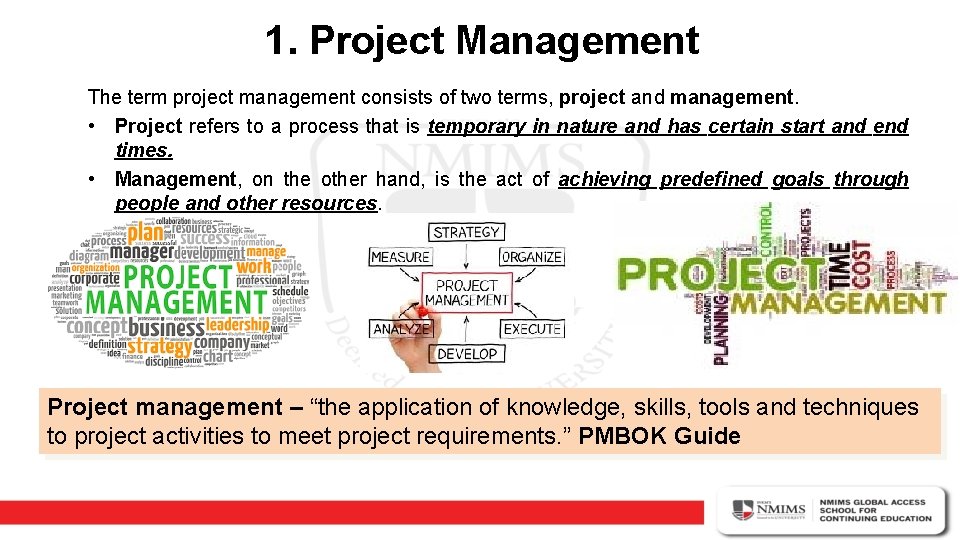
1. Project Management The term project management consists of two terms, project and management. • Project refers to a process that is temporary in nature and has certain start and end times. • Management, on the other hand, is the act of achieving predefined goals through people and other resources. Project management – “the application of knowledge, skills, tools and techniques to project activities to meet project requirements. ” PMBOK Guide
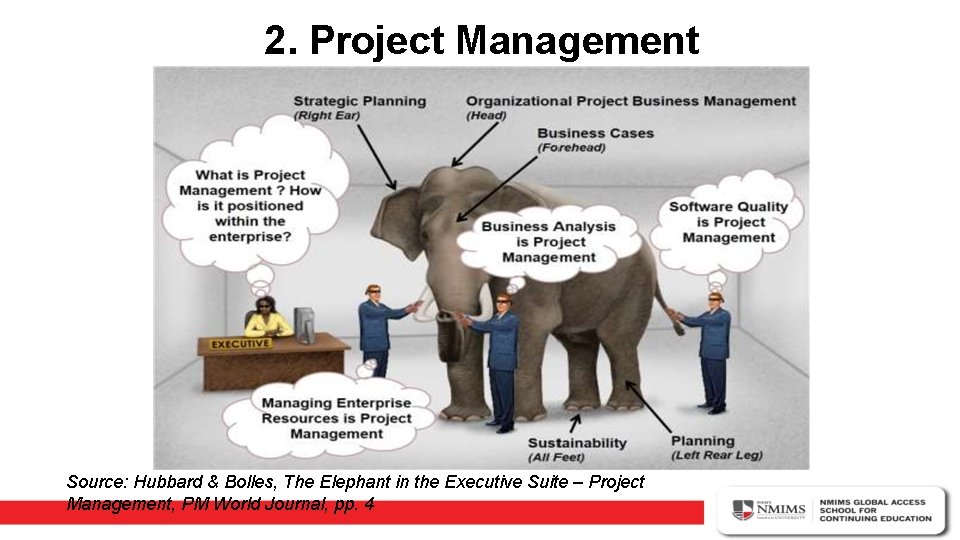
2. Project Management Source: Hubbard & Bolles, The Elephant in the Executive Suite – Project Management, PM World Journal, pp. 4
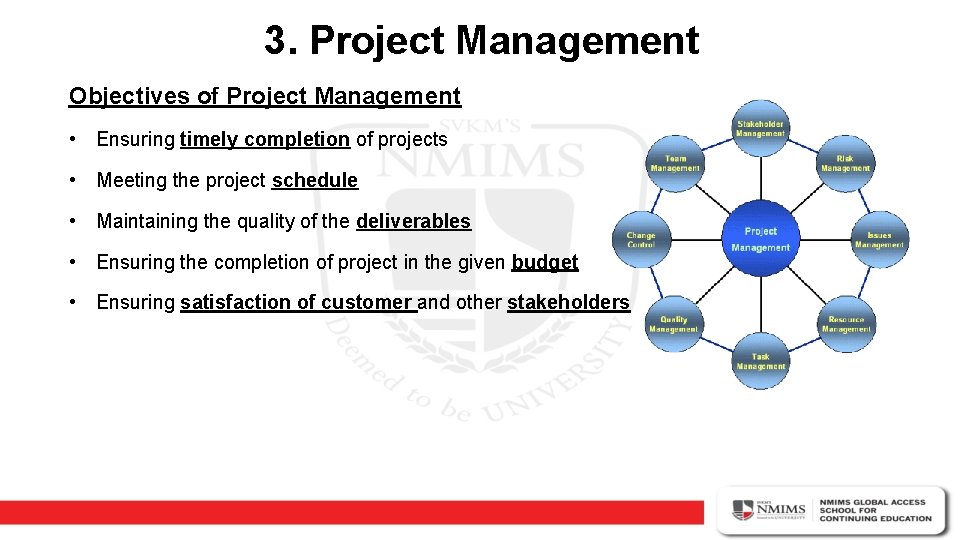
3. Project Management Objectives of Project Management • Ensuring timely completion of projects • Meeting the project schedule • Maintaining the quality of the deliverables • Ensuring the completion of project in the given budget • Ensuring satisfaction of customer and other stakeholders
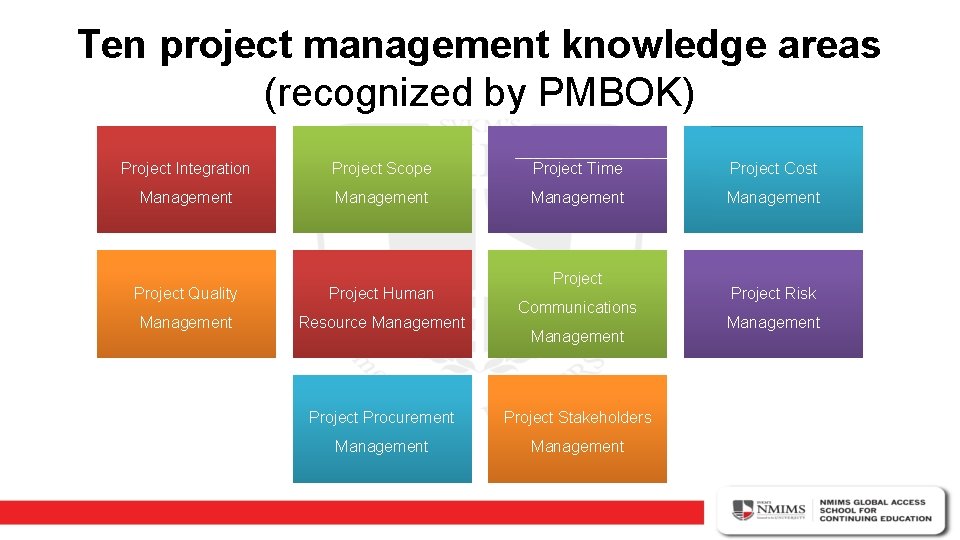
Ten project management knowledge areas (recognized by PMBOK) Project Integration Project Scope Project Time Project Cost Management Project Quality Project Human Management Resource Management Project Communications Management Project Procurement Project Stakeholders Management Project Risk Management
1. Evolution of Project Management (PM) • PM emerged as a formal discipline in the 1950 s • Techniques for planning and controlling schedules and costs were developed for huge Aerospace and Construction Projects in the 1950 s and 1960 s • Manufacturing, Research & Development, IT, and Government projects used and refined management techniques
2. Evolution of Project Management (PM) • Software companies offered software for planning and controlling project costs and schedules in the 1980 s and 1990 s • Risk management techniques for complex projects have been applied to less complex projects • Rapid growth and change in information technology and telecommunications fueled use of PM in the 1990 s and 2000 s in other areas also.
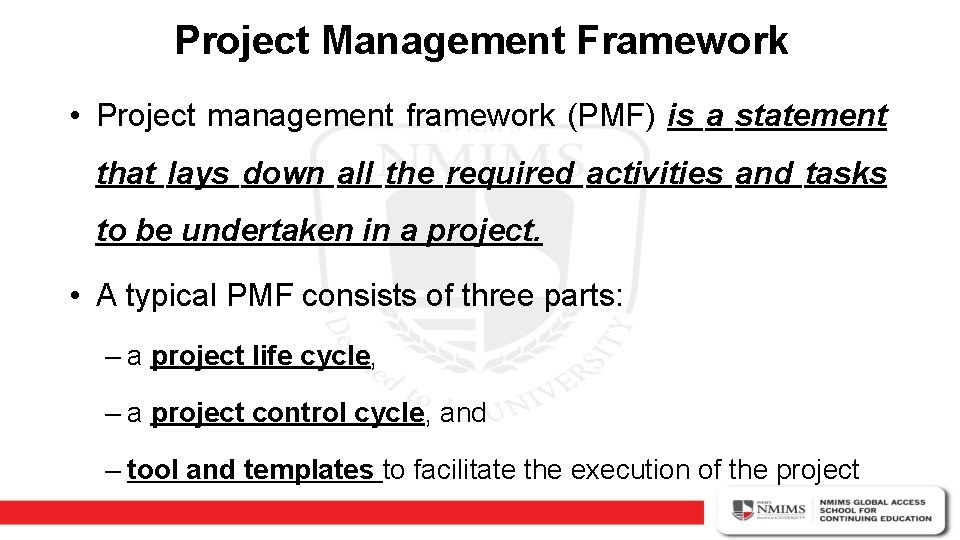
Project Management Framework • Project management framework (PMF) is a statement that lays down all the required activities and tasks to be undertaken in a project. • A typical PMF consists of three parts: – a project life cycle, – a project control cycle, and – tool and templates to facilitate the execution of the project
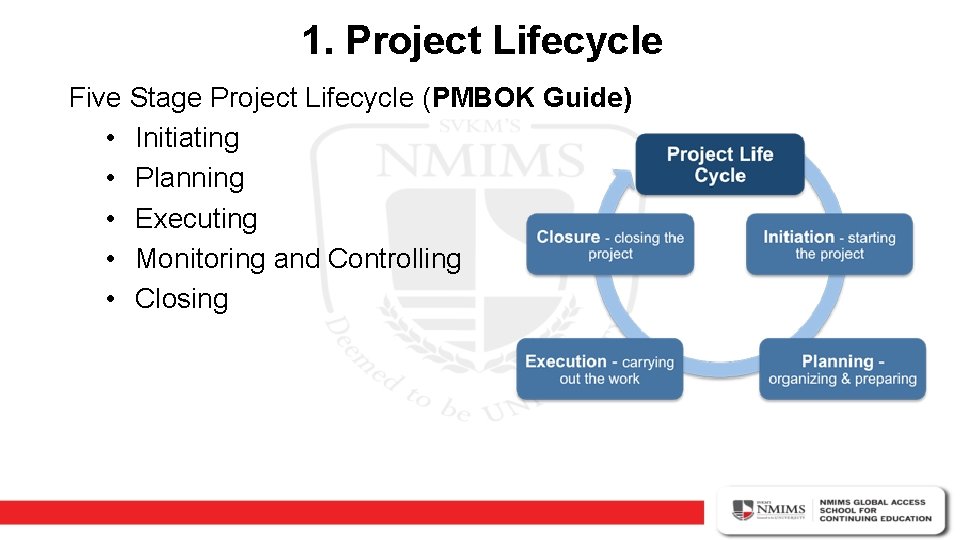
1. Project Lifecycle Five Stage Project Lifecycle (PMBOK Guide) • Initiating • Planning • Executing • Monitoring and Controlling • Closing
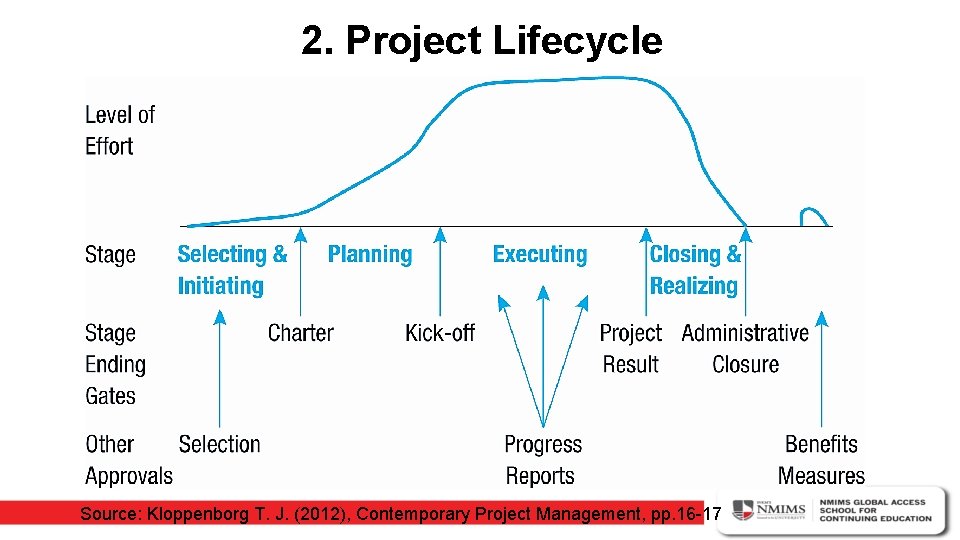
2. Project Lifecycle Source: Kloppenborg T. J. (2012), Contemporary Project Management, pp. 16 -17
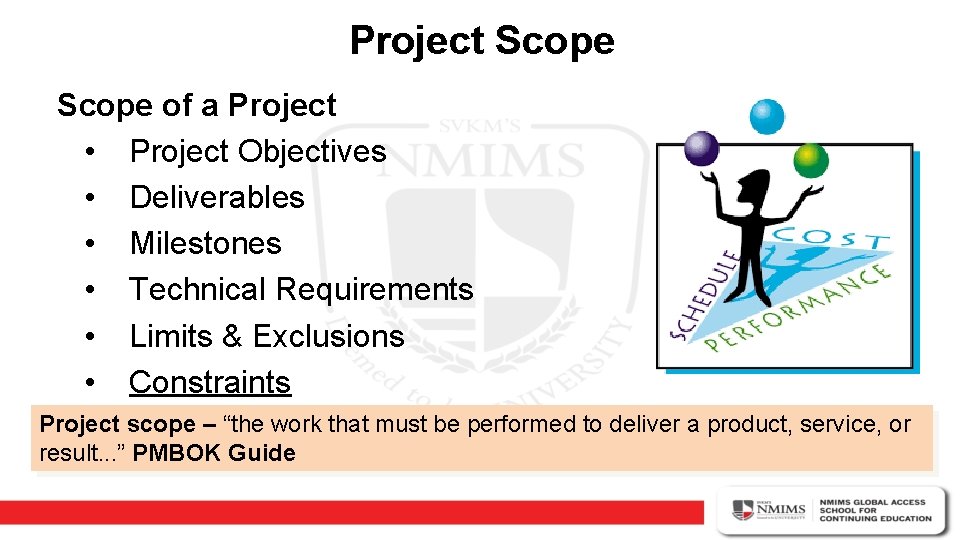
Project Scope of a Project • Project Objectives • Deliverables • Milestones • Technical Requirements • Limits & Exclusions • Constraints Project scope – “the work that must be performed to deliver a product, service, or result. . . ” PMBOK Guide
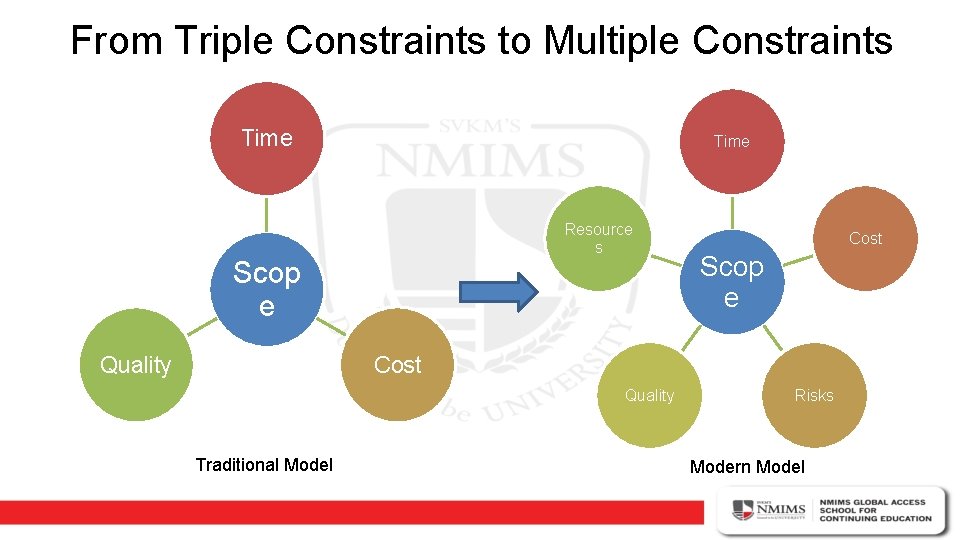
From Triple Constraints to Multiple Constraints Time Resource s Scop e Quality Cost Scop e Cost Quality Traditional Model Risks Modern Model
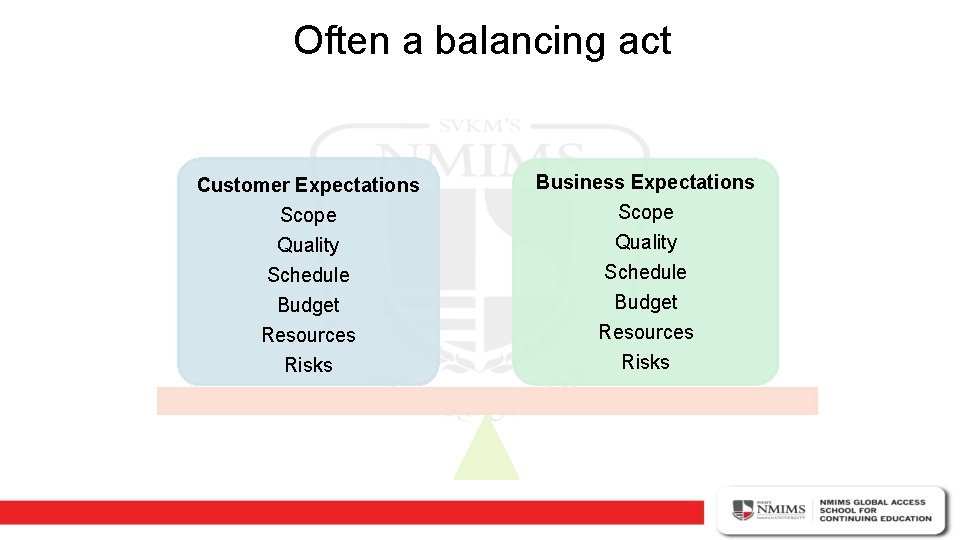
Often a balancing act Customer Expectations Scope Quality Schedule Budget Resources Risks Business Expectations Scope Quality Schedule Budget Resources Risks
Role of a Project Manager • Directly accountable for the project results, schedule, and budget. • The main communicator • Responsible for the planning and execution of the project • Works on the project from start to finish. • The project manager often must get things done through the power of influence since his or her formal power may be limited. Project manager – “the person assigned by the performing organization to achieve the project objectives. ” PMBOK Guide
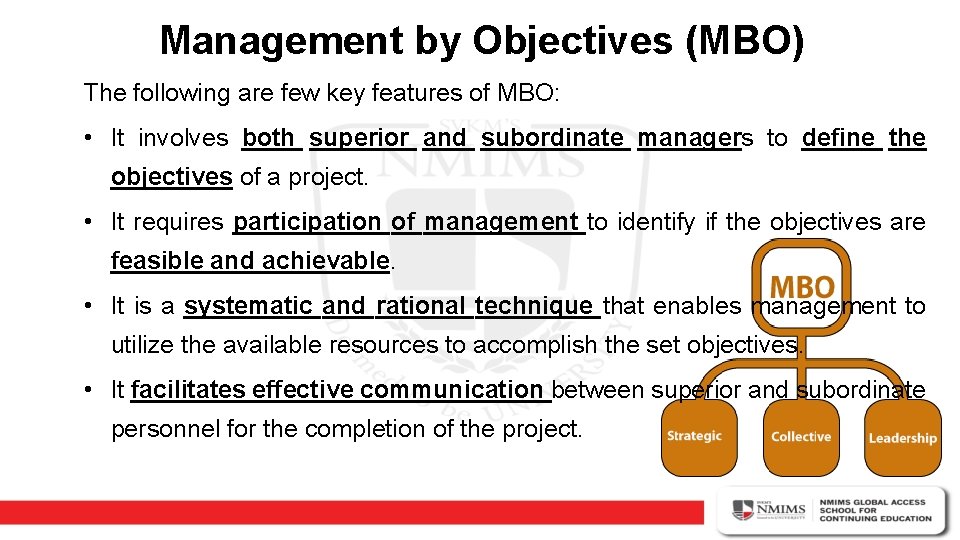
Management by Objectives (MBO) The following are few key features of MBO: • It involves both superior and subordinate managers to define the objectives of a project. • It requires participation of management to identify if the objectives are feasible and achievable. • It is a systematic and rational technique that enables management to utilize the available resources to accomplish the set objectives. • It facilitates effective communication between superior and subordinate personnel for the completion of the project.
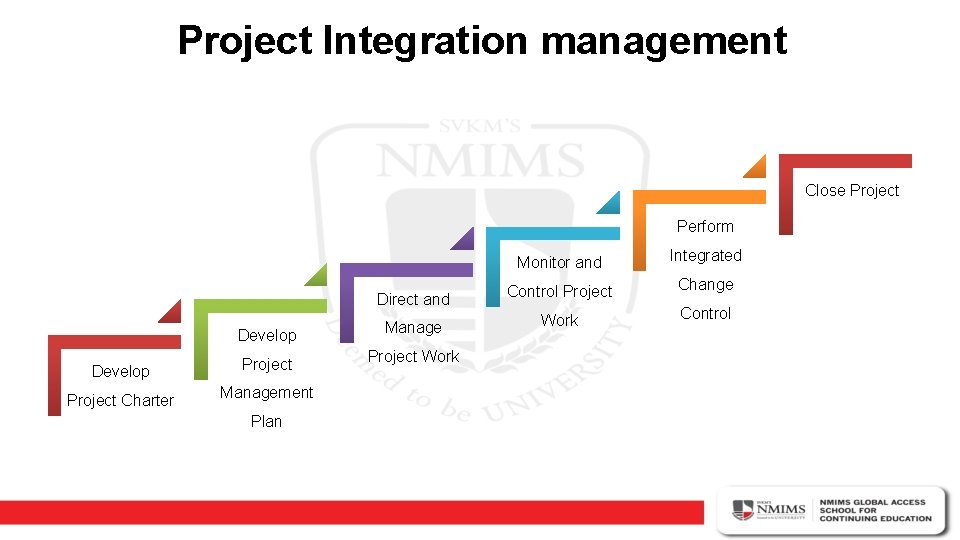
Project Integration management Close Project Perform Monitor and Integrated Direct and Control Project Change Manage Control Develop Work Develop Project Work Project Charter Management Plan
Case Study - PMBOK helps deliver Hong Kong’s massive project • West-East Gas Pipeline from mainland China to Hong Kong • Challenges: Regulations, Communication issues, Environmental requirements and project schedule. • The project team used the best practices knowledge from PMBOK for project management. • PMBOK helped the project team in project planning, scope management, quality monitoring, people management, risk & safety management, communication, decision making and stakeholder management. • Results: Timely completion, no environmental damage and zero accidents.
Project Organisation Chapter 2
Presentation Outline • • Concept of Project Organizational Structures Functional Organization Projectized Organization Matrix Organization The Project Management Office Projects as a Part of Functional Organizations Cases Study-2
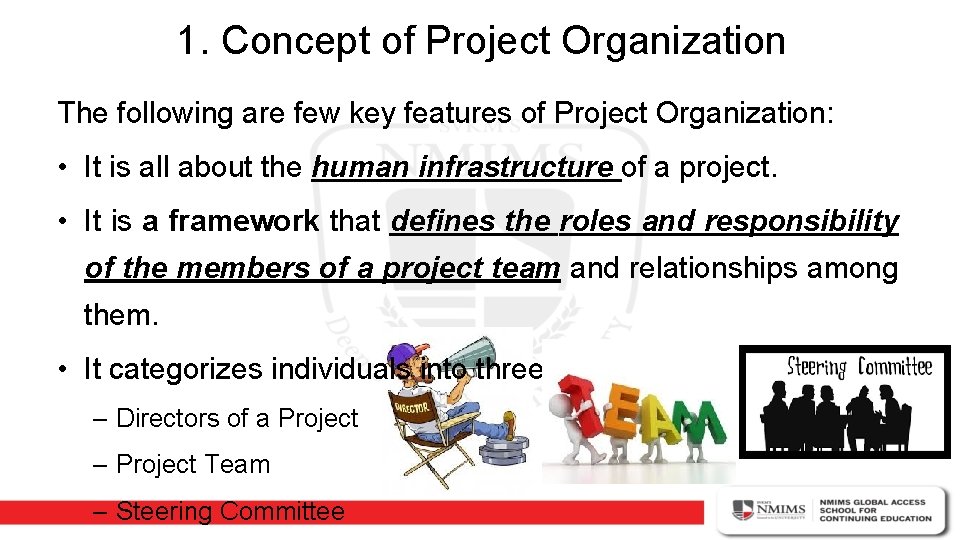
1. Concept of Project Organization The following are few key features of Project Organization: • It is all about the human infrastructure of a project. • It is a framework that defines the roles and responsibility of the members of a project team and relationships among them. • It categorizes individuals into three groups – Directors of a Project – Project Team – Steering Committee
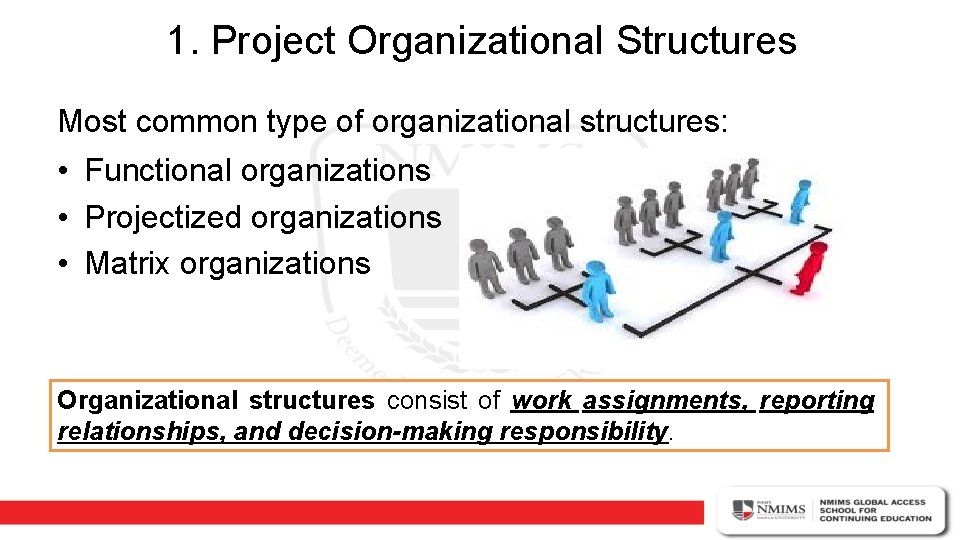
1. Project Organizational Structures Most common type of organizational structures: • Functional organizations • Projectized organizations • Matrix organizations Organizational structures consist of work assignments, reporting relationships, and decision-making responsibility.
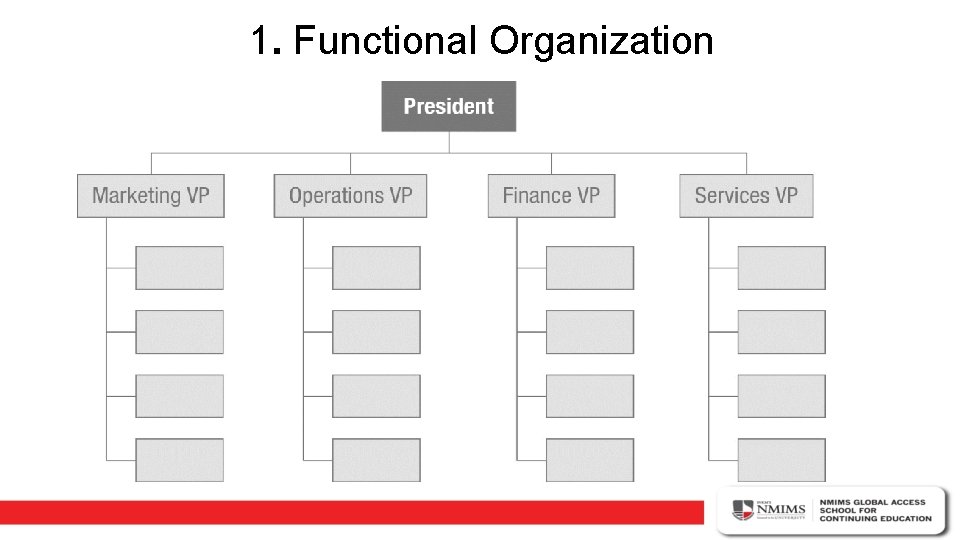
1. Functional Organization
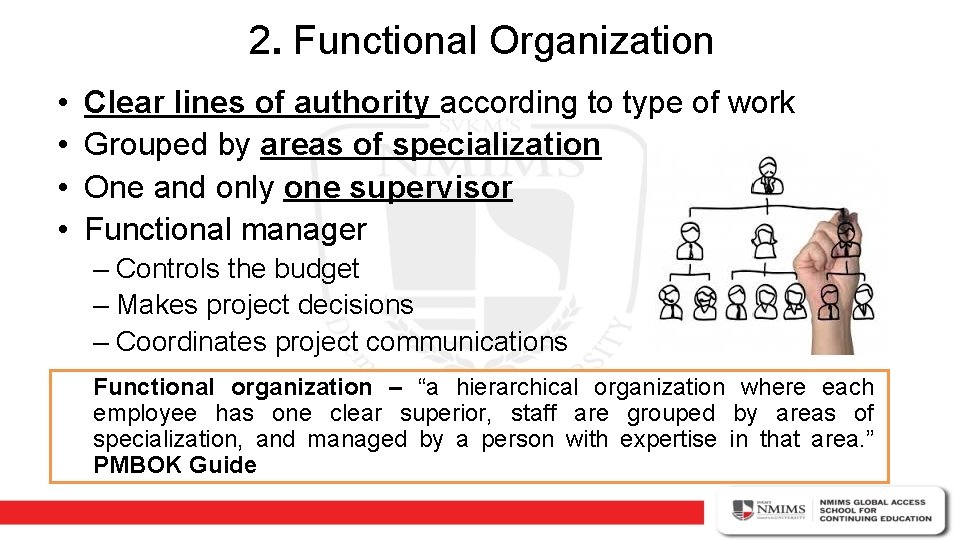
2. Functional Organization • • Clear lines of authority according to type of work Grouped by areas of specialization One and only one supervisor Functional manager – Controls the budget – Makes project decisions – Coordinates project communications Functional organization – “a hierarchical organization where each employee has one clear superior, staff are grouped by areas of specialization, and managed by a person with expertise in that area. ” PMBOK Guide
3. Functional Organization Advantages of functional organizations • Unity of command – Only one “boss” is giving instructions. • Workers learn readily from each other and keep technical skills sharp. • Upon project completion, workers continue to report to the same functional manager. • Share resources among multiple small projects.
4. Functional Organization Disadvantages of functional organizations • Slow communications across multiple functions and channels • Technical difficulty in incorporating input from other disciplines • Long communication channels make for slow decision making and slow response to change
1. Projectized Organization
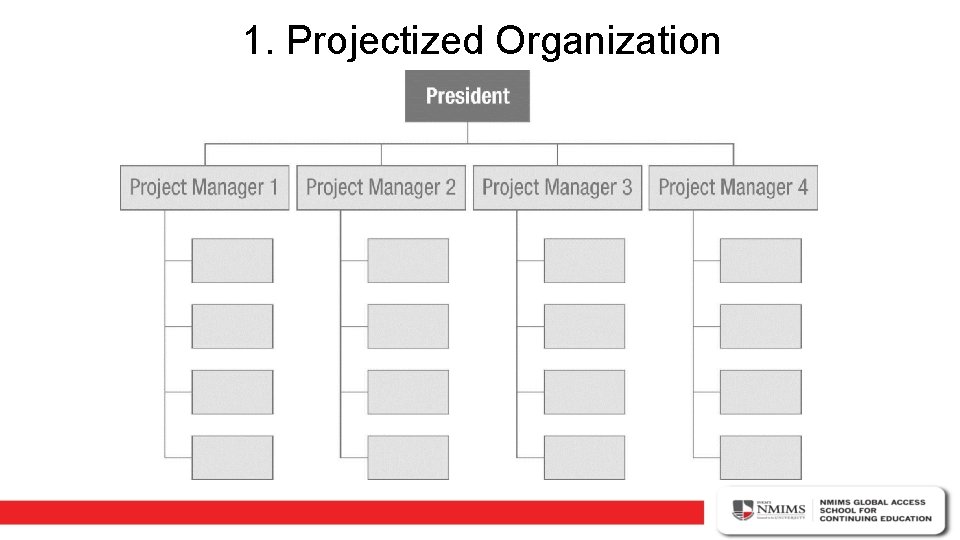
2. Projectized Organization • The project manager has authority for budgets, personnel, and decision making • People are assigned to a project and report upward through the project manager • The reporting manager is a project manager, not a functional manager Projectized organization – “any organizational structure in which the project manager has full authority to assign projects, apply resources, and direct work of persons assigned to the project. ” PMBOK Guide
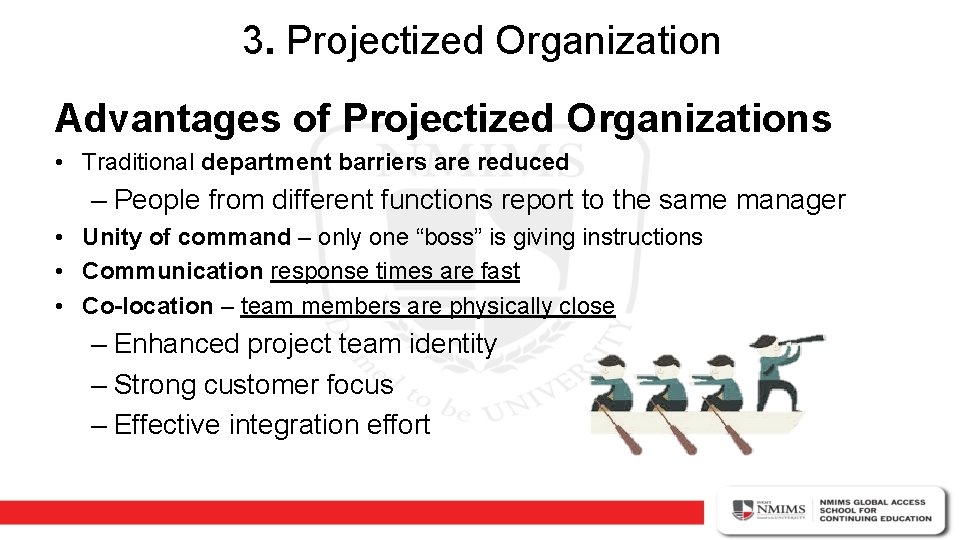
3. Projectized Organization Advantages of Projectized Organizations • Traditional department barriers are reduced – People from different functions report to the same manager • Unity of command – only one “boss” is giving instructions • Communication response times are fast • Co-location – team members are physically close – Enhanced project team identity – Strong customer focus – Effective integration effort
4. Projectized Organization Disadvantages of Projectized Organizations • Cost of assigning team members to only one part-time project • Teams development work methods that differ from the organization • Teams may fail to communicate lessons learned • Discipline-specific competence may suffer
1. Matrix Organization
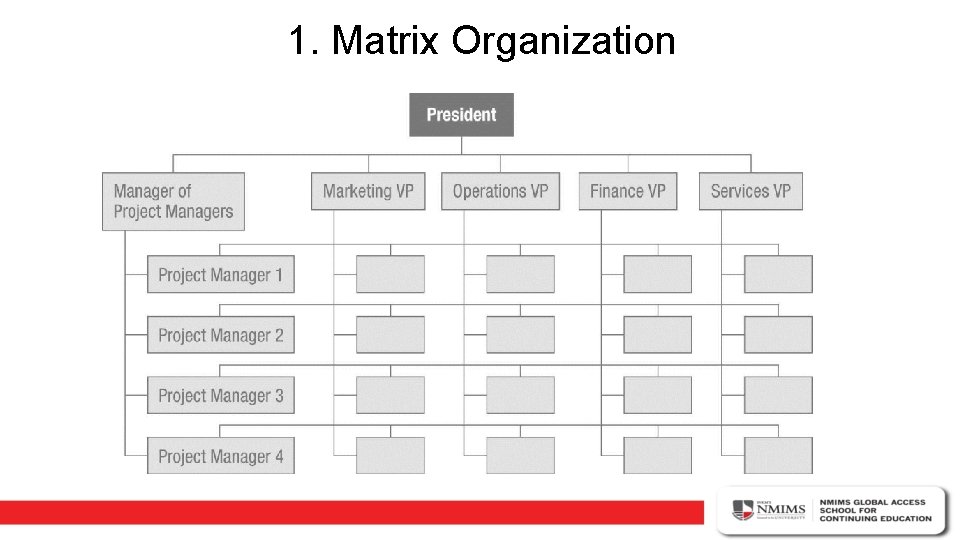
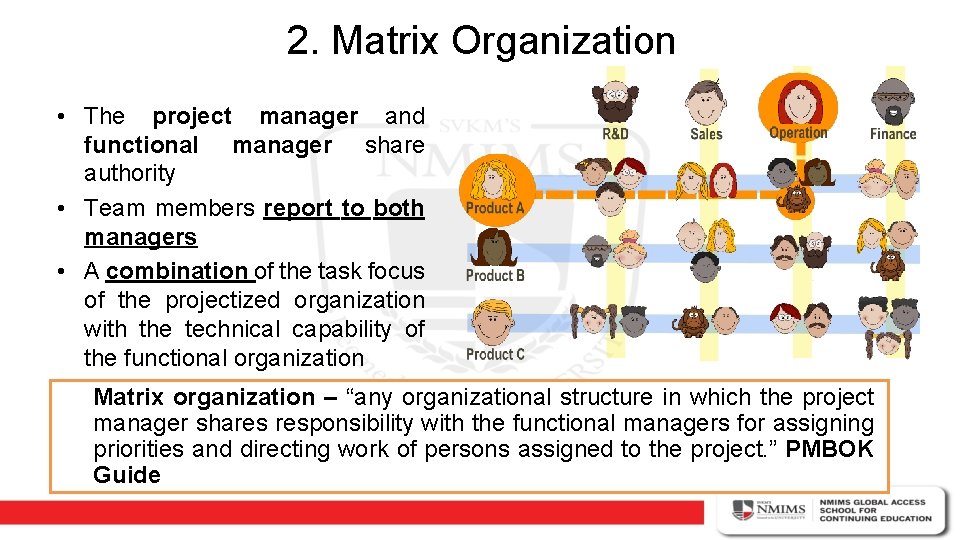
2. Matrix Organization • The project manager and functional manager share authority • Team members report to both managers • A combination of the task focus of the projectized organization with the technical capability of the functional organization Matrix organization – “any organizational structure in which the project manager shares responsibility with the functional managers for assigning priorities and directing work of persons assigned to the project. ” PMBOK Guide
3. Matrix Organization Advantages of Matrix Organizations • • Shared resources between departments and projects Good cooperation between functional and project managers High-quality decisions are well received Continued development of discipline specific knowledge Effective integration Lessons learned shared effectively Flexibility – weak, balance, strong matrix
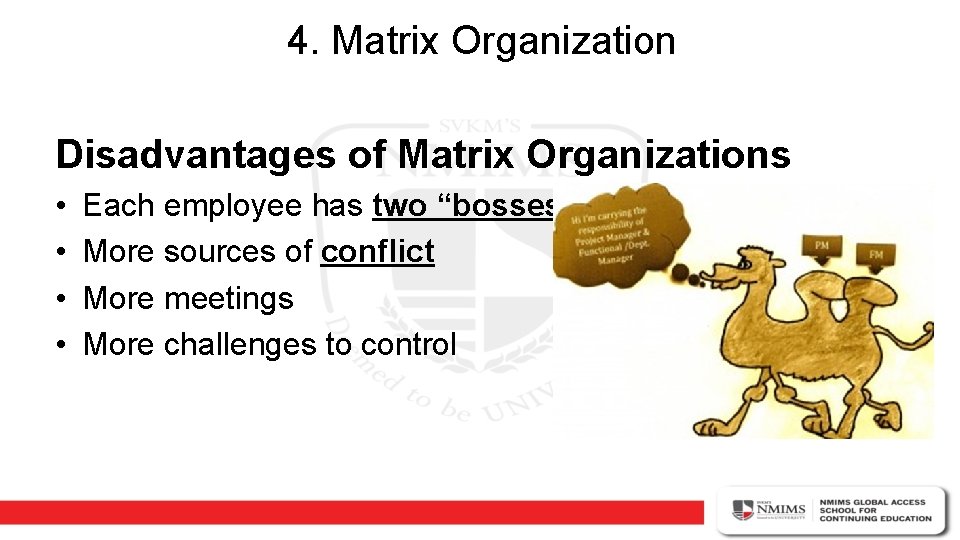
4. Matrix Organization Disadvantages of Matrix Organizations • • Each employee has two “bosses” More sources of conflict More meetings More challenges to control
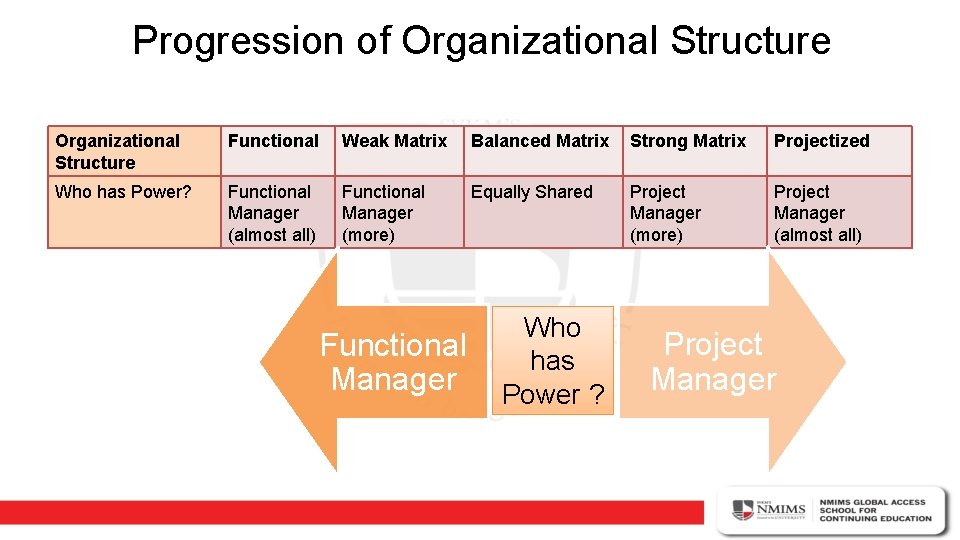
Progression of Organizational Structure Functional Weak Matrix Balanced Matrix Strong Matrix Projectized Who has Power? Functional Manager (almost all) Functional Manager (more) Equally Shared Project Manager (more) Project Manager (almost all) Functional Manager Who has Power ? Project Manager
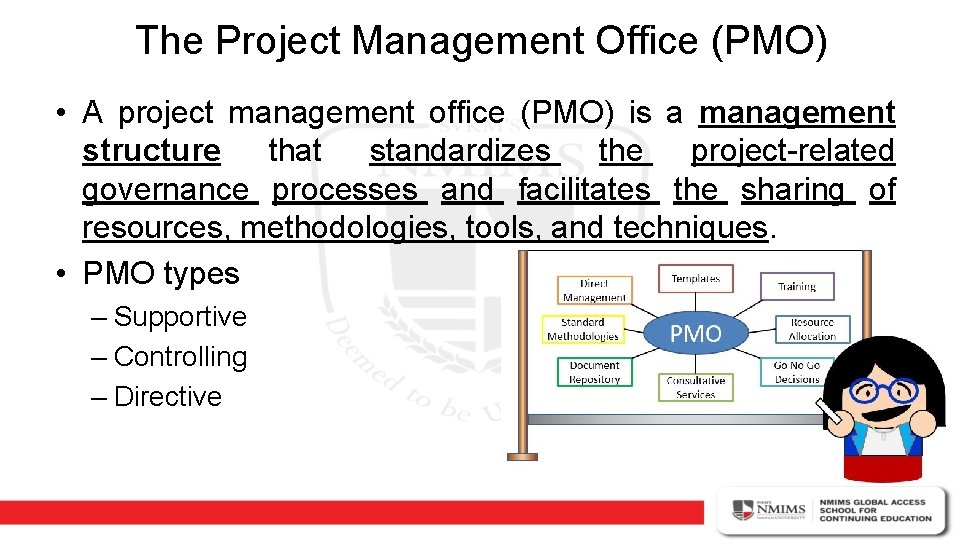
The Project Management Office (PMO) • A project management office (PMO) is a management structure that standardizes the project-related governance processes and facilitates the sharing of resources, methodologies, tools, and techniques. • PMO types – Supportive – Controlling – Directive
Projects as a Part of Functional Organizations • When a project is implemented in a functional organisation structure, it is made a part of one of the functional divisions and the functional division play a major role in ensuring the success of the project. • Advantage of implementing a project in a functional organization – Functional organizations offer maximum flexibility in the use of organization's staff. – Experts from various divisions within an organization are temporarily assigned work responsibility. – After the completion of their tasks, these experts can immediately resume their routine assignments.
Case Study – Fast-track PMO implementation rescues Finolex’s troubled projects and enhanced customer satisfaction • Project: Finolex’s expansion to new fields like healthcare. • Challenges: – IT resources, Increasing demand, organizational resources, cost, business practice standardization and performance enhancement. – Failure in implementing PMO. • Solution: – Hired PM solutions for PMO implementation. – PM solutions delivered the PMO in 6 months time – PM solutions helped Finolex in selecting project portfolio management tool. • Project Outcomes: – Enhancement in the morale of the project manager. – Improved project performance. – Higher customer satisfaction.
Operating and Environmental Feasibility Chapter 3
Presentation Outline • • Feasibility Study Operating feasibility Capacity and resource requirement in project Increasing plant capacity Selecting project location Environmental feasibility Cases Study-3
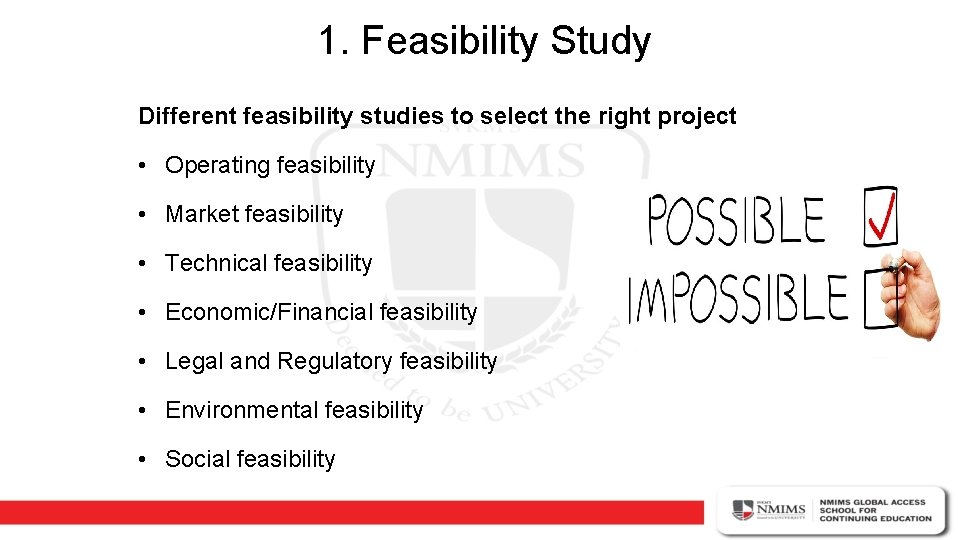
1. Feasibility Study Different feasibility studies to select the right project • Operating feasibility • Market feasibility • Technical feasibility • Economic/Financial feasibility • Legal and Regulatory feasibility • Environmental feasibility • Social feasibility
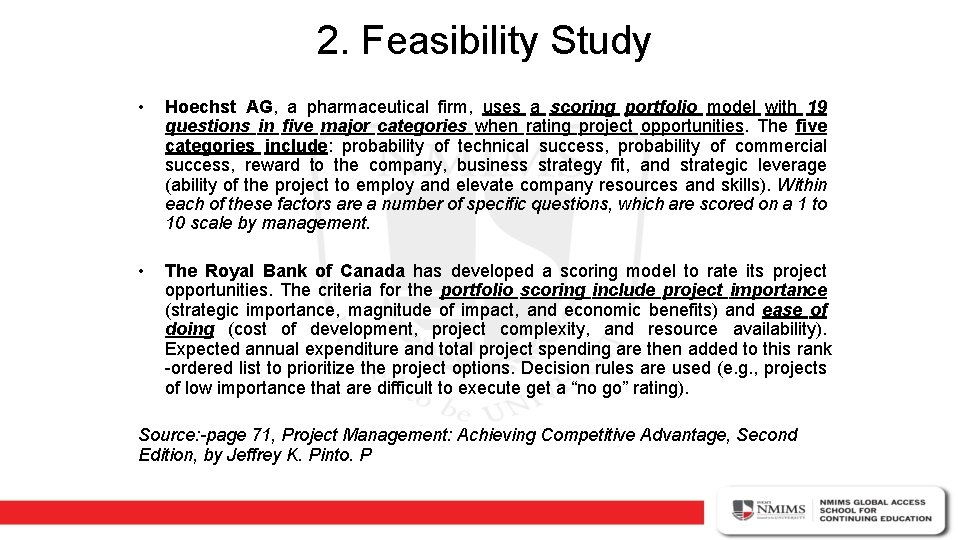
2. Feasibility Study • Hoechst AG, a pharmaceutical firm, uses a scoring portfolio model with 19 questions in five major categories when rating project opportunities. The five categories include: probability of technical success, probability of commercial success, reward to the company, business strategy fit, and strategic leverage (ability of the project to employ and elevate company resources and skills). Within each of these factors are a number of specific questions, which are scored on a 1 to 10 scale by management. • The Royal Bank of Canada has developed a scoring model to rate its project opportunities. The criteria for the portfolio scoring include project importance (strategic importance, magnitude of impact, and economic benefits) and ease of doing (cost of development, project complexity, and resource availability). Expected annual expenditure and total project spending are then added to this rank -ordered list to prioritize the project options. Decision rules are used (e. g. , projects of low importance that are difficult to execute get a “no go” rating). Source: -page 71, Project Management: Achieving Competitive Advantage, Second Edition, by Jeffrey K. Pinto. P
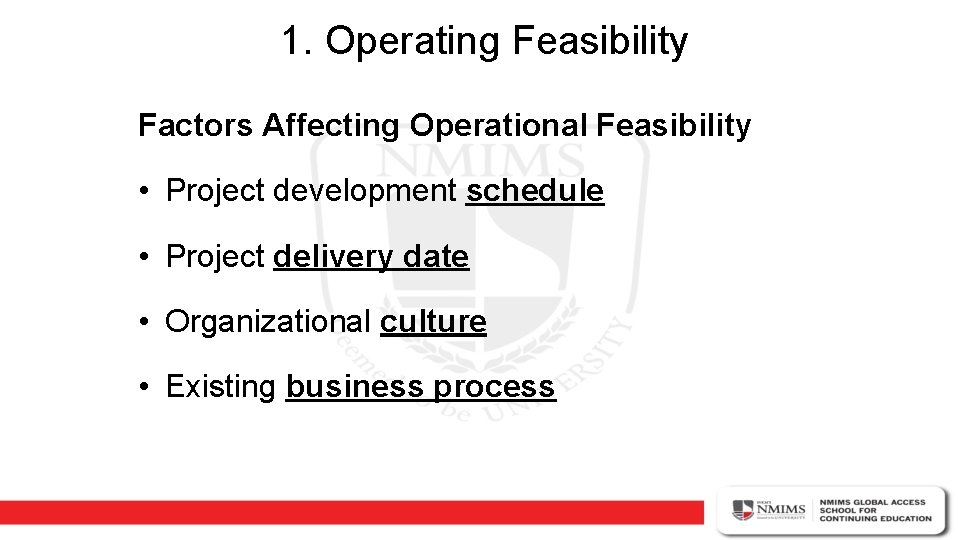
1. Operating Feasibility Factors Affecting Operational Feasibility • Project development schedule • Project delivery date • Organizational culture • Existing business process
2. Operating Feasibility Operational feasibility study helps organizations to: • Assess the potential of a project • Evaluate the probable impact of the project on the environment • Implement the project efficiently • Review the implemented project periodically • Analyze the impact of the project on end users • Utilize resources judiciously
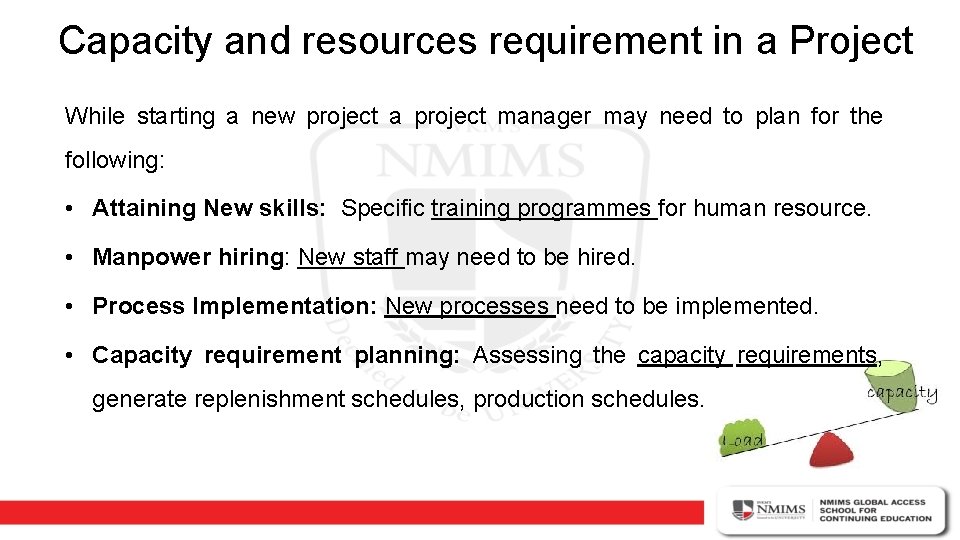
Capacity and resources requirement in a Project While starting a new project a project manager may need to plan for the following: • Attaining New skills: Specific training programmes for human resource. • Manpower hiring: New staff may need to be hired. • Process Implementation: New processes need to be implemented. • Capacity requirement planning: Assessing the capacity requirements, generate replenishment schedules, production schedules.
Increasing Plant Capacity The following factors may affect the capacity of a Plant • Input constraints • Investment cost • Market situation • Government policies
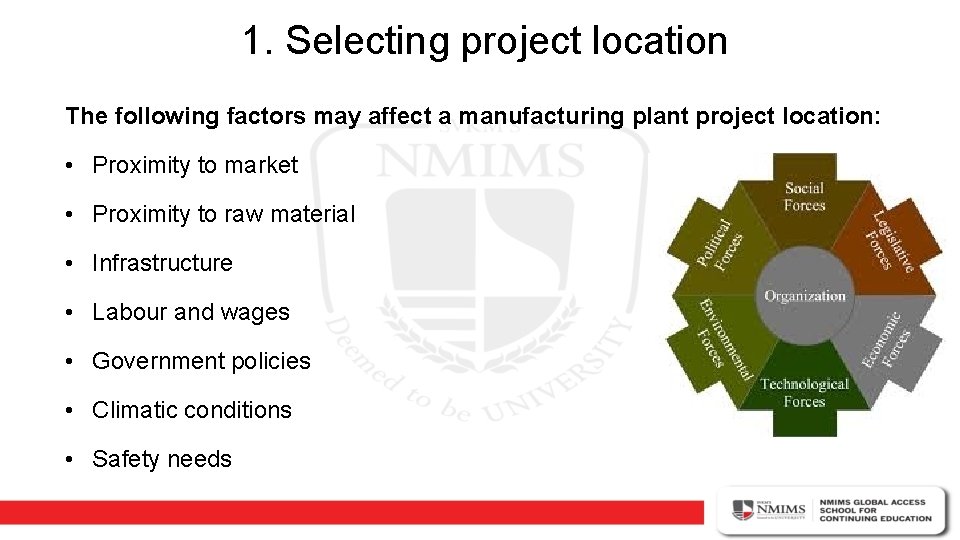
1. Selecting project location The following factors may affect a manufacturing plant project location: • Proximity to market • Proximity to raw material • Infrastructure • Labour and wages • Government policies • Climatic conditions • Safety needs
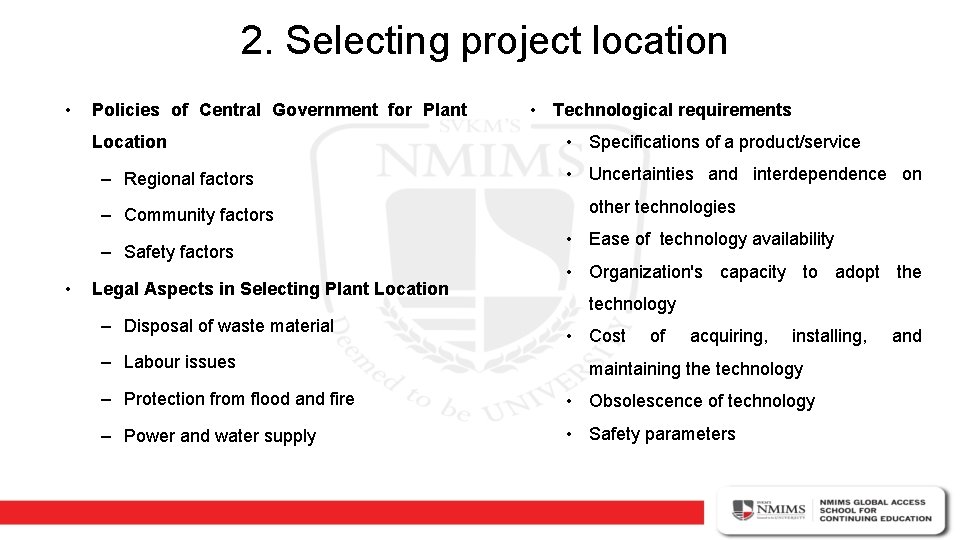
2. Selecting project location • Policies of Central Government for Plant Location – Regional factors – Community factors – Safety factors • Legal Aspects in Selecting Plant Location – Disposal of waste material – Labour issues • Technological requirements • Specifications of a product/service • Uncertainties and interdependence on other technologies • Ease of technology availability • Organization's capacity to adopt the technology • Cost of acquiring, installing, maintaining the technology – Protection from flood and fire • Obsolescence of technology – Power and water supply • Safety parameters and
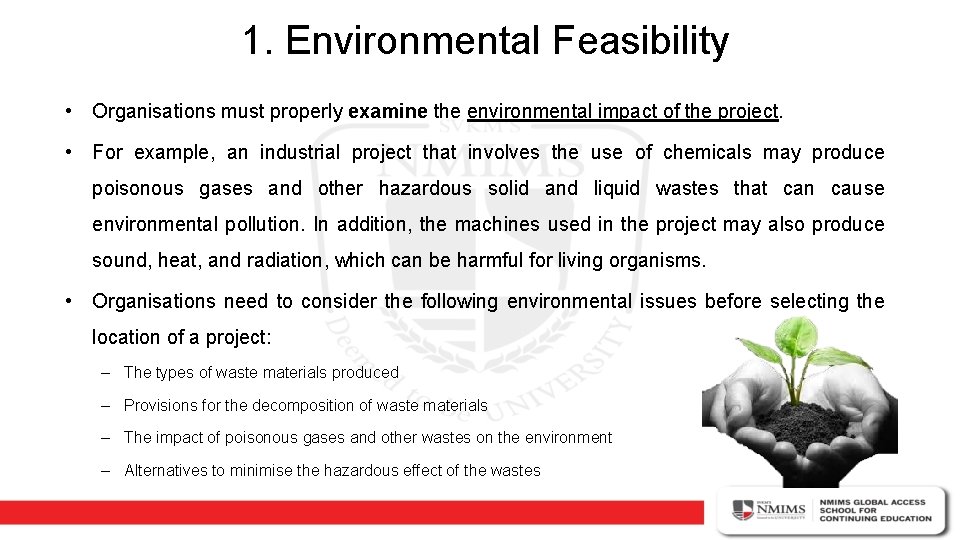
1. Environmental Feasibility • Organisations must properly examine the environmental impact of the project. • For example, an industrial project that involves the use of chemicals may produce poisonous gases and other hazardous solid and liquid wastes that can cause environmental pollution. In addition, the machines used in the project may also produce sound, heat, and radiation, which can be harmful for living organisms. • Organisations need to consider the following environmental issues before selecting the location of a project: – The types of waste materials produced – Provisions for the decomposition of waste materials – The impact of poisonous gases and other wastes on the environment – Alternatives to minimise the hazardous effect of the wastes
2. Environmental Feasibility Concept of Industrially Backward Areas • The industrial policies of the governments are considered while taking location decisions of organisations for setting up new plants. • In India, the industrial development of backward areas for balanced regional development has always been a priority. • As per the Industrial Policy Resolution of 1977, “the Government attaches great important to balanced regional development of the entire country so that disparities in levels of development between different regions are progressively reduced”. • Majority of the industrial development since India’s independence has been restricted around metropolitan areas and big cities.
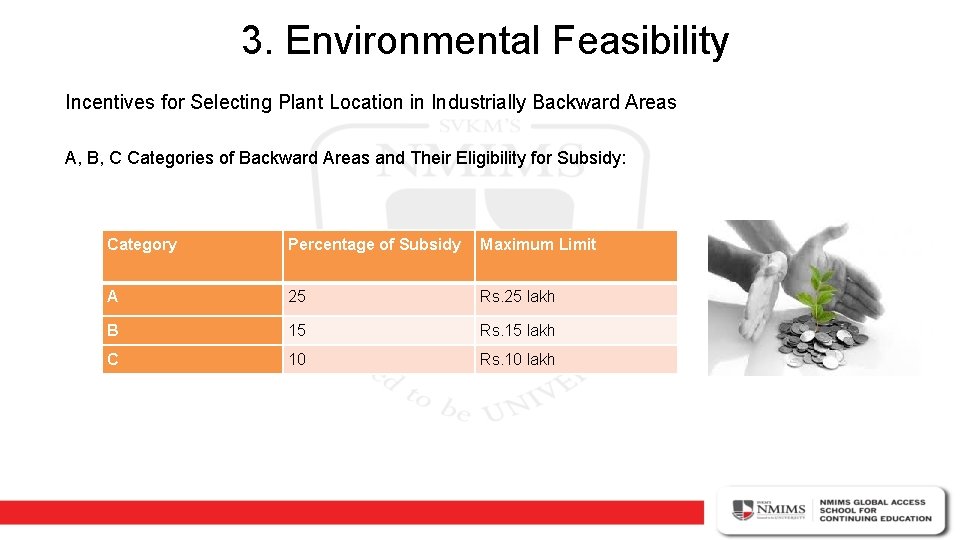
3. Environmental Feasibility Incentives for Selecting Plant Location in Industrially Backward Areas A, B, C Categories of Backward Areas and Their Eligibility for Subsidy: Category Percentage of Subsidy Maximum Limit A 25 Rs. 25 lakh B 15 Rs. 15 lakh C 10 Rs. 10 lakh
Case Study- Feasibility Study of a bulk water distribution project • Company: Global Partners water LLC • Project: Bringing water from Iceland to Haiti • Challenges: – Massive cultural difference – Complex logistics system – Highly unstable political environment and large displaced citizens – Earthquake prone • Feasibility study: – Consultants at Burns & Hammond developed a feasibility study and implementation plan for the project – Environmental, social and economic impacts were studied – A distribution strategy was developed to make to the 2010 reconstruction efforts free from any impact from the project – Feasibility study on Haiti’s readiness to serve as a test market. – Stakeholder engagement across multiple government, citizen, business, and NGO. – Socio-cultural, economic, political, technological and environmental analysis provided a framework to the client to assess the opportunities and risks.