
Introduction to Programming in C Subprograms procedures and
Introduction to Programming (in C++) Subprograms: procedures and functions Jordi Cortadella, Ricard Gavaldà, Fernando Orejas Dept. of Computer Science, UPC
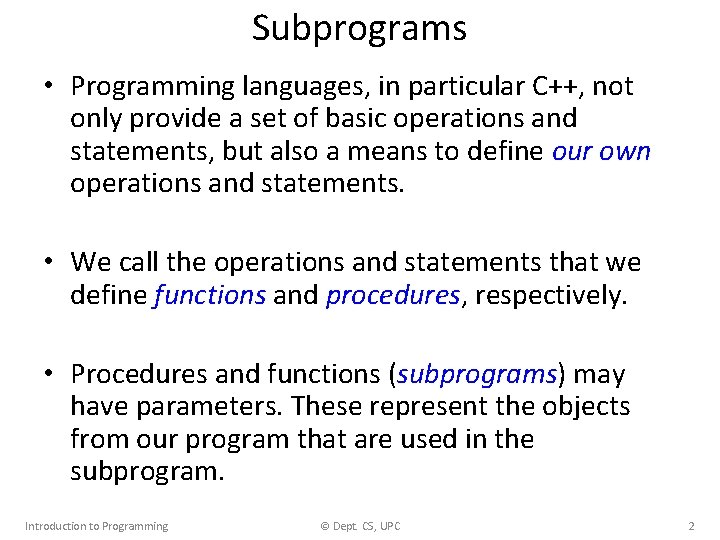
Subprograms • Programming languages, in particular C++, not only provide a set of basic operations and statements, but also a means to define our own operations and statements. • We call the operations and statements that we define functions and procedures, respectively. • Procedures and functions (subprograms) may have parameters. These represent the objects from our program that are used in the subprogram. Introduction to Programming © Dept. CS, UPC 2
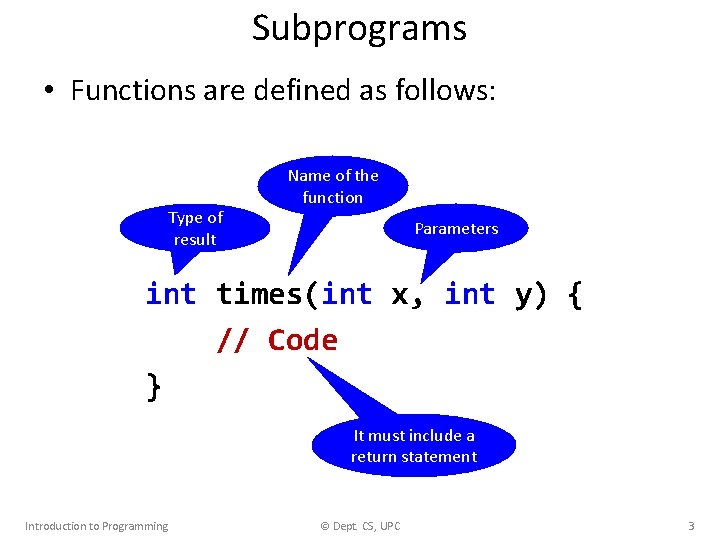
Subprograms • Functions are defined as follows: Type of result Name of the function Parameters int times(int x, int y) { // Code } It must include a return statement Introduction to Programming © Dept. CS, UPC 3
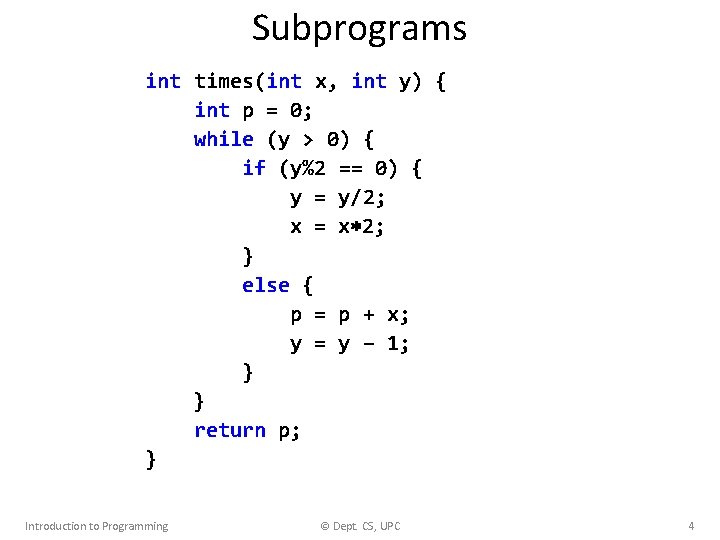
Subprograms int times(int x, int y) { int p = 0; while (y > 0) { if (y%2 == 0) { y = y/2; x = x 2; } else { p = p + x; y = y – 1; } } return p; } Introduction to Programming © Dept. CS, UPC 4

Subprograms • Procedures are defined similarly, but without delivering any result: No result void factors(int x) { // Code } Introduction to Programming © Dept. CS, UPC 5
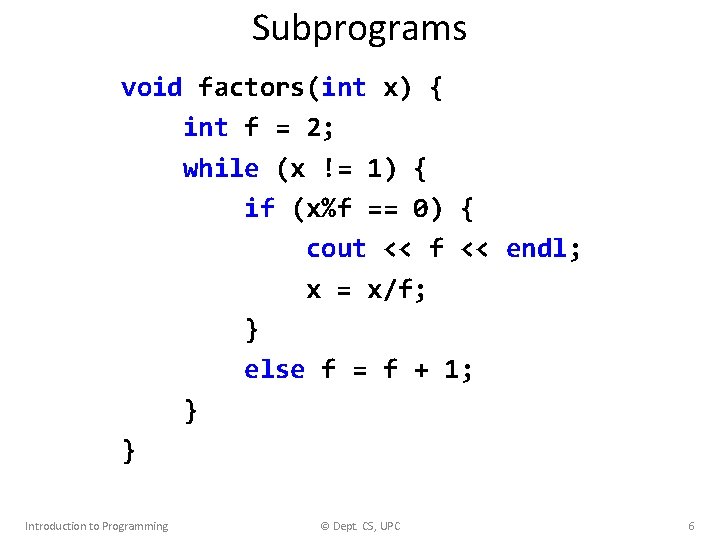
Subprograms void factors(int x) { int f = 2; while (x != 1) { if (x%f == 0) { cout << f << endl; x = x/f; } else f = f + 1; } } Introduction to Programming © Dept. CS, UPC 6
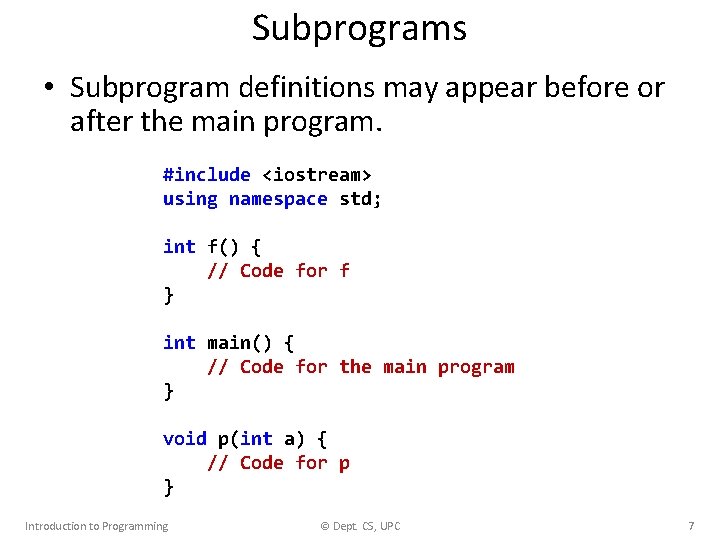
Subprograms • Subprogram definitions may appear before or after the main program. #include <iostream> using namespace std; int f() { // Code for f } int main() { // Code for the main program } void p(int a) { // Code for p } Introduction to Programming © Dept. CS, UPC 7
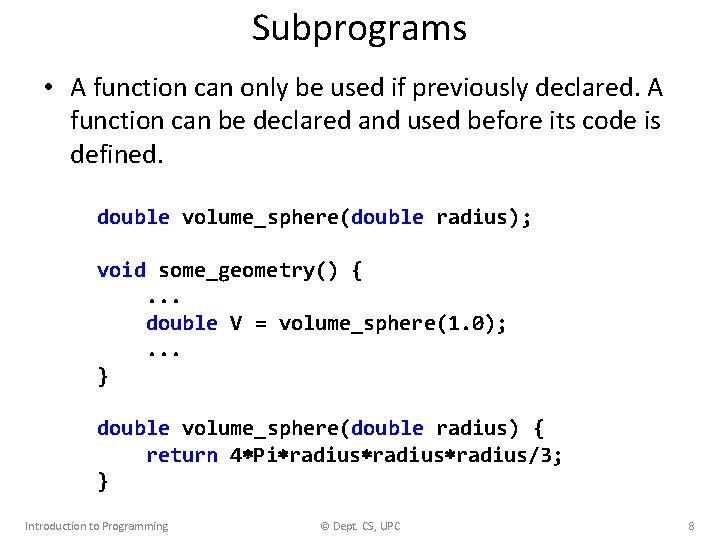
Subprograms • A function can only be used if previously declared. A function can be declared and used before its code is defined. double volume_sphere(double radius); void some_geometry() {. . . double V = volume_sphere(1. 0); . . . } double volume_sphere(double radius) { return 4 Pi radius/3; } Introduction to Programming © Dept. CS, UPC 8
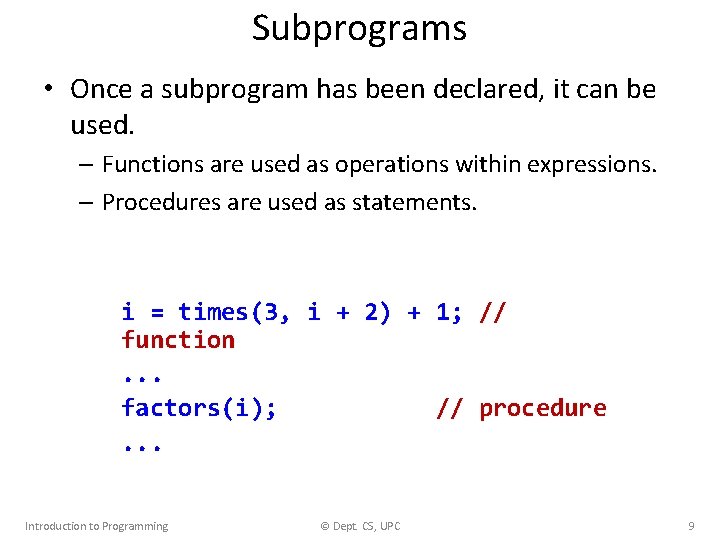
Subprograms • Once a subprogram has been declared, it can be used. – Functions are used as operations within expressions. – Procedures are used as statements. i = times(3, i + 2) + 1; // function. . . factors(i); // procedure. . . Introduction to Programming © Dept. CS, UPC 9
Subprograms • Appropriate use of subprograms: – Increases readability: programs are better structured and easier to understand. – Enables the use of abstraction in the program design. – Facilitates code reuse. Introduction to Programming © Dept. CS, UPC 10
Subprograms • Evaluating the expression times(3, i + 2) + 1 means executing the code of times over the arguments 3 and i+2 and then adding 1 to the result returned by the function. Introduction to Programming © Dept. CS, UPC 11
Subprograms • Evaluating the statement factors(i); means executing the code of factors over the argument i. Introduction to Programming © Dept. CS, UPC 12
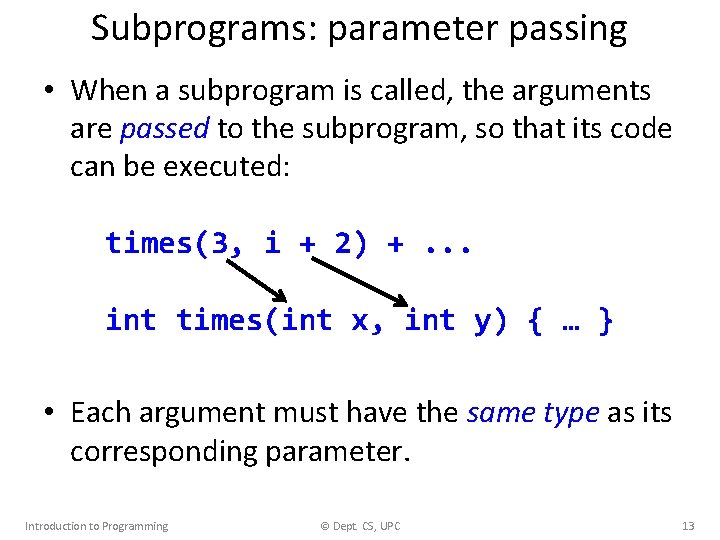
Subprograms: parameter passing • When a subprogram is called, the arguments are passed to the subprogram, so that its code can be executed: times(3, i + 2) +. . . int times(int x, int y) { … } • Each argument must have the same type as its corresponding parameter. Introduction to Programming © Dept. CS, UPC 13
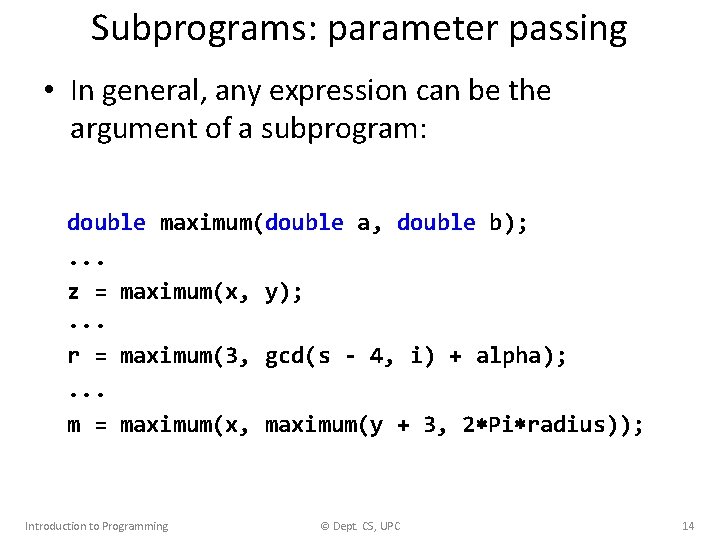
Subprograms: parameter passing • In general, any expression can be the argument of a subprogram: double maximum(double a, double b); . . . z = maximum(x, y); . . . r = maximum(3, gcd(s - 4, i) + alpha); . . . m = maximum(x, maximum(y + 3, 2 Pi radius)); Introduction to Programming © Dept. CS, UPC 14
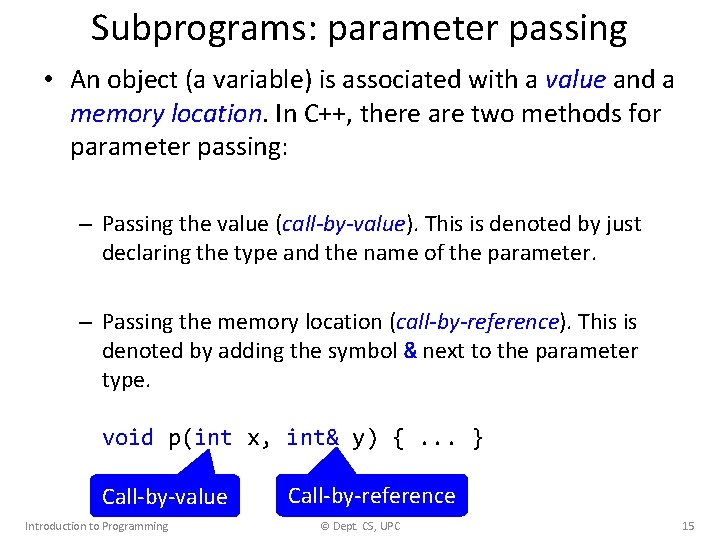
Subprograms: parameter passing • An object (a variable) is associated with a value and a memory location. In C++, there are two methods for parameter passing: – Passing the value (call-by-value). This is denoted by just declaring the type and the name of the parameter. – Passing the memory location (call-by-reference). This is denoted by adding the symbol & next to the parameter type. void p(int x, int& y) {. . . } Call-by-value Introduction to Programming Call-by-reference © Dept. CS, UPC 15
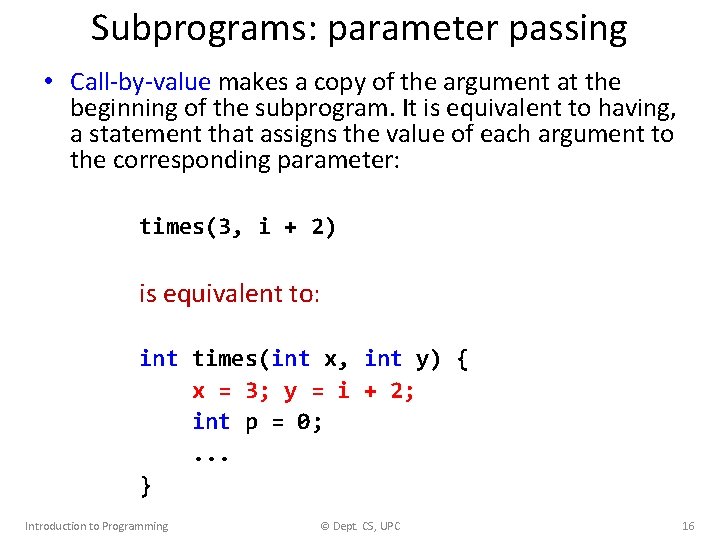
Subprograms: parameter passing • Call-by-value makes a copy of the argument at the beginning of the subprogram. It is equivalent to having, a statement that assigns the value of each argument to the corresponding parameter: times(3, i + 2) is equivalent to: int times(int x, int y) { x = 3; y = i + 2; int p = 0; . . . } Introduction to Programming © Dept. CS, UPC 16
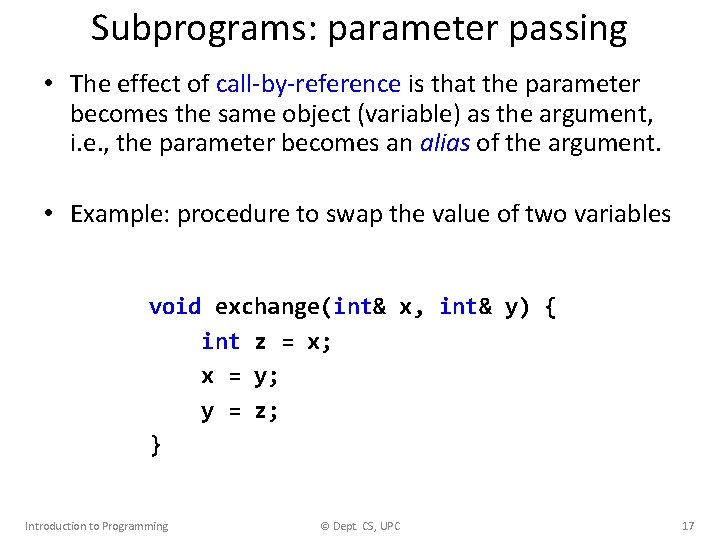
Subprograms: parameter passing • The effect of call-by-reference is that the parameter becomes the same object (variable) as the argument, i. e. , the parameter becomes an alias of the argument. • Example: procedure to swap the value of two variables void exchange(int& x, int& y) { int z = x; x = y; y = z; } Introduction to Programming © Dept. CS, UPC 17
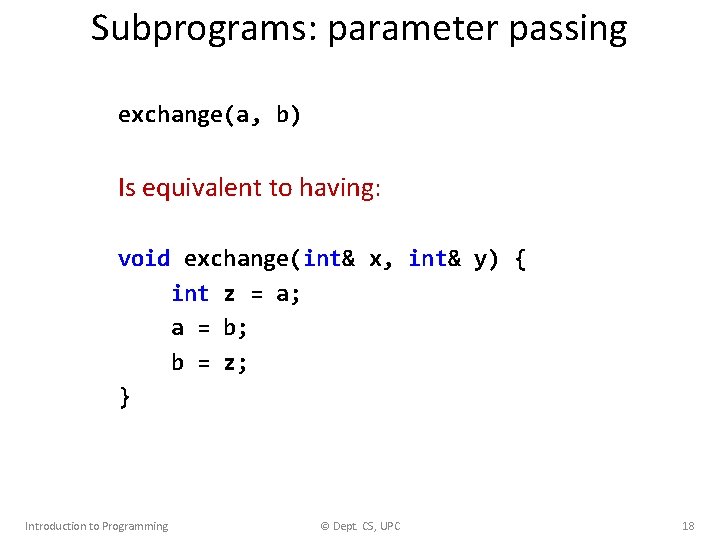
Subprograms: parameter passing exchange(a, b) Is equivalent to having: void exchange(int& x, int& y) { int z = a; a = b; b = z; } Introduction to Programming © Dept. CS, UPC 18
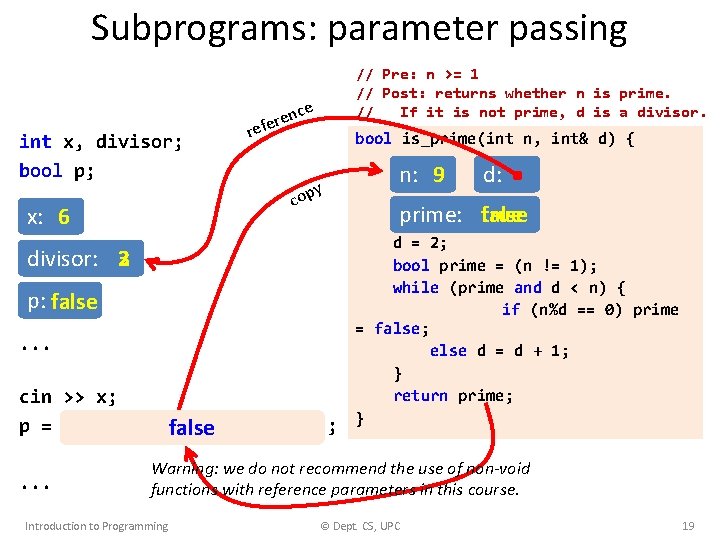
Subprograms: parameter passing int x, divisor; bool p; x: 6 ren e f e r // Pre: n >= 1 // Post: returns whether n is prime. // If it is not prime, d is a divisor. ce bool is_prime(int n, int& d) { y cop divisor: 32 p: false. . . cin >> x; p = is_prime(xfalse + 3, divisor); . . . n: 9 d: true prime: false d = 2; bool prime = (n != 1); while (prime and d < n) { if (n%d == 0) prime = false; else d = d + 1; } return prime; } Warning: we do not recommend the use of non-void functions with reference parameters in this course. Introduction to Programming © Dept. CS, UPC 19
Subprograms: parameter passing • Use call-by-value to pass parameters that must not be modified by the subprogram. • Use call-by-reference when the changes made by the subprogram must affect the variable to which the parameter is bound. • In some cases, call-by-reference is used to avoid copies of large objects, even though the parameter is not modified. Introduction to Programming © Dept. CS, UPC 20
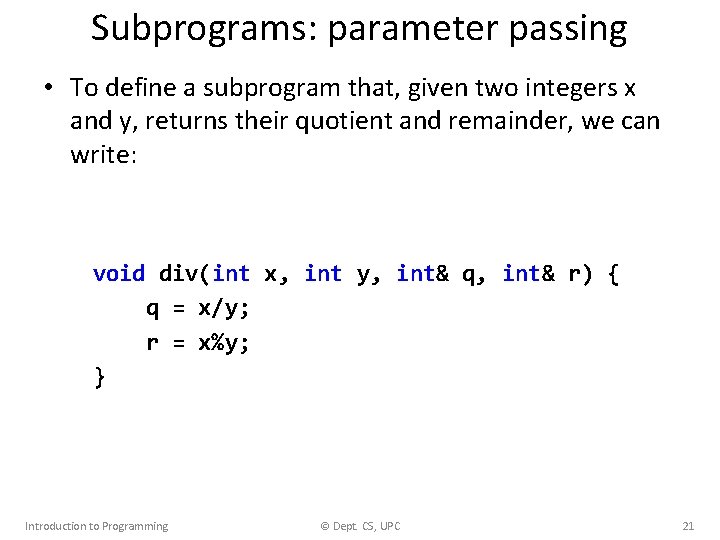
Subprograms: parameter passing • To define a subprogram that, given two integers x and y, returns their quotient and remainder, we can write: void div(int x, int y, int& q, int& r) { q = x/y; r = x%y; } Introduction to Programming © Dept. CS, UPC 21
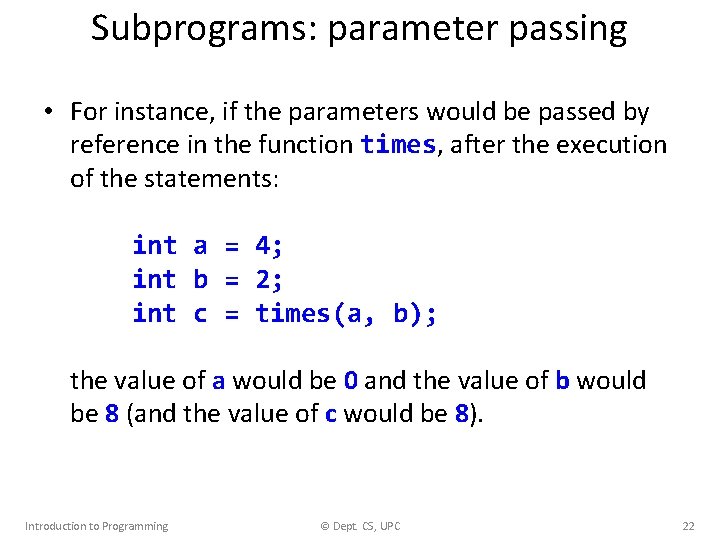
Subprograms: parameter passing • For instance, if the parameters would be passed by reference in the function times, after the execution of the statements: int a = 4; int b = 2; int c = times(a, b); the value of a would be 0 and the value of b would be 8 (and the value of c would be 8). Introduction to Programming © Dept. CS, UPC 22
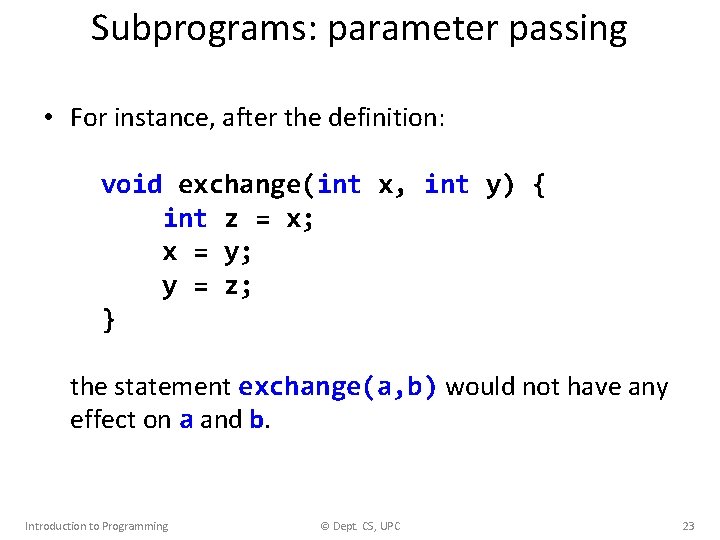
Subprograms: parameter passing • For instance, after the definition: void exchange(int x, int y) { int z = x; x = y; y = z; } the statement exchange(a, b) would not have any effect on a and b. Introduction to Programming © Dept. CS, UPC 23
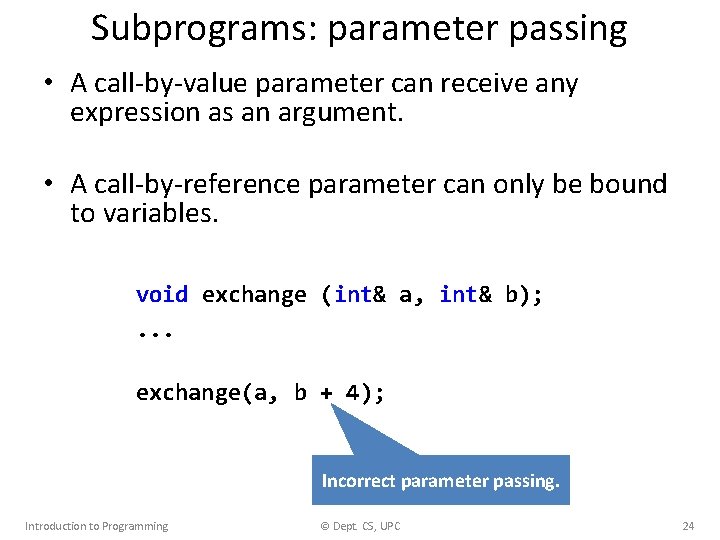
Subprograms: parameter passing • A call-by-value parameter can receive any expression as an argument. • A call-by-reference parameter can only be bound to variables. void exchange (int& a, int& b); . . . exchange(a, b + 4); Incorrect parameter passing. Introduction to Programming © Dept. CS, UPC 24
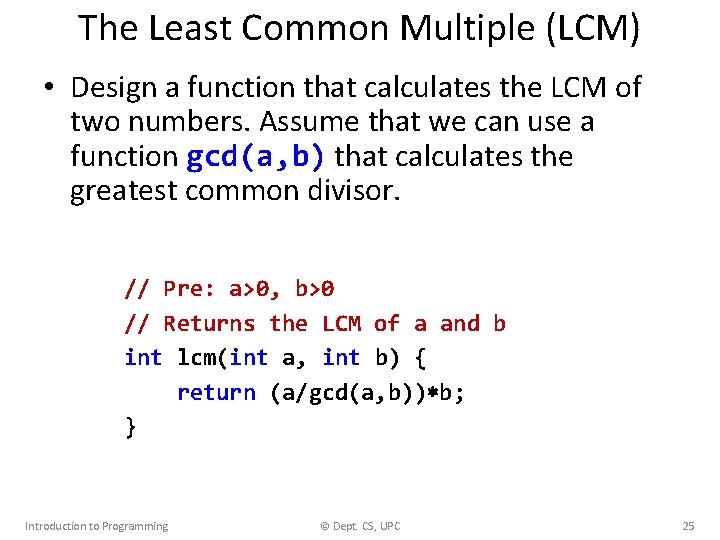
The Least Common Multiple (LCM) • Design a function that calculates the LCM of two numbers. Assume that we can use a function gcd(a, b) that calculates the greatest common divisor. // Pre: a>0, b>0 // Returns the LCM of a and b int lcm(int a, int b) { return (a/gcd(a, b)) b; } Introduction to Programming © Dept. CS, UPC 25
- Slides: 25