
Introduction to Programming in C Loops Jordi Cortadella
- Slides: 38
Introduction to Programming (in C++) Loops Jordi Cortadella, Ricard Gavaldà, Fernando Orejas Dept. of Computer Science, UPC
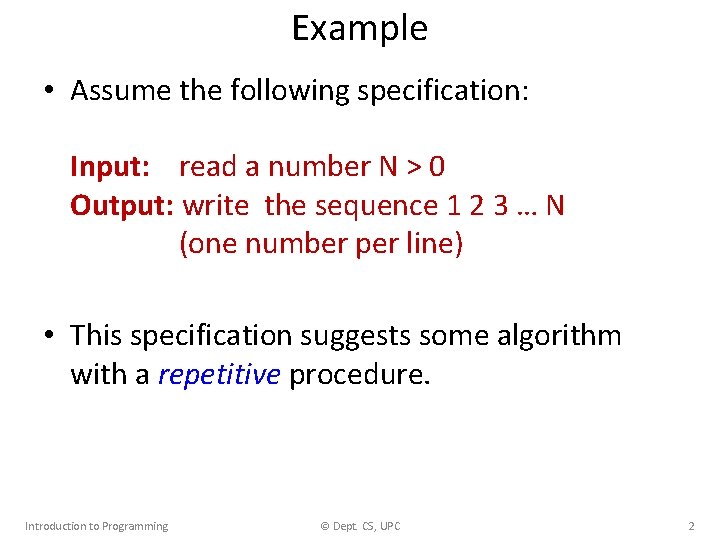
Example • Assume the following specification: Input: read a number N > 0 Output: write the sequence 1 2 3 … N (one number per line) • This specification suggests some algorithm with a repetitive procedure. Introduction to Programming © Dept. CS, UPC 2
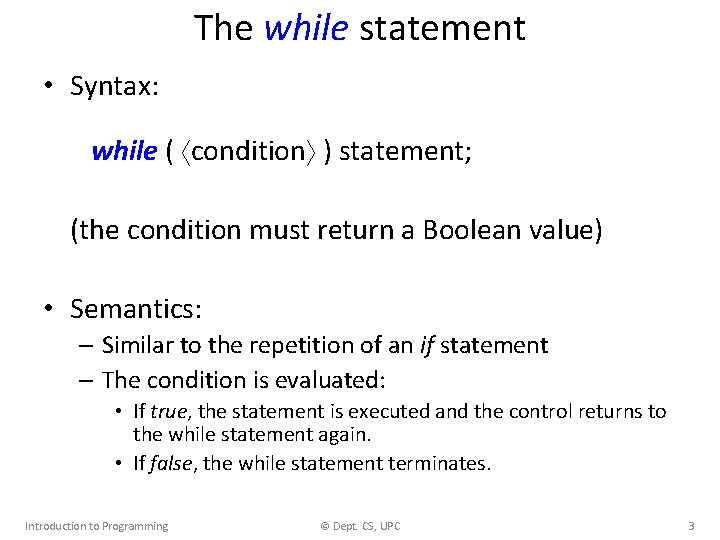
The while statement • Syntax: while ( condition ) statement; (the condition must return a Boolean value) • Semantics: – Similar to the repetition of an if statement – The condition is evaluated: • If true, the statement is executed and the control returns to the while statement again. • If false, the while statement terminates. Introduction to Programming © Dept. CS, UPC 3
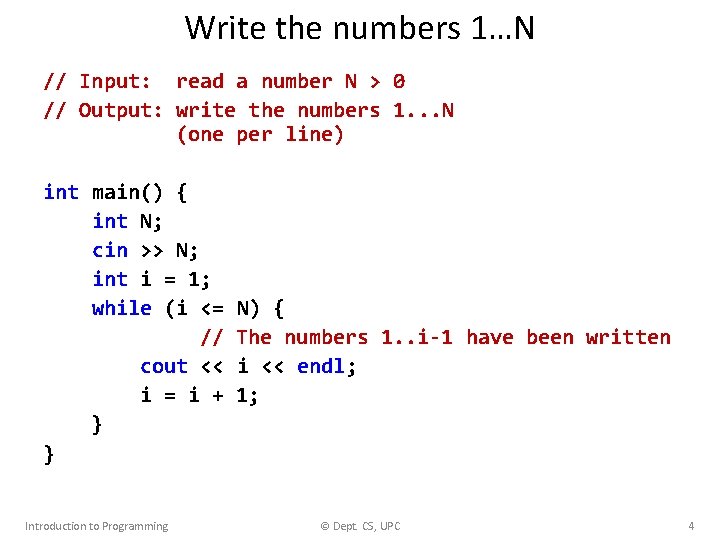
Write the numbers 1…N // Input: read a number N > 0 // Output: write the numbers 1. . . N (one per line) int main() { int N; cin >> N; int i = 1; while (i <= // cout << i = i + } } Introduction to Programming N) { The numbers 1. . i-1 have been written i << endl; 1; © Dept. CS, UPC 4
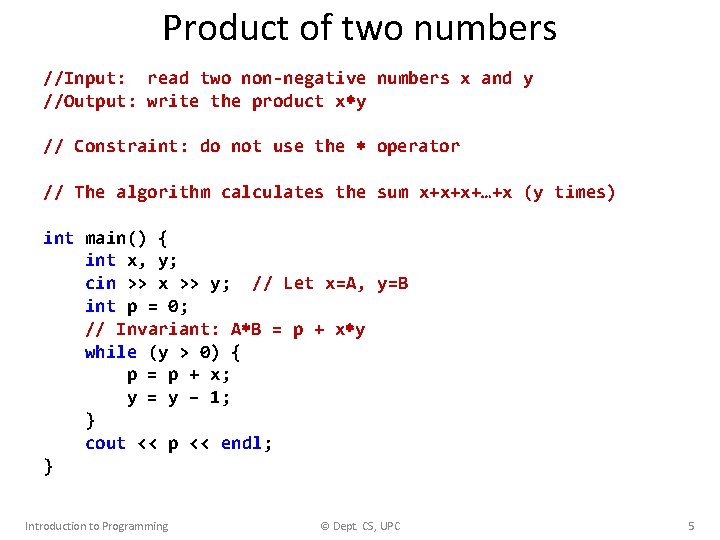
Product of two numbers //Input: read two non-negative numbers x and y //Output: write the product x y // Constraint: do not use the operator // The algorithm calculates the sum x+x+x+…+x (y times) int main() { int x, y; cin >> x >> y; // Let x=A, y=B int p = 0; // Invariant: A B = p + x y while (y > 0) { p = p + x; y = y – 1; } cout << p << endl; } Introduction to Programming © Dept. CS, UPC 5
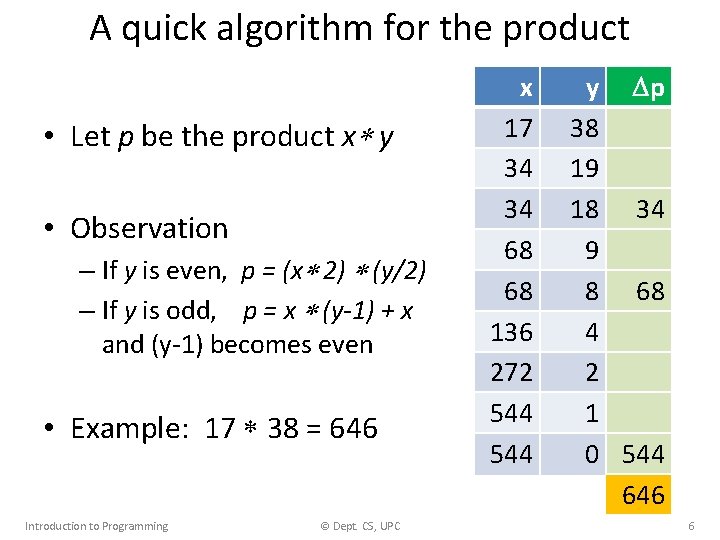
A quick algorithm for the product • Let p be the product x y • Observation – If y is even, p = (x 2) (y/2) – If y is odd, p = x (y-1) + x and (y-1) becomes even • Example: 17 38 = 646 Introduction to Programming © Dept. CS, UPC x 17 34 34 68 68 136 272 544 y p 38 19 18 34 9 8 68 4 2 1 0 544 646 6
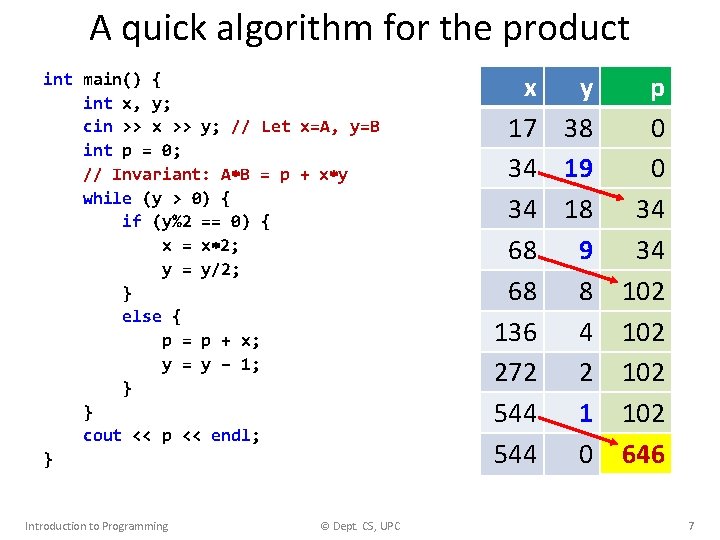
A quick algorithm for the product int main() { int x, y; cin >> x >> y; // Let x=A, y=B int p = 0; // Invariant: A B = p + x y while (y > 0) { if (y%2 == 0) { x = x 2; y = y/2; } else { p = p + x; y = y – 1; } } cout << p << endl; } Introduction to Programming © Dept. CS, UPC x y 17 38 34 19 34 18 68 9 68 8 136 4 272 2 544 1 544 0 p 0 0 34 34 102 102 646 7
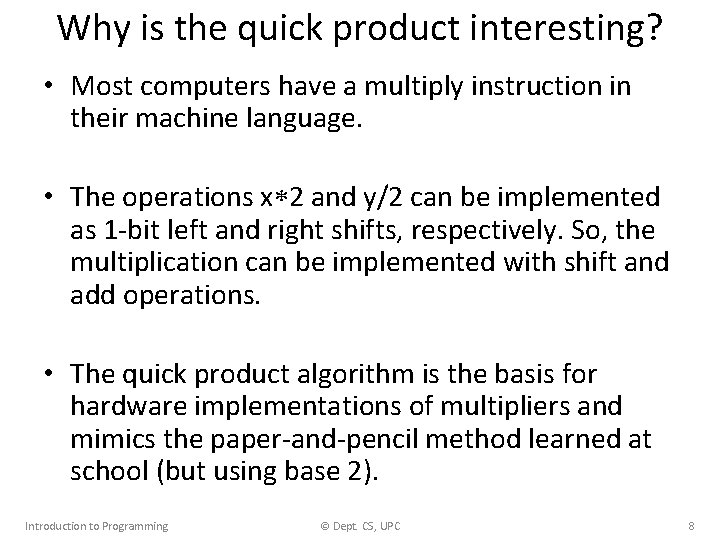
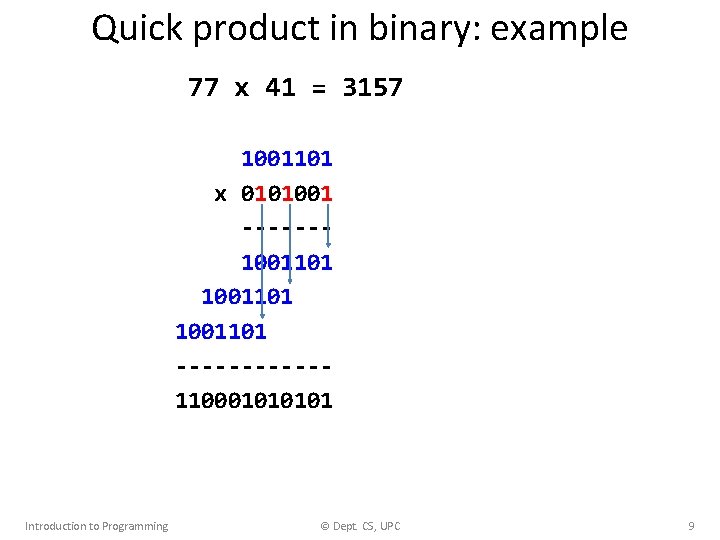
Why is the quick product interesting? • Most computers have a multiply instruction in their machine language. • The operations x 2 and y/2 can be implemented as 1 -bit left and right shifts, respectively. So, the multiplication can be implemented with shift and add operations. • The quick product algorithm is the basis for hardware implementations of multipliers and mimics the paper-and-pencil method learned at school (but using base 2). Introduction to Programming © Dept. CS, UPC 8
Quick product in binary: example 77 x 41 = 3157 1001101 x 0101001 ------1001101 ------11000101 Introduction to Programming © Dept. CS, UPC 9
Counting a’s • We want to read a text represented as a sequence of characters that ends with ‘. ’ • We want to calculate the number of occurrences of the letter ‘a’ • We can assume that the text always has at least one character (the last ‘. ’) • Example: the text Programming in C++ is amazingly easy!. has 4 a’s Introduction to Programming © Dept. CS, UPC 10
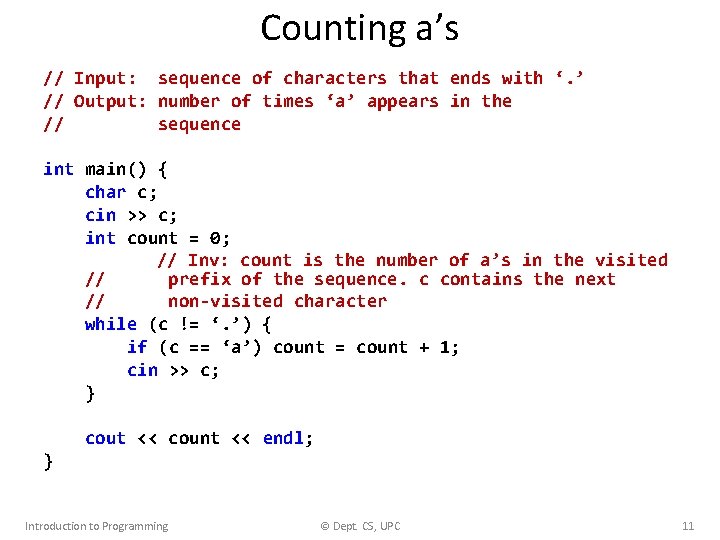
Counting a’s // Input: sequence of characters that ends with ‘. ’ // Output: number of times ‘a’ appears in the // sequence int main() { char c; cin >> c; int count = 0; // Inv: count is the number of a’s in the visited // prefix of the sequence. c contains the next // non-visited character while (c != ‘. ’) { if (c == ‘a’) count = count + 1; cin >> c; } cout << count << endl; } Introduction to Programming © Dept. CS, UPC 11
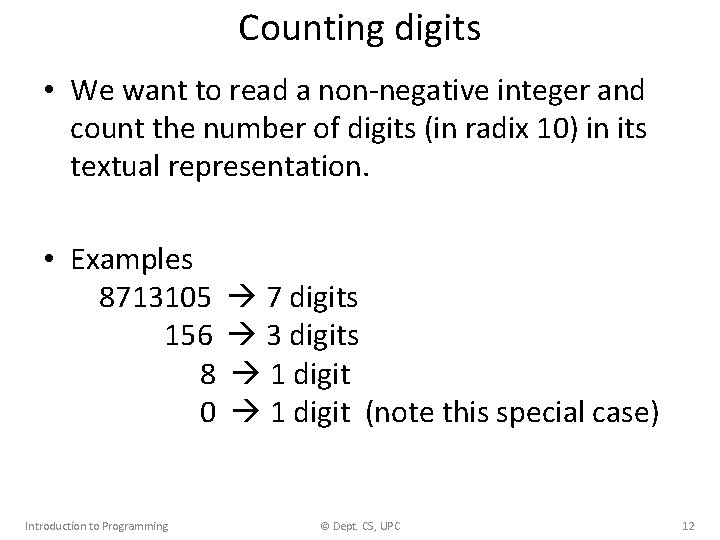
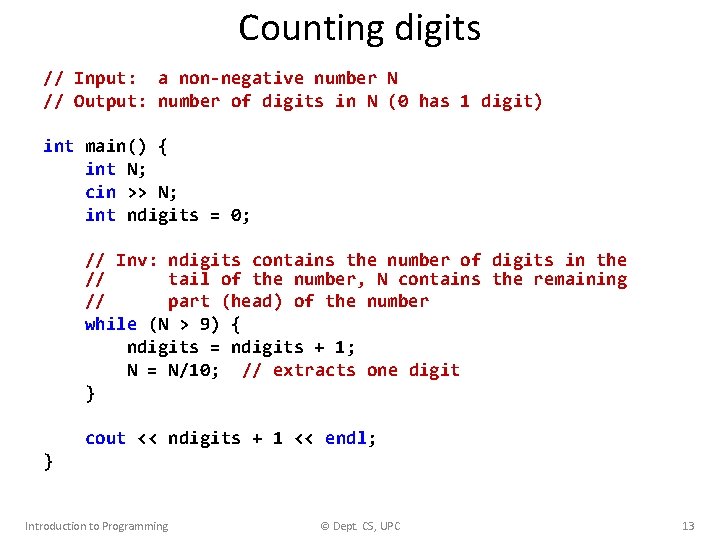
Counting digits • We want to read a non-negative integer and count the number of digits (in radix 10) in its textual representation. • Examples 8713105 156 8 0 Introduction to Programming 7 digits 3 digits 1 digit (note this special case) © Dept. CS, UPC 12
Counting digits // Input: a non-negative number N // Output: number of digits in N (0 has 1 digit) int main() { int N; cin >> N; int ndigits = 0; // Inv: ndigits contains the number of digits in the // tail of the number, N contains the remaining // part (head) of the number while (N > 9) { ndigits = ndigits + 1; N = N/10; // extracts one digit } cout << ndigits + 1 << endl; } Introduction to Programming © Dept. CS, UPC 13
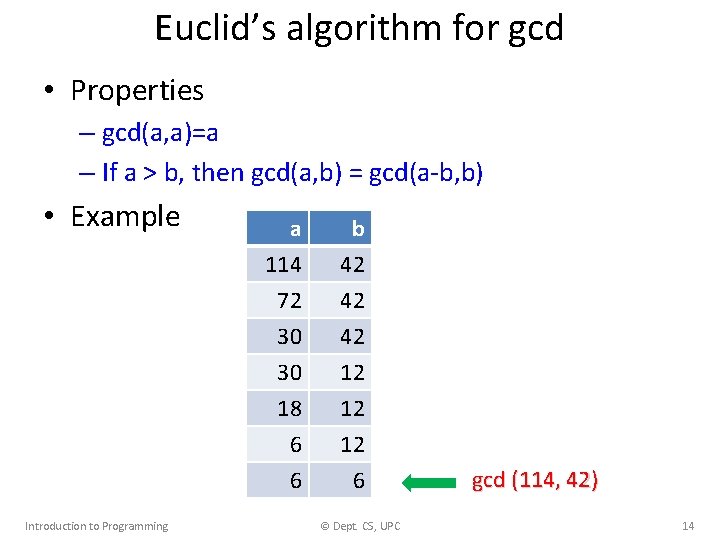
Euclid’s algorithm for gcd • Properties – gcd(a, a)=a – If a > b, then gcd(a, b) = gcd(a-b, b) • Example Introduction to Programming a 114 72 30 b 42 42 42 30 18 6 6 12 12 12 6 © Dept. CS, UPC gcd (114, 42) 14
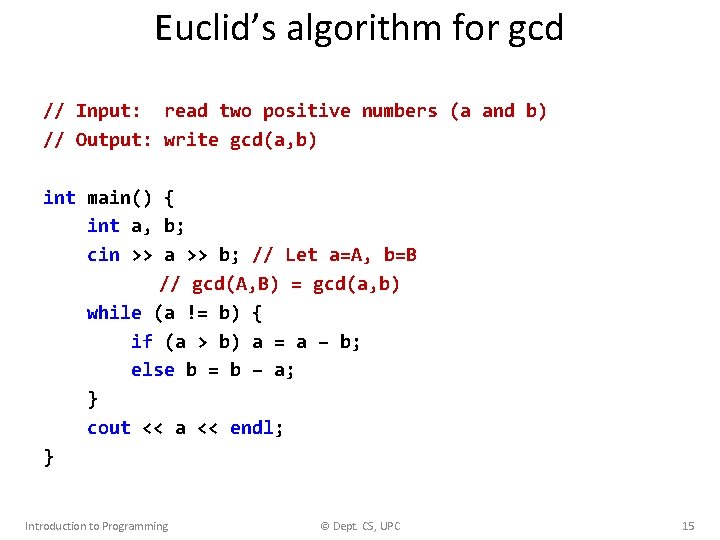
Euclid’s algorithm for gcd // Input: read two positive numbers (a and b) // Output: write gcd(a, b) int main() { int a, b; cin >> a >> b; // Let a=A, b=B // gcd(A, B) = gcd(a, b) while (a != b) { if (a > b) a = a – b; else b = b – a; } cout << a << endl; } Introduction to Programming © Dept. CS, UPC 15
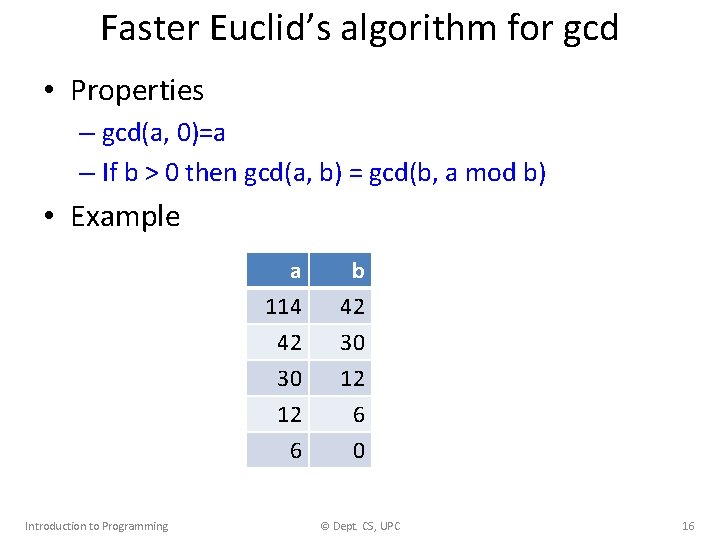
Faster Euclid’s algorithm for gcd • Properties – gcd(a, 0)=a – If b > 0 then gcd(a, b) = gcd(b, a mod b) • Example Introduction to Programming a 114 42 30 b 42 30 12 12 6 6 0 © Dept. CS, UPC 16
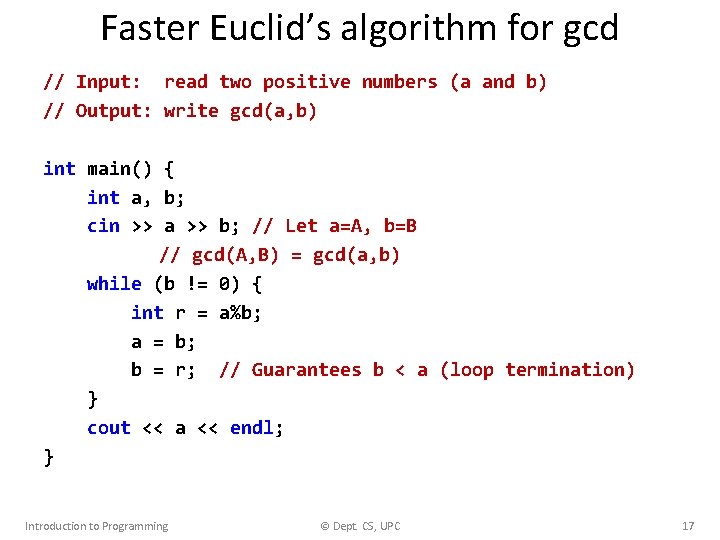
Faster Euclid’s algorithm for gcd // Input: read two positive numbers (a and b) // Output: write gcd(a, b) int main() { int a, b; cin >> a >> b; // Let a=A, b=B // gcd(A, B) = gcd(a, b) while (b != 0) { int r = a%b; a = b; b = r; // Guarantees b < a (loop termination) } cout << a << endl; } Introduction to Programming © Dept. CS, UPC 17
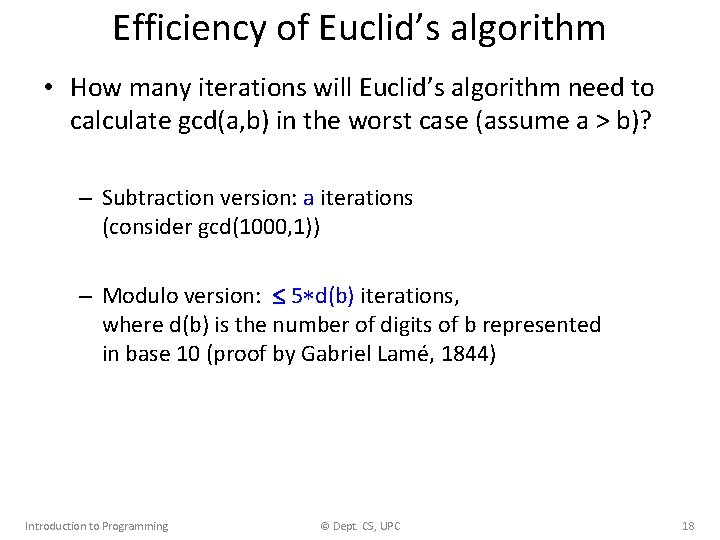
Efficiency of Euclid’s algorithm • How many iterations will Euclid’s algorithm need to calculate gcd(a, b) in the worst case (assume a > b)? – Subtraction version: a iterations (consider gcd(1000, 1)) – Modulo version: 5 d(b) iterations, where d(b) is the number of digits of b represented in base 10 (proof by Gabriel Lamé, 1844) Introduction to Programming © Dept. CS, UPC 18
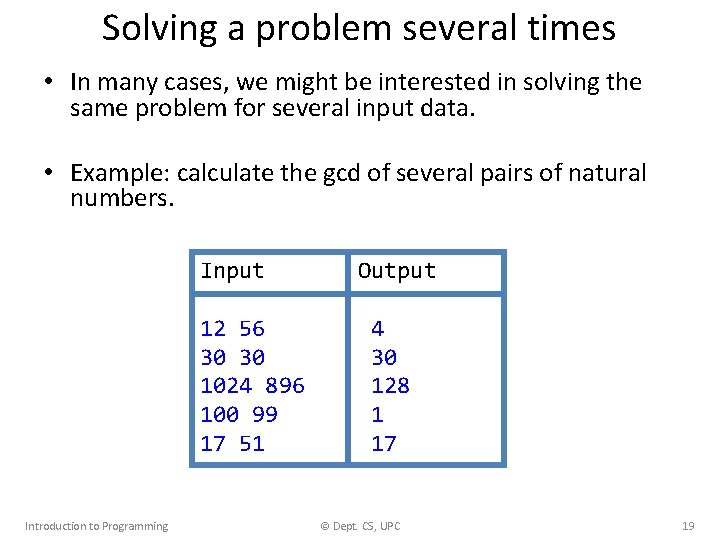
Solving a problem several times • In many cases, we might be interested in solving the same problem for several input data. • Example: calculate the gcd of several pairs of natural numbers. Input 12 56 30 30 1024 896 100 99 17 51 Introduction to Programming Output 4 30 128 1 17 © Dept. CS, UPC 19
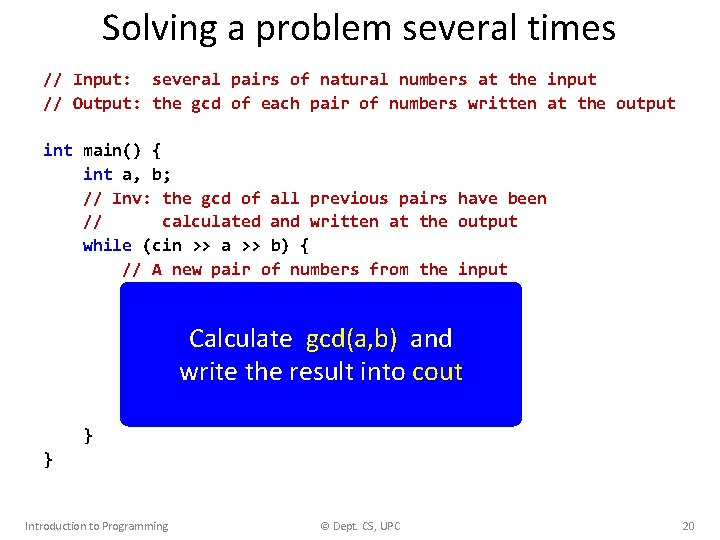
Solving a problem several times // Input: several pairs of natural numbers at the input // Output: the gcd of each pair of numbers written at the output int main() { int a, b; // Inv: the gcd of all previous pairs have been // calculated and written at the output while (cin >> a >> b) { // A new pair of numbers from the input while (b != 0) { int r = a%b; a =Calculate b; gcd(a, b) and b = r; write the result into cout } cout << a << endl; } } Introduction to Programming © Dept. CS, UPC 20
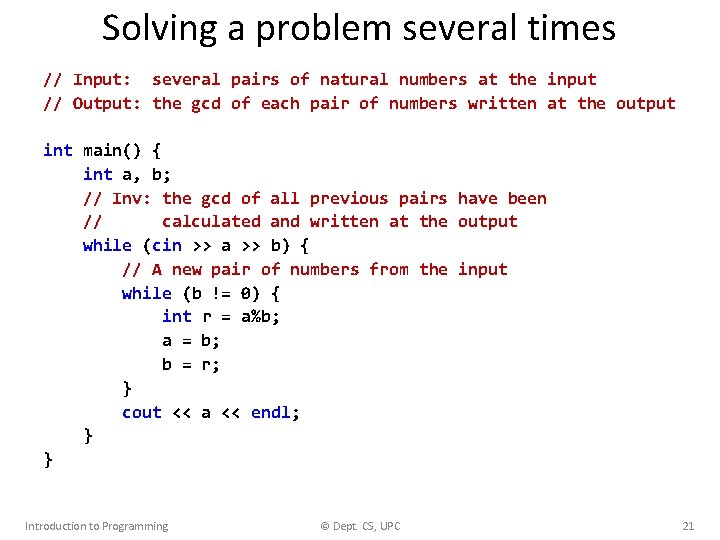
Solving a problem several times // Input: several pairs of natural numbers at the input // Output: the gcd of each pair of numbers written at the output int main() { int a, b; // Inv: the gcd of all previous pairs have been // calculated and written at the output while (cin >> a >> b) { // A new pair of numbers from the input while (b != 0) { int r = a%b; a = b; b = r; } cout << a << endl; } } Introduction to Programming © Dept. CS, UPC 21
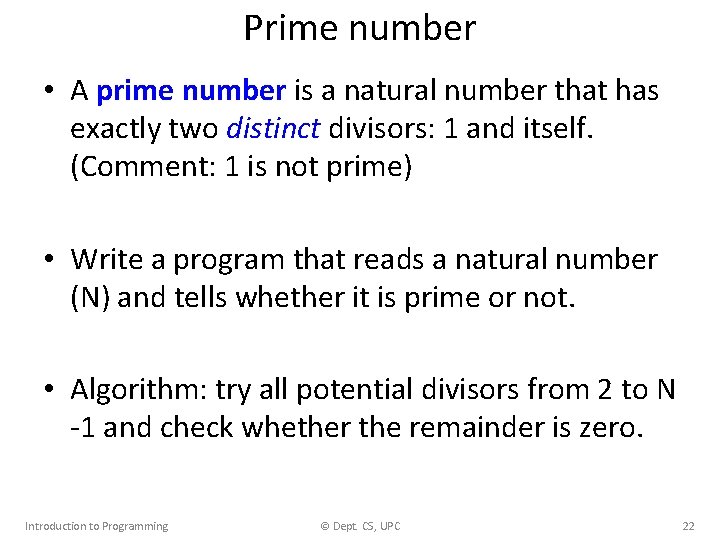
Prime number • A prime number is a natural number that has exactly two distinct divisors: 1 and itself. (Comment: 1 is not prime) • Write a program that reads a natural number (N) and tells whether it is prime or not. • Algorithm: try all potential divisors from 2 to N -1 and check whether the remainder is zero. Introduction to Programming © Dept. CS, UPC 22
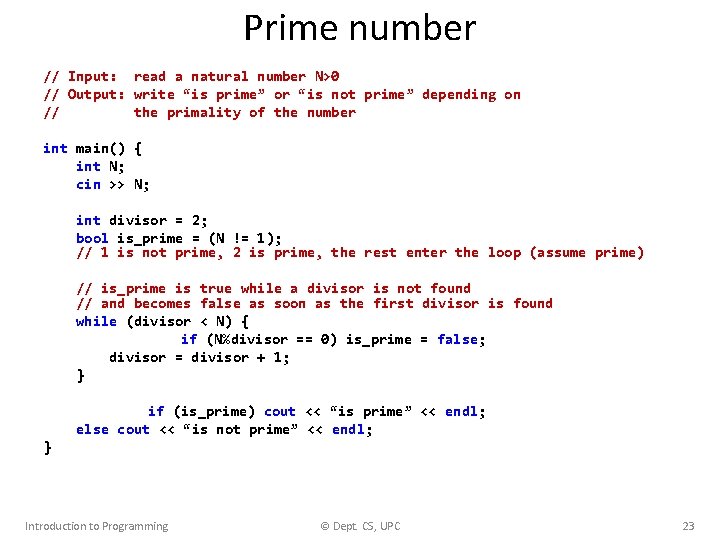
Prime number // Input: read a natural number N>0 // Output: write “is prime” or “is not prime” depending on // the primality of the number int main() { int N; cin >> N; int divisor = 2; bool is_prime = (N != 1); // 1 is not prime, 2 is prime, the rest enter the loop (assume prime) // is_prime is true while a divisor is not found // and becomes false as soon as the first divisor is found while (divisor < N) { if (N%divisor == 0) is_prime = false; divisor = divisor + 1; } if (is_prime) cout << “is prime” << endl; else cout << “is not prime” << endl; } Introduction to Programming © Dept. CS, UPC 23
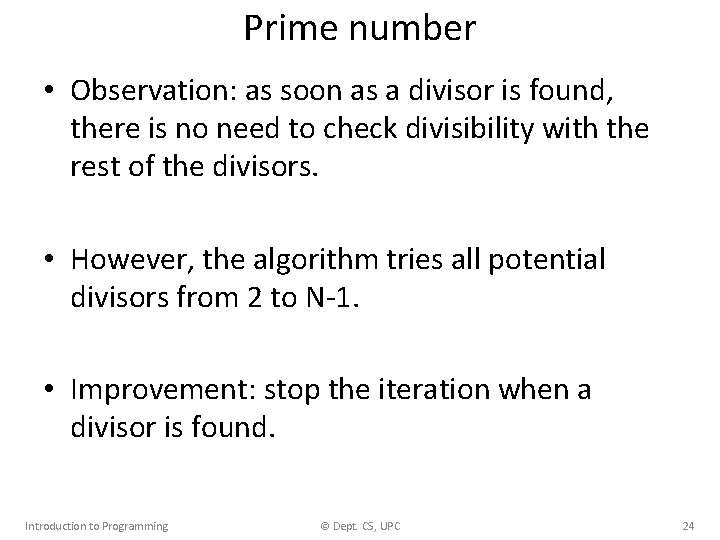
Prime number • Observation: as soon as a divisor is found, there is no need to check divisibility with the rest of the divisors. • However, the algorithm tries all potential divisors from 2 to N-1. • Improvement: stop the iteration when a divisor is found. Introduction to Programming © Dept. CS, UPC 24
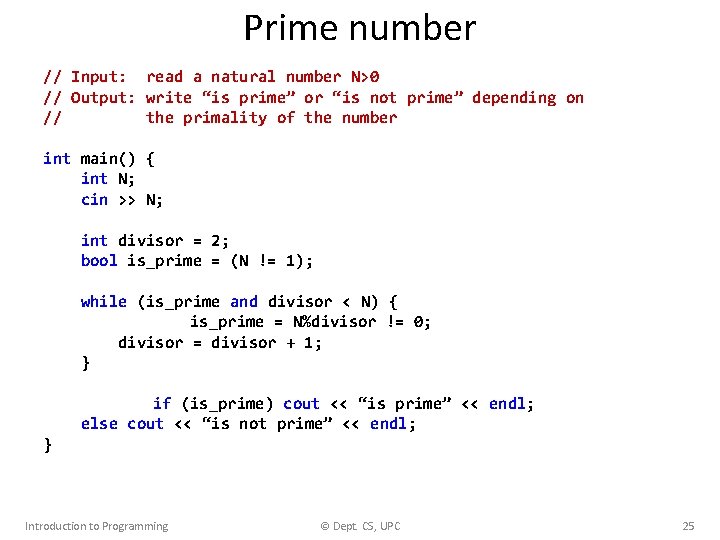
Prime number // Input: read a natural number N>0 // Output: write “is prime” or “is not prime” depending on // the primality of the number int main() { int N; cin >> N; int divisor = 2; bool is_prime = (N != 1); while (is_prime and divisor < N) { is_prime = N%divisor != 0; divisor = divisor + 1; } if (is_prime) cout << “is prime” << endl; else cout << “is not prime” << endl; } Introduction to Programming © Dept. CS, UPC 25
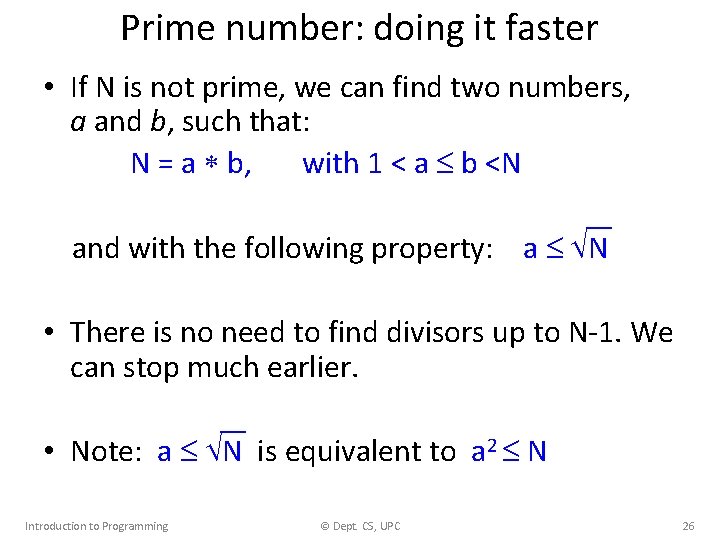
Prime number: doing it faster • If N is not prime, we can find two numbers, a and b, such that: N = a b, with 1 < a b <N and with the following property: a N • There is no need to find divisors up to N-1. We can stop much earlier. • Note: a N is equivalent to a 2 N Introduction to Programming © Dept. CS, UPC 26
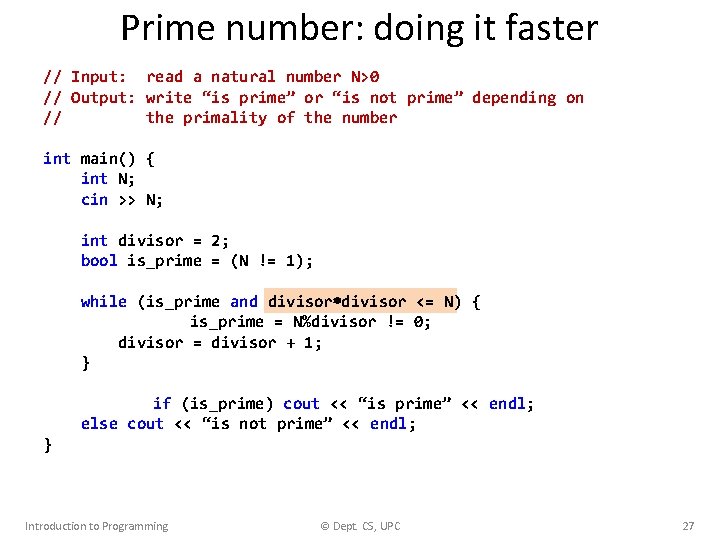
Prime number: doing it faster // Input: read a natural number N>0 // Output: write “is prime” or “is not prime” depending on // the primality of the number int main() { int N; cin >> N; int divisor = 2; bool is_prime = (N != 1); while (is_prime and divisor <= N) { is_prime = N%divisor != 0; divisor = divisor + 1; } if (is_prime) cout << “is prime” << endl; else cout << “is not prime” << endl; } Introduction to Programming © Dept. CS, UPC 27
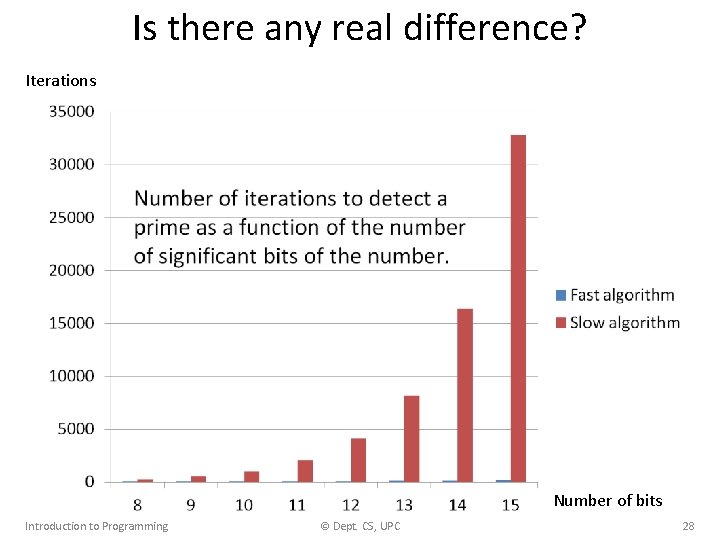
Is there any real difference? Iterations Number of bits Introduction to Programming © Dept. CS, UPC 28
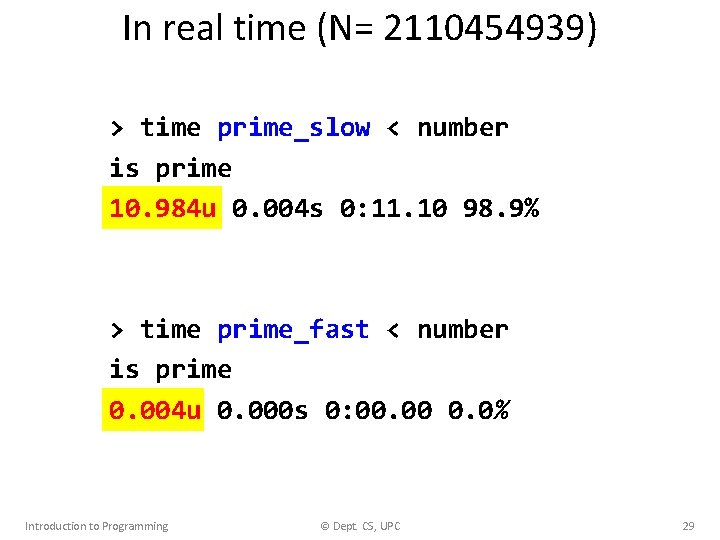
In real time (N= 2110454939) > time prime_slow < number is prime 10. 984 u 0. 004 s 0: 11. 10 98. 9% > time prime_fast < number is prime 0. 004 u 0. 000 s 0: 00. 00 0. 0% Introduction to Programming © Dept. CS, UPC 29
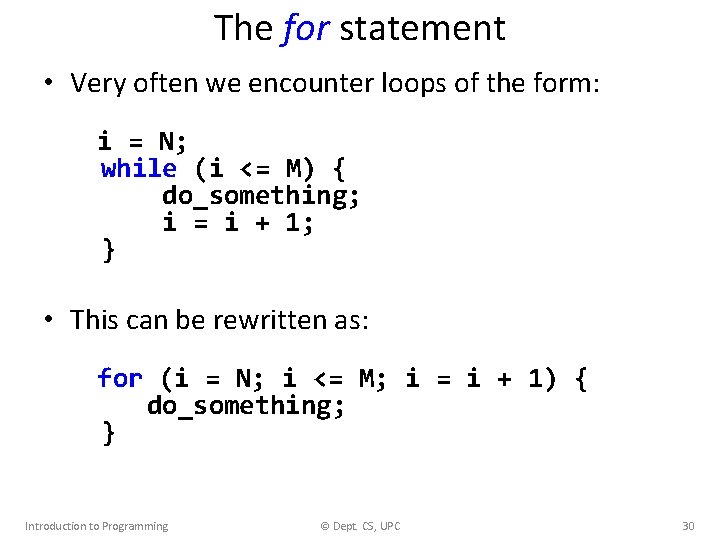
The for statement • Very often we encounter loops of the form: i = N; while (i <= M) { do_something; i = i + 1; } • This can be rewritten as: for (i = N; i <= M; i = i + 1) { do_something; } Introduction to Programming © Dept. CS, UPC 30
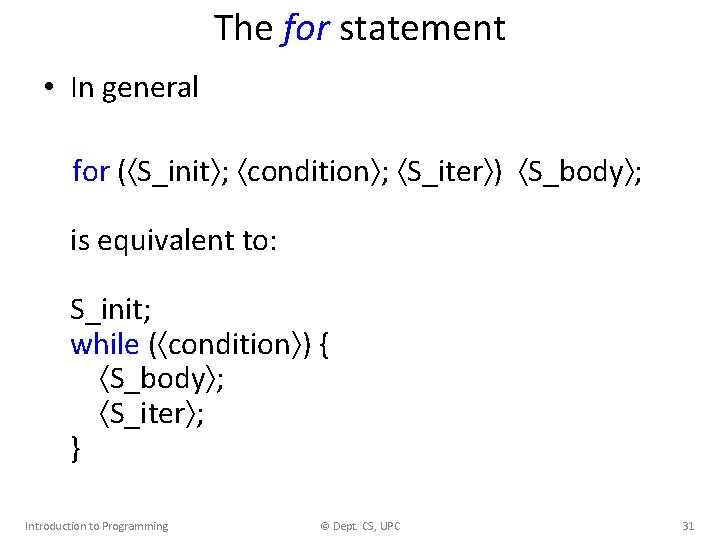
The for statement • In general for ( S_init ; condition ; S_iter ) S_body ; is equivalent to: S_init; while ( condition ) { S_body ; S_iter ; } Introduction to Programming © Dept. CS, UPC 31
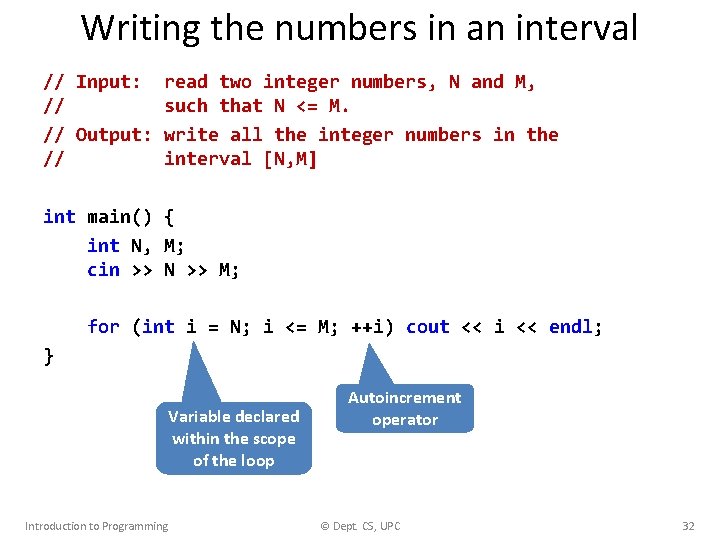
Writing the numbers in an interval // Input: // // Output: // read two integer numbers, N and M, such that N <= M. write all the integer numbers in the interval [N, M] int main() { int N, M; cin >> N >> M; for (int i = N; i <= M; ++i) cout << i << endl; } Variable declared within the scope of the loop Introduction to Programming Autoincrement operator © Dept. CS, UPC 32
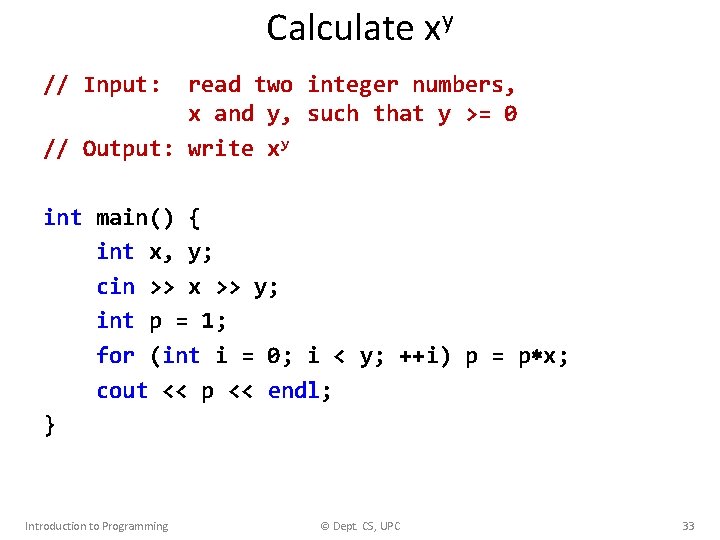
Calculate xy // Input: read two integer numbers, x and y, such that y >= 0 // Output: write xy int main() { int x, y; cin >> x >> y; int p = 1; for (int i = 0; i < y; ++i) p = p x; cout << p << endl; } Introduction to Programming © Dept. CS, UPC 33
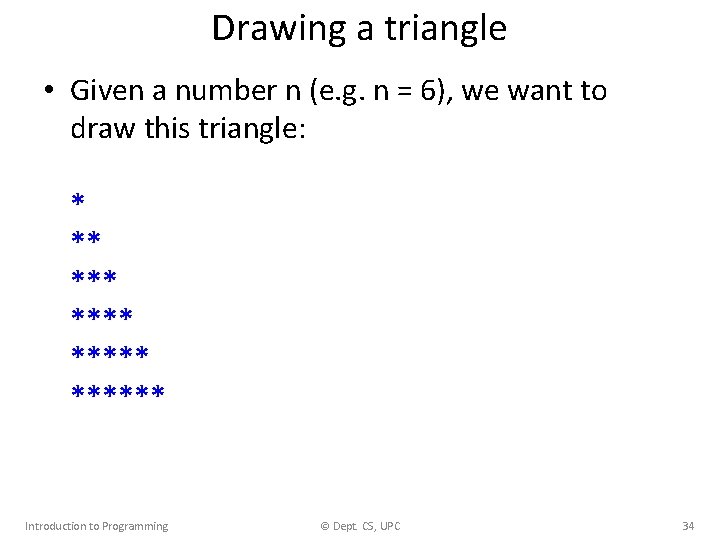
Drawing a triangle • Given a number n (e. g. n = 6), we want to draw this triangle: * ** ****** Introduction to Programming © Dept. CS, UPC 34
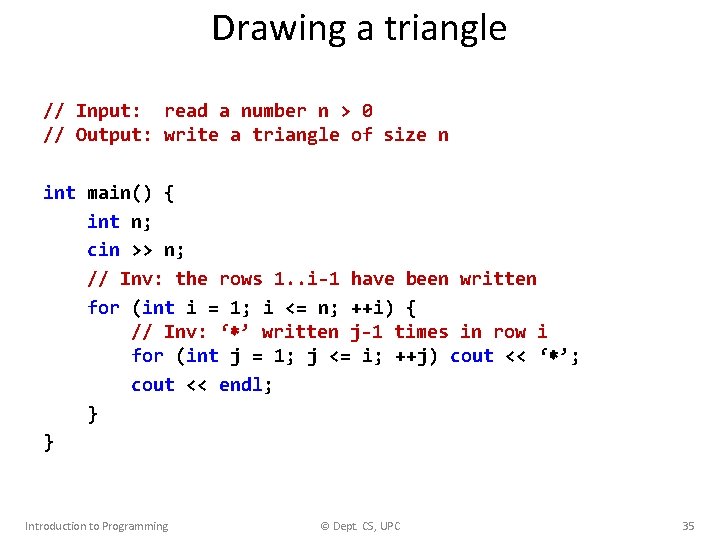
Drawing a triangle // Input: read a number n > 0 // Output: write a triangle of size n int main() { int n; cin >> n; // Inv: the rows 1. . i-1 have been written for (int i = 1; i <= n; ++i) { // Inv: ‘ ’ written j-1 times in row i for (int j = 1; j <= i; ++j) cout << ‘ ’; cout << endl; } } Introduction to Programming © Dept. CS, UPC 35
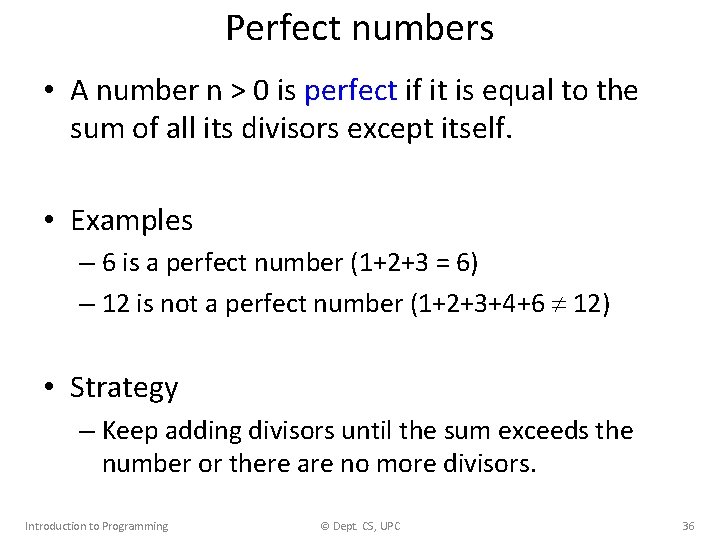
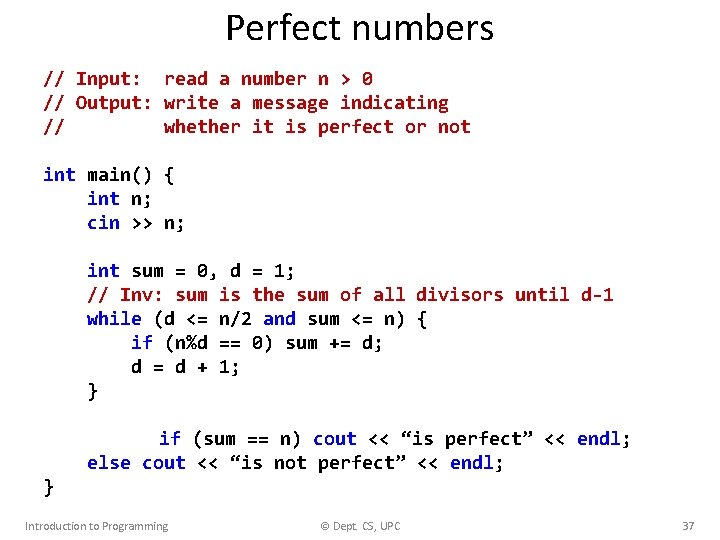
Perfect numbers • A number n > 0 is perfect if it is equal to the sum of all its divisors except itself. • Examples – 6 is a perfect number (1+2+3 = 6) – 12 is not a perfect number (1+2+3+4+6 12) • Strategy – Keep adding divisors until the sum exceeds the number or there are no more divisors. Introduction to Programming © Dept. CS, UPC 36
Perfect numbers // Input: read a number n > 0 // Output: write a message indicating // whether it is perfect or not int main() { int n; cin >> n; int sum = 0, d = 1; // Inv: sum is the sum of all divisors until d-1 while (d <= n/2 and sum <= n) { if (n%d == 0) sum += d; d = d + 1; } if (sum == n) cout << “is perfect” << endl; else cout << “is not perfect” << endl; } Introduction to Programming © Dept. CS, UPC 37
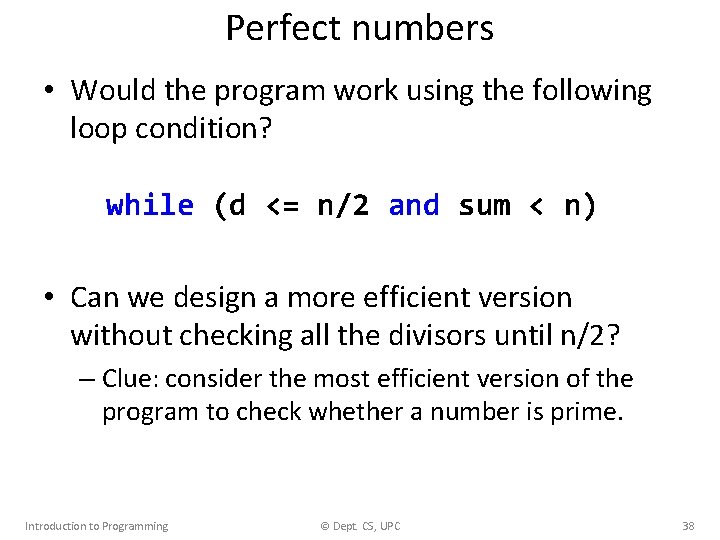
Perfect numbers • Would the program work using the following loop condition? while (d <= n/2 and sum < n) • Can we design a more efficient version without checking all the divisors until n/2? – Clue: consider the most efficient version of the program to check whether a number is prime. Introduction to Programming © Dept. CS, UPC 38