
Introduction to Production and Operations Management Management Science

- Slides: 63
Introduction to Production and Operations Management
Management Science …is the study and development of techniques for the formulation and analysis of management and related business problems. Operations research models are often helpful in this process.
Operations Management is: l The business function responsible for planning, coordinating, and controlling the resources needed to produce products and services for a company l A management function l An organization’s core function l In every organization whether Service or Manufacturing, profit or Not for profit
Operations Research …is the application of techniques developed in mathematics, statistics, engineering and the physical sciences to the solution of problems in business, government, industry, economics and the social sciences.
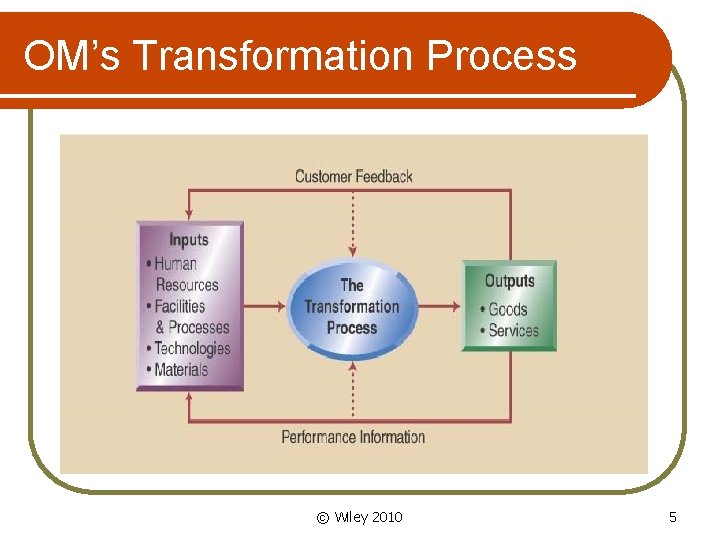
OM’s Transformation Process © Wiley 2010 5
Quantitative Methods …employ mathematical models to reach a wide variety of business decisions. l l l They give modern managers a competitive edge Managers do not need to have great mathematical skills Familiarity allows one to: l l Ask the right questions Recognize when additional analysis is necessary Evaluate potential solutions Make informed decisions
Qualitative Methods …like more traditional methods, however, qualitative methods come in many varieties. Different researchers focus on different sources of data: l l One's own immediate experience Others' experiences, which we might seek to understand through: l l l their speech or writing, their other behaviors, their products - technology, artwork, footprints, etc.
New Challenges in Operations Management
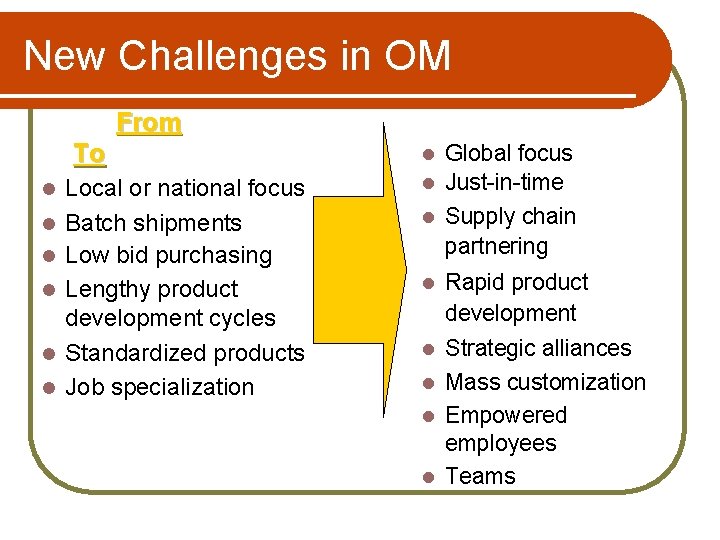
New Challenges in OM From To l l l Local or national focus Batch shipments Low bid purchasing Lengthy product development cycles Standardized products Job specialization Global focus l Just-in-time l Supply chain partnering l l Rapid product development Strategic alliances l Mass customization l Empowered employees l Teams l
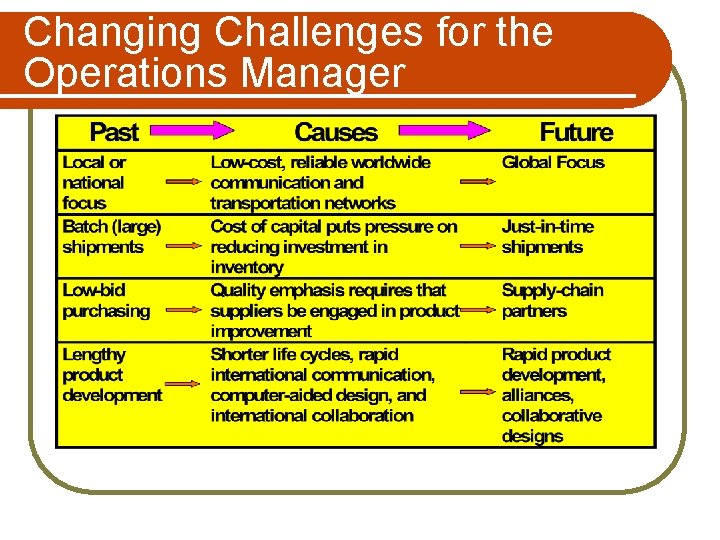
Changing Challenges for the Operations Manager
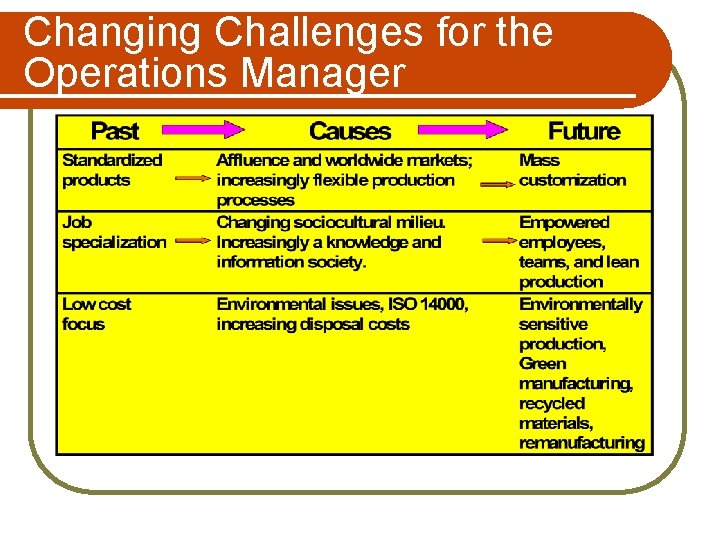
Changing Challenges for the Operations Manager
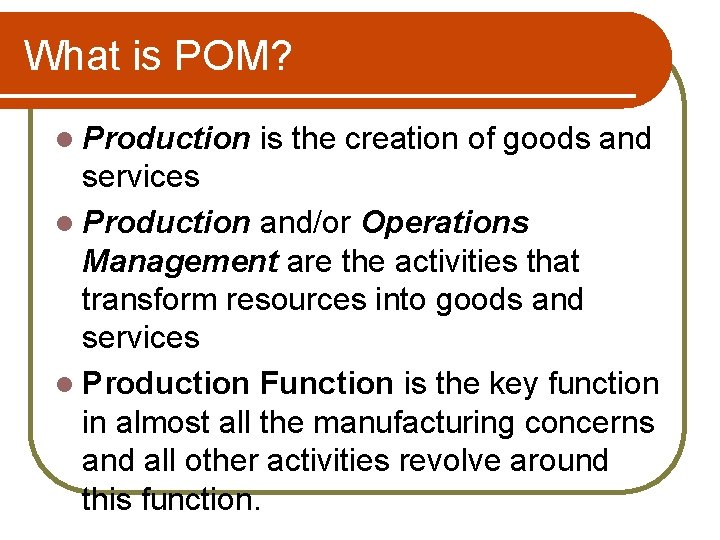
What is POM? l Production is the creation of goods and services l Production and/or Operations Management are the activities that transform resources into goods and services l Production Function is the key function in almost all the manufacturing concerns and all other activities revolve around this function.
Goods vs. Services
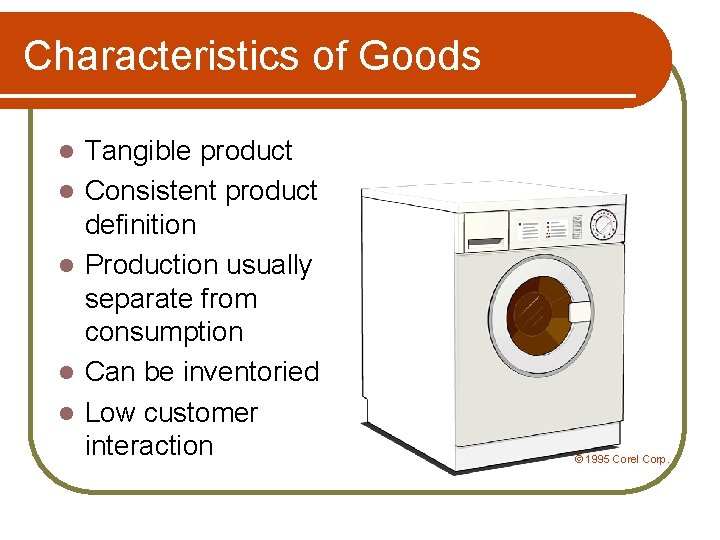
Characteristics of Goods l l l Tangible product Consistent product definition Production usually separate from consumption Can be inventoried Low customer interaction © 1995 Corel Corp.
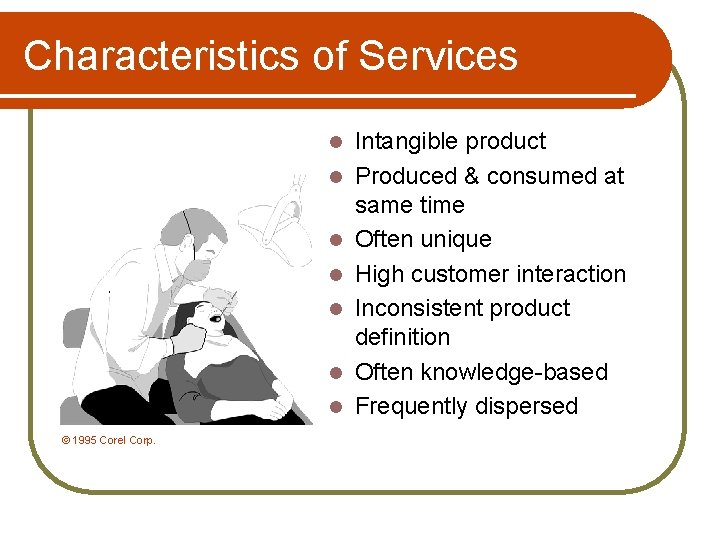
Characteristics of Services l l l l © 1995 Corel Corp. Intangible product Produced & consumed at same time Often unique High customer interaction Inconsistent product definition Often knowledge-based Frequently dispersed
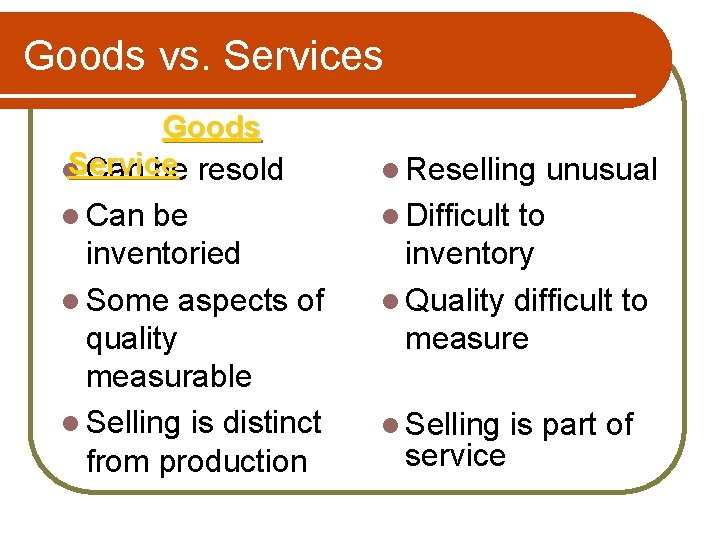
Goods vs. Services Goods l. Service Can be resold l Can be inventoried l Some aspects of quality measurable l Selling is distinct from production l Reselling unusual l Difficult to inventory l Quality difficult to measure l Selling service is part of
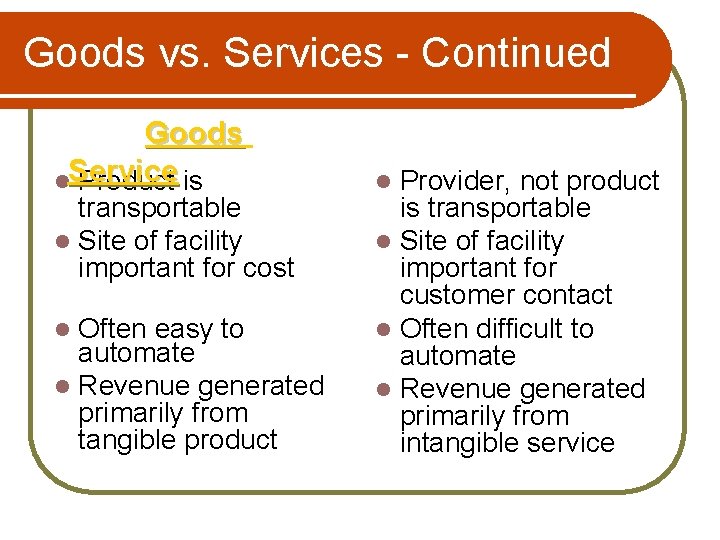
Goods vs. Services - Continued Goods l. Service Product is transportable l Site of facility important for cost Often easy to automate l Revenue generated primarily from tangible product l Provider, not product is transportable l Site of facility important for customer contact l Often difficult to automate l Revenue generated primarily from intangible service l
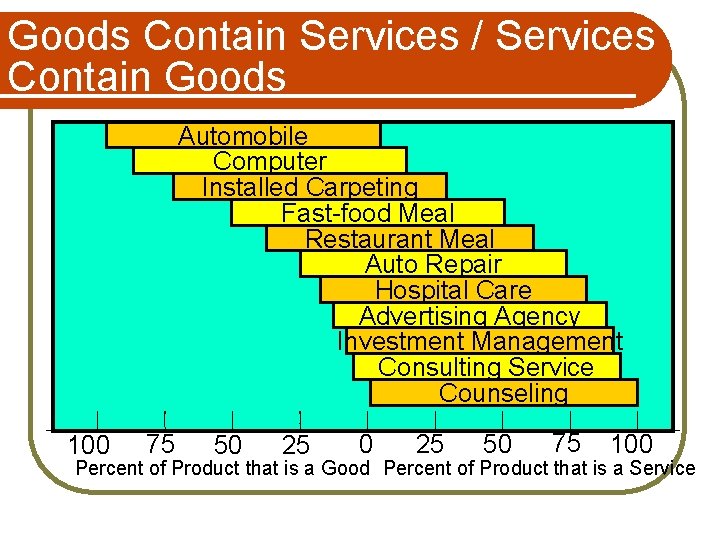
Goods Contain Services / Services Contain Goods Automobile Computer Installed Carpeting Fast-food Meal Restaurant Meal Auto Repair Hospital Care Advertising Agency Investment Management Consulting Service Counseling 100 75 50 25 50 75 100 Percent of Product that is a Good Percent of Product that is a Service
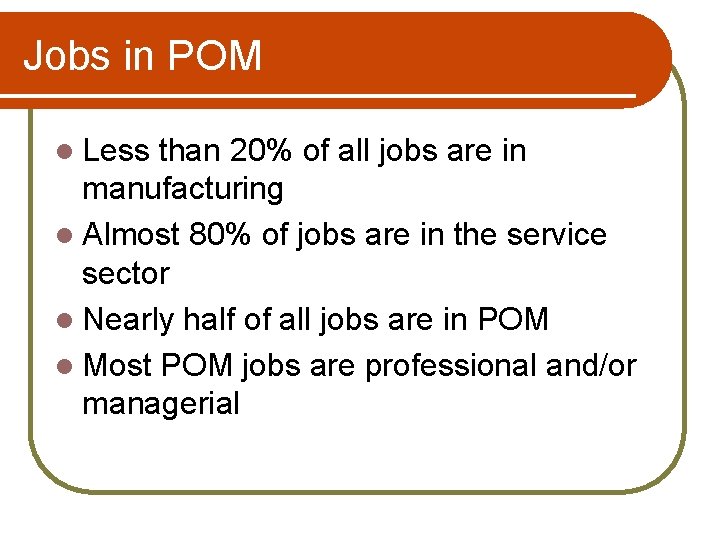
Jobs in POM l Less than 20% of all jobs are in manufacturing l Almost 80% of jobs are in the service sector l Nearly half of all jobs are in POM l Most POM jobs are professional and/or managerial
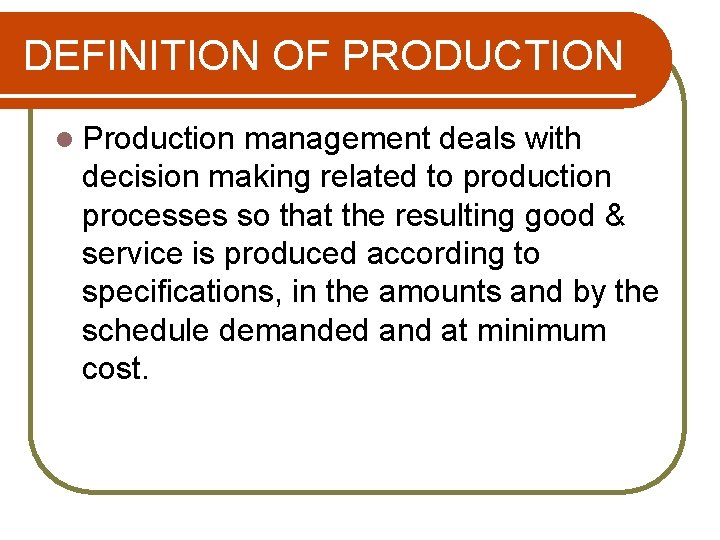
DEFINITION OF PRODUCTION l Production management deals with decision making related to production processes so that the resulting good & service is produced according to specifications, in the amounts and by the schedule demanded and at minimum cost.
Why Study POM? l It is one of the 3 critical parts of any organization: l l l Marketing – generates demand Operations – creates the product Finance/accounting – tracks organizational performance, pays bills, collects money It shows us how goods and services are produced l It shows us what POM managers do l It is the most costly part of any organization l
Aspects of Production Function Manufacturing function: selection of factory, location, design & layout, type of products to be produced, research, development of product. l Ancillary Function: - production planning & control, maintenance, purchasing, storekeeping, material handling l Advisory: - work study, method study, operational research, inspection & quality control. l
5 P’s of Production Management l l l PRODUCT PLANT PROCESS PROGRAMME PEOPLE
Types of Production 1. JOB PRODUCTION : -Production is according to specific customer order, products are generally non-standarised and heterogeneous in nature. l FEATURES: - wide range of general purpose machines required, different job employed, variations in production, flexible finance, inventory of materials, movement of material. l LIMITATION: -INEFFICIENT use of labour, cost is difficult, irregularity in demand, l
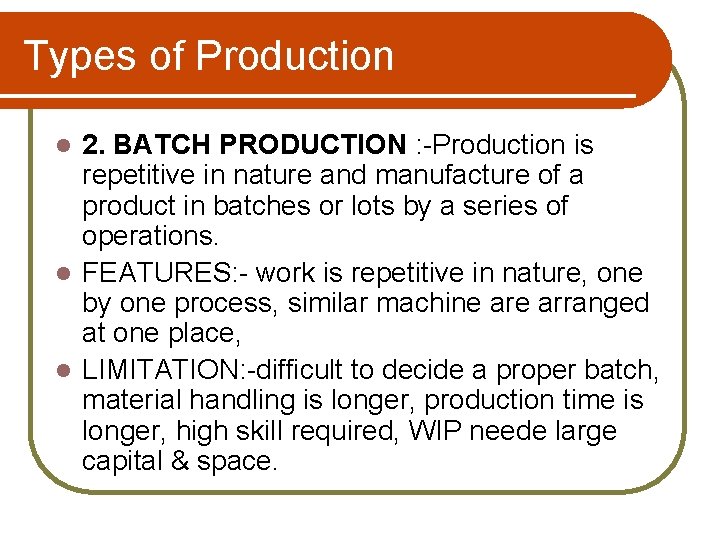
Types of Production 2. BATCH PRODUCTION : -Production is repetitive in nature and manufacture of a product in batches or lots by a series of operations. l FEATURES: - work is repetitive in nature, one by one process, similar machine arranged at one place, l LIMITATION: -difficult to decide a proper batch, material handling is longer, production time is longer, high skill required, WIP neede large capital & space. l
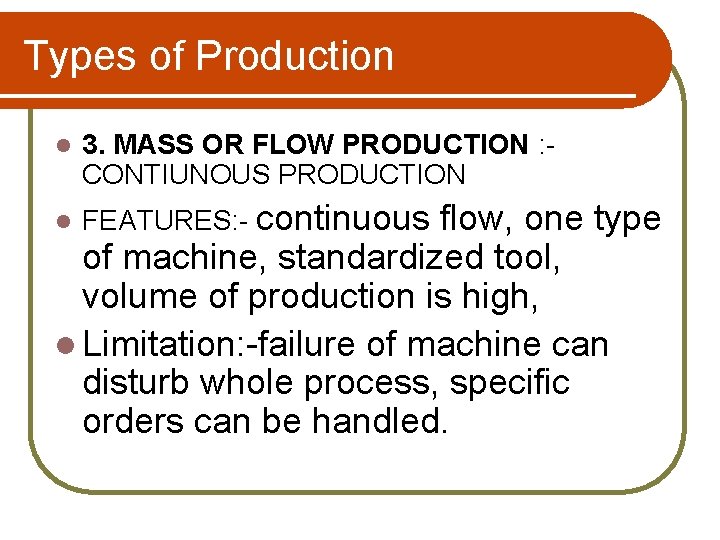
Types of Production l 3. MASS OR FLOW PRODUCTION : CONTIUNOUS PRODUCTION flow, one type of machine, standardized tool, volume of production is high, l Limitation: -failure of machine can disturb whole process, specific orders can be handled. l FEATURES: - continuous
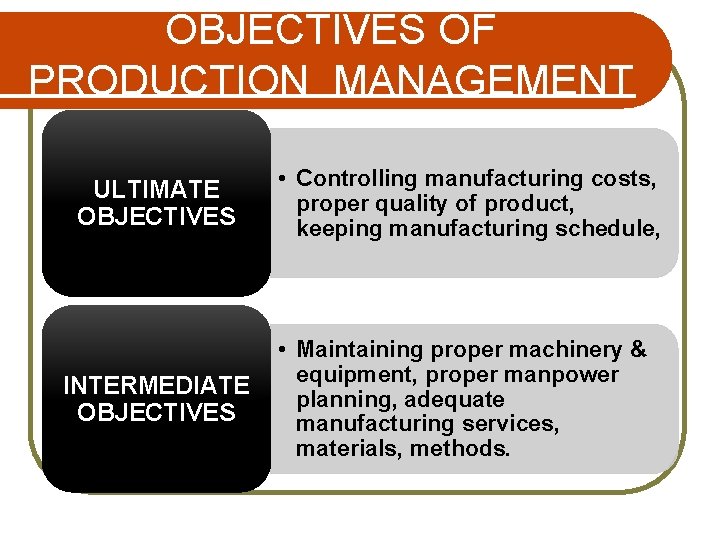
OBJECTIVES OF PRODUCTION MANAGEMENT ULTIMATE OBJECTIVES • Controlling manufacturing costs, proper quality of product, keeping manufacturing schedule, INTERMEDIATE OBJECTIVES • Maintaining proper machinery & equipment, proper manpower planning, adequate manufacturing services, materials, methods.
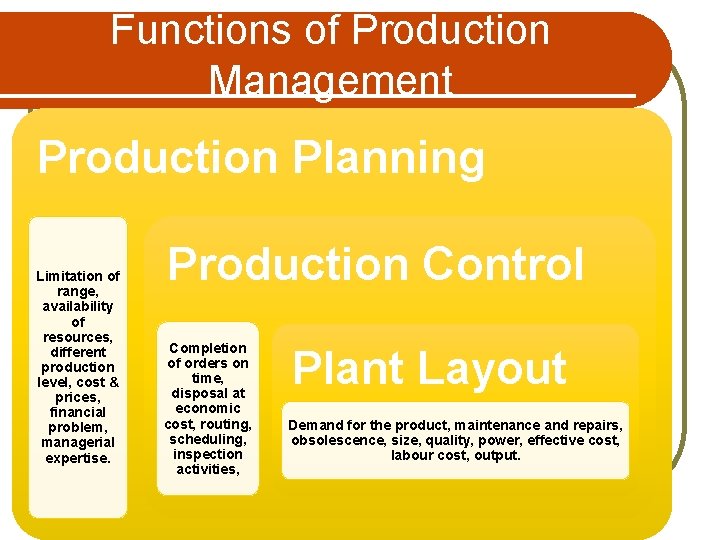
Functions of Production Management Production Planning Limitation of range, availability of resources, different production level, cost & prices, financial problem, managerial expertise. Production Control Completion of orders on time, disposal at economic cost, routing, scheduling, inspection activities, Plant Layout Demand for the product, maintenance and repairs, obsolescence, size, quality, power, effective cost, labour cost, output.
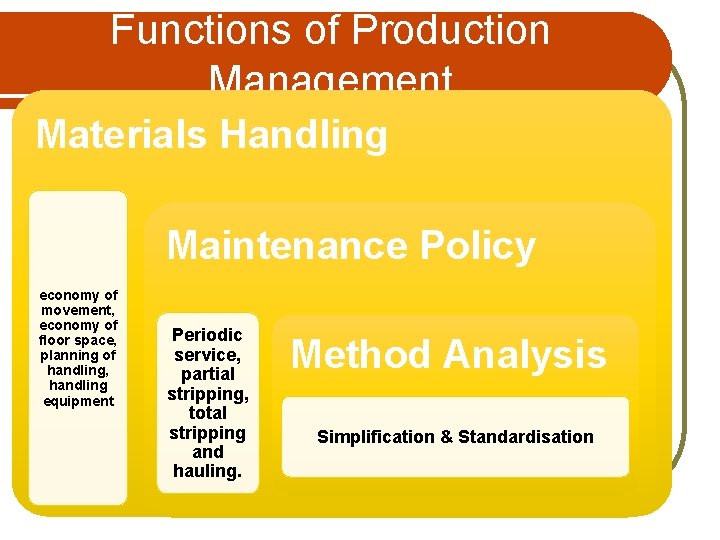
Functions of Production Management Materials Handling Maintenance Policy economy of movement, economy of floor space, planning of handling, handling equipment Periodic service, partial stripping, total stripping and hauling. Method Analysis Simplification & Standardisation
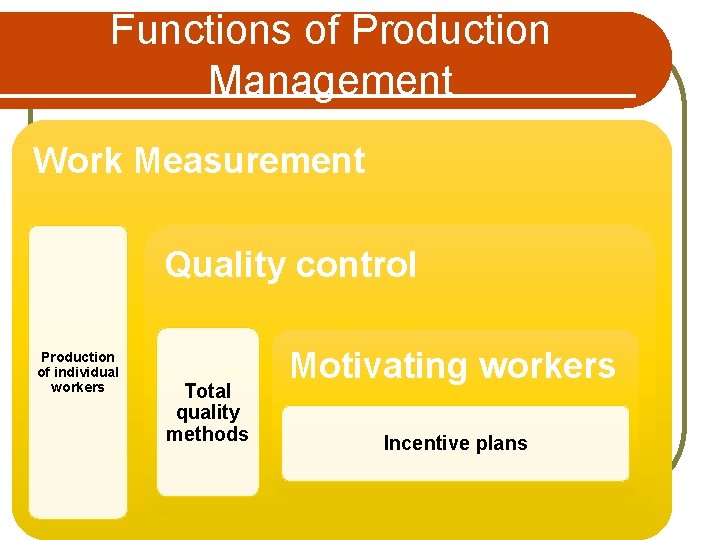
Functions of Production Management Work Measurement Quality control Production of individual workers Total quality methods Motivating workers Incentive plans
SIMPLIFICATION l Refers to the practice of reducing the variety of components and/or final products. it aims the elimination of all those uses of labour and materials that are not absolutely essential for obtaining more effective production.
SIMPLIFICATION l Process includes: - 1. cutting down 2. reduction of frills. l It is related to product design, production method, machines used
STANDARDISATION l. Interchangeability of standard components and between different end products. l. Refers to setting up of fixed size, types, qualities usually.
Benefits of simplification & Standardisation l Benefits from the standpoint of the management v More effective & quicker production v Inspection & quality testing v Specialization of experts v Reduction of capital requirement v Variety of skills v Reduction of machine tools requirement
Benefits of simplification & Standardisation l. Benefits from the standpoint of the distributers ØReduction in paper work ØEasier handling of results ØFewer models & spare parts ØSale increase
Benefits of simplification & Standardisation l. Benefits from the standpoint of the customers üLower selling price üGetting speedier delivery üBetter quality product üEfficient customer service for spares & repairs
Benefits of simplification & Standardisation Benefits from the standpoint of the employee q possibility of learning specialized job q. Reduction in time required to get trained
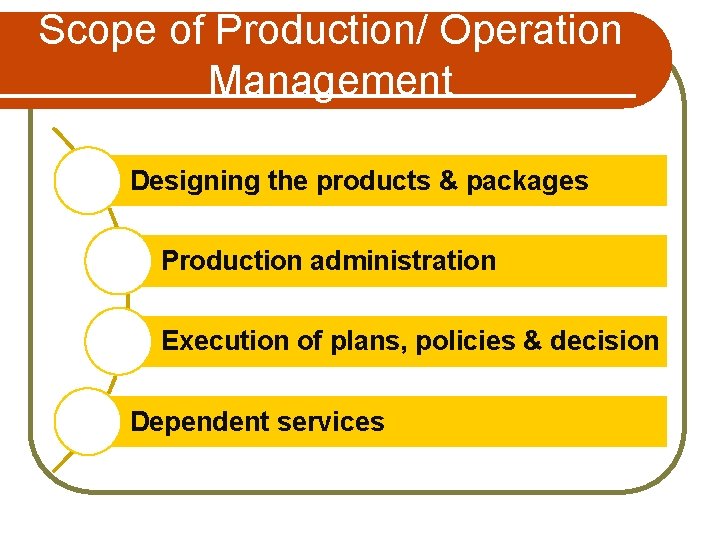
Scope of Production/ Operation Management Designing the products & packages Production administration Execution of plans, policies & decision Dependent services
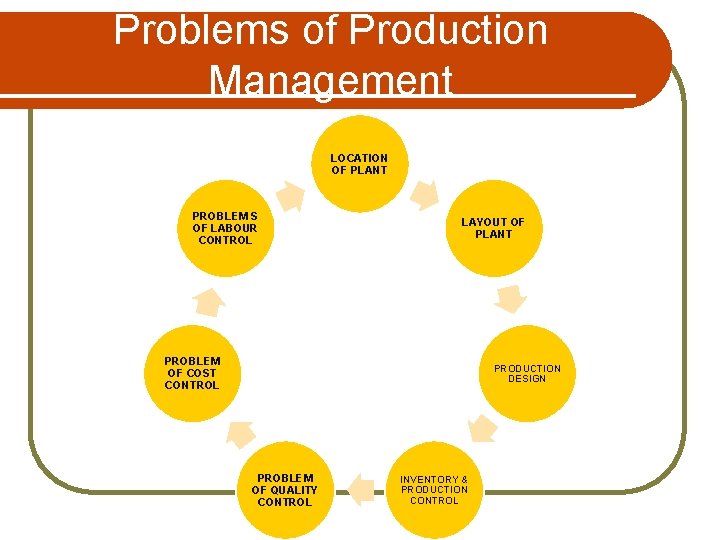
Problems of Production Management LOCATION OF PLANT PROBLEM S OF LABOUR CONTROL LAYOUT OF PLANT PROBLEM OF COST CONTROL PRODUCTION DESIGN PROBLEM OF QUALITY CONTROL INVENTORY & PRODUCTION CONTROL
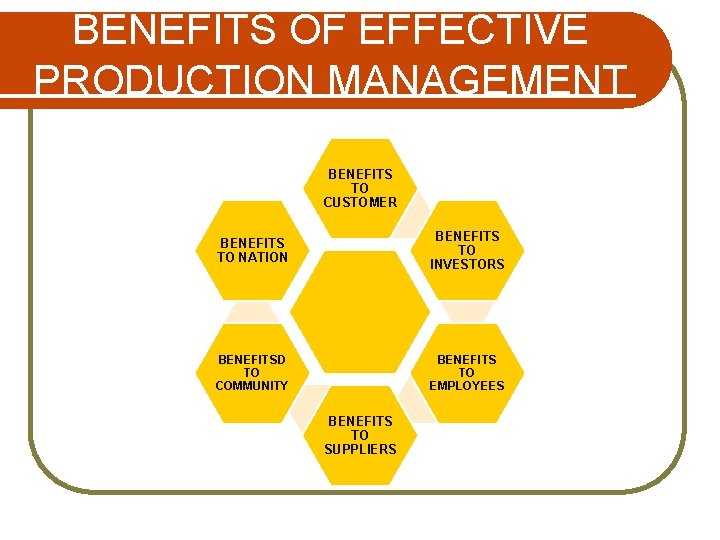
BENEFITS OF EFFECTIVE PRODUCTION MANAGEMENT BENEFITS TO CUSTOMER BENEFITS TO NATION BENEFITS TO INVESTORS BENEFITSD TO COMMUNITY BENEFITS TO EMPLOYEES BENEFITS TO SUPPLIERS
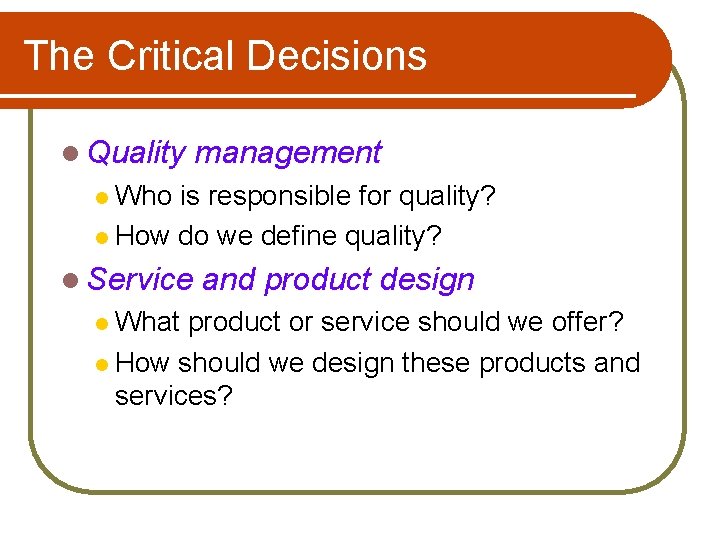
The Critical Decisions l Quality management l Who is responsible for quality? l How do we define quality? l Service l What and product design product or service should we offer? l How should we design these products and services?
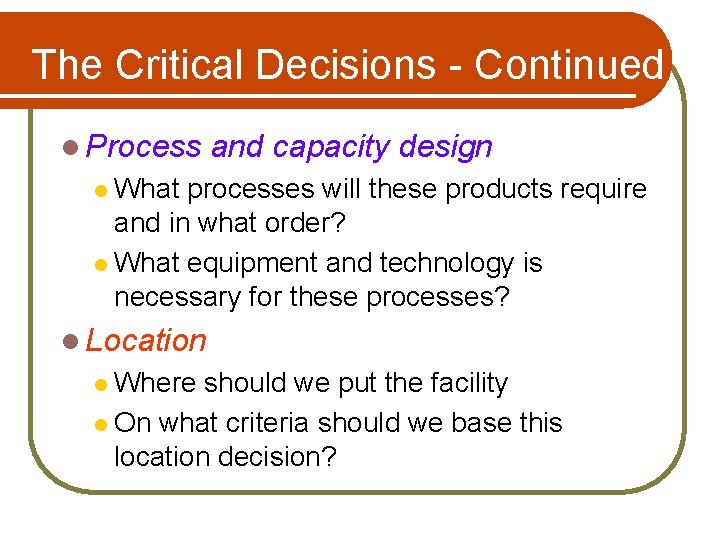
The Critical Decisions - Continued l Process and capacity design l What processes will these products require and in what order? l What equipment and technology is necessary for these processes? l Location l Where should we put the facility l On what criteria should we base this location decision?
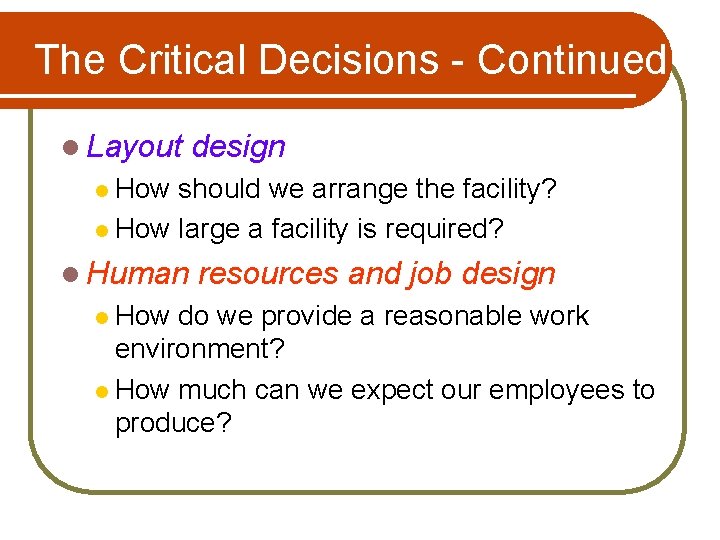
The Critical Decisions - Continued l Layout design l How should we arrange the facility? l How large a facility is required? l Human l How resources and job design do we provide a reasonable work environment? l How much can we expect our employees to produce?
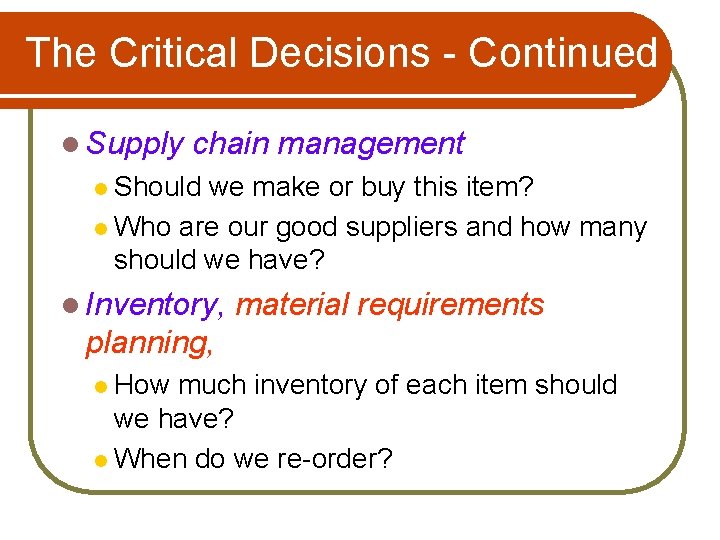
The Critical Decisions - Continued l Supply chain management l Should we make or buy this item? l Who are our good suppliers and how many should we have? l Inventory, material requirements planning, l How much inventory of each item should we have? l When do we re-order?
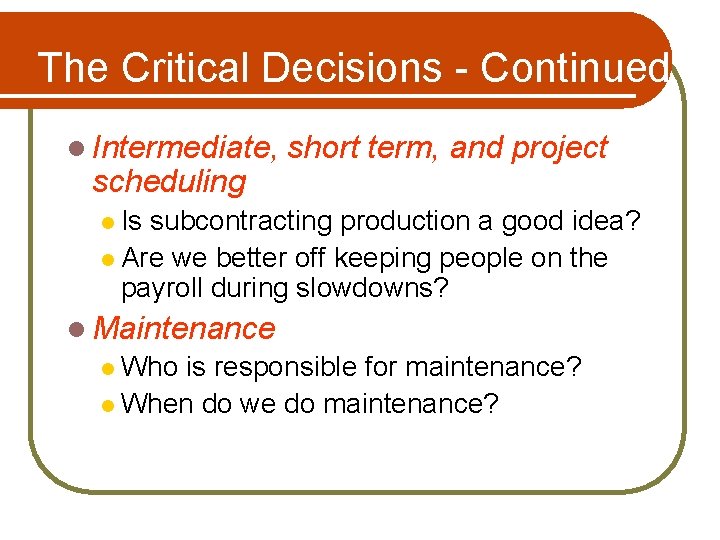
The Critical Decisions - Continued l Intermediate, scheduling short term, and project l Is subcontracting production a good idea? l Are we better off keeping people on the payroll during slowdowns? l Maintenance l Who is responsible for maintenance? l When do we do maintenance?
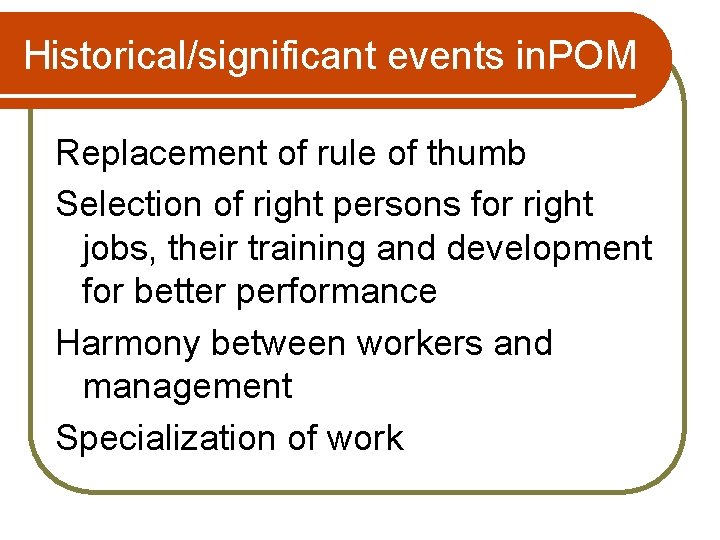
Historical/significant events in. POM Replacement of rule of thumb Selection of right persons for right jobs, their training and development for better performance Harmony between workers and management Specialization of work
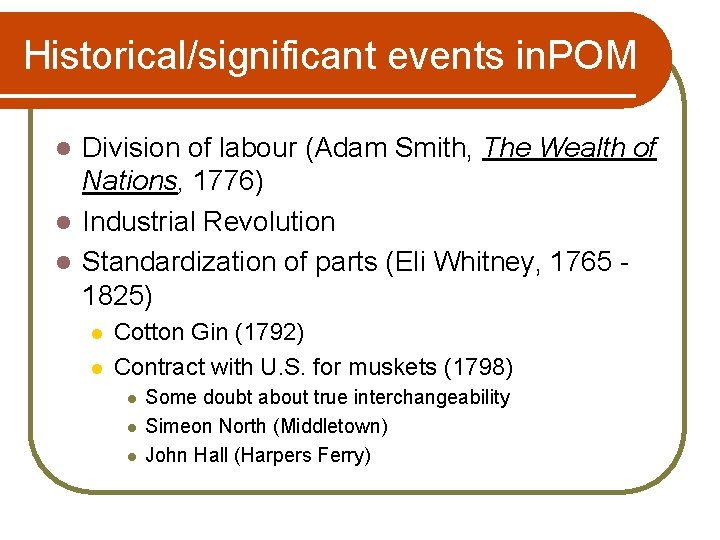
Historical/significant events in. POM Division of labour (Adam Smith, The Wealth of Nations, 1776) l Industrial Revolution l Standardization of parts (Eli Whitney, 1765 1825) l l l Cotton Gin (1792) Contract with U. S. for muskets (1798) l l l Some doubt about true interchangeability Simeon North (Middletown) John Hall (Harpers Ferry)
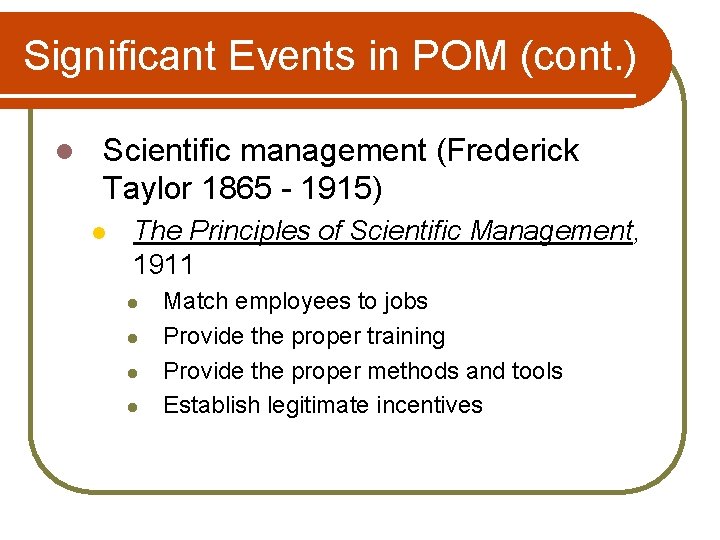
Significant Events in POM (cont. ) l Scientific management (Frederick Taylor 1865 - 1915) l The Principles of Scientific Management, 1911 l l Match employees to jobs Provide the proper training Provide the proper methods and tools Establish legitimate incentives
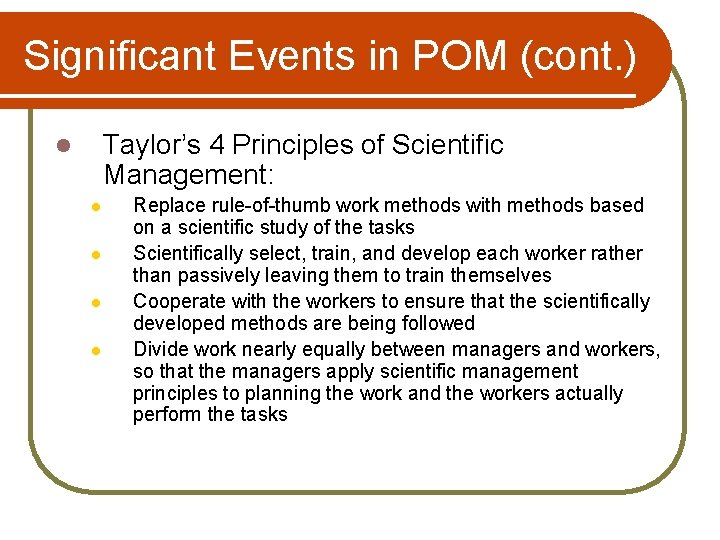
Significant Events in POM (cont. ) Taylor’s 4 Principles of Scientific Management: l l l Replace rule-of-thumb work methods with methods based on a scientific study of the tasks Scientifically select, train, and develop each worker rather than passively leaving them to train themselves Cooperate with the workers to ensure that the scientifically developed methods are being followed Divide work nearly equally between managers and workers, so that the managers apply scientific management principles to planning the work and the workers actually perform the tasks
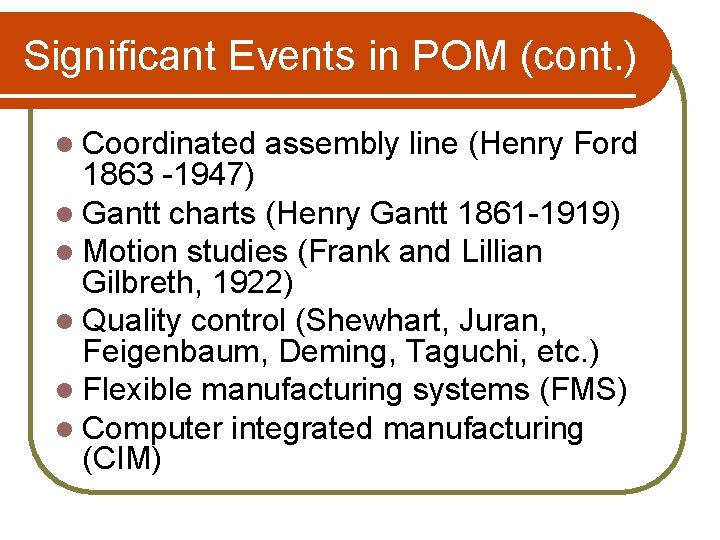
Significant Events in POM (cont. ) l Coordinated assembly line (Henry Ford 1863 -1947) l Gantt charts (Henry Gantt 1861 -1919) l Motion studies (Frank and Lillian Gilbreth, 1922) l Quality control (Shewhart, Juran, Feigenbaum, Deming, Taguchi, etc. ) l Flexible manufacturing systems (FMS) l Computer integrated manufacturing (CIM)
The Productivity Challenge
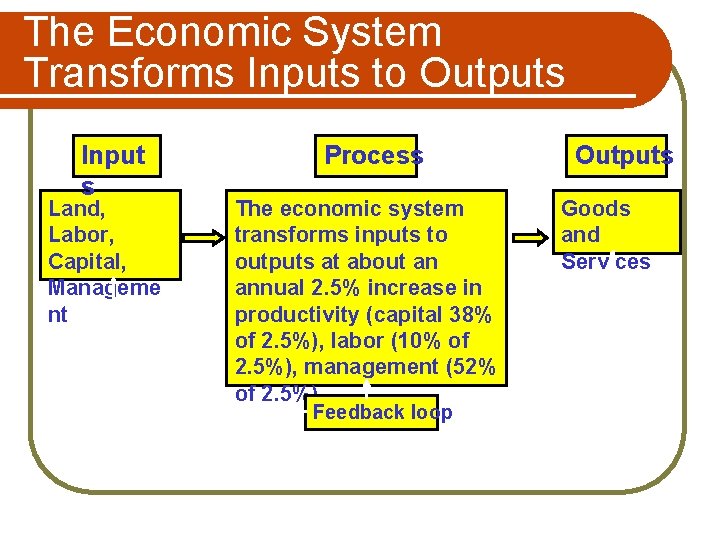
The Economic System Transforms Inputs to Outputs Input s Land, Labor, Capital, Manageme nt Process The economic system transforms inputs to outputs at about an annual 2. 5% increase in productivity (capital 38% of 2. 5%), labor (10% of 2. 5%), management (52% of 2. 5%) Feedback loop Outputs Goods and Services
Adam Smith on Productivity …He asserted that ten workers could produce 48, 000 pins per day if each of eighteen specialized tasks was assigned to particular workers. Average productivity: 4, 800 pins per worker per day. But absent the division of labor, a worker would be lucky to produce even one pin per day.
Henry Ford on Productivity …In 1907, Henry Ford announced his goal for the Ford Motor Company: to create "a motor car for the great multitude. " At that time, automobiles were expensive, custom-made machines. Ford realized he'd need a more efficient way to produce the Model T in order to lower the price. He and his team looked at other industries and four principles that would further their goal: l l Interchangeable parts Continuous flow Division of labor Reducing wasted effort
Frank Gilbreth on Productivity …improved a five-thousand-year-old job and had enabled bricklayers to lay brick faster with less effort and fatigue. On one particularly difficult type of wall, where the previous record had been 120 bricks per hour, his methods allowed them to lay 350 bricks, an increase in productivity of over 190%.
Walter Shewhart on Productivity …the original notions of Total Quality Management and continuous improvement trace back to a former Bell Telephone employee named Walter Shewhart. One of W. Edwards Deming's teachers, he preached the importance of adapting management processes to create profitable situations for both businesses and consumers, promoting the utilization of his own creation: the SPC chart.
Key Variables for Improved Labor Productivity l Basic education appropriate for the labor force l Diet of the labor force l Social overhead that makes labor available l Maintaining and enhancing skills in the midst of rapidly changing technology and knowledge
Service Productivity l Typically labor intensive l Frequently individually processed l Often an intellectual task performed by professionals l Often difficult to mechanize l Often difficult to evaluate for quality
Current Trends l U. S. is becoming more of a knowledge intensive service economy l Globalization l Total Quality Control l Need for flexibility and innovation
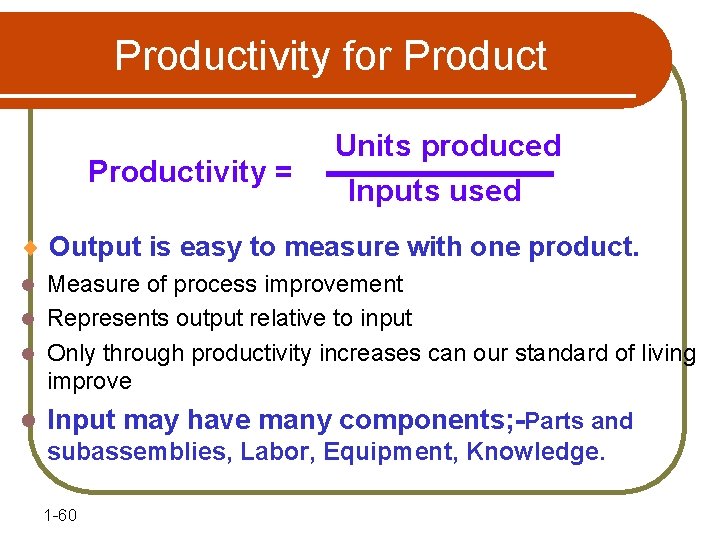
Productivity for Productivity = Units produced Inputs used ¨ Output is easy to measure with one product. Measure of process improvement l Represents output relative to input l Only through productivity increases can our standard of living improve l l Input may have many components; -Parts and subassemblies, Labor, Equipment, Knowledge. 1 -60
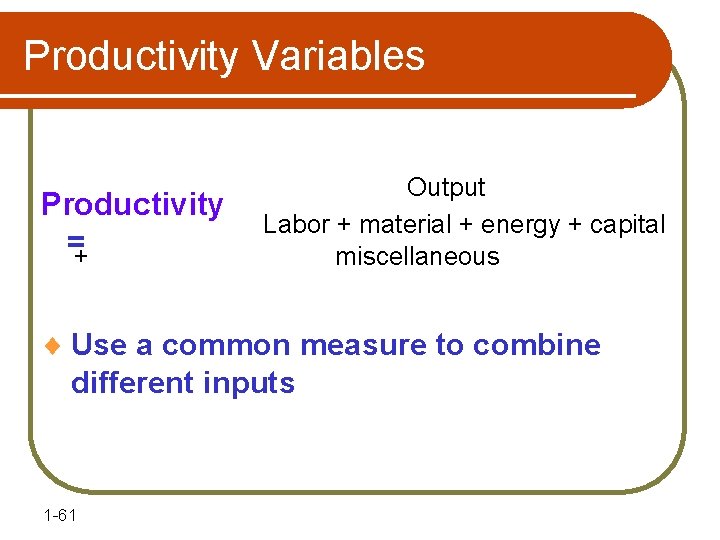
Productivity Variables Productivity =+ Output Labor + material + energy + capital miscellaneous ¨ Use a common measure to combine different inputs 1 -61
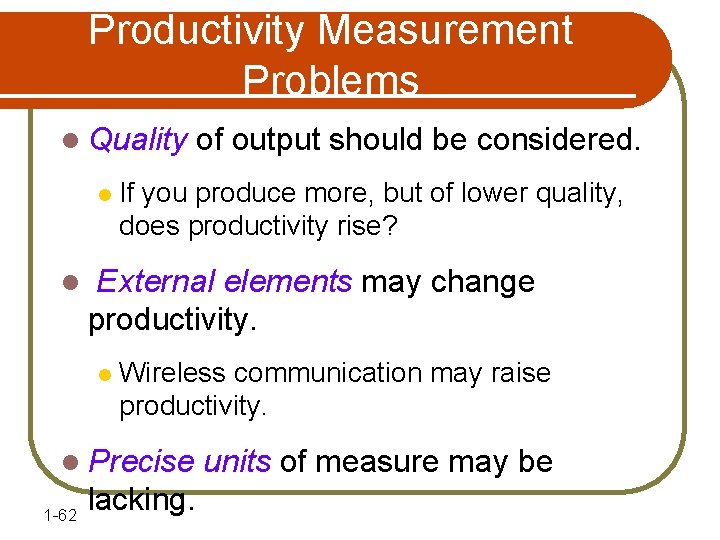
Productivity Measurement Problems l Quality l l If you produce more, but of lower quality, does productivity rise? External elements may change productivity. l Wireless communication may raise productivity. l Precise 1 -62 of output should be considered. lacking. units of measure may be
THANK YOU