
Introduction to Product Management Todays Agenda n Role


- Slides: 22
Introduction to Product Management
Today’s Agenda n Role of the Product Management n Organizational Structures n Critical Skills of the Product Manager n Changes affecting Product Mgmt. n Overview of the Marketing Planning Process n Marketing Plan Assignment
Role of the PM
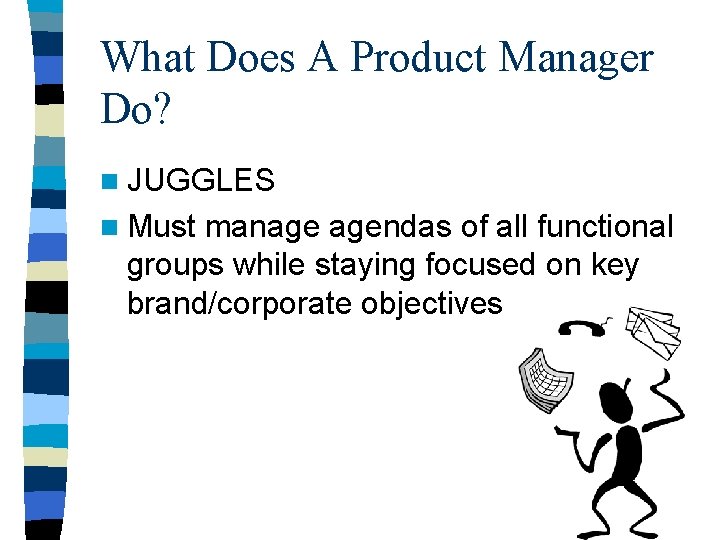
What Does A Product Manager Do? n JUGGLES n Must manage agendas of all functional groups while staying focused on key brand/corporate objectives
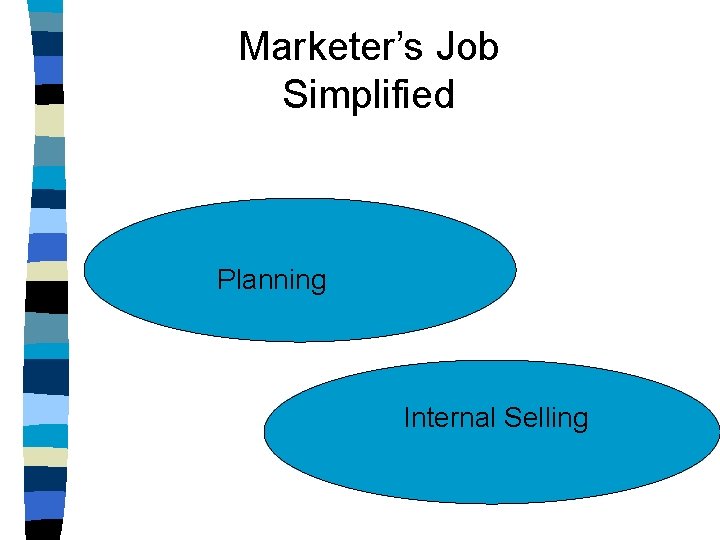
Marketer’s Job Simplified Planning Internal Selling
Planning Activities Annual Business Plans Ø • • Collect & Analyze product & category data Use analysis to develop marketing strategies
Internal Selling n Coordinating with other areas of the corporation to execute programs (ie R&D, Graphics & Promotion, Research etc) n Keeping Senior Management informed and supportive
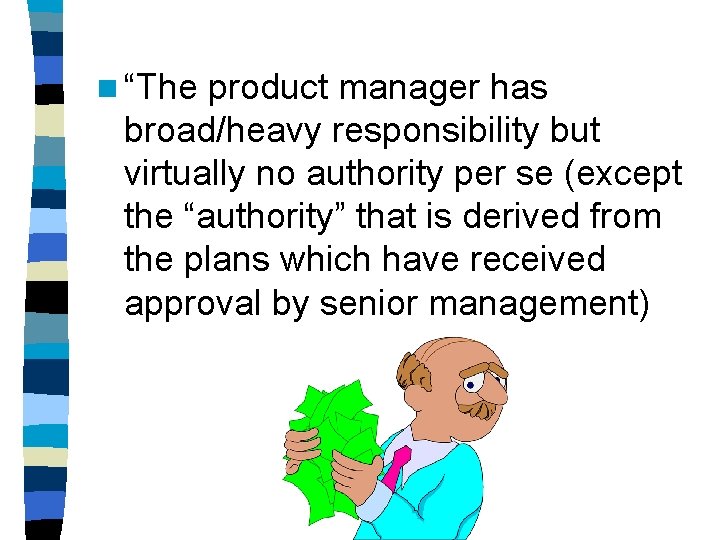
n “The product manager has broad/heavy responsibility but virtually no authority per se (except the “authority” that is derived from the plans which have received approval by senior management)
Organizational Structures
Organizational Structures n PM’s Job depends on how the organization is structured n We will explore 3 Organizational structures; 1. Product-Focused Organizations 2. Market-Focused Organizations 3. Functionally Focused
Product-Focused Structure n Product Manager Acts as a “mini-CEO” n Takes responsibility for overall health of a brand n Well Defined Hierarchy exists (ie Group product Manager, Brand manager, Assistant Brand Manager)
Product-Focused Organization Advantages n Locus of responsibility is clear (directly accountable for brand) n Invaluable training & experience for PM n Disadvantages n Inability to ask fundamental questions (too close) n PM is may become somewhat removed from the action in the field n Short-term focused n
Market-Focused Organization n Defines authority by Market segment n Segments can be industry, channel, regions of the country or customer size n Useful when there are significant differences in buyer behaviour among the market segments
Market-Focused Organizations Advantages n Disadvantages n Strong Customer n Does not give Focus managers full n Easier to get Product responsibility for Managers to ‘pull products services together’ (more coordination) n Better knowledge of n Lose ‘mini-CEO company’s line of training’ products n
Functionally-Focused Organizations Align themselves by functions (ie Advertising, Sales, merchandising) n No Single person is responsible for the day-to -day health of a brand n CEO & Vice Presidents (VP’s) make marketing strategy decisions n Strategies are implemented through discussion & coordination among functional groups n
Functionally-Focused Organizations Advantages n Administratively simple n Functional training is strong n CEO & VP’s make important strategy decisions n Disadvantages n Limited responsibility for specific products n Conflicts b/w strategies can only be resolved through discussion – time consuming n Narrow scope of managers – limits development n
More Variables: Industry & Size of Company n High-tech Companies – New Products – Feedback via web n Smaller Companies – more execution n Consumer Products Companies – more research – Evaluations on Profit & Loss
Product Management: Critical Skills n Teamwork n Communication n Analytical Ability Skills
Discussion Topic What market trends are impacting the role of the Product Manger?
Category Management n Driven by increased power by retailer n Analysis of category to optimize product mix n Product are business units customized on a store-by-store basis n Impact on marketing organization
Marketing Planning Process Overview
Exercise n Get into groups of 4 -5 people and complete the 2 pages on Marketing Plans handout n Be prepared to share your answers with the class