
Introduction to probability theory and statistics HY 335
Introduction to probability theory and statistics HY 335 Presented by: George Fortetsanakis
Roadmap • • Elements of probability theory Probability distributions Statistical estimation Reading plots
Terminology • Event: every possible outcome of an experiment. • Sample space: The set of all possible outcomes of an experiment Example: Roll a dice • Every possible outcome is an event • Sample space: {1, 2, 3, 4, 5, 6} Example: Toss a coin • Every possible outcome is an event • Sample space: {head, tails}
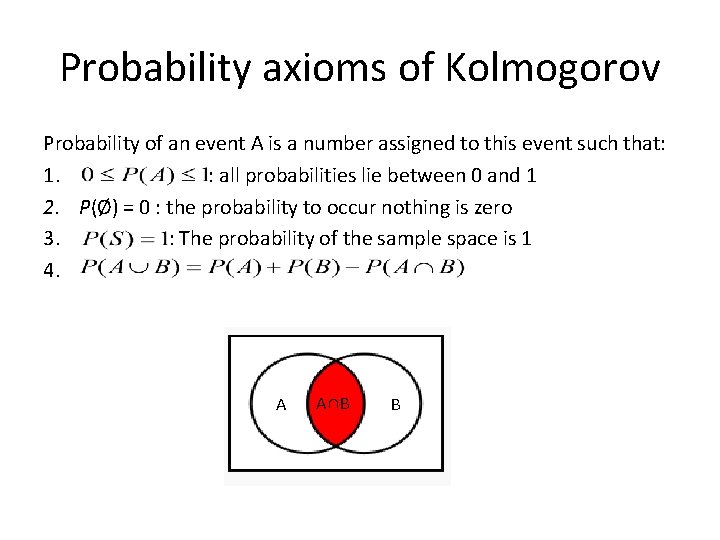
Probability axioms of Kolmogorov Probability of an event A is a number assigned to this event such that: 1. : all probabilities lie between 0 and 1 2. P(Ø) = 0 : the probability to occur nothing is zero 3. : The probability of the sample space is 1 4. A A∩B B
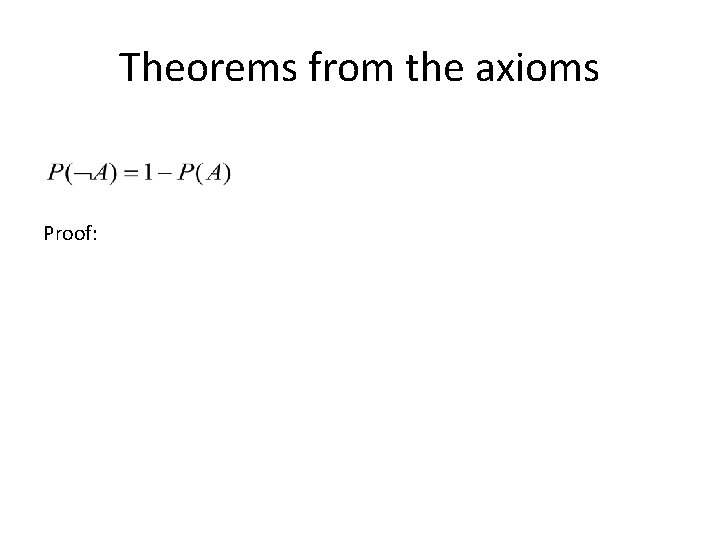
Theorems from the axioms Proof:
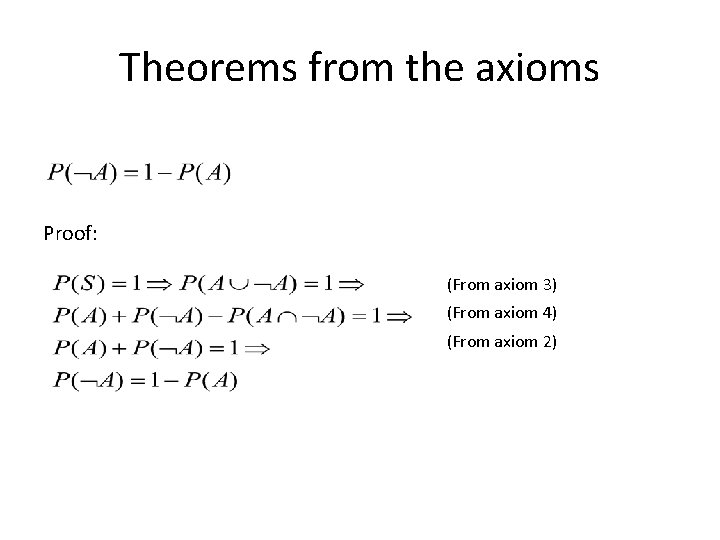
Theorems from the axioms Proof: (From axiom 3) (From axiom 4) (From axiom 2)
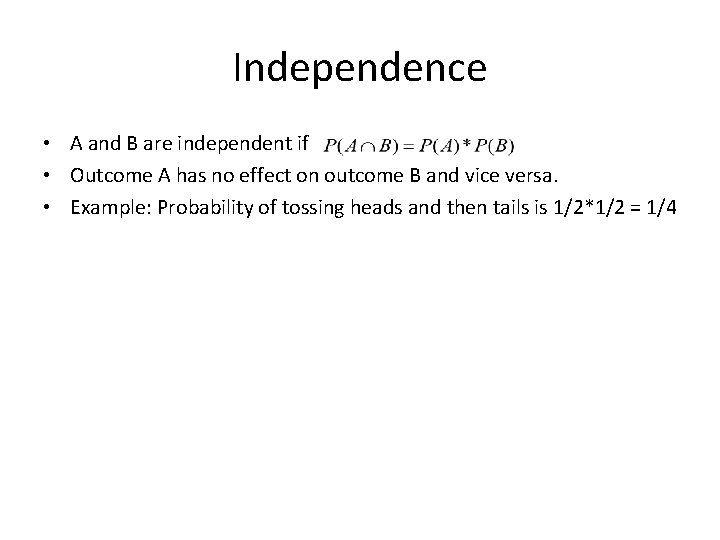
Independence • A and B are independent if • Outcome A has no effect on outcome B and vice versa. • Example: Probability of tossing heads and then tails is 1/2*1/2 = 1/4
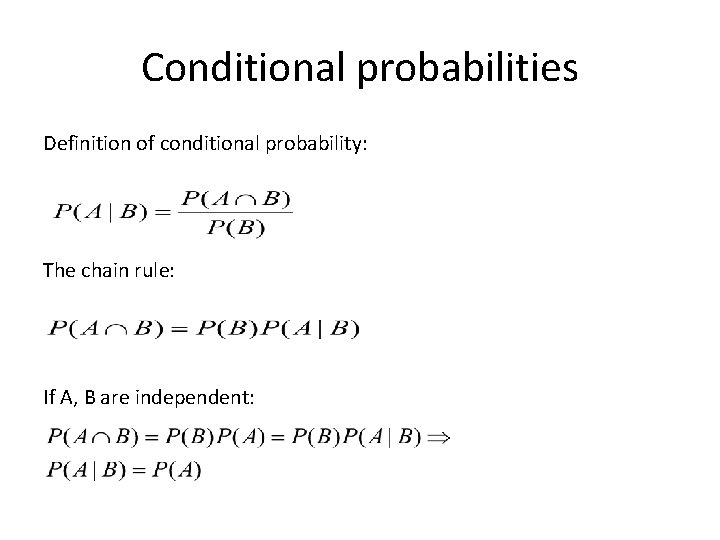
Conditional probabilities Definition of conditional probability: The chain rule: If A, B are independent:
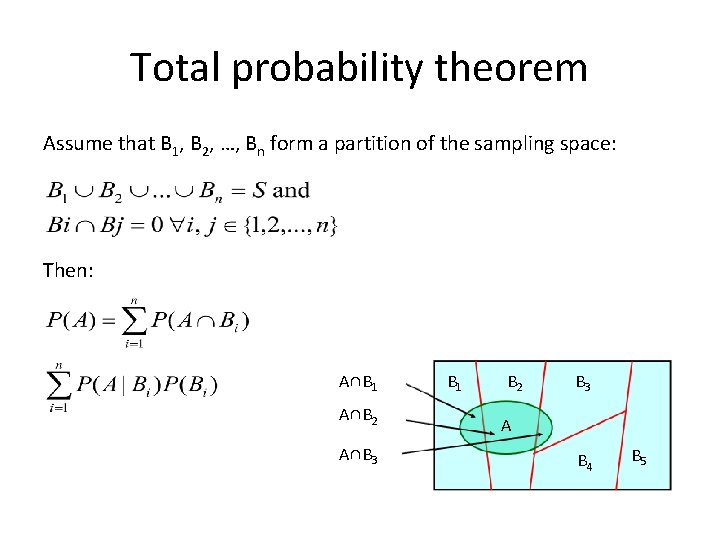
Total probability theorem Assume that B 1, B 2, …, Bn form a partition of the sampling space: Then: A∩B 1 A∩B 2 A∩B 3 B 1 B 2 B 3 A B 4 B 5
Roadmap • • Elements of probability theory Probability distributions Statistical estimation Reading plots
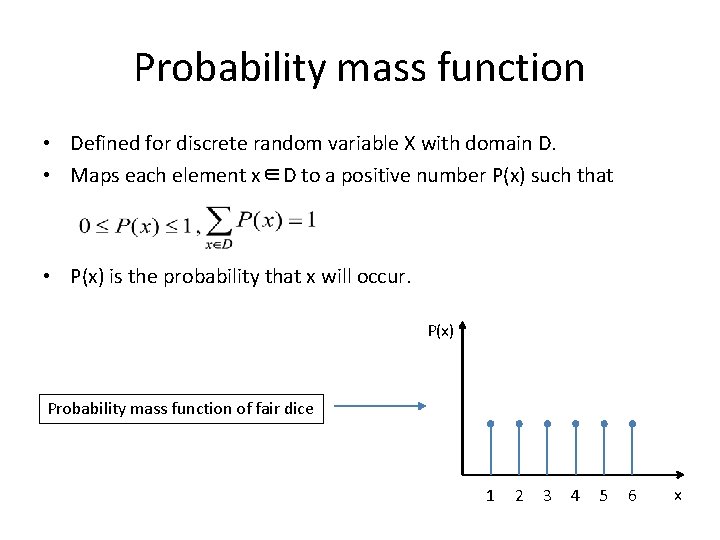
Probability mass function • Defined for discrete random variable X with domain D. • Maps each element x∈D to a positive number P(x) such that • P(x) is the probability that x will occur. P(x) Probability mass function of fair dice 1 2 3 4 5 6 x
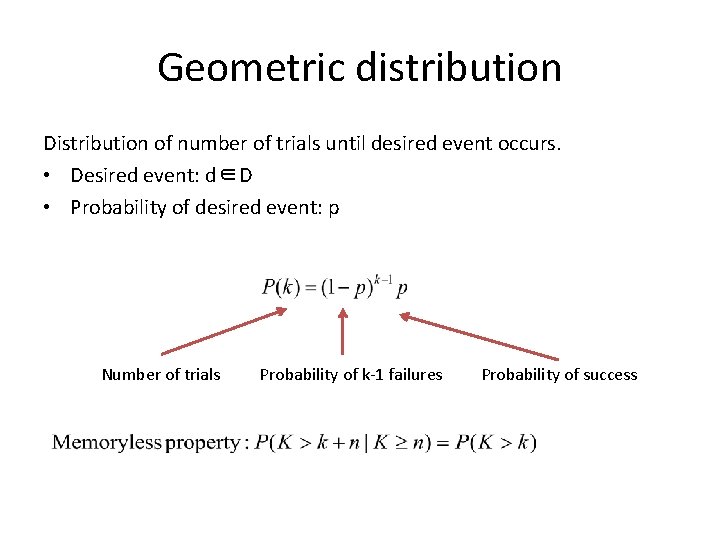
Geometric distribution Distribution of number of trials until desired event occurs. • Desired event: d∈D • Probability of desired event: p Number of trials Probability of k-1 failures Probability of success
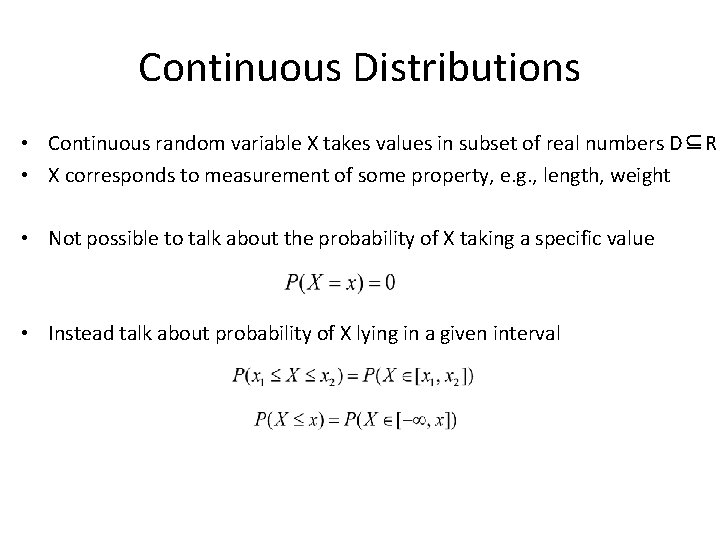
Continuous Distributions • Continuous random variable X takes values in subset of real numbers D⊆R • X corresponds to measurement of some property, e. g. , length, weight • Not possible to talk about the probability of X taking a specific value • Instead talk about probability of X lying in a given interval
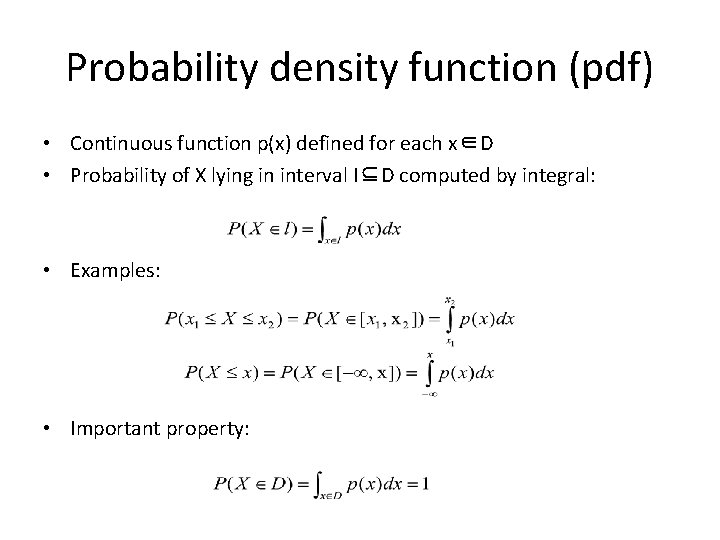
Probability density function (pdf) • Continuous function p(x) defined for each x∈D • Probability of X lying in interval I⊆D computed by integral: • Examples: • Important property:

Cumulative distribution function (cdf) • For each x∈D defines the probability Important properties: • • • Complementary cumulative distribution function (ccdf)
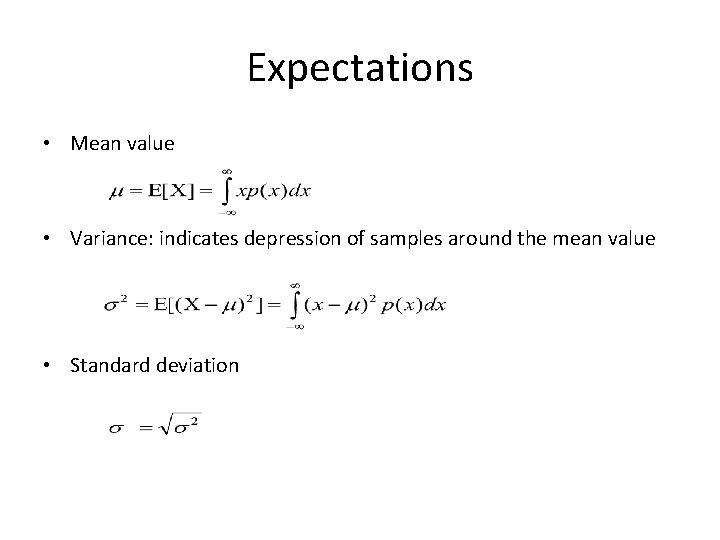
Expectations • Mean value • Variance: indicates depression of samples around the mean value • Standard deviation
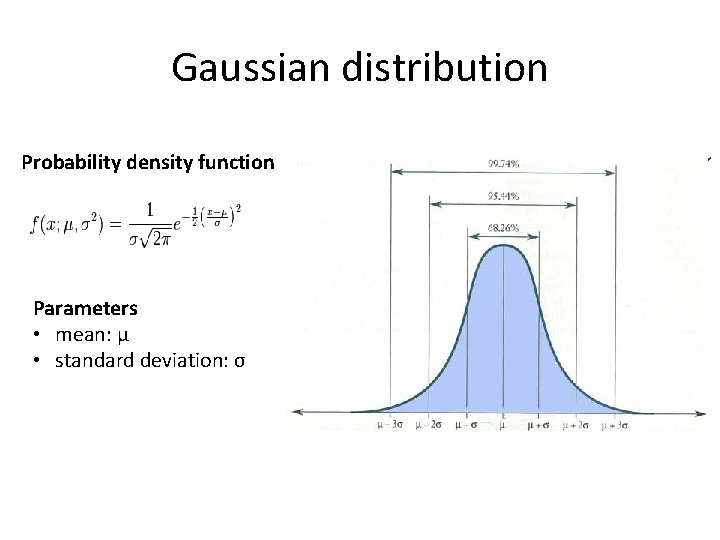
Gaussian distribution Probability density function Parameters • mean: μ • standard deviation: σ
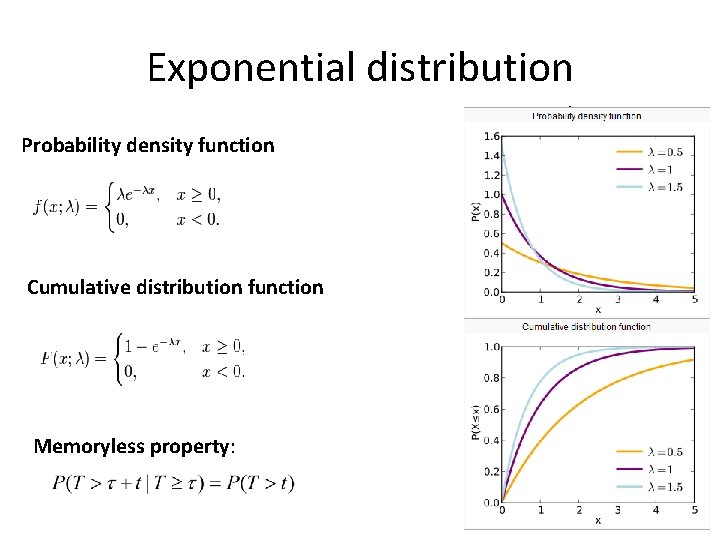
Exponential distribution Probability density function Cumulative distribution function Memoryless property:
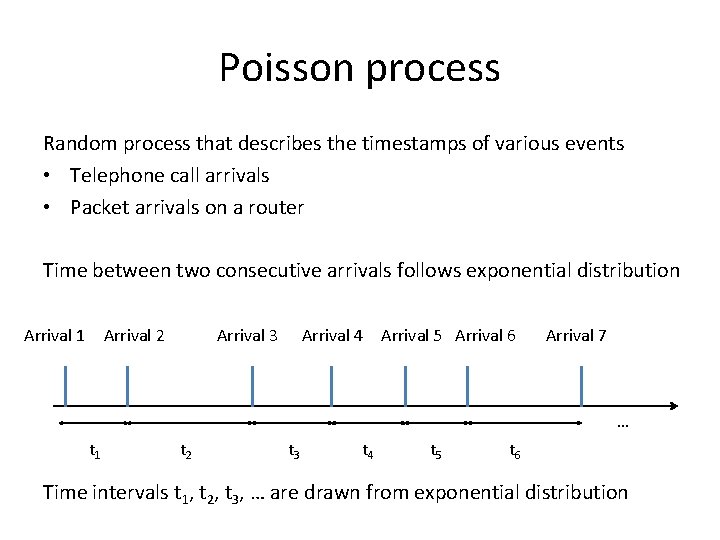
Poisson process Random process that describes the timestamps of various events • Telephone call arrivals • Packet arrivals on a router Time between two consecutive arrivals follows exponential distribution Arrival 1 Arrival 2 Arrival 3 Arrival 4 Arrival 5 Arrival 6 Arrival 7 … t 1 t 2 t 3 t 4 t 5 t 6 Time intervals t 1, t 2, t 3, … are drawn from exponential distribution
Problem definition Dataset D={x 1, x 2, …, xk} collected by network administrator • Arrivals of users in the network • Arrivals of packets on a wireless router How can we compute the parameter λ of the exponential distribution that better fits the data?
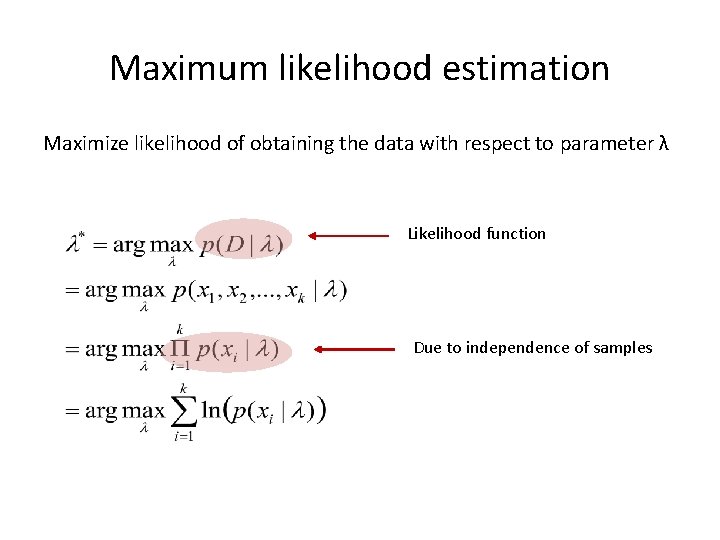
Maximum likelihood estimation Maximize likelihood of obtaining the data with respect to parameter λ Likelihood function Due to independence of samples
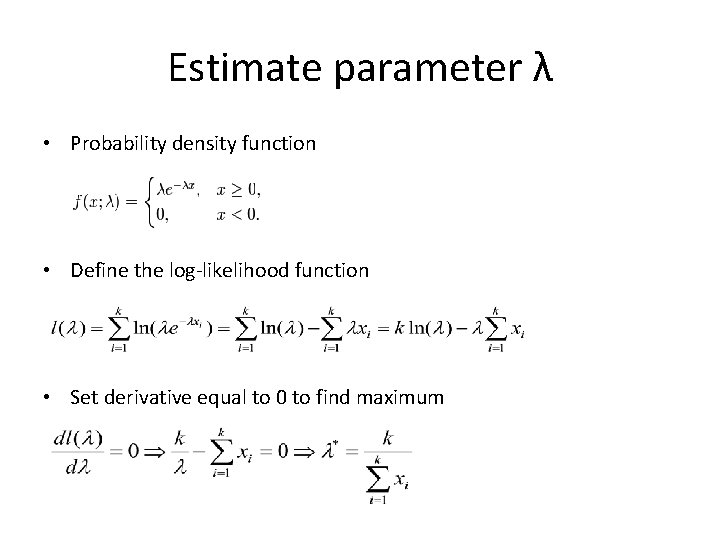
Estimate parameter λ • Probability density function • Define the log-likelihood function • Set derivative equal to 0 to find maximum
Roadmap • • Elements of probability theory Probability distributions Statistical estimation Reading plots
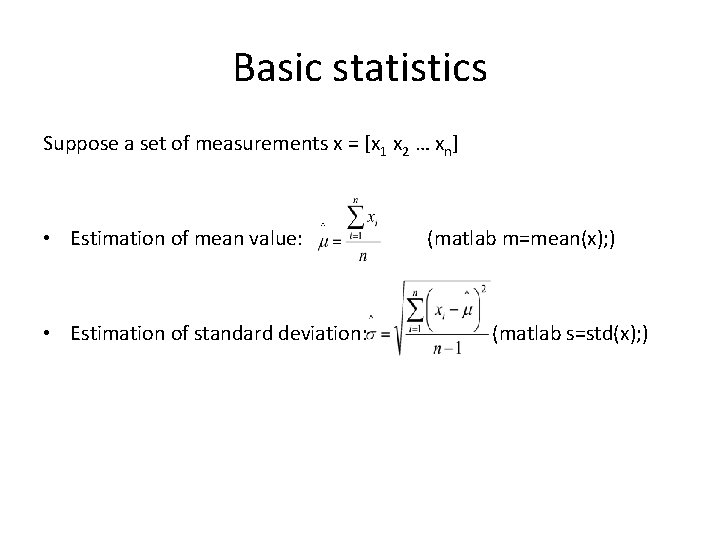
Basic statistics Suppose a set of measurements x = [x 1 x 2 … xn] • Estimation of mean value: • Estimation of standard deviation: (matlab m=mean(x); ) (matlab s=std(x); )
![Estimate pdf • Suppose dataset x = [x 1 x 2 … xn] •](http://slidetodoc.com/presentation_image_h2/9dd905d4eb3975d4bbdbd838c872d646/image-25.jpg "Estimate pdf • Suppose dataset x = [x 1 x 2 … xn] •")
Estimate pdf • Suppose dataset x = [x 1 x 2 … xn] • Can we estimate the pdf that values in x follow?
![Estimate pdf • Suppose dataset x = [x 1 x 2 … xn] •](http://slidetodoc.com/presentation_image_h2/9dd905d4eb3975d4bbdbd838c872d646/image-26.jpg "Estimate pdf • Suppose dataset x = [x 1 x 2 … xn] •")
Estimate pdf • Suppose dataset x = [x 1 x 2 … xn] • Can we estimate the pdf that values in x follow? Produce histogram
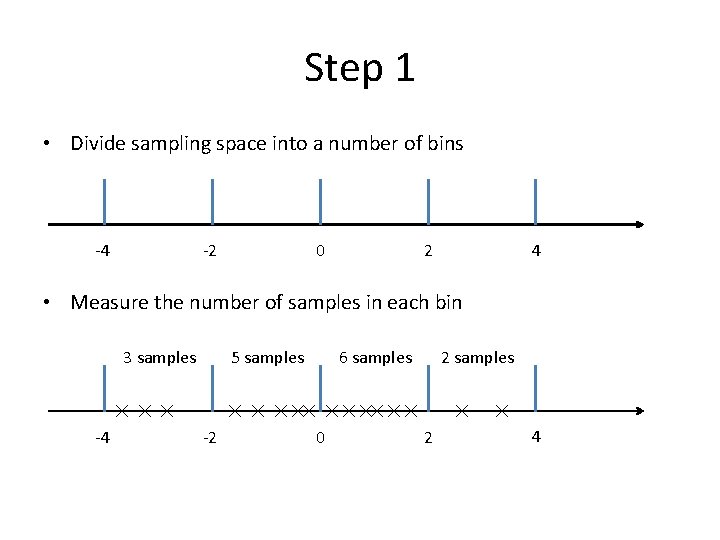
Step 1 • Divide sampling space into a number of bins -4 -2 0 4 2 • Measure the number of samples in each bin 3 samples -4 5 samples -2 6 samples 0 2 samples 2 4
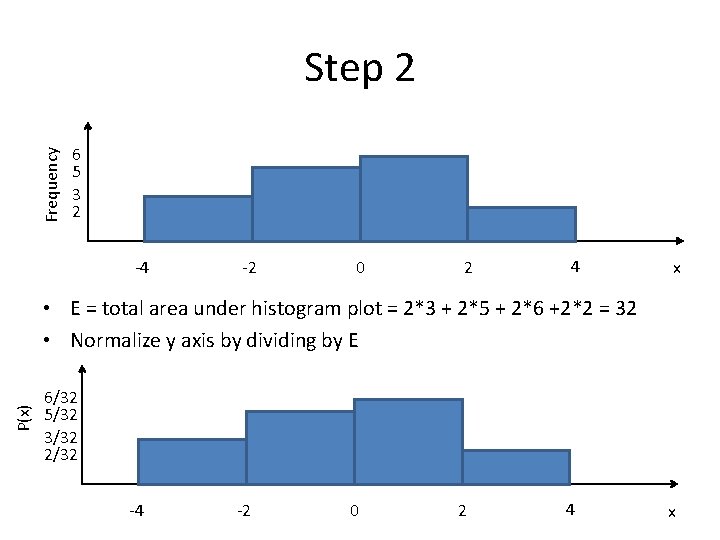
Frequency Step 2 6 5 3 2 -4 -2 0 2 4 x P(x) • E = total area under histogram plot = 2*3 + 2*5 + 2*6 +2*2 = 32 • Normalize y axis by dividing by E 6/32 5/32 3/32 2/32 -4 -2 0 2 4 x
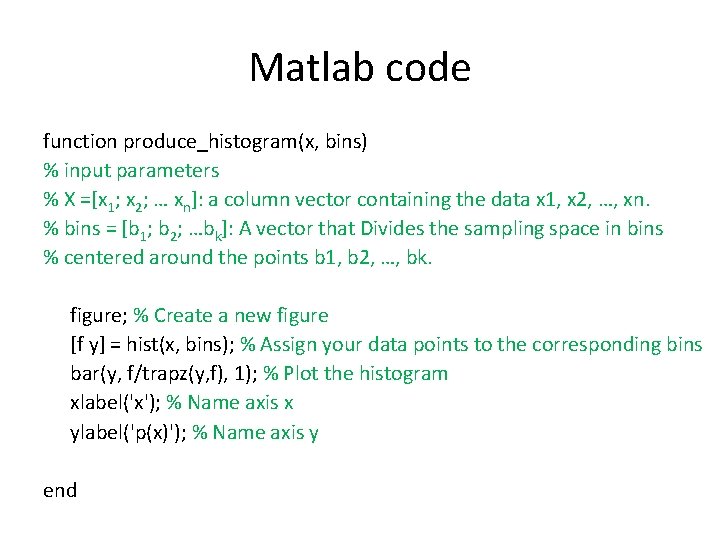
Matlab code function produce_histogram(x, bins) % input parameters % X =[x 1; x 2; … xn]: a column vector containing the data x 1, x 2, …, xn. % bins = [b 1; b 2; …bk]: A vector that Divides the sampling space in bins % centered around the points b 1, b 2, …, bk. figure; % Create a new figure [f y] = hist(x, bins); % Assign your data points to the corresponding bins bar(y, f/trapz(y, f), 1); % Plot the histogram xlabel('x'); % Name axis x ylabel('p(x)'); % Name axis y end
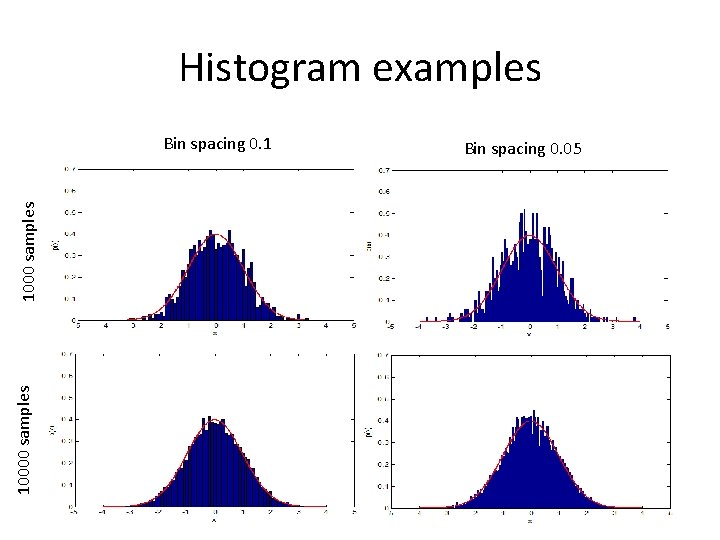
Histogram examples 10000 samples 1000 samples Bin spacing 0. 1 Bin spacing 0. 05
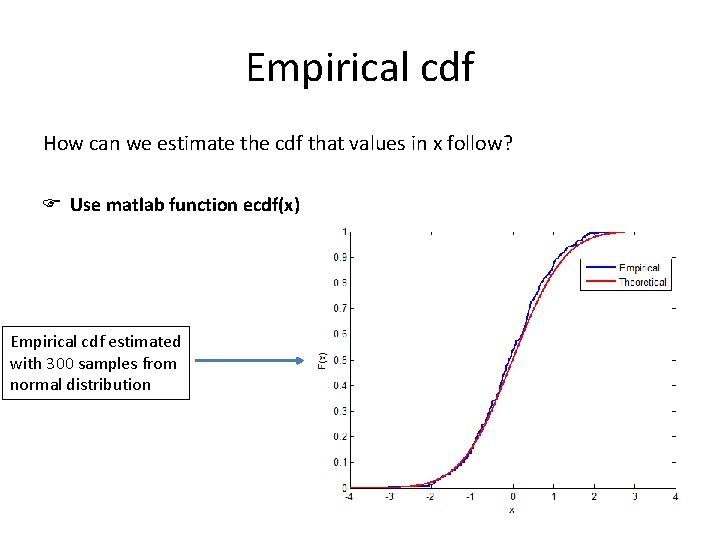
Empirical cdf How can we estimate the cdf that values in x follow? Use matlab function ecdf(x) Empirical cdf estimated with 300 samples from normal distribution
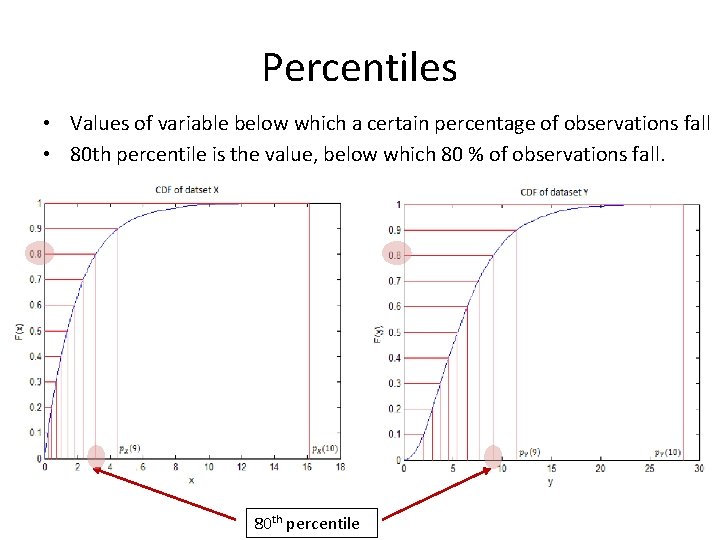
Percentiles • Values of variable below which a certain percentage of observations fall • 80 th percentile is the value, below which 80 % of observations fall. 80 th percentile
Estimate percentiles Percentiles in matlab: p = prctile(x, y); • y takes values in interval [0 100] • 80 th percentile: p = prctile(x, 80); Median: the 50 th percentile • med = prctile(x, 50); or • med = median(x); Why is median different than the mean? • Suppose dataset x = [1 100]: mean = 201/3=67, median = 100
Roadmap • • Elements of probability theory Probability distributions Statistical estimation Reading plots
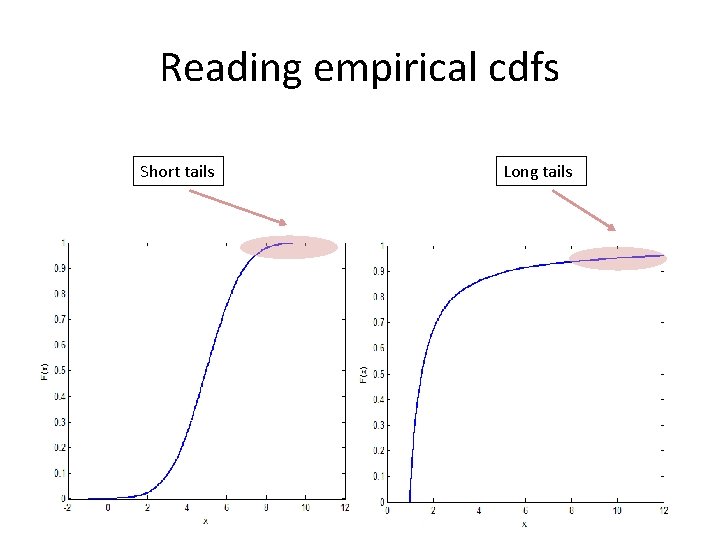
Reading empirical cdfs Short tails Long tails
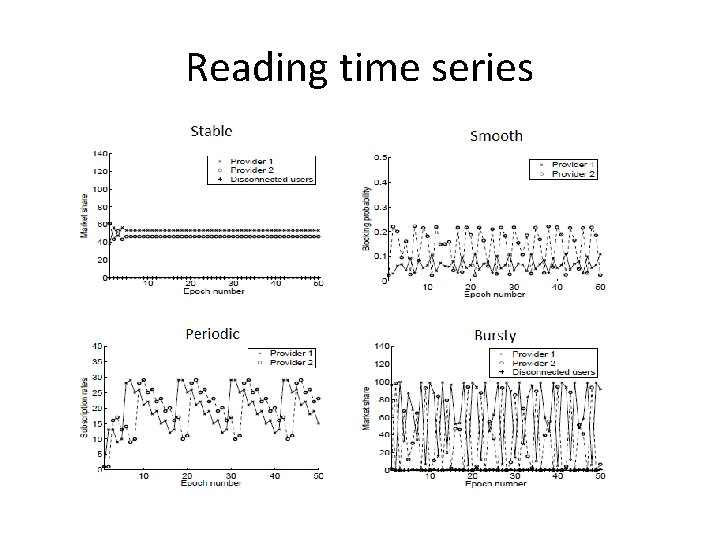
Reading time series
- Slides: 36