
Introduction to Probability of Detection POD for Nondestructive
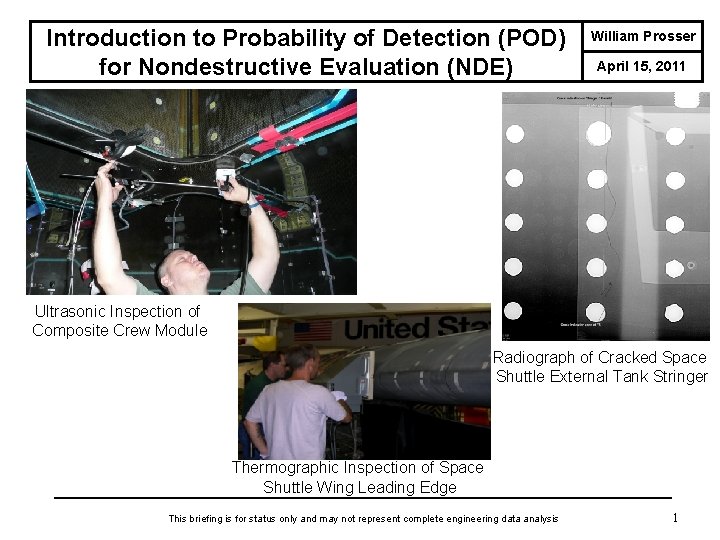
Introduction to Probability of Detection (POD) for Nondestructive Evaluation (NDE) William Prosser April 15, 2011 Ultrasonic Inspection of Composite Crew Module Radiograph of Cracked Space Shuttle External Tank Stringer Thermographic Inspection of Space Shuttle Wing Leading Edge This briefing is for status only and may not represent complete engineering data analysis 1
Outline William Prosser April 15, 2011 • What is POD and why is it important? • How is POD used? • How do you estimate POD for NDE? • When is POD required? • What is not covered – POD detailed statistical methodologies – Actual POD curves, or detectable flaw size limits based on POD for specific NDE techniques or applications This briefing is for status only and may not represent complete engineering data analysis 2
NDE Capability William Prosser April 15, 2011 • “What is smallest flaw that an NDE technique can detect? ” • One of the most commonly asked questions about NDE … Also, the wrong question to be asking! • More important question is “what are the largest flaws that might be missed by an NDE technique? ” It is these flaws that can lead to failure. • Also of importance is an understanding of the false call rate • These questions relate to the “capability” of NDE, which is characterized by “Probability of Detection” or POD This briefing is for status only and may not represent complete engineering data analysis 3

What is POD? William Prosser April 15, 2011 • POD is the probability that a flaw of a specific type will be detected by a given technique given the flaw exists in the material. It is usually unknown and therefore statistically estimated. • False call rate is the percentage of times a technique will indicate a flaw when no flaw is present in the material This briefing is for status only and may not represent complete engineering data analysis 4
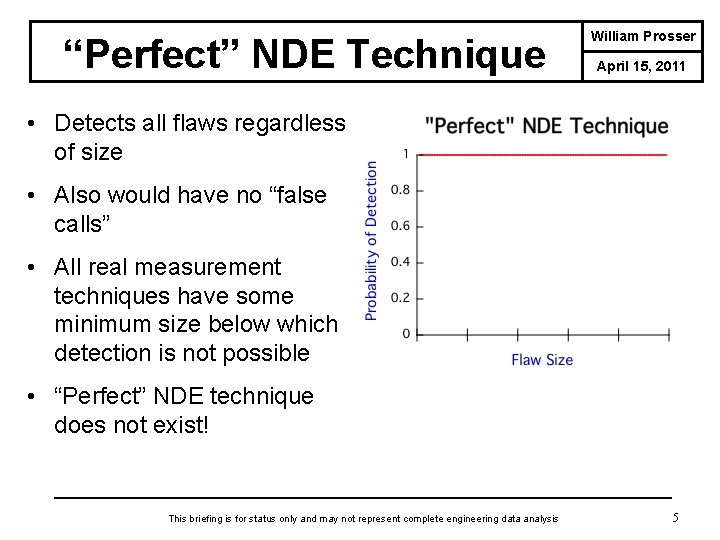
“Perfect” NDE Technique William Prosser April 15, 2011 • Detects all flaws regardless of size • Also would have no “false calls” • All real measurement techniques have some minimum size below which detection is not possible • “Perfect” NDE technique does not exist! This briefing is for status only and may not represent complete engineering data analysis 5
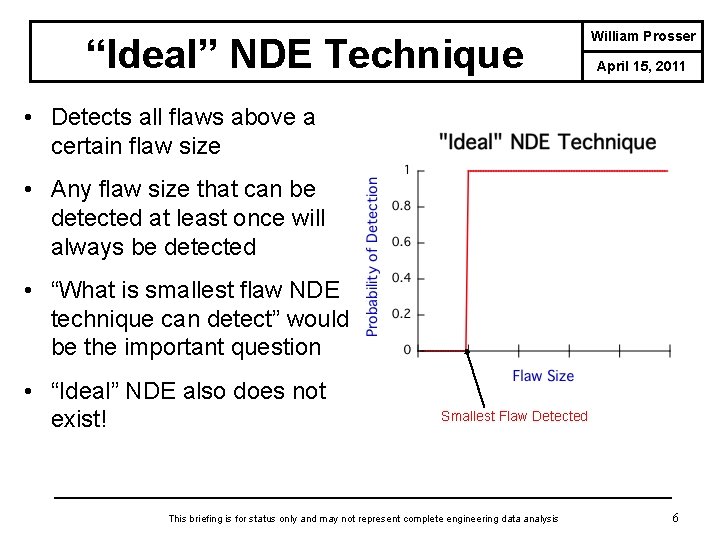
“Ideal” NDE Technique William Prosser April 15, 2011 • Detects all flaws above a certain flaw size • Any flaw size that can be detected at least once will always be detected • “What is smallest flaw NDE technique can detect” would be the important question • “Ideal” NDE also does not exist! Smallest Flaw Detected This briefing is for status only and may not represent complete engineering data analysis 6
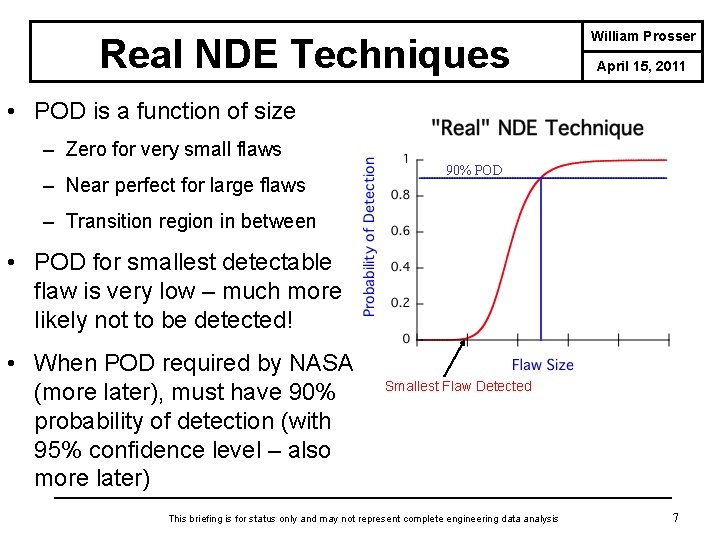
Real NDE Techniques William Prosser April 15, 2011 • POD is a function of size – Zero for very small flaws – Near perfect for large flaws 90% POD – Transition region in between • POD for smallest detectable flaw is very low – much more likely not to be detected! • When POD required by NASA (more later), must have 90% probability of detection (with 95% confidence level – also more later) Smallest Flaw Detected This briefing is for status only and may not represent complete engineering data analysis 7

How is POD Used? William Prosser April 15, 2011 • All real materials and structures have flaws • For fracture critical components, materials/structural engineers must calculate an “critical flaw size” – Function of material properties, structural geometry, operating environment (loads, temperature, etc. ), planned lifetime, etc. – Conservative assumptions (e. g. multiple estimated lifetimes) • NDE used to ensure that no flaws are present that are of this critical size or larger – Flaw size detection capability established by POD – Must be equal to or less than critical flaw size • Results in low probability that flaws exist in material or structure that will grow to failure -> SAFETY This briefing is for status only and may not represent complete engineering data analysis 8
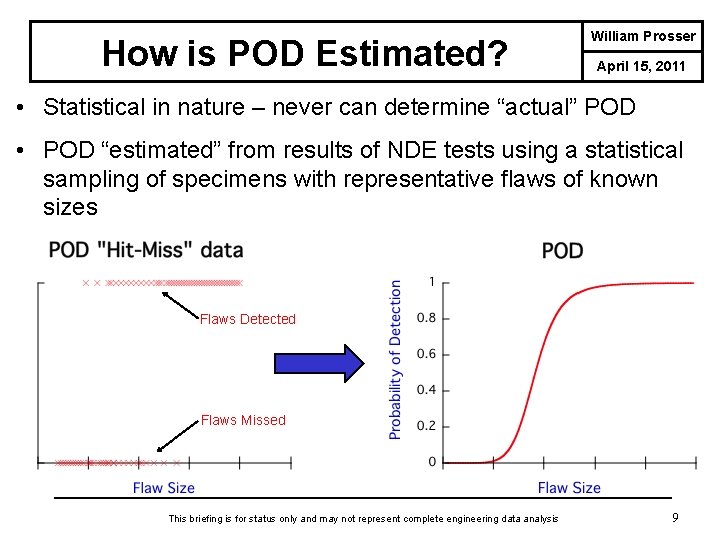
How is POD Estimated? William Prosser April 15, 2011 • Statistical in nature – never can determine “actual” POD • POD “estimated” from results of NDE tests using a statistical sampling of specimens with representative flaws of known sizes Flaws Detected Flaws Missed This briefing is for status only and may not represent complete engineering data analysis 9
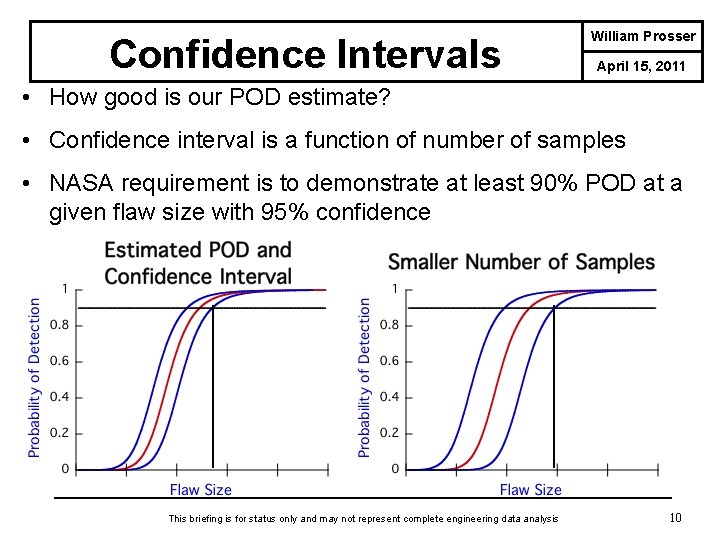
Confidence Intervals William Prosser April 15, 2011 • How good is our POD estimate? • Confidence interval is a function of number of samples • NASA requirement is to demonstrate at least 90% POD at a given flaw size with 95% confidence This briefing is for status only and may not represent complete engineering data analysis 10
Two Methods William Prosser April 15, 2011 • Full POD (MIL-HDBK-1823 A 2009 Nondestructive Evaluation System Reliability Assessment) – Larger number of test flaws whose flaw sizes are distributed over range from not detectable to readily detectable – Perform testing and generate estimate of POD curve – Determine estimated flaw size for 90% POD with 95% confidence – Provides minimum flaw size with required capability • Point Estimate (Materials Evaluation, Vol. 40, No. 9, pp 922 -932, 1982) – Demonstrate capability is at least 90% POD at a given flaw size with 95% confidence – Smaller number of specimens with nominally same size flaws (and a few larger and smaller flaw sizes to verify detection assumptions) – Binomial statistics provides number of successful detections required for 90/95 demonstration (e. g. 29/29, 45/46 …) – Specified flaw size set in demonstration. Required capability may exist at even smaller flaw sizes This briefing is for status only and may not represent complete engineering data analysis 11
Factors Affecting Capability William Prosser April 15, 2011 • Flaw – Nature, Length, width, depth, location, surface characteristics, etc. • Material – Surface finish, microstructure, product form, physical properties, etc. • Structure – Dimensional variations, geometry, inspection access, etc. • NDE Technique – Probe sensitivity variations, instrument settings, electronic noise, etc. • Operator (Human Factors) – Skills, training, attention to detail, etc. This briefing is for status only and may not represent complete engineering data analysis 12
When is POD Required? William Prosser April 15, 2011 • Primary Agency Guidance – NASA STD-5009 – Nondestructive Evaluation Requirements for Fracture-Critical Metallic Components • Also called out in other Program specific requirements and procurement standards – SD 73 -SH-0082 A Space Shuttle Orbiter Fracture Control Plan – SSP-30558 Fracture Control Requirements for Space Station – ANSI/AIAA S-080 – Metallic Pressure Vessels – ANSI/AIAA S-081 - COPV Metallic Pressure Vessel Liners – NASA-STD-5019 Fracture Control Requirements for Spaceflight Hardware • Check with NDE technical authority for specific program or project This briefing is for status only and may not represent complete engineering data analysis 13
NASA STD-5009 William Prosser April 15, 2011 • Defines requirements for nondestructive evaluation in support of NASA-STD-5019, Fracture Control Requirements for Spaceflight Hardware • Fracture-Critical Hardware, Component, or Part: Classification that assumes that cracks in the hardware, component, or part could lead to a catastrophic failure, an event that results in loss of life, serious personal injury, loss of the manned flight system, or national asset. • Nondestructive inspections of fracture-critical hardware shall detect the initial crack sizes used in the damage tolerance fracture analyses with a capability of 90/95 (90 percent probability of detection at a 95 percent confidence level). • Not all components are fracture critical! This briefing is for status only and may not represent complete engineering data analysis 14
NASA STD-5009 William Prosser April 15, 2011 • Two NASA NDE Classifications – Standard • Limited to the following NDE techniques: eddy current, fluorescent penetrant, magnetic particle, radiography, and ultrasonics • Established minimum detectable crack sizes • Formal POD demonstration not required, only a calibration on simulated or real crack-like flaws – Special • Flaw sizes smaller than standard established minimum detectable sizes • Includes techniques other than those listed above • Formal 90/95 POD demonstration required by specific inspector(s) that will perform inspection • Can use either point estimate or full POD method This briefing is for status only and may not represent complete engineering data analysis 15
Summary William Prosser April 15, 2011 • POD used to estimate capability of NDE techniques • Many factors affect POD • Two methods for estimating POD: Point estimate and full POD method • When POD required by NASA, must demonstrate 90 percent POD with 95 percent confidence • NASA STD-5009 provides general guidance for when POD required, but also included in other program or procurement specific documents • NASA STD-5009 designates two levels of NDE – Standard – certain methods and established minimum detectable flaw sizes – no formal POD demonstration required – Special – smaller flaw sizes or nonstandard methods – formal POD demonstration required by specific inspector(s) This briefing is for status only and may not represent complete engineering data analysis 16
- Slides: 16