
Introduction to Probability and Statistics Fourteenth Edition Introduction
Introduction to Probability and Statistics Fourteenth Edition Introduction Train Your Brain for Statistics
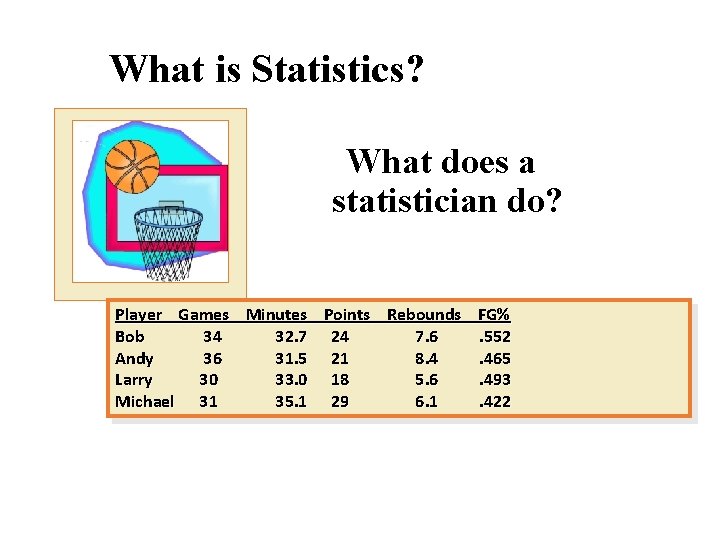
What is Statistics? What does a statistician do? Player Games Minutes Points Rebounds FG% Bob 34 32. 7 24 7. 6. 552 Andy 36 31. 5 21 8. 4. 465 Larry 30 33. 0 18 5. 6. 493 Michael 31 35. 1 29 6. 1. 422
Job of a Statistician • Collects numbers or data • Organizes or arranges the data • Analyzes the data • Infers general conclusions
Uses of Statistics • a theoretical discipline in its own right • a tool for researchers in other fields • used to draw general conclusions in a large variety of applications
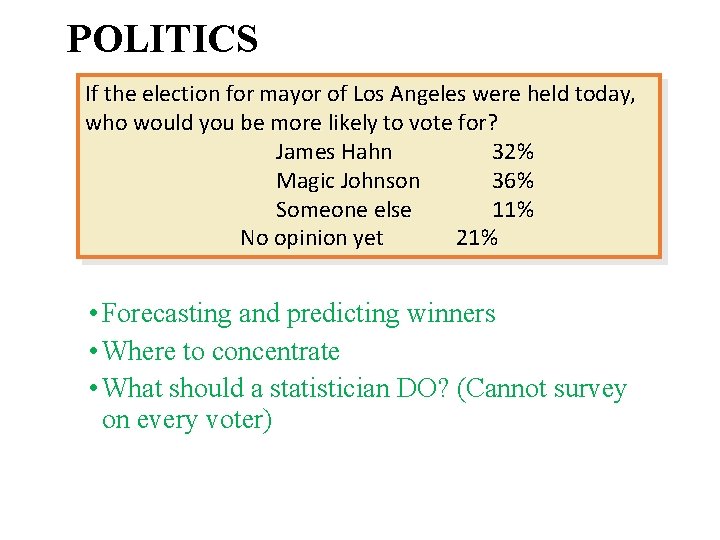
POLITICS If the election for mayor of Los Angeles were held today, who would you be more likely to vote for? James Hahn 32% Magic Johnson 36% Someone else 11% No opinion yet 21% • Forecasting and predicting winners • Where to concentrate • What should a statistician DO? (Cannot survey on every voter)
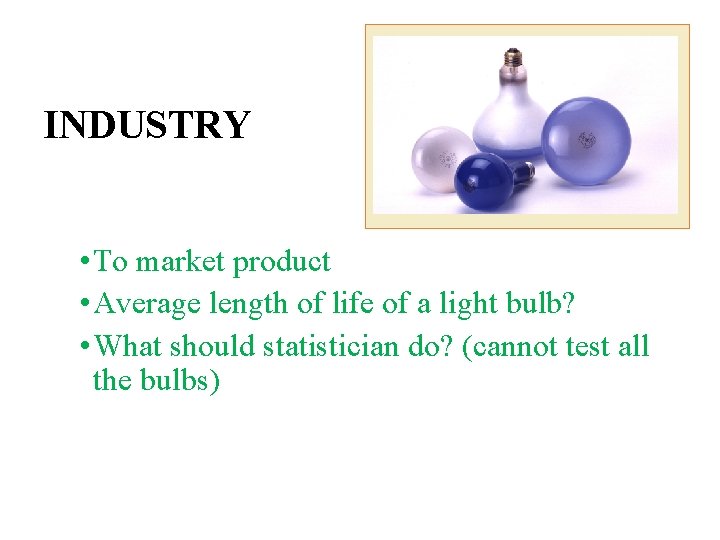
INDUSTRY • To market product • Average length of life of a light bulb? • What should statistician do? (cannot test all the bulbs)
Solution • Collect a smaller set of measurements that will (hopefully) be representative of the whole set. • POPULATION: set of all measurements • SAMPLE: A subset of population
Definitions Variable is a characteristic that changes or varies over time and/or for different individuals or objects under consideration Experimental Units are items or objects on which measurements are taken Measurement results when a variable is actually measured on an experimental unit Population is the WHOLE set of all possible measurements Sample is a subset of population
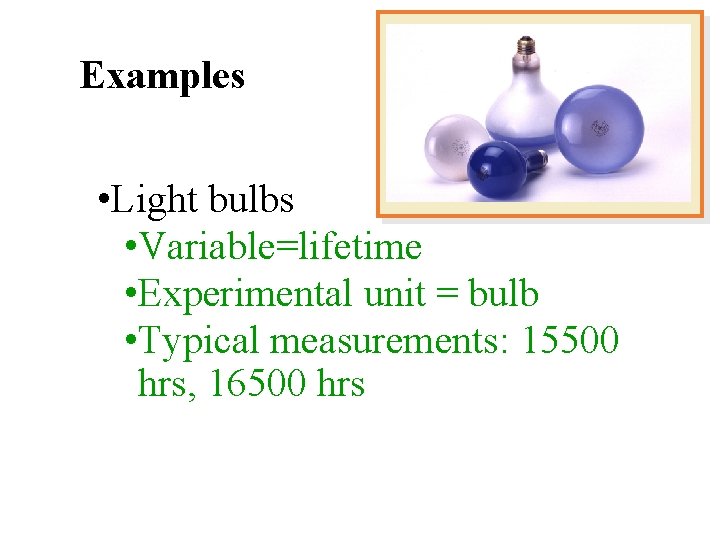
Examples • Light bulbs • Variable=lifetime • Experimental unit = bulb • Typical measurements: 15500 hrs, 16500 hrs
Examples • Opinion polls • Variable = opinion • Experimental unit = person • Typical Measurements = Magic Johnson, someone else
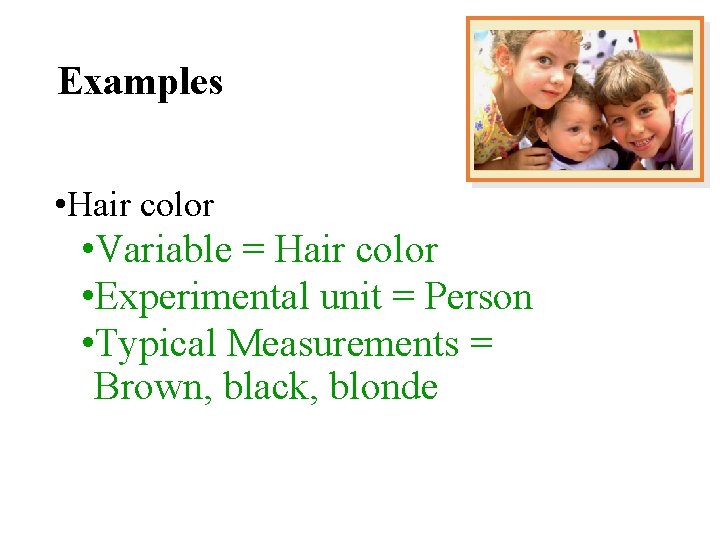
Examples • Hair color • Variable = Hair color • Experimental unit = Person • Typical Measurements = Brown, black, blonde
Descriptive Statistics • When we can enumerate whole population, We use • DESCRIPTIVE STATISTICS: Procedures used to summarize and describe the set of measurements.
Inferential Statistics • When we cannot enumerate the whole population, we use • INFERENTIAL STATISTICS: Procedures used to draw conclusions or inferences about the population from information contained in the sample.
Objective of Inferential Statistics • To make inferences about a population from information contained in a sample. • The statistician’s job is to find the best way to do this.
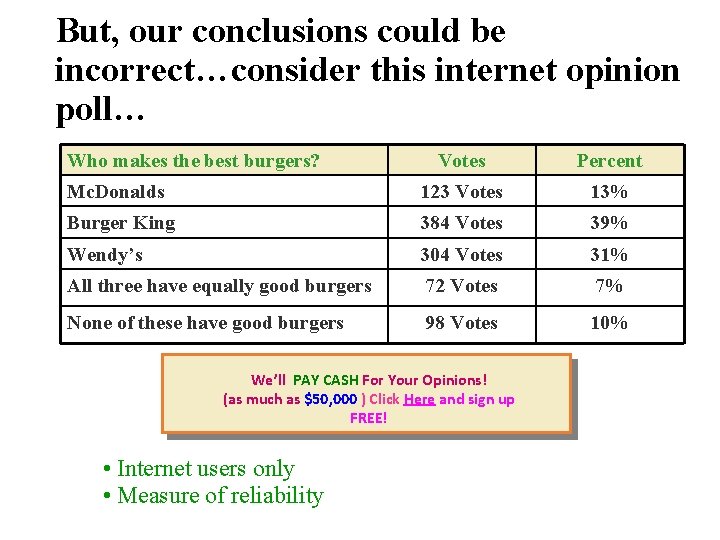
But, our conclusions could be incorrect…consider this internet opinion poll… Who makes the best burgers? Votes Percent Mc. Donalds 123 Votes 13% Burger King 384 Votes 39% Wendy’s 304 Votes 31% All three have equally good burgers 72 Votes 7% None of these have good burgers 98 Votes 10% We’ll PAY CASH For Your Opinions! (as much as $50, 000 ) Click Here and sign up FREE! • Internet users only • Measure of reliability
The Steps in Inferential Statistics • Define the objective of the experiment and the population of interest • Determine the design of the experiment and the sampling plan to be used • Collect and analyze the data • Make inferences about the population from information in the sample • Determine the goodness or reliability of the inference.
Key Words Variable Experimental Unit Population Sample Descriptive Statistics Inferential Statistics
- Slides: 17