
Introduction to Private Health Insurance Ira B Wilson
Introduction to Private Health Insurance Ira B. Wilson, MD, MSc February 3, 2014

Case PHP 310, Spring 2014
Goals • • Moral Hazard Public vs. private insurance Types of private insurance What it costs you What you get How the ACA changes private insurance Important facts about employer based insurance PHP 310, Spring 2014 3
Moral Hazard and Cost Sharing
Definition of Moral Hazard • Moral hazard occurs when a party insulated from financial risk behaves differently than it would behave if it were fully exposed to the financial risk • The “moral” in moral hazard has nothing to do with ethics PHP 310 Spring 2014 5
Key Points about Moral Hazard • When we have insurance we behave differently in ways that may produce utilization than when we do not • When we have insurance we are more likely to utilize health services than when we do not, and the more insurance we have the more we are likely to use PHP 310 Spring 2014 6
Counterbalancing Moral Hazard • Balance or tension • No insurance or poor insurance: little protection against financial losses • Too much or poorly structured insurance: unnecessary or wasteful utilization PHP 310 Spring 2014 7
Cost Sharing • Premium cost sharing, deductables, copays, and coinsurances (book, page 205; more on this Friday) • Attempt to counterbalance the natural tendency to unnecessary utilization by requiring payment at the point of service • Motivate patients to be smart shoppers or to have “skin in the game” PHP 310 Spring 2014 8
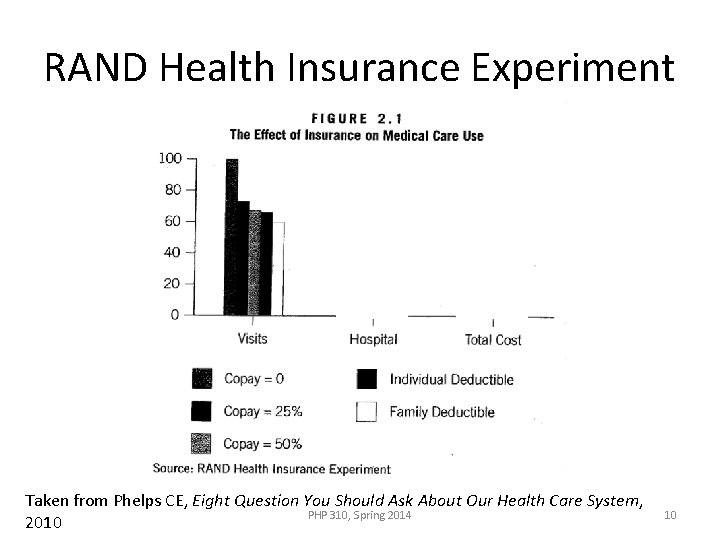
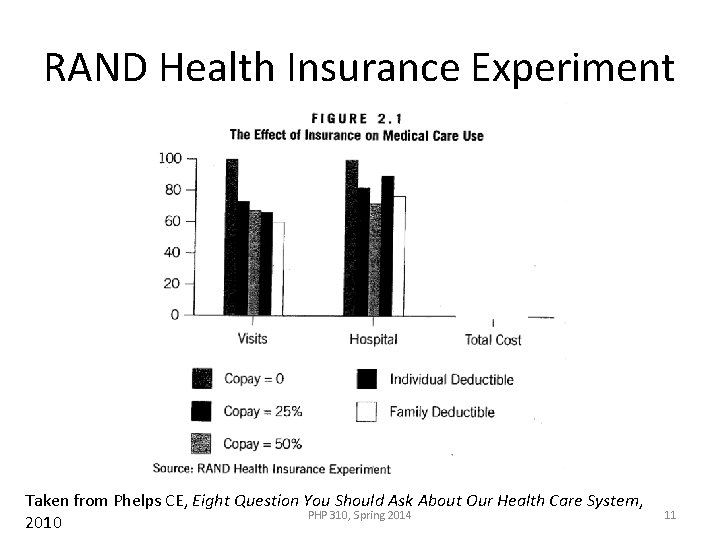
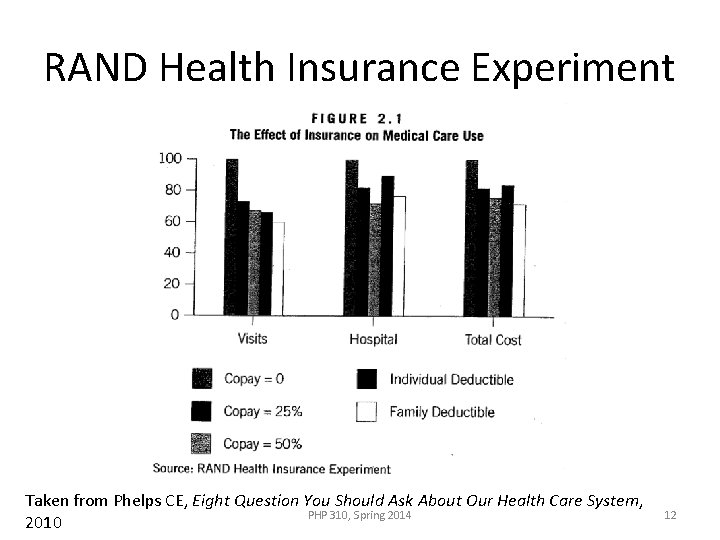
RAND Health Insurance Experiment • Study of the impact of cost sharing on utilization and health outcomes • 1980’s • Patients and families randomized to different levels of cost sharing PHP 310, Spring 2014 9
RAND Health Insurance Experiment Taken from Phelps CE, Eight Question You Should Ask About Our Health Care System, PHP 310, Spring 2014 2010 10
RAND Health Insurance Experiment Taken from Phelps CE, Eight Question You Should Ask About Our Health Care System, PHP 310, Spring 2014 2010 11
RAND Health Insurance Experiment Taken from Phelps CE, Eight Question You Should Ask About Our Health Care System, PHP 310, Spring 2014 2010 12
RAND Health Insurance Experiment • Cost sharing reduced utilization but did not result in worse health outcomes • Medical care demand is price sensitive – but can it be to sensitive? • Case PHP 310, Spring 2014 13
Prices • To be a smart consumer you have to know what the prices of things are • Price transparency has been slow to arrive … but that may start to change quickly PHP 310 Spring 2014 14
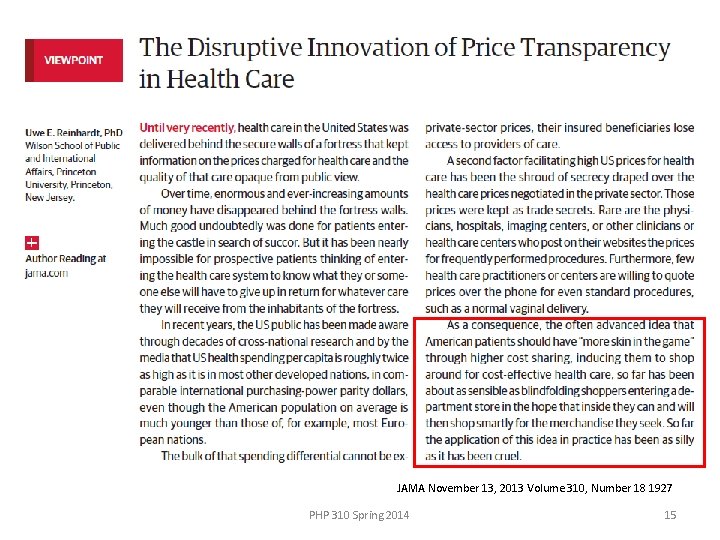
JAMA November 13, 2013 Volume 310, Number 18 1927 PHP 310 Spring 2014 15
Problems with Cost Sharing • Shopping for medical care is not like shopping for groceries; different information asymmetry problem (providers know more than patients) • Medicaid co-pay example • Poor decisions (i. e. , decisions that are not in the self-interest of the medical shopper) are probably common • Soumerai studies from 1980 s* on what medications people stopped taking when Medicaid medication payment strategy changed *Soumerai SB et al. , N Engl J Med. 1987 Aug 27; 317(9): 550 -6 PHP 310 Spring 2014 16
Cost Sharing Balancing Act • On the one hand it works to reduce utilization • On the other hand it does nothing to insure that patients make the right decisions about what utilization to forego • Population impact (RAND HIE) vs. individual impact (case from previous slide) • Current trend: increase patient cost sharing PHP 310 Spring 2014 17
Public vs. Private Insurance
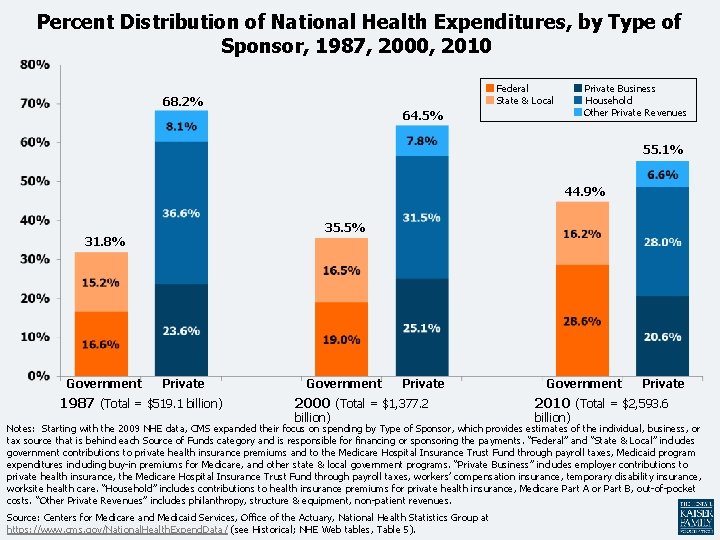
Percent Distribution of National Health Expenditures, by Type of Sponsor, 1987, 2000, 2010 68. 2% 64. 5% Federal Private Business State & Local Household Other Private Revenues 55. 1% 44. 9% 35. 5% 31. 8% Government Private 1987 (Total = $519. 1 billion) Government Private 2000 (Total = $1, 377. 2 billion) Government Private 2010 (Total = $2, 593. 6 billion) Notes: Starting with the 2009 NHE data, CMS expanded their focus on spending by Type of Sponsor, which provides estimates of the individual, business, or tax source that is behind each Source of Funds category and is responsible for financing or sponsoring the payments. “Federal” and “State & Local” includes government contributions to private health insurance premiums and to the Medicare Hospital Insurance Trust Fund through payroll taxes, Medicaid program expenditures including buy-in premiums for Medicare, and other state & local government programs. “Private Business” includes employer contributions to private health insurance, the Medicare Hospital Insurance Trust Fund through payroll taxes, workers’ compensation insurance, temporary disability insurance, worksite health care. “Household” includes contributions to health insurance premiums for private health insurance, Medicare Part A or Part B, out-of-pocket costs. “Other Private Revenues” includes philanthropy, structure & equipment, non-patient revenues. Source: Centers for Medicare and Medicaid Services, Office of the Actuary, National Health Statistics Group at https: //www. cms. gov/National. Health. Expend. Data/ (see Historical; NHE Web tables, Table 5).
Sources by Age Group • Over 65: Virtually all public insurance (Medicare) • Under 65: combination of sources, but majority private PHP 310, Spring 2014 20
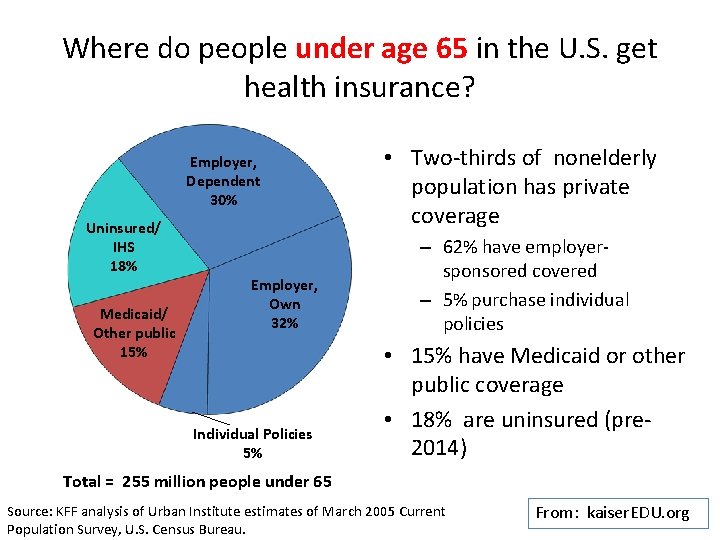
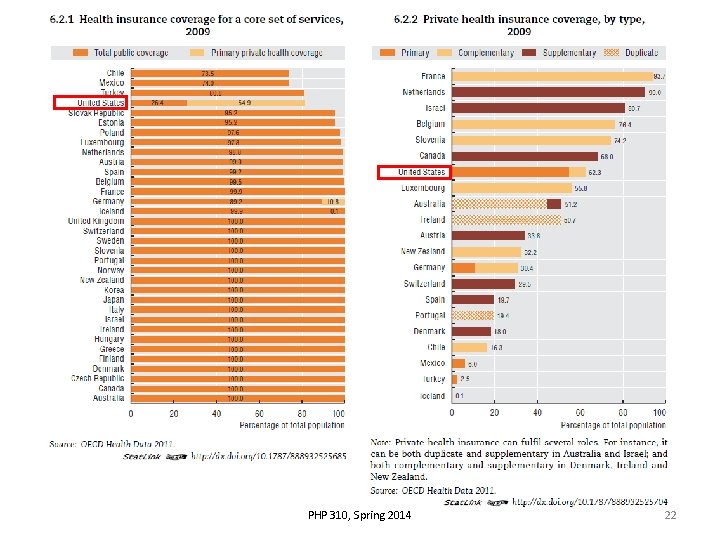
Where do people under age 65 in the U. S. get health insurance? Employer, Dependent 30% Uninsured/ IHS 18% Medicaid/ Other public 15% Employer, Own 32% Individual Policies 5% • Two-thirds of nonelderly population has private coverage – 62% have employersponsored covered – 5% purchase individual policies • 15% have Medicaid or other public coverage • 18% are uninsured (pre 2014) Total = 255 million people under 65 Source: KFF analysis of Urban Institute estimates of March 2005 Current Population Survey, U. S. Census Bureau. From: kaiser. EDU. org
PHP 310, Spring 2014 22
Culture and History • See Ch 3 in textbook • Roots of private insurance in the 1930’s • Long history of distrust of government role in health care • The private health insurance industry is very large and very politically powerful PHP 310, Spring 2014 23
Take Home Messages • Private insurance in the US is critical to solving the health care access puzzle • Likely to remain for the foreseeable future PHP 310, Spring 2014 24
Kinds of Private Insurance PHP 310, Spring 2014
Donna Dubinsky Article She and her family had trouble buying heath insurance because of all of the following except A. Serious pre-existing conditions B. Trivial pre-existing conditions C. High premiums D. High deductibles E. Major paperwork hassles PHP 310, Spring 2014 26
Classification by Size • Employer Sponsored Insurance (ESI; sometimes Employer Based Insurance or EBI); this is group insurance – Large group: generally ≥ 200 employees – Small group: generally < 200 employees • NB: the ACA defines a “small employer” as 2 to 50 employees • Individual PHP 310, Spring 2014 27
Employer Based Insurance Versus Individual Insurance • Risk pooling – The bigger the company the bigger the pool and the more risk is spread – No pooling for individual insurance • Underwriting for groups – Less risky because underwriting focuses on groups not individuals; idea of actuarial stability – Less expensive because you don’t have to assess the risk of each individual PHP 310, Spring 2014 28
Employer Based Insurance Versus Individual Insurance • Less of an adverse selection problem because people didn’t select to join that company because of their health risks • Huge public subsidies because both company and individual contributions to health insurance are tax exempt (>$250 B/year) • Between companies there is experience rating; within a company there is, in effect, community rating PHP 310, Spring 2014 29
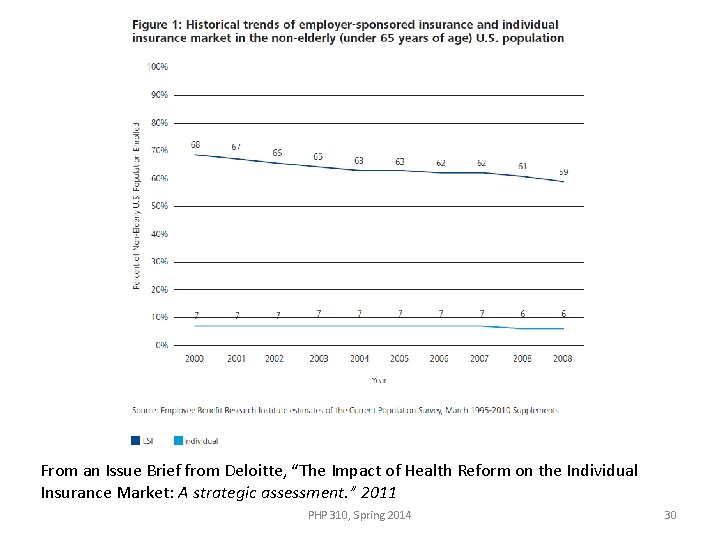
From an Issue Brief from Deloitte, “The Impact of Health Reform on the Individual Insurance Market: A strategic assessment. ” 2011 PHP 310, Spring 2014 30

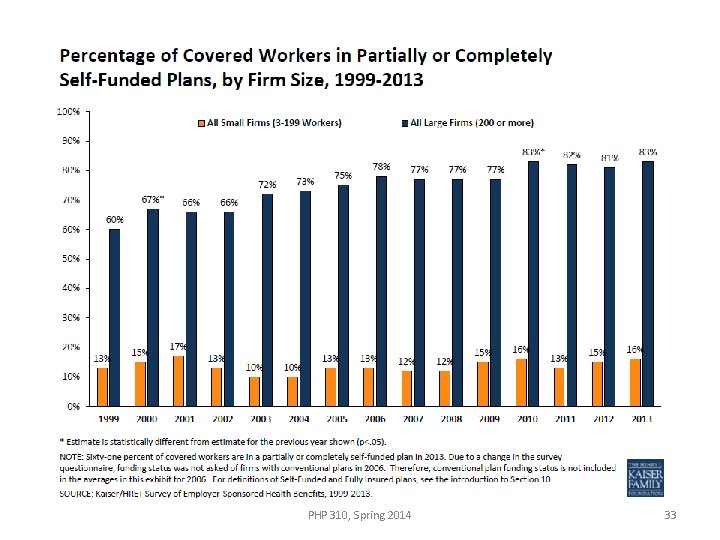
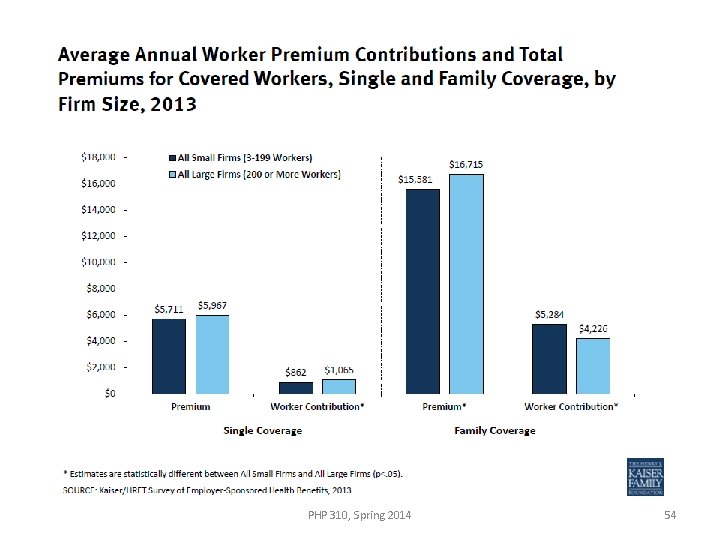
State-licensed vs. Self-insured • State-licensed health insuring organizations or “fully insured” plans – BCBS, Aetna, United Healthcare – Employer pays an premium for each employee, and the plan assumes full insurance risk for employee – Tend to be smaller employers, 3 -199 employee range – 45% of the private insurance market – Regulated by states PHP 310, Spring 2014 31
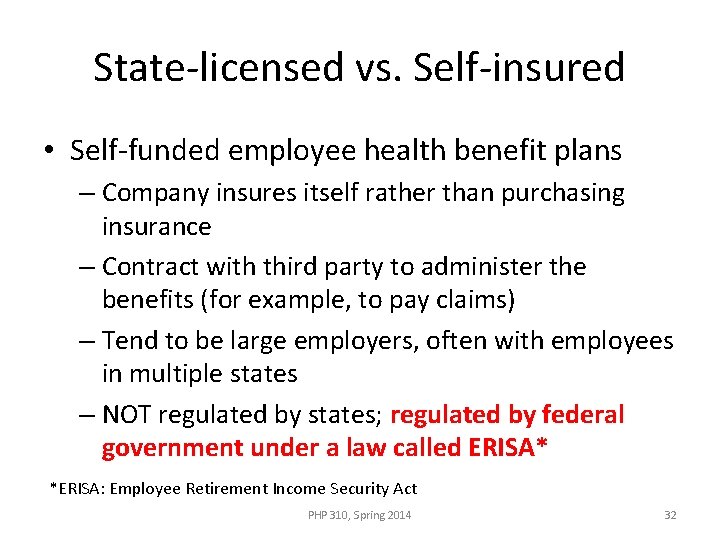
State-licensed vs. Self-insured • Self-funded employee health benefit plans – Company insures itself rather than purchasing insurance – Contract with third party to administer the benefits (for example, to pay claims) – Tend to be large employers, often with employees in multiple states – NOT regulated by states; regulated by federal government under a law called ERISA* *ERISA: Employee Retirement Income Security Act PHP 310, Spring 2014 32
PHP 310, Spring 2014 33
What it Costs You Premiums, Deductibles, Co-pays and Co-Insurance PHP 310, Spring 2014
Key Terms • Premium: amount you pay to purchase insurance – Comes out of your paycheck if you have employer based insurance – Monthly bill if you have individual insurance PHP 310, Spring 2014 35
Key Terms • Premium • Deductible: the amount that an individual or family has to pay out of pocket before insurance takes effect – In the next lecture we will discuss “High deductible health plans” – Very high deductibles can be like “catastrophic coverage” – No deductible = “first dollar coverage” PHP 310, Spring 2014 36
Key Terms • Premium • Deductible • Co-pay: a fixed amount that the insured person has to pay at the time a service is provided – Office visit co-pay might be $15 or $20 – Emergency Department visit might be $75 or more PHP 310, Spring 2014 37
Key Terms • • Premium Deductible Co-pay Co-insurance: a fraction of the cost of a service that the insured person has to pay – Co-insurance for a hospital stay might be 25% PHP 310, Spring 2014 38
Key Terms • • • Premium Deductible Co-pay Co-insurance NB: even if you have insurance … total out of pocket costs (the sum of all of the above) can really add up PHP 310, Spring 2014 39
What You Get Benefits PHP 310, Spring 2014
ACA: Essential Health Benefits 1. 2. 3. 4. 5. 6. 7. 8. 9. Ambulatory patient services Emergency services Hospitalization Maternity and newborn care Mental health and substance use disorder services including behavioral health treatment Prescription drugs Rehabilitative and habilitative services and devices Preventive and wellness services and chronic disease management Pediatric services, including vision and dental care PHP 310, Spring 2014 41
Benefits Before the ACA • Variation in what was covered • Variation in how and to what extent it was covered • Exclusions for pre-existing conditions • Yearly and life-time spending caps • Variable coverage of medications • Variable coverage of mental health and substance abuse disorders • Part time workers often not covered PHP 310, Spring 2014 42
How the ACA Changes Private Insurance PHP 310, Spring 2014
How ACA Changes Things • Guaranteed issue: require insurers to accept all applicants in individual and group markets, regardless of health status, occupation, or other risk factors PHP 310, Spring 2014 44
How ACA Changes Things • Guaranteed issue • Guaranteed renewability – Renewable at the policyholder’s discretion – Exceptions nonpayment or late payment of premiums, for an act of fraud by the policyholder, or for other limited reasons PHP 310, Spring 2014 45
How ACA Changes Things • Guaranteed issue • Guaranteed renewability • Modified community rating – Adjustments allowed for family coverage, geography, age, and tobacco use – No adjustments permitted for pre-existing conditions, occupation, gender, duration of coverage, credit worthiness – 3: 1 variation in 21 -64 age group allowed PHP 310, Spring 2014 46
How ACA Changes Things • • Guaranteed issue Guaranteed renewability Modified community rating Single risk pool: claims experiences of all enrollees in individual plans pooled; reduces risk that sicker people will pay higher premiums PHP 310, Spring 2014 47
How ACA Changes Things • • • Guaranteed issue Guaranteed renewability Modified community rating Single risk pool Required coverage of “Essential Health Benefits” PHP 310, Spring 2014 48
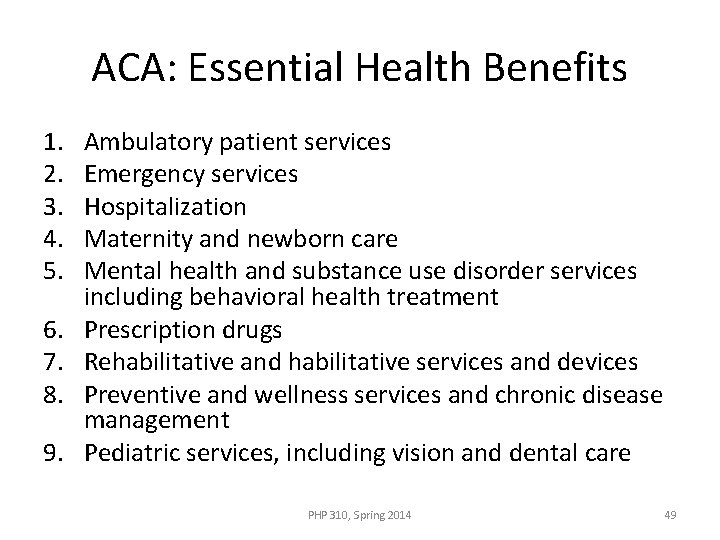
ACA: Essential Health Benefits 1. 2. 3. 4. 5. 6. 7. 8. 9. Ambulatory patient services Emergency services Hospitalization Maternity and newborn care Mental health and substance use disorder services including behavioral health treatment Prescription drugs Rehabilitative and habilitative services and devices Preventive and wellness services and chronic disease management Pediatric services, including vision and dental care PHP 310, Spring 2014 49
How ACA Changes Things • • • Guaranteed issue Guaranteed renewability Modified community rating Single risk pool Required coverage of “Essential Health Benefits” Medical Loss Ratio (p 336 in textbook): requirement that 80% of premium dollars in individual market be spend on care and quality improvement PHP 310, Spring 2014 50
Important Facts about Employer Based Insurance PHP 310, Spring 2014
PHP 310, Spring 2014 52
PHP 310, Spring 2014 53
PHP 310, Spring 2014 54
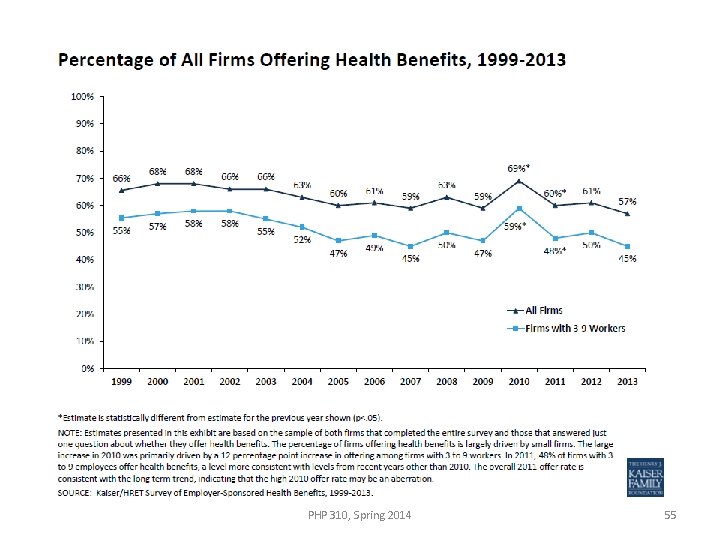
PHP 310, Spring 2014 55
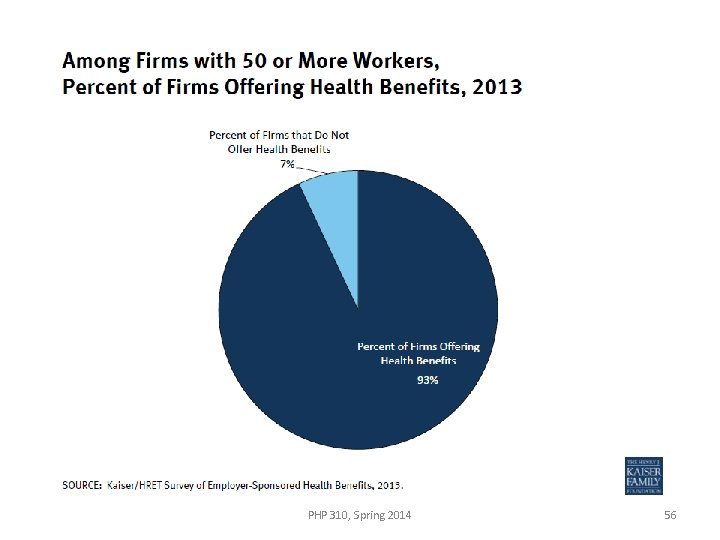
PHP 310, Spring 2014 56
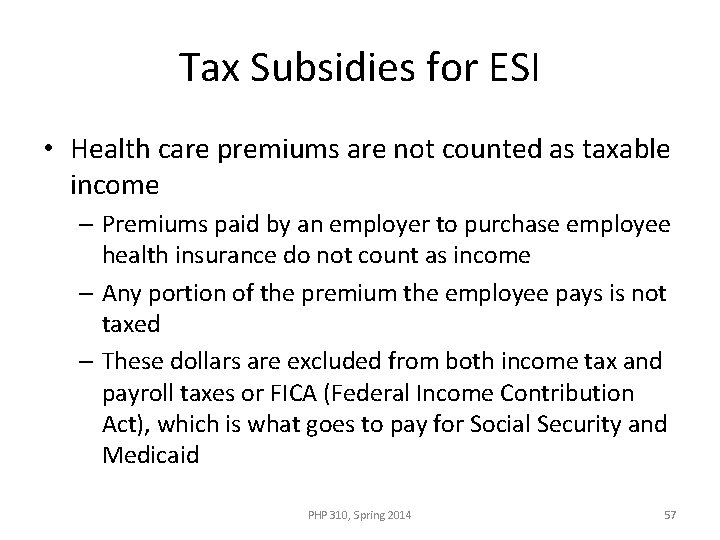
Tax Subsidies for ESI • Health care premiums are not counted as taxable income – Premiums paid by an employer to purchase employee health insurance do not count as income – Any portion of the premium the employee pays is not taxed – These dollars are excluded from both income tax and payroll taxes or FICA (Federal Income Contribution Act), which is what goes to pay for Social Security and Medicaid PHP 310, Spring 2014 57
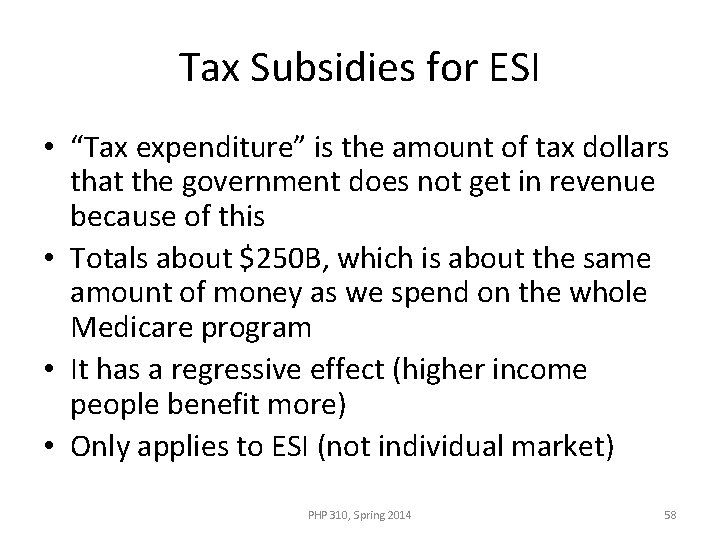
Tax Subsidies for ESI • “Tax expenditure” is the amount of tax dollars that the government does not get in revenue because of this • Totals about $250 B, which is about the same amount of money as we spend on the whole Medicare program • It has a regressive effect (higher income people benefit more) • Only applies to ESI (not individual market) PHP 310, Spring 2014 58
Policy Issues • These deductions reduce government revenues • Contributes to over utilization (moral hazard) • See excellent David Brooks NYT editorial PHP 310, Spring 2014 59
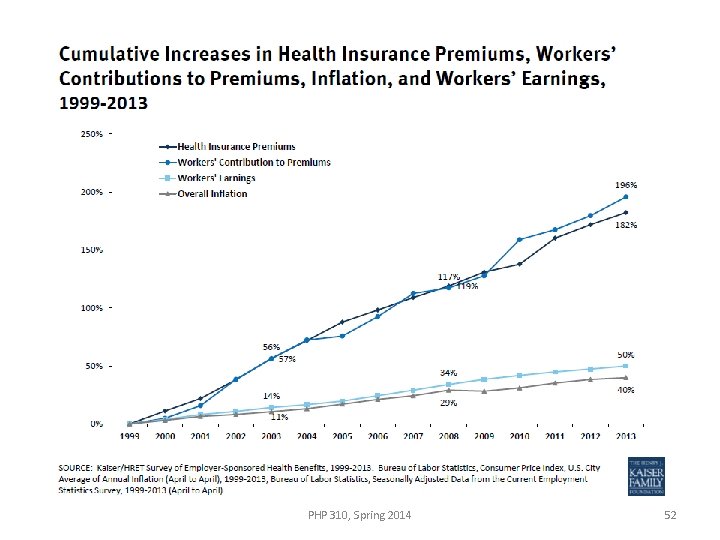
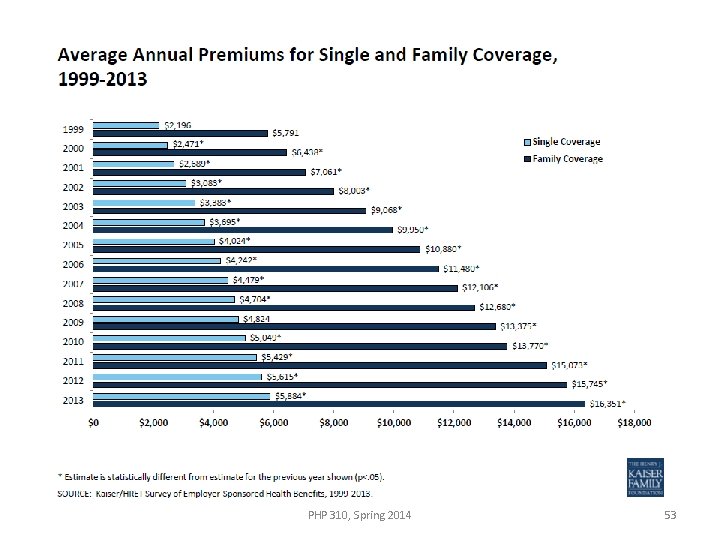
Take Home Messages • Private insurance is a critical component of the health care “system”, and covers more than 50% of Americans under 65 • Employer based and individual • Large companies tend to “self insure” • Premiums, deductibles, co-pays and coinsurance • Costs of private insurance are rising PHP 310, Spring 2014 60
Take Home Messages • ACA makes fundamental changes in private insurance – stabilize private insurance – eliminate what are perceived as unfair practices (e. g. , excluding those with pre-existing conditions) • Federal government provides large and regressive subsidies to ESI through tax policies PHP 310, Spring 2014 61
- Slides: 61