
Introduction to Precalculus Period 1 Session 1 What


- Slides: 10
Introduction to Precalculus Period 1 Session 1
What is Calculus?
Precalculus I already know trig and algebra, can I just do Calculus now? Precalculus builds on the knowledge of algebra and trigonometry to make the transition much easier In Precalculus, you will learn important concepts used in Calculus while honing your problem solving skills
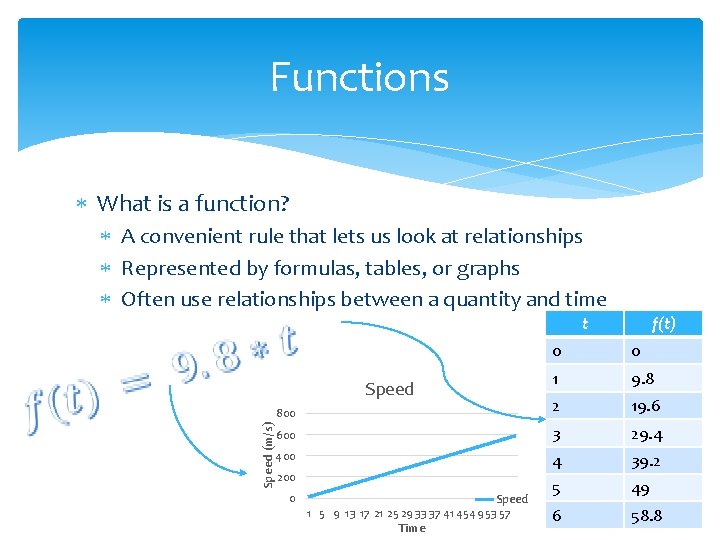
Functions What is a function? A convenient rule that lets us look at relationships Represented by formulas, tables, or graphs Often use relationships between a quantity and time t 0 0 1 9. 8 800 2 19. 6 600 3 29. 4 400 4 39. 2 5 49 6 58. 8 Speed (m/s) f(t) 200 0 Speed 1 5 9 13 17 21 25 29 33 37 41 4549 53 57 Time
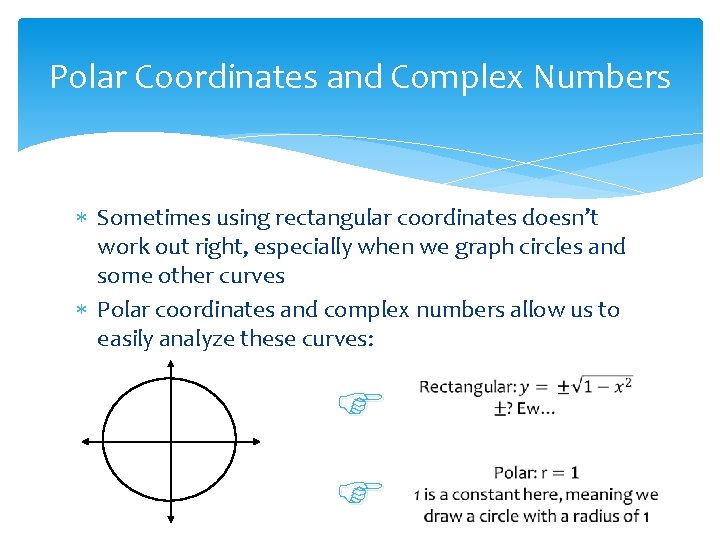
Polar Coordinates and Complex Numbers Sometimes using rectangular coordinates doesn’t work out right, especially when we graph circles and some other curves Polar coordinates and complex numbers allow us to easily analyze these curves:
Parametric Equations When you aren’t working with circles, equations can still be hard to figure out with rectangular and polar coordinates We can express x and y as functions of a new variable (usually time) to make analysis easy! It also provides direction of motion, kind of like a map
Exponential and Logarithmic Functions We use exponential functions to describe things that grow much more quickly (or shrink!) as time goes on. Think population: with every generation, the offspring outnumber the parents, and soon they will become parents. The way this changes would be very nice to know! A logarithmic function on the other hand grows much more slowly as the input increases. Suppose you cram study for an hour. The amount information you forget after you finish is logarithmically related to time, because you forget most of it right after you finish “re-learning”.
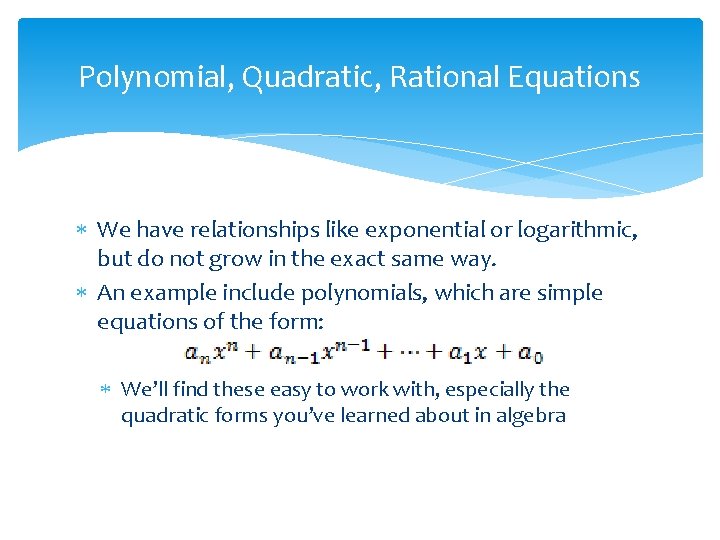
Polynomial, Quadratic, Rational Equations We have relationships like exponential or logarithmic, but do not grow in the exact same way. An example include polynomials, which are simple equations of the form: We’ll find these easy to work with, especially the quadratic forms you’ve learned about in algebra
Polynomial, Quadratic, Rational Equations A quotient of polynomials (rational equations) becomes a different story, but we’ll figure out how those work out, especially where the break occurs (we’ll call it an asymptote).
Conclusion Throughout the course of the semester, we’ll cover material relevant to Calculus such as: Understanding functions Understanding several different types of functions Finding new ways to visualize and interpret functions Each of these will help us become more analytically sound and more well prepared once Calculus rolls around