
Introduction to PPP Sharon Katz History n Dialup

- Slides: 28
Introduction to PPP Sharon Katz
History n Dial-up file transfer protocol n Early 80`s: PC users begin to communicate Dial-up networking through fileworld transfer protocols: In the unix TCP/IP vs. file transfer protocols n X-Modem Telecommunication technologies: protocols §n Y-Modem Local networks: Asymetric 3 MB and 10 MB ethernets. §n Z-Modem Distance communication: Leased lines Primitive dial-up modems
History n Using dial-up modems for packet-orientednetworking (I. e connecting to the internet) requires a data-link layer protocol n widely-spread protocols: n SLIP n PPP
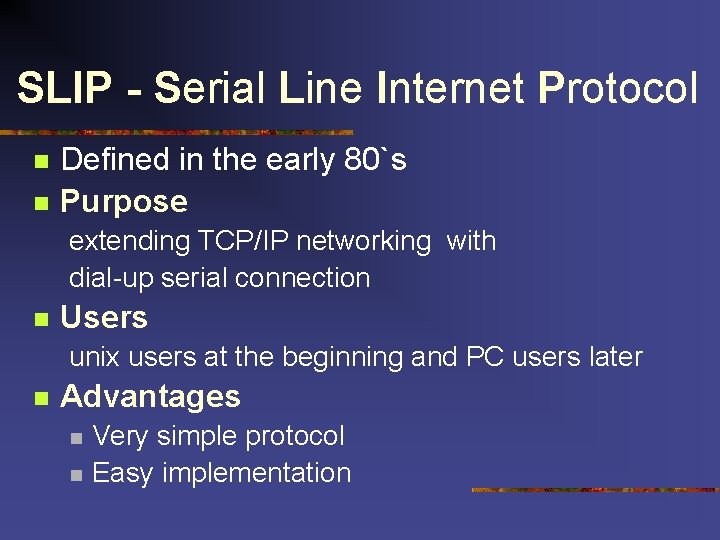
SLIP - Serial Line Internet Protocol n n Defined in the early 80`s Purpose extending TCP/IP networking with dial-up serial connection n Users unix users at the beginning and PC users later n Advantages n n Very simple protocol Easy implementation
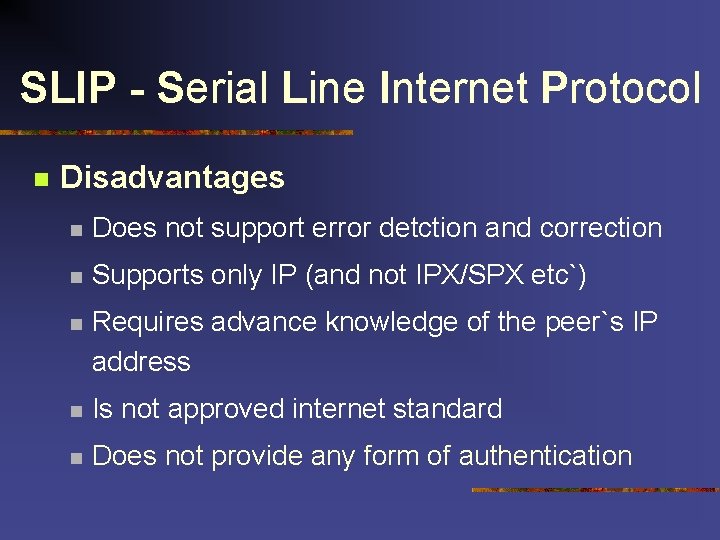
SLIP - Serial Line Internet Protocol n Disadvantages n Does not support error detction and correction n Supports only IP (and not IPX/SPX etc`) n Requires advance knowledge of the peer`s IP address n Is not approved internet standard n Does not provide any form of authentication
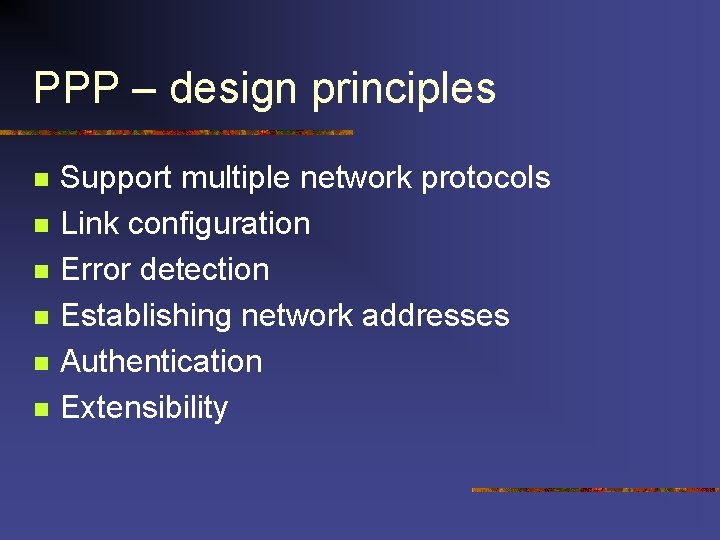
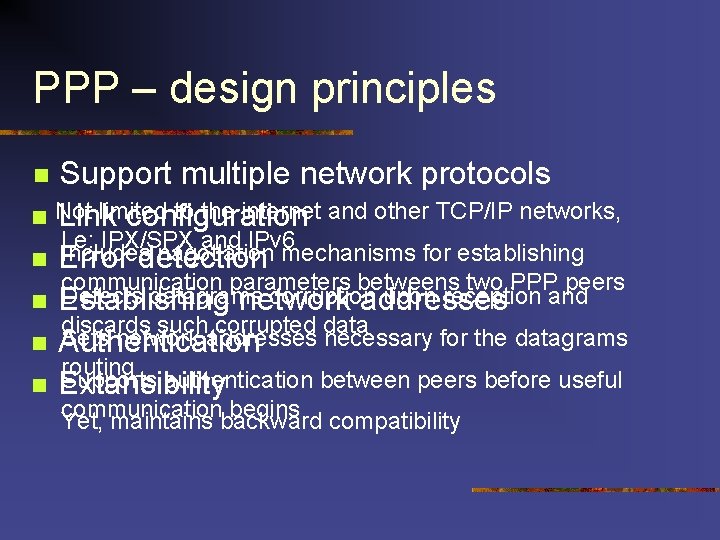
PPP – design principles n n n Support multiple network protocols Link configuration Error detection Establishing network addresses Authentication Extensibility
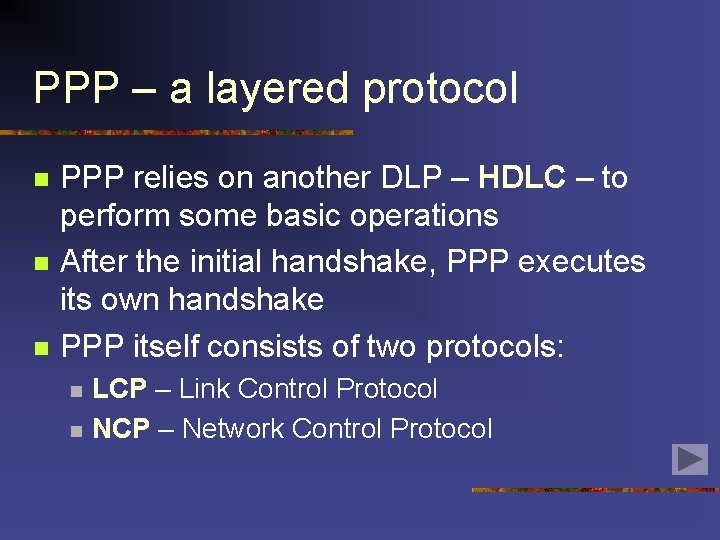
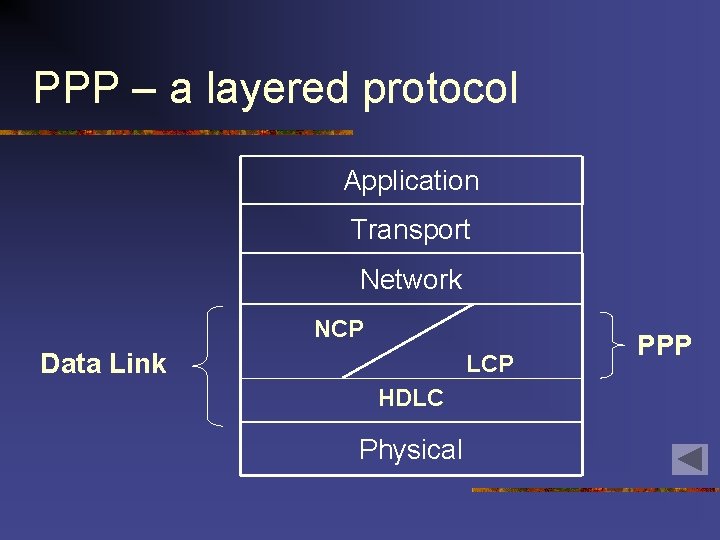
PPP – a layered protocol n n n PPP relies on another DLP – HDLC – to perform some basic operations After the initial handshake, PPP executes its own handshake PPP itself consists of two protocols: n n LCP – Link Control Protocol NCP – Network Control Protocol
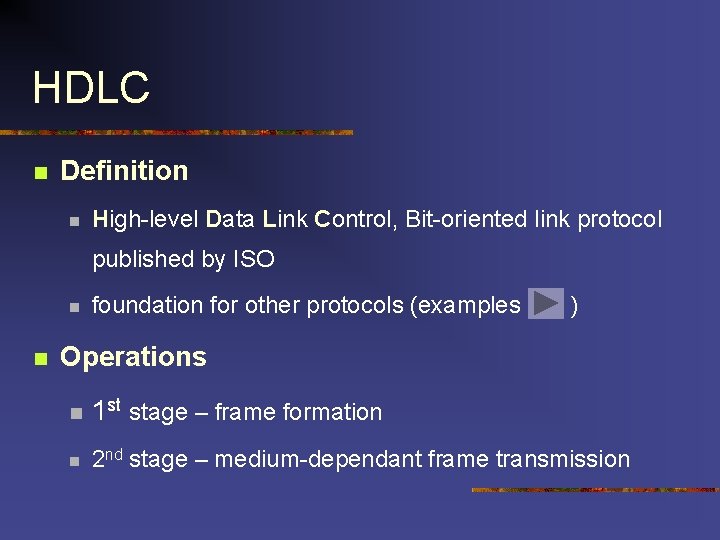
HDLC n Definition n High-level Data Link Control, Bit-oriented link protocol published by ISO n n foundation for other protocols (examples ) Operations n 1 st stage – frame formation n 2 nd stage – medium-dependant frame transmission
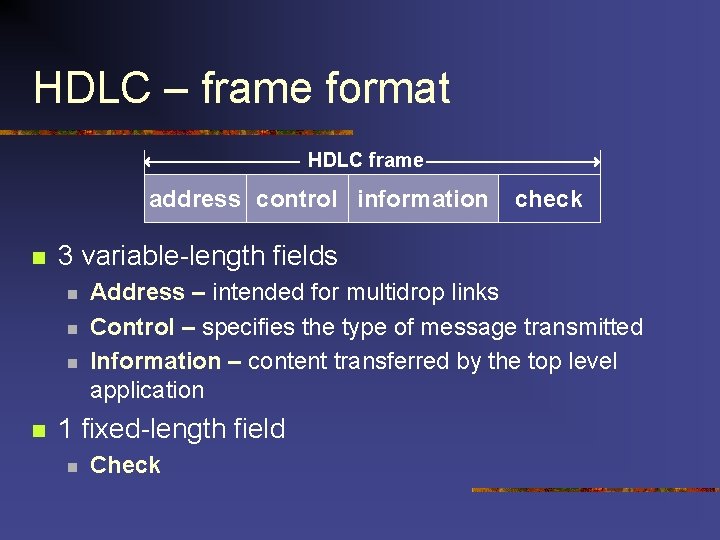
HDLC – frame format HDLC frame address control information n 3 variable-length fields n n check Address – intended for multidrop links Control – specifies the type of message transmitted Information – content transferred by the top level application 1 fixed-length field n Check
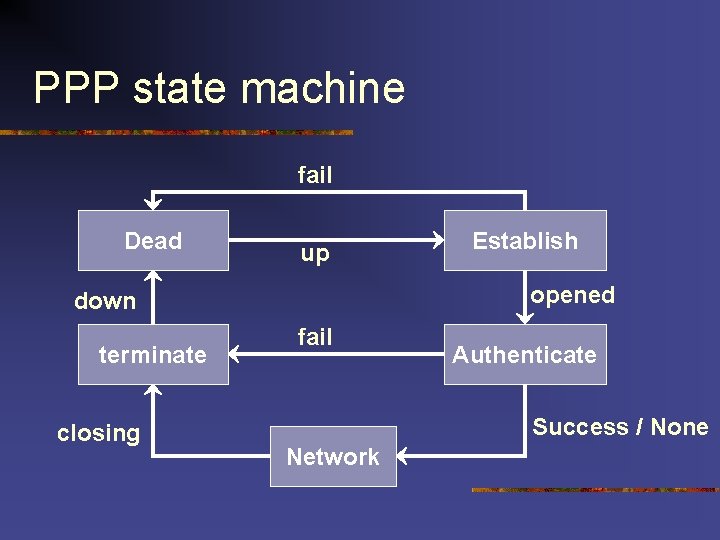
PPP state machine n Establishing PPP communication requires transitioning a connection through several states n Some of these operations are done by LCP and some by NCP
PPP state machine fail Dead up opened down terminate closing Establish fail Authenticate Success / None Network
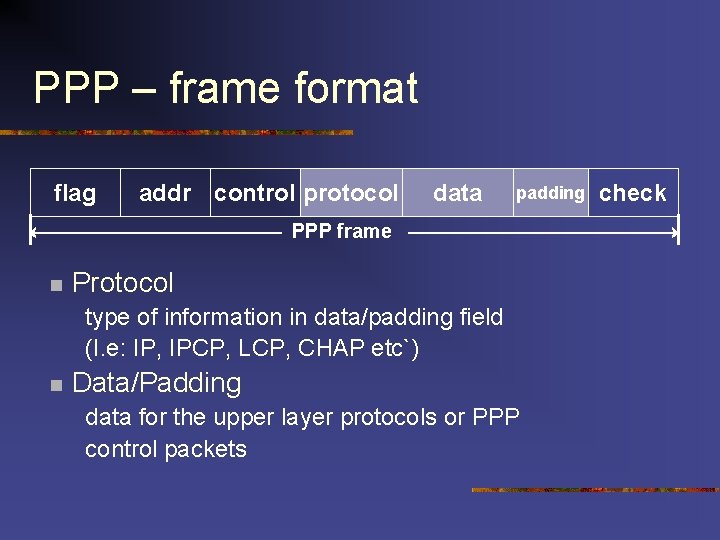
PPP – frame format flag addr control protocol data padding PPP frame n Protocol type of information in data/padding field (I. e: IP, IPCP, LCP, CHAP etc`) n Data/Padding data for the upper layer protocols or PPP control packets check
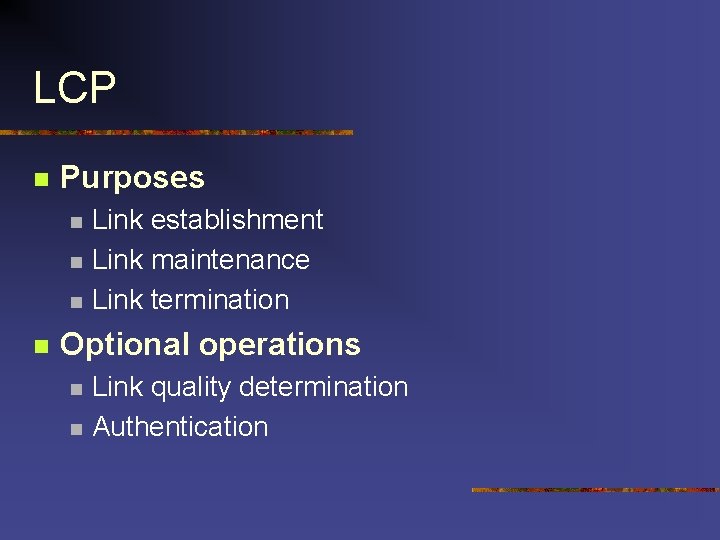
LCP n Purposes n n Link establishment Link maintenance Link termination Optional operations n n Link quality determination Authentication
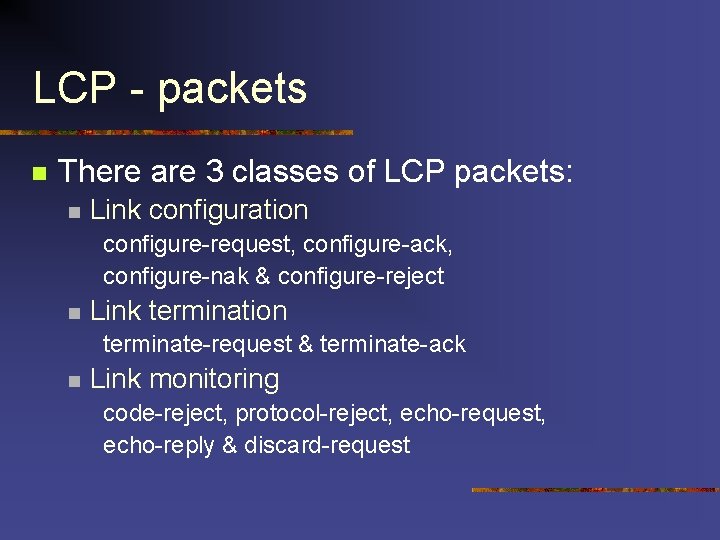
LCP - packets n There are 3 classes of LCP packets: n Link configuration configure-request, configure-ack, configure-nak & configure-reject n Link termination terminate-request & terminate-ack n Link monitoring code-reject, protocol-reject, echo-request, echo-reply & discard-request
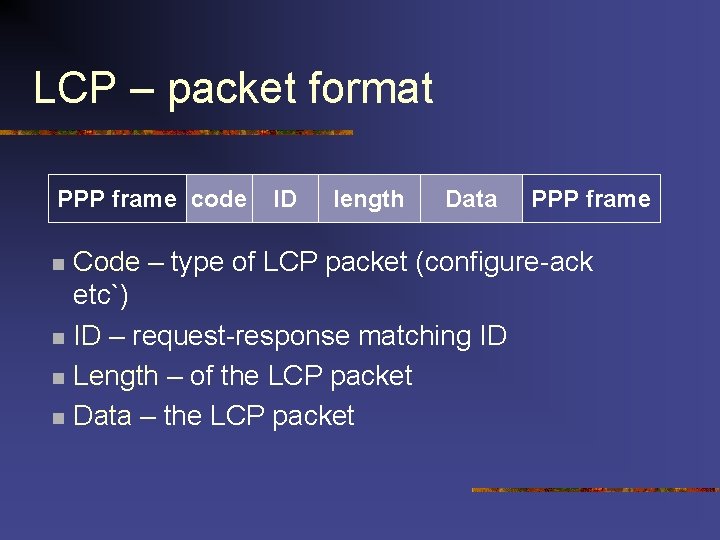
LCP – packet format PPP frame code n n ID length Data PPP frame Code – type of LCP packet (configure-ack etc`) ID – request-response matching ID Length – of the LCP packet Data – the LCP packet
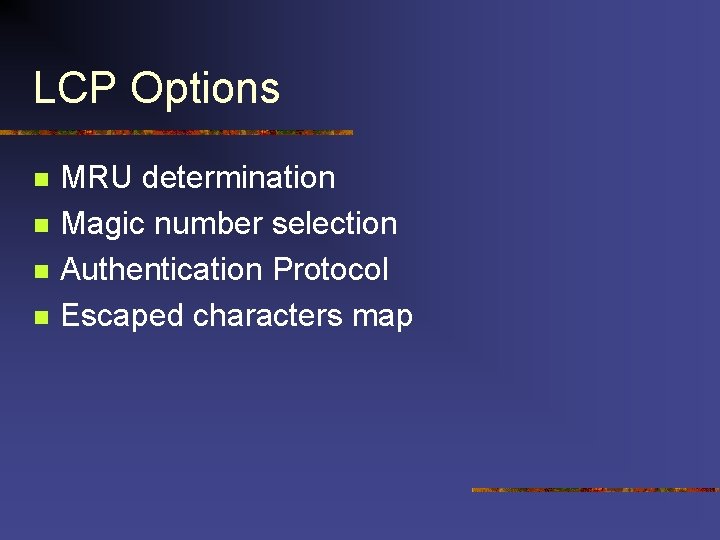
LCP Options n n MRU determination Magic number selection Authentication Protocol Escaped characters map
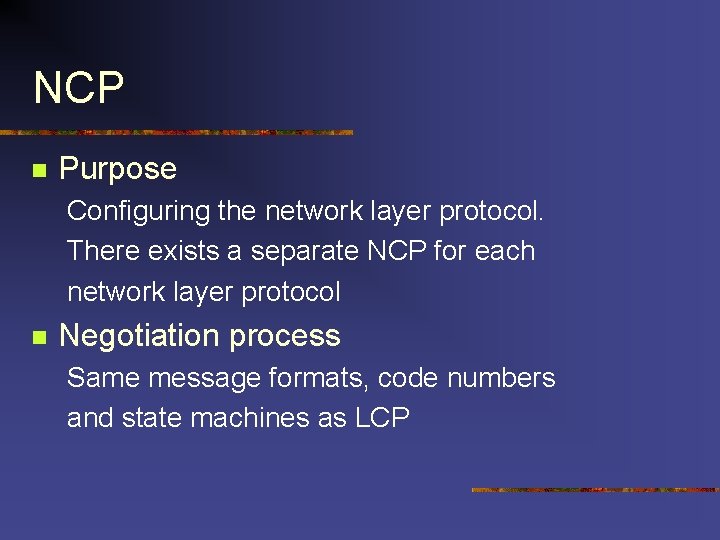
NCP n Purpose Configuring the network layer protocol. There exists a separate NCP for each network layer protocol n Negotiation process Same message formats, code numbers and state machines as LCP
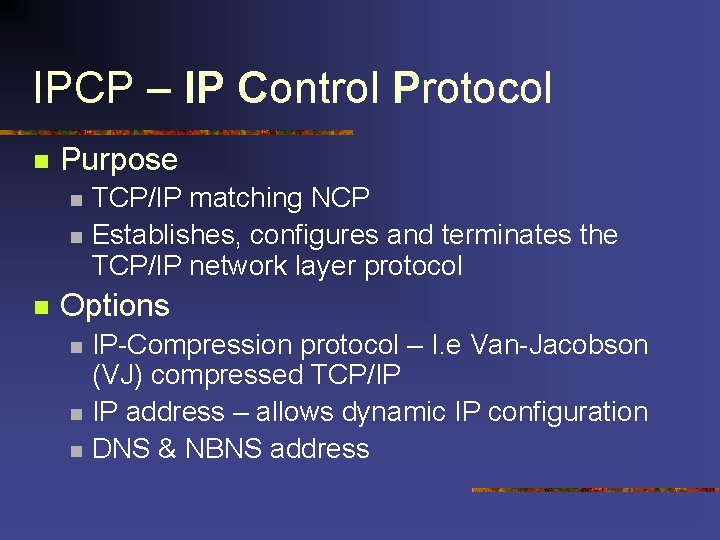
IPCP – IP Control Protocol n Purpose n n n TCP/IP matching NCP Establishes, configures and terminates the TCP/IP network layer protocol Options n n n IP-Compression protocol – I. e Van-Jacobson (VJ) compressed TCP/IP IP address – allows dynamic IP configuration DNS & NBNS address
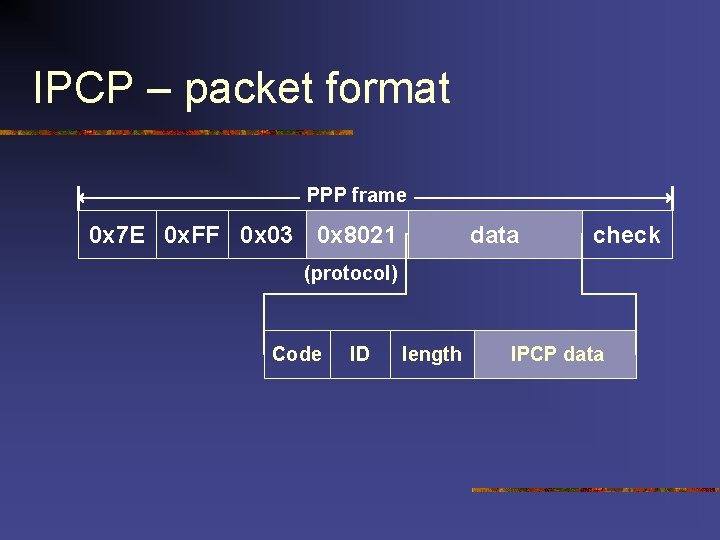
IPCP – packet format PPP frame 0 x 7 E 0 x. FF 0 x 03 0 x 8021 data check (protocol) Code ID length IPCP data
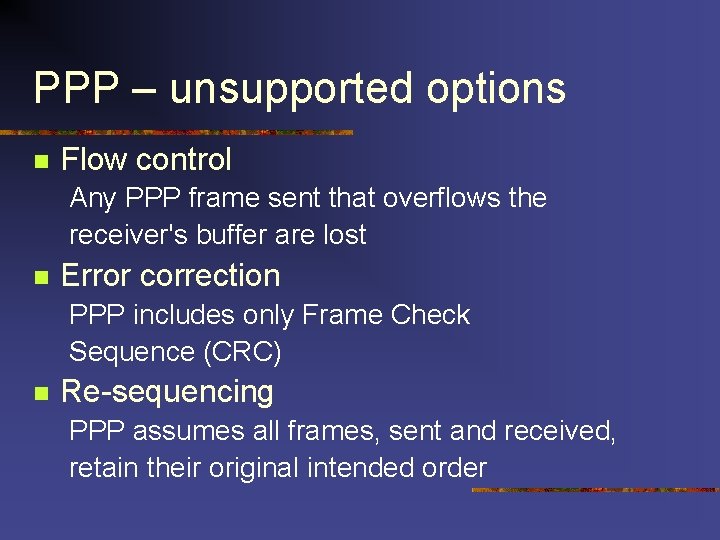
PPP – unsupported options n Flow control Any PPP frame sent that overflows the receiver's buffer are lost n Error correction PPP includes only Frame Check Sequence (CRC) n Re-sequencing PPP assumes all frames, sent and received, retain their original intended order
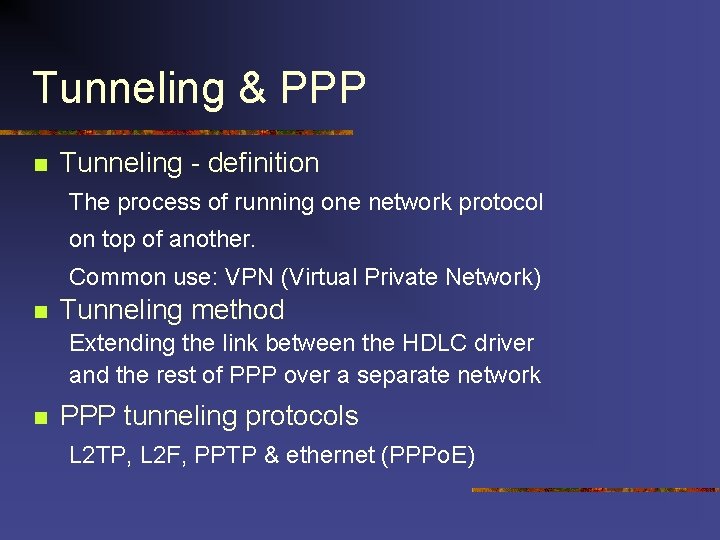
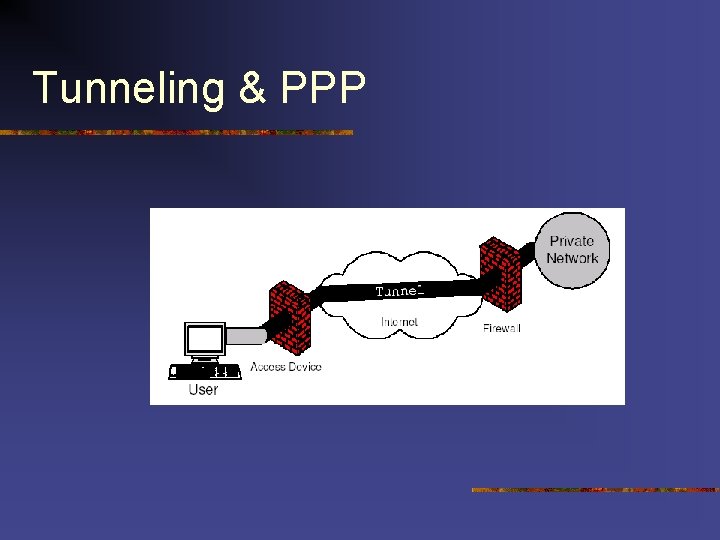
Tunneling & PPP n Tunneling - definition The process of running one network protocol on top of another. Common use: VPN (Virtual Private Network) n Tunneling method Extending the link between the HDLC driver and the rest of PPP over a separate network n PPP tunneling protocols L 2 TP, L 2 F, PPTP & ethernet (PPPo. E)
Tunneling & PPP
THE MIDDLE Next: PPP security
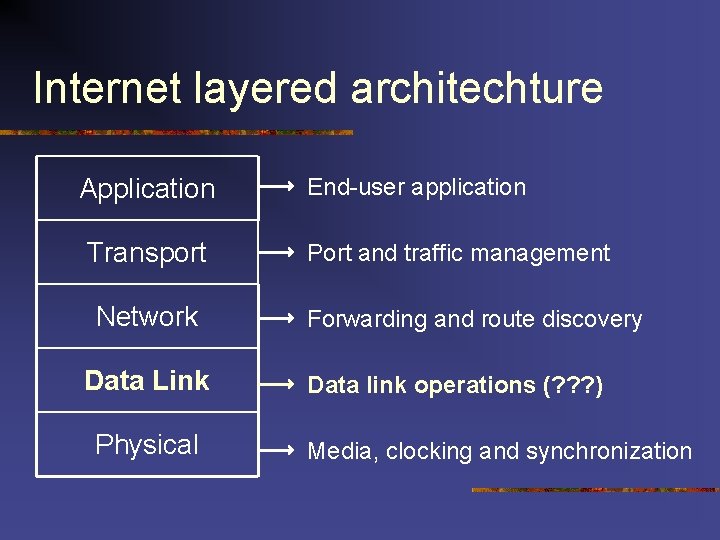
Internet layered architechture Application Transport Network Data Link Physical End-user application Port and traffic management Forwarding and route discovery Data link operations (? ? ? ) Media, clocking and synchronization
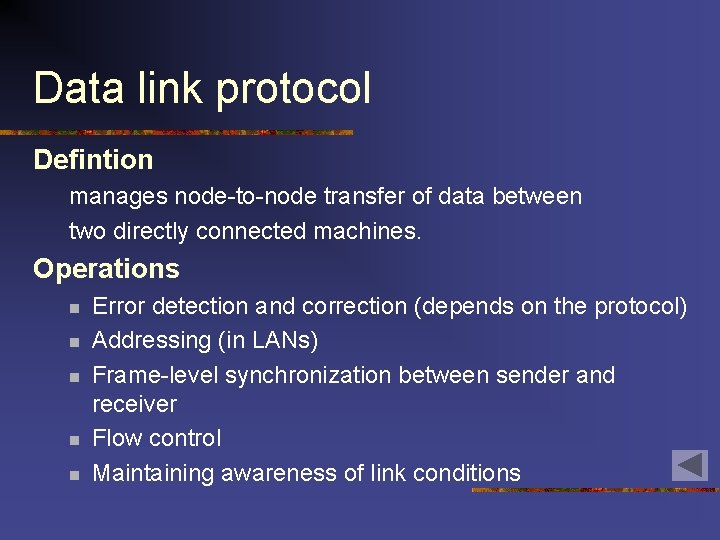
Data link protocol Defintion manages node-to-node transfer of data between two directly connected machines. Operations n n n Error detection and correction (depends on the protocol) Addressing (in LANs) Frame-level synchronization between sender and receiver Flow control Maintaining awareness of link conditions
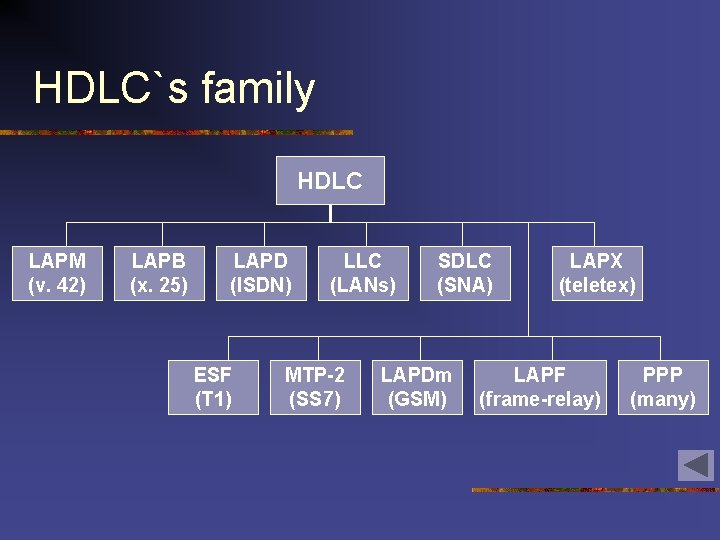
HDLC`s family HDLC LAPM (v. 42) LAPB (x. 25) LAPD (ISDN) ESF (T 1) LLC (LANs) MTP-2 (SS 7) SDLC (SNA) LAPDm (GSM) LAPX (teletex) LAPF (frame-relay) PPP (many)
PPP – a layered protocol Application Transport Network NCP Data Link LCP HDLC Physical PPP
PPP – design principles Support multiple network protocols limited to the internet and other TCP/IP networks, n Not Link configuration I. e: IPX/SPX and IPv 6 Includes nagotiation mechanisms for establishing n Error detection communication parameters betweens two PPP peers Detects datagrams corruption upon reception and n Establishing network addresses discards such corrupted data Sets network addresses necessary for the datagrams n Authentication routing Supports authentication between peers before useful n Extansibility n communication begins compatibility Yet, maintains backward