
Introduction to Pointers pointer operator available in C
Introduction to Pointers
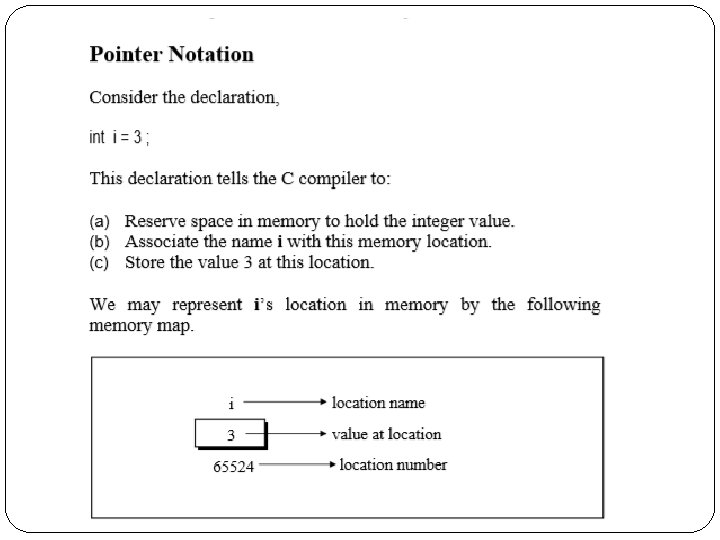
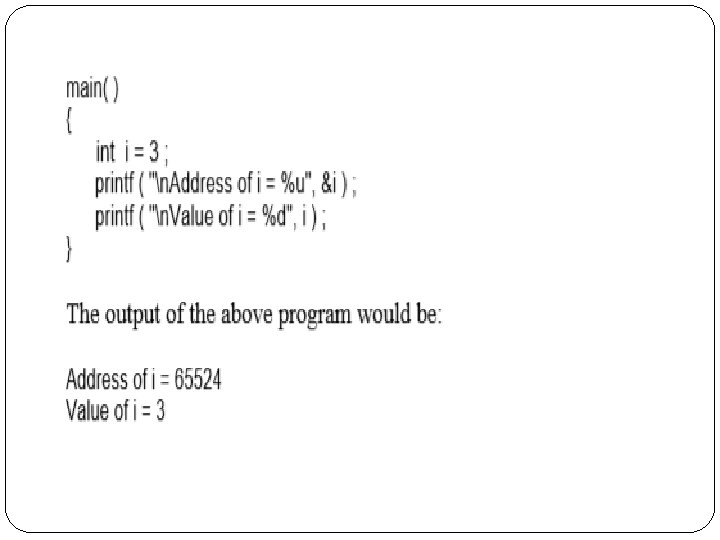
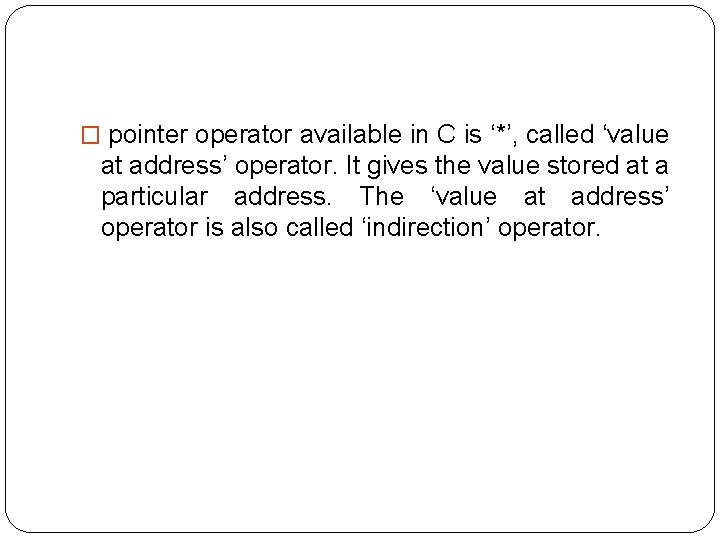
� pointer operator available in C is ‘*’, called ‘value at address’ operator. It gives the value stored at a particular address. The ‘value at address’ operator is also called ‘indirection’ operator.

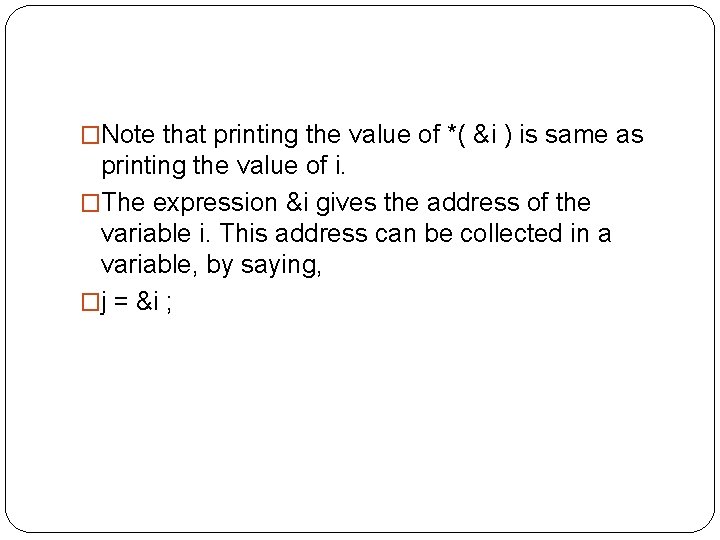
�Note that printing the value of *( &i ) is same as printing the value of i. �The expression &i gives the address of the variable i. This address can be collected in a variable, by saying, �j = &i ;
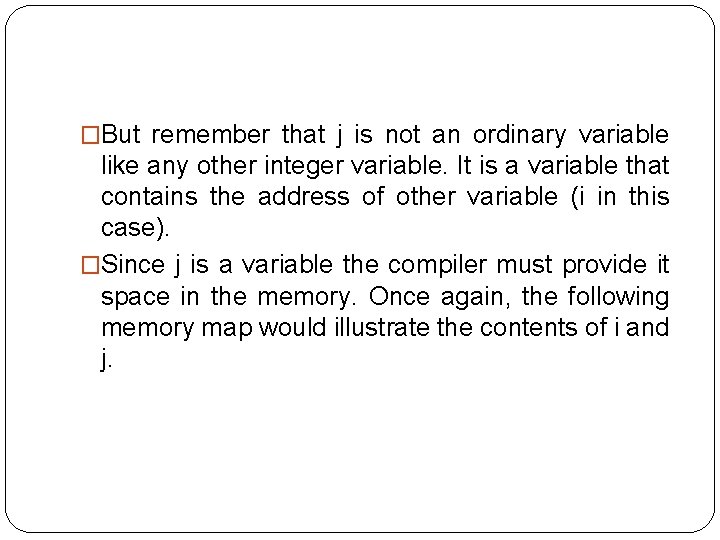
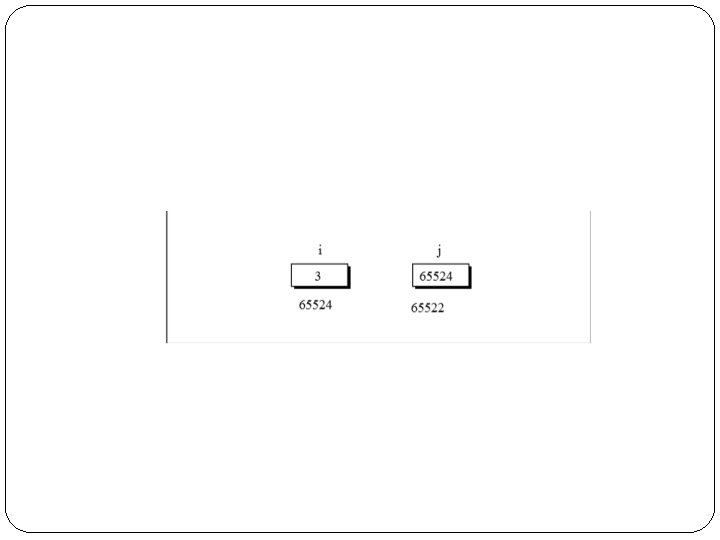
�But remember that j is not an ordinary variable like any other integer variable. It is a variable that contains the address of other variable (i in this case). �Since j is a variable the compiler must provide it space in the memory. Once again, the following memory map would illustrate the contents of i and j.
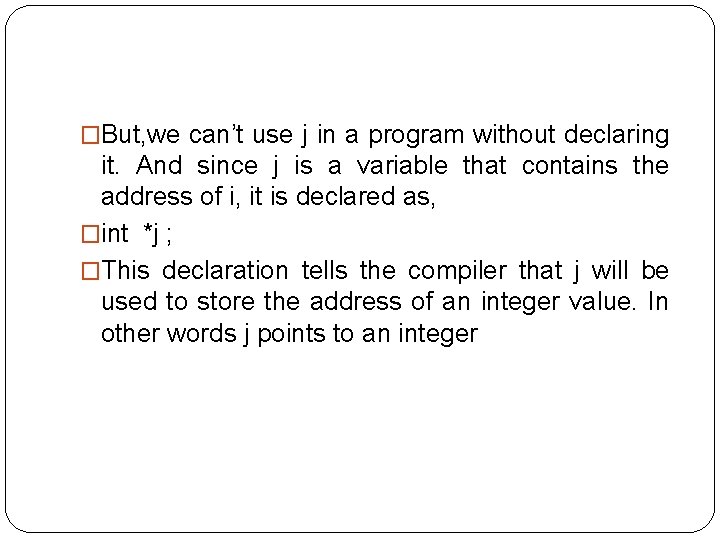
�But, we can’t use j in a program without declaring it. And since j is a variable that contains the address of i, it is declared as, �int *j ; �This declaration tells the compiler that j will be used to store the address of an integer value. In other words j points to an integer
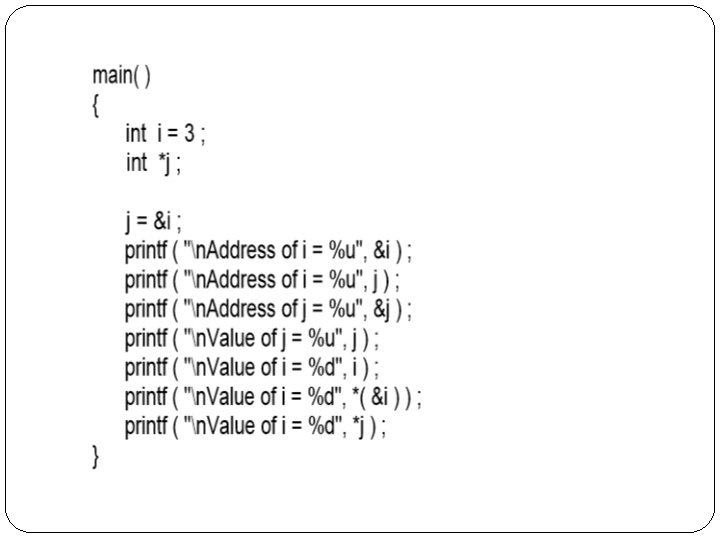
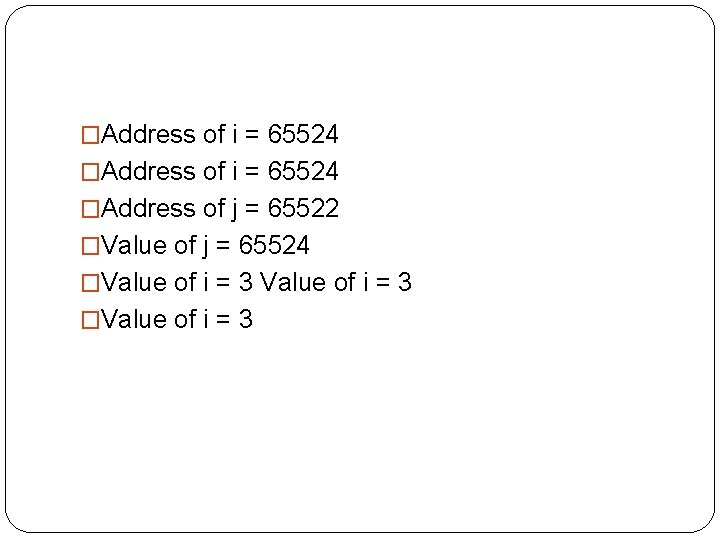
�Address of i = 65524 �Address of j = 65522 �Value of j = 65524 �Value of i = 3
Pointer Arithmetic
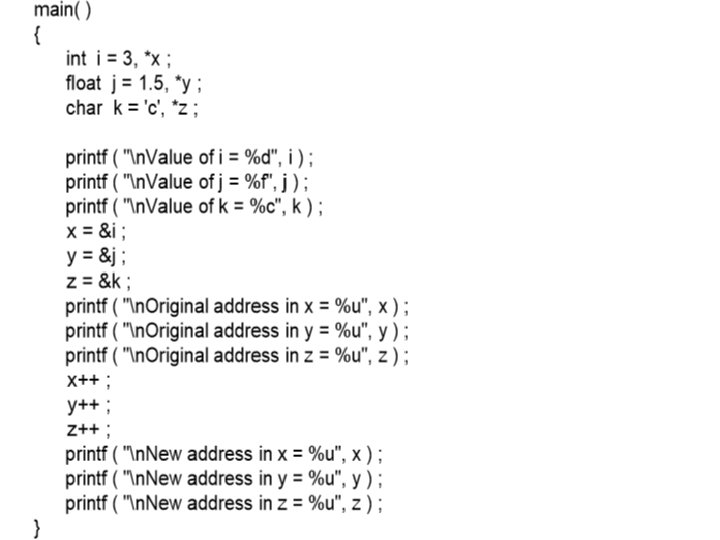
Output:
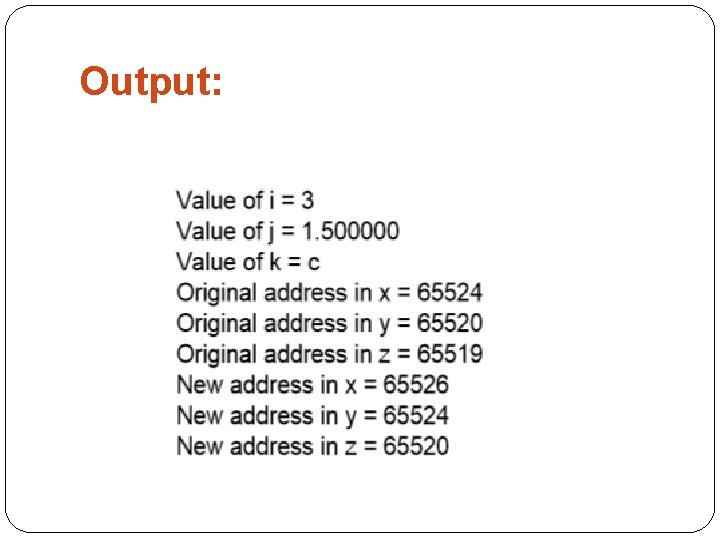
Observations �Observe the last three lines of the output. 65526 is original value in x plus 2, 65524 is original value in y plus 4, and 65520 is original value e in z plus 1. � This so happens because every time a pointer is incremented it points to the immediately next location of its type. �That is why, when the integer pointer x is incremented, it points to an address two locations after the current location, since an int is always 2 bytes long. � Similarly, y points to an address 4 locations after the current location and z points 1 location after
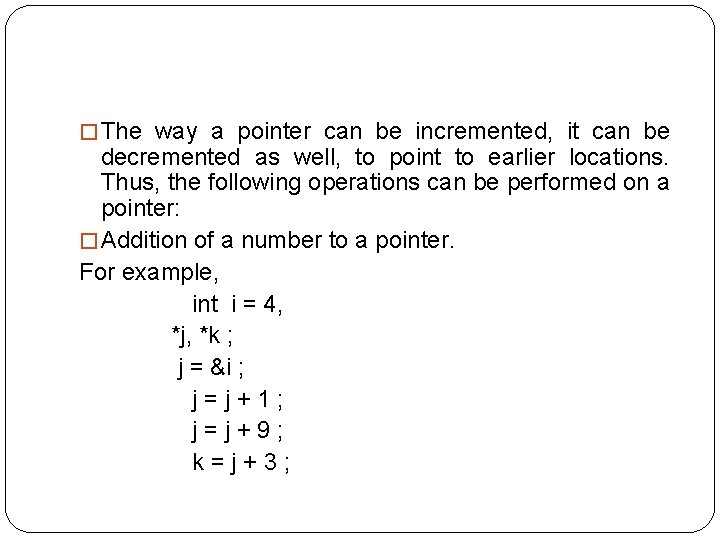
� The way a pointer can be incremented, it can be decremented as well, to point to earlier locations. Thus, the following operations can be performed on a pointer: � Addition of a number to a pointer. For example, int i = 4, *j, *k ; j = &i ; j=j+1; j=j+9; k=j+3;
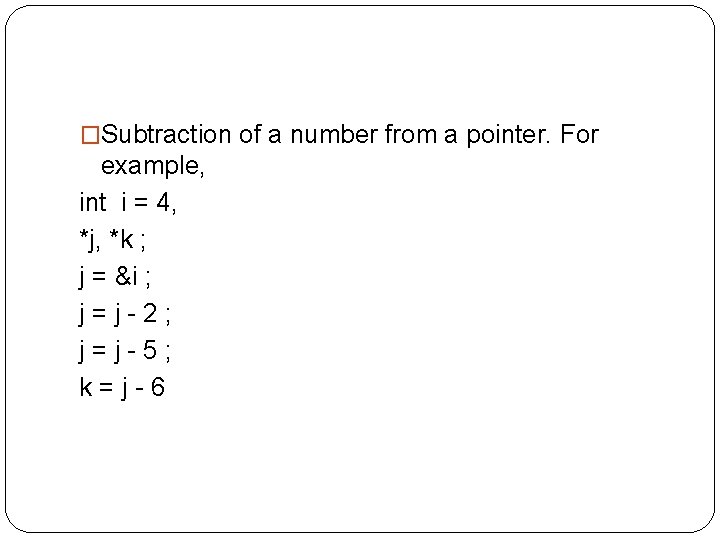
�Subtraction of a number from a pointer. For example, int i = 4, *j, *k ; j = &i ; j=j-2; j=j-5; k=j-6
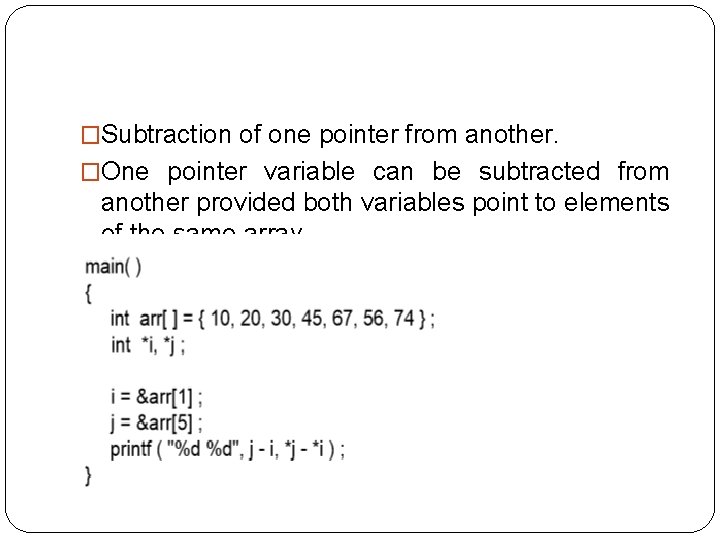
�Subtraction of one pointer from another. �One pointer variable can be subtracted from another provided both variables point to elements of the same array.
![�Suppose the array begins at location 65502, then the elements arr[1] and arr[5] would](http://slidetodoc.com/presentation_image_h2/aa6c0f1164bcd154b7208a4148f5e668/image-19.jpg "�Suppose the array begins at location 65502, then the elements arr[1] and arr[5] would")
�Suppose the array begins at location 65502, then the elements arr[1] and arr[5] would be present at locations 65504 and 65512 respectively, �since each integer in the array occupies two bytes in memory. The expression j - i would print a value 4 and not 8. This is because j and i are pointing to locations that are 4 integers apart. �What would be the result of the expression *j - *i? 36, since *j and *i return the values present at addresses contained in the pointers j and i.
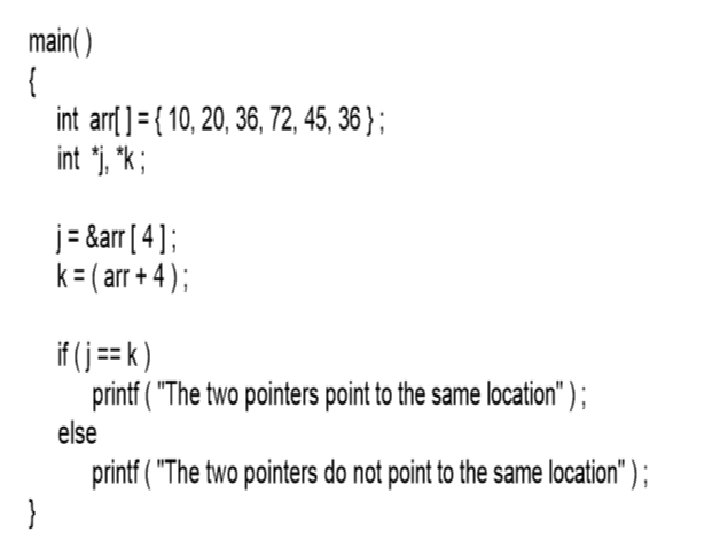
Comparison of two pointer variables �Pointer variables can be compared provided both variables point to objects of the same data type. �Such comparisons can be useful when both pointer variables point to elements of the same array. �The comparison can test for either equality or inequality. Moreover, a pointer variable can be compared with zero (usually expressed as NULL). The following program illustrates how the comparison is carried out.
�Do not attempt the following operations on pointers. . . they would never work out. (a) Addition of two pointers (b) Multiplication of a pointer with a constant (c) Division of a pointer with a constant
Pointers and Functions �Passing pointer as function parameter �Function returning Pointer �Pointer to functions or Function pointer
Function returning a pointer �A function can also return a pointer to the calling function
Function pointer �Function pointer : A pointer which keeps address of a function is known as function pointer
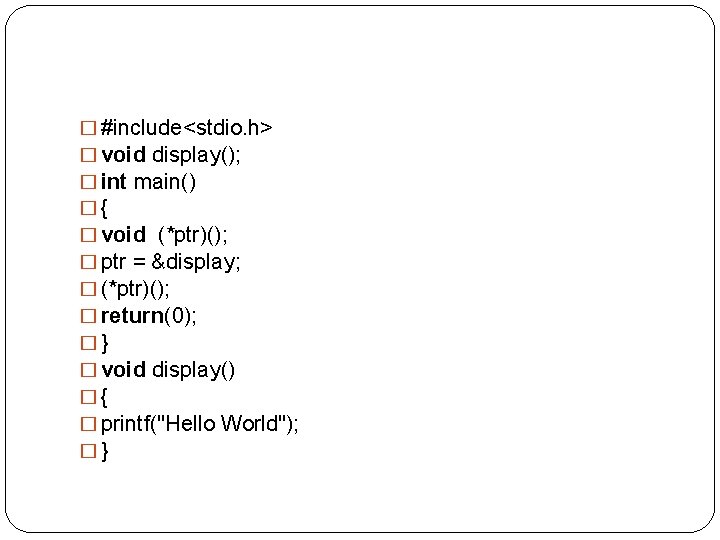
� #include<stdio. h> � void display(); � int main() �{ � void (*ptr)(); � ptr = &display; � (*ptr)(); � return(0); �} � void display() �{ � printf("Hello World"); �}
�Consider Scenario using pointer , We should following 3 steps to use pointer to call function – �Declare Pointer which is capable of storing address of function. �Initialize Pointer Variable �Call function using Pointer Variable.
�Step 1 : Declaring Pointer �void (*ptr)(); We are simply declaring a double pointer. �Write () symbol after “Pointer“. �void represents that , function is not returning any value. �() represents that , function is not taking any parameter.
- Slides: 28