
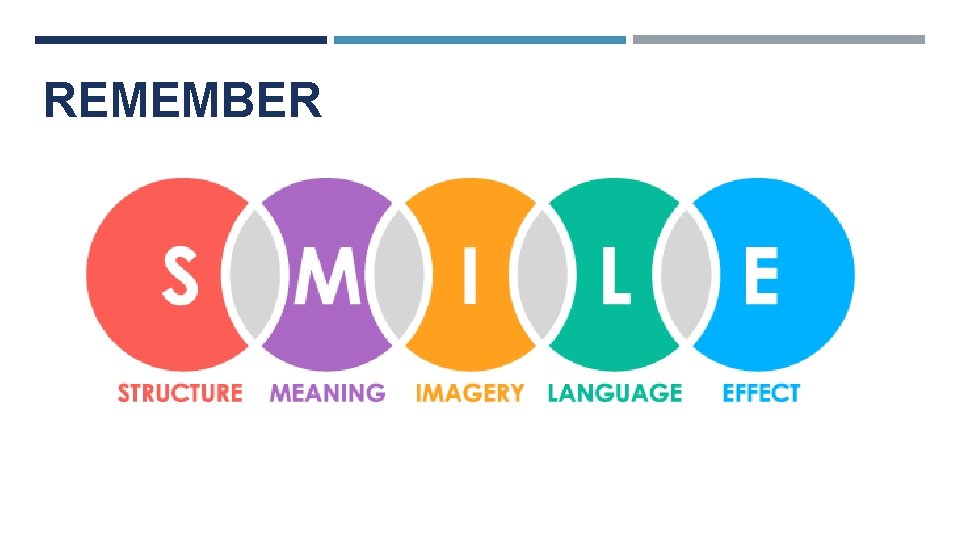
INTRODUCTION TO POETRY THE SMILE METHOD ANALYZING VS
- Slides: 22
INTRODUCTION TO POETRY THE SMILE METHOD ANALYZING VS SUMMARIZING
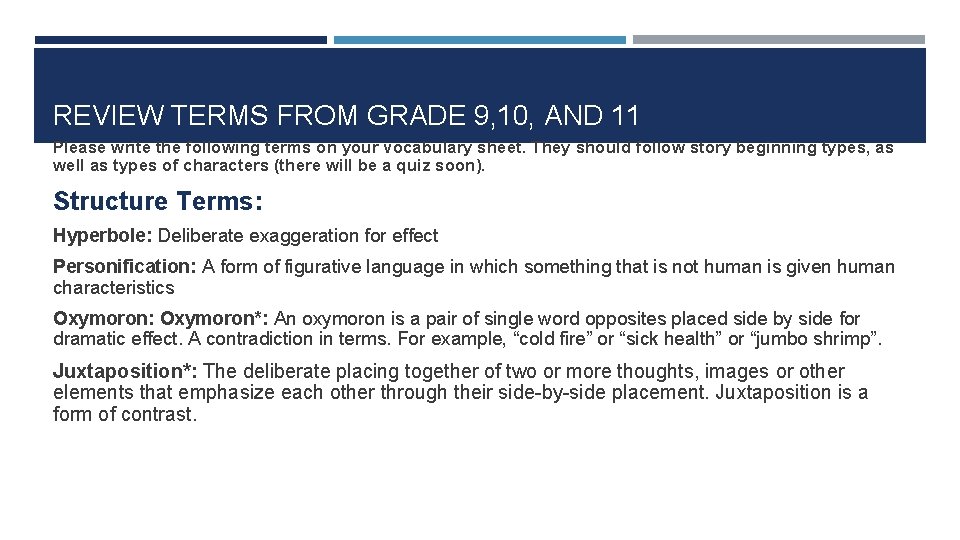
REVIEW TERMS FROM GRADE 9, 10, AND 11 Please write the following terms on your vocabulary sheet. They should follow story beginning types, as well as types of characters (there will be a quiz soon). Remember that this is for your own study purposes. You do not need to write down definitions if you don’t need to, but write down the word so you can remember that we’ve covered it. Structure Terms: Stanza (Verse): a group of lines in a poem Line: a line in a poem
REVIEW TERMS FROM GRADE 9, 10, AND 11 Please write the following terms on your vocabulary sheet. They should follow story beginning types, as well as types of characters (there will be a quiz soon). Metaphor: A direct comparison between two dissimilar items. ______ IS ____ Extended Metaphor: the comparison is stretched through an entire stanza or poem, often by multiple comparisons of unlike objects or ideas. Simile: A comparison between two dissimilar items by using “like” or “as”. Figurative Language*: The imaginative language that makes a poem rich to a reader. Figurative language often relies on comparison devices like simile, metaphor, and personification to make the point. Figurative language is the opposite of literal language.
REVIEW TERMS FROM GRADE 9, 10, AND 11 Please write the following terms on your vocabulary sheet. They should follow story beginning types, as well as types of characters (there will be a quiz soon). Sound Terms: Rhyme: When two or more words end with the same sound Internal Rhyme: When two or more words rhyme within the same line of poetry. For example, “Once upon a midnight dreary, while I pondered weak and weary” is an example of internal rhyme. End Rhyme: When the ends of two lines of poetry rhyme Rhyme Scheme: The pattern of rhyme in a poem Alliteration: When two or more words begin with the same sound
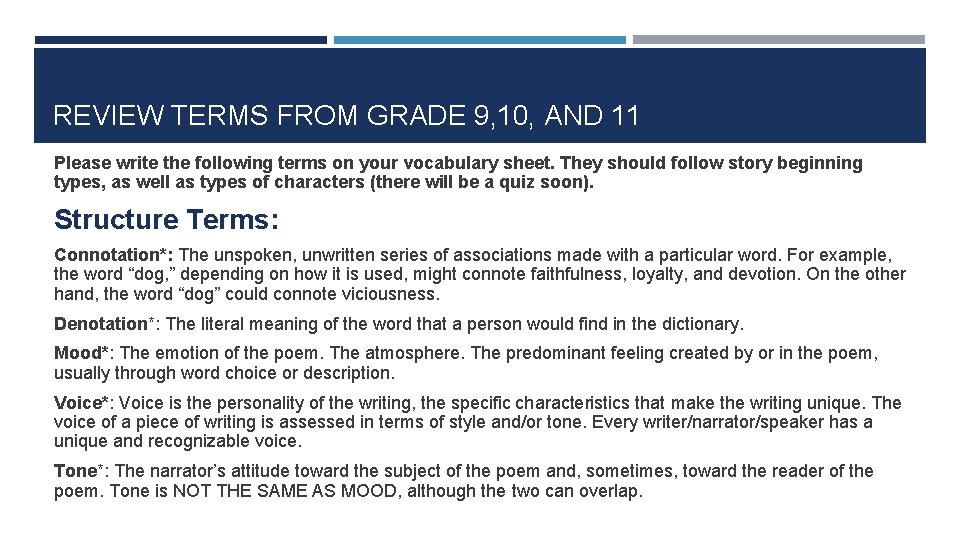
REVIEW TERMS FROM GRADE 9, 10, AND 11 Please write the following terms on your vocabulary sheet. They should follow story beginning types, as well as types of characters (there will be a quiz soon). Structure Terms: Hyperbole: Deliberate exaggeration for effect Personification: A form of figurative language in which something that is not human is given human characteristics Oxymoron: Oxymoron*: An oxymoron is a pair of single word opposites placed side by side for dramatic effect. A contradiction in terms. For example, “cold fire” or “sick health” or “jumbo shrimp”. Juxtaposition*: The deliberate placing together of two or more thoughts, images or other elements that emphasize each other through their side-by-side placement. Juxtaposition is a form of contrast.
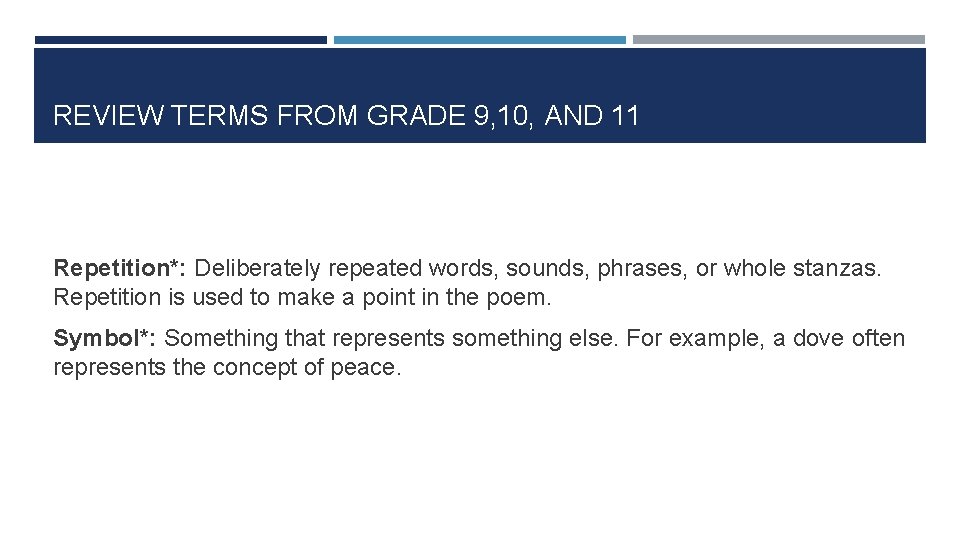
REVIEW TERMS FROM GRADE 9, 10, AND 11 Please write the following terms on your vocabulary sheet. They should follow story beginning types, as well as types of characters (there will be a quiz soon). Structure Terms: Connotation*: The unspoken, unwritten series of associations made with a particular word. For example, the word “dog, ” depending on how it is used, might connote faithfulness, loyalty, and devotion. On the other hand, the word “dog” could connote viciousness. Denotation*: The literal meaning of the word that a person would find in the dictionary. Mood*: The emotion of the poem. The atmosphere. The predominant feeling created by or in the poem, usually through word choice or description. Voice*: Voice is the personality of the writing, the specific characteristics that make the writing unique. The voice of a piece of writing is assessed in terms of style and/or tone. Every writer/narrator/speaker has a unique and recognizable voice. Tone*: The narrator’s attitude toward the subject of the poem and, sometimes, toward the reader of the poem. Tone is NOT THE SAME AS MOOD, although the two can overlap.
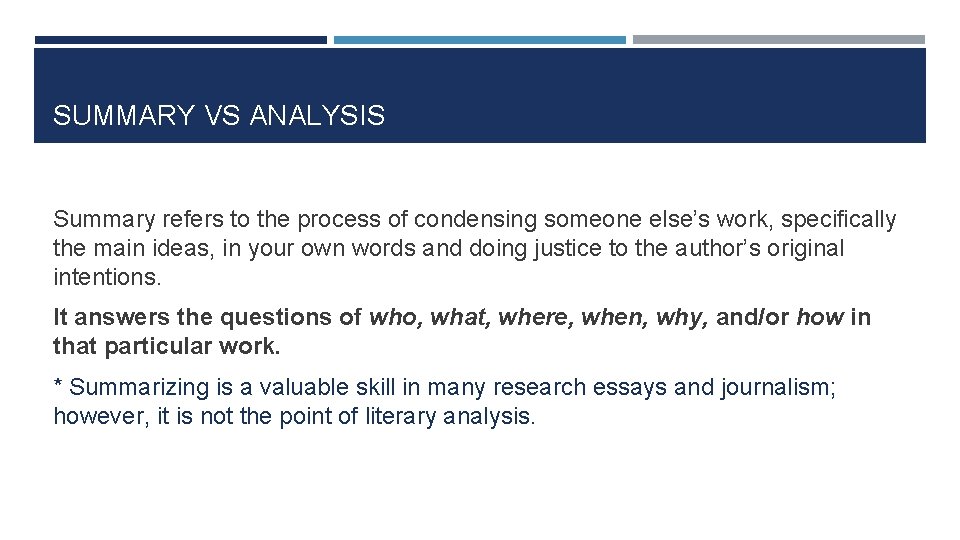
REVIEW TERMS FROM GRADE 9, 10, AND 11 Repetition*: Deliberately repeated words, sounds, phrases, or whole stanzas. Repetition is used to make a point in the poem. Symbol*: Something that represents something else. For example, a dove often represents the concept of peace.
SUMMARY VS ANALYSIS Summary refers to the process of condensing someone else’s work, specifically the main ideas, in your own words and doing justice to the author’s original intentions. It answers the questions of who, what, where, when, why, and/or how in that particular work. * Summarizing is a valuable skill in many research essays and journalism; however, it is not the point of literary analysis.
SUMMARY VS ANALYSIS Analysis, in contrast, features original thought from you, the writer. It examines the deeper meaning of the summarized content. This examination includes—but is not limited to—the work’s purpose, theme, and figurative language, as well as patterns, pros and cons, and cause/effect relationships Analysis answers the deeper questions how and/or why theme or patterns in the text are important and/or relevant. This is what you are hoping to achieve in a good literary paragraph
GOOD LITERARY WRITING ADDS SOMETHING NEW TO THE CONVERSATION. It does not repeat what has already been said. You should use your instincts and the literary devices at your disposal to make these arguments…
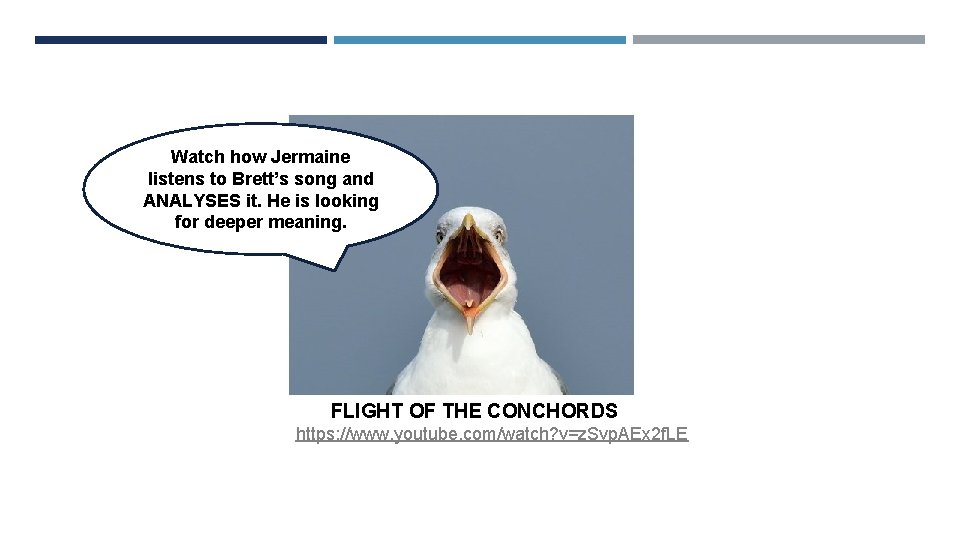
Watch how Jermaine listens to Brett’s song and ANALYSES it. He is looking for deeper meaning. FLIGHT OF THE CONCHORDS https: //www. youtube. com/watch? v=z. Svp. AEx 2 f. LE
LETS DO IT TOGETHER… 1) WATCH ALICIA KEY’S SLAM POETRY PRESENTATION OF ‘PRISONER OF WORDS’ AND EXPLORE ITS MEANING. 2) ANNOTATE USING THE SMILE METHOD FROM THE WORKSHEET THAT YOU HAVE BEEN GIVEN. 3) A GOOD ANNOTATION HAS WRITING ALL OVER IT. FILL THE PAGE. YOU WILL BE HANDING THIS IN WITH YOUR WRITING ASSIGNMENT NEXT CLASS.
Annotate Alicia Keys’ ’ ‘P. O. W’ https: //www. youtube. com/watch? v=_o. Twr. YKIo-s
REMEMBER
DAY TWO VOCAB AND ‘NOT READY TO MAKE NICE’
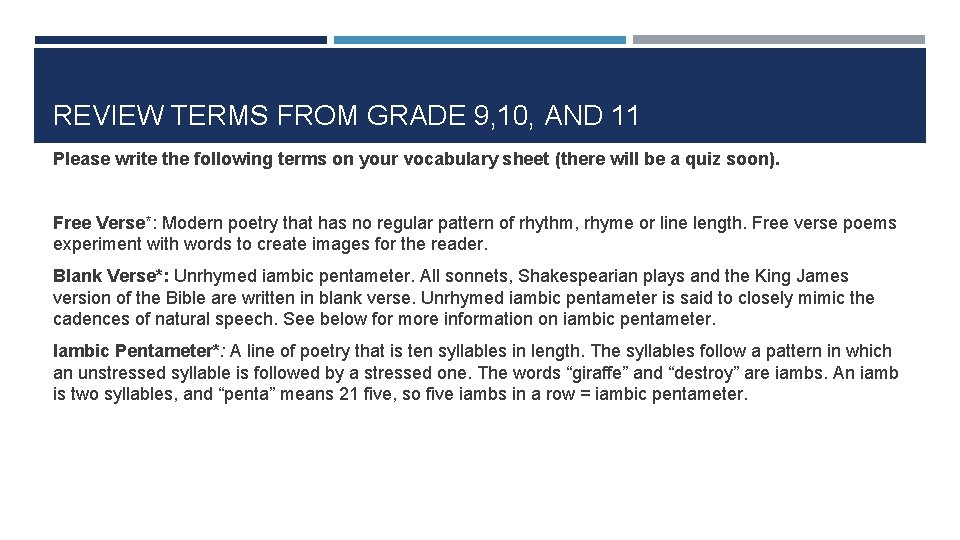
REVIEW TERMS FROM GRADE 9, 10, AND 11 Please write the following terms on your vocabulary sheet (there will be a quiz soon). Free Verse*: Modern poetry that has no regular pattern of rhythm, rhyme or line length. Free verse poems experiment with words to create images for the reader. Blank Verse*: Unrhymed iambic pentameter. All sonnets, Shakespearian plays and the King James version of the Bible are written in blank verse. Unrhymed iambic pentameter is said to closely mimic the cadences of natural speech. See below for more information on iambic pentameter. Iambic Pentameter*: A line of poetry that is ten syllables in length. The syllables follow a pattern in which an unstressed syllable is followed by a stressed one. The words “giraffe” and “destroy” are iambs. An iamb is two syllables, and “penta” means 21 five, so five iambs in a row = iambic pentameter.
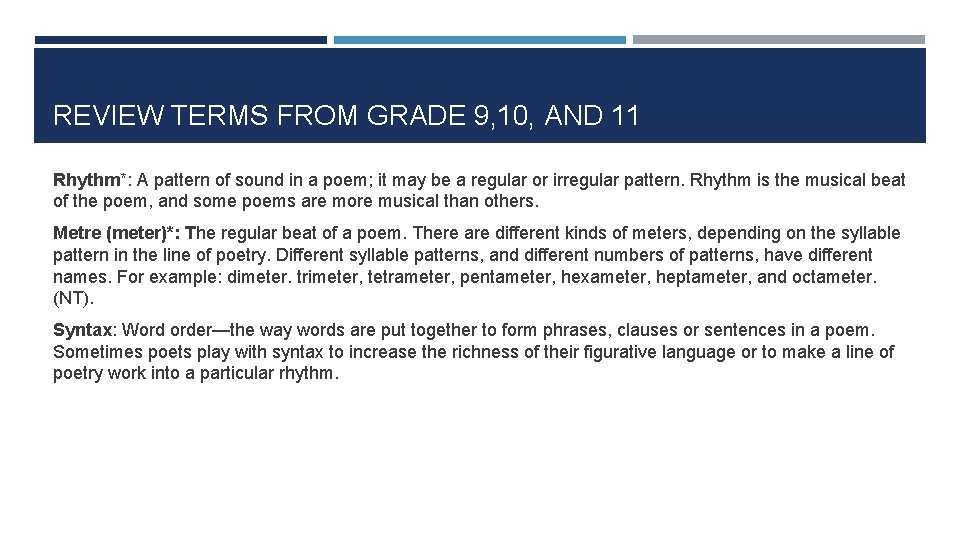
REVIEW TERMS FROM GRADE 9, 10, AND 11 Rhythm*: A pattern of sound in a poem; it may be a regular or irregular pattern. Rhythm is the musical beat of the poem, and some poems are more musical than others. Metre (meter)*: The regular beat of a poem. There are different kinds of meters, depending on the syllable pattern in the line of poetry. Different syllable patterns, and different numbers of patterns, have different names. For example: dimeter. trimeter, tetrameter, pentameter, hexameter, heptameter, and octameter. (NT). Syntax: Word order—the way words are put together to form phrases, clauses or sentences in a poem. Sometimes poets play with syntax to increase the richness of their figurative language or to make a line of poetry work into a particular rhythm.
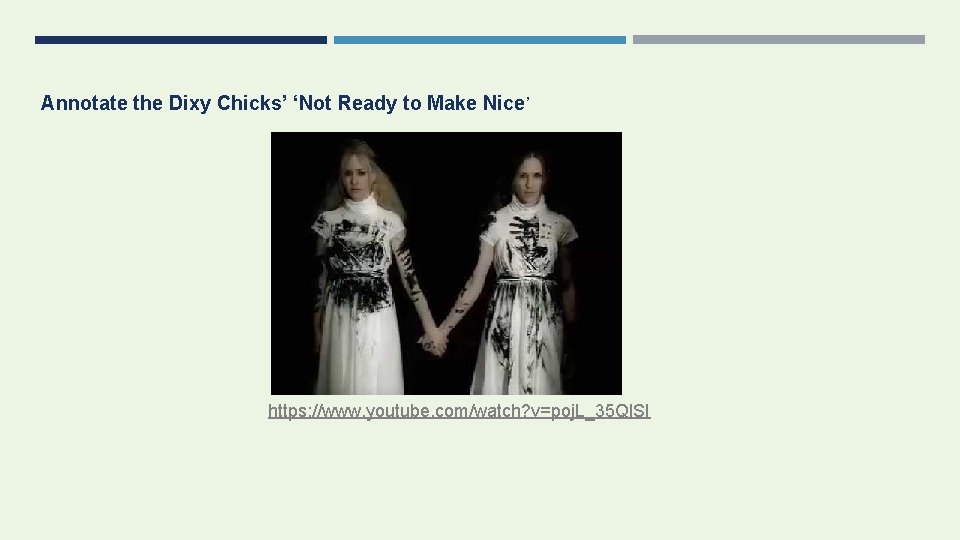
Annotate the Dixy Chicks’ ‘Not Ready to Make Nice’ https: //www. youtube. com/watch? v=poj. L_35 Ql. SI
ASSIGNMENT: WRITING PROMPT Write a persuasive synthesis paragraph expressing the importance of speaking your mind (either positive or negative). You must use both examples in your argument.
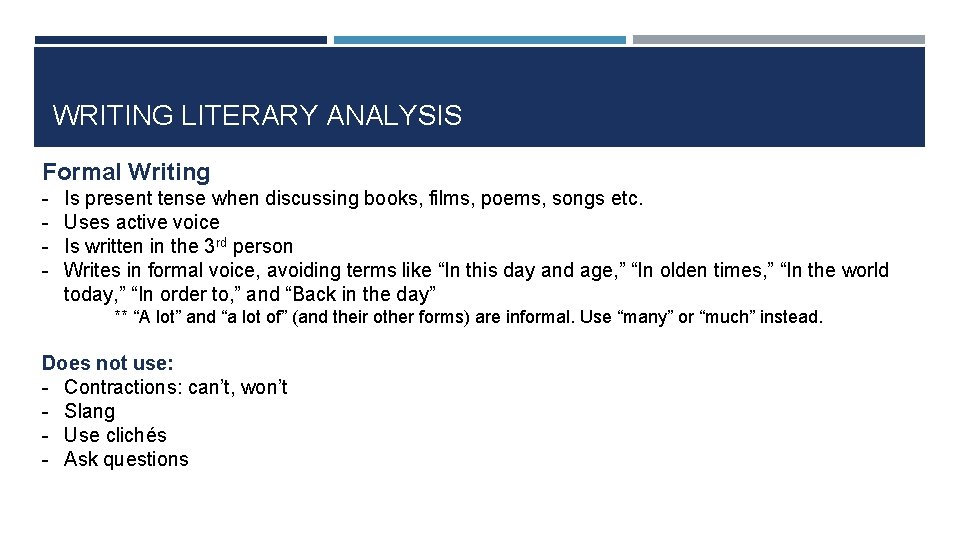
WRITING LITERARY ANALYSIS Formal Writing - Is present tense when discussing books, films, poems, songs etc. Uses active voice Is written in the 3 rd person Writes in formal voice, avoiding terms like “In this day and age, ” “In olden times, ” “In the world today, ” “In order to, ” and “Back in the day” ** “A lot” and “a lot of” (and their other forms) are informal. Use “many” or “much” instead. Does not use: - Contractions: can’t, won’t - Slang - Use clichés - Ask questions
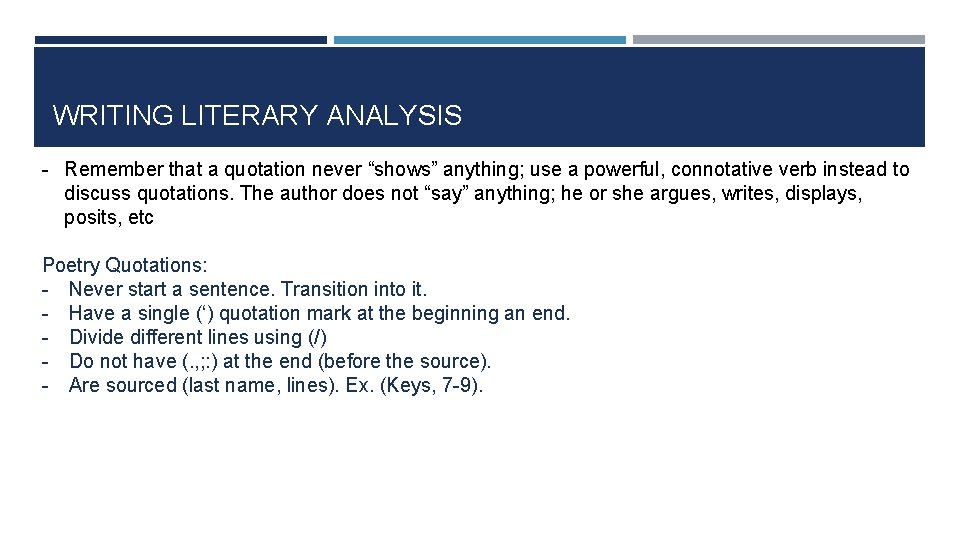
WRITING LITERARY ANALYSIS - Remember that a quotation never “shows” anything; use a powerful, connotative verb instead to discuss quotations. The author does not “say” anything; he or she argues, writes, displays, posits, etc Poetry Quotations: - Never start a sentence. Transition into it. - Have a single (‘) quotation mark at the beginning an end. - Divide different lines using (/) - Do not have (. , ; : ) at the end (before the source). - Are sourced (last name, lines). Ex. (Keys, 7 -9).
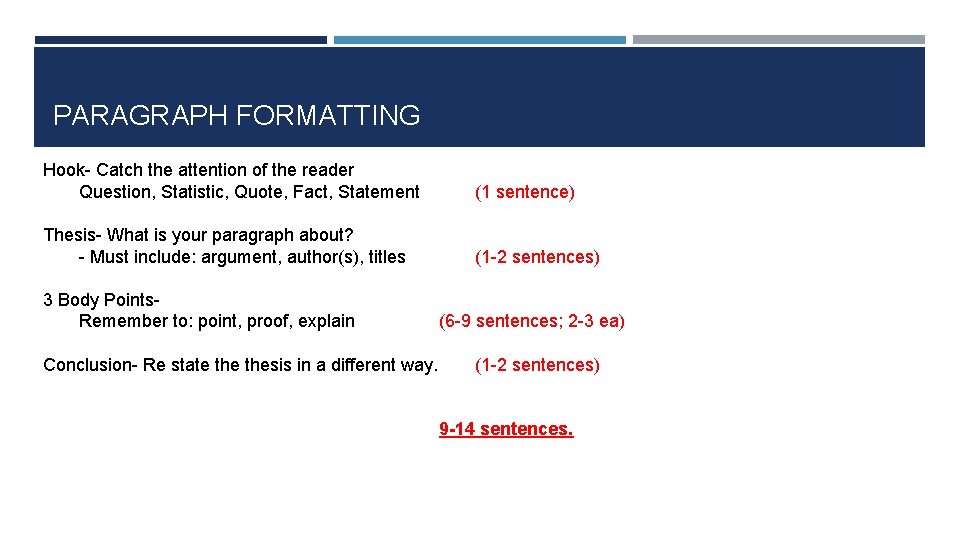
PARAGRAPH FORMATTING Hook- Catch the attention of the reader Question, Statistic, Quote, Fact, Statement (1 sentence) Thesis- What is your paragraph about? - Must include: argument, author(s), titles (1 -2 sentences) 3 Body Points. Remember to: point, proof, explain Conclusion- Re state thesis in a different way. (6 -9 sentences; 2 -3 ea) (1 -2 sentences) 9 -14 sentences.