
Introduction to Poetry Poetic Devices Terms A The





- Slides: 12
Introduction to Poetry Poetic Devices & Terms
A. The repetition of sounds End rhyme- the last word on each line rhymes. Example: hat, cat, brat, fat, mat, sat My Beard by Shel Silverstein My beard grows to my toes, I never wears no clothes, I wraps my hair Around my bare, And down the road I goes. Internal rhyme- Words INSIDE the sentence rhyme.
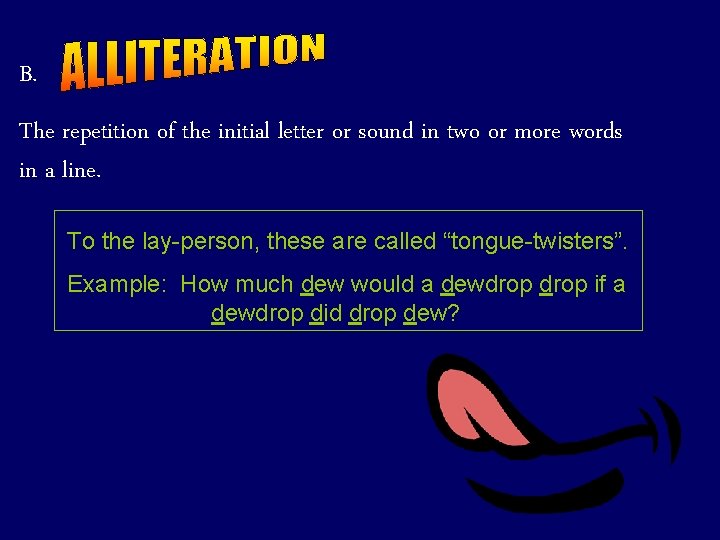
B. The repetition of the initial letter or sound in two or more words in a line. To the lay-person, these are called “tongue-twisters”. Example: How much dew would a dewdrop if a dewdrop did drop dew?
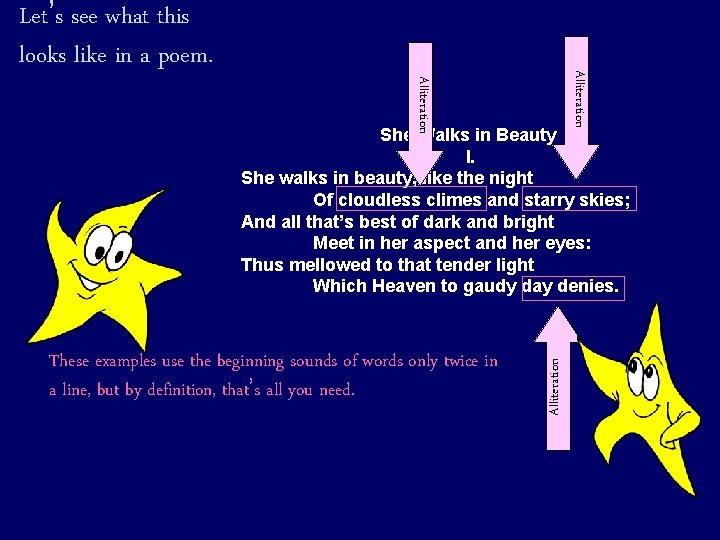
Alliteration Let’s see what this looks like in a poem. These examples use the beginning sounds of words only twice in a line, but by definition, that’s all you need. Alliteration She Walks in Beauty I. She walks in beauty, like the night Of cloudless climes and starry skies; And all that’s best of dark and bright Meet in her aspect and her eyes: Thus mellowed to that tender light Which Heaven to gaudy day denies.
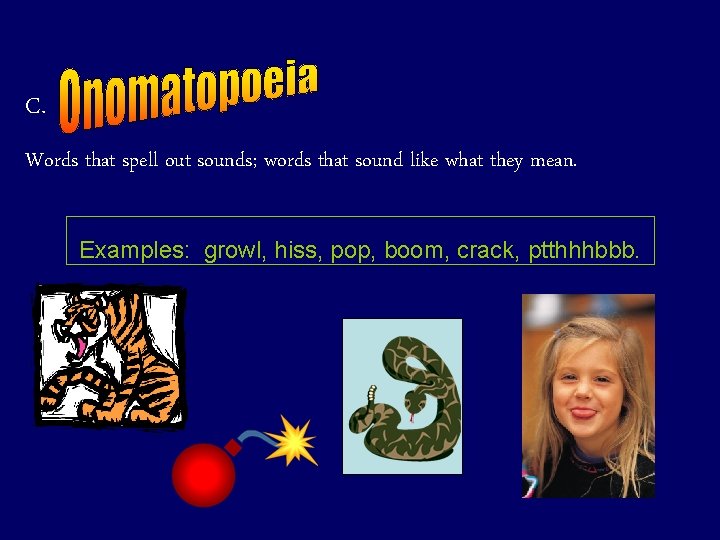
C. Words that spell out sounds; words that sound like what they mean. Examples: growl, hiss, pop, boom, crack, ptthhhbbb.
Let’s see what this looks like in a poem. Noise Day by Shel Silverstein Let’s have one day for girls and boyses When you can make the grandest noises. Screech, scream, holler, and yell – Onomatopoeia Buzz a buzzer, clang a bell, Sneeze – hiccup – whistle – shout, Laugh until your lungs wear out, Several other words not highlighted could also be considered as onomatopoeia. Can you find any? Toot a whistle, kick a can, Bang a spoon against a pan, Sing, yodel, bellow, hum, Blow a horn, beat a drum, Rattle a window, slam a door, Scrape a rake across the floor. .
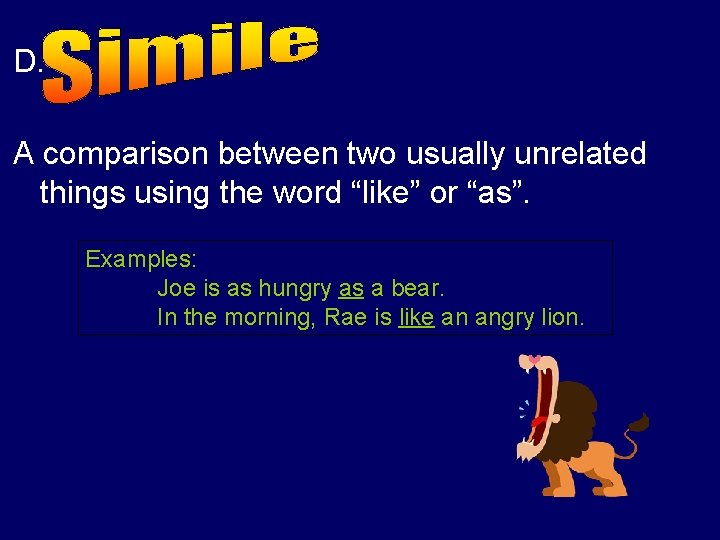
D. A comparison between two usually unrelated things using the word “like” or “as”. Examples: Joe is as hungry as a bear. In the morning, Rae is like an angry lion.
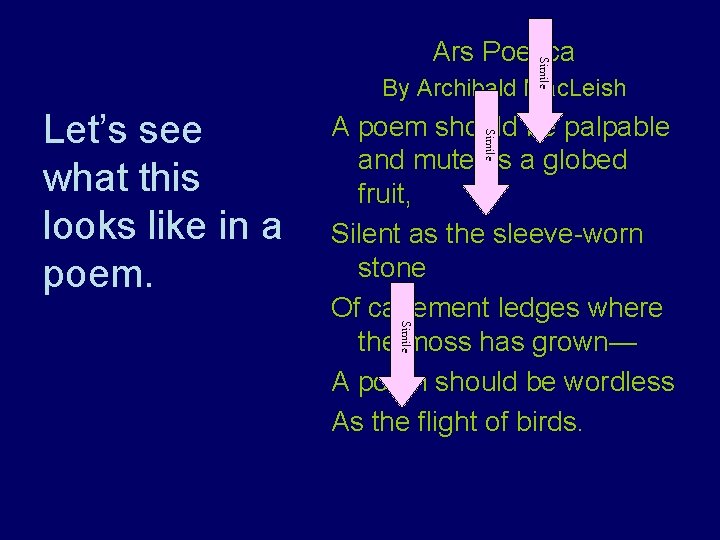
Simile Ars Poetica By Archibald Mac. Leish A poem should be palpable and mute as a globed fruit, Silent as the sleeve-worn stone Of casement ledges where the moss has grown— A poem should be wordless As the flight of birds. Simile Let’s see what this looks like in a poem. Simile
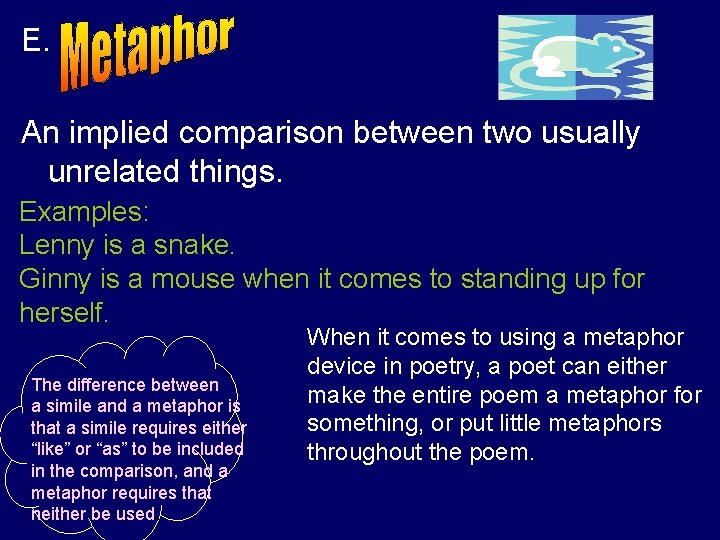
E. An implied comparison between two usually unrelated things. Examples: Lenny is a snake. Ginny is a mouse when it comes to standing up for herself. The difference between a simile and a metaphor is that a simile requires either “like” or “as” to be included in the comparison, and a metaphor requires that neither be used. When it comes to using a metaphor device in poetry, a poet can either make the entire poem a metaphor for something, or put little metaphors throughout the poem.
When it comes to using a metaphor device in poetry, a poet can either make the entire poem a metaphor for something, or put little metaphors throughout the poem. • The following poem is one big metaphor.
F. Giving human characteristics to inanimate objects, ideas, or animals. Example: The sun stretched its lazy fingers over the valley.