
Introduction to Play Activities Definition of Play A
- Slides: 10
Introduction to Play Activities
Definition of Play A transaction between the individual and the environment that is intrinsically motivated, internally controlled and free form many of the constraints of objective reality (Bundy, 1991) Play is recognized as a universal right for every child in the United Nations convention on the rights of the child (Save the Children Canada, 2000). UNICEF (2002)
Characteristics of play �Play is intrinsically motivated �Play involve attention to the means rather than the ends �Play is organism dominated rather than stimulus �Play is non literal and simulative behavior �Play requires active involvement of the players �Play is free from externally imposed rules
Components responsible to make any activity a Play �Intrinsic motivation �Internal control �Suspension of reality
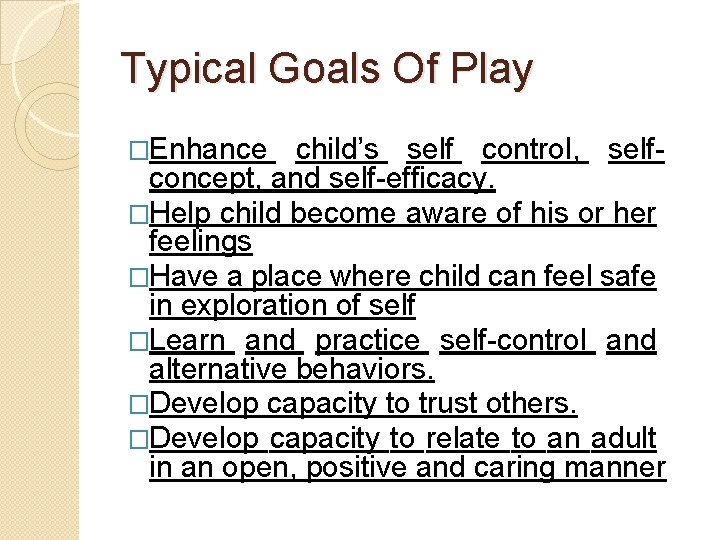
Typical Goals Of Play �Enhance child’s self control, selfconcept, and self-efficacy. �Help child become aware of his or her feelings �Have a place where child can feel safe in exploration of self �Learn and practice self-control and alternative behaviors. �Develop capacity to trust others. �Develop capacity to relate to an adult in an open, positive and caring manner
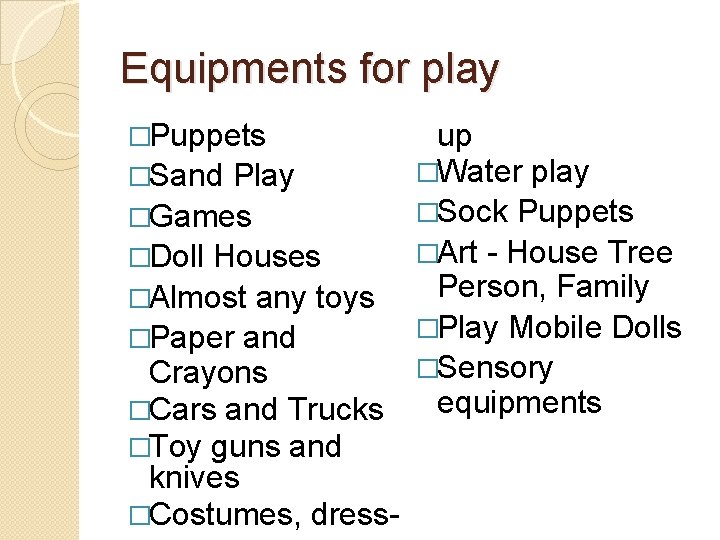
Equipments for play �Puppets up �Water play �Sand Play �Sock Puppets �Games �Art - House Tree �Doll Houses Person, Family �Almost any toys �Play Mobile Dolls �Paper and �Sensory Crayons equipments �Cars and Trucks �Toy guns and knives �Costumes, dress-
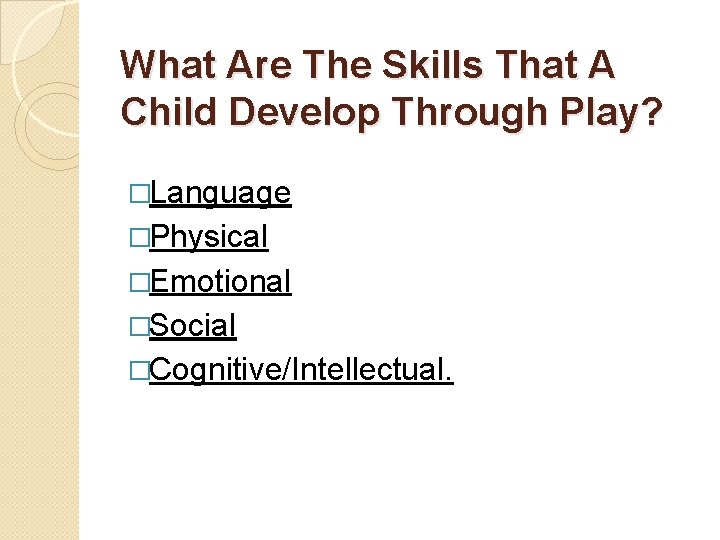
What Are The Skills That A Child Develop Through Play? �Language �Physical �Emotional �Social �Cognitive/Intellectual.
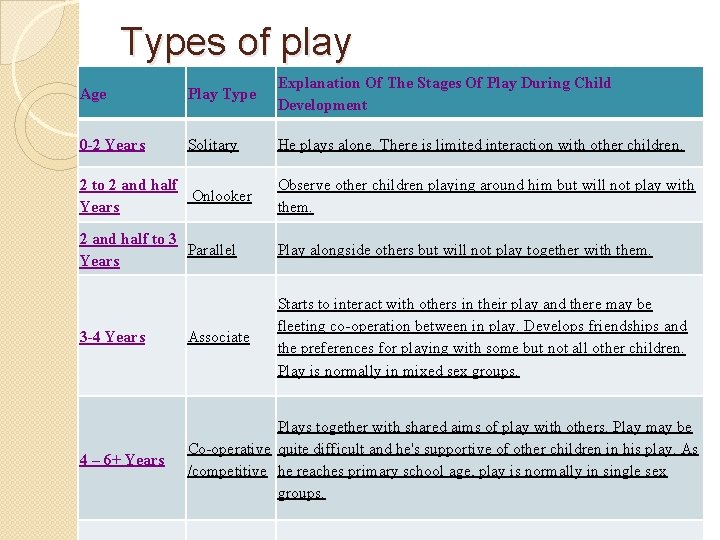
Types of play Age Play Type Explanation Of The Stages Of Play During Child Development 0 -2 Years Solitary He plays alone. There is limited interaction with other children. 2 to 2 and half Onlooker Years Observe other children playing around him but will not play with them. 2 and half to 3 Parallel Years Play alongside others but will not play together with them. 3 -4 Years Associate Starts to interact with others in their play and there may be fleeting co-operation between in play. Develops friendships and the preferences for playing with some but not all other children. Play is normally in mixed sex groups. 4 – 6+ Years Plays together with shared aims of play with others. Play may be Co-operative quite difficult and he's supportive of other children in his play. As /competitive he reaches primary school age, play is normally in single sex groups.
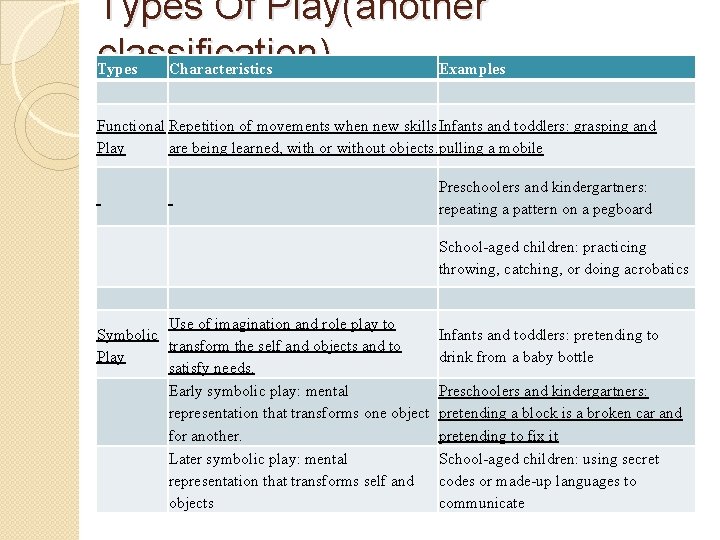
Types Of Play(another classification) Types Characteristics Examples Functional Repetition of movements when new skills Infants and toddlers: grasping and Play are being learned, with or without objects. pulling a mobile Preschoolers and kindergartners: repeating a pattern on a pegboard School-aged children: practicing throwing, catching, or doing acrobatics Use of imagination and role play to Symbolic transform the self and objects and to Play satisfy needs. Early symbolic play: mental representation that transforms one object for another. Later symbolic play: mental representation that transforms self and objects Infants and toddlers: pretending to drink from a baby bottle Preschoolers and kindergartners: pretending a block is a broken car and pretending to fix it School-aged children: using secret codes or made-up languages to communicate
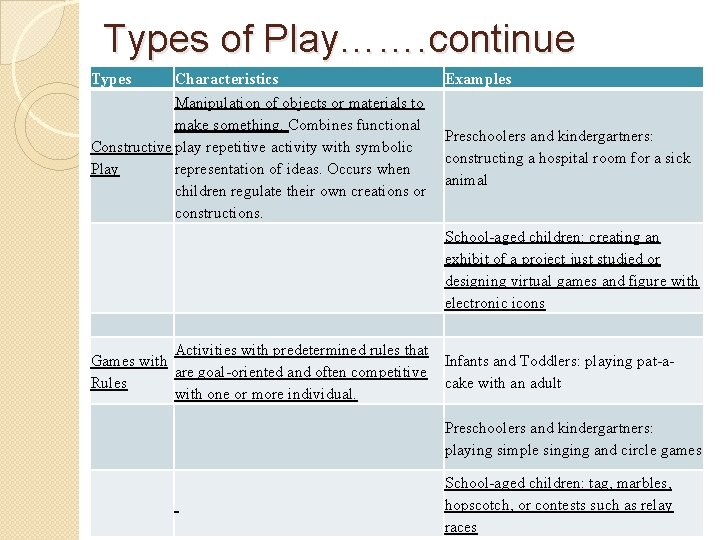
Types of Play……. continue Types Characteristics Manipulation of objects or materials to make something. Combines functional Constructive play repetitive activity with symbolic Play representation of ideas. Occurs when children regulate their own creations or constructions. Examples Preschoolers and kindergartners: constructing a hospital room for a sick animal School-aged children: creating an exhibit of a project just studied or designing virtual games and figure with electronic icons Activities with predetermined rules that Games with Infants and Toddlers: playing pat-aare goal-oriented and often competitive Rules cake with an adult with one or more individual. Preschoolers and kindergartners: playing simple singing and circle games School-aged children: tag, marbles, hopscotch, or contests such as relay races