
Introduction to Plasma Physics and Plasmabased Acceleration Numerical
Introduction to Plasma Physics and Plasmabased Acceleration Numerical techniques Based on work by Wei Lu and Mikhail Tzoufras, UCLA
Simulations as the “third column” – Analytic fluid or Vlasov models cannot capture all physics – Visualising wakefields and trapped electrons in experiments is very hard or impossible – Simulations are used to (attempt to) bridge this gap
Pros and cons For: – Capture more physics than in analytical models – Model larger/more complex/higher dimensional systems Against: – Not a substitute for thought – Numerical arithmetic follows its own rules – Numerical models may have unexpected/unphysical side effects – Compilers and hardware not always reliable
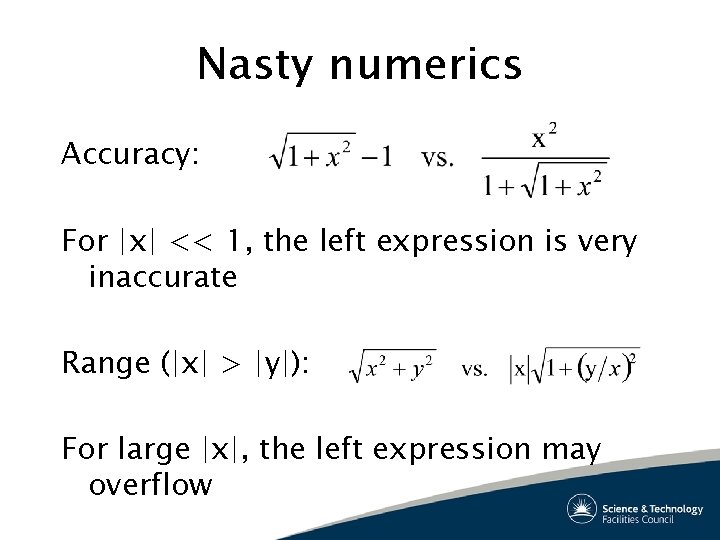
Nasty numerics Accuracy: For |x| << 1, the left expression is very inaccurate Range (|x| > |y|): For large |x|, the left expression may overflow
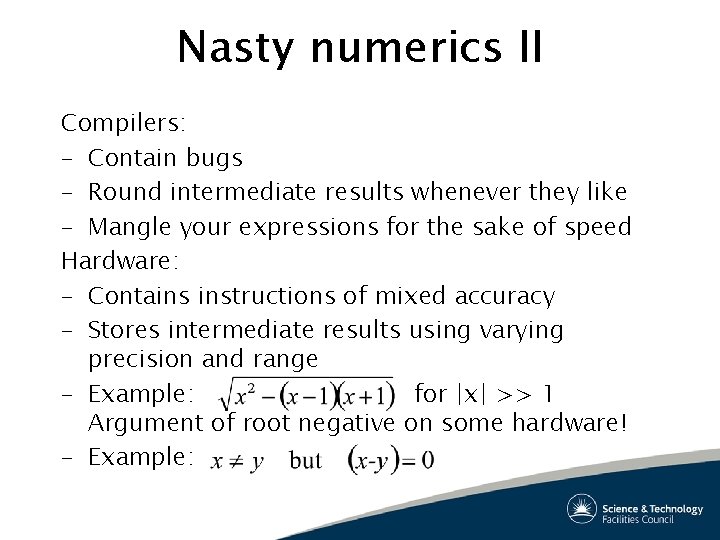
Nasty numerics II Compilers: – Contain bugs – Round intermediate results whenever they like – Mangle your expressions for the sake of speed Hardware: – Contains instructions of mixed accuracy – Stores intermediate results using varying precision and range – Example: for |x| >> 1 Argument of root negative on some hardware! – Example:
Types of numerical model Plasma modelling – Particle model – Vlasov model – Fluid model EM field modelling – Full Maxwell model – Envelope models

Plasma modelling
Particle model The workhorse of laser-plasma numerical modelling – Model uses macro-particles, each representing many real particles – Model keeps track of position and momentum of each macro-particle – Charge and current densities found by “projecting” particles onto grid – Lorentz force, derived from EM fields, projected back onto particle – Monte-Carlo collision models possible
Particle model II Pro: – Accurate modelling of particle microdynamics – Still cheaper than other “microscopic” models, e. g. Vlasov Contra: – Noisy – No simultaneous conservation of energy and momentum (“numerical heating”) – Need many particles to model thermal plasma – Difficult to model collisions properly – Not really suitable for high plasma densities (overcritical/solid)
Vlasov model – “Simply” solve the Vlasov equation on a large, multi-dimensional grid – Charge and current densities found by integrating f(t, x, p) over p-space – Lorentz force enters Vlasov equation directly, no projection needed – Inclusion of collisions by adding terms to the RHS of the Vlasov equation
Vlasov model II Pro: – Very little noise, no numerical heating – “Natural” modelling of thermal plasma, collisions, radiation absorption, etc. – Also suitable for dense plasma Contra: – Very expensive: a full 3 -D Vlasov simulation needs a 6 -D grid – Limited momentum range, so energetic particles can “fall off” grid
Fluid model – Integrate Vlasov equation to obtain a set of moment equations – Add equations of state to close system – Add models for collisions, radiation absorption, etc.
Fluid model II Pro: – Cheap and fast – Can be used for hot, (very) dense matter, if proper collision/radiation models available – Little noise Contra: – Limited/no microdynamics – Does not tolerate trajectory crossing (wave breaking, particle trapping)
Field modelling
Full Maxwell model Integrate charge and current densities to obtain fields on a grid – Can model microscopic fields down to grid size – Covers a wide range of wave-wave interactions by default – Numerical dispersion (and wave speeds) do not always match physical dispersion – Modelling of X-rays, radiation generation often limited by too-large grid size – Most suitable for not-too-dense plasma (as used in laser-wakefield acceleration)
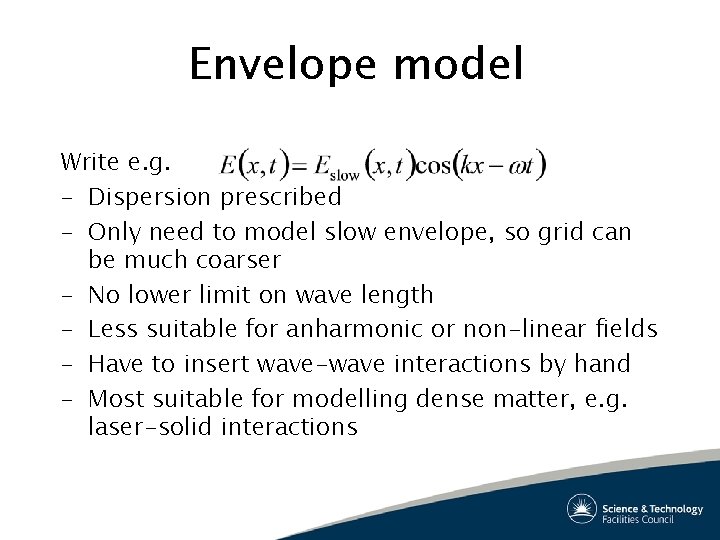
Envelope model Write e. g. – Dispersion prescribed – Only need to model slow envelope, so grid can be much coarser – No lower limit on wave length – Less suitable for anharmonic or non-linear fields – Have to insert wave-wave interactions by hand – Most suitable for modelling dense matter, e. g. laser-solid interactions
Faster models In order to speed things up, one can take shortcuts: –Quasi-static model –Lorentz-boosted model –delta-f particles (for Vlasov codes) –Boltzmann or fluid electrons in hybrid codes “The fast will drive out the slow, even if the fast is wrong. ”, William Kahan
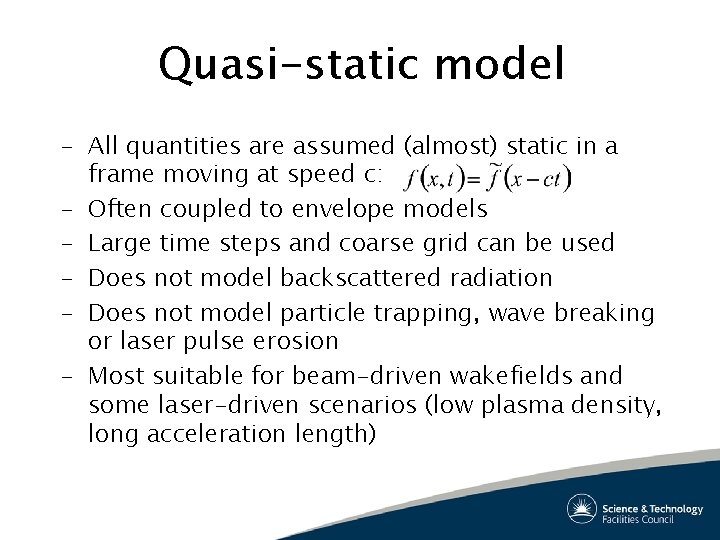
Quasi-static model – All quantities are assumed (almost) static in a frame moving at speed c: – Often coupled to envelope models – Large time steps and coarse grid can be used – Does not model backscattered radiation – Does not model particle trapping, wave breaking or laser pulse erosion – Most suitable for beam-driven wakefields and some laser-driven scenarios (low plasma density, long acceleration length)
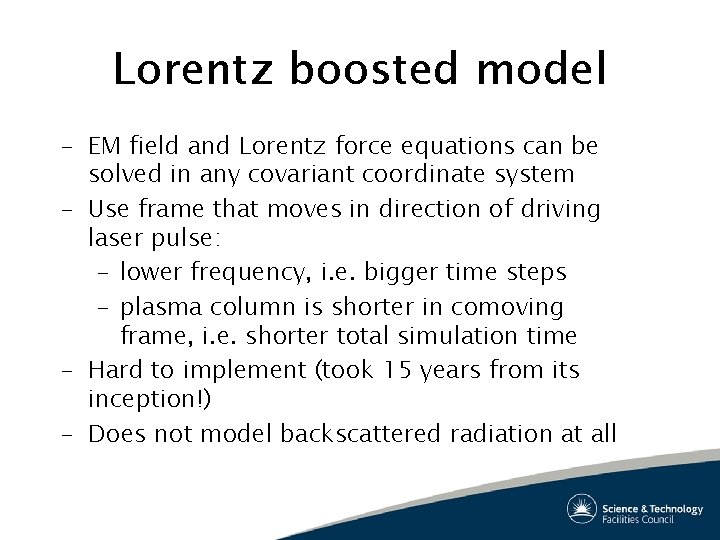
Lorentz boosted model – EM field and Lorentz force equations can be solved in any covariant coordinate system – Use frame that moves in direction of driving laser pulse: – lower frequency, i. e. bigger time steps – plasma column is shorter in comoving frame, i. e. shorter total simulation time – Hard to implement (took 15 years from its inception!) – Does not model backscattered radiation at all
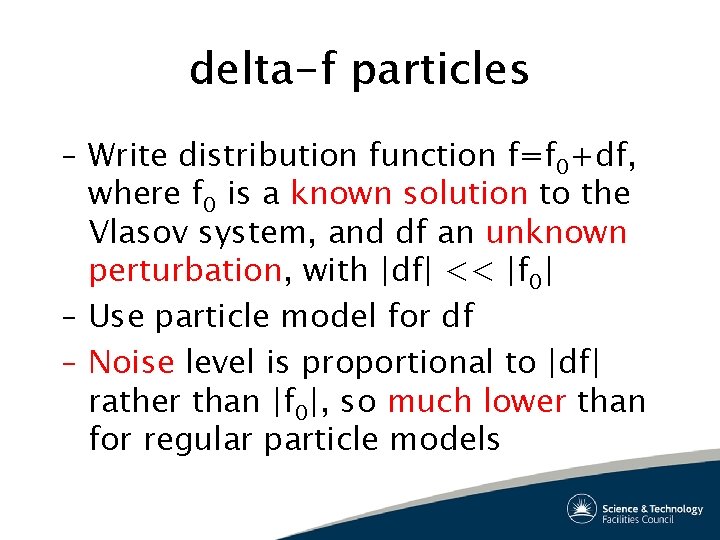
delta-f particles – Write distribution function f=f 0+df, where f 0 is a known solution to the Vlasov system, and df an unknown perturbation, with |df| << |f 0| – Use particle model for df – Noise level is proportional to |df| rather than |f 0|, so much lower than for regular particle models
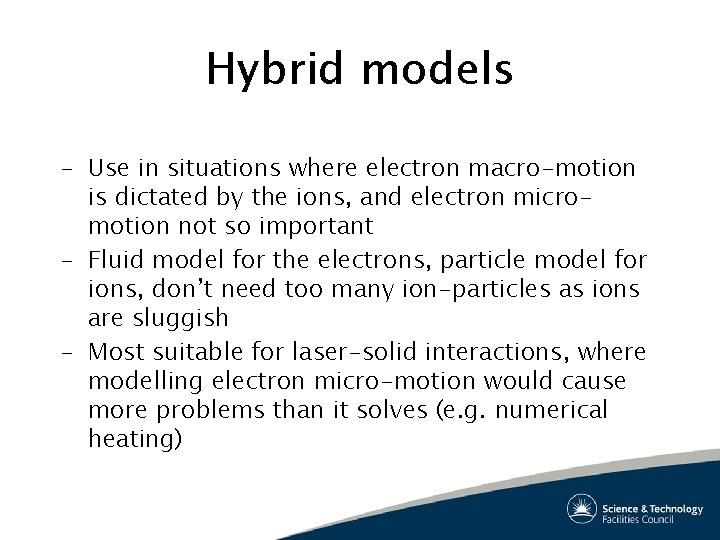
Hybrid models – Use in situations where electron macro-motion is dictated by the ions, and electron micromotion not so important – Fluid model for the electrons, particle model for ions, don’t need too many ion-particles as ions are sluggish – Most suitable for laser-solid interactions, where modelling electron micro-motion would cause more problems than it solves (e. g. numerical heating)
Summary – Many models available to model both fields and plasma particles – Choice of model determined by various factors: – Available computer power – Configuration one wishes to model – Which effects are dominant? – No model is perfect, choosing the most appropriate model for any situation requires careful thought – Apart from the bugs in your own code, compiler and hardware problems may also trip you up, so beware!
- Slides: 22