
Introduction to Plasma Physics and Plasmabased Acceleration Introduction
Introduction to Plasma Physics and Plasmabased Acceleration Introduction to plasma
What is plasma? Plasma: ionised gas – Ionised by high temperature, radiation, electrical discharge, … – “Fourth state of matter” – Mixture of free electrons, positive ions, neutral atoms – Behaviour is dominated by electromagnetic interactions between charged particles
Where do we find it? Almost everywhere! – 99% of all matter in the universe is in the plasma state! – Sun, stars, giant gaseous planets, interstellar matter… – Fluorescent lamps, plasma screens – Nuclear fusion devices – Plasma-based accelerators
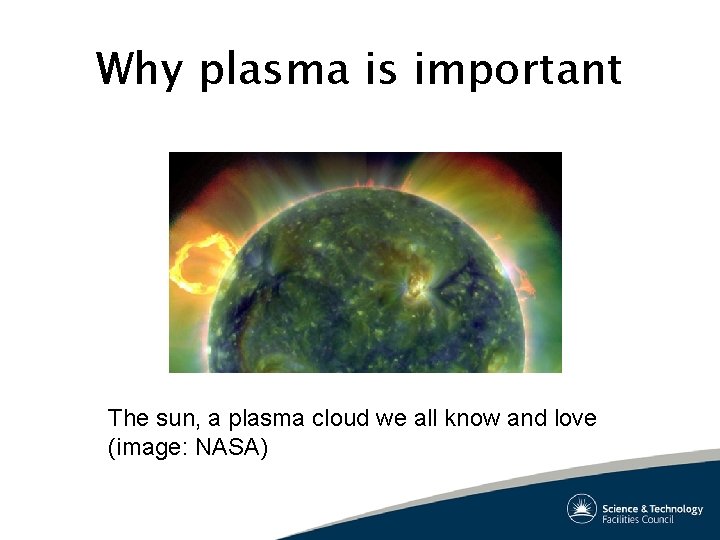
Why plasma is important The sun, a plasma cloud we all know and love (image: NASA)
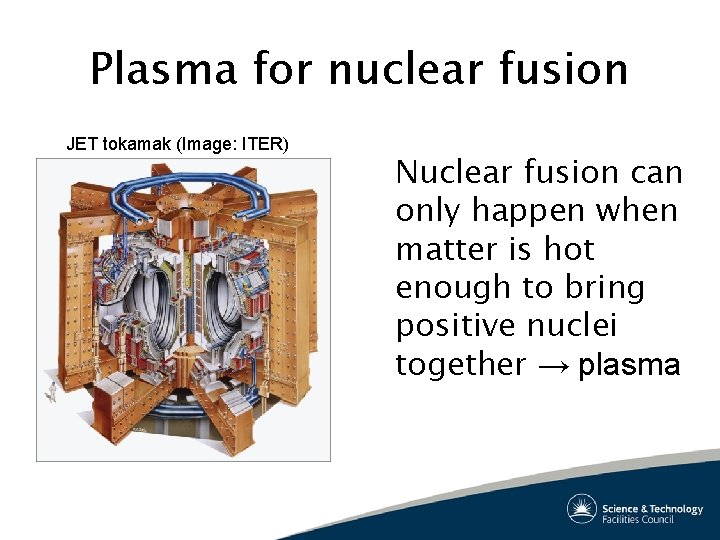
Plasma for nuclear fusion JET tokamak (Image: ITER) Nuclear fusion can only happen when matter is hot enough to bring positive nuclei together → plasma
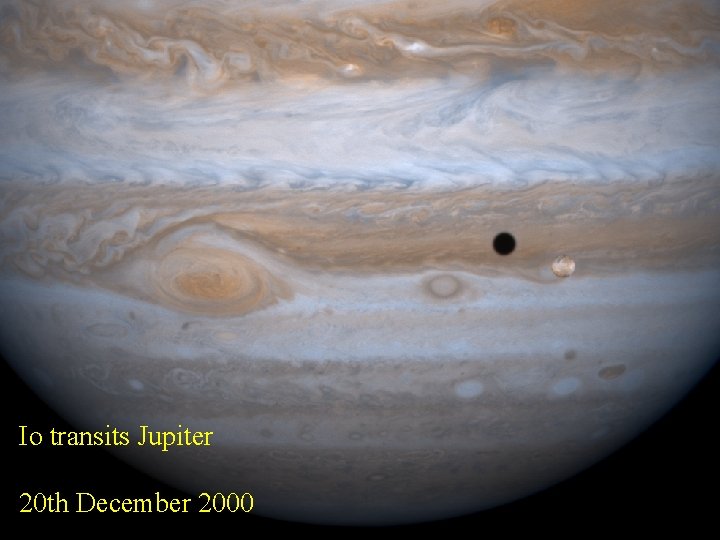
Io transits Jupiter 20 th December 2000
Essence of a gas – Short-range Van der Waals interactions – Except for collisions, particles move freely – No significant collective effects
Essence of plasma – Long-range EM interactions – Interaction strength does not fall off: – Coulomb force: ~1/r 2 – Number of particles: ~r 2 – Total interaction: ~1 – Collective effects dominate behaviour; collisions are relatively rare
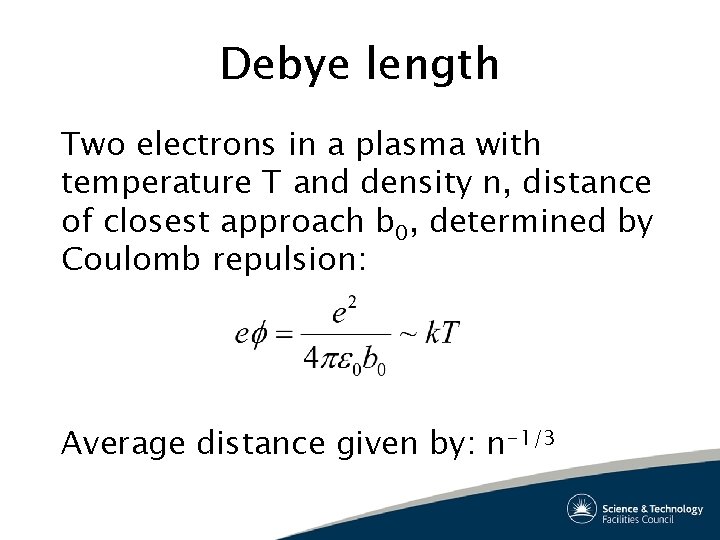
Debye length Two electrons in a plasma with temperature T and density n, distance of closest approach b 0, determined by Coulomb repulsion: Average distance given by: n-1/3
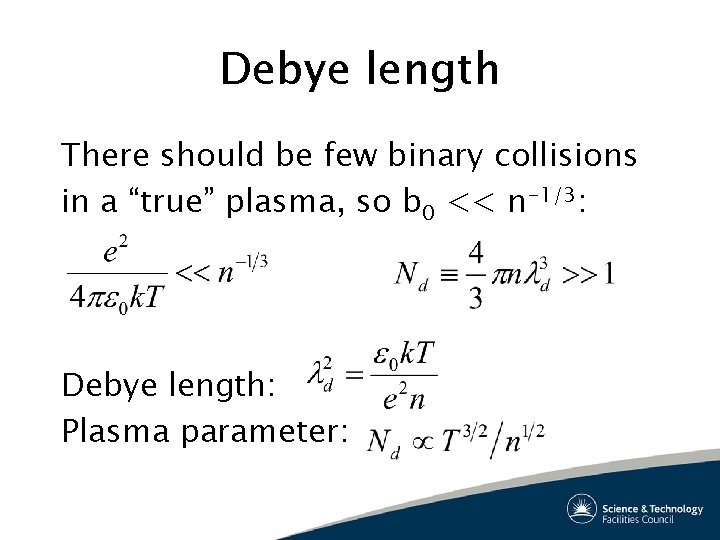
Debye length There should be few binary collisions in a “true” plasma, so b 0 << n-1/3: Debye length: Plasma parameter:
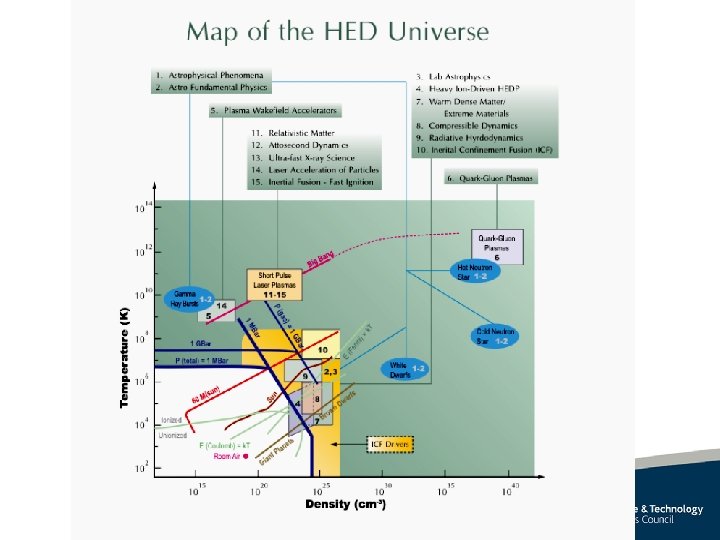
The “truest” plasma Nd > 105: interstellar “gas”, solar corona (both low density), thermonuclear plasma in fusion device (very hot) Nd < 100: solar atmosphere discharge (too cold), laser-produced plasma (too dense)
Debye shielding A charge in a plasma is shielded by charged particles (electrons) in the plasma Typical shielding distance: Debye length Number of particles involved in shielding: Plasma parameter
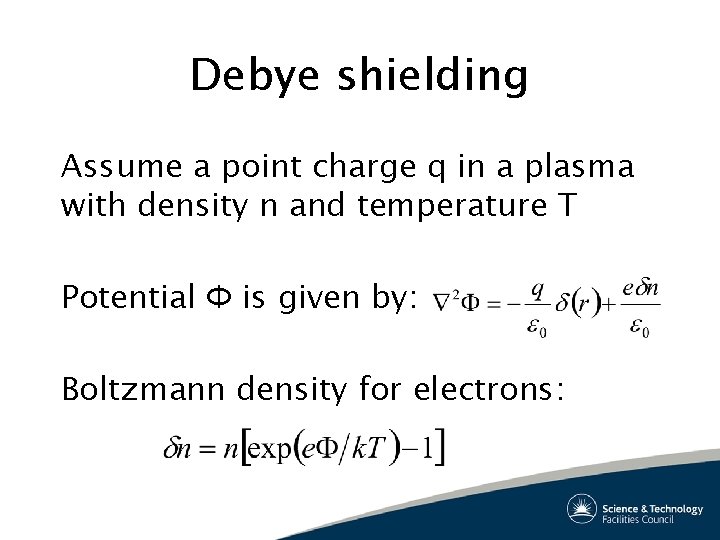
Debye shielding Assume a point charge q in a plasma with density n and temperature T Potential Φ is given by: Boltzmann density for electrons:
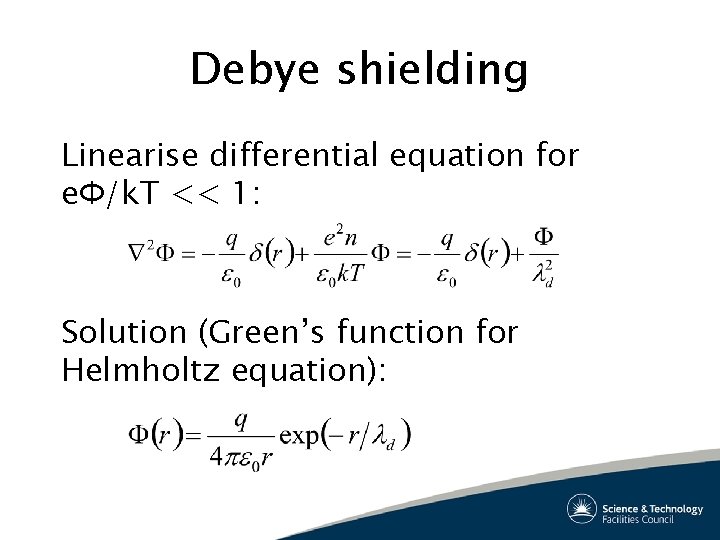
Debye shielding Linearise differential equation for eΦ/k. T << 1: Solution (Green’s function for Helmholtz equation):
Debye shielding Point charge q is shielded by a cloud of charged particles with radius λd and total charge –q At distances shorter than λd : individual particles “visible” At long distances: collective behaviour only, individual particles “invisible” (true plasma)
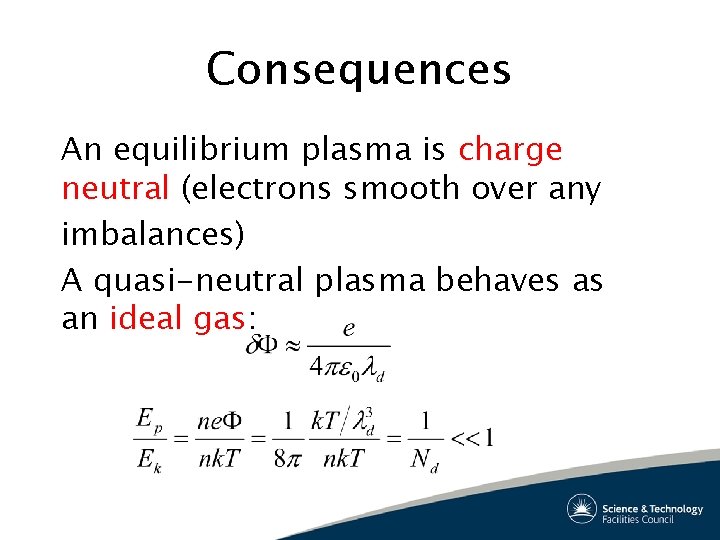
Consequences An equilibrium plasma is charge neutral (electrons smooth over any imbalances) A quasi-neutral plasma behaves as an ideal gas:
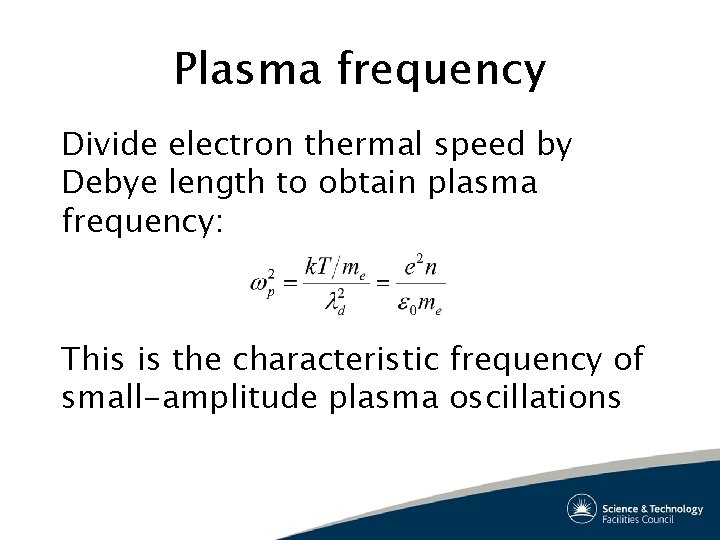
Plasma frequency Divide electron thermal speed by Debye length to obtain plasma frequency: This is the characteristic frequency of small-amplitude plasma oscillations
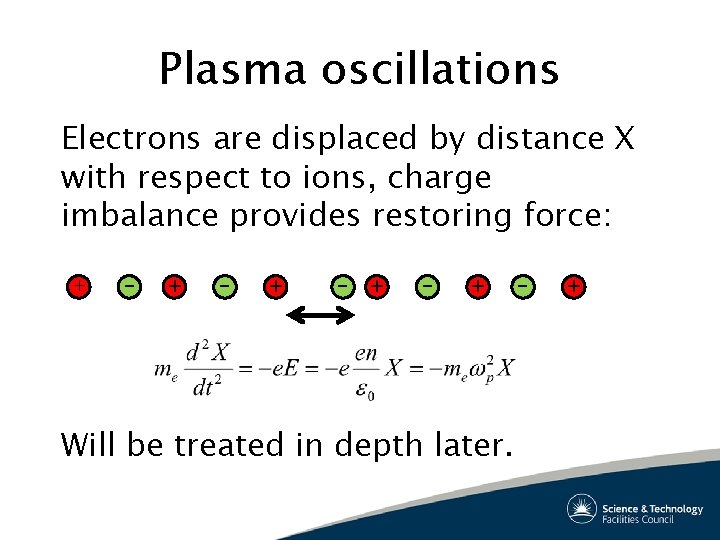
Plasma oscillations Electrons are displaced by distance X with respect to ions, charge imbalance provides restoring force: + - + - + Will be treated in depth later. - +
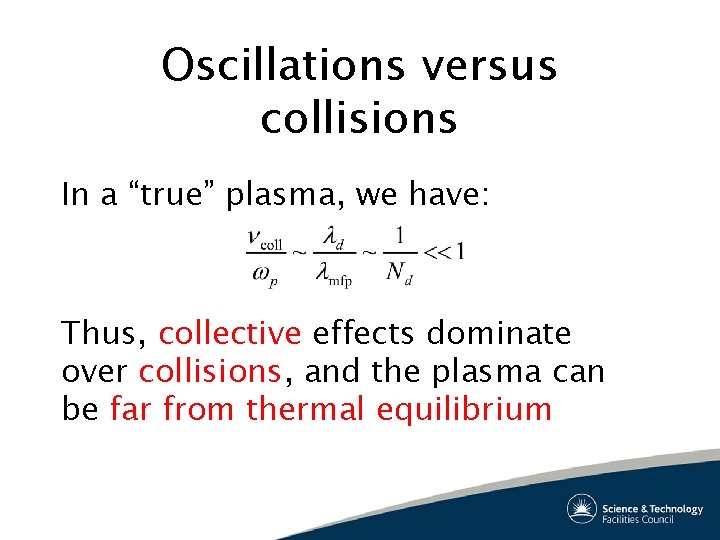
Oscillations versus collisions In a “true” plasma, we have: Thus, collective effects dominate over collisions, and the plasma can be far from thermal equilibrium
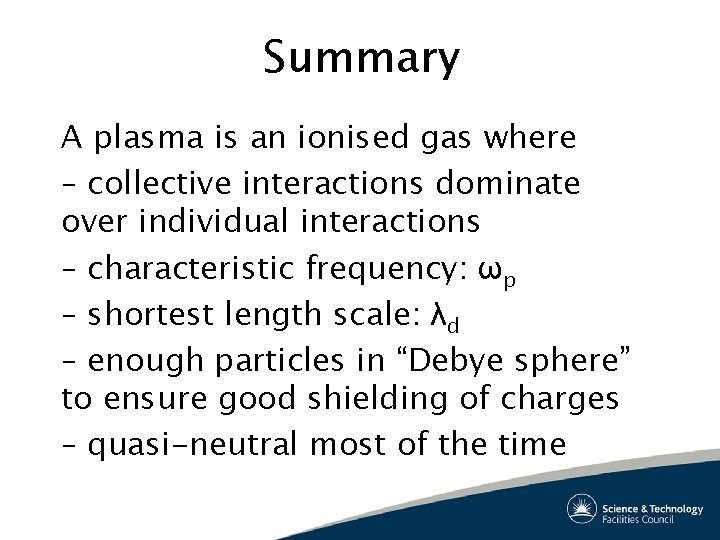
Summary A plasma is an ionised gas where – collective interactions dominate over individual interactions – characteristic frequency: ωp – shortest length scale: λd – enough particles in “Debye sphere” to ensure good shielding of charges – quasi-neutral most of the time
- Slides: 21