
Introduction to Plasma Physics and Plasmabased Acceleration Bubbleshaped
Introduction to Plasma Physics and Plasmabased Acceleration Bubble-shaped wakefields and beam loading Based on work by Wei Lu and Mikhail Tzoufras, UCLA
Bubble-shaped wakefield – A strongly non-linear wakefield driven by an intense laser pulse or ultra-relativistic particle beam – There are no electrons inside the bubble; a thin, dense sheath of electrons surrounds the bubble – The bubble cannot be described using normal fluid models because electron trajectories cross each other

Bubble formation Bubble shape Bubble is formed when “inner” electrons are pushed further out than “outer” electrons W. Lu et al. , Phys. Plasmas 13, 056709 (2006) Electron trajectories
Trajectory crossing versus particle trapping – Previously: longitudinal trajectory crossing (wave breaking) would come after particle trapping – Here: transverse trajectory crossing precedes particle trapping – Particle trapping happens only if electric field at the back of the bubble is strong enough

Bubble equations rb is bubble radius, ξ=ct-z, β is related to sheath thickness. For derivation, see W. Lu et al.
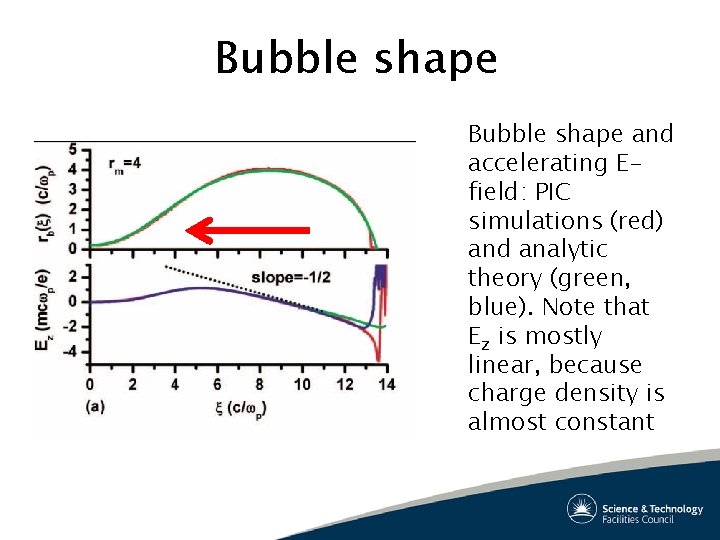
Bubble shape and accelerating Efield: PIC simulations (red) and analytic theory (green, blue). Note that Ez is mostly linear, because charge density is almost constant
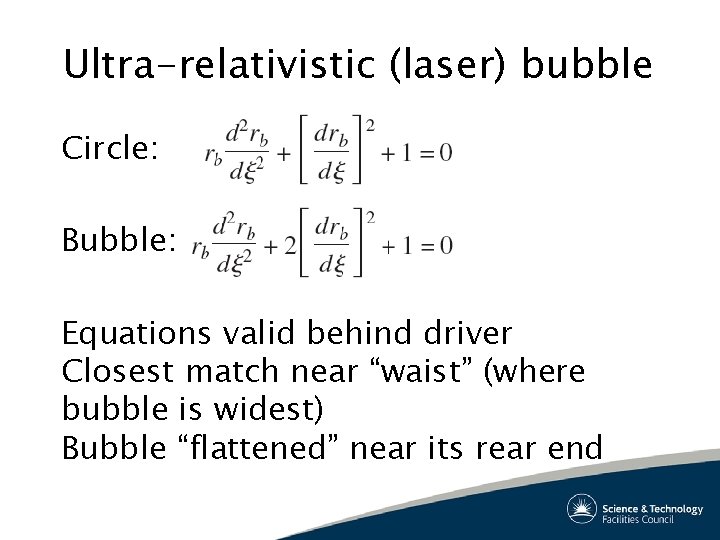
Ultra-relativistic (laser) bubble Circle: Bubble: Equations valid behind driver Closest match near “waist” (where bubble is widest) Bubble “flattened” near its rear end
Beam loading Wakefield accelerates particles → wakefield amplitude is reduced behind particle bunch This is called “beam loading” Difference in wakefield energy content before/after bunch determines efficiency of energy transfer from wakefield to bunch
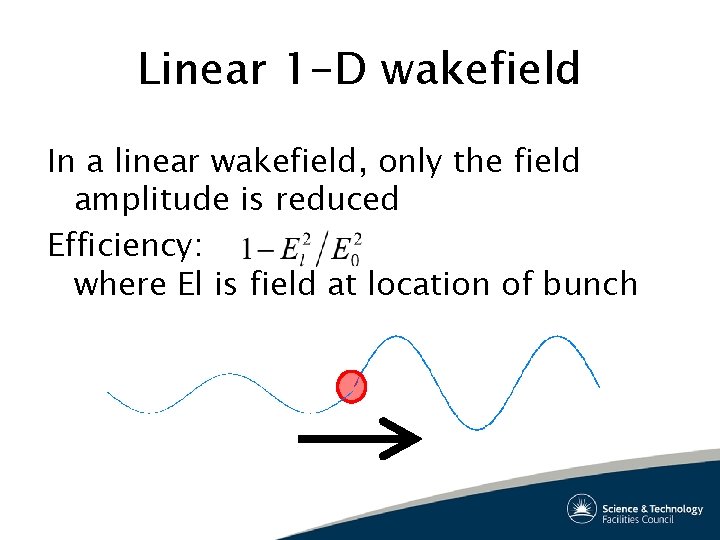
Linear 1 -D wakefield In a linear wakefield, only the field amplitude is reduced Efficiency: where El is field at location of bunch
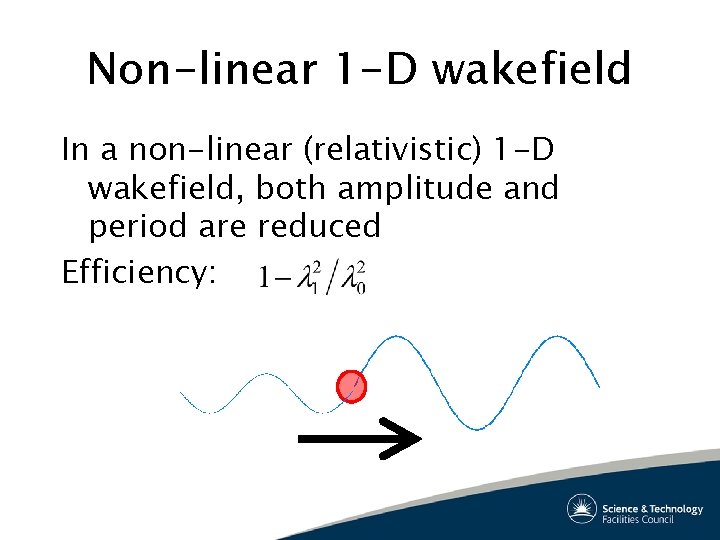
Non-linear 1 -D wakefield In a non-linear (relativistic) 1 -D wakefield, both amplitude and period are reduced Efficiency:
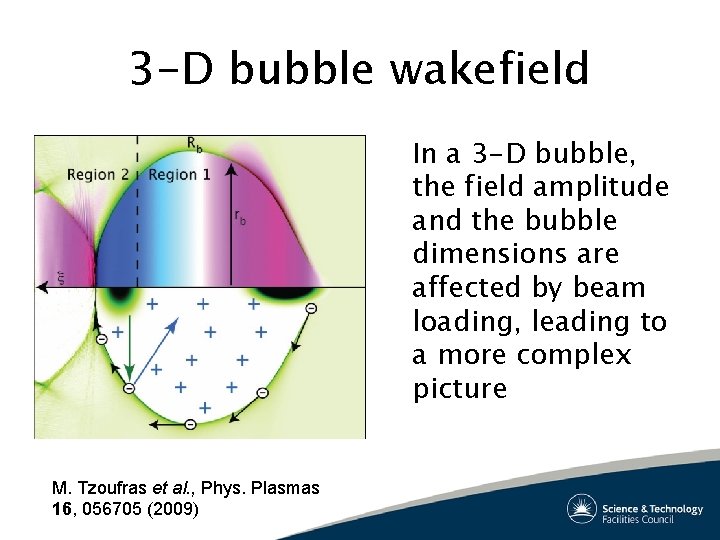
3 -D bubble wakefield In a 3 -D bubble, the field amplitude and the bubble dimensions are affected by beam loading, leading to a more complex picture M. Tzoufras et al. , Phys. Plasmas 16, 056705 (2009)
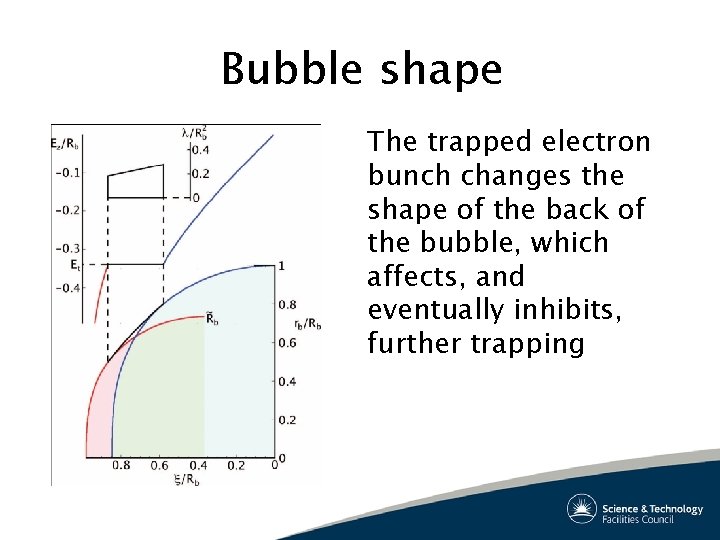
Bubble shape The trapped electron bunch changes the shape of the back of the bubble, which affects, and eventually inhibits, further trapping
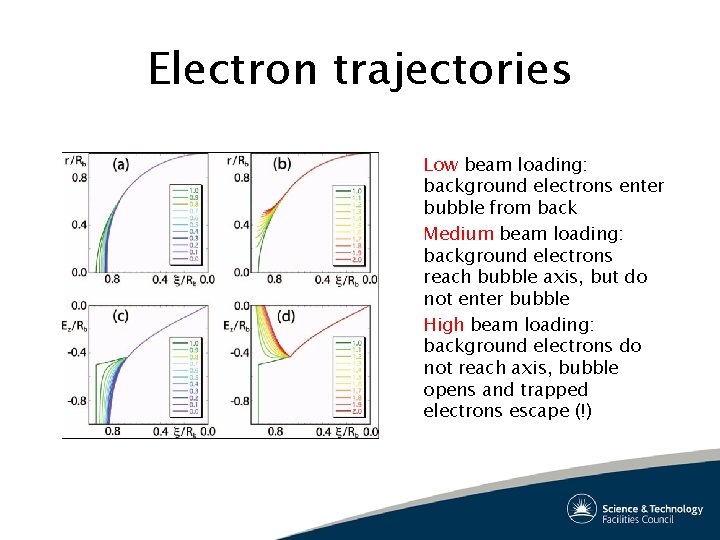
Electron trajectories Low beam loading: background electrons enter bubble from back Medium beam loading: background electrons reach bubble axis, but do not enter bubble High beam loading: background electrons do not reach axis, bubble opens and trapped electrons escape (!)
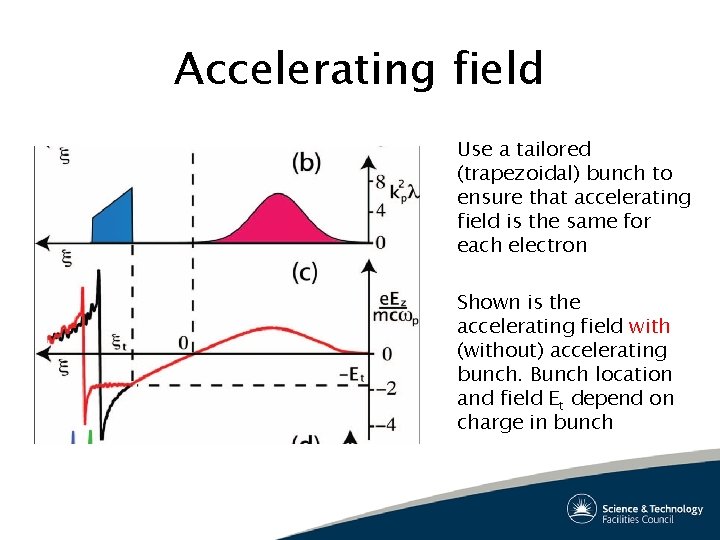
Accelerating field Use a tailored (trapezoidal) bunch to ensure that accelerating field is the same for each electron Shown is the accelerating field with (without) accelerating bunch. Bunch location and field Et depend on charge in bunch
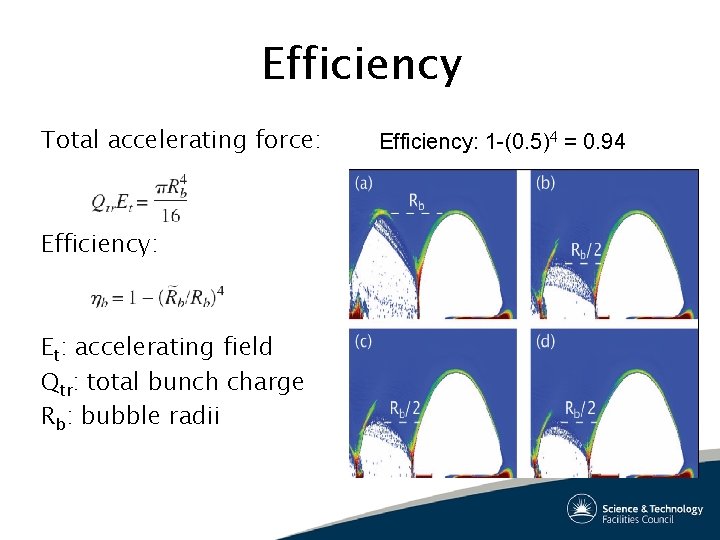
Efficiency Total accelerating force: Efficiency: Et: accelerating field Qtr: total bunch charge Rb: bubble radii Efficiency: 1 -(0. 5)4 = 0. 94
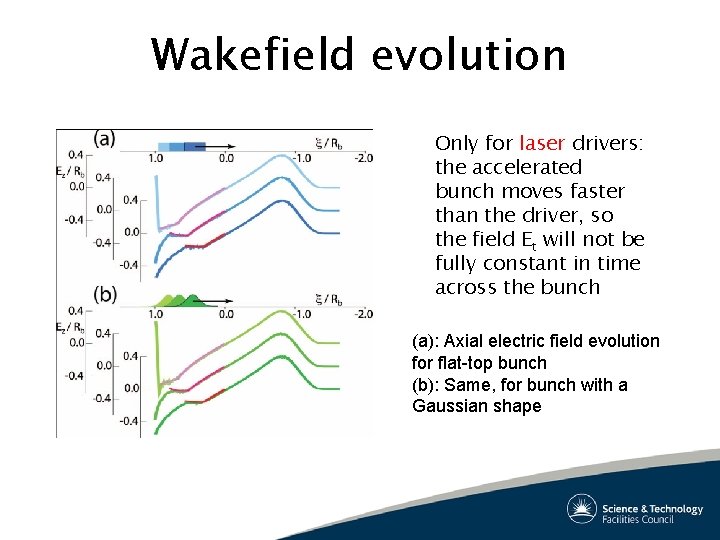
Wakefield evolution Only for laser drivers: the accelerated bunch moves faster than the driver, so the field Et will not be fully constant in time across the bunch (a): Axial electric field evolution for flat-top bunch (b): Same, for bunch with a Gaussian shape
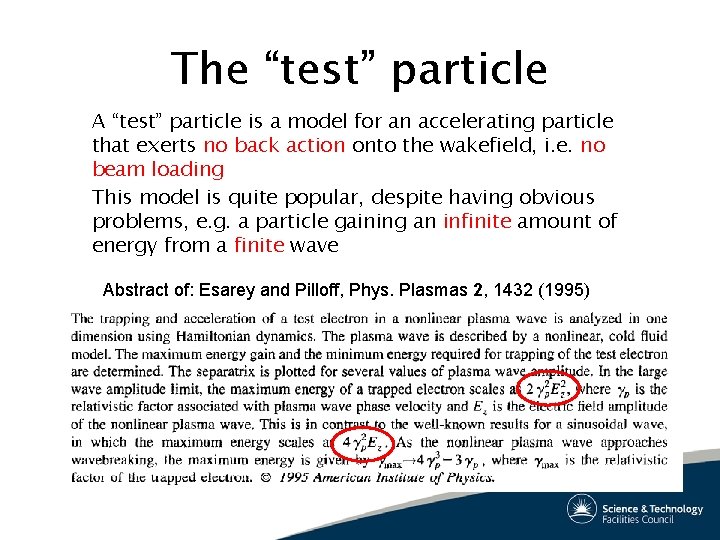
The “test” particle A “test” particle is a model for an accelerating particle that exerts no back action onto the wakefield, i. e. no beam loading This model is quite popular, despite having obvious problems, e. g. a particle gaining an infinite amount of energy from a finite wave Abstract of: Esarey and Pilloff, Phys. Plasmas 2, 1432 (1995)
Beware of test particles Test particles are used in: – Particle trapping and acceleration in wakefields or by relativistic shocks – Photon reflection by the high density regions in wakefields (“flying mirror” scheme for X-ray production) – Photon reflection by moving, laser-driven ionisation fronts (also for X-ray production) Favourite test particle quote: “How can I ever get 1 J of X-rays out of this scheme if there’s only 400 m. J in my driving laser beam!? ”, D. Jaroszynski, Strathclyde University
Summary – Description of the bubble-shaped wakefield – Description of beam loading and acceleration efficiency in the bubble – Read the papers: – W. Lu et al. , Phys. Plasmas 13, 056709 (2006) – M. Tzoufras et al. , Phys. Plasmas 16, 056705 (2009) – Beware of test particles, as they are often misused: – 1 test particle is fine, 2 is doubtful, 3 is bad – 1 test particle gaining a lot of energy is also bad
- Slides: 19