
Introduction to Plant Development Keep a green tree






- Slides: 34
Introduction to Plant Development Keep a green tree in your heart and perhaps the singing bird will come. . Chinese proverb
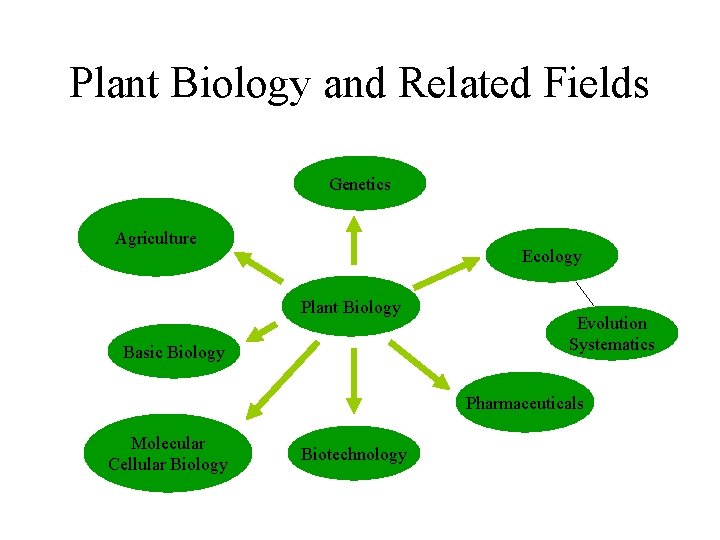
Plant Biology and Related Fields Genetics Agriculture Ecology Plant Biology Basic Biology Evolution Systematics Pharmaceuticals Molecular Cellular Biology Biotechnology
Already • What are the major organ systems that make up the plant body? – what are the major functions of these organs? • What are three major tissues that make up plant organs? – which cell types comprise these tissues? – what are some functions of these cells? • What cellular structures or cellular processes are unique to plants (or at least highly unusual compared with animals)?
Today and Monday • How do plant organs, tissues and cells develop? – Examine Plant Growth, • the irreversible increase in size that (in plants) almost always results from both cell division and cell enlargement, – Examine Plant Cell Differentiation, • the process by which a cell acquires metabolic, structural and functional properties distinct from those of its progenitor, • Development, – the sum total of events that contribute to the progressive elaboration of the body of an organism.
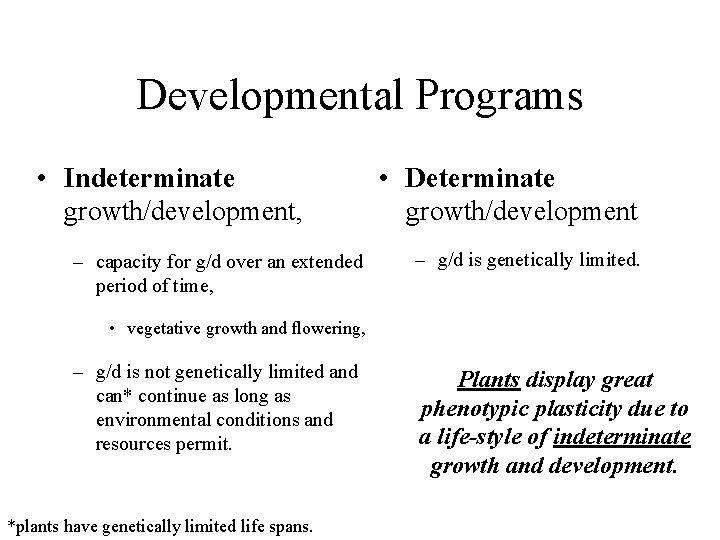
Developmental Programs • Indeterminate growth/development, – capacity for g/d over an extended period of time, • Determinate growth/development – g/d is genetically limited. • vegetative growth and flowering, – g/d is not genetically limited and can* continue as long as environmental conditions and resources permit. *plants have genetically limited life spans. Plants display great phenotypic plasticity due to a life-style of indeterminate growth and development.
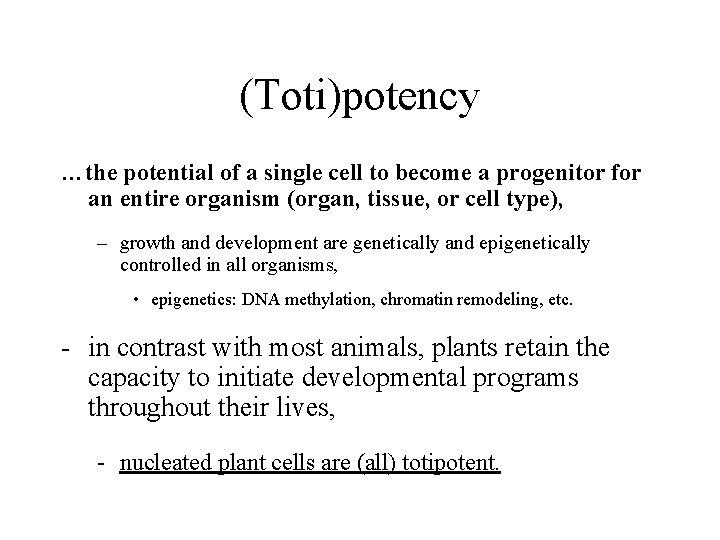
(Toti)potency …the potential of a single cell to become a progenitor for an entire organism (organ, tissue, or cell type), – growth and development are genetically and epigenetically controlled in all organisms, • epigenetics: DNA methylation, chromatin remodeling, etc. - in contrast with most animals, plants retain the capacity to initiate developmental programs throughout their lives, - nucleated plant cells are (all) totipotent.
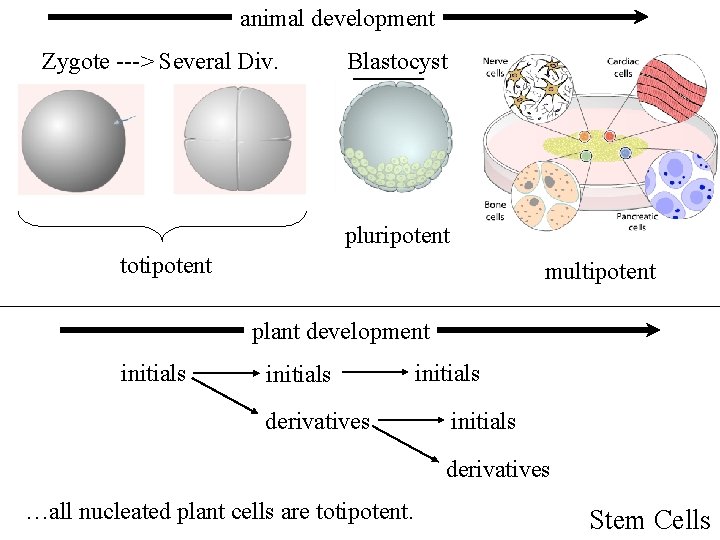
animal development Zygote ---> Several Div. Blastocyst pluripotent totipotent multipotent plant development initials derivatives …all nucleated plant cells are totipotent. Stem Cells
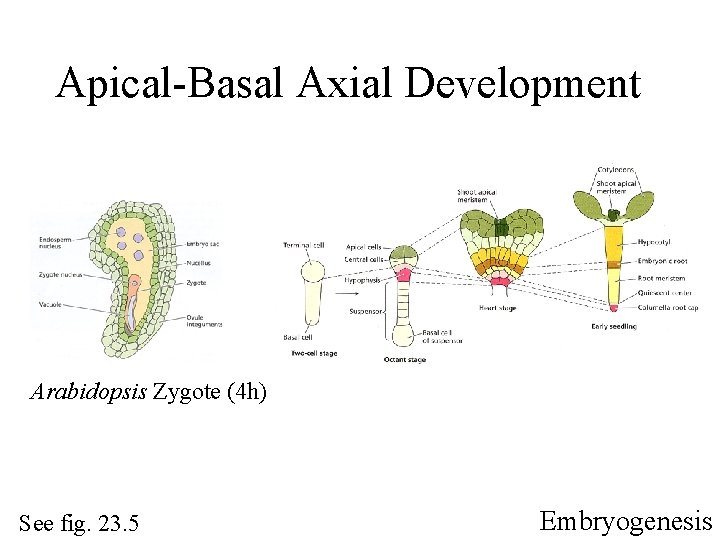
Apical-Basal Axial Development Arabidopsis Zygote (4 h) See fig. 23. 5 Embryogenesis
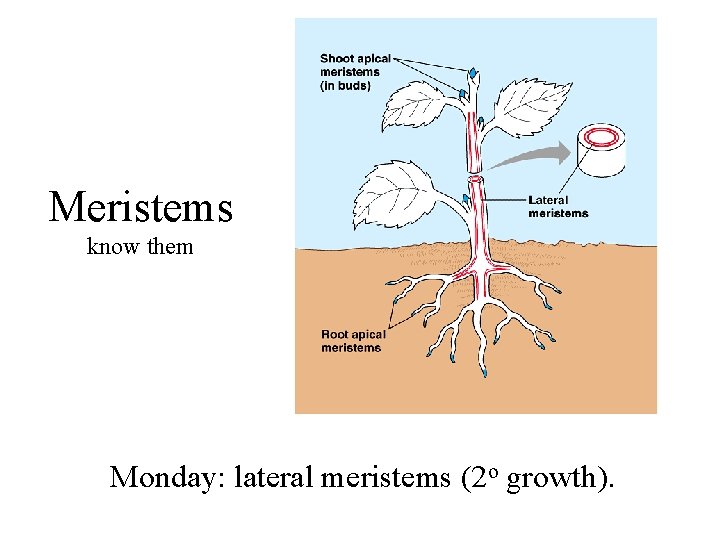
Meristems. . . …persistent populations of small isodiametric cells with embryonic characteristics.
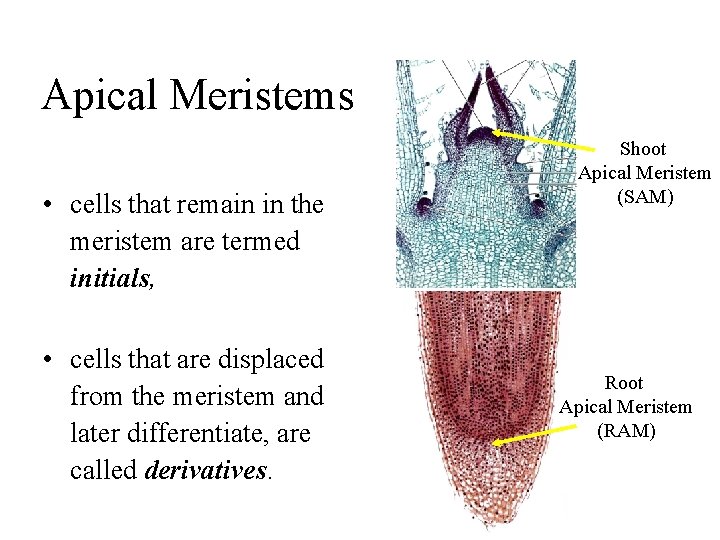
Apical Meristems • cells that remain in the meristem are termed initials, • cells that are displaced from the meristem and later differentiate, are called derivatives. Shoot Apical Meristem (SAM) Root Apical Meristem (RAM)
Totipotency plant development initials derivatives …all nucleated plant cells are totipotent.
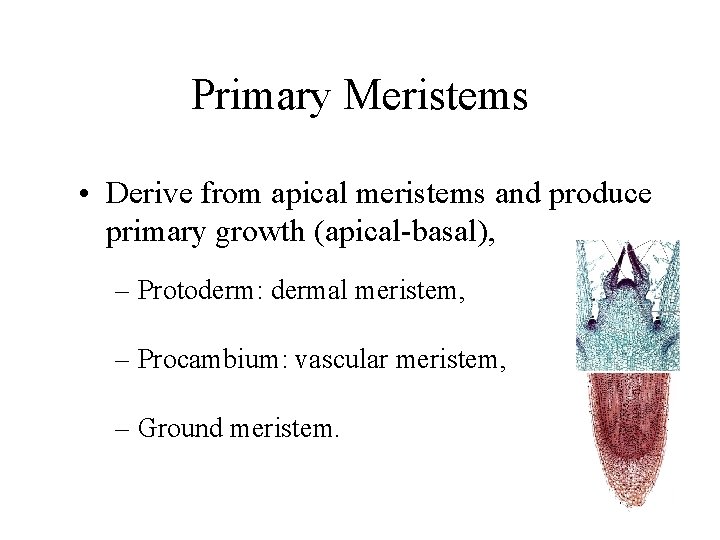
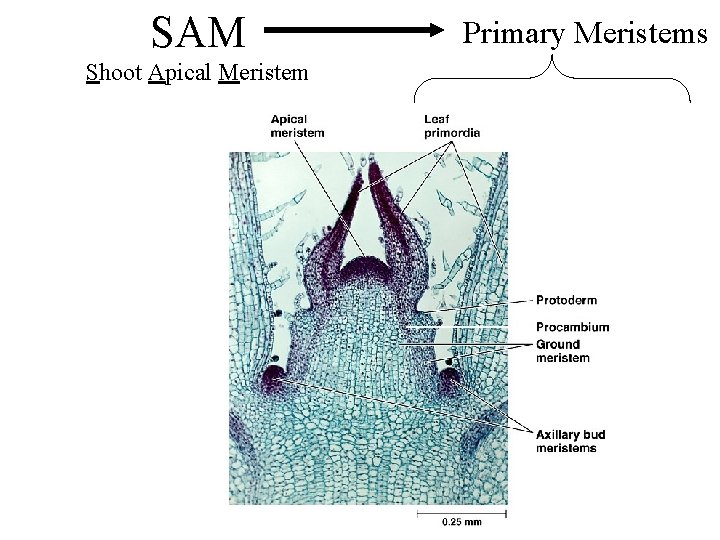
Primary Meristems • Derive from apical meristems and produce primary growth (apical-basal), – Protoderm: dermal meristem, – Procambium: vascular meristem, – Ground meristem.
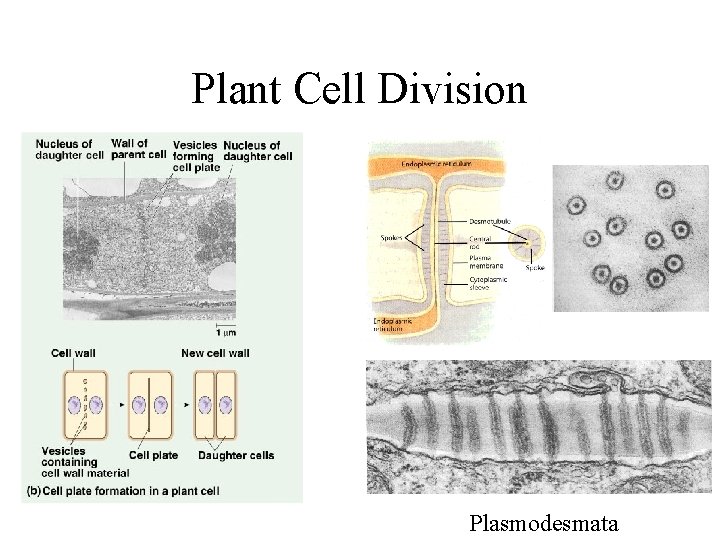
Plant Cell Division Plasmodesmata
Plant Structure Apoplast / Symplast Apoplast Symplast The cell wall continuum of a plant. “Outside of the symplast. ” The interconnected protoplasts and their plasmodesmata.
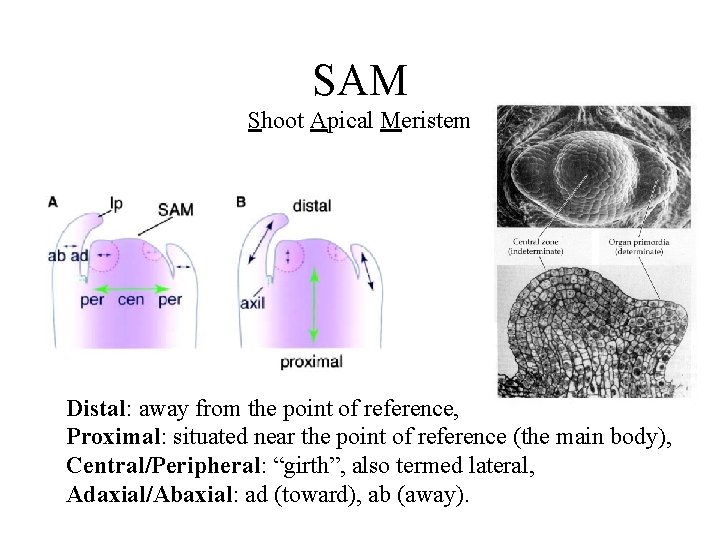
SAM Shoot Apical Meristem Distal: away from the point of reference, Proximal: situated near the point of reference (the main body), Central/Peripheral: “girth”, also termed lateral, Adaxial/Abaxial: ad (toward), ab (away).
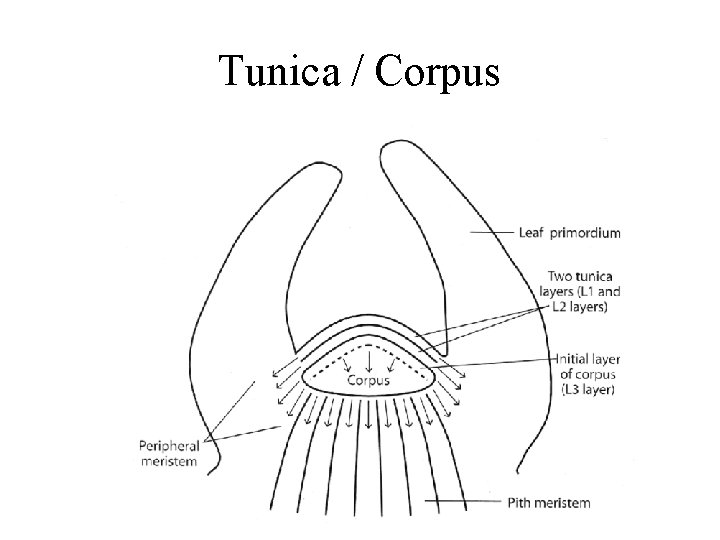
Tunica / Corpus
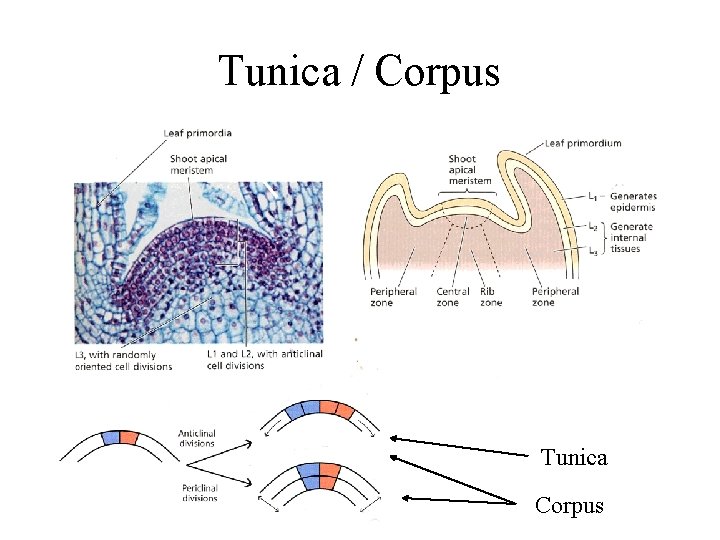
Tunica / Corpus Tunica Corpus
SAM Shoot Apical Meristem Primary Meristems
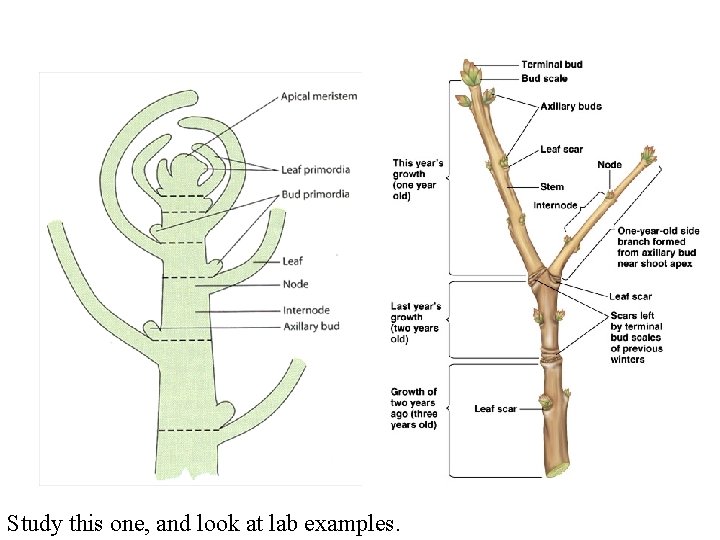
Study this one, and look at lab examples.
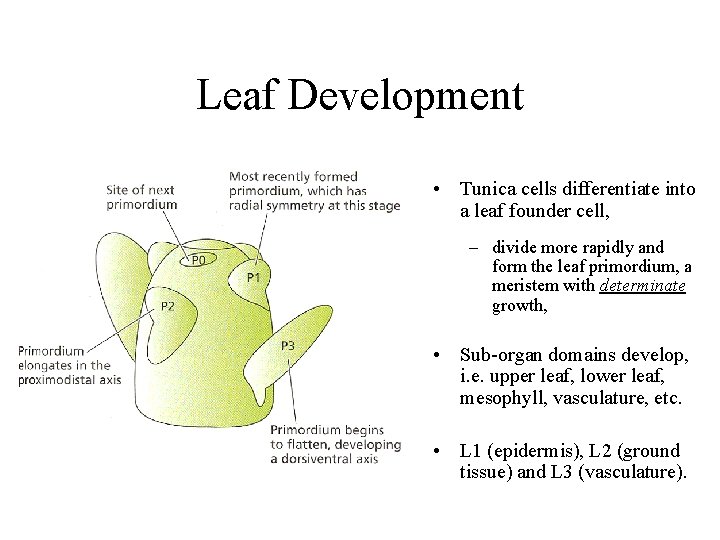
Leaf Development • Tunica cells differentiate into a leaf founder cell, – divide more rapidly and form the leaf primordium, a meristem with determinate growth, • Sub-organ domains develop, i. e. upper leaf, lower leaf, mesophyll, vasculature, etc. • L 1 (epidermis), L 2 (ground tissue) and L 3 (vasculature).
Phyllotaxy • The number and order in which leaf primordia form is genetically determined and is generally characteristic of species.
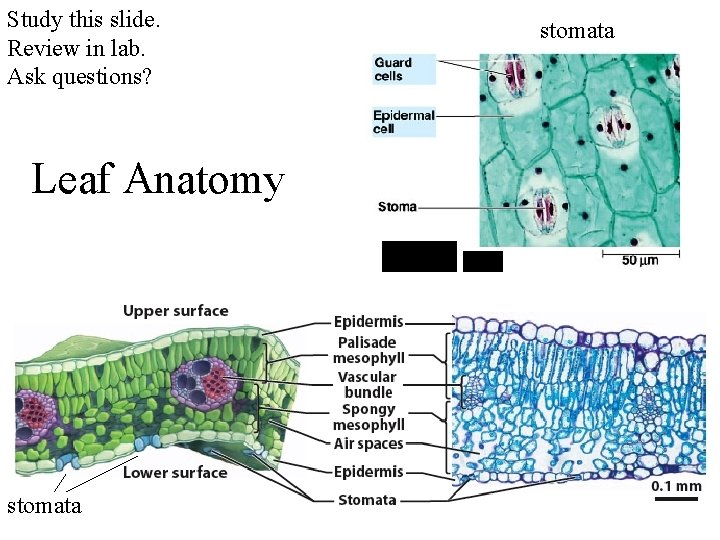
Study this slide. Review in lab. Ask questions? Leaf Anatomy stomata
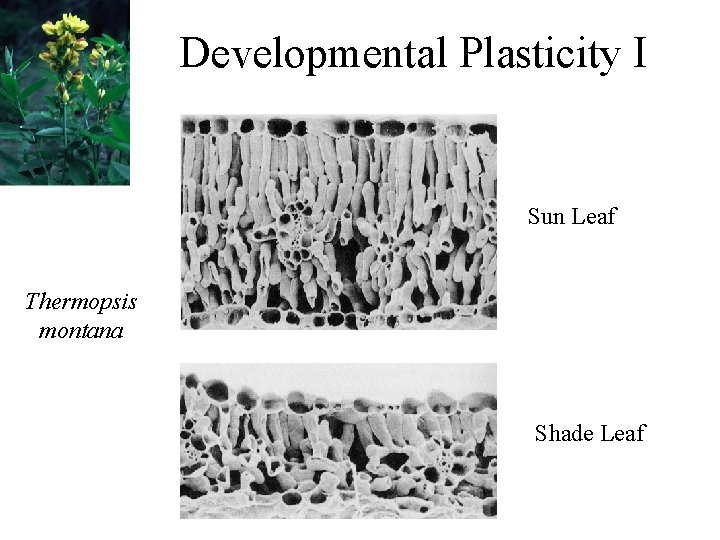
Developmental Plasticity I Sun Leaf Thermopsis montana Shade Leaf
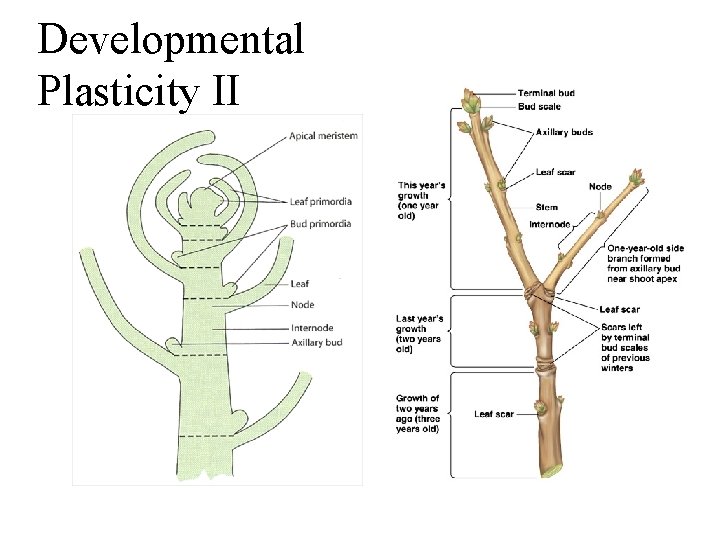
Developmental Plasticity II
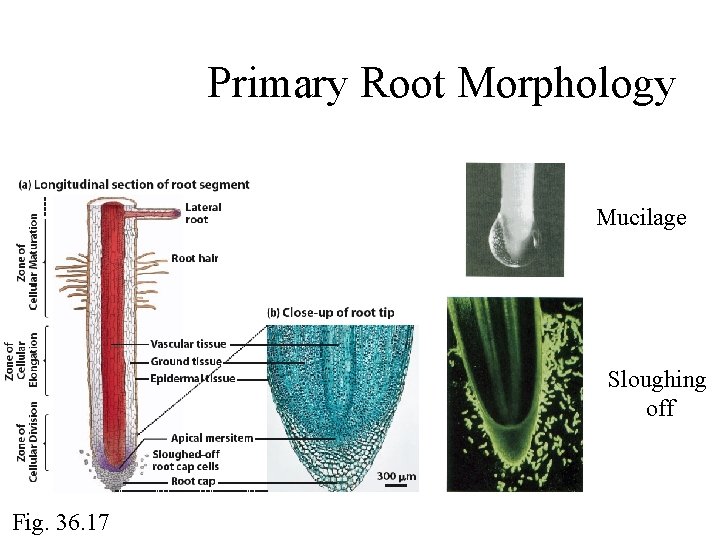
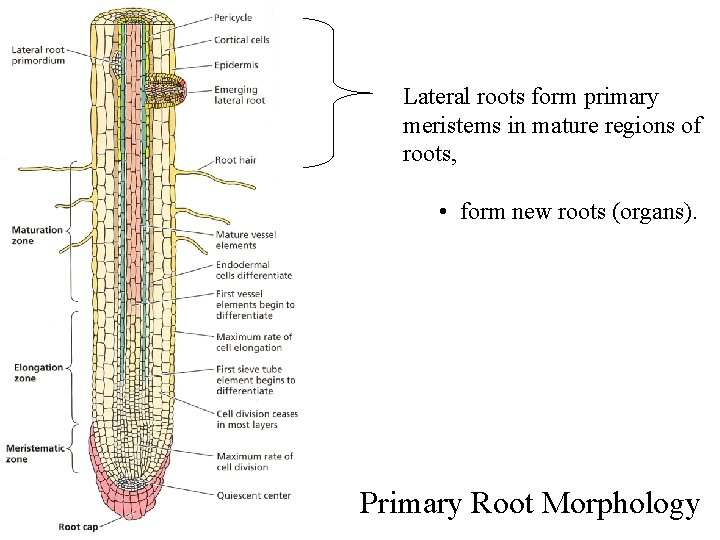
Primary Root Morphology Mucilage Sloughing off Fig. 36. 17
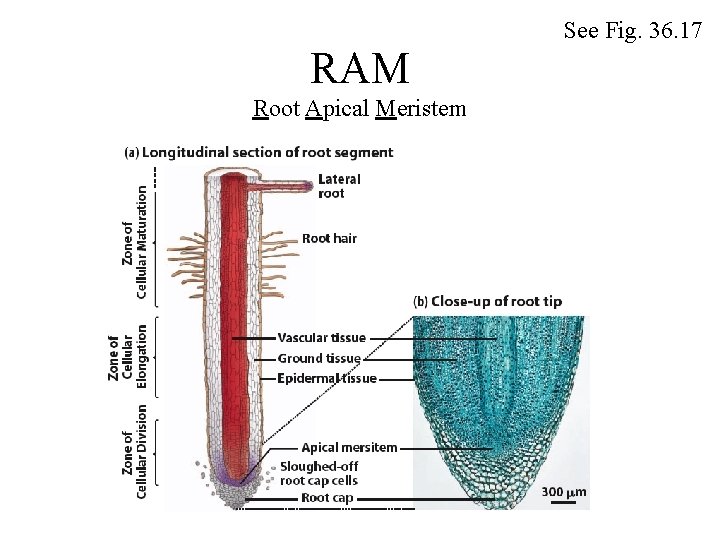
Root Morphology The Zone of Elongation Cells Grow in Size Vacuole Appears and Grows Mature Organelles are Produced The Zone of Mitosis (Meristematic) Makes new cells by Mitosis Meristematic Cells Divide by Mitosis The Root Cap To reduce friction from growth in soil The root cap secretes mucilage The root cap sloughs cells
See Fig. 36. 17 RAM Root Apical Meristem
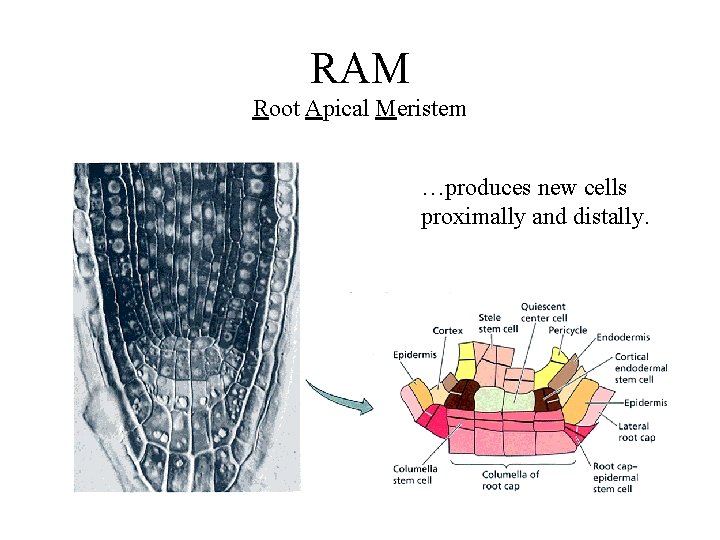
RAM Root Apical Meristem …produces new cells proximally and distally.
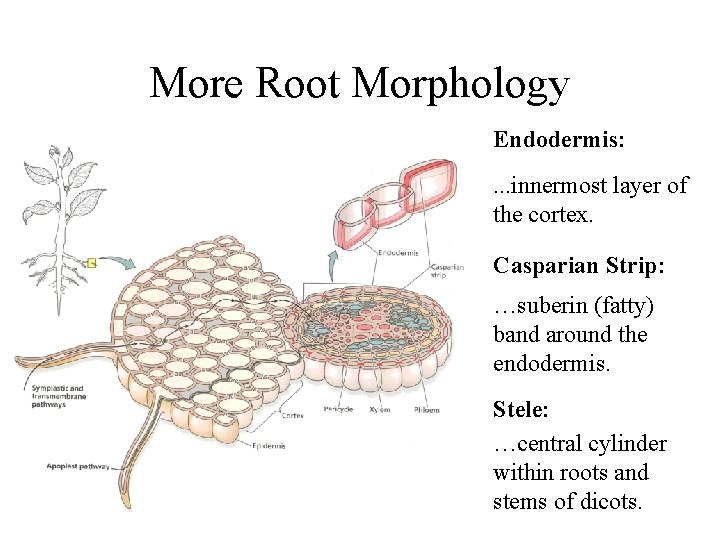
More Root Morphology Endodermis: . . . innermost layer of the cortex. Casparian Strip: …suberin (fatty) band around the endodermis. Stele: …central cylinder within roots and stems of dicots.
Lateral roots form primary meristems in mature regions of roots, • form new roots (organs). Primary Root Morphology
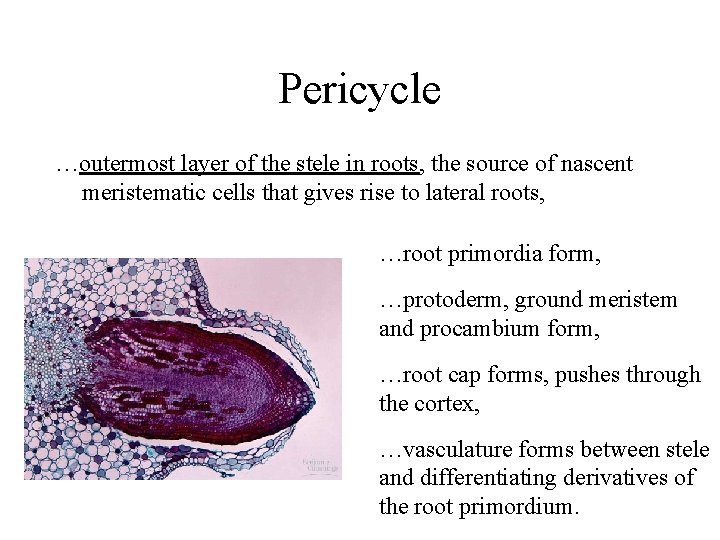
Pericycle …outermost layer of the stele in roots, the source of nascent meristematic cells that gives rise to lateral roots, …root primordia form, …protoderm, ground meristem and procambium form, …root cap forms, pushes through the cortex, …vasculature forms between stele and differentiating derivatives of the root primordium.
Meristems know them Monday: lateral meristems (2 o growth).
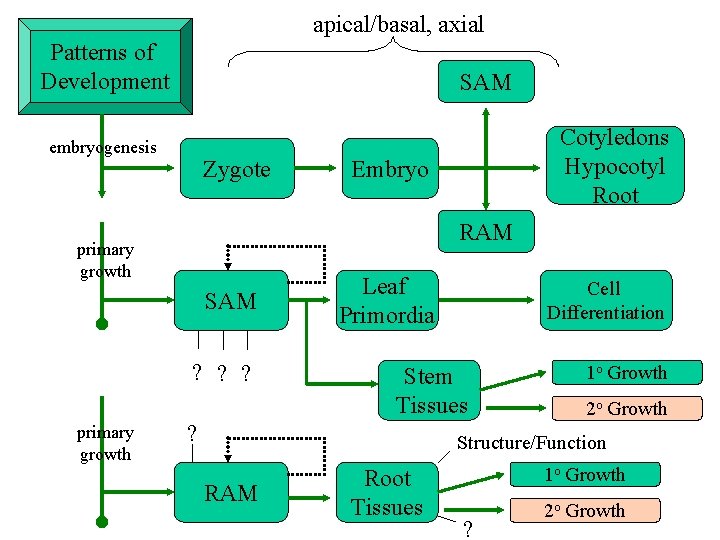
apical/basal, axial Patterns of Development SAM embryogenesis Zygote Embryo RAM primary growth SAM ? ? ? primary growth Cotyledons Hypocotyl Root Leaf Primordia Cell Differentiation Stem Tissues ? 1 o Growth 2 o Growth Structure/Function RAM Root Tissues 1 o Growth ? 2 o Growth
Monday • Read the rest of the chapter, • Stump the me with questions?