
Introduction to Physics Process Skills Measurement What is

- Slides: 34
Introduction to Physics Process Skills
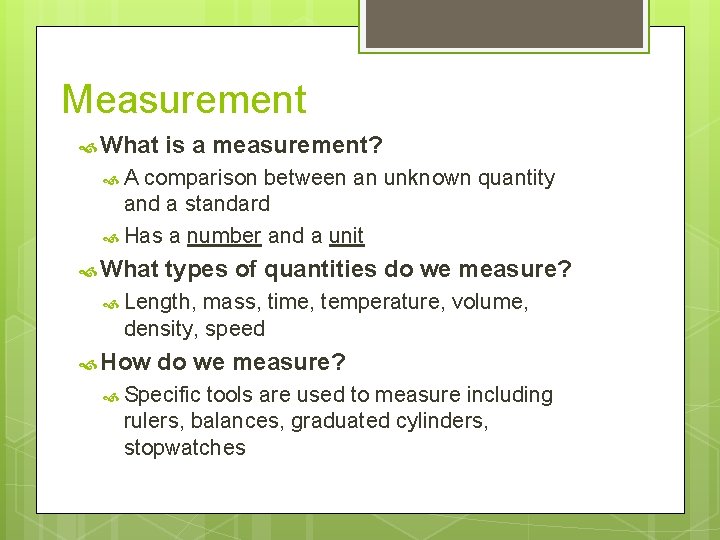
Measurement What is a measurement? A comparison between an unknown quantity and a standard Has a number and a unit What types of quantities do we measure? Length, mass, time, temperature, volume, density, speed How do we measure? Specific tools are used to measure including rulers, balances, graduated cylinders, stopwatches
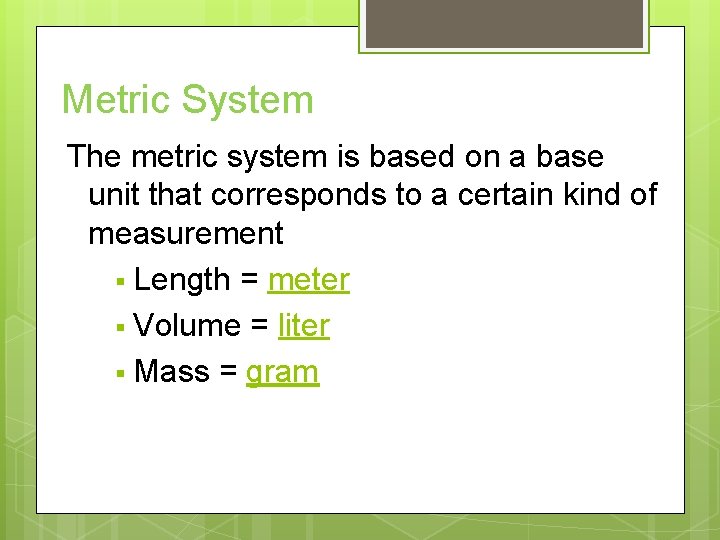
Metric System The metric system is based on a base unit that corresponds to a certain kind of measurement § Length = meter § Volume = liter § Mass = gram
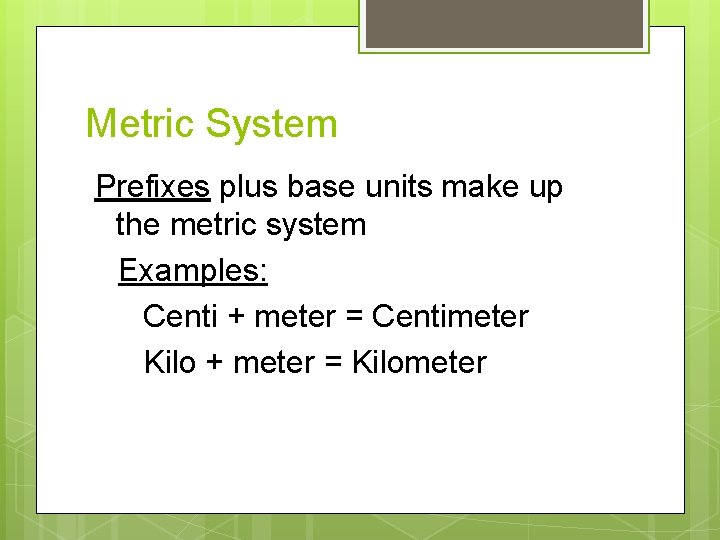
Metric System Prefixes plus base units make up the metric system Examples: Centi + meter = Centimeter Kilo + meter = Kilometer
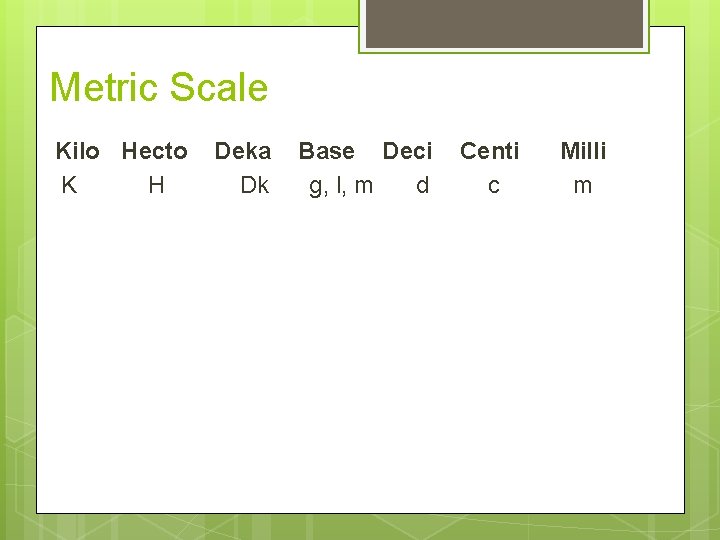
Metric Scale Kilo Hecto K H Deka Dk Base Deci g, l, m d Centi c Milli m
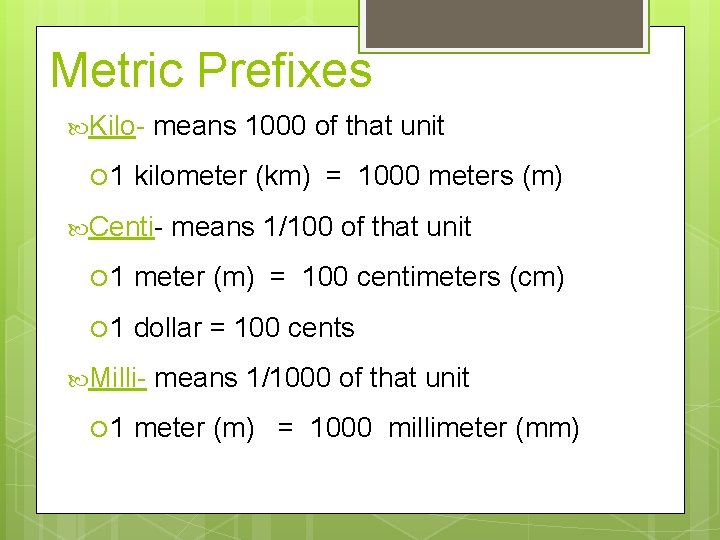
Metric Prefixes Kilo 1 means 1000 of that unit kilometer (km) = 1000 meters (m) Centi- means 1/100 of that unit 1 meter (m) = 100 centimeters (cm) 1 dollar = 100 cents Milli 1 means 1/1000 of that unit meter (m) = 1000 millimeter (mm)
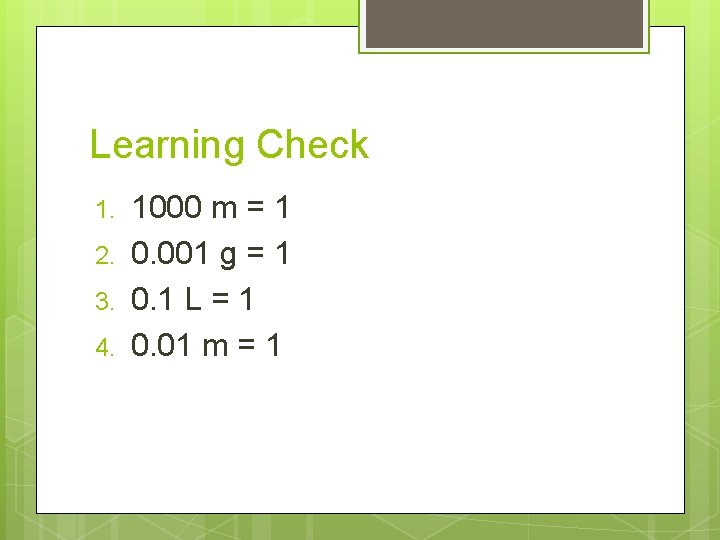
Learning Check 1. 2. 3. 4. 1000 m = 1 0. 001 g = 1 0. 1 L = 1 0. 01 m = 1
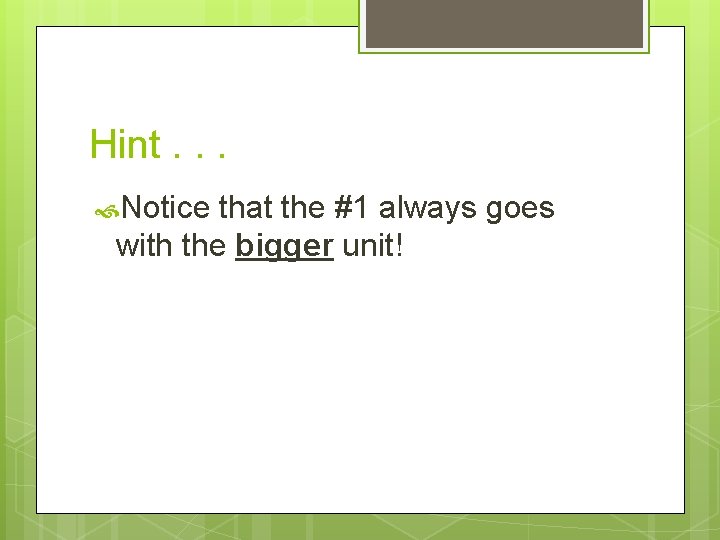
Hint. . . Notice that the #1 always goes with the bigger unit!
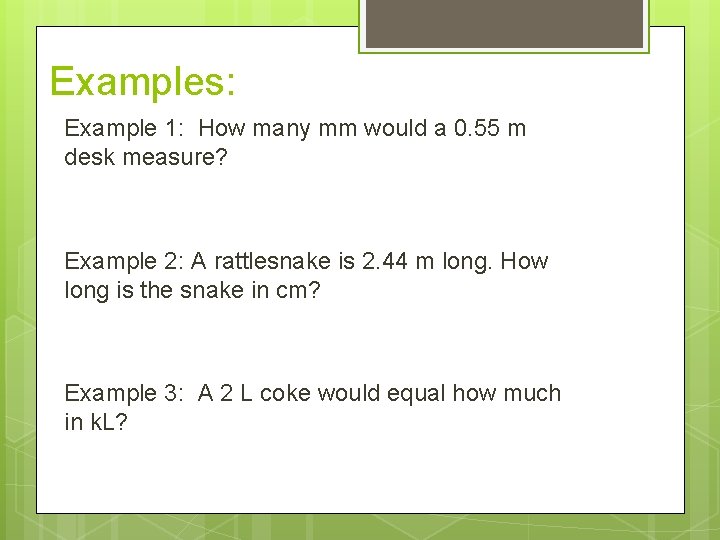
Examples: Example 1: How many mm would a 0. 55 m desk measure? Example 2: A rattlesnake is 2. 44 m long. How long is the snake in cm? Example 3: A 2 L coke would equal how much in k. L?
Scientific Notation § § Scientific notation is a way of expressing really big numbers or really small numbers. For very large and very small numbers, scientific notation is more concise.
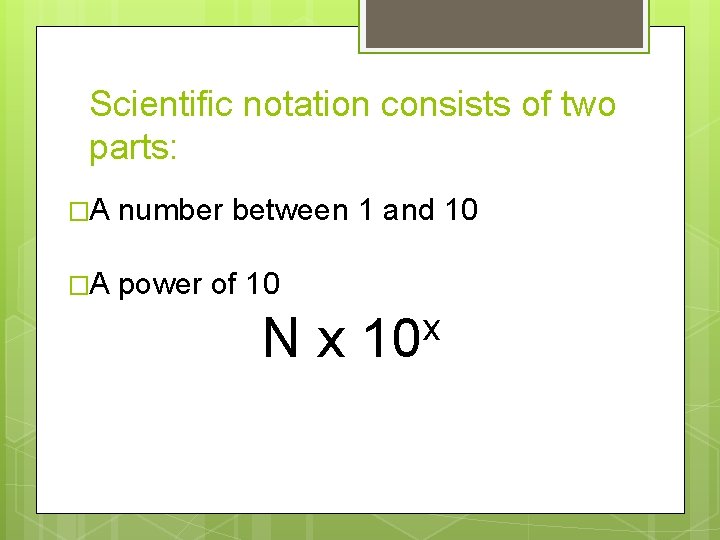
Scientific notation consists of two parts: �A number between 1 and 10 �A power of 10 Nx x 10
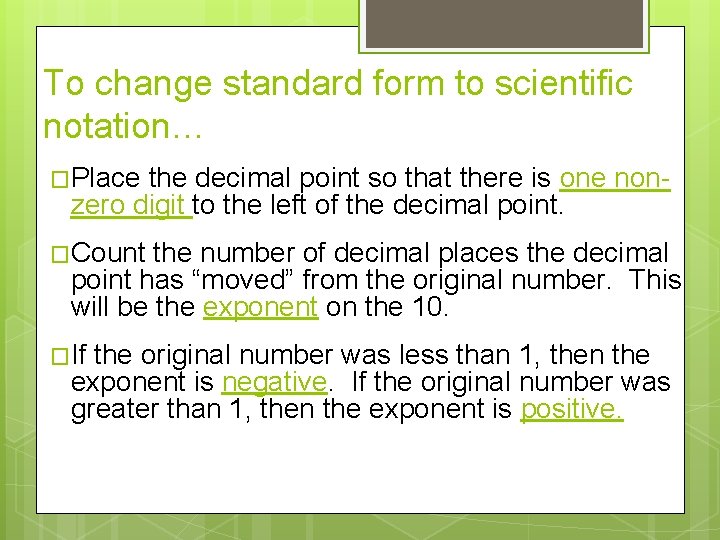
To change standard form to scientific notation… �Place the decimal point so that there is one nonzero digit to the left of the decimal point. �Count the number of decimal places the decimal point has “moved” from the original number. This will be the exponent on the 10. �If the original number was less than 1, then the exponent is negative. If the original number was greater than 1, then the exponent is positive.
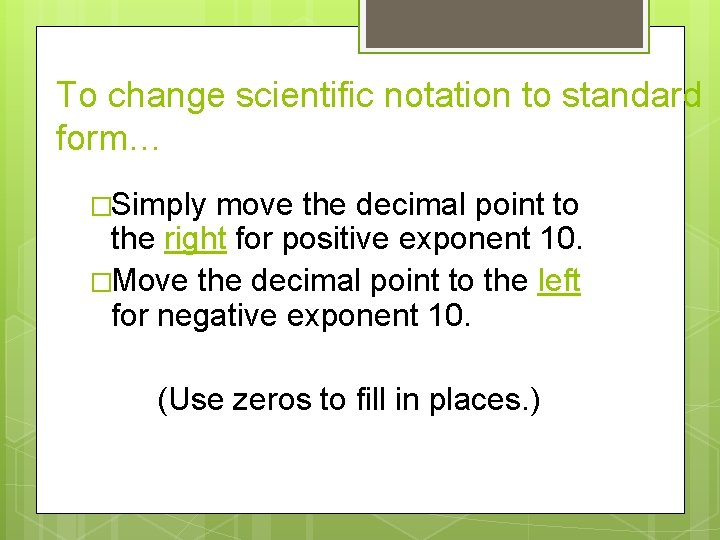
To change scientific notation to standard form… �Simply move the decimal point to the right for positive exponent 10. �Move the decimal point to the left for negative exponent 10. (Use zeros to fill in places. )
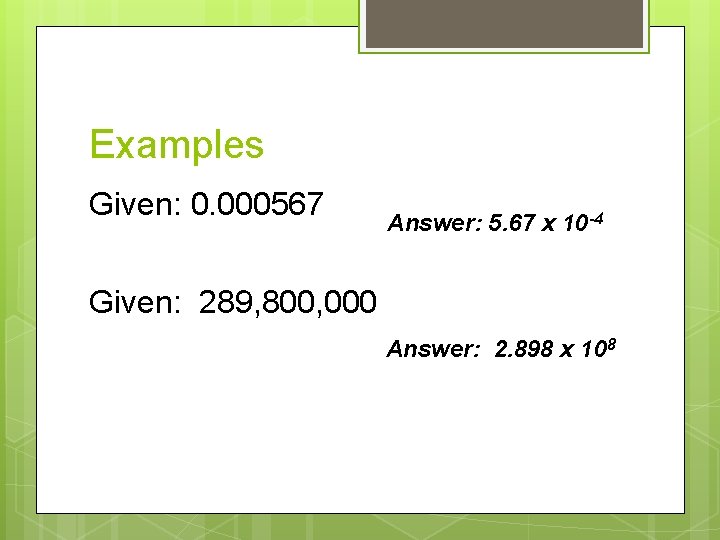
Examples Given: 0. 000567 Answer: 5. 67 x 10 -4 Given: 289, 800, 000 Answer: 2. 898 x 108
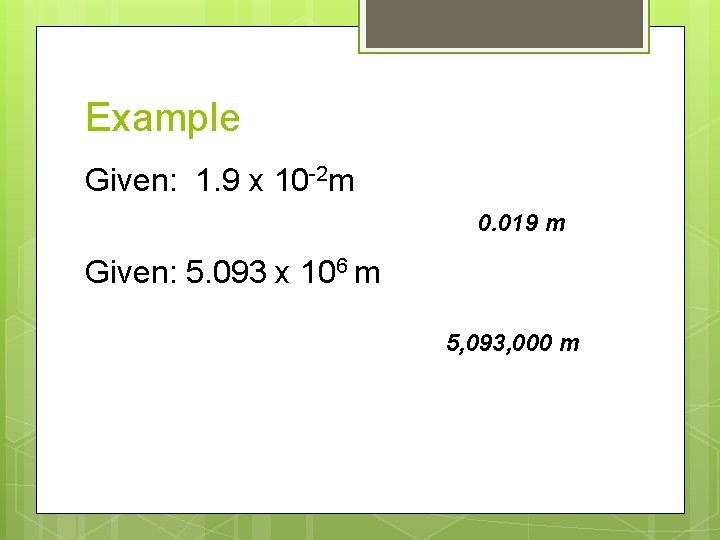
Example Given: 1. 9 x 10 -2 m 0. 019 m Given: 5. 093 x 106 m 5, 093, 000 m
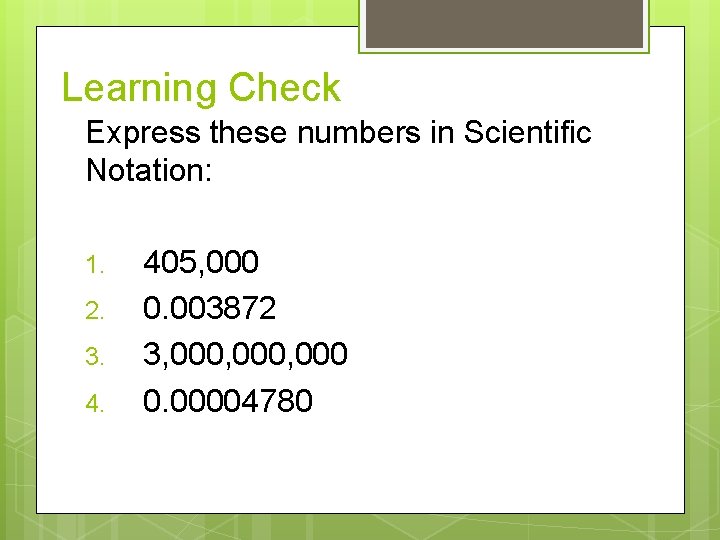
Learning Check Express these numbers in Scientific Notation: 1. 2. 3. 4. 405, 000 0. 003872 3, 000, 000 0. 00004780
Graphing § § A mathematical picture; used to show information quickly and simply Relationships we will study include linear and inverse
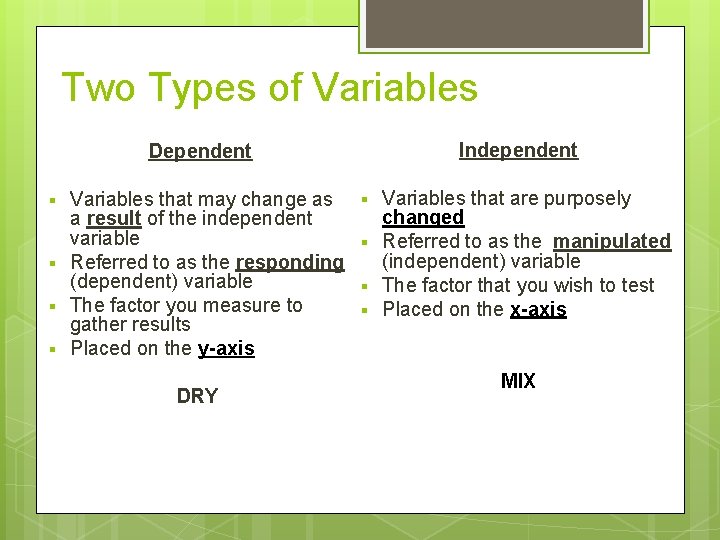
Two Types of Variables Independent Dependent § § Variables that may change as a result of the independent variable Referred to as the responding (dependent) variable The factor you measure to gather results Placed on the y-axis DRY § § Variables that are purposely changed Referred to as the manipulated (independent) variable The factor that you wish to test Placed on the x-axis MIX
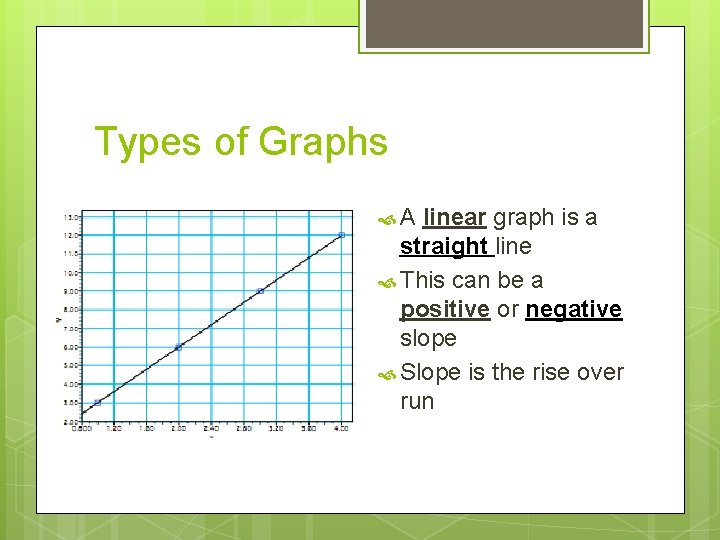
Types of Graphs A linear graph is a straight line This can be a positive or negative slope Slope is the rise over run
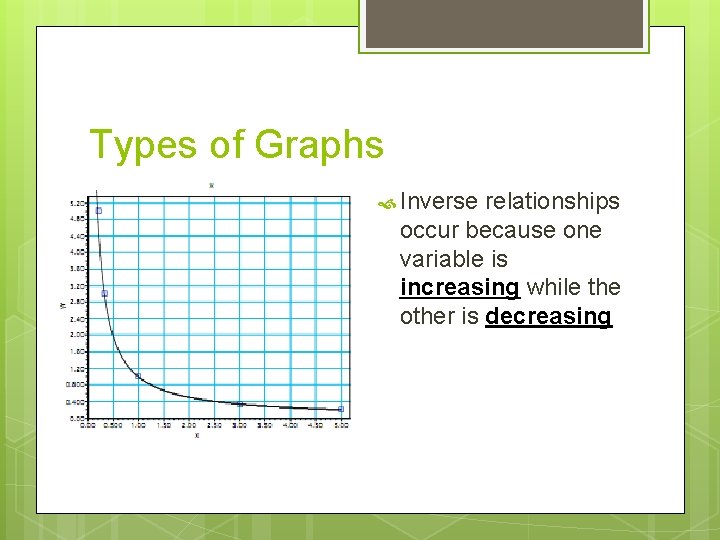
Types of Graphs Inverse relationships occur because one variable is increasing while the other is decreasing
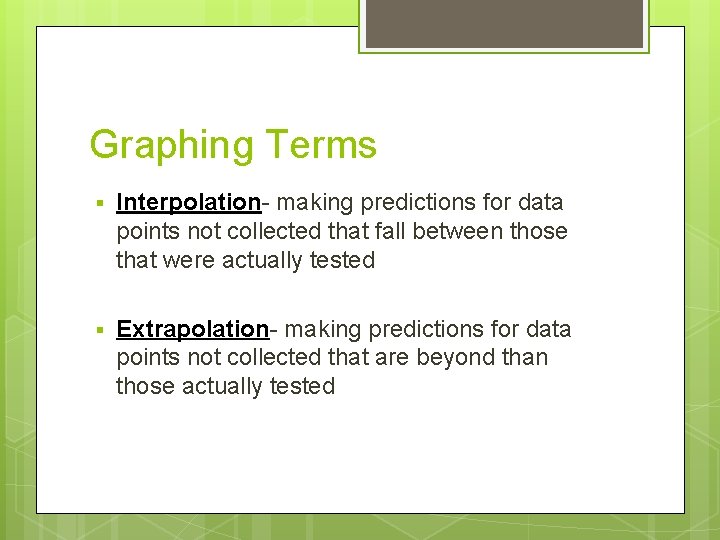
Graphing Terms § Interpolation- making predictions for data points not collected that fall between those that were actually tested § Extrapolation- making predictions for data points not collected that are beyond than those actually tested
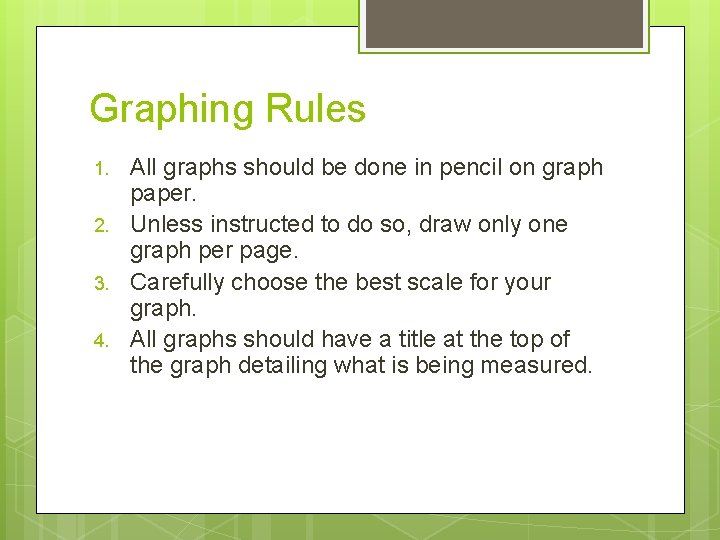
Graphing Rules 1. 2. 3. 4. All graphs should be done in pencil on graph paper. Unless instructed to do so, draw only one graph per page. Carefully choose the best scale for your graph. All graphs should have a title at the top of the graph detailing what is being measured.
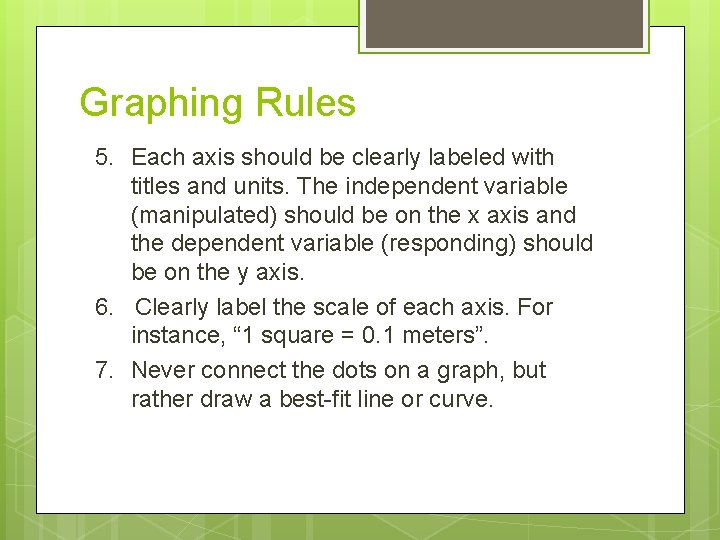
Graphing Rules 5. Each axis should be clearly labeled with titles and units. The independent variable (manipulated) should be on the x axis and the dependent variable (responding) should be on the y axis. 6. Clearly label the scale of each axis. For instance, “ 1 square = 0. 1 meters”. 7. Never connect the dots on a graph, but rather draw a best-fit line or curve.
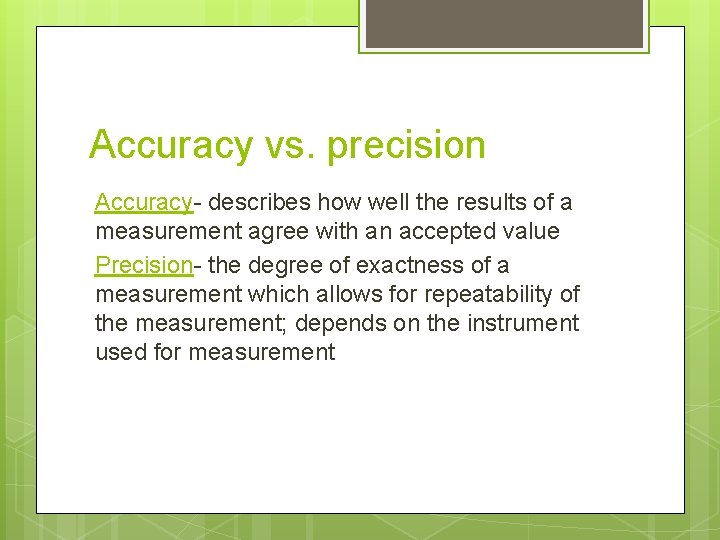
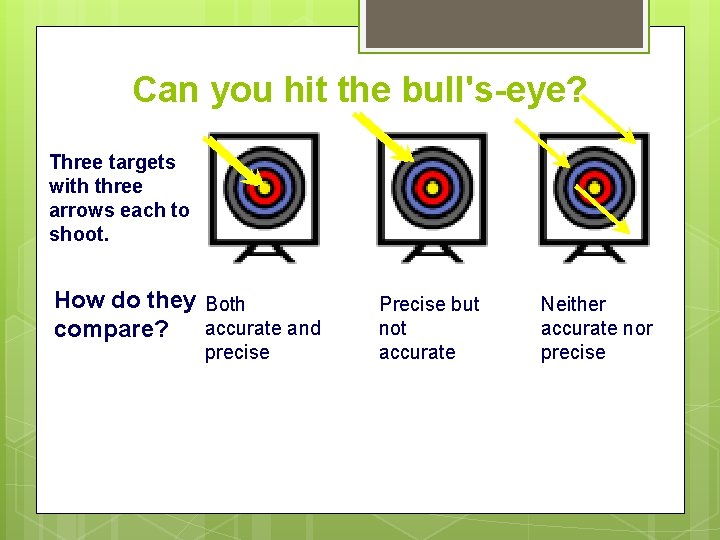
Accuracy vs. precision Accuracy- describes how well the results of a measurement agree with an accepted value Precision- the degree of exactness of a measurement which allows for repeatability of the measurement; depends on the instrument used for measurement
Can you hit the bull's-eye? Three targets with three arrows each to shoot. How do they Both accurate and compare? precise Precise but not accurate Neither accurate nor precise
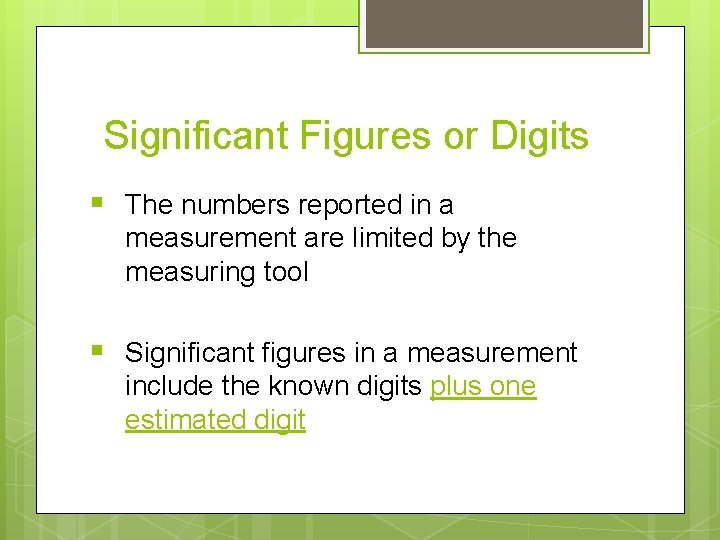
Significant Figures or Digits § The numbers reported in a measurement are limited by the measuring tool § Significant figures in a measurement include the known digits plus one estimated digit
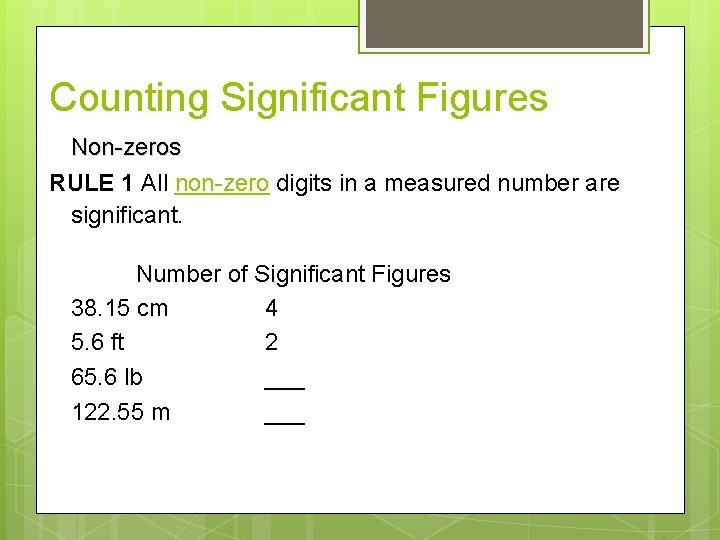
Counting Significant Figures Non-zeros RULE 1 All non-zero digits in a measured number are significant. Number of Significant Figures 38. 15 cm 4 5. 6 ft 2 65. 6 lb ___ 122. 55 m ___
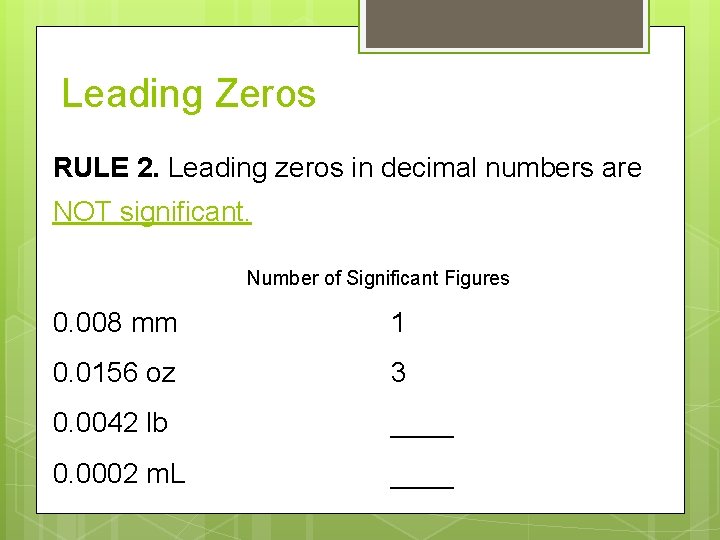
Leading Zeros RULE 2. Leading zeros in decimal numbers are NOT significant. Number of Significant Figures 0. 008 mm 1 0. 0156 oz 3 0. 0042 lb ____ 0. 0002 m. L ____
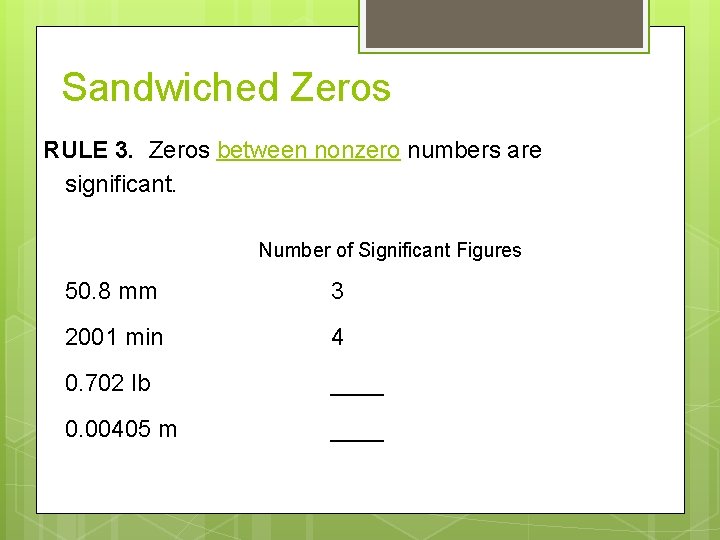
Sandwiched Zeros RULE 3. Zeros between nonzero numbers are significant. Number of Significant Figures 50. 8 mm 3 2001 min 4 0. 702 lb ____ 0. 00405 m ____
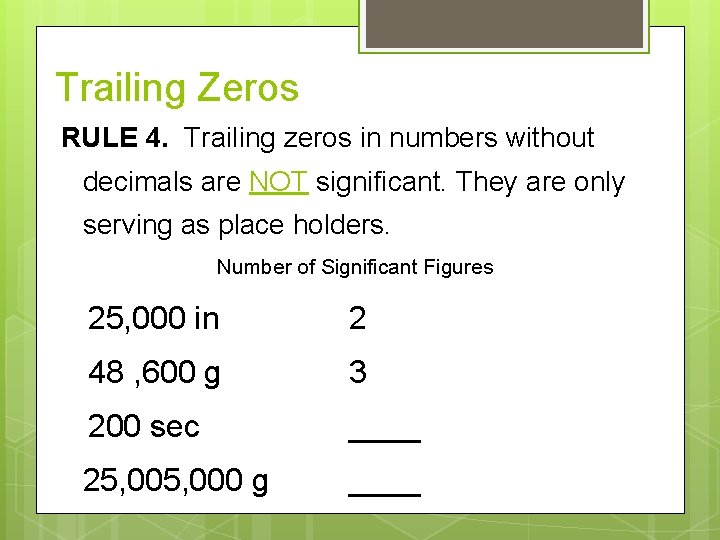
Trailing Zeros RULE 4. Trailing zeros in numbers without decimals are NOT significant. They are only serving as place holders. Number of Significant Figures 25, 000 in 2 48 , 600 g 3 200 sec ____ 25, 000 g ____
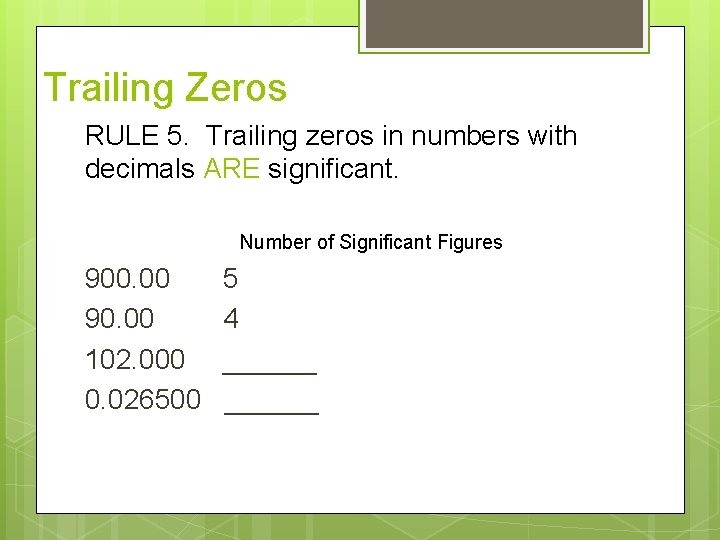
Trailing Zeros RULE 5. Trailing zeros in numbers with decimals ARE significant. Number of Significant Figures 900. 00 90. 00 102. 000 0. 026500 5 4 ______
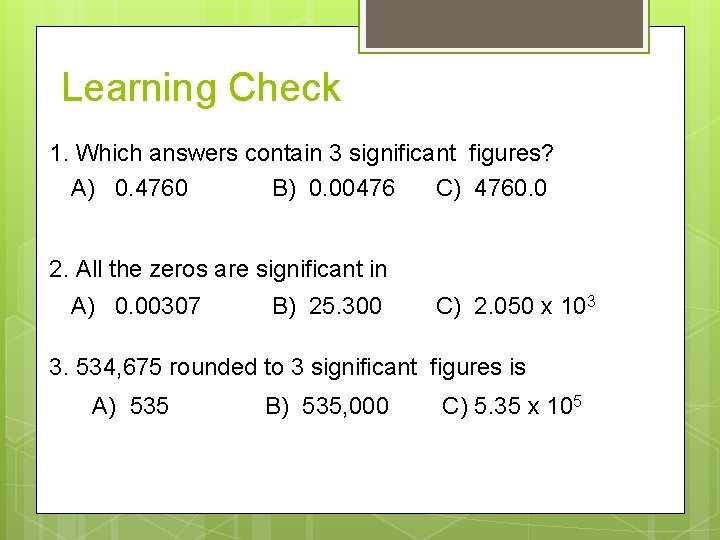
Learning Check 1. Which answers contain 3 significant figures? A) 0. 4760 B) 0. 00476 C) 4760. 0 2. All the zeros are significant in A) 0. 00307 B) 25. 300 C) 2. 050 x 103 3. 534, 675 rounded to 3 significant figures is A) 535 B) 535, 000 C) 5. 35 x 105
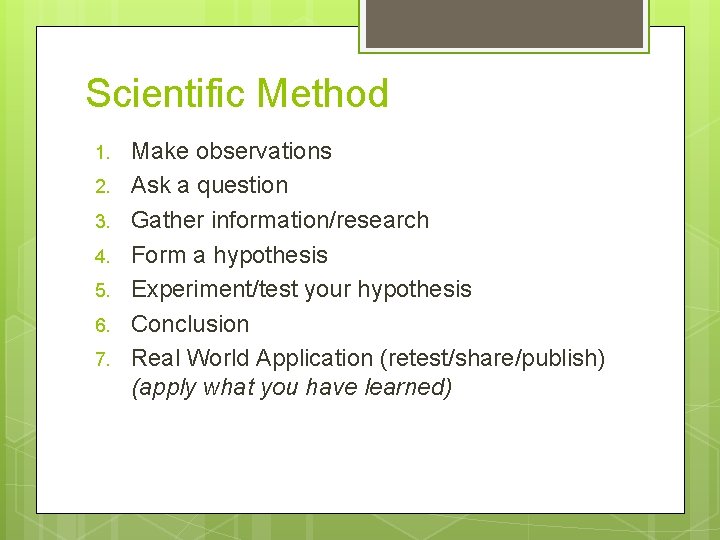
Scientific Method 1. 2. 3. 4. 5. 6. 7. Make observations Ask a question Gather information/research Form a hypothesis Experiment/test your hypothesis Conclusion Real World Application (retest/share/publish) (apply what you have learned)
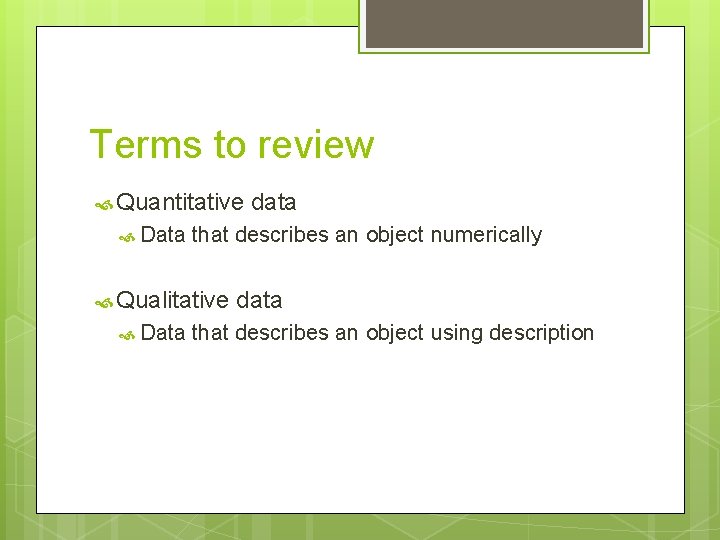
Terms to review Quantitative Data that describes an object numerically Qualitative Data data that describes an object using description