
Introduction to Personality Chapter 13 Lecture 1 Personality
- Slides: 12
Introduction to Personality Chapter 13, Lecture 1
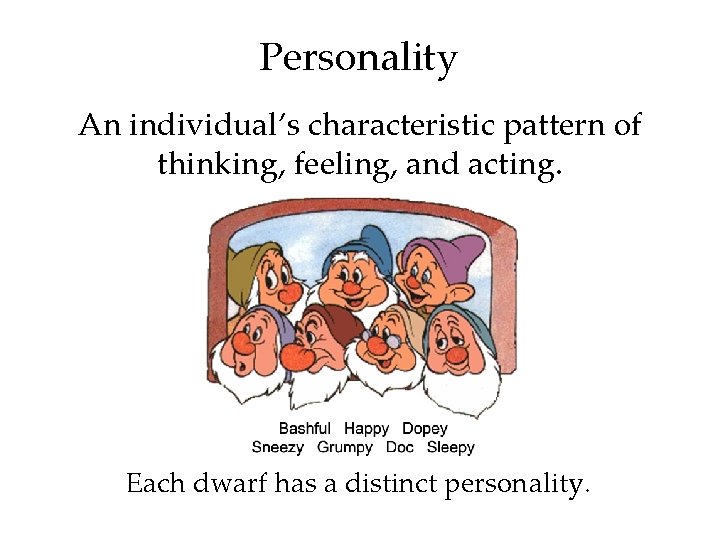
Personality An individual’s characteristic pattern of thinking, feeling, and acting. Each dwarf has a distinct personality.
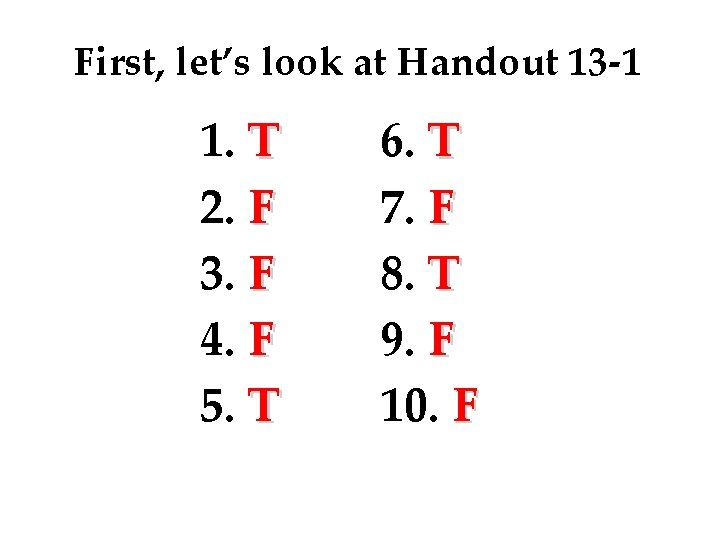
First, let’s look at Handout 13 -1 1. T 2. F 3. F 4. F 5. T 6. T 7. F 8. T 9. F 10. F
Next, a question for your notes… Who am I? ? ? Write “I am…” and then number from 1 to 10. Beside each number, list what you consider to be some of your own positive and negative personality qualities.
B. R. Hergenhahn observes that while other psychologists are concerned with human perception, intelligence, motivation, or development, personality theorists are in the unique position of studying the entire person. They have the monumental task of synthesizing the best information from the diverse fields of the discipline into a coherent, holistic configuration. In the course of their work, personality theorists address the fundamental issues of human nature and individual differences. Duane Schultz has suggested that a theorist’s answers to the following basic questions define his or her image of human nature.
1. Free will or determinism? Do we have a conscious awareness and control of ourselves? Are we free to choose, to be masters of our fate, or are we victims of biological factors, unconscious factors, or external stimuli? 2. Nature or nurture? Is our personality determined primarily by the abilities, temperaments, or predispositions we inherit, or are we shaped more strongly by the environments in which we live?
3. Past, present, or future? Is personality development basically complete in early childhood? Or is personality independent of the past, capable of being influenced by events and experiences in the present and even by future aspirations and goals? 4. Uniqueness or universality? Is the personality of each individual unique or are there broad personality patterns that fit large numbers of persons?
5. Equilibrium or growth? Are we primarily tension-reducing, pleasure-seeking animals or are we motivated primarily by the need to grow, to reach our full potential to reach for everhigher levels of self-expression and development? 6. Optimism or pessimism? Are human beings basically good or evil? Are we kind and compassionate, or cruel and merciless?
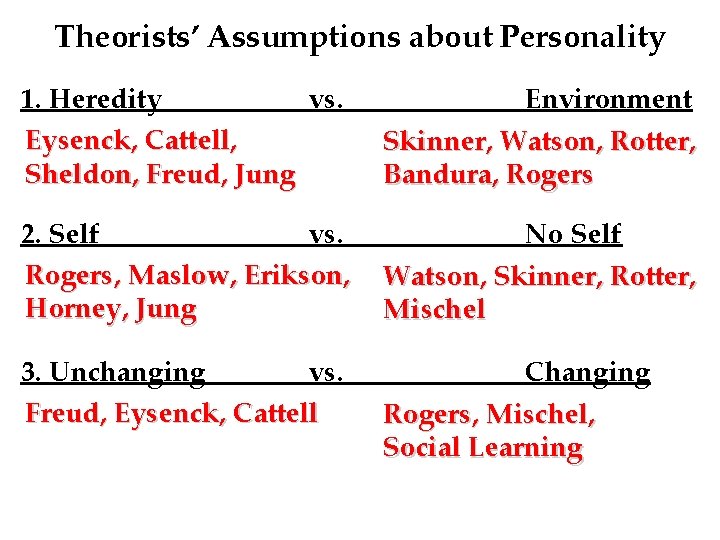
Theorists’ Assumptions about Personality 1. Heredity vs. Eysenck, Cattell, Sheldon, Freud, Jung 2. Self vs. Rogers, Maslow, Erikson, Horney, Jung 3. Unchanging vs. Freud, Eysenck, Cattell Environment Skinner, Watson, Rotter, Bandura, Rogers No Self Watson, Skinner, Rotter, Mischel Changing Rogers, Mischel, Social Learning
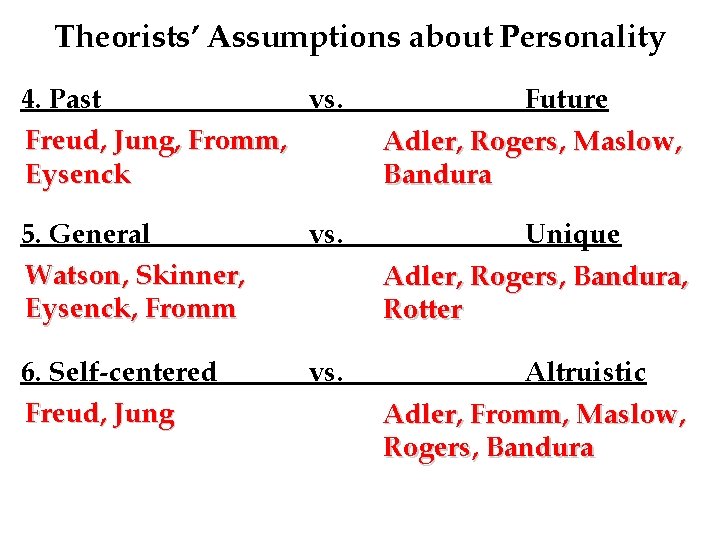
Theorists’ Assumptions about Personality 4. Past vs. Freud, Jung, Fromm, Eysenck 5. General Watson, Skinner, Eysenck, Fromm vs. 6. Self-centered Freud, Jung vs. Future Adler, Rogers, Maslow, Bandura Unique Adler, Rogers, Bandura, Rotter Altruistic Adler, Fromm, Maslow, Rogers, Bandura
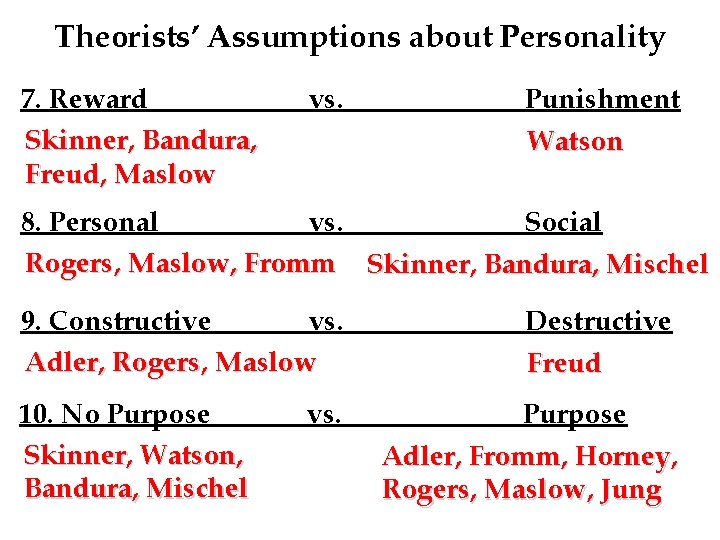
Theorists’ Assumptions about Personality 7. Reward Skinner, Bandura, Freud, Maslow vs. Punishment Watson 8. Personal vs. Social Rogers, Maslow, Fromm Skinner, Bandura, Mischel 9. Constructive vs. Adler, Rogers, Maslow Destructive Freud 10. No Purpose Skinner, Watson, Bandura, Mischel Purpose vs. Adler, Fromm, Horney, Rogers, Maslow, Jung
Homework Read p. 553 -564