
Introduction to Personal Selling and Direct Marketing Preview
- Slides: 30
Introduction to Personal Selling and Direct Marketing
Preview • Role of a company’s salespeople in creating value for customers and building customer relationships • Six major sales force management steps • Personal selling process, distinguishing between transaction-oriented and relationship marketing • Direct marketing and its benefits to customers and companies • Major forms of direct marketing 2
Nature of Personal Selling • Most salespeople well-educated, welltrained professionals who work to build and maintain long-term customer relationships • Salespeople cover a wide range of positions • • Order taker: Department store clerk Order getter: Creative selling in different environments 3
Role of the Sales Force • Personal selling is paid, personal form of promotion • Involves two-way personal communication between salespeople and individual customers • Salespeople • • Probe customers to learn about problems Adjust marketing offers to fit special needs Negotiate terms of sales Build long-term personal relationships 4
Role of the Sales Force • Sales force serves as critical link between company and its customers • • • Represents company to customers Represents customers to company Goal = customer satisfaction and company profit 5
Sales Force Management • Analysis, planning, implementation, and control of sales force activities • Includes • • • Designing sales force strategy and structure Recruiting and selecting salespeople Training salespeople Compensating salespeople Supervising salespeople Evaluating salespeople 6
Sale Force Structure • Territorial • Salesperson assigned to exclusive area and sells full line of products • Product • Sales force sells only certain product lines • Customer • Sales force organized by customer or industry • Complex • Combination of several types of structures 7
Outside and Inside Sales Forces • Outside sales force travels to call on customers in the field • Inside sales force conducts business from office via telephone or visits from perspective buyers • Includes • Technical support people • Sales assistants • Telemarketers 8
Team Selling • Used to service large, complex accounts • Can find problems, solutions, and sales opportunities that no single person could find • Can include experts from different areas of selling firm • Pitfalls • Can confuse or overwhelm customers • Working in teams trouble for some people • Hard to evaluate individual contributions 9
Successful Salespeople • Careful selection can greatly enhance overall sales force performance while minimizing costly turnover • Key talents of successful salespeople • • Intrinsic motivation Disciplined work style Ability to close a sale Ability to build relationships with customers 10
Recruiting Salespeople • Recommendations • Searching the from current sales Web force • College • Employment placement agencies services • Classified ads • Recruit from other companies 11
Sales Force Training Goals • Learn about different types of customers and their needs, buying motives, and buying habits • Learn how to make effective sales presentations • Learn about and identify with the company, its products and its competitors 12
Compensating Salespeople • Fixed amount • Salary • Variable amount • Commissions or bonuses • Expenses • Repays for job-related expenditures • Fringe benefits • Vacations, sick leave, pension, etc. 13
Supervising Salespeople • Goal of supervision is to encourage salespeople to “work smart” • Help them identify customers and set call norms • Specify time to be spent prospecting • Annual call plan • Time-and-duty analysis • Sales force automation systems 14
Motivating Salespeople • Goal of motivating sales force is to encourage salespeople to “work hard” • Organizational climate • Sales quotas • Positive incentives • • Sales meetings Sales contests Recognition and honors Cash awards, trips, profit sharing 15
Personal Selling Process for Salesperson • Prospecting • Identify and qualify potential customers (called prospects) • Pre-approach • Learn as much as possible about prospects before making sales calls • Approach • Meet potential customer for first time • Presentation • Tell “product story” to potential buyer, highlighting customer benefits 16
Personal Selling Process (cont. ) • Handling Objections • Seek out, clarify, and overcome customer objections to buying • Turn objections into reasons for buying • Closing—Ask for an order • Difficult if lack confidence or feel guilty asking • Follow-up • After the sale effort to ensure customer satisfaction and repeat business • Selling process is transaction oriented; most firms go beyond this and attempt to build mutually profitable relationships 17
Direct Marketing • Direct marketing consists of direct connections with carefully targeted individual consumers to both obtain an immediate response and cultivate lasting customer relationships • • One-on-one communication in which offers are tailored to needs of narrowly defined segments Usually seeks a direct, immediate, and measurable consumer response 18
Benefits of Direct Marketing to Buyers • • Convenient Easy to use Private Ready access to products and information • Immediate and interactive 19
Benefits of Direct Marketing to Sellers • Powerful tool for building customer relationships • Can target small groups or individuals • Can tailor offers to individual needs • Can be timed to reach prospects at just right moment • Gives access to buyers unreachable through other channels • Offers low-cost, efficient way to reach 20
Customer Databases Organized collection of comprehensive data about individual customers or prospects, including • Geographic data • Demographic data • Psychographic data • Behavioral data 21
Direct Marketing Forms • • • Telephone marketing Direct-mail marketing Catalog marketing Direct-response TV marketing Kiosk marketing Online marketing 22
Telemarketing • Used in both consumer and B 2 B markets • Can be outbound or inbound calls • Do-Not-Call legislation has affected telemarketing industry 23
Direct-Mail Marketing • Involves sending an offer, reminder, announcement, or other item to person at particular address • Permits high target-market selectivity • Can be personalized and is flexible • Higher CPM yields better prospects than mass media • Easy to measure results 24
Catalog Marketing • Expected catalog sales in 2008 = $175 billion Although print still primary medium, more and more catalogs going digital Advantages of Web vs. print catalogs • • • Save on production and mailing costs Can offer unlimited merchandise (no size constraint) Allow real-time merchandising—products and prices changeable instantly Can spice up with interactive entertainment 25
Direct Response TV Marketing • Direct-response advertising • TV spots that are 60 or 120 seconds long • Always contain 1 -800 # or Web address • Infomercials • A 30 minute or longer advertising program for single product • Home shopping channels • Entire cable channels dedicated to selling multiple brands, items, and services 26
Kiosk Marketing Information and ordering machines generally found in stores, airports, and other locations • Example: In-store Kodak kiosks allow customers to transfer pictures from digital storage devices, edit them, and produce high-quality color prints 27
Integrated Direct Marketing • Involves carefully coordinated multiplemedia, multiple-stage campaigns • Improve response rates and profits by adding media and stages that contribute more to additional sales than to additional costs • Example: Integrating paid ad with response channel (Web or phone), direct mail, outbound telemarketing, face-to-face sales call, and continuing communication 28
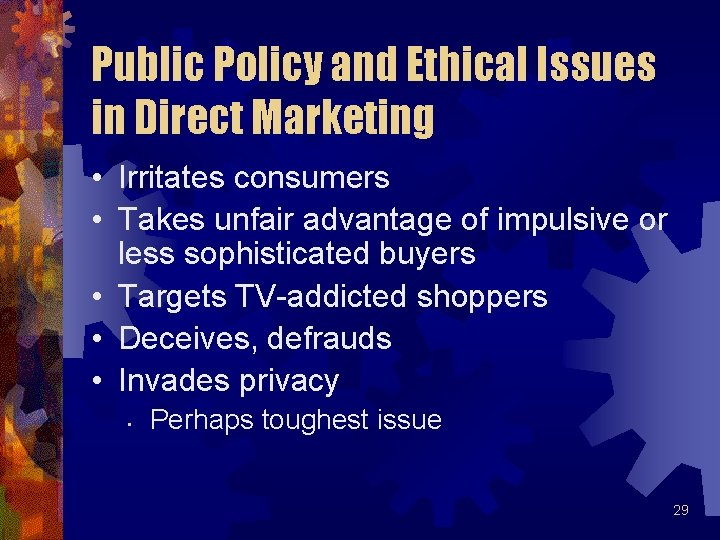
Public Policy and Ethical Issues in Direct Marketing • Irritates consumers • Takes unfair advantage of impulsive or less sophisticated buyers • Targets TV-addicted shoppers • Deceives, defrauds • Invades privacy • Perhaps toughest issue 29
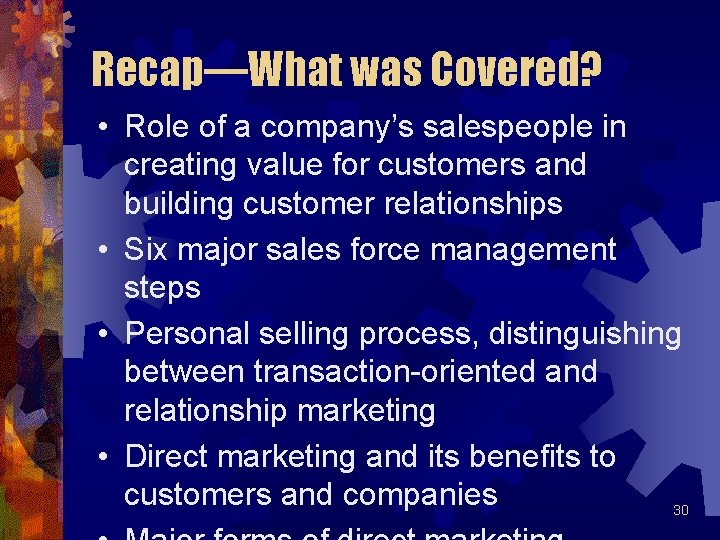
Recap—What was Covered? • Role of a company’s salespeople in creating value for customers and building customer relationships • Six major sales force management steps • Personal selling process, distinguishing between transaction-oriented and relationship marketing • Direct marketing and its benefits to customers and companies 30