
Introduction to Parts of Personality John D Mayer



- Slides: 12
Introduction to Parts of Personality John D. Mayer Based on: Mayer, J. D. (1995). A framework for the classification of personality components. Journal of Personality, 63, 819 -877. Mayer, J. D. (2005). A tale of two visions: Can a new view of personality help integrate psychology? American Psychologist, 60, 294 -307. © Copyright 2008 John D. Mayer
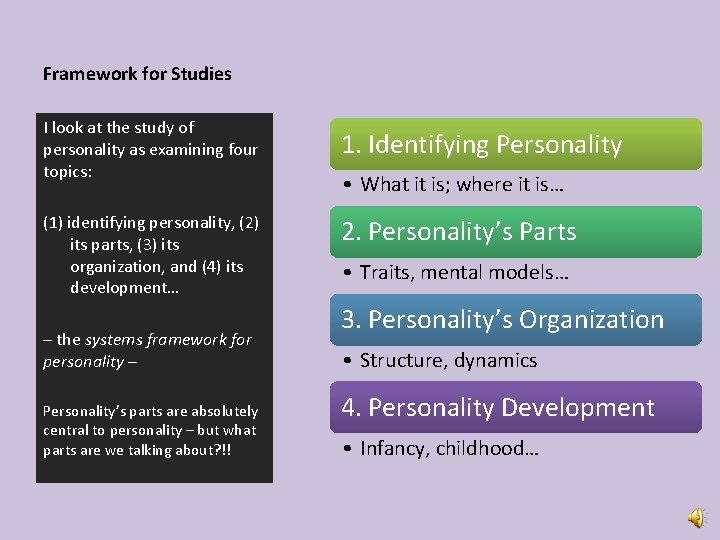
Framework for Studies I look at the study of personality as examining four topics: (1) identifying personality, (2) its parts, (3) its organization, and (4) its development… – the systems framework for personality – Personality’s parts are absolutely central to personality – but what parts are we talking about? !! 1. Identifying Personality • What it is; where it is… 2. Personality’s Parts • Traits, mental models… 3. Personality’s Organization • Structure, dynamics 4. Personality Development • Infancy, childhood…
Personality’s Parts One kind of part is the trait – a relatively consistent long term characteristic of personality that (typically) combines innate and learned characteristics. 1. Identifying Personality • What it is; where it is… 2. Personality’s Parts • Traits, mental models… 3. Personality’s Organization • Structure, dynamics • Infancy, childhood… 4. Personality Development
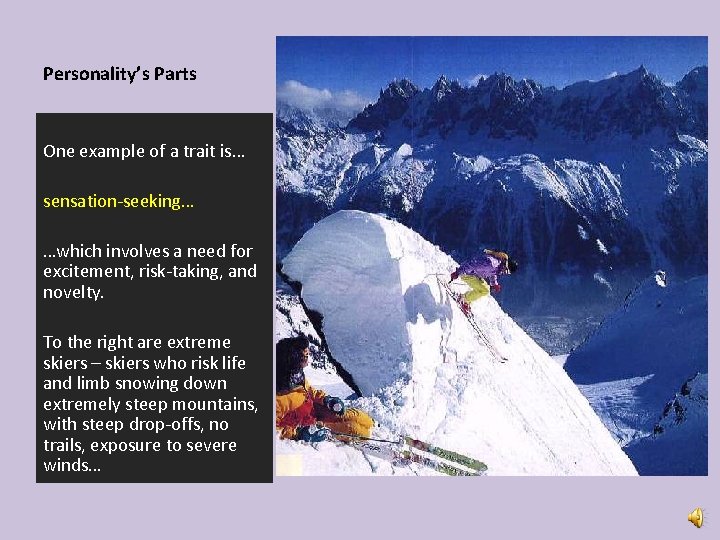
Personality’s Parts One example of a trait is… sensation-seeking… …which involves a need for excitement, risk-taking, and novelty. To the right are extreme skiers – skiers who risk life and limb snowing down extremely steep mountains, with steep drop-offs, no trails, exposure to severe winds…
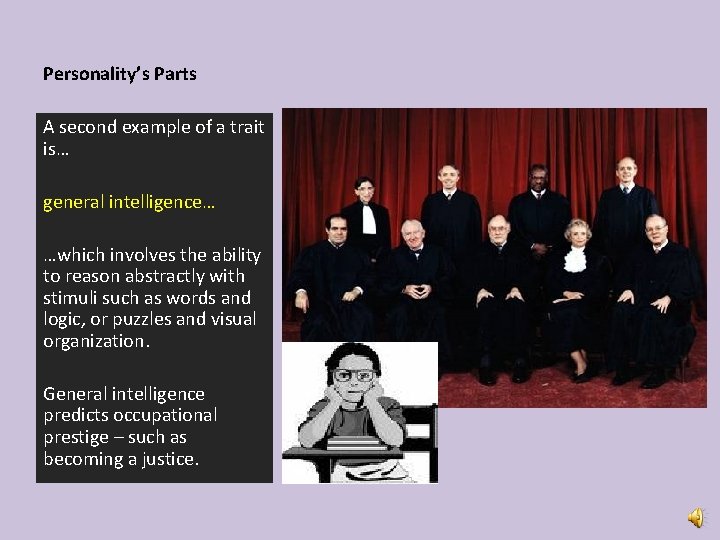
Personality’s Parts A second example of a trait is… general intelligence… …which involves the ability to reason abstractly with stimuli such as words and logic, or puzzles and visual organization. General intelligence predicts occupational prestige – such as becoming a justice.
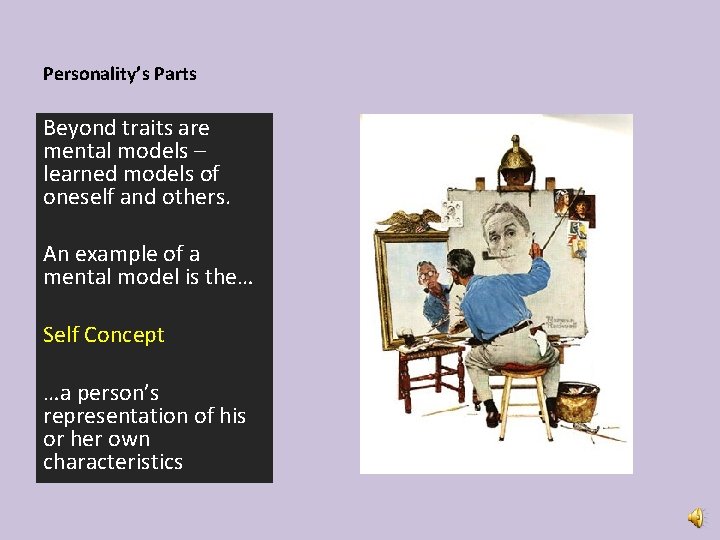
Personality’s Parts Beyond traits are mental models – learned models of oneself and others. An example of a mental model is the… Self Concept …a person’s representation of his or her own characteristics
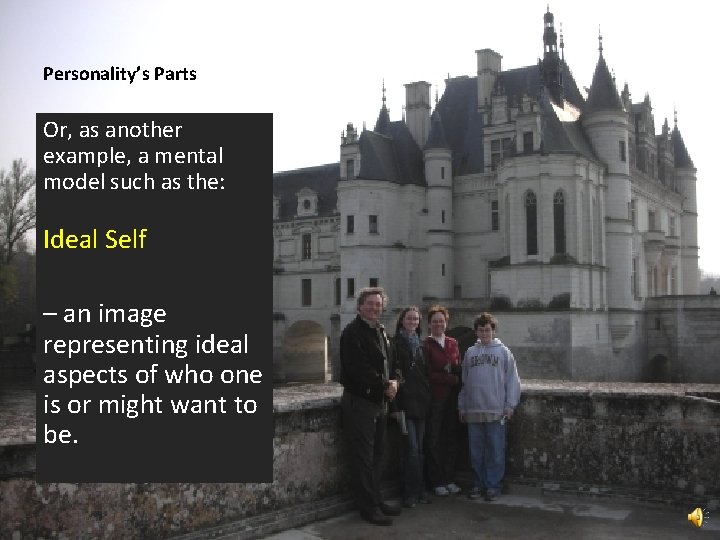
Personality’s Parts Or, as another example, a mental model such as the: Ideal Self – an image representing ideal aspects of who one is or might want to be.
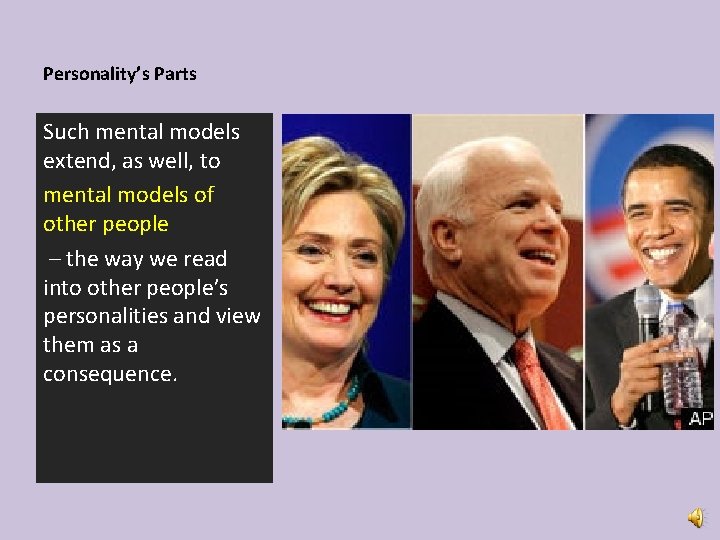
Personality’s Parts Such mental models extend, as well, to mental models of other people – the way we read into other people’s personalities and view them as a consequence.
Personality’s Parts Traits such as: • Sensation-seeking, and • Intelligence …and mental models such as a person’s: • Self concept • Ideal self, and • Models of others …are important topics of scientific research. Research identifies which parts are defined well and exert key influences on the personality system. • When a person has a high level of a trait, or an unusual mental model, it may help account for their successes or challenges in life.
Some of the Four Hundred Parts: Personality’s Parts There is an obstacle, however… There are very many personality parts – over 400 commonly-studied personality parts according to one count (see a part of the list to the right) Even if one just examines the traits and models key to a person there must be a way to organize the parts. • • • • Ability traits Absorption Acquiescence Actual self Actualizing tendency Anima/Animus Anticipated consequences Anxiety Approach-avoidance conflict Archetype Attentional processes Authoritarianism Automatization Awareness … (from Mayer, 1995, Table 1)
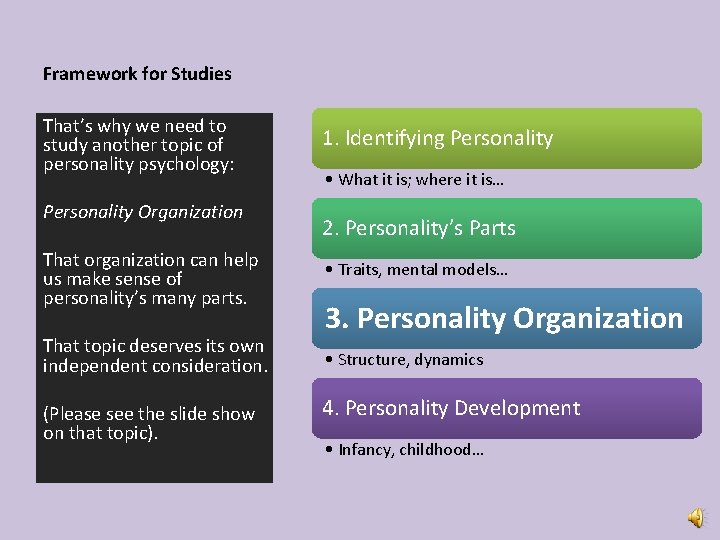
Framework for Studies That’s why we need to study another topic of personality psychology: Personality Organization That organization can help us make sense of personality’s many parts. That topic deserves its own independent consideration. (Please see the slide show on that topic). 1. Identifying Personality • What it is; where it is… 2. Personality’s Parts • Traits, mental models… 3. Personality Organization • Structure, dynamics 4. Personality Development • Infancy, childhood…
End of slide show