
Introduction to Parliamentary Procedure May 2007 Leadership Revision
- Slides: 14
Introduction to Parliamentary Procedure May 2007 Leadership Revision Committee
What is it? n Parliamentary Procedure is: The correct rules for conducting or running a successful meeting.
Purpose n Ensures that: - One item is addressed at a time - Courtesy is given to every member - The majority rules - The rights of the minority are protected
Use of the Gavel n One tap: Be seated Or… n Follows: n Announcement of adjournment n Completion of a business item n n Two taps: Calls the meeting to order Three taps: Stand on the third tap Series of taps: Restores order
The Chair n n The person in charge-conducts the meeting Presiding Officer referred to as: n n Chairperson refers to self in the third person n n Mr/Madam President or Mr/Madam Chairman “The chair rules…” “The chair will entertain a motion. ” Never says “I” Alternates debate between opposing and supporting sides
Responsibilities of The Chair n n n Speak up and speak clearly Be respectful Be impartial Do not say “I” Know correct parliamentary procedure
Responsibilities of the Members n n Discuss when called upon Respect other members and chair Speak up when discussing Know Parli. Pro.
Conducting Business n Quorum n n 1/2 of members in a club plus 1 Minimum number of members that must be present at a meeting for legal business to be transacted Types of Votes: n None n n Majority n n Decided by chair 1/2 of members present at any meeting plus 1 Minimum number of members that must vote for a motion for it to pass Used to vote on most motions Two-Thirds § A two thirds vote is required when a motion will limit the rights of a member or members § This means that two thirds of the voters must be in favor of the motion for it to pass
Ways to Vote n n Voice Vote: saying “aye” or “no” Standing Vote: standing or a show of hands Secret Ballot: a written vote Roll Call: each member speaking their vote when the secretary calls their name
Basic Rights Everyone gets the chance to voice their opinion n Everyone gets the chance to vote n n Must take yes and no votes Only one topic at a time can be discussed n Whoever makes a motion has the right to discuss it first n The Chairperson makes or breaks a tie n
Classifications of Motions n n n Main Motions: bring business before the meeting Subsidiary Motions: treats or disposes of a main motion; always applied to another motion while it is pending Privileged Motions: take precedence over all other motions; don’t have to relate to pending business Incidental Motions: related to pending business or other business; almost always must be decided before business can continue Unclassified Motions: these are typically motions that bring a question again before the assembly
How to State a Motion n A properly stated motion: § begins with “I move that…” § NOT, “I make a motion to…”
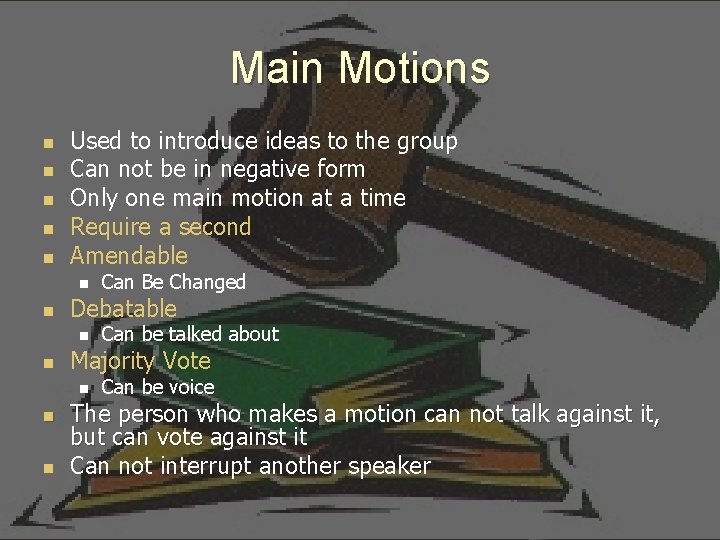
Main Motions n n n Used to introduce ideas to the group Can not be in negative form Only one main motion at a time Require a second Amendable n n Debatable n n n Can be talked about Majority Vote n n Can Be Changed Can be voice The person who makes a motion can not talk against it, but can vote against it Can not interrupt another speaker
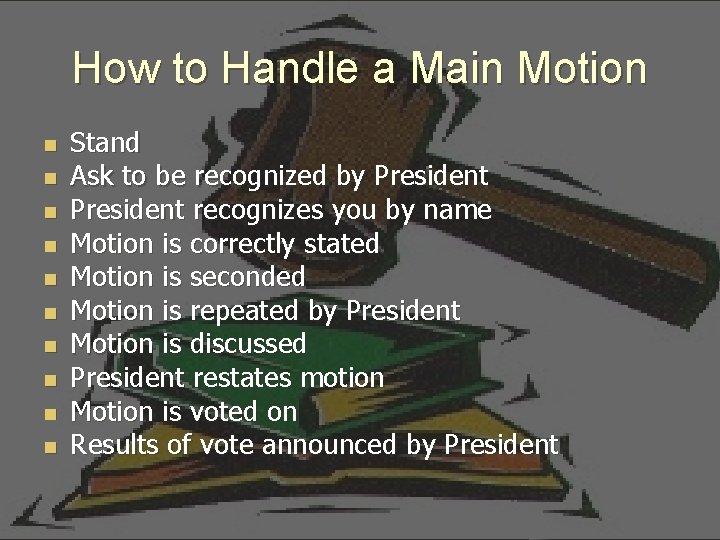
How to Handle a Main Motion n n Stand Ask to be recognized by President recognizes you by name Motion is correctly stated Motion is seconded Motion is repeated by President Motion is discussed President restates motion Motion is voted on Results of vote announced by President