
Introduction to Parasitology Terminology Medical Parasitology It is


- Slides: 18
Introduction to Parasitology
Terminology Medical Parasitology: It is the science which deals with the parasites that infect man. Parasite: Is an organism, which lives on or within another organism (host) for survival. Host: Is a living organism that harbours the parasite Dr. Mona El Sobky
Parasitic kingdom include three phyla 1 - Arthropods. 2 - Helminths. 3 - Protozoa. 1 - Arthropods : These parasites having exoskeleton and jointed legs, divided into 2 classes: A. Class Insecta : e. g. Mosquitoes, lice and fleas. B. Class Arachnida : e. g. Ticks and mites. Dr. Mona El Sobky
2 - Helminths: They are metazoa (Multicellular parasite) wormlike parasite, divided into 3 classes: A. Class Trematoda (Flukes): They are flattened leaf- shaped worms e. g: Schistosoma heamatobium. B. Class Nematoda ( Roundworms ) : a. Intestinal nematodes, e. g, Ascaris lumbricoides. b. Tissue nematodes, e. g, Wuchereria bancrofti. C. Class Cestoda ( Tapeworms) : They are flattened and segmented worms e. g: Taenia saginata. Dr. Mona El Sobky
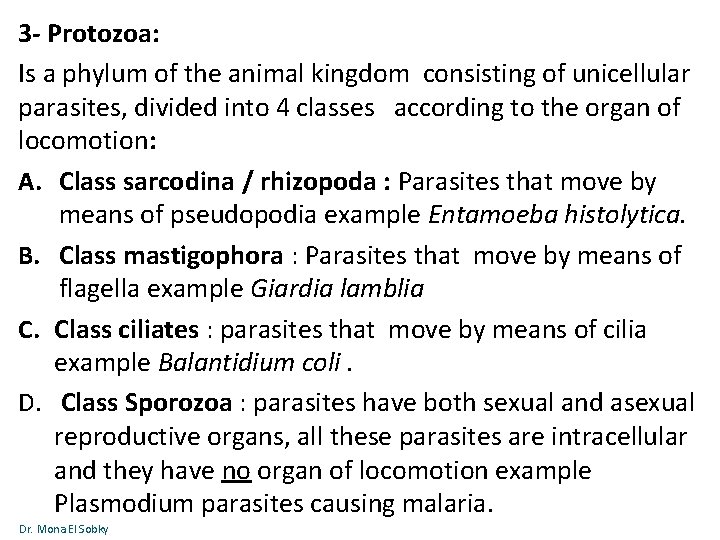
3 - Protozoa: Is a phylum of the animal kingdom consisting of unicellular parasites, divided into 4 classes according to the organ of locomotion: A. Class sarcodina / rhizopoda : Parasites that move by means of pseudopodia example Entamoeba histolytica. B. Class mastigophora : Parasites that move by means of flagella example Giardia lamblia C. Class ciliates : parasites that move by means of cilia example Balantidium coli. D. Class Sporozoa : parasites have both sexual and asexual reproductive organs, all these parasites are intracellular and they have no organ of locomotion example Plasmodium parasites causing malaria. Dr. Mona El Sobky
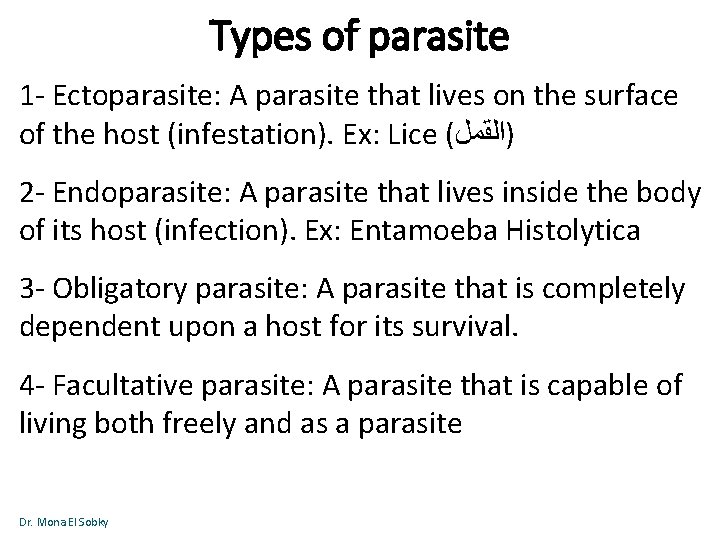
Types of parasite 1 - Ectoparasite: A parasite that lives on the surface of the host (infestation). Ex: Lice ( )ﺍﻟﻘﻤﻞ 2 - Endoparasite: A parasite that lives inside the body of its host (infection). Ex: Entamoeba Histolytica 3 - Obligatory parasite: A parasite that is completely dependent upon a host for its survival. 4 - Facultative parasite: A parasite that is capable of living both freely and as a parasite Dr. Mona El Sobky
Types of parasite 5 - Opportunistic parasite: A parasite that causes disease only in immunodeficient patients (AIDS, cancer patients), while in immunocompetent individuals, the parasite may exist in a latent form producing no or mild symptoms. 6 - Coprozoic or spurious parasite: An organism that passes through the human intestine without causing any disease and is detected in the stool after ingestion. Dr. Mona El Sobky
Types of hosts 1. Definitive host (D. H): It is the host which harbours the mature adult stage of the parasite or in which sexual reproduction of the parasite takes place. Ex : man in case of Taenia 2. Reservoir host (R. H): The host which harbours the parasite and considered the source of human infection. 3. Intermediate host (I. H): It is the host which harbours larval stage (immature or non-sexually reproducing forms of the parasites). Ex : Snail in case of Bilharzia. ﺍﻟﻘﻮﻗﻊ 4. Accidental host: The host which harbours the Dr. Mona El Sobky parasite which is not normally found.
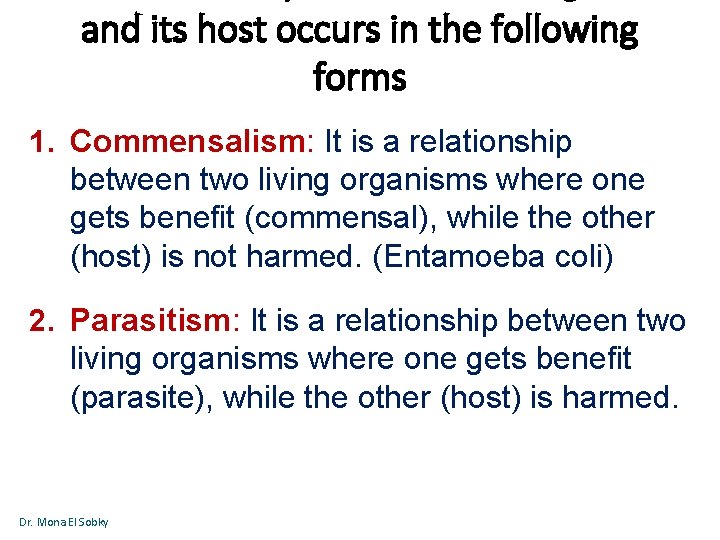
and its host occurs in the following forms 1. Commensalism: It is a relationship between two living organisms where one gets benefit (commensal), while the other (host) is not harmed. (Entamoeba coli) 2. Parasitism: It is a relationship between two living organisms where one gets benefit (parasite), while the other (host) is harmed. Dr. Mona El Sobky
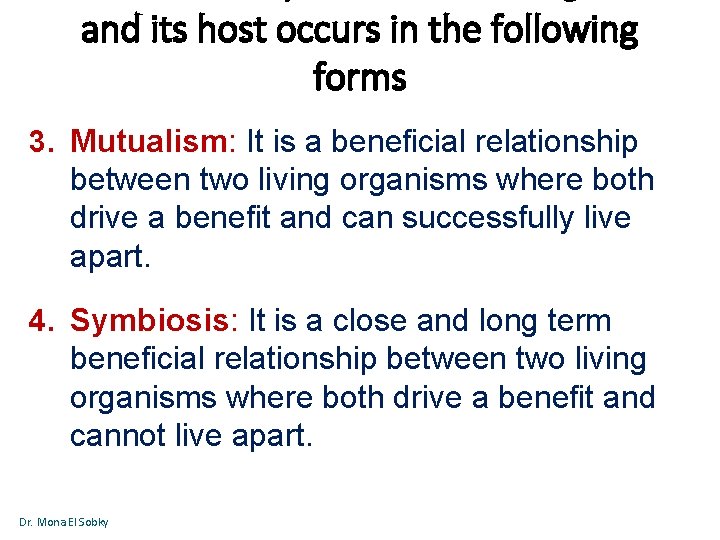
and its host occurs in the following forms 3. Mutualism: It is a beneficial relationship between two living organisms where both drive a benefit and can successfully live apart. 4. Symbiosis: It is a close and long term beneficial relationship between two living organisms where both drive a benefit and cannot live apart. Dr. Mona El Sobky
Modes of transmission of parasitic infection 1. Direct contact through the skin. 2. Penetration of the skin. 3. Ingestion of contaminated food or drinking water containing the infective stage of the parasite. 4. Inhalation of dust carrying the infective stage of parasite. 5. Congenital from mother to foetus (transplacental) or may by transmammary (mother`s milk). Dr. Mona El Sobky
Modes of transmission of parasitic infection 6. Sexual contact. 7. Autoinfection (either external or internal). 8. Vectors, through bite or feces of infected vector or by swallowing the vector. 9. Blood transfusion or through contaminated syringes. 10. Organ transplantation. Dr. Mona El Sobky
Stages of parasitic infections ØInfective stage (I. S): The stage by which the infection takes place. ØDiagnostic stage (D. S): The stage by which we can diagnose the parasitic infection (disease). q The pathogenesis of the parasite depends on the number, size and morphology of the parasite, its activity (movement and migration), site (habitat), specific toxin and host reaction. Dr. Mona El Sobky
Pathogenesis of parasitic infection v. Occurs through the following: 1) Mechanical: The parasite may obstruct normal passage like intestine or bile tract. 2) Traumatic : üExternal due to invasion of the skin. üInternal by attachment to intestinal mucosa by buccal capsule producing ulcers. 3) Toxin production: Circulation of parasitic products (toxins and waste products). Dr. Mona El Sobky
Pathogenesis of parasitic infection 4) Tissue damage and necrosis: Due to enzymes secreted by parasites. 5) Cellular destruction: As RBCs or RES damage. 6) Immune stimulation: Parasitic antigens produce humoral /or cellular immune response cellular proliferation and infiltration formation of fibrous encapsulation around parasites (ex: hepatic granuloma in Schistosoma mansonia). 7) Allergic reaction due to insect bites or parasitic toxins. Dr. Mona El Sobky
Diagnosis of parasitic infection I. Clinical diagnosis: Ø Depends on the characteristic signs and symptoms related to the parasitic infection. II. Laboratory diagnosis: v Direct methods (to detect the diagnostic stage): Microscopical examination of the tested samples (ex: 1 - stool, 2 - urine, 3 - blood , 4 - tissue biopsy, 5 -sputum & 6 -aspirates). Dr. Mona El Sobky
v Indirect methods (for detecting antibodies and antigens in patient’s serum): Used when parasites are present in tissues or in cases of chronic infection. e. g 1. Detection of antibodies or antigens in the patient's serum by serological test as indirect haemagglutination test (IHAT), complement fixation test (CFT), enzyme linked immunosorbent assay (ELISA) and indirect immunofluorescent antibody test (IFAT). 2. Molecular as PCR, Radiology…. Dr. Mona El Sobky
v. Indirect methods (for detecting antibodies and antigens in patient’s serum): -Used when parasites are present in tissues or in cases of chronic infection. e. g 1 - Detection of antibodies or antigens in the patient's serum by serological test as indirect haemagglutination test (IHAT), complement fixation test (CFT), enzyme linked immunosorbent assay (ELISA) and indirect immunofluorescent antibody test (IFAT). 2 - Molecular as PCR, Radiology….