
Introduction to Parallel Processing 3 1 Basic concepts
Introduction to Parallel Processing • • • 3. 1 Basic concepts 3. 2 Types and levels of parallelism 3. 3 Classification of parallel architecture 3. 4 Basic parallel techniques 3. 5 Relationships between languages and parallel architecture TECH Computer Science CH 03
3. 1 Basic concepts • 3. 1. 1 The concept of program Q ordered set of instructions (programmer’s view) Q executable file (operating system’s view)
The concept of process • OS view, process relates to execution • Process creation Q setting up the process description Q allocating an address space Q loading the program into the allocated address space, and Q passing the process description to the scheduler • process states Q ready to run Q running Q wait
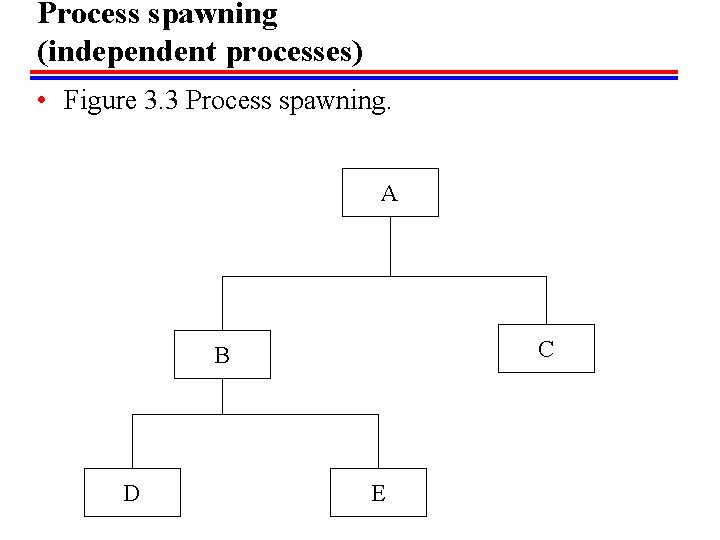
Process spawning (independent processes) • Figure 3. 3 Process spawning. A C B D E
3. 1. 3 The concept of thread • smaller chunks of code (lightweight) • threads are created within and belong to process • for parallel thread processing, scheduling is performed on a per-thread basis • finer-grain, less overhead on switching from thread to thread
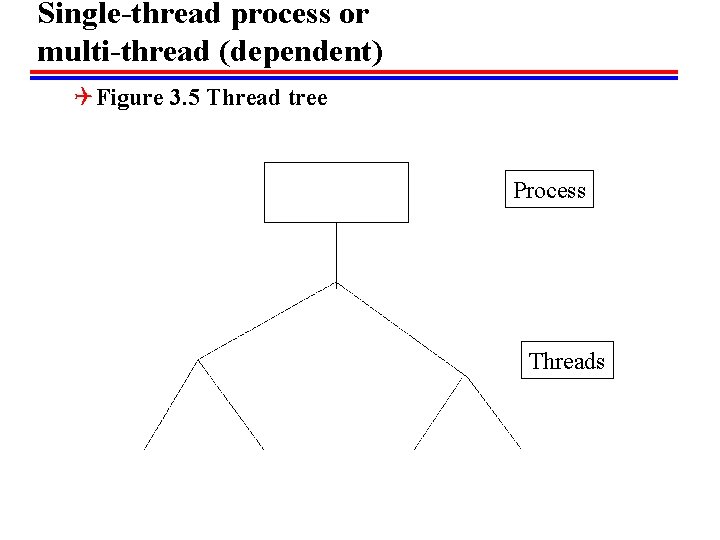
Single-thread process or multi-thread (dependent) Q Figure 3. 5 Thread tree Process Threads
Three basic methods for creating and terminating threads • 1. unsynchronized creation and unsynchronized termination Q calling library functions: CREATE_THREAD, START_THREAD • 2. unsynchronized creation and synchronized termination Q FORK and JOIN • 3. synchronized creation and synchronized termination Q COBEGIN and COEND
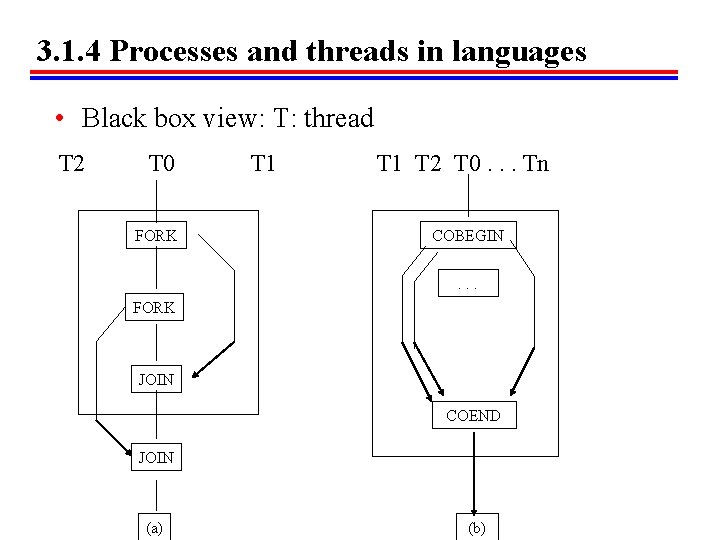
3. 1. 4 Processes and threads in languages • Black box view: T: thread T 2 T 0 FORK T 1 T 2 T 0. . . Tn COBEGIN. . . FORK JOIN COEND JOIN (a) (b)
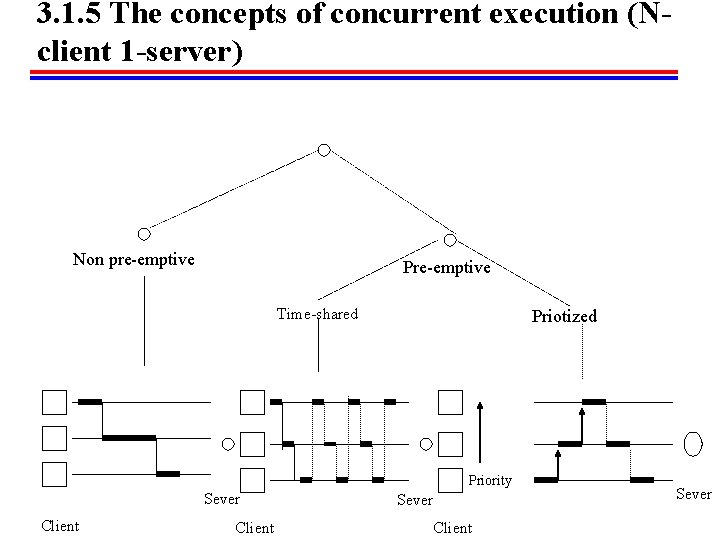
3. 1. 5 The concepts of concurrent execution (Nclient 1 -server) Non pre-emptive Pre-emptive Time-shared Priotized Priority Sever Client Sever
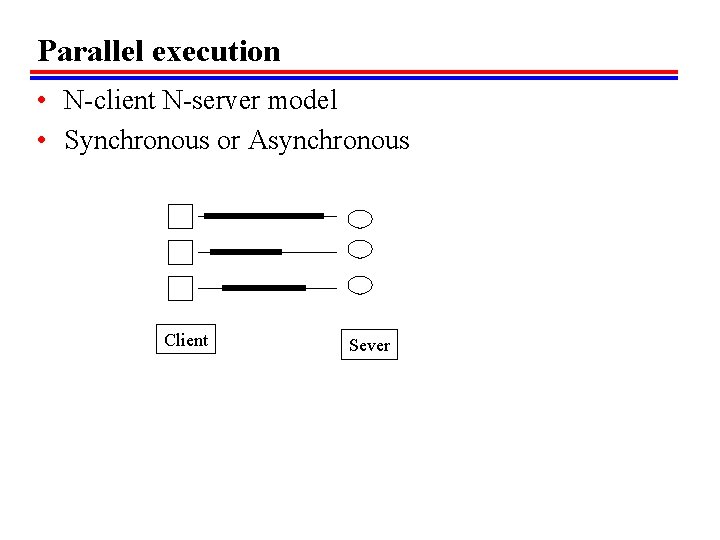
Parallel execution • N-client N-server model • Synchronous or Asynchronous Client Sever
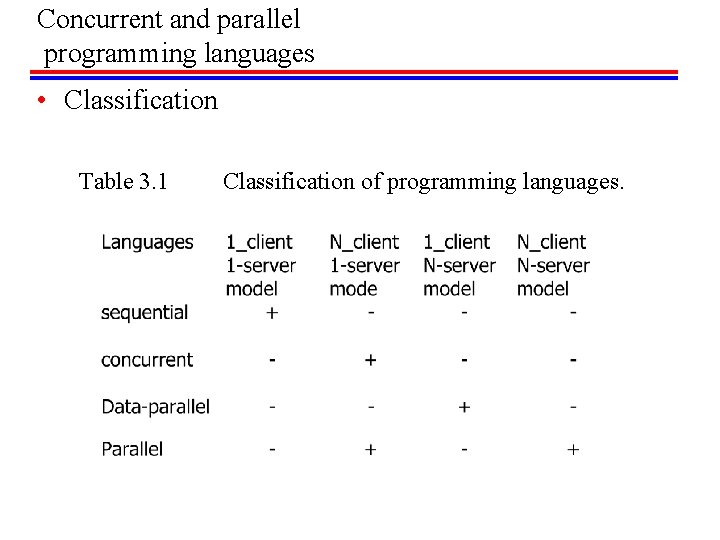
Concurrent and parallel programming languages • Classification Table 3. 1 Classification of programming languages.
3. 2 Types and levels of parallelism • 3. 2. 1 Available and utilized parallelism Q available: in program or in the problem solutions Q utilized: during execution • 3. 2. 2 Types of available parallelism Q functional farises from the logic of a problem solution Q data farises from data structures
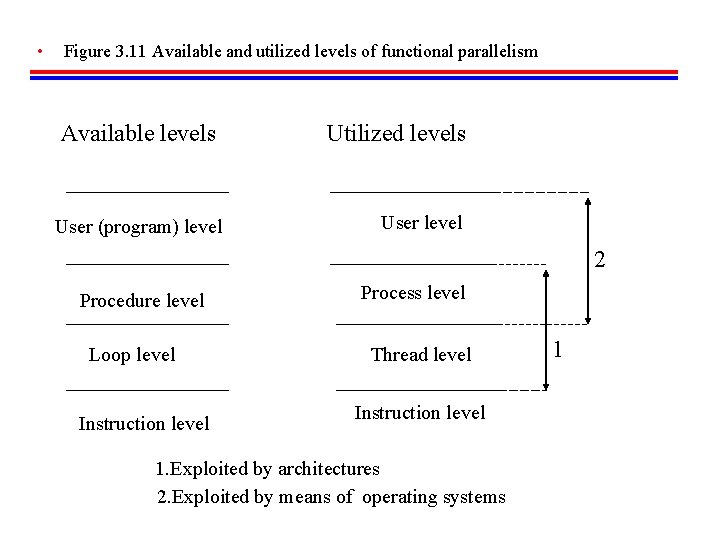
• Figure 3. 11 Available and utilized levels of functional parallelism Available levels User (program) level Utilized levels User level 2 Procedure level Loop level Instruction level Process level Thread level Instruction level 1. Exploited by architectures 2. Exploited by means of operating systems 1
3. 2. 4 Utilization of functional parallelism • Available parallelism can be utilized by Q architecture, finstruction-level parallel architectures Q compilers fparallel optimizing compiler Q operating system fmultitasking

3. 2. 5 Concurrent execution models • User level --- Multiprogramming, time sharing • Process level --- Multitasking • Thread level --- Multi-threading
3. 2. 6 Utilization of data parallelism • by using data-parallel architecture
3. 3 Classification of parallel architectures • 3. 3. 1 Flynn’s classification Q SISD Q SIMD Q MISD (Multiple Instruction Single Date) Q MIMD
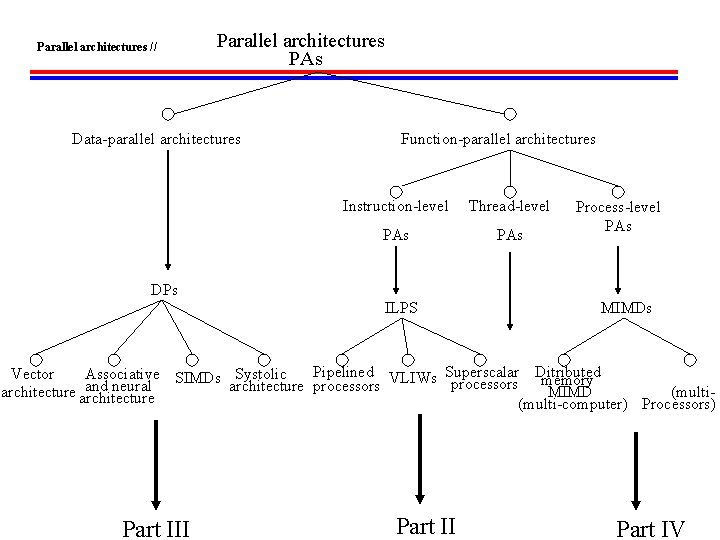
Parallel architectures // Parallel architectures PAs Data-parallel architectures Function-parallel architectures Instruction-level Thread-level PAs Process-level PAs DPs ILPS MIMDs Pipelined VLIWs Superscalar Ditributed Shared Vector Associative SIMDs Systolic memory processors memory and neural architecture processors architecture MIMD (multi-computer) Processors) Part III Part IV
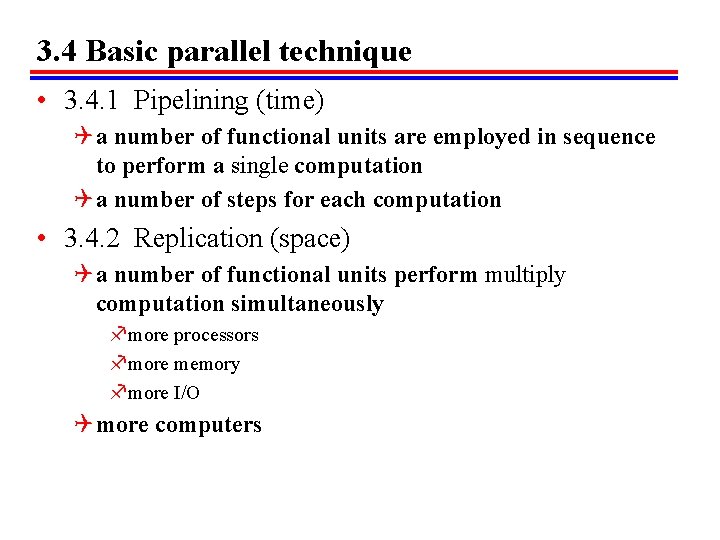
3. 4 Basic parallel technique • 3. 4. 1 Pipelining (time) Q a number of functional units are employed in sequence to perform a single computation Q a number of steps for each computation • 3. 4. 2 Replication (space) Q a number of functional units perform multiply computation simultaneously fmore processors fmore memory fmore I/O Q more computers
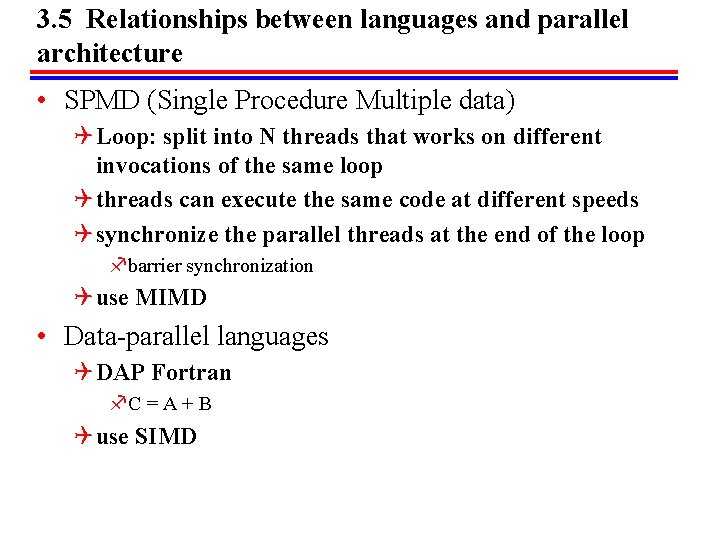
3. 5 Relationships between languages and parallel architecture • SPMD (Single Procedure Multiple data) Q Loop: split into N threads that works on different invocations of the same loop Q threads can execute the same code at different speeds Q synchronize the parallel threads at the end of the loop fbarrier synchronization Q use MIMD • Data-parallel languages Q DAP Fortran f. C = A + B Q use SIMD
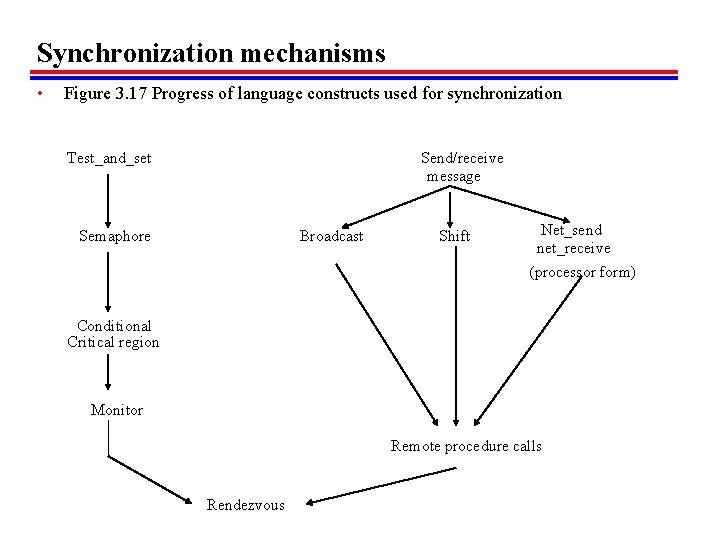
Synchronization mechanisms • Figure 3. 17 Progress of language constructs used for synchronization Test_and_set Send/receive message Semaphore Broadcast Shift Net_send net_receive (processor form) Conditional Critical region Monitor Remote procedure calls Rendezvous
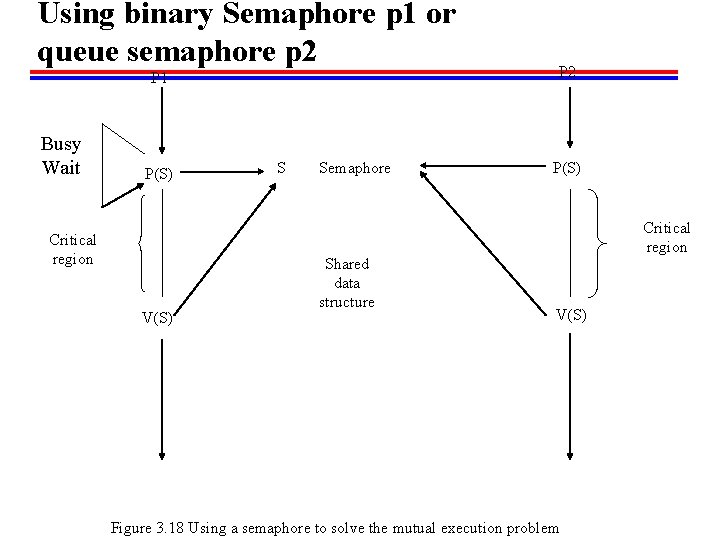
Using binary Semaphore p 1 or queue semaphore p 2 P 1 Busy Wait P(S) Critical region V(S) S Semaphore Shared data structure P 2 P(S) Critical region V(S) Figure 3. 18 Using a semaphore to solve the mutual execution problem
Parallel distributed computing • Ada Q used rendezvous concepts which combines feature of RPC and monitors • PVM (Parallel Virtual Machine) Q to support workstation clusters • MPI (Message-Passing Interface) Q programming interface for parallel computers • COBRA ? • Windows NT ?
Summary of forms of parallelism • See Table 3. 3
- Slides: 24