
Introduction to palliative care at Northern Beaches Hospital
Introduction to palliative care at Northern Beaches Hospital Dr Abbie Franklin Brigitte Karle Joanne Rainback CNC Palliative Care
The palliative care team at Northern Beaches • Dr Abbie Franklin Staff specialist (works 2 ½ days) • (Dr Peter Roach Staff Specialist) relieves annual leave • Brigitte Karle CNC • Joanne Rainback CNC • Consultative service 5 days a week • Employed by Hammond. Care, who contracts with Healthscope to provide this service.
How to refer to Palliative Care • 0408 786 7099 5 days a week. • EMR palliative medicine referral. • Over the weekends there is NO ON CALL SERVICE.
Take home points • Palliative care is not only for cancer patients. • We need to identify dying • We need to relieve suffering • Regular pain/symptom relief is better than PRN. • We need to improve our communication skills.

WHO Definition of Palliative Care • Palliative care is an approach that improves the quality of life of patients and their families facing the problem associated with lifethreatening illness, • through the prevention and relief of suffering by means of early identification and impeccable assessment and treatment of pain and other problems, physical, psychosocial and spiritual.
WHO Definition of Palliative Care • provides relief from pain and other distressing symptoms; • affirms life and regards dying as a normal process; • intends neither to hasten or postpone death; • integrates the psychological and spiritual aspects of patient care; • offers a support system to help patients live as actively as possible until death; www. who. int/cancer/palliative/definition/en/
WHO Definition of Palliative Care • offers a support system to help the family cope during the patient’s illness and in their own bereavement; • uses a team approach to address the needs of patients and their families, including bereavement counselling, if indicated; • will enhance quality of life, and may also positively influence the course of illness;
WHO Definition of Palliative Care • is applicable early in the course of illness, in conjunction with otherapies that are intended to prolong life, such as chemotherapy or radiation therapy, • and includes those investigations needed to better understand manage distressing clinical complications. /
Other benefits of early introduction of palliative care • Improved health related quality of life • Improved symptom management • People stay at home longer. • More discussions from patients to their families and doctors about what their wishes are. • More people die in their place of choice. • It may even prolong life (Temel et al sentinel work, 2010)
Link between NBH and community 1. May be known to the community team. (NSLHD) • • • Northern Beaches: situated in Mona Vale: Greenwich: for North Shore patients. Neringah (Wahroonga) for patients from St Ives to Castle Hill. a team of doctors, nurses, OTs , social workers, etc. A consultative service. 2. May have an ambulance plan, stating “Do not return to hospital”. • • • Why do they come here? Family override ambos (symptoms not well controlled. ) Scared of them dying at home. No bed at the PCU. Middle of the night admissions unusual to PCU (better to transfer straight from home). Can be transferred DIRECTLY from ED to PCU if known to the community palliative care team.
Why do we need palliative care in an acute hospital? • Because it is important to recognise when a person is approaching end of life. • It matters how people die. • It matters to them and to their families. • Futile treatment / “freeway” to ICU is not always the best place for older , frail people with advanced disease.
Recognising dying • Identifying which patients are approaching the end-of-life phase is crucial to delivering appropriate health care. • Recognition of end of life allows patients and families to plan for inevitable death. • Many people state that they prefer honest and upfront conversations about prognosis so that preparation for the end of life can begin. • However only around 14% of Australians have completed an advance care directive. • This means that for many patients and families’ conversations about end-of -life choices will happen for the first time during a health crisis or when you ask.
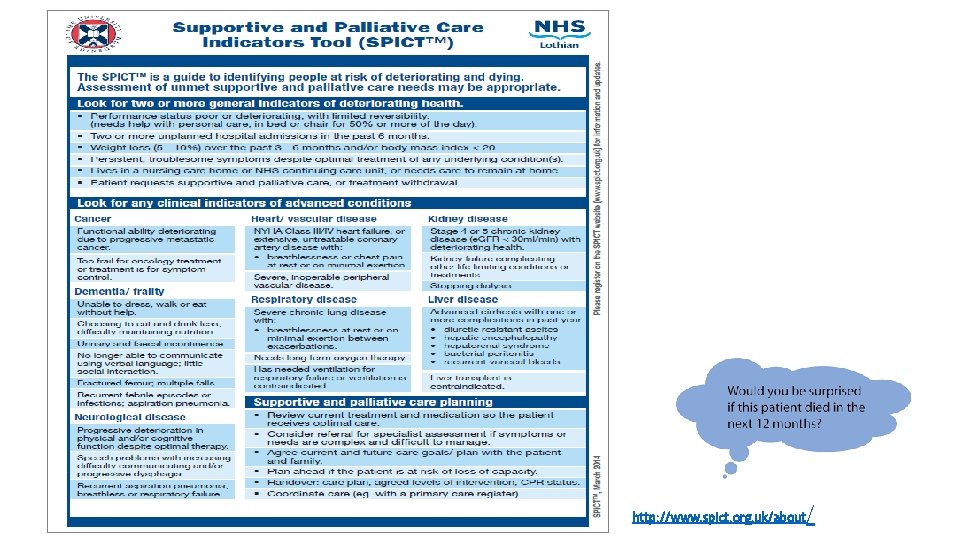
http: //www. spict. org. uk/about /
Therapies with the potential for overuse • Chemotherapy. • Radiotherapy. • Life sustaining therapies. • Imaging. • Blood testing. • Non-beneficial medication.
Potentially underused interventions • Early conversations about patients care goals and values. • Family support. • Carefully titrated pain control with follow up. • Nonpain symptom management. • Psychosocial and spiritual support.
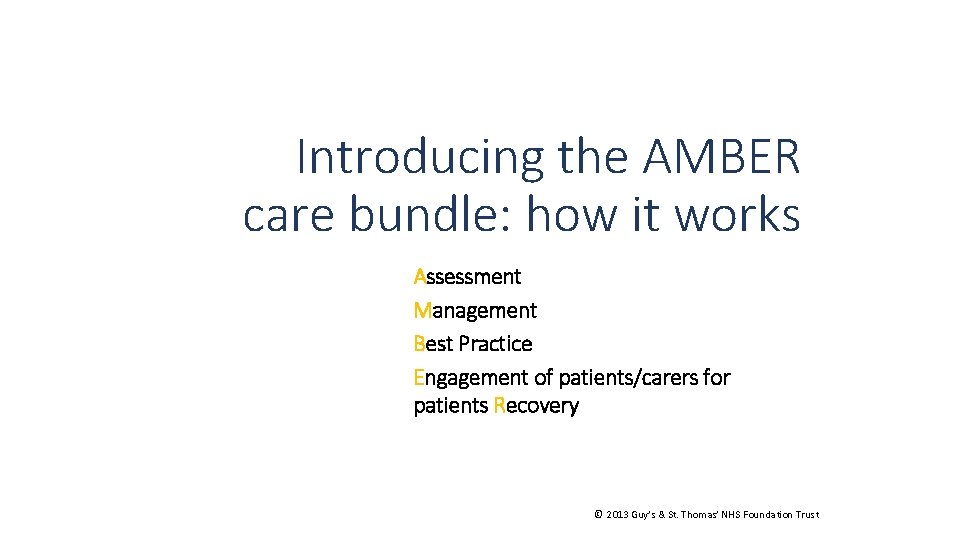
Introducing the AMBER care bundle: how it works Assessment Management Best Practice Engagement of patients/carers for patients Recovery is uncertain © 2013 Guy’s & St. Thomas’ NHS Foundation Trust
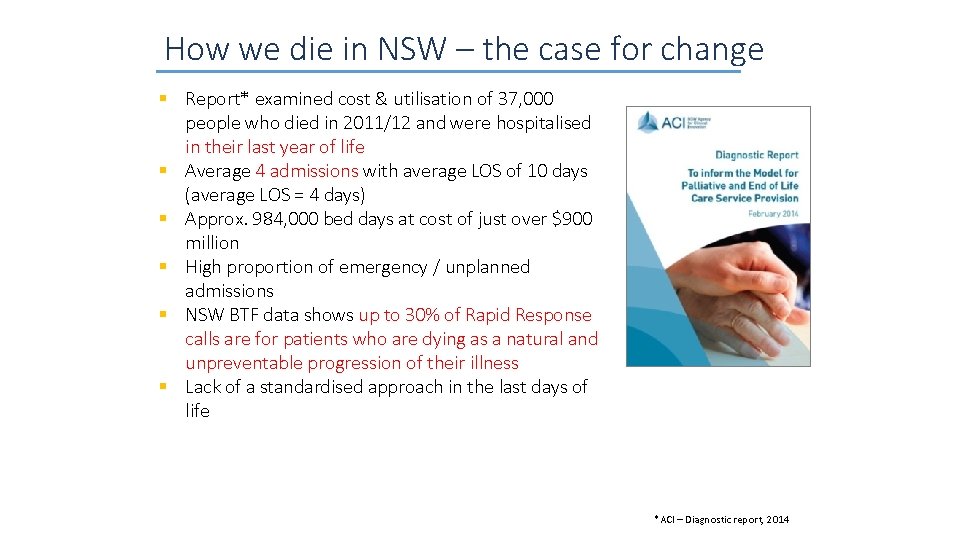
How we die in NSW – the case for change § Report* examined cost & utilisation of 37, 000 people who died in 2011/12 and were hospitalised in their last year of life § Average 4 admissions with average LOS of 10 days (average LOS = 4 days) § Approx. 984, 000 bed days at cost of just over $900 million § High proportion of emergency / unplanned admissions § NSW BTF data shows up to 30% of Rapid Response calls are for patients who are dying as a natural and unpreventable progression of their illness § Lack of a standardised approach in the last days of life *ACI – Diagnostic report, 2014
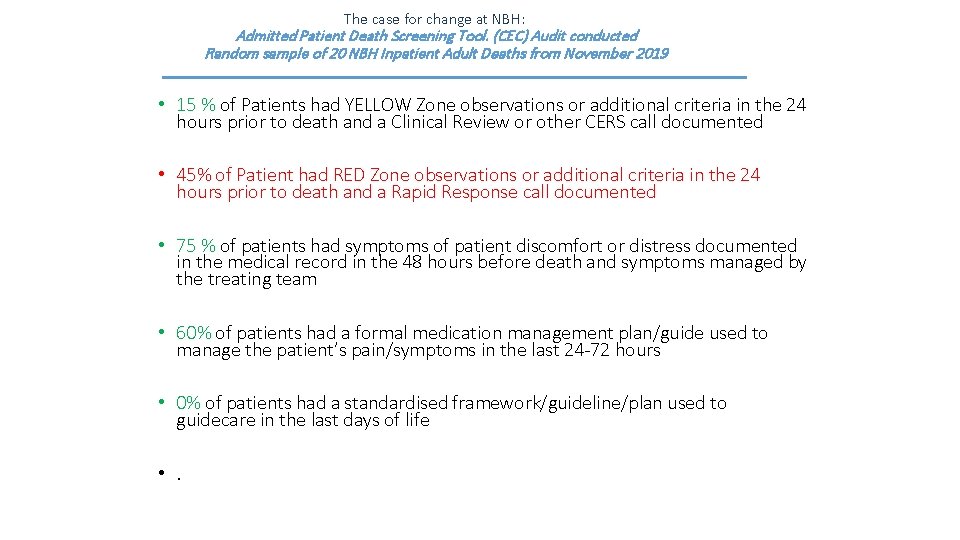
The case for change at NBH: Admitted Patient Death Screening Tool. (CEC) Audit conducted Random sample of 20 NBH Inpatient Adult Deaths from November 2019 • 15 % of Patients had YELLOW Zone observations or additional criteria in the 24 hours prior to death and a Clinical Review or other CERS call documented • 45% of Patient had RED Zone observations or additional criteria in the 24 hours prior to death and a Rapid Response call documented • 75 % of patients had symptoms of patient discomfort or distress documented in the medical record in the 48 hours before death and symptoms managed by the treating team • 60% of patients had a formal medication management plan/guide used to manage the patient’s pain/symptoms in the last 24‐ 72 hours • 0% of patients had a standardised framework/guideline/plan used to guidecare in the last days of life • .
The case for change: cont. • 50% of patients had Readmission within 28 days from previous hospitalization • If YES, • A new problem 10% • Same problem 90% • 30% of patients had unplanned ICU admission • 20% of patients had an Operative procedure in the 30 days prior to death • 5% Unplanned return to Theatre • 20% of patients Unexpected Death not reasonably preventable with clinical intervention • 80% of patients Anticipated death due to disease progression and could of been eligible for Amber Care bundle
What is a Care bundle? Bundle has: § Four to five components § Can be rapidly answered yes/no § Based on good evidence or self evident good practice § Can be locally implemented / quality controlled § Helps communication and team working § Easy to measure Using Care Bundles to Improve Health Care Quality Resar R et al (2012) (Available on www. IHI. org) BMJ. 2010 Mar 31; 340: c 1234. doi: 10. 1136/bmj. c 1234
AMBER care bundle § Developed at Guy’s and St Thomas’ Trust in the UK § Designed to prompt medical teams to have conversations with patients and their carers when recovery uncertain § Four components to the approach: § Talk to patient and family re concerns about their condition, and discuss preferences and wishes § Confirm the current management plan § Identify how the patient will be cared for should their condition get worse § Agree plan with MDT as well as the patient and family. § May still be being actively treated ‐ not waiting until the patient is dying
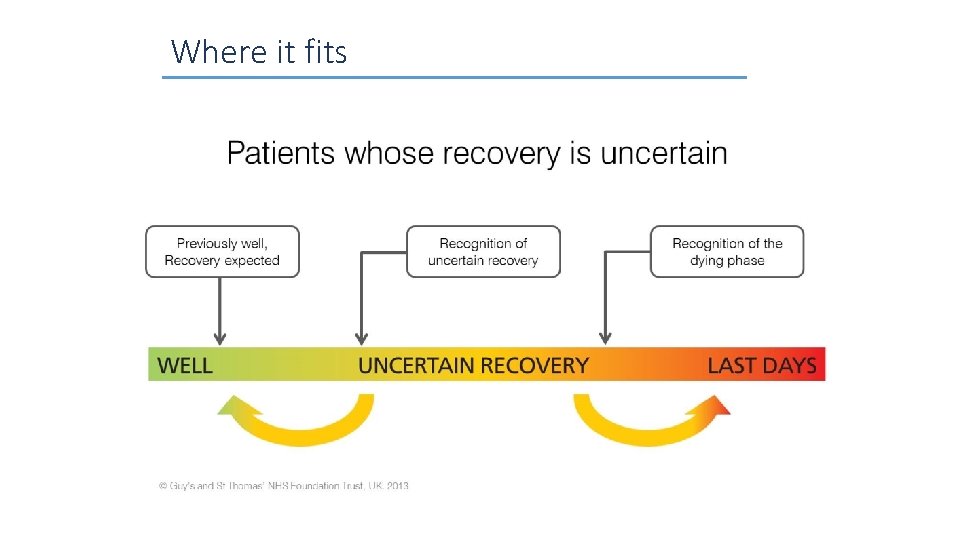
Where it fits
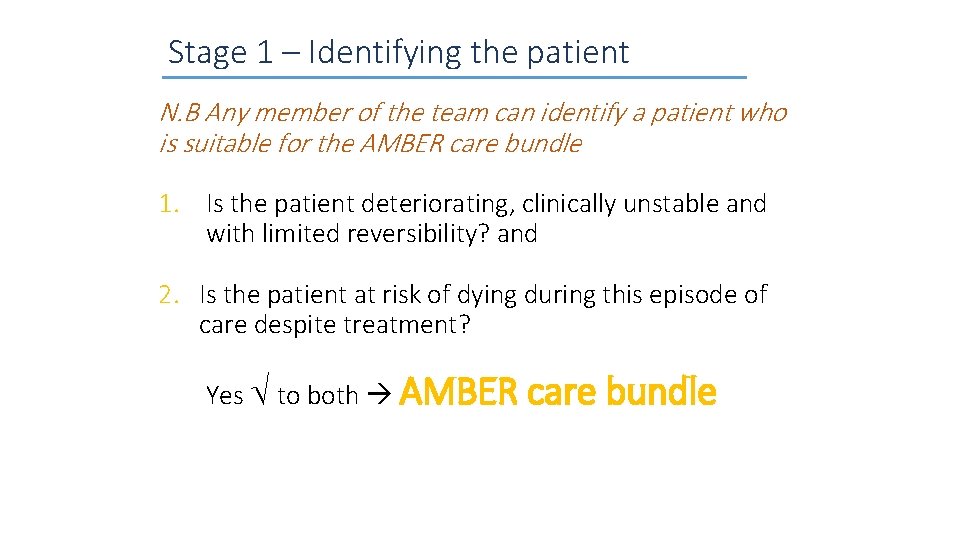
Stage 1 – Identifying the patient N. B Any member of the team can identify a patient who is suitable for the AMBER care bundle 1. Is the patient deteriorating, clinically unstable and with limited reversibility? and 2. Is the patient at risk of dying during this episode of care despite treatment? Yes to both AMBER care bundle
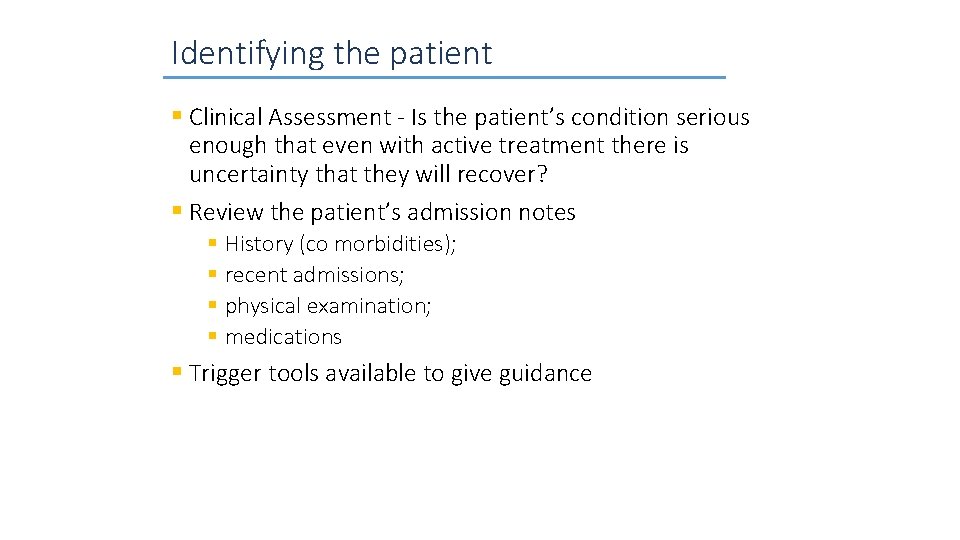
Identifying the patient § Clinical Assessment ‐ Is the patient’s condition serious enough that even with active treatment there is uncertainty that they will recover? § Review the patient’s admission notes § History (co morbidities); § recent admissions; § physical examination; § medications § Trigger tools available to give guidance
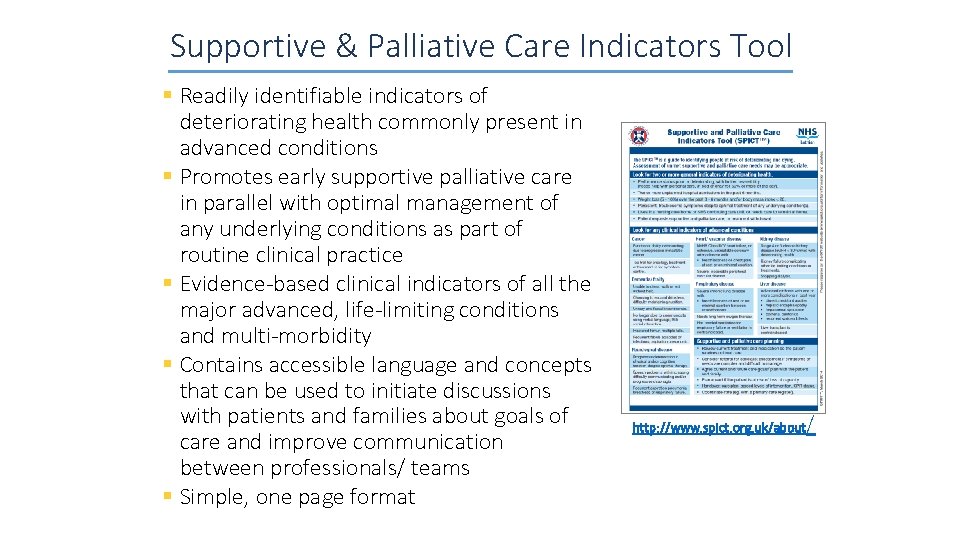
Supportive & Palliative Care Indicators Tool § Readily identifiable indicators of deteriorating health commonly present in advanced conditions § Promotes early supportive palliative care in parallel with optimal management of any underlying conditions as part of routine clinical practice § Evidence‐based clinical indicators of all the major advanced, life‐limiting conditions and multi‐morbidity § Contains accessible language and concepts that can be used to initiate discussions with patients and families about goals of care and improve communication between professionals/ teams § Simple, one page format http: //www. spict. org. uk/about /
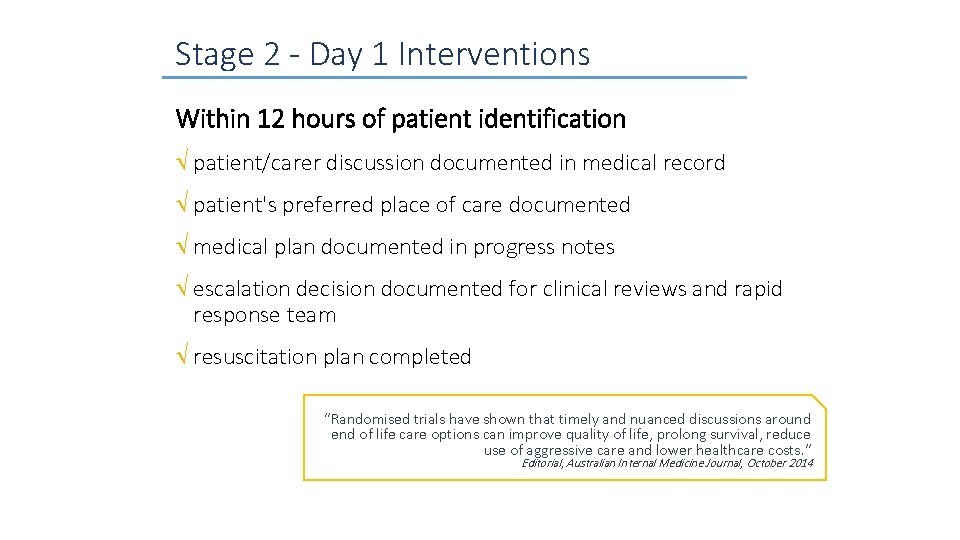
Stage 2 ‐ Day 1 Interventions Within 12 hours of patient identification patient/carer discussion documented in medical record patient's preferred place of care documented medical plan documented in progress notes escalation decision documented for clinical reviews and rapid response team resuscitation plan completed “Randomised trials have shown that timely and nuanced discussions around end of life care options can improve quality of life, prolong survival, reduce use of aggressive care and lower healthcare costs. ” Editorial, Australian Internal Medicine Journal, October 2014
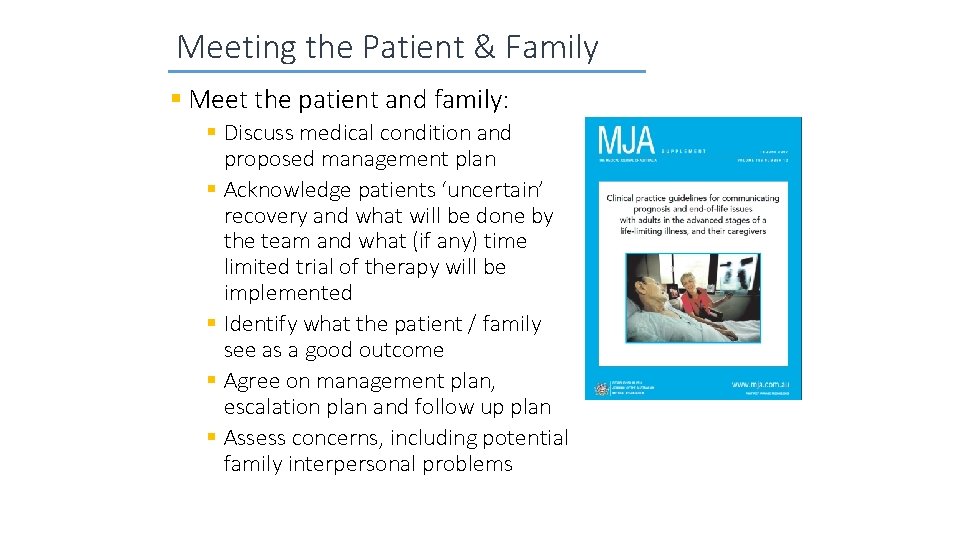
Meeting the Patient & Family § Meet the patient and family: § Discuss medical condition and proposed management plan § Acknowledge patients ‘uncertain’ recovery and what will be done by the team and what (if any) time limited trial of therapy will be implemented § Identify what the patient / family see as a good outcome § Agree on management plan, escalation plan and follow up plan § Assess concerns, including potential family interpersonal problems
Documentation § There should be detailed documentation of the conversation with the patient and family/carer around management plan. At a minimum should include: § who was present in discussion (both the MDT and family members) § what information was given § what were patient's concerns/choices § did the patient and/or family / carer understand the patient’s condition and the goals of care § did the patient have a preference for place of death § Indicators of symptom/pain control, psychosocial and spiritual support (including family care) were addressed
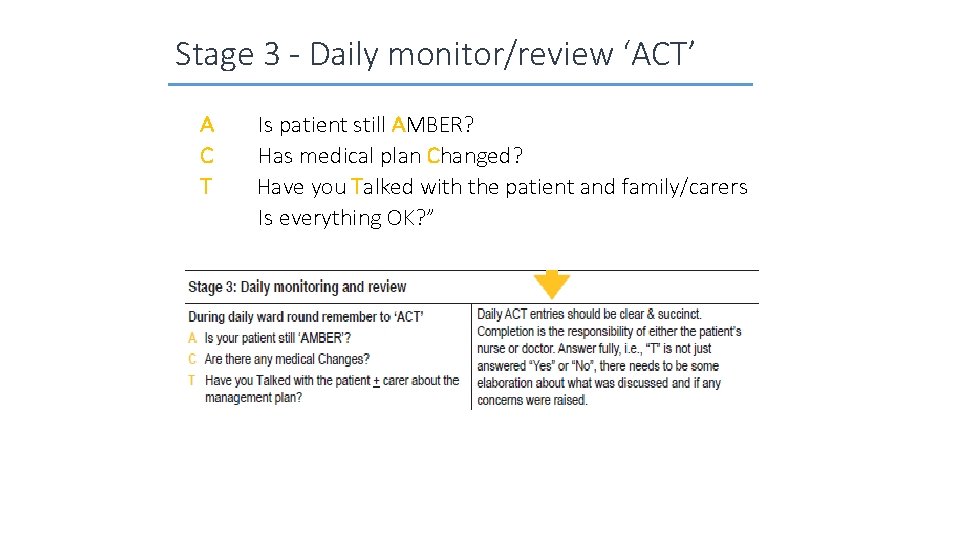
Stage 3 ‐ Daily monitor/review ‘ACT’ A C T Is patient still AMBER? Has medical plan Changed? Have you Talked with the patient and family/carers Is everything OK? ”
Daily monitoring / review using ‘ACT’ § Can be done by either nursing or medical staff or as part to the multidisciplinary round § Clarify any concerns with all members of health care team § Visit the patient ü Review treatment plan ü Discuss patient/family concerns ü Discuss preferred place of death (if appropriate) Not an ‘add on’ task – done as part of routine daily patient review § Document findings, discussions with patient / family and any changes to care plan §
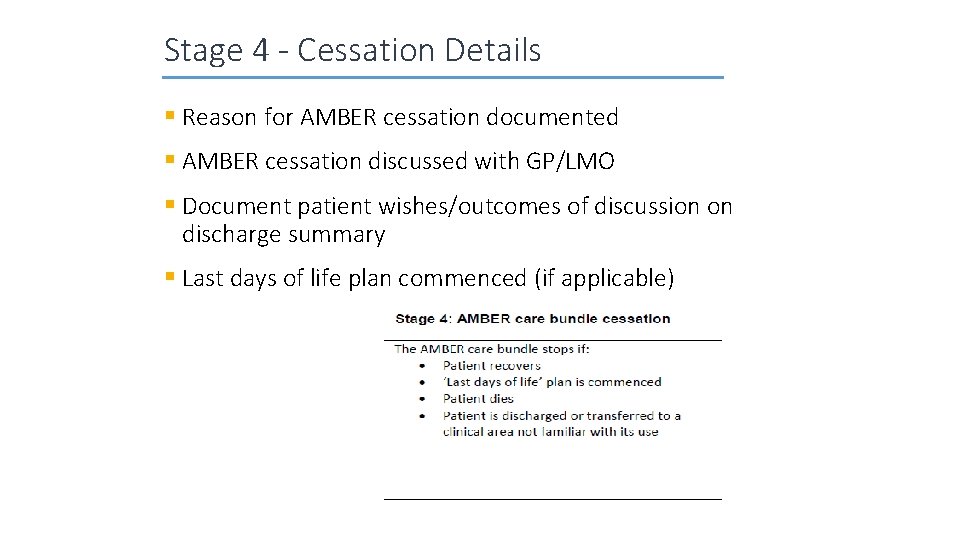
Stage 4 ‐ Cessation Details § Reason for AMBER cessation documented § AMBER cessation discussed with GP/LMO § Document patient wishes/outcomes of discussion on discharge summary § Last days of life plan commenced (if applicable)
1. Be prepared: • Look on Power. Chart: there may already have been goals of care discussed in the community. • Have discussions with oncologists first. • Know your patient’s clinical condition. 2. Never ask people if they want CPR. This is an unfair question. It makes people think they can decide when they live or die. Know that in certain conditions CPR doesn’t work, in non-cardiac, frail, elderly. “Given the severity of your illness, CPR has almost no chance of being effective, and I do not recommend that you have it. We will continue to give you all treatments that are effective to keep you comfortable. ”
Abbie’s Top 4 Conversation tips 3. If the conversation is getting heated, or people are becoming distressed have a “Time out” comment. • Blame the disease. • “Oh, my goodness, X is a terrible disease” 4. If the conversation is falling to pieces, it’s OK to bail. • Don’t see it as a failure, it will make the next person’s life easier when they initiate the conversation.
Sentences we hate…. . • We are going to fully palliate now…. . • There’s nothing left to do for you, we’re going to refer you to the palliative care team now.

References • Caresearch Training (2019) https: //training. caresearch. com. au/learner/course
- Slides: 40