
Introduction to p QCD and TMD physics Lecture

- Slides: 17
Introduction to p. QCD and TMD physics Lecture 3: TMD physics (I) Zhongbo Kang Los Alamos National Laboratory Spinfest 2016 University of California, Riverside July 25 – 26, 2016
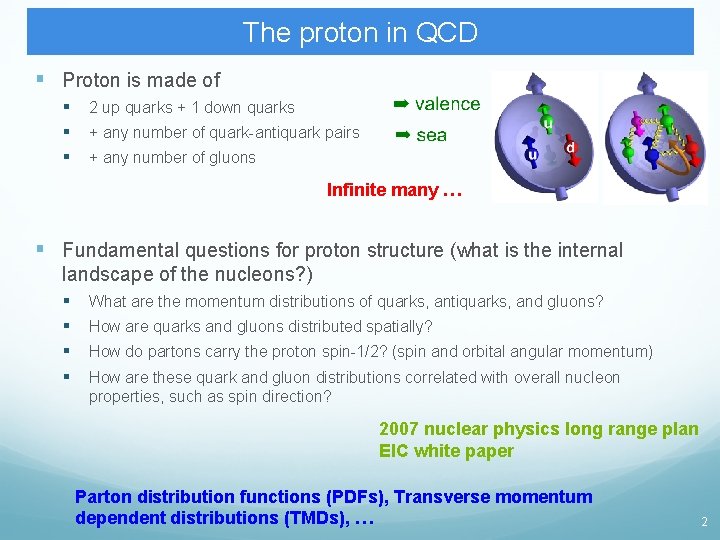
The proton in QCD § Proton is made of § § § 2 up quarks + 1 down quarks + any number of quark-antiquark pairs + any number of gluons Infinite many … § Fundamental questions for proton structure (what is the internal landscape of the nucleons? ) § § What are the momentum distributions of quarks, antiquarks, and gluons? How are quarks and gluons distributed spatially? How do partons carry the proton spin-1/2? (spin and orbital angular momentum) How are these quark and gluon distributions correlated with overall nucleon properties, such as spin direction? 2007 nuclear physics long range plan EIC white paper Parton distribution functions (PDFs), Transverse momentum dependent distributions (TMDs), … 2
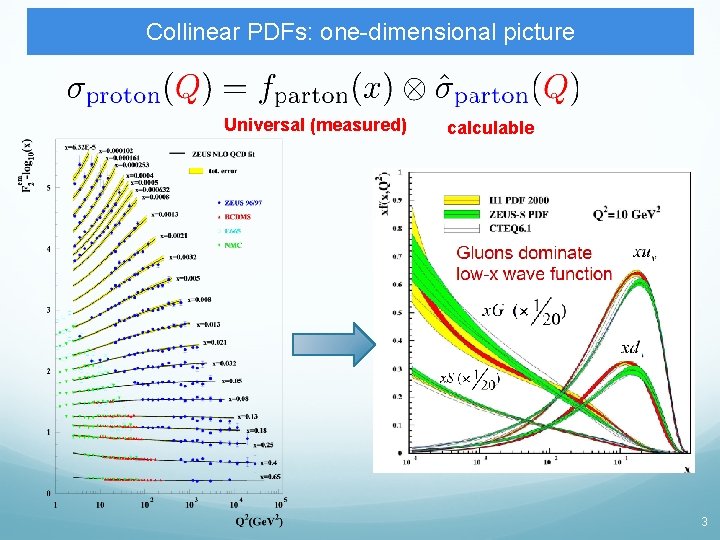
Collinear PDFs: one-dimensional picture Universal (measured) calculable 3
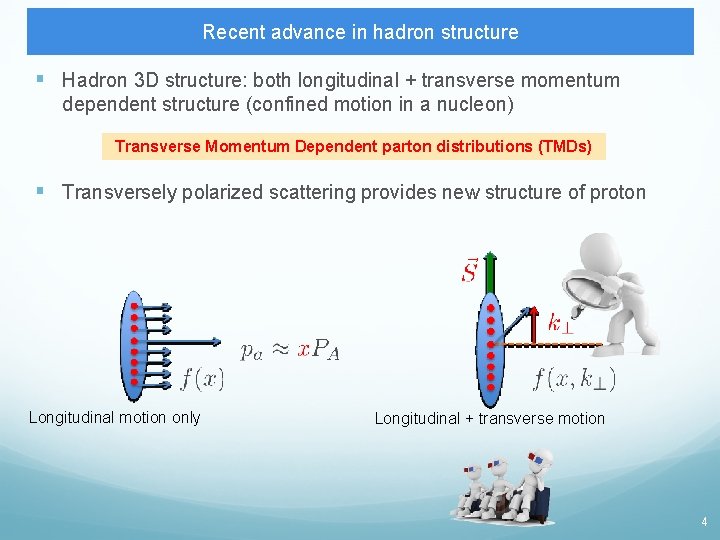
Recent advance in hadron structure § Hadron 3 D structure: both longitudinal + transverse momentum dependent structure (confined motion in a nucleon) Transverse Momentum Dependent parton distributions (TMDs) § Transversely polarized scattering provides new structure of proton Longitudinal motion only Longitudinal + transverse motion 4
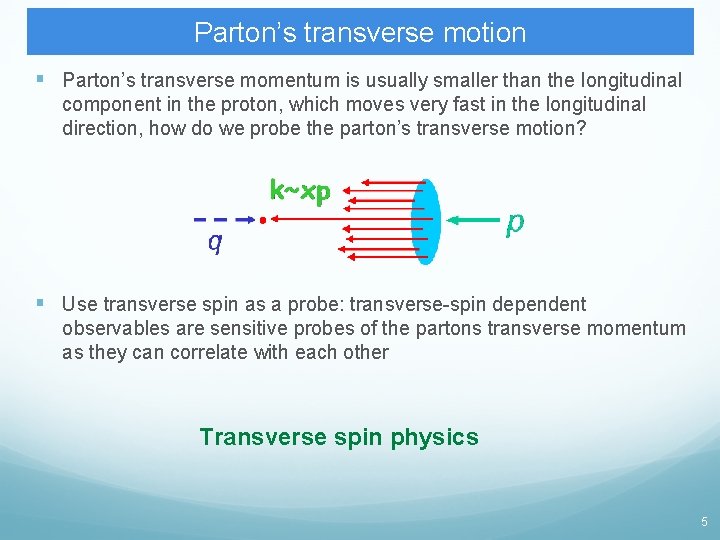
Parton’s transverse motion § Parton’s transverse momentum is usually smaller than the longitudinal component in the proton, which moves very fast in the longitudinal direction, how do we probe the parton’s transverse motion? § Use transverse spin as a probe: transverse-spin dependent observables are sensitive probes of the partons transverse momentum as they can correlate with each other Transverse spin physics 5
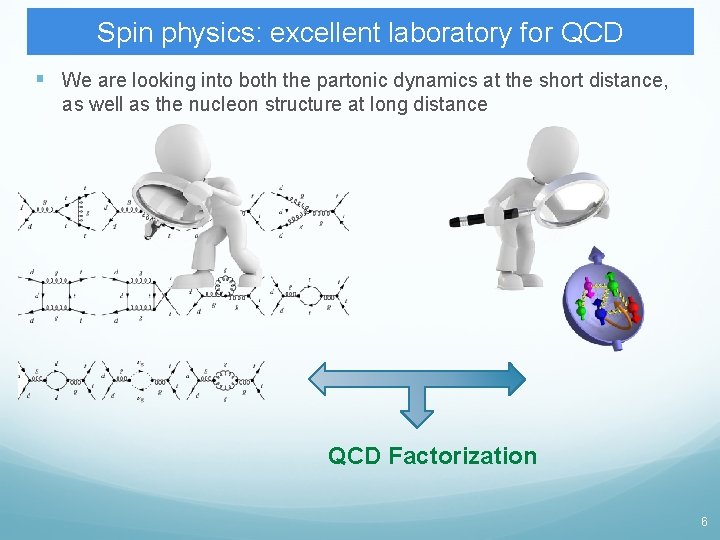
Spin physics: excellent laboratory for QCD § We are looking into both the partonic dynamics at the short distance, as well as the nucleon structure at long distance QCD Factorization 6
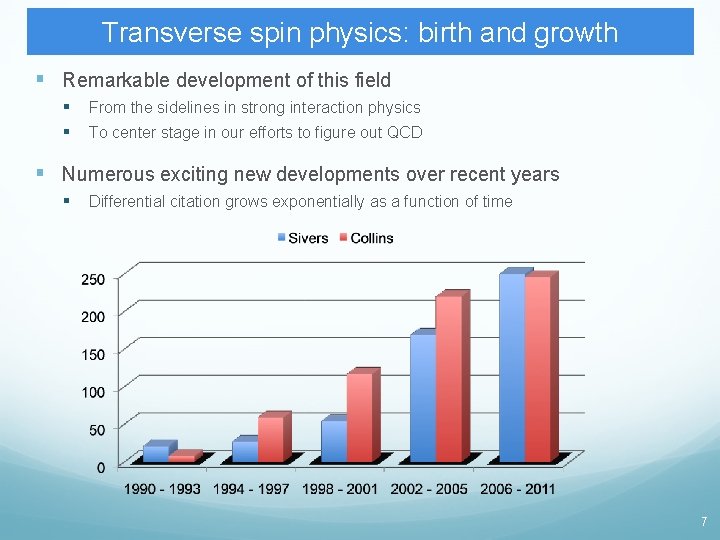
Transverse spin physics: birth and growth § Remarkable development of this field § § From the sidelines in strong interaction physics To center stage in our efforts to figure out QCD § Numerous exciting new developments over recent years § Differential citation grows exponentially as a function of time 7
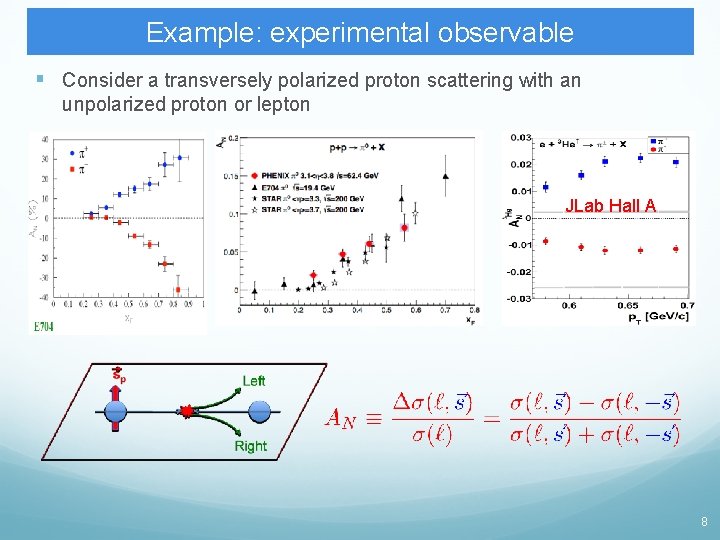
Example: experimental observable § Consider a transversely polarized proton scattering with an unpolarized proton or lepton JLab Hall A 8
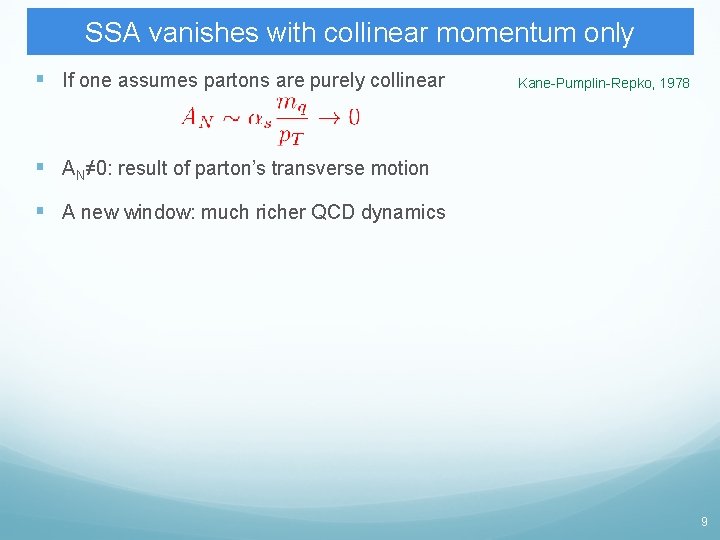
SSA vanishes with collinear momentum only § If one assumes partons are purely collinear Kane-Pumplin-Repko, 1978 § AN≠ 0: result of parton’s transverse motion § A new window: much richer QCD dynamics 9
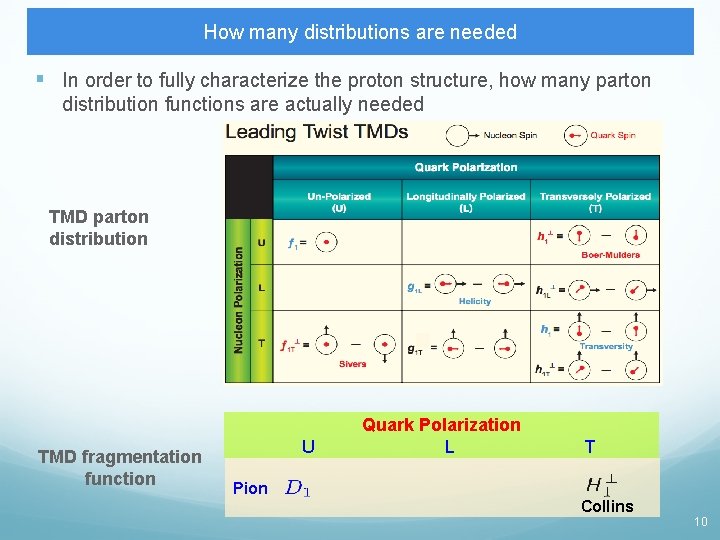
How many distributions are needed § In order to fully characterize the proton structure, how many parton distribution functions are actually needed TMD parton distribution TMD fragmentation function U Quark Polarization L T Pion Collins 10
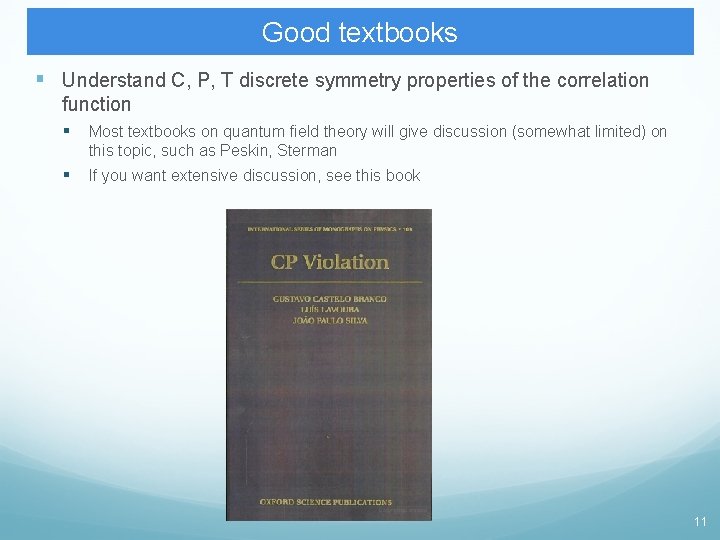
Good textbooks § Understand C, P, T discrete symmetry properties of the correlation function § Most textbooks on quantum field theory will give discussion (somewhat limited) on this topic, such as Peskin, Sterman § If you want extensive discussion, see this book 11
Operator analysis § Operator analysis to figure out how many distributions are needed to characterize the nucleon structure § I provide a detailed study for spin-0 particle § For details, see § § § Mulders, Tangerman hep-ph/9403227 Mulders, Tangerman hep-ph/9510301 Mulders, http: //www. nat. vu. nl/~mulders/correlations-0 new. pdf § The next slide continues after I mentioned gauge link 12
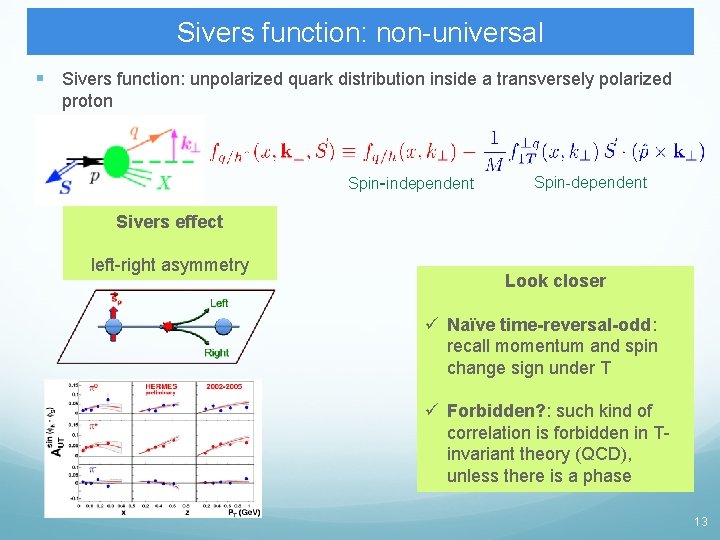
Sivers function: non-universal § Sivers function: unpolarized quark distribution inside a transversely polarized proton Spin-independent Spin-dependent Sivers effect left-right asymmetry Look closer ü Naïve time-reversal-odd: recall momentum and spin change sign under T ü Forbidden? : such kind of correlation is forbidden in Tinvariant theory (QCD), unless there is a phase 13
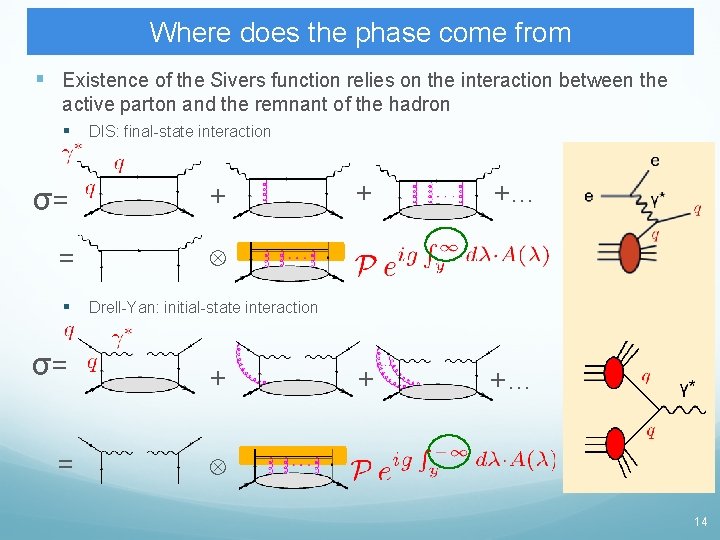
Where does the phase come from § Existence of the Sivers function relies on the interaction between the active parton and the remnant of the hadron § DIS: final-state interaction σ= + = ⊗ § + +… Drell-Yan: initial-state interaction σ= + = ⊗ 14
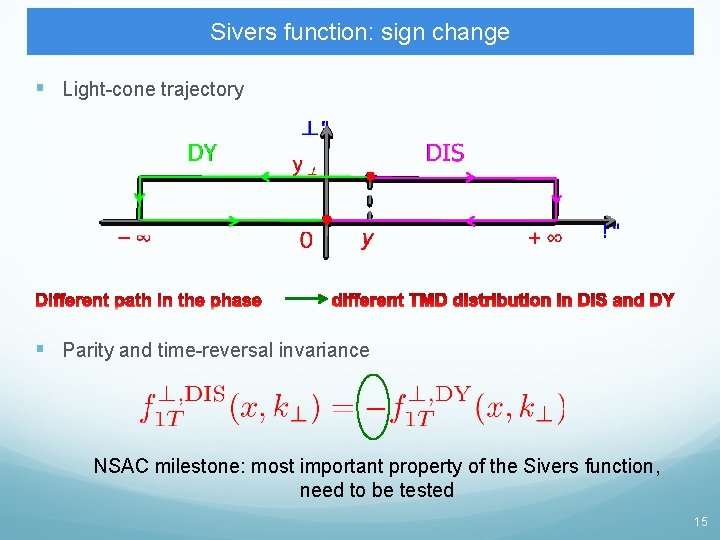
Sivers function: sign change § Light-cone trajectory § Parity and time-reversal invariance NSAC milestone: most important property of the Sivers function, need to be tested 15
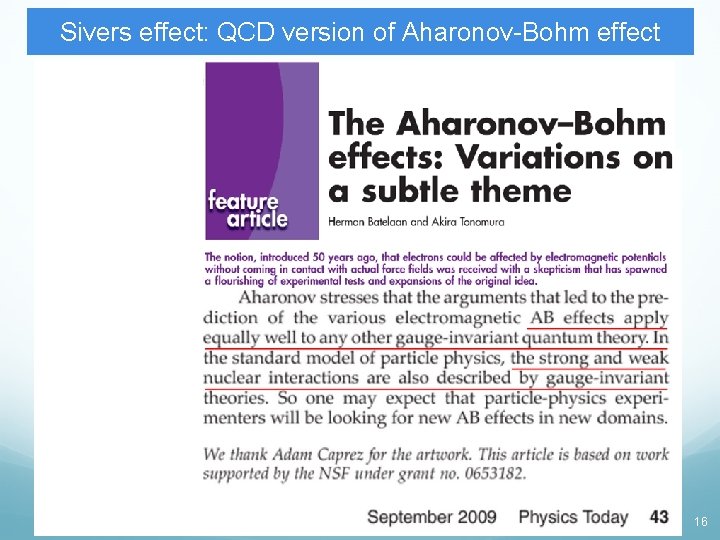
Sivers effect: QCD version of Aharonov-Bohm effect § Pure quantum effect: different paths lead to interference § Physics today, September 2009 16
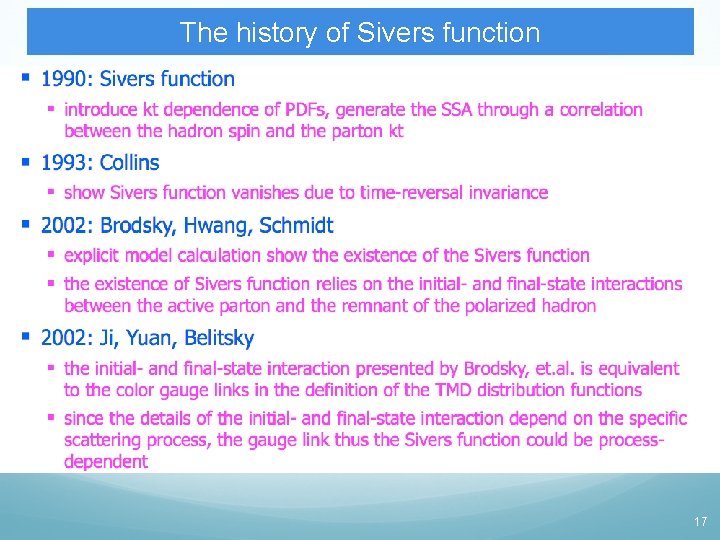
The history of Sivers function 17