
Introduction to Overfill Prevention for USTs Presented by

Introduction to Overfill Prevention for USTs Presented by: Ted Unkles UST Program Coordinator Vermont Dep’t of Environmental Conservation Montpelier, Vermont (802) 522 -0488 e-mail: ted. unkles@vermont. gov

Overfill prevention: why is it important? • Tank overfills can result in large spills. • One particularly awful overfill in Biloxi, Mississippi, released more than 500 gallons of gasoline (August 9, 1998).

Biloxi Overfill tragedy • Gas flowed into the street and caught fire. • 5 people sitting in traffic died in the fire; a 6 th survived but was severely burned.
Overfill prevention: Regulatory Requirements • Federal UST Regs: 40 CFR§ 280. 20(c) for new UST systems, and 280. 21(d), for existing UST systems. • Most states (probably all) have requirements in their UST regs that mirror these federal requirements.
Overfill prevention – regulatory requirements • All regulated UST systems must have a device that will do one of the following: – Stop delivery when the tank is no more than 95% full; or – Slow down the delivery when the tank is no more than 90% full; or – Alert the delivery driver with a high level alarm one minute before overfilling.
Overfill prevention – regulatory requirements Other options -- Federal regs also allow devices that will: • restrict flow 30 minutes prior to overfilling, or • automatically shut off flow so that product never touches any tank-top fittings. • These options are not commonly used, and many states do not allow them.
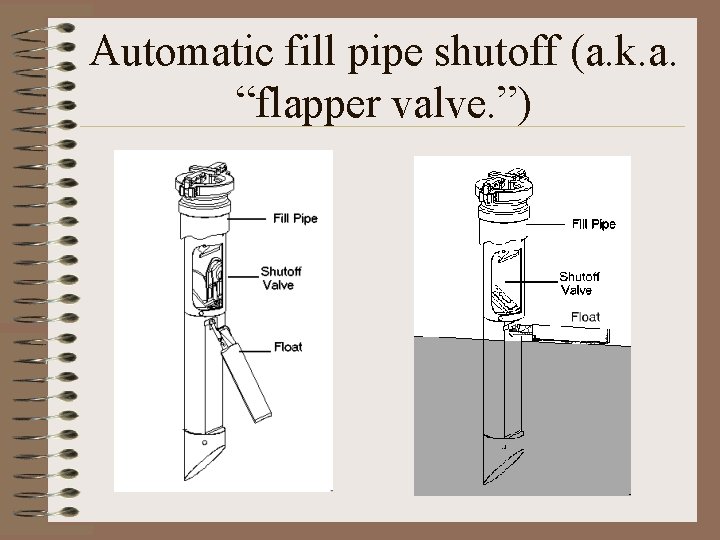
Automatic fill pipe shutoff (a. k. a. “flapper valve. ”)
Automatic Fill Pipe Shutoff • They can be set at 95% of the tank’s capacity. • If the hose is not attached to the fill pipe securely, it can come loose. • If the drop tube is not mounted properly inside the fill pipe, the whole unit can be slammed into the bottom of the tank.
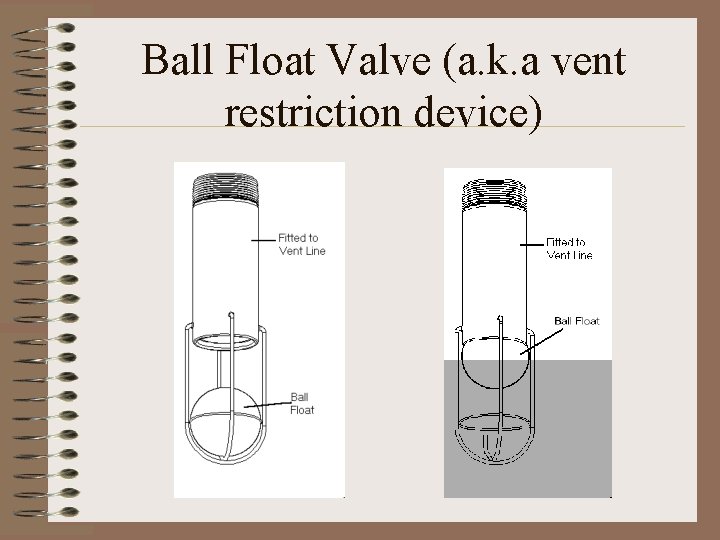
Ball Float Valve (a. k. a vent restriction device)
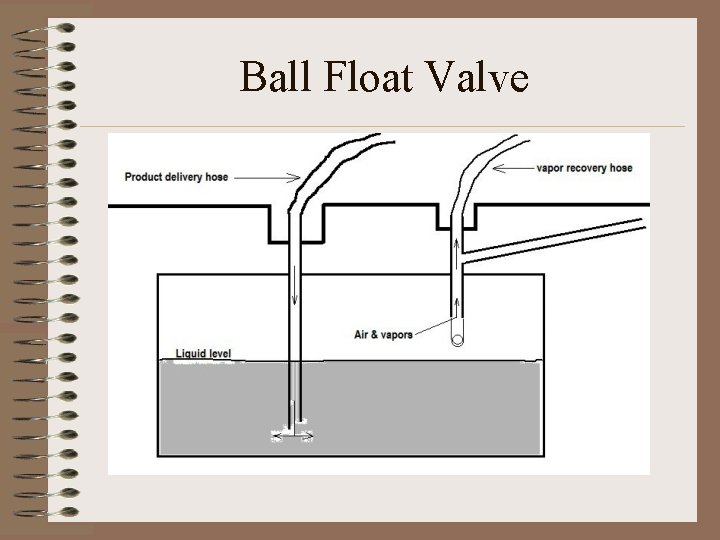
Ball Float Valve

Ball Float Valve
Ball Float Valves • All fittings on top of the tank must be vapor-tight. • They cause pressurization of the vapor space, which can cause problems with vapor recovery systems. • They don’t work with coaxial vapor recovery systems. • If a tank has a remote fill the gauging port must be capped tightly.
Ball Float Valves • Ball Float valves are not allowed on new UST systems. • But many tanks are equipped with ball floats, and they can still be used as long as they continue to function properly.

Audible Alarm • The alarm must be visible and/or audible to the driver making the delivery. • Too often, the alarm is inside the building, as part of the console. • The alarm itself does nothing to stop the flow into the tank. The driver has to stop the flow manually.
Quick Summary • All regulated USTs must be equipped with a device that will do one of the following: – Stop delivery at 95% full (auto fill pipe shutoff); or – Slow delivery at 90% full (ball float) – but remember, these are not allowed for new UST systems; – Alert the delivery driver 1 minute before overfill occurs (audible alarm).

Questions? • Call me at (802) 522 -0488, or • e-mail me at: ted. unkles@vermont. gov
- Slides: 16