
Introduction to Osteopathic Principles and Practice Sarah Cole

- Slides: 52
Introduction to Osteopathic Principles and Practice Sarah Cole, DO, FAAFP
Disclosures • I have no disclosures to report.
Learning Objectives • Be able to name the four tenets that define osteopathic principles and practice (OPP). • Be able to define somatic dysfunction and it’s characteristics. • Understand who can safely and successfully perform osteopathic manipulative therapy (OMT). • Be familiar with evidence regarding the effectiveness of OMT for health conditions.
An Incomplete History of OPP OSTEOPATHIC PRINCIPLES & PRACTICE
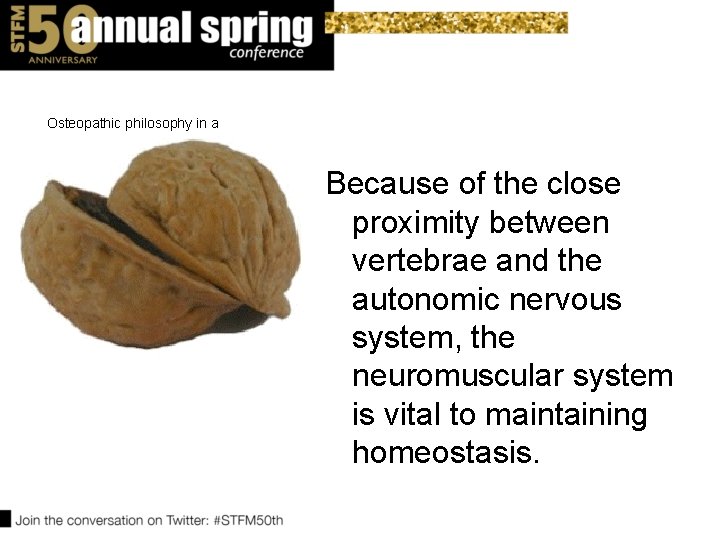
Osteopathic philosophy in a Because of the close proximity between vertebrae and the autonomic nervous system, the neuromuscular system is vital to maintaining homeostasis.
Tenets of osteopathic principles and practice v v The body is a unit. Structure and function are interrelated. The body has intrinsic healing properties. Osteopathic treatment is based on an understanding of the above three tenets.
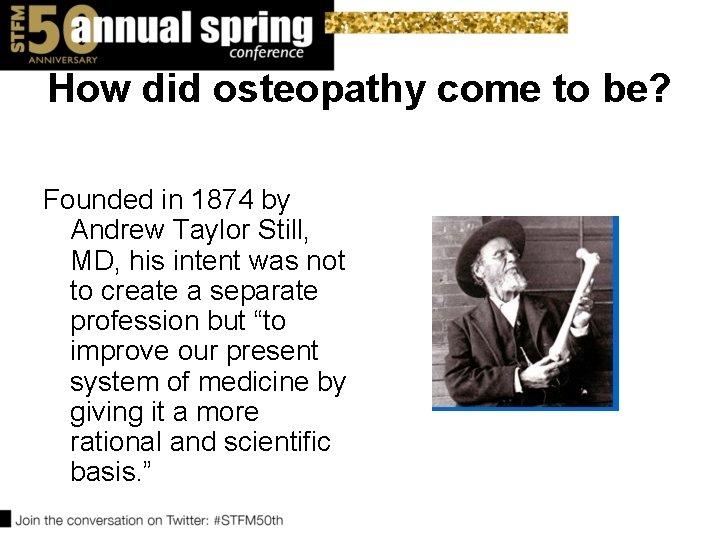
How did osteopathy come to be? Founded in 1874 by Andrew Taylor Still, MD, his intent was not to create a separate profession but “to improve our present system of medicine by giving it a more rational and scientific basis. ”
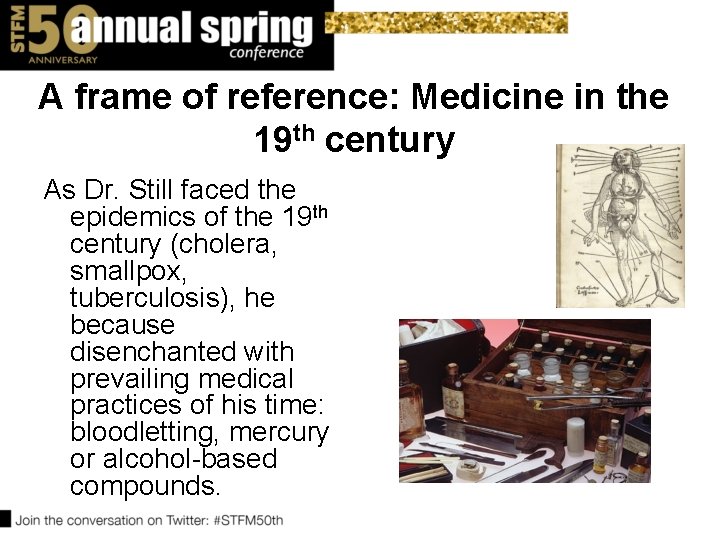
A frame of reference: Medicine in the 19 th century As Dr. Still faced the epidemics of the 19 th century (cholera, smallpox, tuberculosis), he because disenchanted with prevailing medical practices of his time: bloodletting, mercury or alcohol-based compounds.
Innate capacity for self-healing v. Dr. Still believed the body’s function was closely related to its structure and that problems in one organ affected other parts of the body. v. He maintained the physician could best promote health by ensuring the musculoskeletal system was in alignment, thus minimizing obstructions to blood and lymph flow.
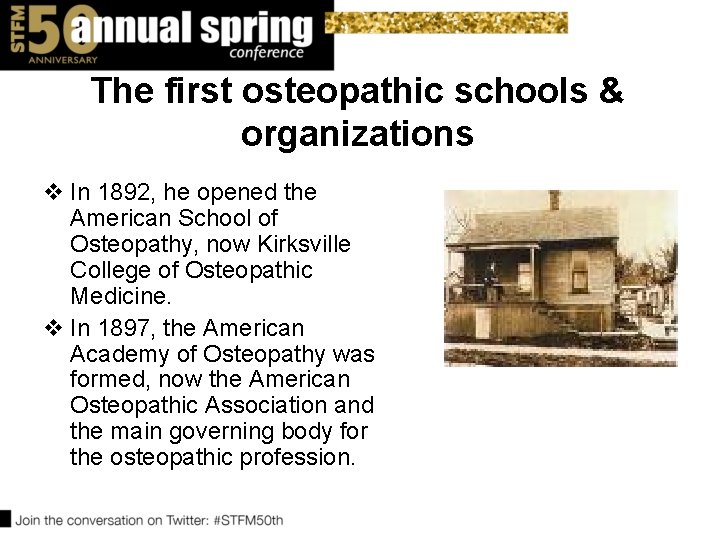
The first osteopathic schools & organizations v In 1892, he opened the American School of Osteopathy, now Kirksville College of Osteopathic Medicine. v In 1897, the American Academy of Osteopathy was formed, now the American Osteopathic Association and the main governing body for the osteopathic profession.
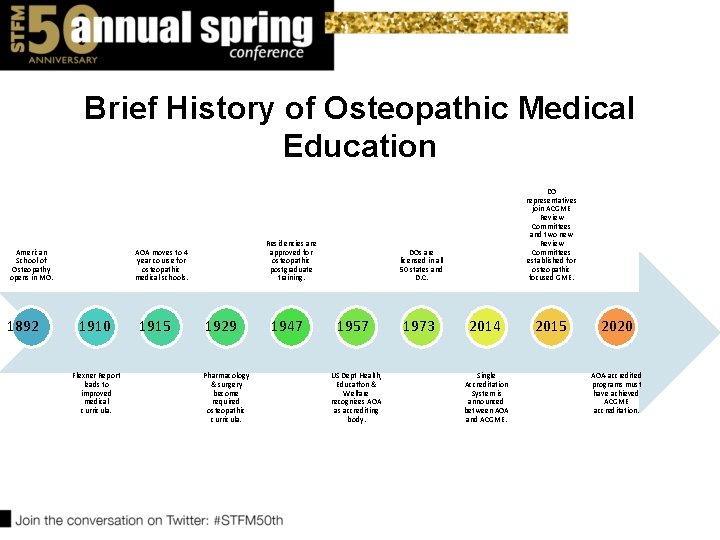
Brief History of Osteopathic Medical Education American School of Osteopathy opens in MO. 1892 Residencies are approved for osteopathic postgraduate training. AOA moves to 4 year course for osteopathic medical schools. 1910 Flexner Report leads to improved medical curricula. 1915 1929 Pharmacology & surgery become required osteopathic curricula. 1947 DO representatives join ACGME Review Committees and two new Review Committees established for osteopathic focused GME. DOs are licensed in all 50 states and D. C. 1957 US Dept Health, Educatfon & Welfare recognizes AOA as accrediting body. 1973 2014 Single Accreditation System is announced between AOA and ACGME. 2015 2020 AOA-accredited programs must have achieved ACGME accreditation.
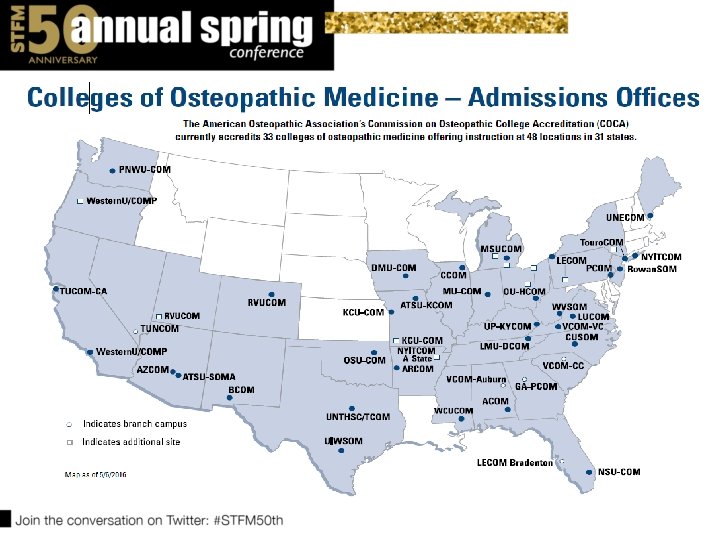
Today… • Today, more than 20 % of medical students in the United States are training to be osteopathic physicians. • 33 osteopathic medical schools in US • Sixty percent of current US osteopathic medical school graduates practice primary care, compared to 20% of current US allopathic graduates. • Most of these are in Family Medicine, followed by Internal Medicine and Pediatrics. http: //www. aacom. org/become-a-doctor/about-om Accessed 3/29/17
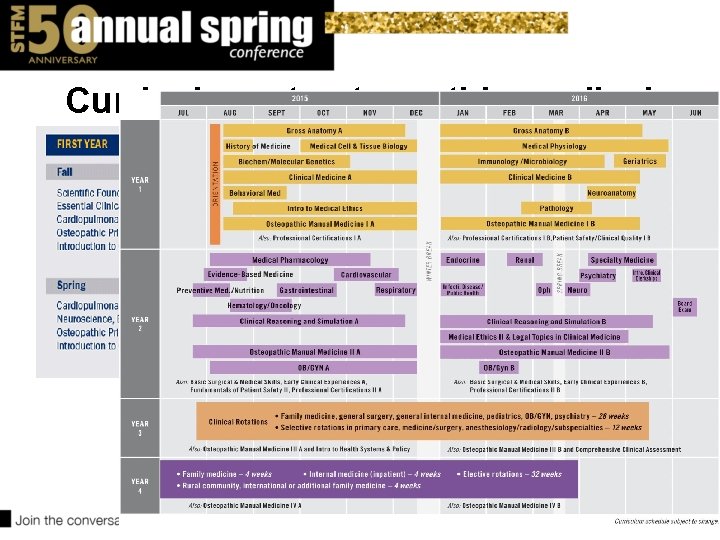
Curriculum at osteopathic medical school
COMLEX • Comprehensive Osteopathic Licensing Exam of the United States • 3 -step licensing exam administered by the National Osteopathic Board of Medical Examiners (NBOME) comparable to the USMLE
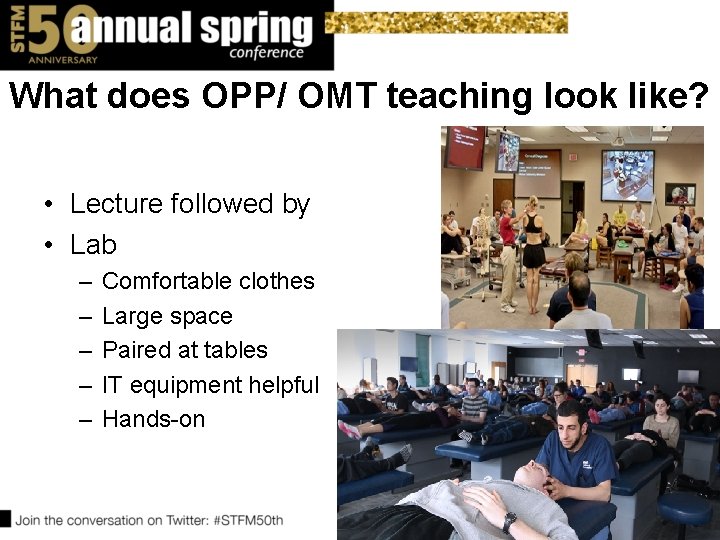
What does OPP/ OMT teaching look like? • Lecture followed by • Lab – – – Comfortable clothes Large space Paired at tables IT equipment helpful Hands-on
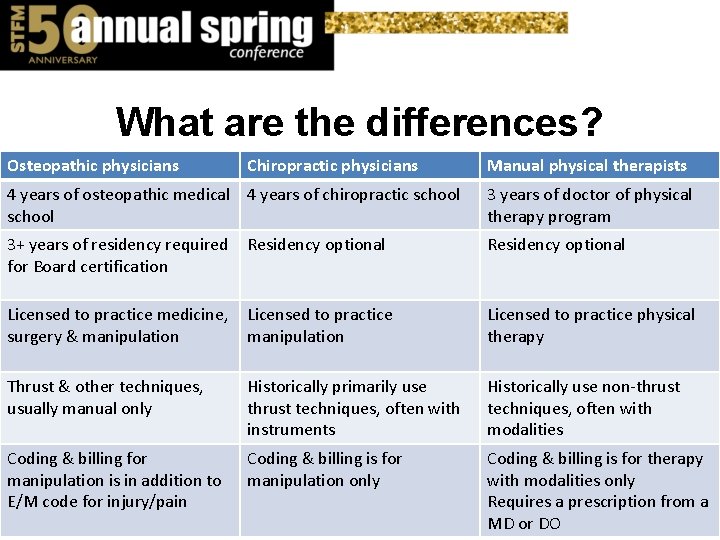
What are the differences? Osteopathic physicians Chiropractic physicians Manual physical therapists 4 years of osteopathic medical 4 years of chiropractic school 3 years of doctor of physical therapy program 3+ years of residency required for Board certification Residency optional Licensed to practice medicine, surgery & manipulation Licensed to practice physical therapy Thrust & other techniques, usually manual only Historically primarily use thrust techniques, often with instruments Historically use non-thrust techniques, often with modalities Coding & billing for manipulation is in addition to E/M code for injury/pain Coding & billing is for manipulation only Coding & billing is for therapy with modalities only Requires a prescription from a MD or DO
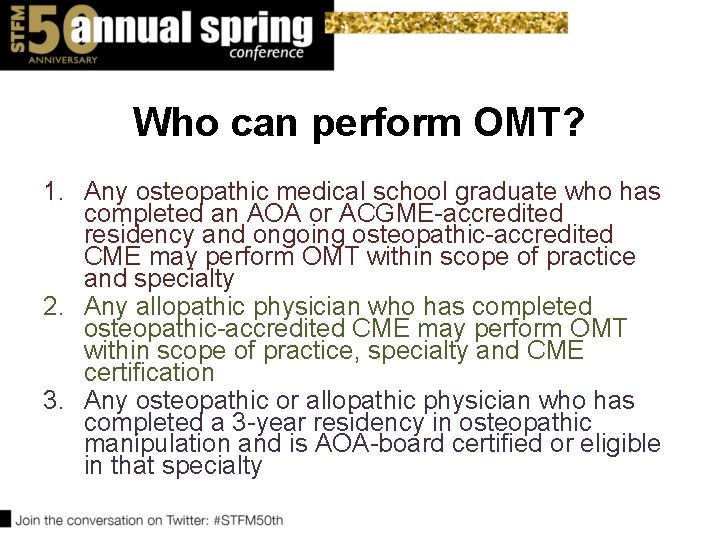
Who can perform OMT? 1. Any osteopathic medical school graduate who has completed an AOA or ACGME-accredited residency and ongoing osteopathic-accredited CME may perform OMT within scope of practice and specialty 2. Any allopathic physician who has completed osteopathic-accredited CME may perform OMT within scope of practice, specialty and CME certification 3. Any osteopathic or allopathic physician who has completed a 3 -year residency in osteopathic manipulation and is AOA-board certified or eligible in that specialty
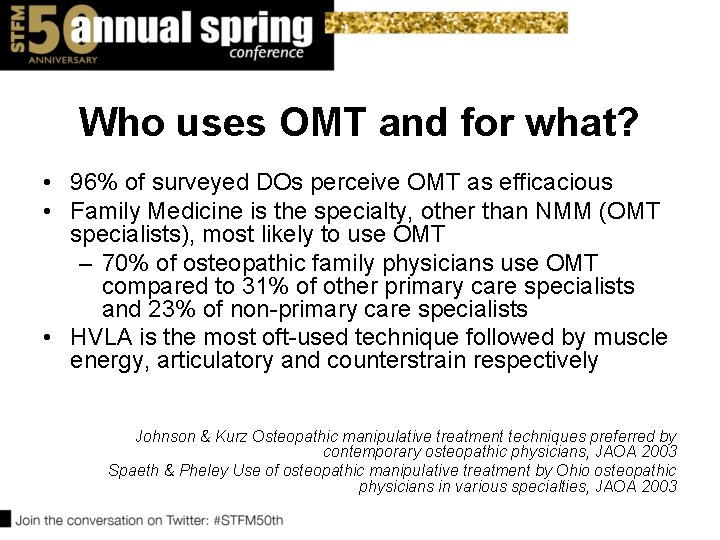
Who uses OMT and for what? • 96% of surveyed DOs perceive OMT as efficacious • Family Medicine is the specialty, other than NMM (OMT specialists), most likely to use OMT – 70% of osteopathic family physicians use OMT compared to 31% of other primary care specialists and 23% of non-primary care specialists • HVLA is the most oft-used technique followed by muscle energy, articulatory and counterstrain respectively Johnson & Kurz Osteopathic manipulative treatment techniques preferred by contemporary osteopathic physicians, JAOA 2003 Spaeth & Pheley Use of osteopathic manipulative treatment by Ohio osteopathic physicians in various specialties, JAOA 2003
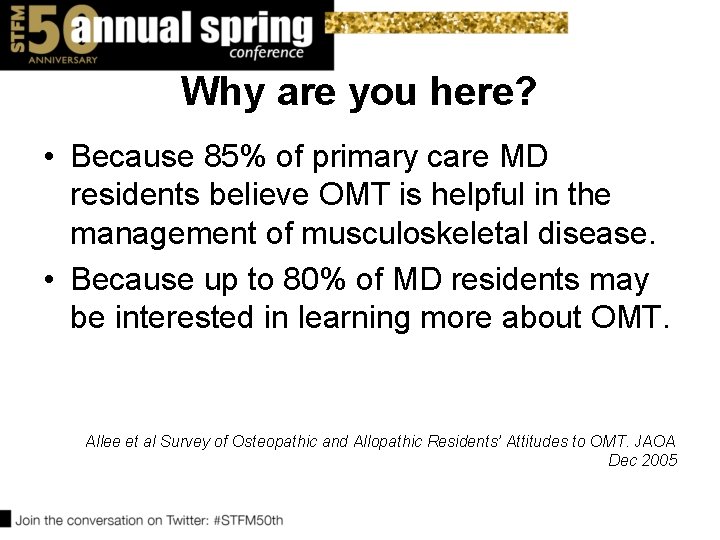
Why are you here? • Because 85% of primary care MD residents believe OMT is helpful in the management of musculoskeletal disease. • Because up to 80% of MD residents may be interested in learning more about OMT. Allee et al Survey of Osteopathic and Allopathic Residents’ Attitudes to OMT. JAOA Dec 2005
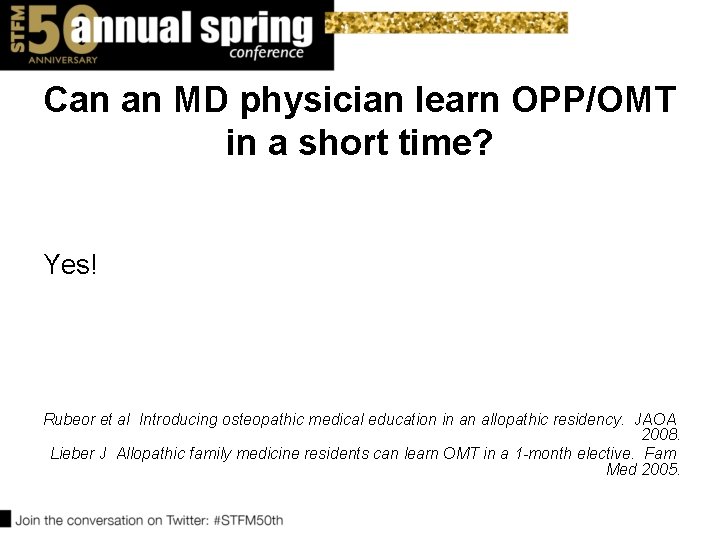
Can an MD physician learn OPP/OMT in a short time? Yes! Rubeor et al Introducing osteopathic medical education in an allopathic residency. JAOA 2008. Lieber J Allopathic family medicine residents can learn OMT in a 1 -month elective. Fam Med 2005.
An Introductory Description of OMT OSTEOPATHIC MANIPULATIVE THERAPY/TREATMENT
Osteopathic diagnosis & treatment v. Changes in the musculoskeletal system can affect other organs (somatovisceral reflex) or allow visceral pathology to manifest as aberrations in musculoskeletal tissue texture and articular motion (viscerosomatic reflex). v. These musculoskeletal changes are known as SOMATIC DYSFUNCTION. v. Somatic dysfunction is palpable on structural examination and can be treated with manual medicine, including osteopathic manipulation.
Somatic Dysfunction v Impaired or altered function of ANY part of the soma: skeletal, myofascial, and related vascular, lymphatic and neural elements v Diagnosed via PALPATION v Freedom of motion vs. Restricted motion v Findings v T – tenderness v A – asymmetry v R – restricted range of motion v T – tissue texture changes
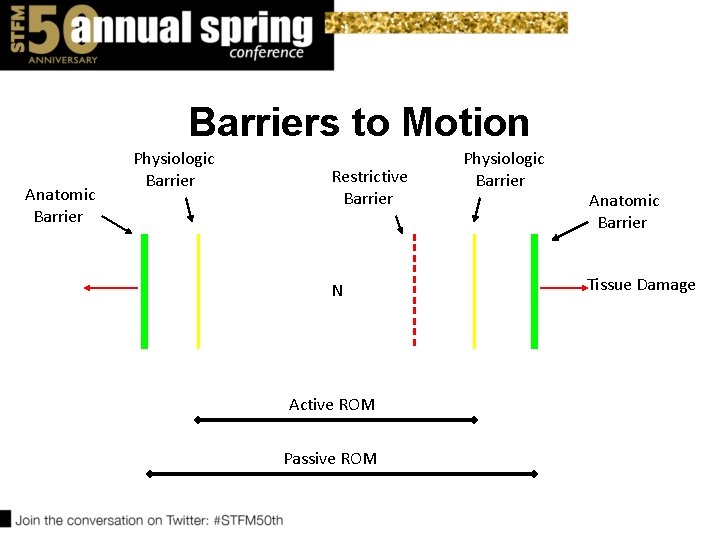
Barriers to Range of Motion v Physiological Barrier v Limit of normal motion v Tested actively v Anatomical Barrier v End range of motion v Tested passively v Elastic Barrier v Range of motion between physiological and anatomic barriers v Restrictive Barrier v Abnormally diminishes physiological range of motion v This is the barrier we work with in OMT
Barriers to Motion Anatomic Barrier Physiologic Barrier Restrictive Barrier N Active ROM Passive ROM Physiologic Barrier Anatomic Barrier Tissue Damage
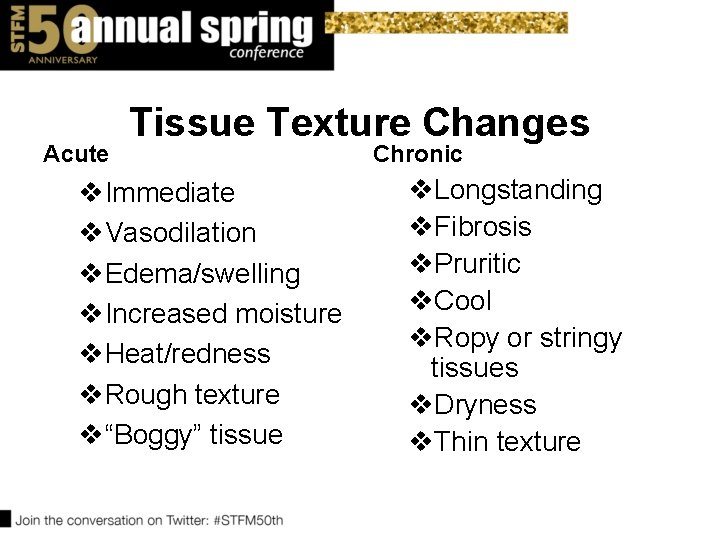
Acute Tissue Texture Changes v. Immediate v. Vasodilation v. Edema/swelling v. Increased moisture v. Heat/redness v. Rough texture v“Boggy” tissue Chronic v. Longstanding v. Fibrosis v. Pruritic v. Cool v. Ropy or stringy tissues v. Dryness v. Thin texture
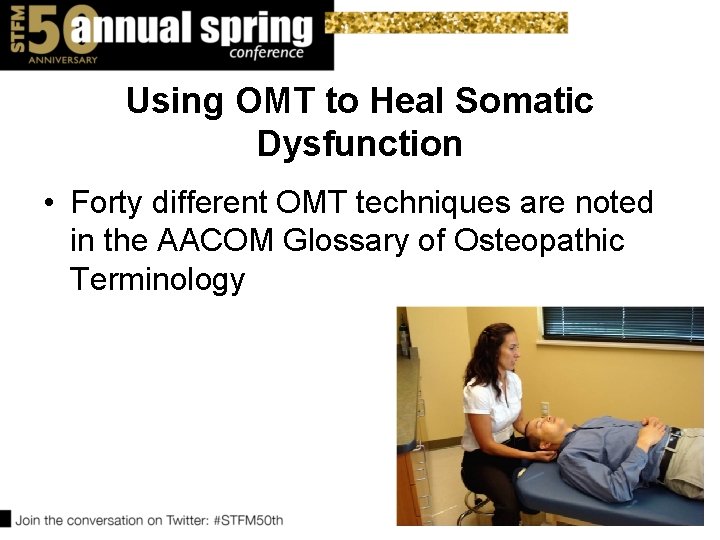
Using OMT to Heal Somatic Dysfunction • Forty different OMT techniques are noted in the AACOM Glossary of Osteopathic Terminology
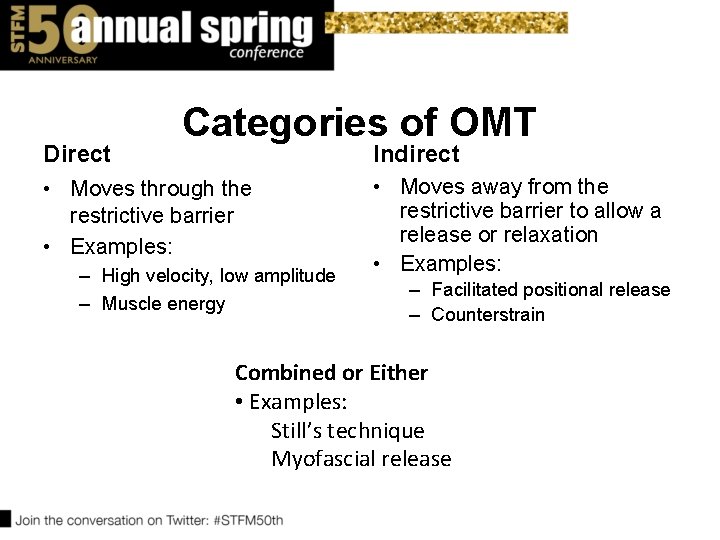
Direct Categories of OMT Indirect • Moves through the restrictive barrier • Examples: – High velocity, low amplitude – Muscle energy • Moves away from the restrictive barrier to allow a release or relaxation • Examples: – Facilitated positional release – Counterstrain Combined or Either • Examples: Still’s technique Myofascial release
Physiologic Effects of OMT • Mechanically: OMT can cause articular release, causing freeing of motion and release of joint tension of vertebrae, long or short bones with or without an accompanying noise • Neuromuscularly: OMT generates afferent input, which diminishes motor neuron discharge and relaxes muscle fibers • Vascularly: OMT increases nitric oxide concentration in blood, thus promoting vasodilation and increasing blood flow to peripheral vascular tissue • Neurochemically: OMT transiently increases serum anandamide, stimulating cannabinoid receptors in the brain • May increase water content of collagenous and cartilagenous structures • May stimulate glycosaminoglycan synthesis
Contraindications to OMT • Contraindications vary by technique. • HVLA, for example, has the most contraindications. – Some examples include osteoporosis, fracture, malignancy or osteomyelitis. • Other techniques, however, may be limited only by patient’s ability to follow directions or lie still.
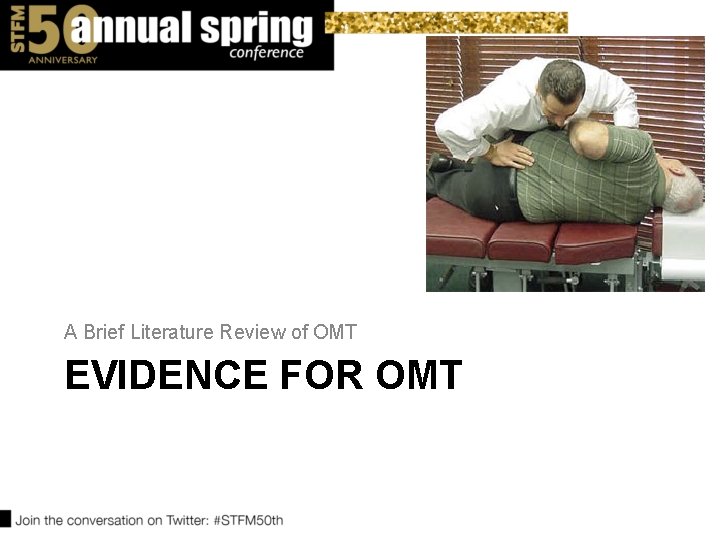
A Brief Literature Review of OMT EVIDENCE FOR OMT
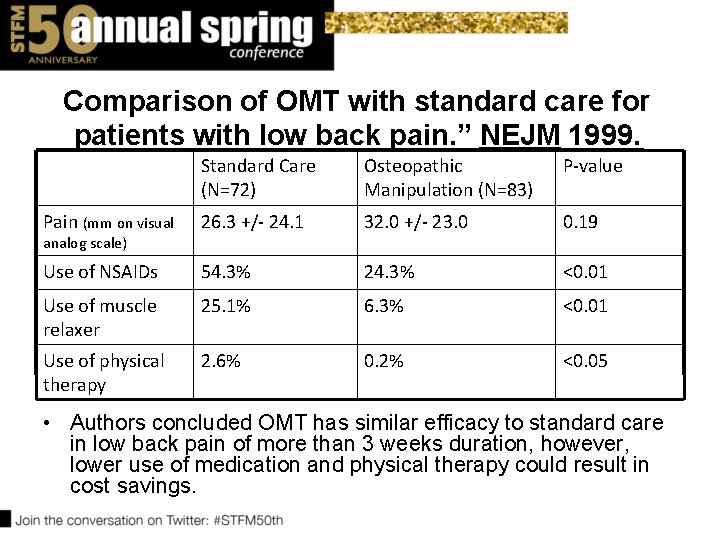
“Comparison of OMT with standard care for patients with low back pain. ” NEJM 1999. • 155 patients with low back pain lasting > 3 weeks and < 6 months • 72 randomized to receive standard care (NSAIDs, analgesics, muscle relaxants, active PT) and 83 randomized to receive OMT weekly for 4 weeks then every 2 weeks for another 4 visits
Comparison of OMT with standard care for patients with low back pain. ” NEJM 1999. Standard Care (N=72) Osteopathic Manipulation (N=83) P-value Pain (mm on visual 26. 3 +/- 24. 1 32. 0 +/- 23. 0 0. 19 Use of NSAIDs 54. 3% 24. 3% <0. 01 Use of muscle relaxer 25. 1% 6. 3% <0. 01 Use of physical therapy 2. 6% 0. 2% <0. 05 analog scale) • Authors concluded OMT has similar efficacy to standard care in low back pain of more than 3 weeks duration, however, lower use of medication and physical therapy could result in cost savings.
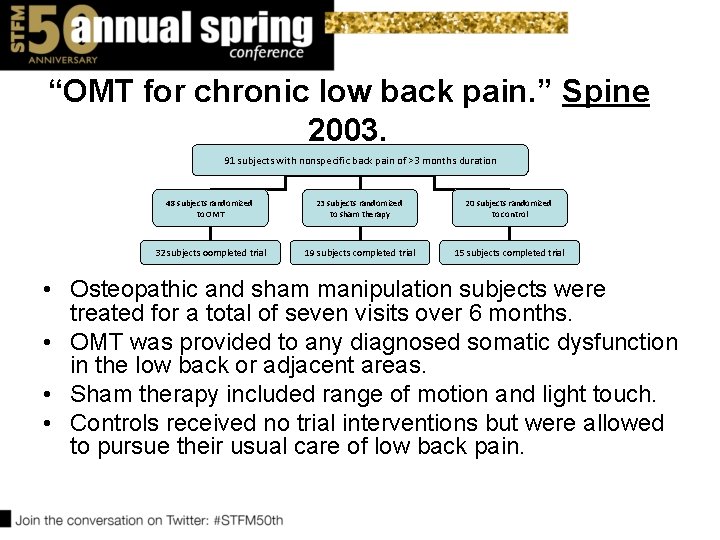
“OMT for chronic low back pain. ” Spine 2003. 91 subjects with nonspecific back pain of >3 months duration 48 subjects randomized to OMT 23 subjects randomized to sham therapy 20 subjects randomized to control 32 subjects oompleted trial 19 subjects completed trial 15 subjects completed trial • Osteopathic and sham manipulation subjects were treated for a total of seven visits over 6 months. • OMT was provided to any diagnosed somatic dysfunction in the low back or adjacent areas. • Sham therapy included range of motion and light touch. • Controls received no trial interventions but were allowed to pursue their usual care of low back pain.
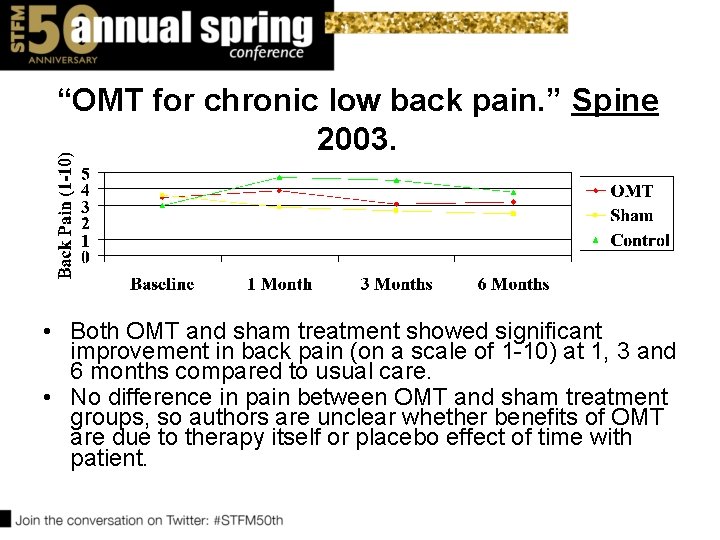
“OMT for chronic low back pain. ” Spine 2003. • Both OMT and sham treatment showed significant improvement in back pain (on a scale of 1 -10) at 1, 3 and 6 months compared to usual care. • No difference in pain between OMT and sham treatment groups, so authors are unclear whether benefits of OMT are due to therapy itself or placebo effect of time with patient.
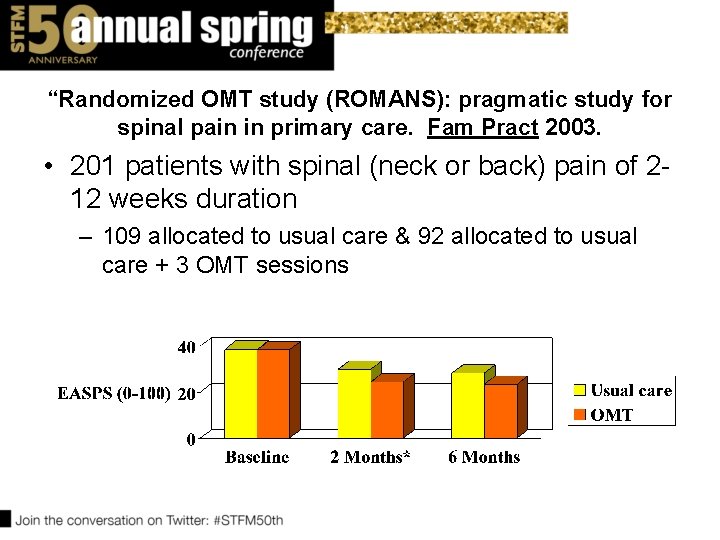
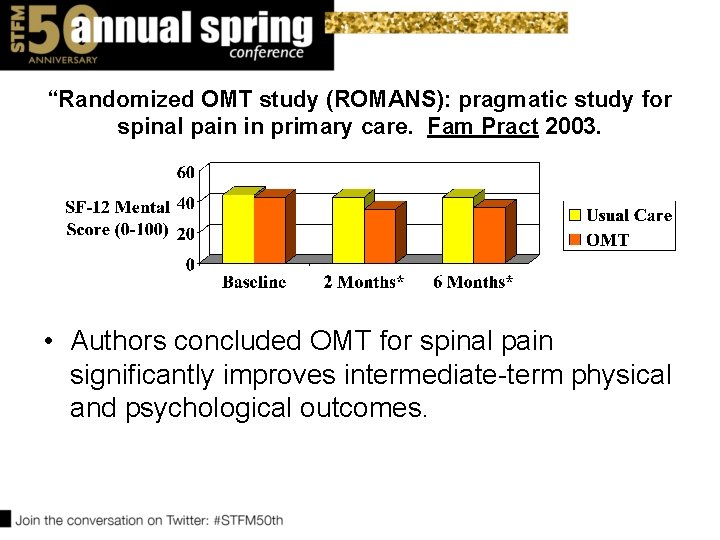
“Randomized OMT study (ROMANS): pragmatic study for spinal pain in primary care. Fam Pract 2003. • 201 patients with spinal (neck or back) pain of 212 weeks duration – 109 allocated to usual care & 92 allocated to usual care + 3 OMT sessions
“Randomized OMT study (ROMANS): pragmatic study for spinal pain in primary care. Fam Pract 2003. • Authors concluded OMT for spinal pain significantly improves intermediate-term physical and psychological outcomes.
“Cost-utility analysis of osteopathy in primary care: results from the ROMANS trial. ” Fam Pract 2004 • No difference in cost analysis of health service costs and lost functionality between usual care and usual care + OMT group at 2 and 6 months of follow-up. • Authors conclude OMT group improves more and at no additional cost to health care system.
“OMT for low back pain: a meta-analysis. ” BMC Musculoskelet Disord 2005. • Analyzed 6 trials, involving 525 subjects with low back pain of at least 3 weeks' duration – 318 in OMT group and 231 in control group • Significant 30% reduction in pain associated with OMT group (P=. 001, 95% CI -0. 47 - -0. 13) – reduction was seen across short-term (<4 weeks), intermediate-term (4 -12 weeks) and long-term (>12 weeks) follow-up intervals
Institute for Clinical Systems Improvement 2006 Guideline for Adult Low Back Pain Reaffirmed 2012 • “When conservative therapy fails after 2 weeks, the patient and/or physician should request a trained spine therapy professional to provide therapies for the patient based on effective techniques supported by literature. • Individuals who may have training in these therapies include physical therapists, chiropractic providers, osteopathic or allopathic physicians. ”
Institute for Clinical Systems Improvement 2006 Guideline for Adult Low Back Pain Reaffirmed 2012 • “Indications for referral include: – Failure to make improvement with home self-care after two weeks – Severe incapacitating and disabling back or leg pain – Significant limitation of functional or job activities • Within 3 -4 visits, the patient must display documented improvement in order to continue therapy. Otherwise comprehensive re-evaluation should be performed for other causes of low back pain. • Typically no more than four to six visits are needed. ”
“ACP/APS 2007 Clinical Practice Guidelines for Diagnosis and Treatment of Low Back Pain” Ann Int Med Oct 2 2007 • Spinal manipulation is nonpharmacologic modality that may be of benefit in acute or chronic low back pain. (weak recommendation based on moderatequality evidence)
“Osteopathic manipulation in back pain associated with pregnancy” Am J Obstet Gyn 2010 Jan • RCT, 144 patients – Randomized to Usual OB Care or Usual OB Care + OMT • Back-specific functioning on the Roland. Morris disability questionnaire deteriorated significantly less in the UOBC+OMT group (p=0. 001)
"Osteopathy for musculoskeletal patients: a systematic review of RCTs. “ Clin Rheum Feb 2011 systematic review of 16 RCTs • Authors conclude collective data shows osteopathic manipulation is not of significant benefit – 5 RCTs with a significant reduction in pain – 11 RCTs with no change in pain
“Association of spinal manipulative therapy with clinical benefit and harm for acute LBP” JAMA Apr 2017 • Meta-analysis of 26 RCTs – Heterogeneity between studies • Modest improvement in both pain and function at 6 weeks f/u compared to sham or alternative treatments
Other • Number of small randomized controlled trials and pilot studies with positive results or retrospective reviews with equivocal results investigating role of OMT in: – – – – – Reduction of PE tube placement for AOM in children Functionality after knee or hip arthroplasty Irritable bowel syndrome Fibromyalgia Infantile postural asymmetry/torticollis Muscle spasticity Joint pain Labor pain or back pain in pregnancy Adult asthma or COPD
OMT for back pain of greater than 3 weeks’ duration may safely and cost-effectively improve pain and functionality in adults. There is a small body of evidence supporting the use of OMT for headaches, neck pain, infantile colic and recurrent acute otitis media. EVIDENCE SUMMARY
Learning Objectives • OPP is defined by the four tenets of osteopathic medicine. • OMT is a set of techniques used to treat somatic dysfunction found on structural examination. • DOs train in OPP/OMT. There is evidence that postgraduate MDs can also successfully train in OPP/OMT. • OMT is one modality that can safely improve pain and functionality for back pain as well as other medical conditions.
In addition to articles previously cited, source material included: 1. 2. 3. 4. 5. 6. 7. http: //www. aacom. org/become-a-doctor/about-om. Accessed 3/28/17. https: //www. osteopathic. org/inside-aoa/single-gme-accreditationsystem/Pages/default. aspx. Accessed 3/28/17. Leosho E. An overview of osteopathic medicine. Arch Fam Med. 1999; 8: 47784. Ward RC, Ed. Foundations for Osteopathic Medicine. Baltimore, MD: Williams & Wilkins; 1997; 3 -14. Salamon E, Zhu W and Stefano G. Nitric oxide as a possible mechanism for understanding therapeutic effects of osteopathic manipulative medicine. Int J Mol Med. 2004; 14: 443 -49. Mc. Partland JM et al. Cannabimimetic effects of osteopathic manipulative treatment. J Am Osteopath Assoc. 2005; 105: 283 -91. Johnson SM and Kurtz ME. Conditions and diagnoses for which osteopathic primary care physicians and specialists use osteopathic manipulative treatment. J Am Osteopath Assoc. 2002; 102: 527 -32.
QUESTIONS?
Please evaluate this presentation using the conference mobile app! Simply click on the "clipboard" icon on the presentation page.