
Introduction to Organic Chemistry Contents Nomenclature and Isomerism

- Slides: 18
Introduction to Organic Chemistry
Contents • • • Nomenclature and Isomerism Petroleum and Alkanes Alkenes and Epoxyethane Haloalkanes Alcohols
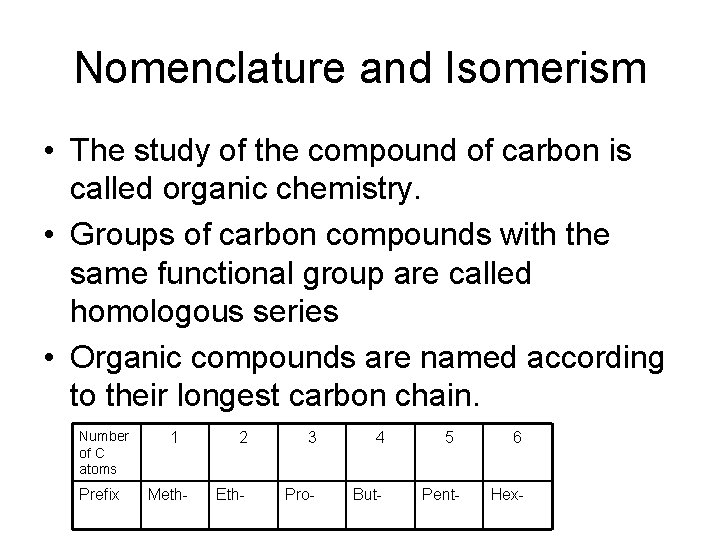
Nomenclature and Isomerism • The study of the compound of carbon is called organic chemistry. • Groups of carbon compounds with the same functional group are called homologous series • Organic compounds are named according to their longest carbon chain. Number of C atoms Prefix 1 Meth- 2 3 4 Eth- Pro- But- 5 Pent- 6 Hex-
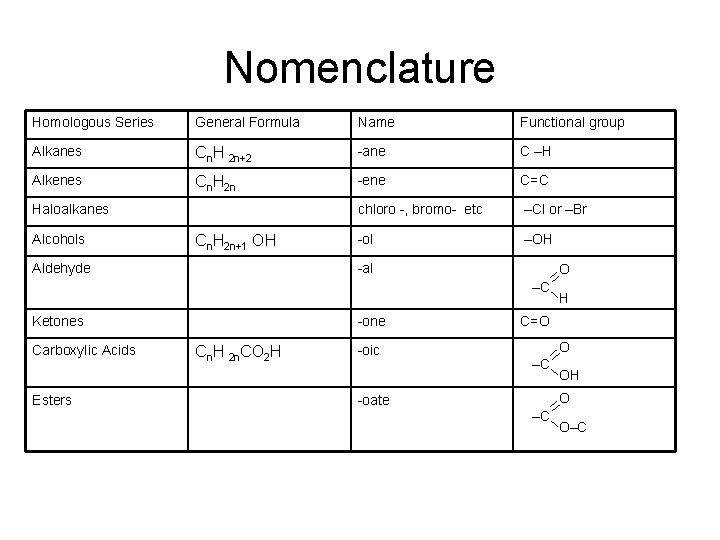
Nomenclature Homologous Series General Formula Name Functional group Alkanes Cn. H 2 n+2 -ane C –H Alkenes Cn. H 2 n -ene C=C chloro -, bromo- etc –Cl or –Br -ol –OH Haloalkanes Alcohols Cn. H 2 n+1 OH Aldehyde -al O –C Ketones Carboxylic Acids Esters -one Cn. H 2 n. CO 2 H -oic H C=O O –C OH O -oate –C O–C
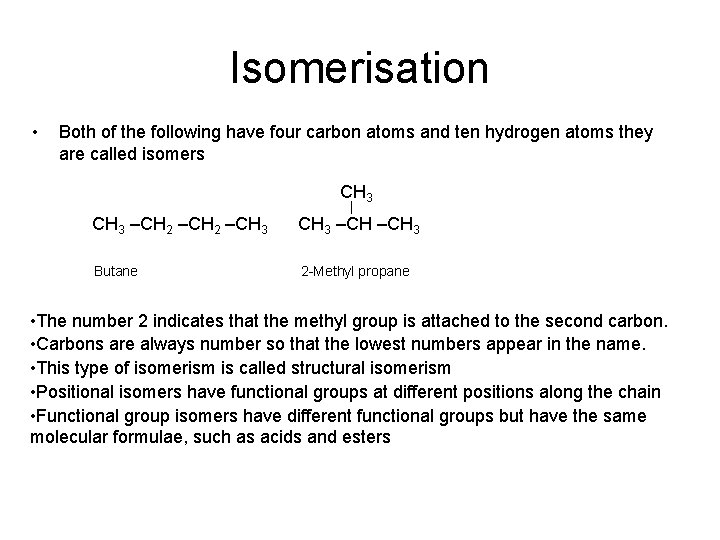
Isomerisation • Both of the following have four carbon atoms and ten hydrogen atoms they are called isomers CH 3 –CH 2 –CH 3 Butane 2 -Methyl propane • The number 2 indicates that the methyl group is attached to the second carbon. • Carbons are always number so that the lowest numbers appear in the name. • This type of isomerism is called structural isomerism • Positional isomers have functional groups at different positions along the chain • Functional group isomers have different functional groups but have the same molecular formulae, such as acids and esters
Petroleum and Alkanes • Petroleum • Combustion • Pollution
Petroleum • Petroleum is another name for crude oil, it is a mixture of hydrocarbons. • The hydrocarbons in crude oil all have different boiling points, this property allows them to be separated by a process call fractional distillation. • Fractional distillation produces more long chain hydrocarbons than the market requires. They are made into shorter more useful molecules by a process called cracking. • Thermal cracking splits the bonds in the hydrocarbon by a free radical process this uses a lot of energy because of the high temperatures used. • Zeolite catalysts can be used to lower the temperature of the cracking process. It proceeds via ionic intermediates.
Combustion • In excess oxygen alkanes burn according to the following equation: • Cn. H 2 n+2 +(1. 5 n+0. 5)O 2 n. CO 2 +(n+1)H 2 O • This is called complete combustion, however if there is in sufficient oxygen present incomplete combustion can occur. • Cn. H 2 n+2 +(n+0. 5)O 2 n. CO +(n+1)H 2 O • With even less oxygen soot is formed.
Pollution • Many pollutants are formed by the combustion of fossil fuels. These include soot and carbon monoxide formed by the incomplete combustion of hydrocarbons. • Besides making every thing look dirty carbon particulates in the atmosphere cause breathing problems in those who are susceptible. • Carbon monoxide interferes with the blood’s ability to carry oxygen and in severe case can lead to death. • Other harmful gases include: – sulphur dioxide which is formed by the oxidation of impurities in fossil fuels – and nitrogen oxides which are formed atmospheric nitrogen is oxidised during the combustion process. • Both of these species react with rain water to form acid rain.
Alkenes and Epoxyethane • Alkenes are unsaturated. This means that they do not have the maximum possible number of hydrogen atoms. • The double bond in in alkenes is comprised of a covalent bond a pi bond. The pi bond has electron density above and below the covalent bond and is weaker than a covalent bond. • Because of the weaker second bond alkenes are more reactive than alkanes. • There is no rotation around the double bond, this causes alkenes to have a planar shape.
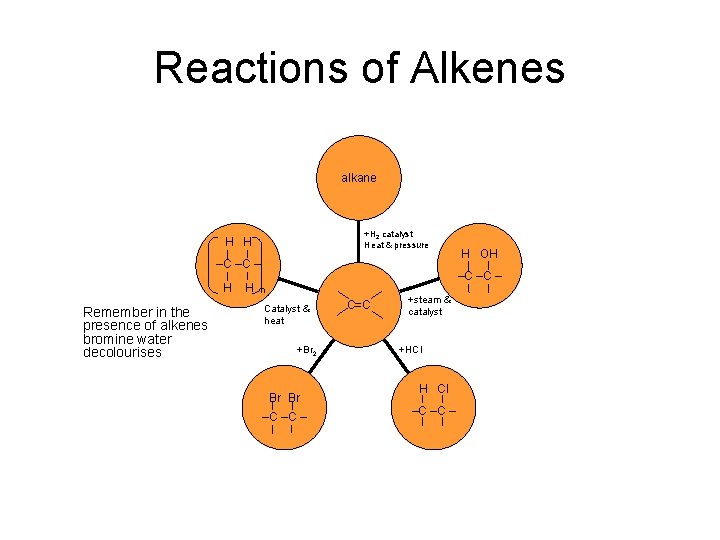
Reactions of Alkenes alkane +H 2 catalyst Heat & pressure H H –C –C – H Remember in the presence of alkenes bromine water decolourises H OH –C –C – H n Catalyst & heat +Br 2 Br Br –C –C – C=C +steam & catalyst +HCl H Cl –C –C –
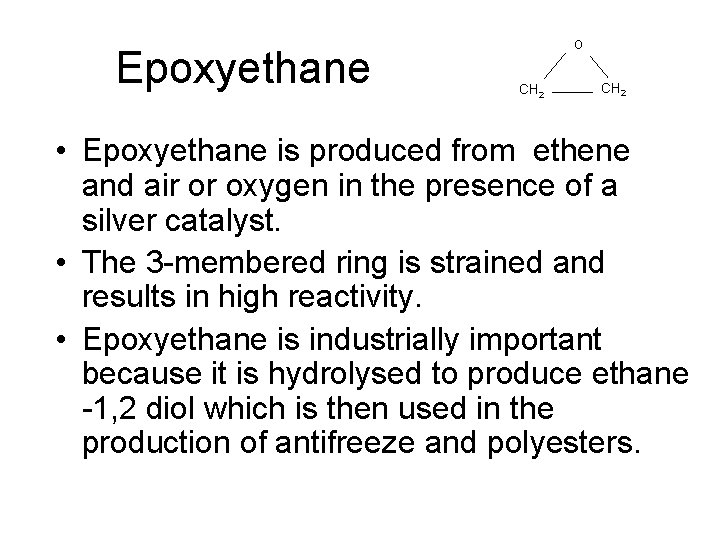
Epoxyethane O CH 2 • Epoxyethane is produced from ethene and air or oxygen in the presence of a silver catalyst. • The 3 -membered ring is strained and results in high reactivity. • Epoxyethane is industrially important because it is hydrolysed to produce ethane -1, 2 diol which is then used in the production of antifreeze and polyesters.
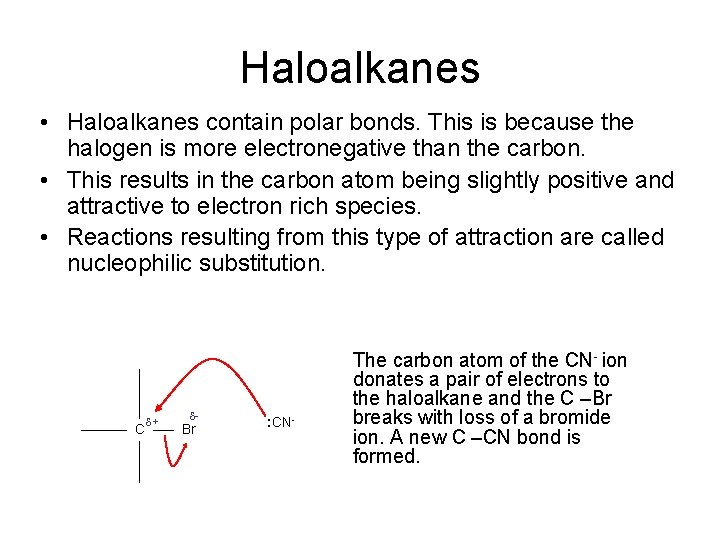
Haloalkanes • Haloalkanes contain polar bonds. This is because the halogen is more electronegative than the carbon. • This results in the carbon atom being slightly positive and attractive to electron rich species. • Reactions resulting from this type of attraction are called nucleophilic substitution. C d+ d- Br : CN- The carbon atom of the CN- ion donates a pair of electrons to the haloalkane and the C –Br breaks with loss of a bromide ion. A new C –CN bond is formed.
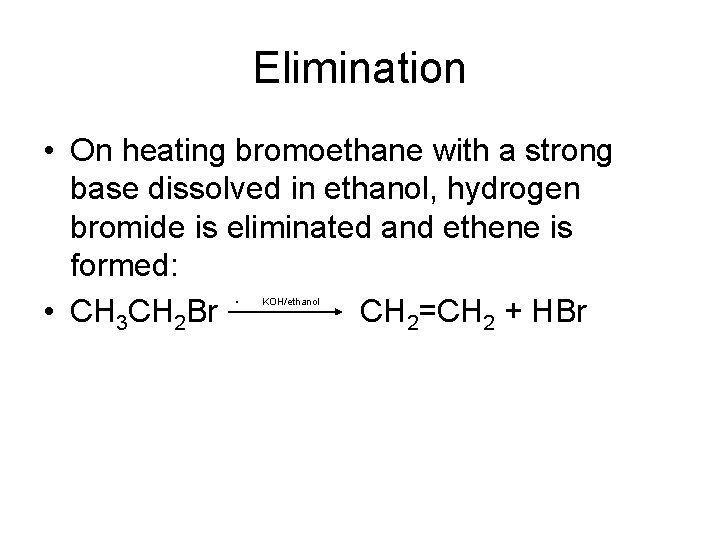
Elimination • On heating bromoethane with a strong base dissolved in ethanol, hydrogen bromide is eliminated and ethene is formed: • CH 3 CH 2 Br CH 2=CH 2 + HBr • KOH/ethanol
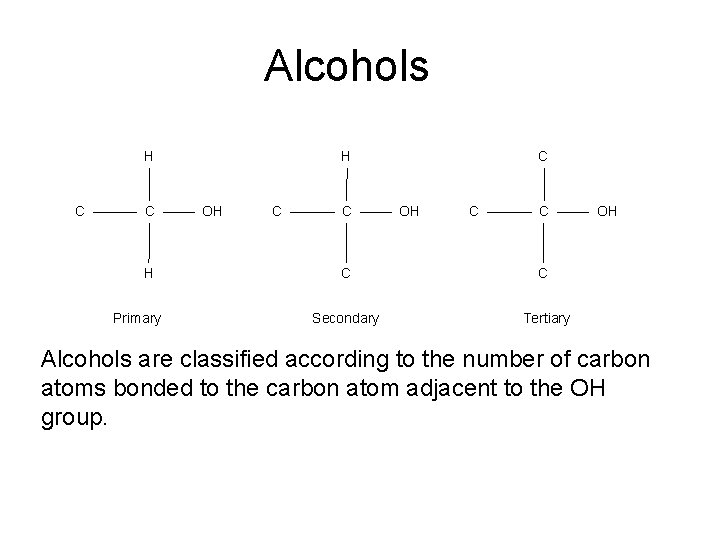
Alcohols H C C H Primary H OH C C C C Secondary Tertiary OH Alcohols are classified according to the number of carbon atoms bonded to the carbon atom adjacent to the OH group.
Manufacture of Alcohols • Alcohol for human consumption is produced by natural fermentation. Yeasts produce enzymes which catalyse the reaction called zymases. • Industrially it cheaper to form ethanol for solvent by the hydrolysis of ethene. • It is cheaper to obtain ethanol in this manner because it is produced in a continuous process
Reactions of Alcohols • Oxidation of primary alcohols produces an aldehyde. • Aldehydes produce a silver mirror with Tollen’s reagent • Secondary and tertiary alcohols produce ketones upon oxidation these do not give a silver mirror with ketones. • Heating alcohols with sulphuric or phosphoric acid causes them to eliminate water and produce alkenes
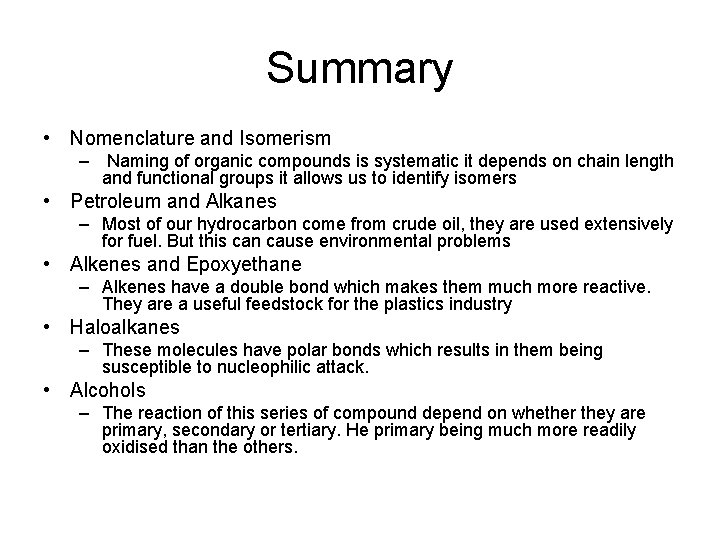
Summary • Nomenclature and Isomerism – Naming of organic compounds is systematic it depends on chain length and functional groups it allows us to identify isomers • Petroleum and Alkanes – Most of our hydrocarbon come from crude oil, they are used extensively for fuel. But this can cause environmental problems • Alkenes and Epoxyethane – Alkenes have a double bond which makes them much more reactive. They are a useful feedstock for the plastics industry • Haloalkanes – These molecules have polar bonds which results in them being susceptible to nucleophilic attack. • Alcohols – The reaction of this series of compound depend on whether they are primary, secondary or tertiary. He primary being much more readily oxidised than the others.