
Introduction to Optical Networking From Wavelength Division Multiplexing


- Slides: 39
Introduction to Optical Networking: From Wavelength Division Multiplexing to Passive Optical Networking Dr. Manyalibo J. Matthews Optical Data Networking Research Bell Laboratories, Lucent Technologies Murray Hill, NJ 07974 USA University of Tokyo Visit – March 22, 2004
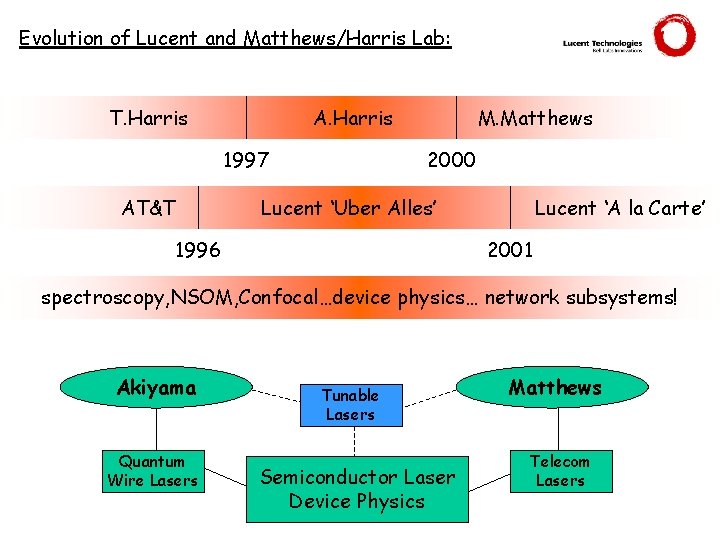
Evolution of Lucent and Matthews/Harris Lab: T. Harris A. Harris 1997 AT&T M. Matthews 2000 Lucent ‘Uber Alles’ 1996 Lucent ‘A la Carte’ 2001 spectroscopy, NSOM, Confocal…device physics… network subsystems! Akiyama Quantum Wire Lasers Tunable Lasers Semiconductor Laser Device Physics Matthews Telecom Lasers
Outline • Introduction • Overview of Optical Networking – Types of Networks – Fiber, Lasers, Receivers • Coarse Wavelength Division Multiplexing • Ethernet Passive Optical Networks • Conclusions & Future
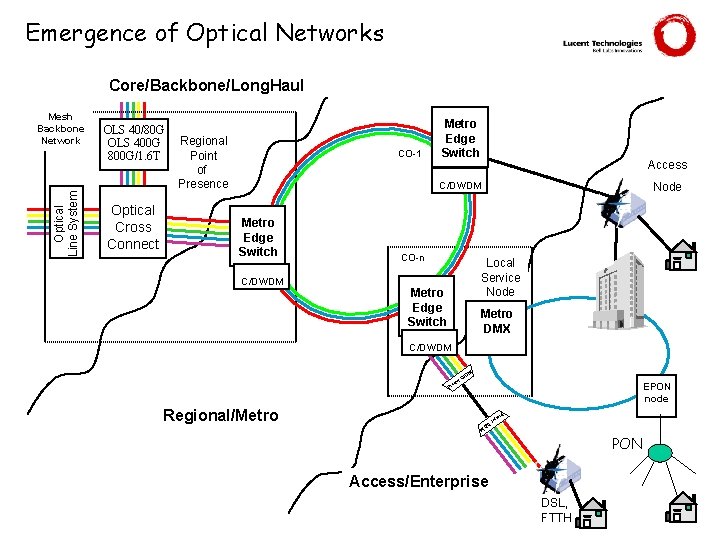
Emergence of Optical Networks Core/Backbone/Long. Haul CO-1 Access C/DWDM Metro Edge Switch C/DWDM CO-n Node Local Service Node Metro Edge Switch Metro DMX C/DWDM W DM EPON node DM Regional/Metro ive W ss Pa ve Optical Cross Connect Regional Point of Presence Metro Edge Switch ssi Optical Line System OLS 40/80 G OLS 400 G 800 G/1. 6 T Pa Mesh Backbone Network PON Access/Enterprise DSL, FTTH
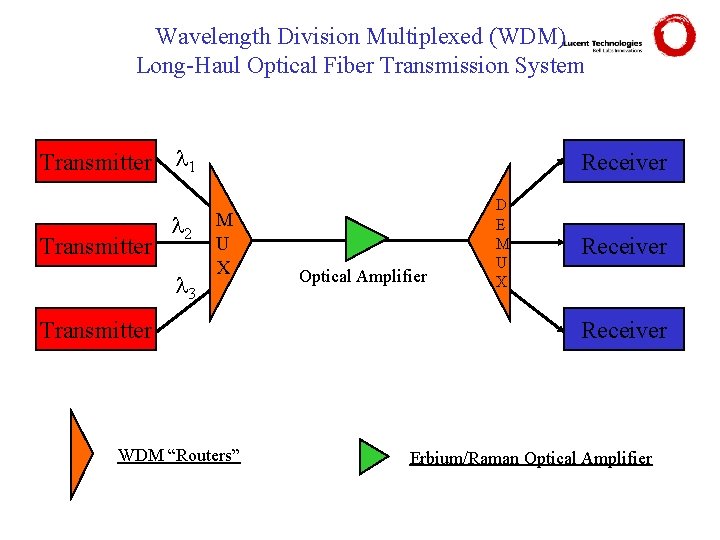
Wavelength Division Multiplexed (WDM) Long-Haul Optical Fiber Transmission System Transmitter l 1 Transmitter l 2 l 3 Receiver M U X Transmitter WDM “Routers” Optical Amplifier D E M U X Receiver Erbium/Raman Optical Amplifier
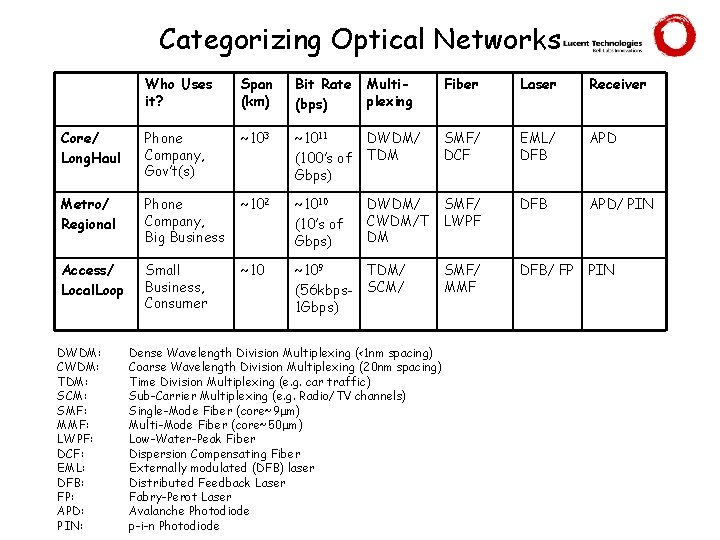
Categorizing Optical Networks Who Uses it? Span (km) Bit Rate (bps) Multiplexing Fiber Laser Receiver Core/ Long. Haul Phone Company, Gov’t(s) ~103 ~1011 (100’s of Gbps) DWDM/ TDM SMF/ DCF EML/ DFB APD Metro/ Regional Phone Company, Big Business ~102 ~1010 (10’s of Gbps) DWDM/ CWDM/T DM SMF/ LWPF DFB APD/ PIN Access/ Local. Loop Small Business, Consumer ~109 TDM/ (56 kbps- SCM/ 1 Gbps) SMF/ MMF DFB/ FP PIN DWDM: CWDM: TDM: SCM: SMF: MMF: LWPF: DCF: EML: DFB: FP: APD: PIN: Dense Wavelength Division Multiplexing (<1 nm spacing) Coarse Wavelength Division Multiplexing (20 nm spacing) Time Division Multiplexing (e. g. car traffic) Sub-Carrier Multiplexing (e. g. Radio/TV channels) Single-Mode Fiber (core~9 mm) Multi-Mode Fiber (core~50 mm) Low-Water-Peak Fiber Dispersion Compensating Fiber Externally modulated (DFB) laser Distributed Feedback Laser Fabry-Perot Laser Avalanche Photodiode p-i-n Photodiode
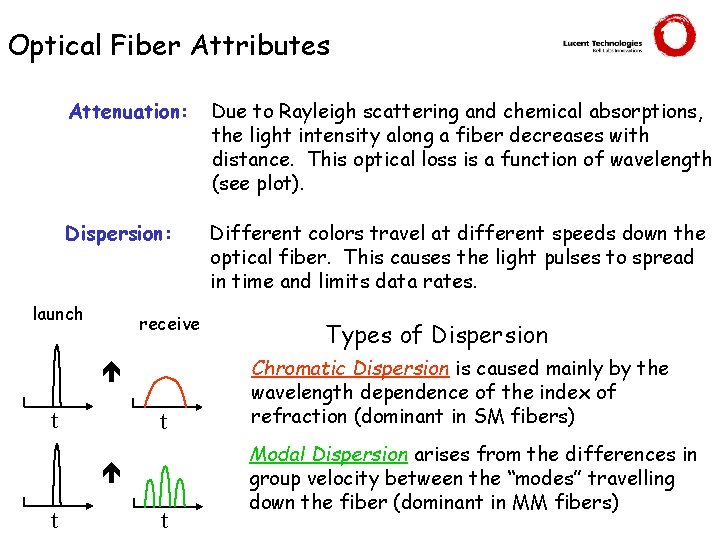
Optical Fiber Attributes Attenuation: Due to Rayleigh scattering and chemical absorptions, the light intensity along a fiber decreases with distance. This optical loss is a function of wavelength (see plot). Dispersion: Different colors travel at different speeds down the optical fiber. This causes the light pulses to spread in time and limits data rates. launch receive é t t Types of Dispersion Chromatic Dispersion is caused mainly by the wavelength dependence of the index of refraction (dominant in SM fibers) Modal Dispersion arises from the differences in group velocity between the “modes” travelling down the fiber (dominant in MM fibers)
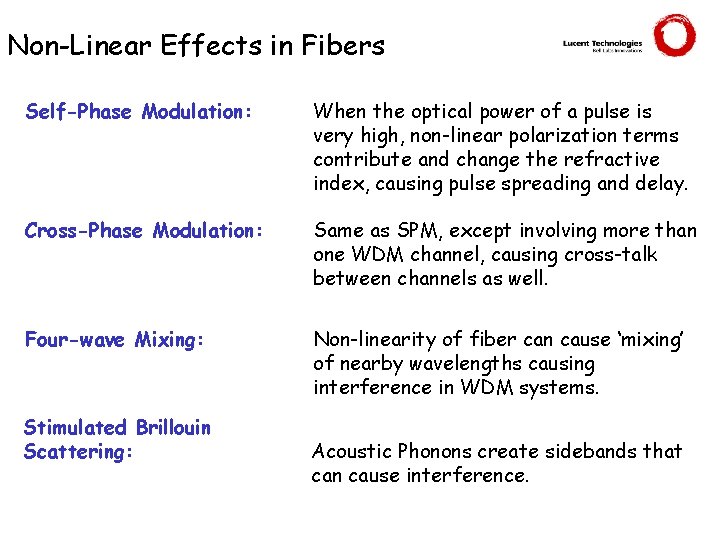
Non-Linear Effects in Fibers Self-Phase Modulation: When the optical power of a pulse is very high, non-linear polarization terms contribute and change the refractive index, causing pulse spreading and delay. Cross-Phase Modulation: Same as SPM, except involving more than one WDM channel, causing cross-talk between channels as well. Four-wave Mixing: Non-linearity of fiber can cause ‘mixing’ of nearby wavelengths causing interference in WDM systems. Stimulated Brillouin Scattering: Acoustic Phonons create sidebands that can cause interference.
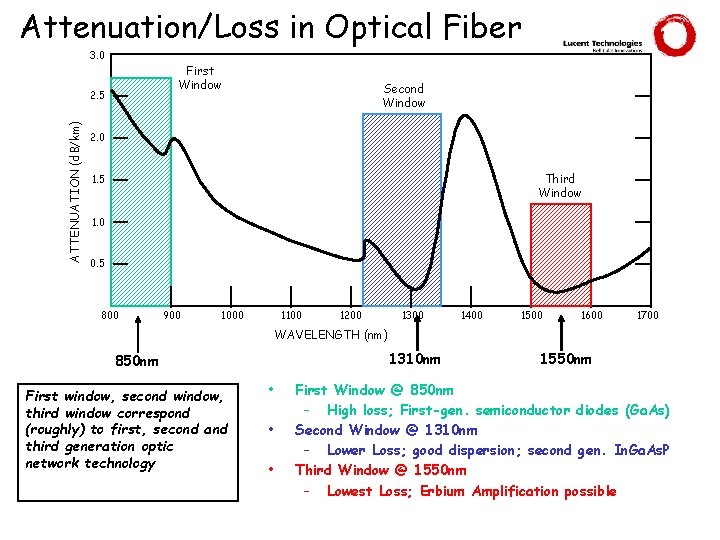
Attenuation/Loss in Optical Fiber 3. 0 First Window ATTENUATION (d. B/km) 2. 5 Second Window 2. 0 Third Window 1. 5 1. 0 0. 5 800 900 1000 1100 1200 1300 1400 1500 1600 1700 WAVELENGTH (nm) 1310 nm 850 nm First window, second window, third window correspond (roughly) to first, second and third generation optic network technology • • • 1550 nm First Window @ 850 nm – High loss; First-gen. semiconductor diodes (Ga. As) Second Window @ 1310 nm – Lower Loss; good dispersion; second gen. In. Ga. As. P Third Window @ 1550 nm – Lowest Loss; Erbium Amplification possible
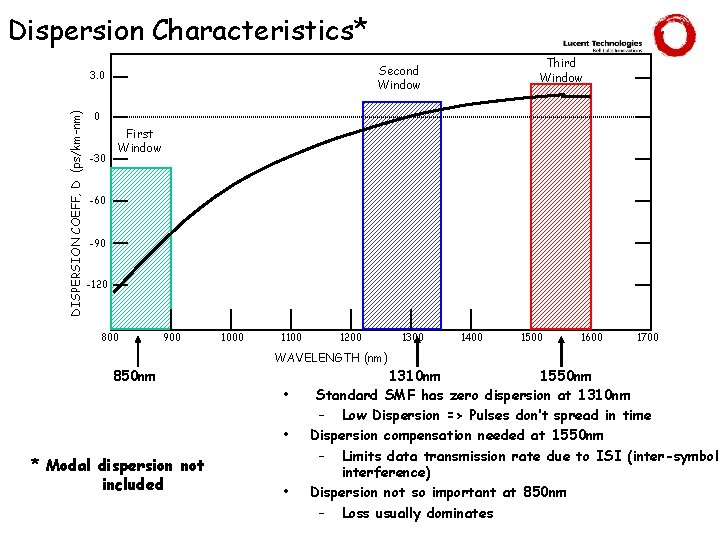
Dispersion Characteristics* DISPERSION COEFF, D (ps/km-nm) Third Window Second Window 3. 0 0 -30 First Window -60 -90 -120 800 900 1000 1100 1200 1300 1400 1500 1600 1700 WAVELENGTH (nm) 850 nm • • * Modal dispersion not included • 1310 nm 1550 nm Standard SMF has zero dispersion at 1310 nm – Low Dispersion => Pulses don’t spread in time Dispersion compensation needed at 1550 nm – Limits data transmission rate due to ISI (inter-symbol interference) Dispersion not so important at 850 nm – Loss usually dominates
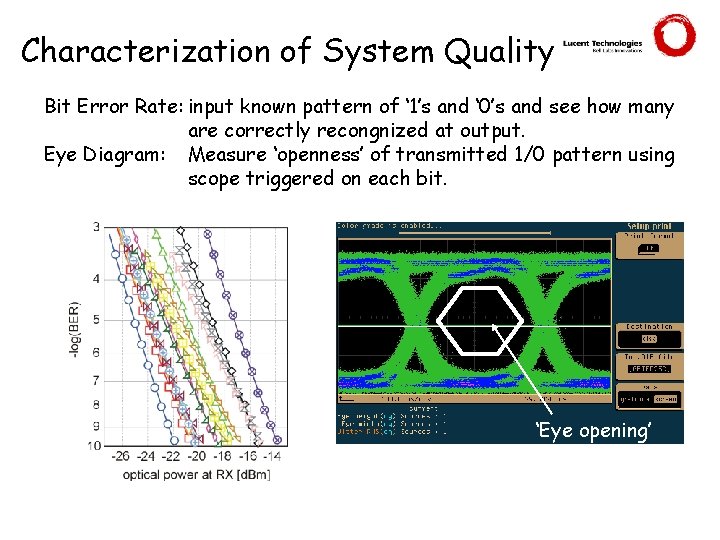
Characterization of System Quality Bit Error Rate: input known pattern of ‘ 1’s and ‘ 0’s and see how many are correctly recongnized at output. Eye Diagram: Measure ‘openness’ of transmitted 1/0 pattern using scope triggered on each bit. ‘Eye opening’
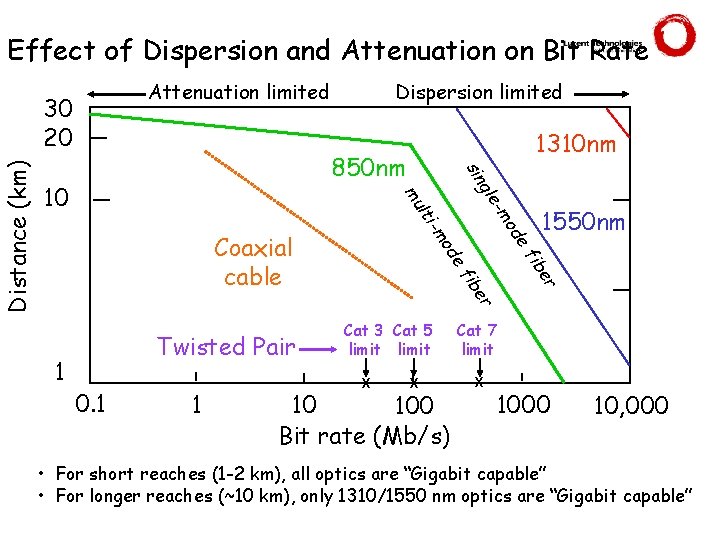
Attenuation limited 30 20 Dispersion limited 1310 nm x 10 100 Bit rate (Mb/s) r x ibe r ibe 1 ef 0. 1 od Twisted Pair Cat 3 Cat 5 limit 1550 nm ef od -m -m lti Coaxial cable 1 gle 10 sin 850 nm mu Distance (km) Effect of Dispersion and Attenuation on Bit Rate Cat 7 limit x 1000 10, 000 • For short reaches (1 -2 km), all optics are “Gigabit capable” • For longer reaches (~10 km), only 1310/1550 nm optics are “Gigabit capable”
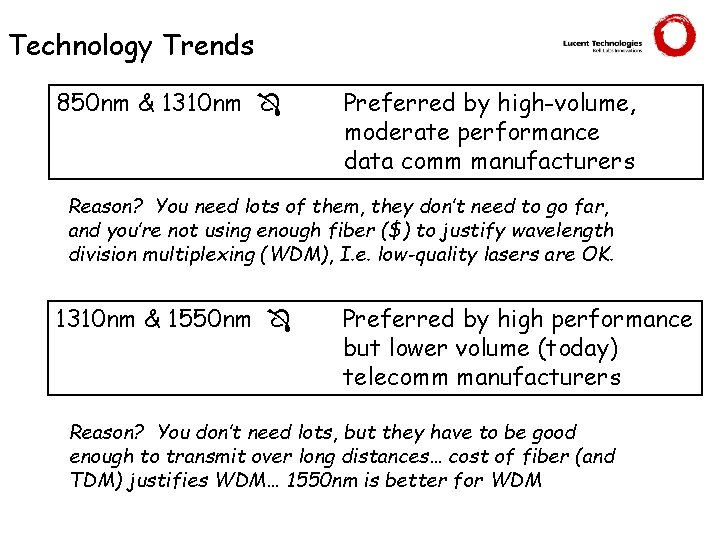
Technology Trends 850 nm & 1310 nm Ô Preferred by high-volume, moderate performance data comm manufacturers Reason? You need lots of them, they don’t need to go far, and you’re not using enough fiber ($) to justify wavelength division multiplexing (WDM), I. e. low-quality lasers are OK. 1310 nm & 1550 nm Ô Preferred by high performance but lower volume (today) telecomm manufacturers Reason? You don’t need lots, but they have to be good enough to transmit over long distances… cost of fiber (and TDM) justifies WDM… 1550 nm is better for WDM
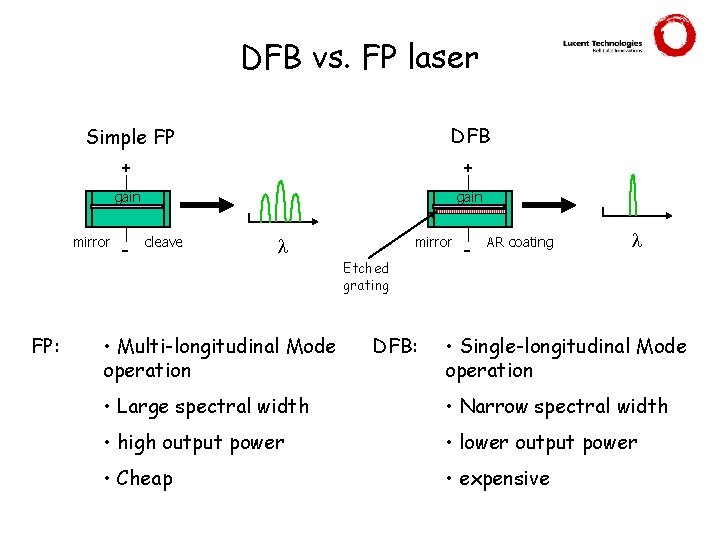
DFB vs. FP laser Simple FP DFB + + gain mirror FP: - cleave l • Multi-longitudinal Mode operation mirror Etched grating DFB: - AR coating l • Single-longitudinal Mode operation • Large spectral width • Narrow spectral width • high output power • lower output power • Cheap • expensive
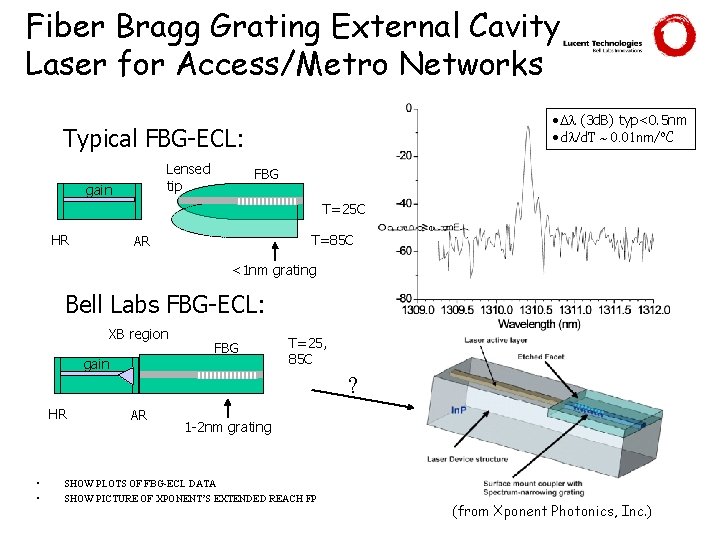
Fiber Bragg Grating External Cavity Laser for Access/Metro Networks ·Dl (3 d. B) typ<0. 5 nm ·dl/d. T ~ 0. 01 nm/o. C Typical FBG-ECL: Lensed tip gain FBG T=25 C HR T=85 C AR <1 nm grating Bell Labs FBG-ECL: XB region gain HR • • FBG T=25, 85 C ? AR 1 -2 nm grating SHOW PLOTS OF FBG-ECL DATA SHOW PICTURE OF XPONENT’S EXTENDED REACH FP (from Xponent Photonics, Inc. )
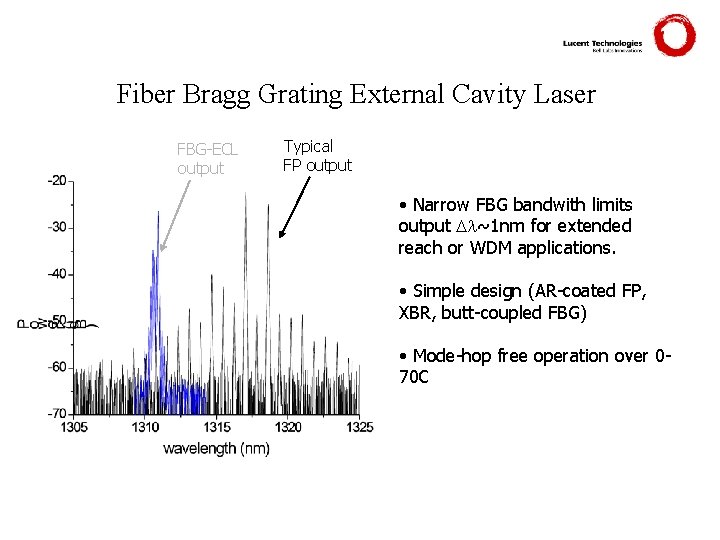
Fiber Bragg Grating External Cavity Laser FBG-ECL output Typical FP output • Narrow FBG bandwith limits output Dl~1 nm for extended reach or WDM applications. • Simple design (AR-coated FP, XBR, butt-coupled FBG) • Mode-hop free operation over 070 C
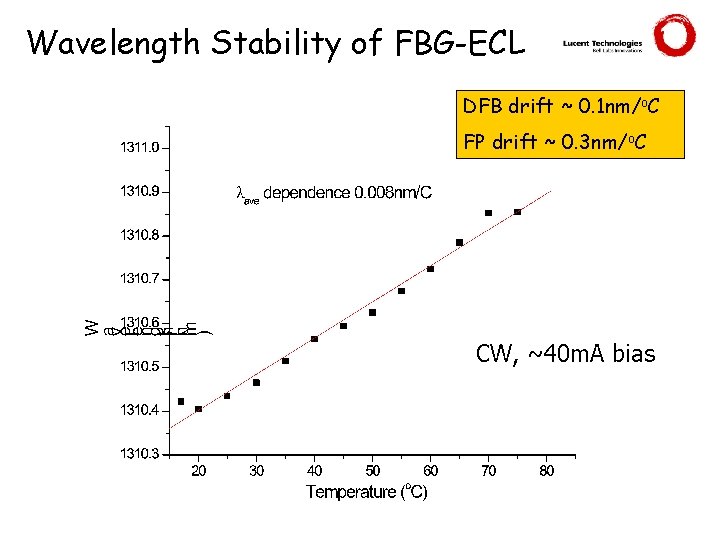
Wavelength Stability of FBG-ECL DFB drift ~ 0. 1 nm/o. C FP drift ~ 0. 3 nm/o. C CW, ~40 m. A bias
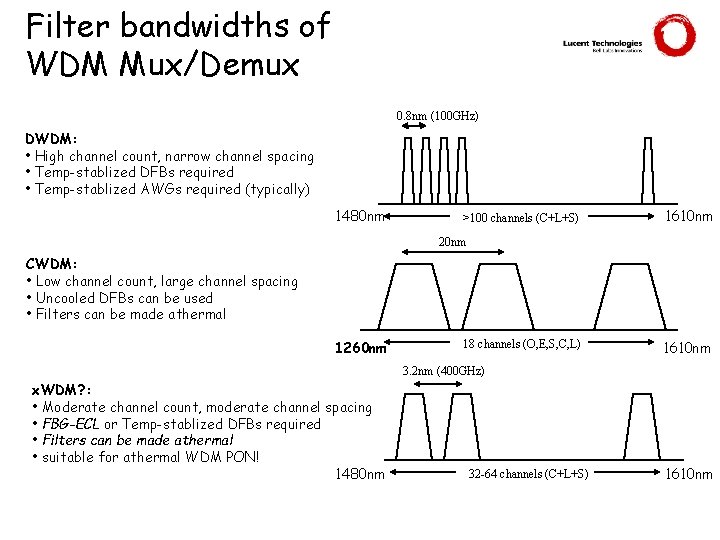
Filter bandwidths of WDM Mux/Demux 0. 8 nm (100 GHz) DWDM: • High channel count, narrow channel spacing • Temp-stablized DFBs required • Temp-stablized AWGs required (typically) 1480 nm >100 channels (C+L+S) 1610 nm 20 nm CWDM: • Low channel count, large channel spacing • Uncooled DFBs can be used • Filters can be made athermal 1260 nm 18 channels (O, E, S, C, L) 1610 nm 3. 2 nm (400 GHz) x. WDM? : • Moderate channel count, moderate channel spacing • FBG-ECL or Temp-stablized DFBs required • Filters can be made athermal • suitable for athermal WDM PON! 1480 nm 32 -64 channels (C+L+S) 1610 nm
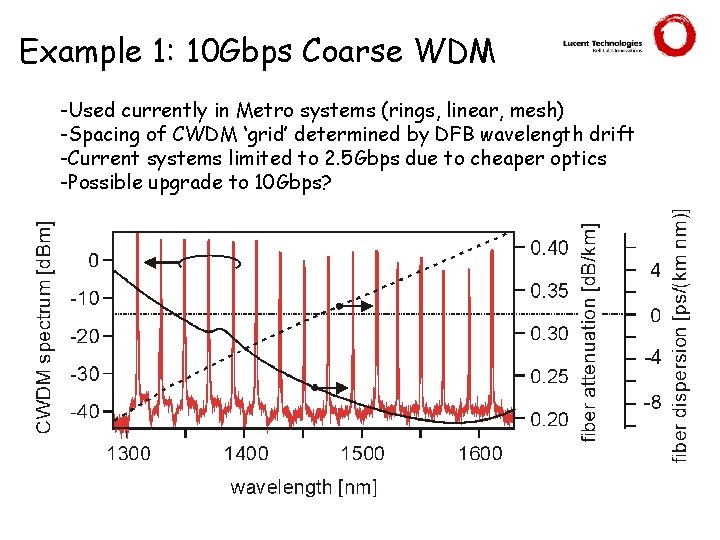
Example 1: 10 Gbps Coarse WDM -Used currently in Metro systems (rings, linear, mesh) -Spacing of CWDM ‘grid’ determined by DFB wavelength drift -Current systems limited to 2. 5 Gbps due to cheaper optics -Possible upgrade to 10 Gbps?
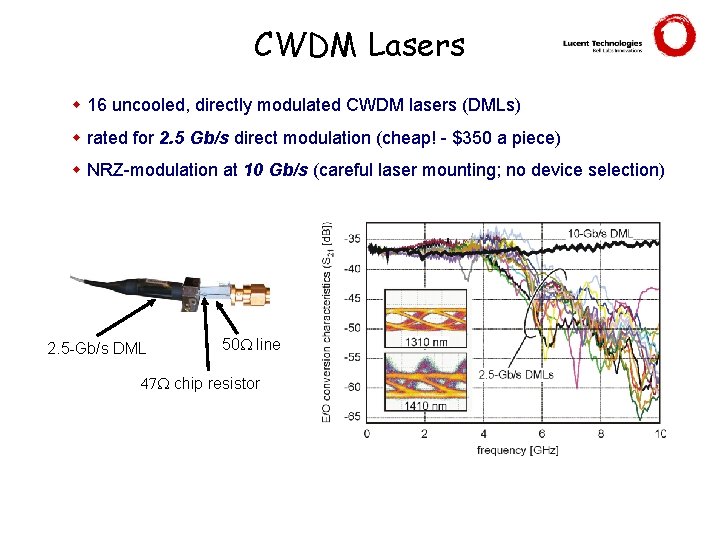
CWDM Lasers w 16 uncooled, directly modulated CWDM lasers (DMLs) w rated for 2. 5 Gb/s direct modulation (cheap! - $350 a piece) w NRZ-modulation at 10 Gb/s (careful laser mounting; no device selection) 2. 5 -Gb/s DML 50 W line 47 W chip resistor
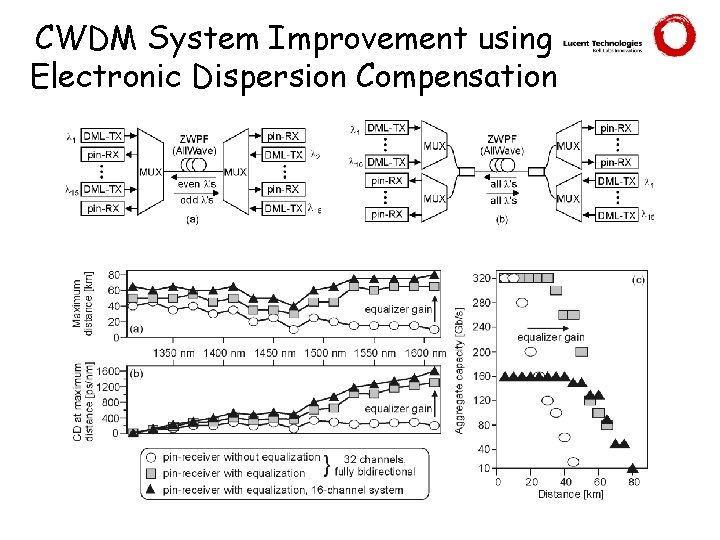
CWDM System Improvement using Electronic Dispersion Compensation
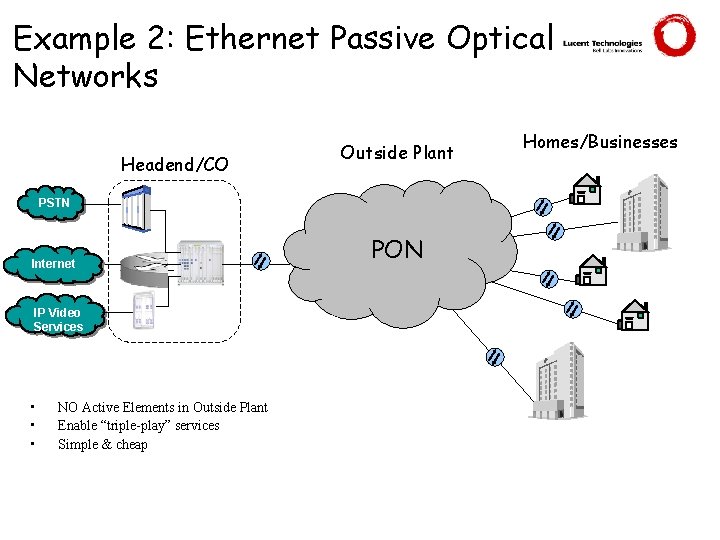
Example 2: Ethernet Passive Optical Networks Headend/CO Outside Plant PSTN Internet IP Video Services • • • NO Active Elements in Outside Plant Enable “triple-play” services Simple & cheap PON Homes/Businesses
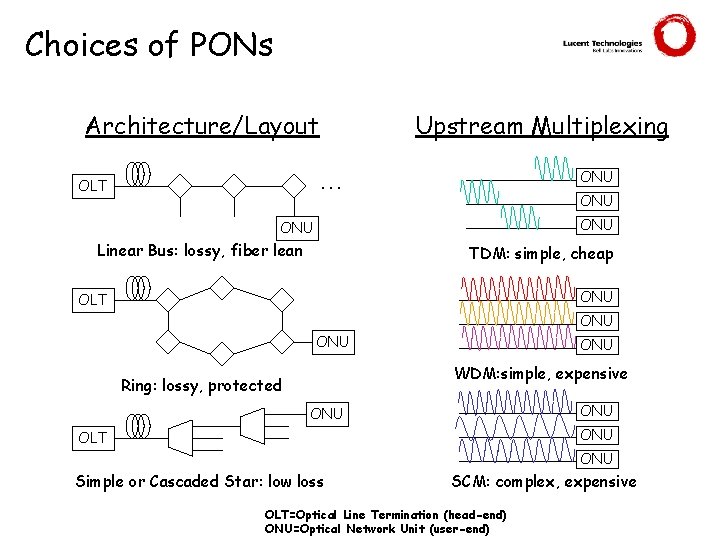
Choices of PONs Architecture/Layout Upstream Multiplexing ONU … OLT ONU ONU Linear Bus: lossy, fiber lean TDM: simple, cheap ONU OLT ONU ONU WDM: simple, expensive Ring: lossy, protected ONU ONU OLT ONU Simple or Cascaded Star: low loss SCM: complex, expensive OLT=Optical Line Termination (head-end) ONU=Optical Network Unit (user-end)
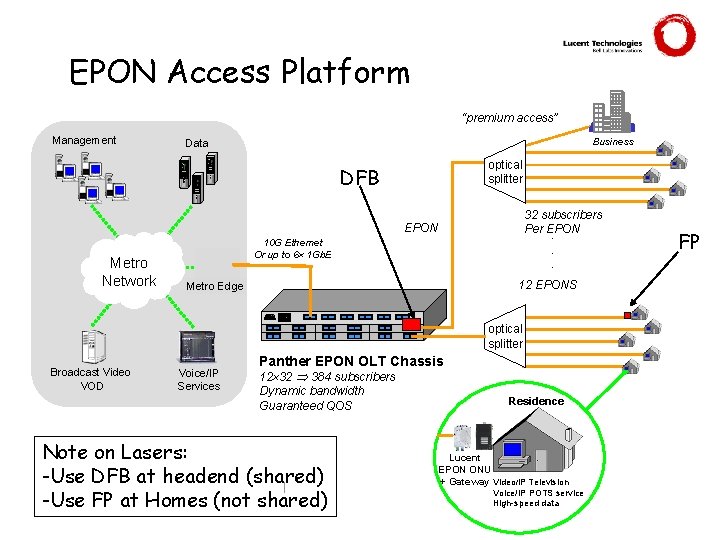
EPON Access Platform “premium access” Management Business Data optical splitter DFB 32 subscribers Per EPON. . . EPON Metro Network 10 G Ethernet Or up to 6 1 Gb. E 12 EPONS Metro Edge optical splitter Broadcast Video VOD Voice/IP Services Panther EPON OLT Chassis 12 32 384 subscribers Dynamic bandwidth Guaranteed QOS Note on Lasers: -Use DFB at headend (shared) -Use FP at Homes (not shared) Residence Lucent EPON ONU + Gateway Video/IP Television Voice/IP POTS service High-speed data FP
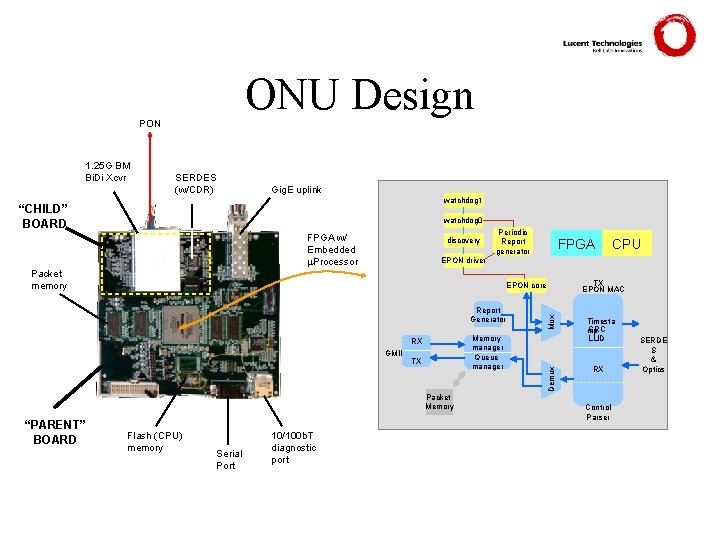
ONU Design PON 1. 25 G BM Bi. Di Xcvr SERDES (w/CDR) Gig. E uplink watchdog 1 “CHILD” BOARD watchdog 0 FPGA w/ Embedded m. Processor discovery Periodic Report generator Packet memory GMII TX Packet Memory Serial Port 10/100 b. T diagnostic port Mux Demux Memory manager Queue manager RX Flash (CPU) memory CPU TX EPON MAC EPON core Report Generator “PARENT” BOARD FPGA EPON driver Timesta CRC mp LLID RX Control Parser SERDE S & Optics
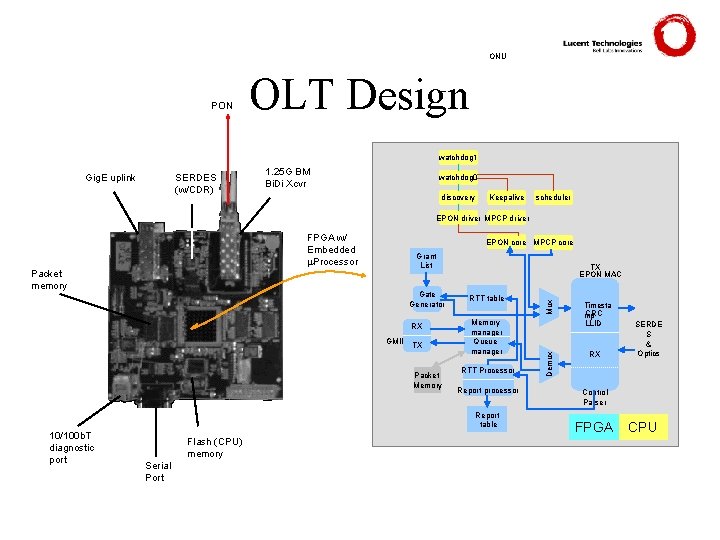
ONU PON OLT Design watchdog 1 Gig. E uplink SERDES (w/CDR) 1. 25 G BM Bi. Di Xcvr watchdog 0 discovery Keepalive scheduler EPON driver MPCP driver FPGA w/ Embedded m. Processor EPON core MPCP core Grant List RX GMII TX Packet Memory RTT table Memory manager Queue manager RTT Processor Report processor Report table 10/100 b. T diagnostic port Flash (CPU) memory Serial Port Mux Gate Generator TX EPON MAC Demux Packet memory Timesta CRC mp LLID RX SERDE S & Optics Control Parser FPGA CPU
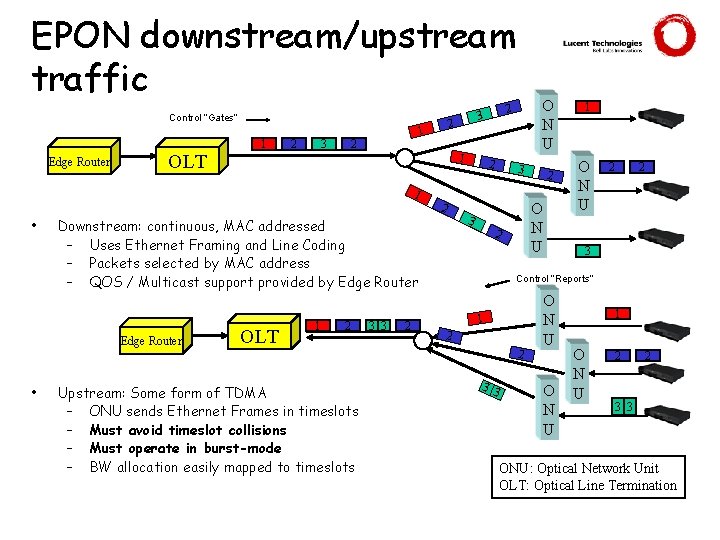
EPON downstream/upstream traffic Control “Gates” 2 1 Edge Router OLT 1 2 3 2 1 1 • Edge Router • 2 Downstream: continuous, MAC addressed – Uses Ethernet Framing and Line Coding – Packets selected by MAC address – QOS / Multicast support provided by Edge Router OLT 1 O N U 2 3 2 Upstream: Some form of TDMA – ONU sends Ethernet Frames in timeslots – Must avoid timeslot collisions – Must operate in burst-mode – BW allocation easily mapped to timeslots 3 3 2 2 3 3 2 O N U 2 1 O N U 2 2 3 Control “Reports” 1 2 2 3 3 O N U 1 O N U 2 2 3 3 ONU: Optical Network Unit OLT: Optical Line Termination
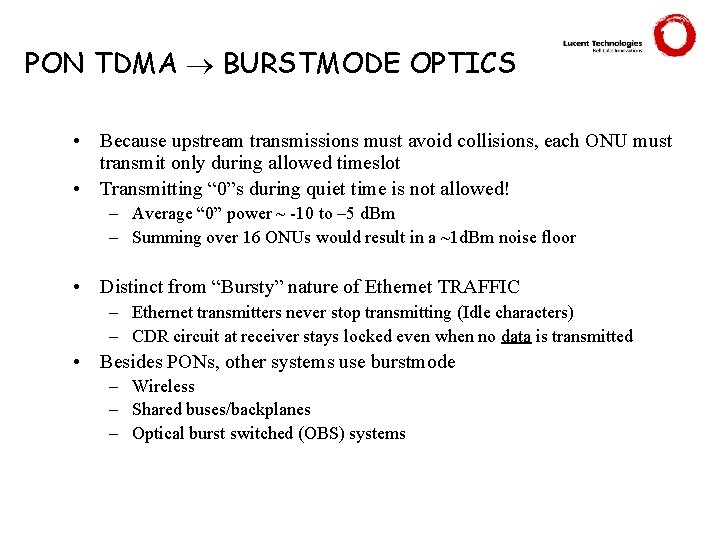
PON TDMA BURSTMODE OPTICS • Because upstream transmissions must avoid collisions, each ONU must transmit only during allowed timeslot • Transmitting “ 0”s during quiet time is not allowed! – Average “ 0” power ~ -10 to – 5 d. Bm – Summing over 16 ONUs would result in a ~1 d. Bm noise floor • Distinct from “Bursty” nature of Ethernet TRAFFIC – Ethernet transmitters never stop transmitting (Idle characters) – CDR circuit at receiver stays locked even when no data is transmitted • Besides PONs, other systems use burstmode – Wireless – Shared buses/backplanes – Optical burst switched (OBS) systems
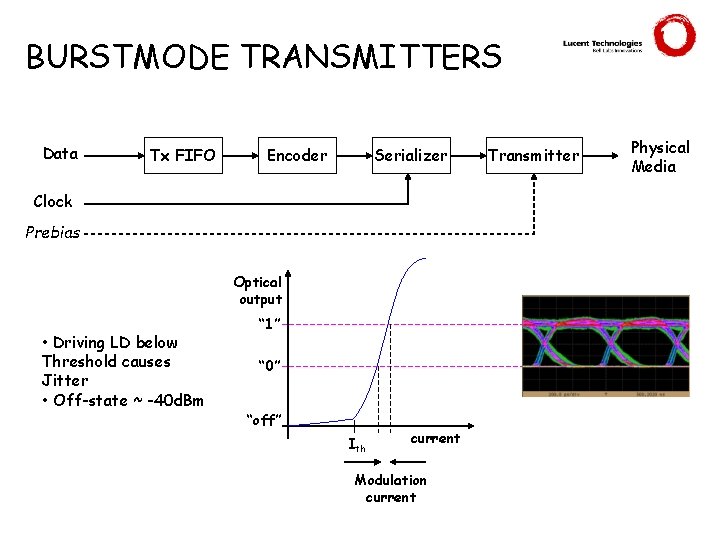
BURSTMODE TRANSMITTERS Data Tx FIFO Encoder Serializer Clock Prebias Optical output • Driving LD below Threshold causes Jitter • Off-state ~ -40 d. Bm “ 1” “ 0” “off” Ith current Modulation current Transmitter Physical Media
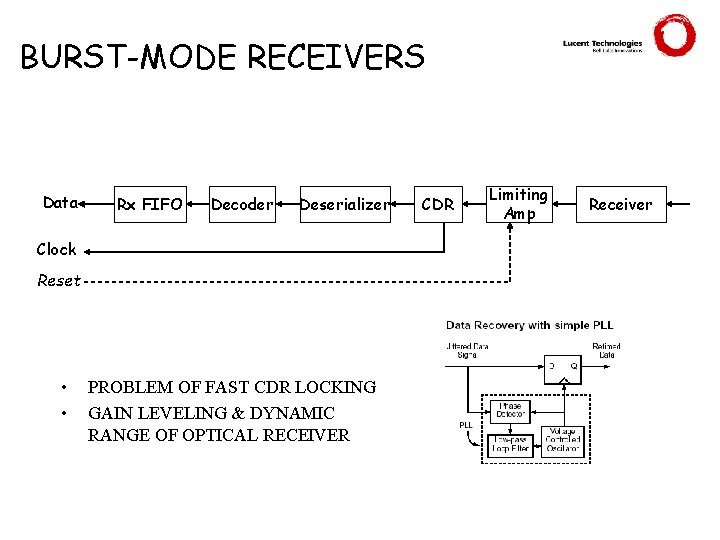
BURST-MODE RECEIVERS Data Rx FIFO Decoder Deserializer Clock Reset • • PROBLEM OF FAST CDR LOCKING GAIN LEVELING & DYNAMIC RANGE OF OPTICAL RECEIVER CDR Limiting Amp Receiver
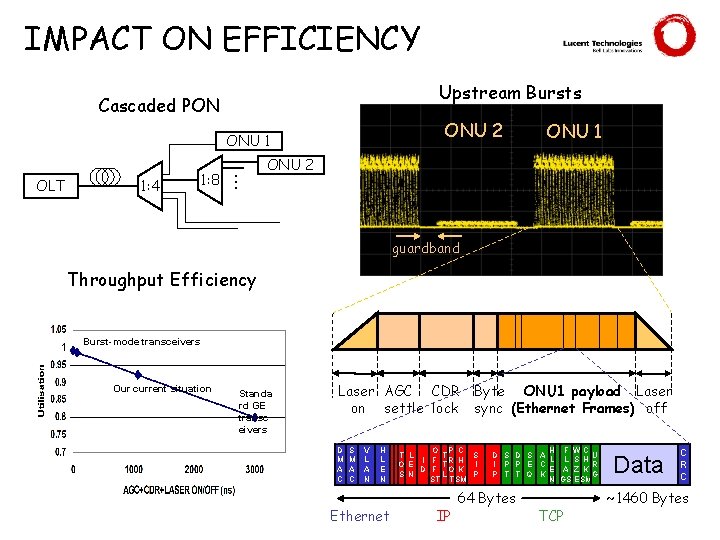
IMPACT ON EFFICIENCY Upstream Bursts Cascaded PON ONU 2 ONU 1 OLT 1: 4 1: 8 ONU 1 ONU 2 . . . guardband Throughput Efficiency Burst-mode transceivers Our current situation Standa rd GE transc eivers Laser AGC CDR on settle lock D M A C S M A C V L A N H L E N Ethernet Byte ONU 1 payload Laser sync (Ethernet Frames) off O P C T L T S I F R H O E T I D F O K S N L P ST T SM IP H F WC U D S A L L S H R I P P E C E A Z K G P T T Q K N GS E SM 64 Bytes TCP Data C R C ~1460 Bytes
Conclusions • Optical Networking getting closer and closer to end user • For Metro, CWDM is lowest cost solution, but must be improved to handle 10 Gbps • PON systems could deploy ‘in mass’ over next 1 -2 years, with EPON one of the leading standards • Lasers dominate cost, therefore useful to study physics of low-cost laser structures! THANK YOU VERY MUCH! (Domo Arigato Gozaimashita!)
Spare Slides
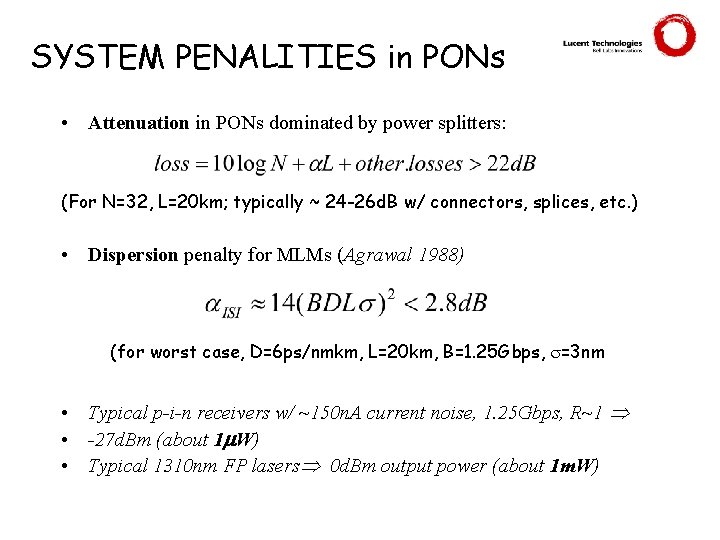
SYSTEM PENALITIES in PONs • Attenuation in PONs dominated by power splitters: (For N=32, L=20 km; typically ~ 24 -26 d. B w/ connectors, splices, etc. ) • Dispersion penalty for MLMs (Agrawal 1988) (for worst case, D=6 ps/nmkm, L=20 km, B=1. 25 Gbps, s=3 nm • Typical p-i-n receivers w/ ~150 n. A current noise, 1. 25 Gbps, R~1 • -27 d. Bm (about 1 m. W) • Typical 1310 nm FP lasers 0 d. Bm output power (about 1 m. W)
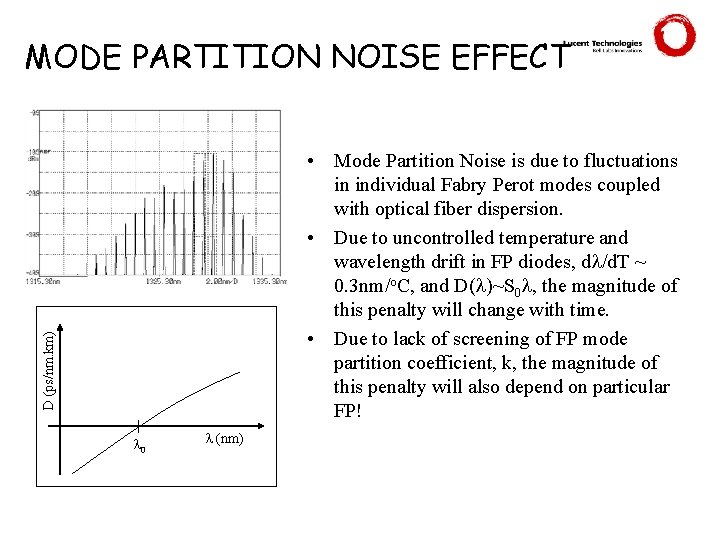
MODE PARTITION NOISE EFFECT D (ps/nm. km) • Mode Partition Noise is due to fluctuations in individual Fabry Perot modes coupled with optical fiber dispersion. • Due to uncontrolled temperature and wavelength drift in FP diodes, dl/d. T ~ 0. 3 nm/o. C, and D(l)~S 0 l, the magnitude of this penalty will change with time. • Due to lack of screening of FP mode partition coefficient, k, the magnitude of this penalty will also depend on particular FP! l 0 l (nm)
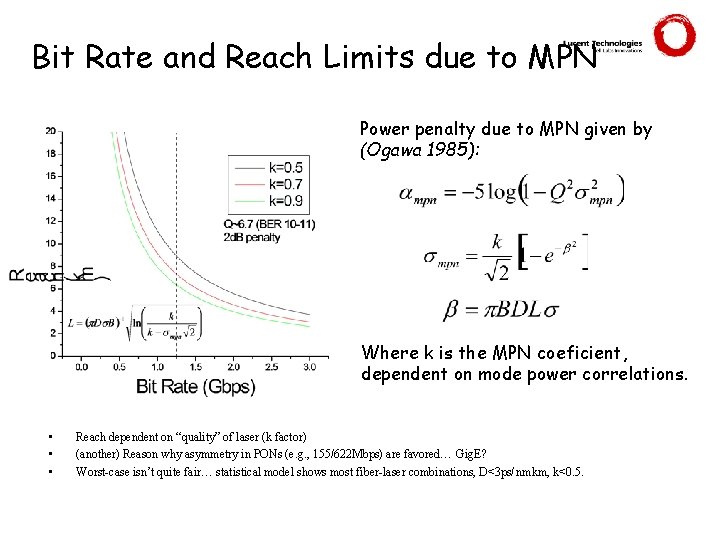
Bit Rate and Reach Limits due to MPN Power penalty due to MPN given by (Ogawa 1985): Where k is the MPN coeficient, dependent on mode power correlations. • • • Reach dependent on “quality” of laser (k factor) (another) Reason why asymmetry in PONs (e. g. , 155/622 Mbps) are favored… Gig. E? Worst-case isn’t quite fair… statistical model shows most fiber-laser combinations, D<3 ps/ nmkm, k<0. 5.
REDUCING MPN • Dispersion Compensation at OLT – Additional Loss, some cost – One-size won’t fit all, SMF l 0 ~ 1300 -1325 nm • High-pass filtering using SOA – Low frequency MPN components are partially removed • Very low noise FP LD driver • Replace FP w/ narrow-line source – DFB is current solution – 1310 nm VCSEL (high-power) – Fiber Bragg Grating ECL also a possibility if cost/integration improves
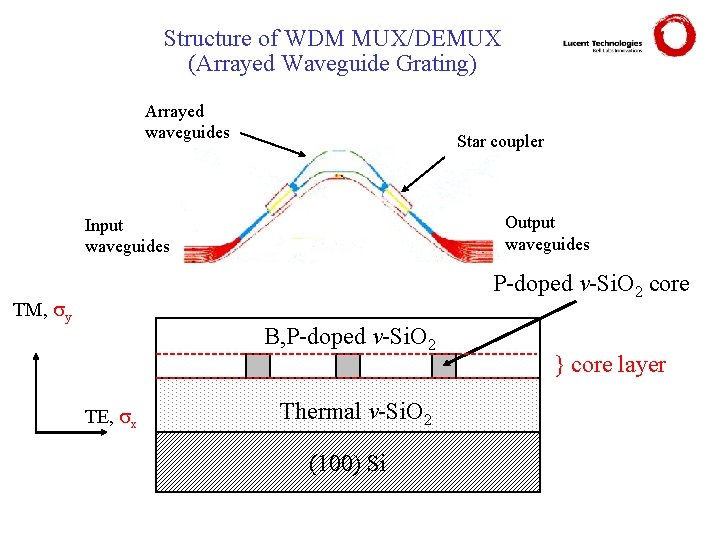
Structure of WDM MUX/DEMUX (Arrayed Waveguide Grating) Arrayed waveguides Star coupler Output waveguides Input waveguides P-doped v-Si. O 2 core TM, sy B, P-doped v-Si. O 2 TE, sx Thermal v-Si. O 2 (100) Si } core layer
Types of Lasers & Receivers used for Telecommunications