
INTRODUCTION TO OPHTHALMOLOGY BY PROF PAT WAHE LECTURERCONSULTANT
INTRODUCTION TO OPHTHALMOLOGY BY PROF. PAT. WAHE LECTURER/CONSULTANT OPHTHALMOLOGY

INTRODUCTION TO OPTHALMOLOGY • What is Ophthalmology? • This is the branch of medicine that deals with the anatomy, physiology and diseases of the eye

INTRODUCTION TO OPTHALMOLOGY • Ophthalmologist is a specialist in medical and surgical eye problems. • Optometrist is a healthcare professional concerned with the refraction of the eyes and related structures, as well as vision, visual systems and vision information processing in humans.
INTRODUCTION TO OPTHALMOLOGY • An optician is a technical practitioner who designs, fits and dispenses corrective lenses for the correction of a person’s vision • Opticians determine the specifications of various ophthalmic appliances that will give the necessary correction to a person’s eyesight
INTRODUCTION TO OPTHALMOLOGY • Some opticians also design and fit special appliances to correct cosmetic, traumatic or anatomical defects. • These devices are called shields or artificial eyes
WHO DEFINITION AND CLASSIFICATION OF VISUAL LOSS • Visual loss is the partial or complete absence of vision where it existed before. • There are 4 levels of visual function, according to the international Classification of Diseases
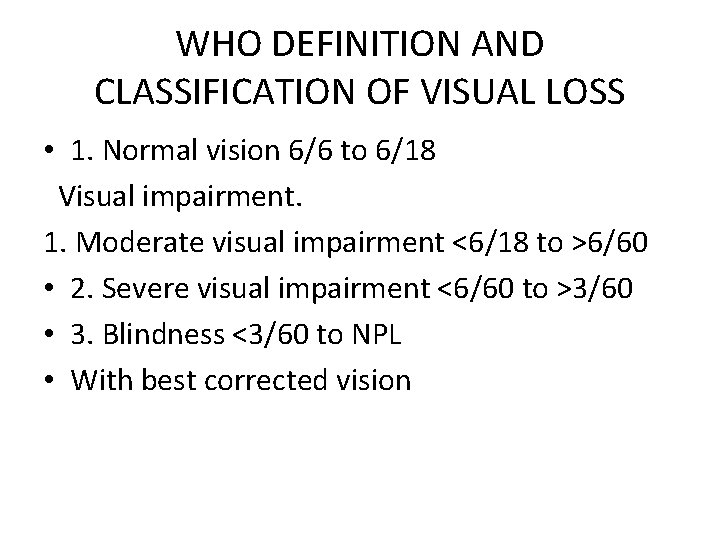
WHO DEFINITION AND CLASSIFICATION OF VISUAL LOSS • 1. Normal vision 6/6 to 6/18 Visual impairment. 1. Moderate visual impairment <6/18 to >6/60 • 2. Severe visual impairment <6/60 to >3/60 • 3. Blindness <3/60 to NPL • With best corrected vision
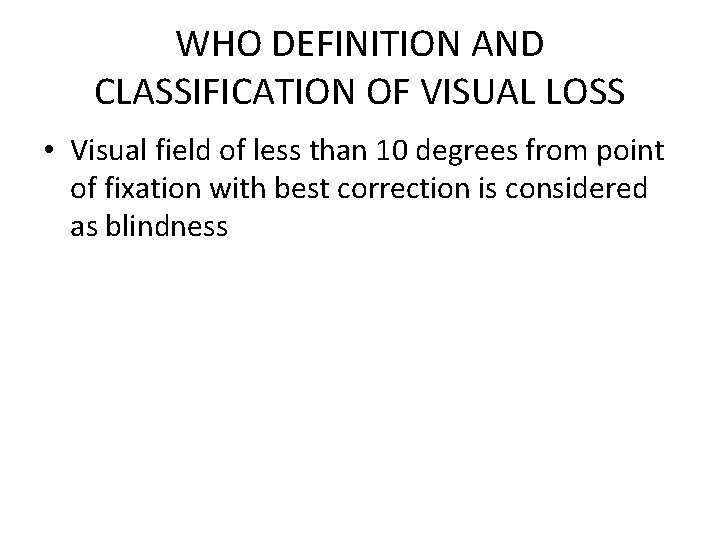
WHO DEFINITION AND CLASSIFICATION OF VISUAL LOSS • Visual field of less than 10 degrees from point of fixation with best correction is considered as blindness
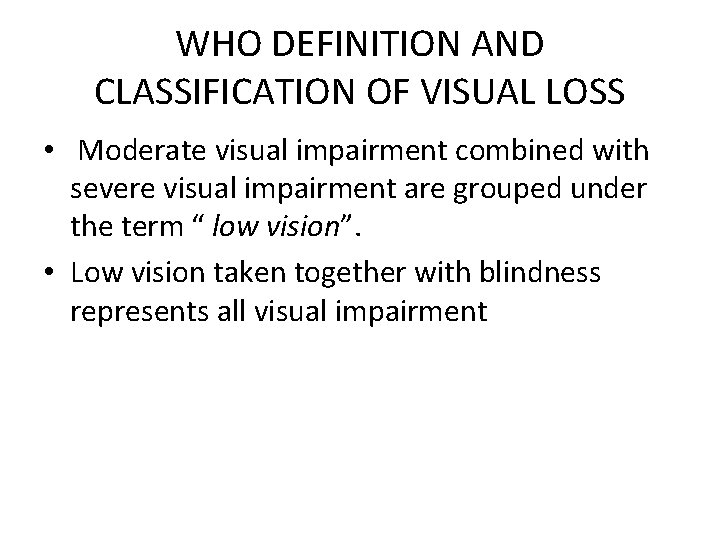
WHO DEFINITION AND CLASSIFICATION OF VISUAL LOSS • Moderate visual impairment combined with severe visual impairment are grouped under the term “ low vision”. • Low vision taken together with blindness represents all visual impairment
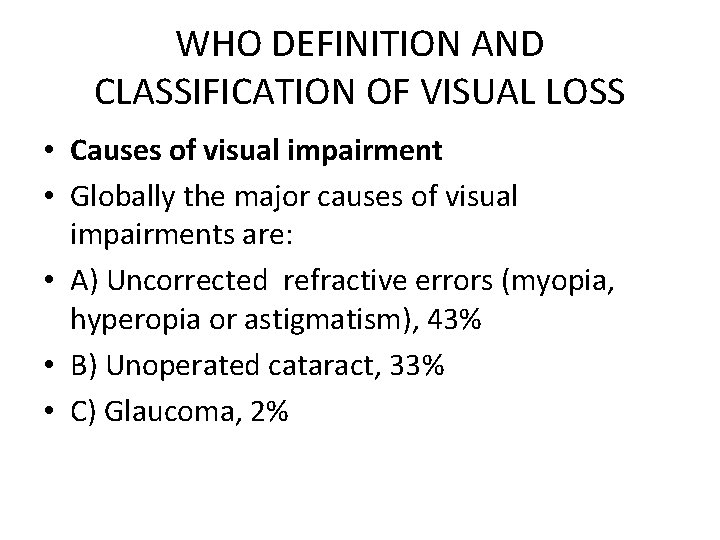
WHO DEFINITION AND CLASSIFICATION OF VISUAL LOSS • Causes of visual impairment • Globally the major causes of visual impairments are: • A) Uncorrected refractive errors (myopia, hyperopia or astigmatism), 43% • B) Unoperated cataract, 33% • C) Glaucoma, 2%
KEY FACTS • 285 million people are estimated to be visually impaired worldwide: 39 million are blind and 246 have low vision • About 90% of the world’s visually impaired live in developing countries. • 82% of people living with blindness are aged 50 and above
KEY FACTS • Globally, uncorrected refractive errors are the main cause of visual impairment • Cataracts remain the leading cause of blindness in the middle and low income countries.
KEY FACTS • The number of people visually impaired from infectious diseases has greatly reduced in the last 20 years. • 80% of all visual impairment can be avoided or cured
RELATIONSHIP BETWEEN VISUAL FUNCTION, CLINICAL FINDINGS AND QUALITY OF LIFE • WH 0 defined quality of life as individual’s perception of their position in life in the context of the culture and value systems in which they live in relation to their goals, expectations, standard and concerns. • It is a broad ranging concept affected in a complex way by the person’s physical health, psychological state, level of independence, social relationships, and their relationship to salient features of their environment
RELATIONSHIP BETWEEN VISUAL FUNCTION, CLINICAL FINDINGS AND QUALITY OF LIFE • Patients with glaucoma, specifically primary open-angle glaucoma, usually fail to produce visual symptoms until either visual field loss or diminished central acuity, or both, have occurred has thwarted efforts at early diagnosis.
RELATIONSHIP BETWEEN VISUAL FUNCTION, CLINICAL FINDINGS AND QUALITY OF LIFE • After glaucoma has been diagnosed, the perception of the quality of life of the patient may be altered not only by the disease process but also by anxiety elicited by diagnosis itself. • The term “glaucoma” may induce implicit fears of blindness and immediately alter perceptions of well-being and future health problems
RELATIONSHIP BETWEEN VISUAL FUNCTION, CLINICAL FINDINGS AND QUALITY OF LIFE • Quality of life assessments are further confounded by the effect of medical and surgical treatments of glaucoma. • Associated local side effects of medical therapy, such as miosis and ocular irritation may produce symptoms in an otherwise asymptomatic patient.
RELATIONSHIP BETWEEN VISUAL FUNCTION, CLINICAL FINDINGS AND QUALITY OF LIFE • Although the objective assessment of progressive glaucomatous damage based on measurement of visual field loss and optic nerve injury is widely accepted, quality of life assessments are considerably more complex when the side effects of therapy are superimposed on frequently both visually and systemically asymptomatic patients early in the course of the disease.
RELATIONSHIP BETWEEN VISUAL FUNCTION, CLINICAL FINDINGS AND QUALITY OF LIFE • The Ophthalmologist must consider the ways in which glaucoma can affect a patient’s life and recognize that these effects begin when the disease is diagnosed and carry forth from treatment effects to other physical and social effects.

THANK YOU
- Slides: 20