
Introduction to Operations and Supply Chain Management 2006
- Slides: 22
Introduction to Operations and Supply Chain Management © 2006 Pearson Prentice Hall — Introduction to Operations and Supply Chain Management — Bozarth & Handfield
Introduction • Why study Operations and Supply Chain Management? • Operations Management • Supply Chain Management • Important trends • Leap. Frog case study © 2006 Pearson Prentice Hall — Introduction to Operations and Supply Chain Management — Bozarth & Handfield Chapter 1, Slide 2
Focus • Key issues surrounding the design and ongoing management of these areas • Common tools and techniques • Analytical skills (both qualitative and quantitative) © 2006 Pearson Prentice Hall — Introduction to Operations and Supply Chain Management — Bozarth & Handfield Chapter 1, Slide 3
Why Study Operations and Supply Chain Management? © 2006 Pearson Prentice Hall — Introduction to Operations and Supply Chain Management — Bozarth & Handfield Chapter 1, Slide 4
Three Basic Truths I. Pervasiveness II. Interdependence III. Profitability and Survival © 2006 Pearson Prentice Hall — Introduction to Operations and Supply Chain Management — Bozarth & Handfield Chapter 1, Slide 5
Pervasiveness Every organization must make a product or provide a service that someone values…………. Manufacturer. Retailer. Design firm. University. Health services. © 2006 Pearson Prentice Hall — Introduction to Operations and Supply Chain Management — Bozarth & Handfield Chapter 1, Slide 6
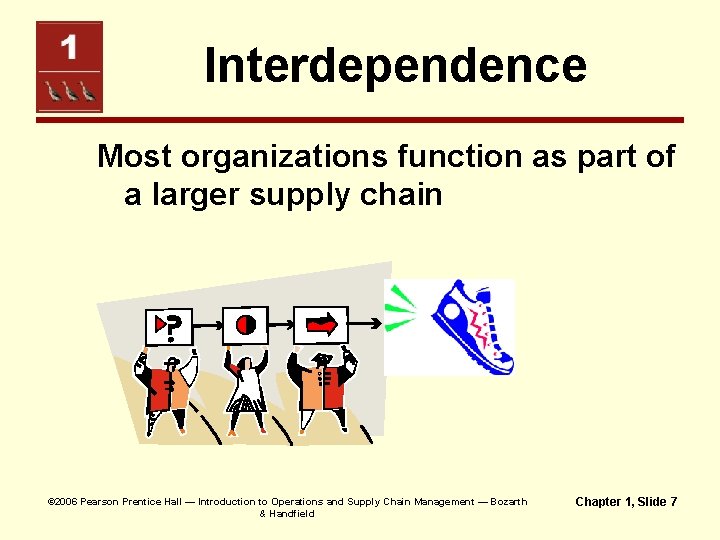
Interdependence Most organizations function as part of a larger supply chain © 2006 Pearson Prentice Hall — Introduction to Operations and Supply Chain Management — Bozarth & Handfield Chapter 1, Slide 7
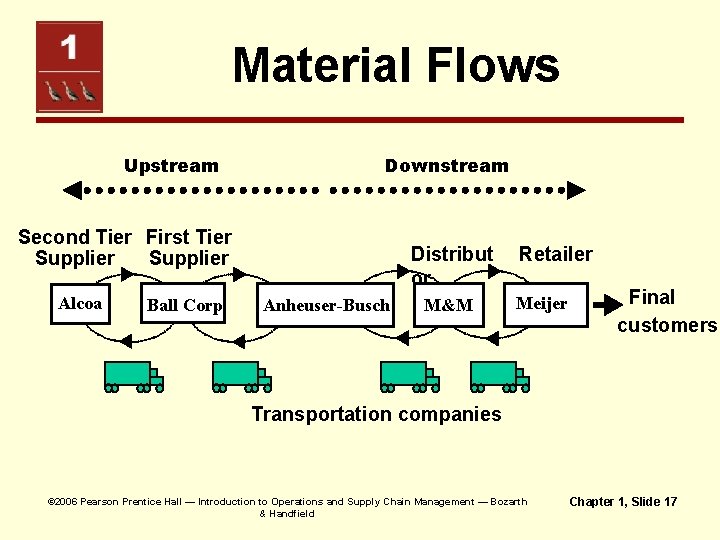
Supply Chains • Networks of manufacturers and service providers that work together to move goods from the raw material stage through to the end user • Linked through physical, information, and monetary flows © 2006 Pearson Prentice Hall — Introduction to Operations and Supply Chain Management — Bozarth & Handfield Chapter 1, Slide 8
Profitability and Survival Organizations must carefully manage their operations and supply chains to prosper, and indeed, survive! Shoe manufacturer: How many shoes should we make? What mix? What resources do we need? What will we outsource? Location? Key performance criteria -- Cost? Quality? Speed? © 2006 Pearson Prentice Hall — Introduction to Operations and Supply Chain Management — Bozarth & Handfield Chapter 1, Slide 9
Operations Management The planning, scheduling, and control of the activities that transform inputs into finished goods and services © 2006 Pearson Prentice Hall — Introduction to Operations and Supply Chain Management — Bozarth & Handfield Chapter 1, Slide 10
Operations Function The collection of people, technology, and systems within a company. . . … that has primary responsibility. . . … for providing the organization’s products or services. © 2006 Pearson Prentice Hall — Introduction to Operations and Supply Chain Management — Bozarth & Handfield Chapter 1, Slide 11
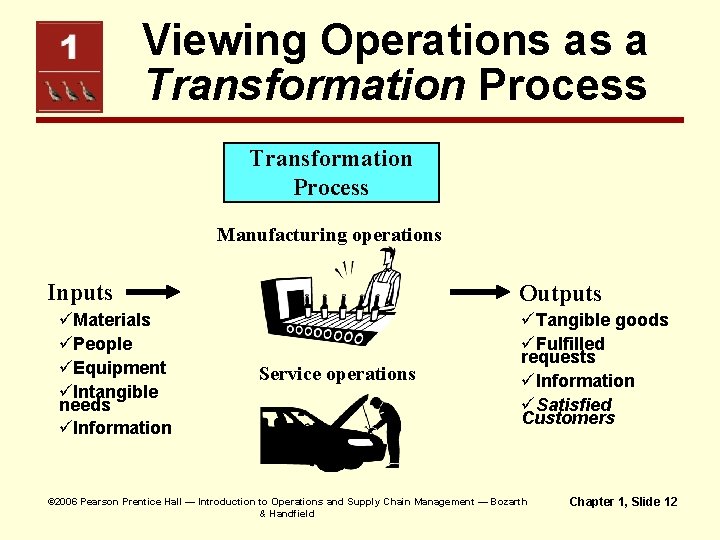
Viewing Operations as a Transformation Process Manufacturing operations Inputs üMaterials üPeople üEquipment üIntangible needs üInformation Outputs Service operations üTangible goods üFulfilled requests üInformation üSatisfied Customers © 2006 Pearson Prentice Hall — Introduction to Operations and Supply Chain Management — Bozarth & Handfield Chapter 1, Slide 12
Manufacturing • Tangible product • Key decisions driven by physical characteristics of the product: – – How is the product made? How do we store it? How do we move it? Etc. © 2006 Pearson Prentice Hall — Introduction to Operations and Supply Chain Management — Bozarth & Handfield Chapter 1, Slide 13
Services • Intangible “Product” or Service – Location, Exchange, Storage, Physiological, Information • Key decisions: – How much customer involvement? – How much customization? © 2006 Pearson Prentice Hall — Introduction to Operations and Supply Chain Management — Bozarth & Handfield Chapter 1, Slide 14
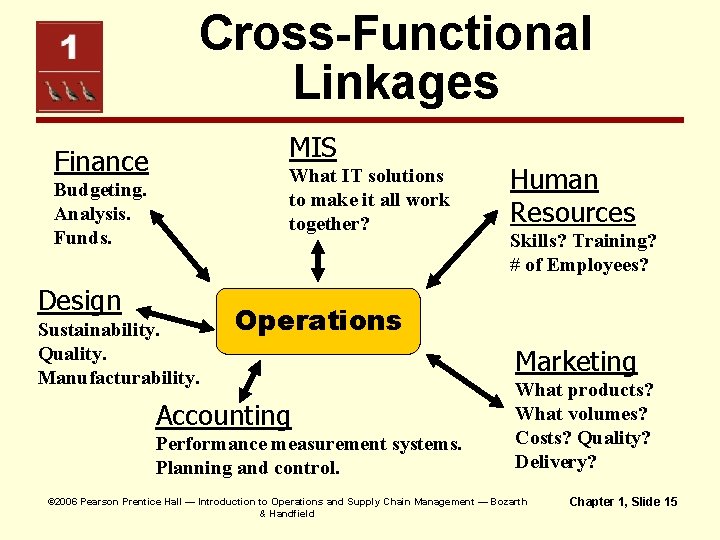
Cross-Functional Linkages MIS Finance What IT solutions to make it all work together? Budgeting. Analysis. Funds. Design Sustainability. Quality. Manufacturability. Human Resources Skills? Training? # of Employees? Operations Accounting Performance measurement systems. Planning and control. Marketing What products? What volumes? Costs? Quality? Delivery? © 2006 Pearson Prentice Hall — Introduction to Operations and Supply Chain Management — Bozarth & Handfield Chapter 1, Slide 15
Supply Chain Management Active management of supply chain activities and relationships to maximize customer value and achieve a sustainable competitive advantage © 2006 Pearson Prentice Hall — Introduction to Operations and Supply Chain Management — Bozarth & Handfield Chapter 1, Slide 16
Material Flows Upstream Downstream Second Tier First Tier Supplier Alcoa Ball Corp Distribut or Anheuser-Busch M&M Retailer Meijer Final customers Transportation companies © 2006 Pearson Prentice Hall — Introduction to Operations and Supply Chain Management — Bozarth & Handfield Chapter 1, Slide 17
Supply Chain Issues • • Length of the chain Complexity Stability Physical, informational, and monetary flows © 2006 Pearson Prentice Hall — Introduction to Operations and Supply Chain Management — Bozarth & Handfield Chapter 1, Slide 18
Wal-Mart — Early 1990 s • Individual stores sent sales data daily to Wal-Mart’s suppliers via satellite • Suppliers plan production and ship based on this sales data • Wal-Mart used its own dedicated fleet to ship from its warehouses to stores © 2006 Pearson Prentice Hall — Introduction to Operations and Supply Chain Management — Bozarth & Handfield Chapter 1, Slide 19
Krispy-Kreme — 2004 • Stores order supplies electronically from K-K’s warehouses • At the warehouse – Radio-frequency tag (RFID) technology to track the location of inventory • Results: Fast and error-free ordering © 2006 Pearson Prentice Hall — Introduction to Operations and Supply Chain Management — Bozarth & Handfield Chapter 1, Slide 20
Important Trends • Electronic commerce – Reduce the costs and time associated with supply chain relationships • Increasing competition and globalization – Fewer industries protected by geography • Relationship management – Competition between chains, not individual firms – Trust and coordination © 2006 Pearson Prentice Hall — Introduction to Operations and Supply Chain Management — Bozarth & Handfield Chapter 1, Slide 21
Leap. Frog Chapter 1 Case Study © 2006 Pearson Prentice Hall — Introduction to Operations and Supply Chain Management — Bozarth & Handfield Chapter 1, Slide 22