
Introduction to Operating Systems CPSCECE 3220 Spring 2020


- Slides: 44
Introduction to Operating Systems CPSC/ECE 3220 Spring 2020 Lecture Notes OSPP Chapter 6 – Part A (adapted by Mark Smotherman from Tom Anderson’s slides on OSPP web site)
Multi-Object Programs • What happens when we try to synchronize across multiple objects in a large program? – Each object with its own lock, condition variables – Is locking modular? • Synchronization performance • Eliminating locks
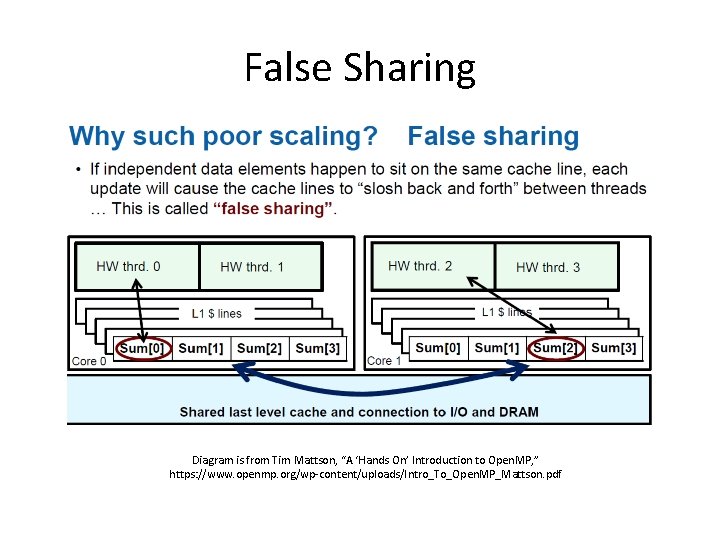
Synchronization Performance • A program with lots of concurrent threads can still have poor performance on a multiprocessor: – Overhead of creating threads, if not needed – Lock contention: only one thread at a time can hold a given lock – Shared data protected by a lock may ping back and forth between cores – False sharing: communication between cores even for data that is not shared
Synchronization Performance Topics • Multiprocessor cache coherence • MCS locks (if locks are mostly busy) • RCU locks (if locks are mostly busy, and data is mostly read-only)
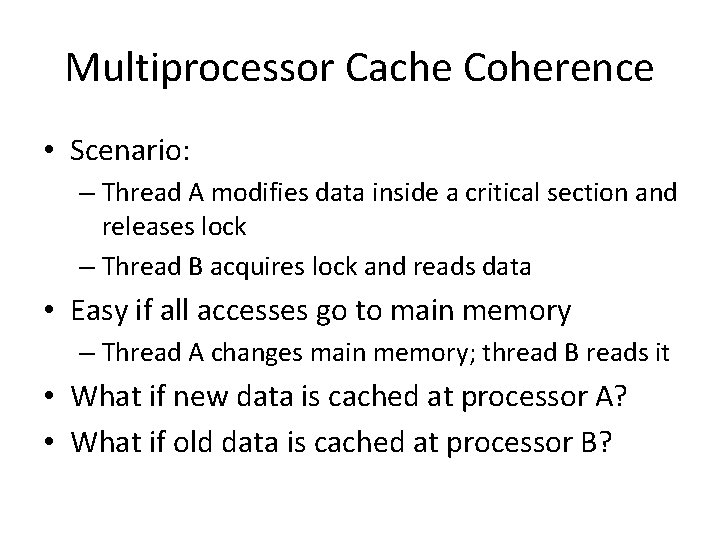
Multiprocessor Cache Coherence • Scenario: – Thread A modifies data inside a critical section and releases lock – Thread B acquires lock and reads data • Easy if all accesses go to main memory – Thread A changes main memory; thread B reads it • What if new data is cached at processor A? • What if old data is cached at processor B?
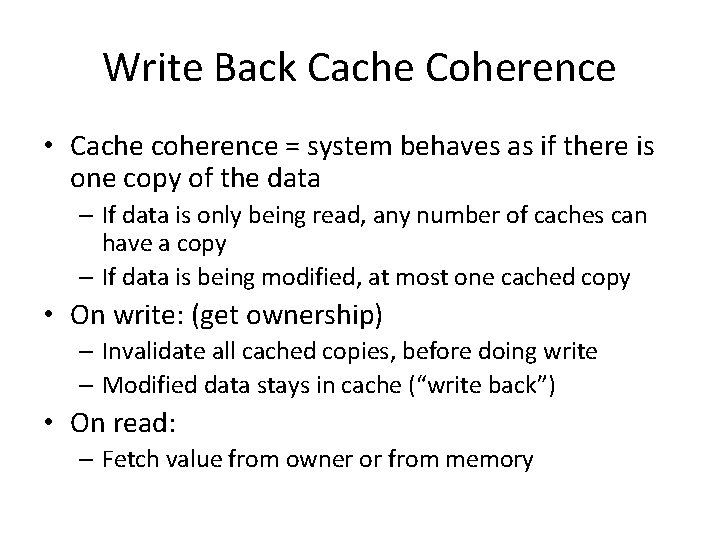
Write Back Cache Coherence • Cache coherence = system behaves as if there is one copy of the data – If data is only being read, any number of caches can have a copy – If data is being modified, at most one cached copy • On write: (get ownership) – Invalidate all cached copies, before doing write – Modified data stays in cache (“write back”) • On read: – Fetch value from owner or from memory
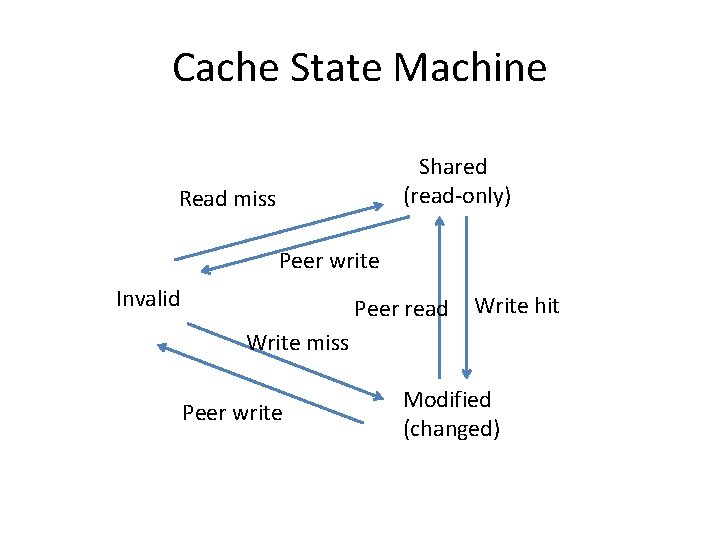
Cache State Machine Shared (read-only) Read miss Peer write Invalid Peer read Write hit Write miss Peer write Modified (changed)
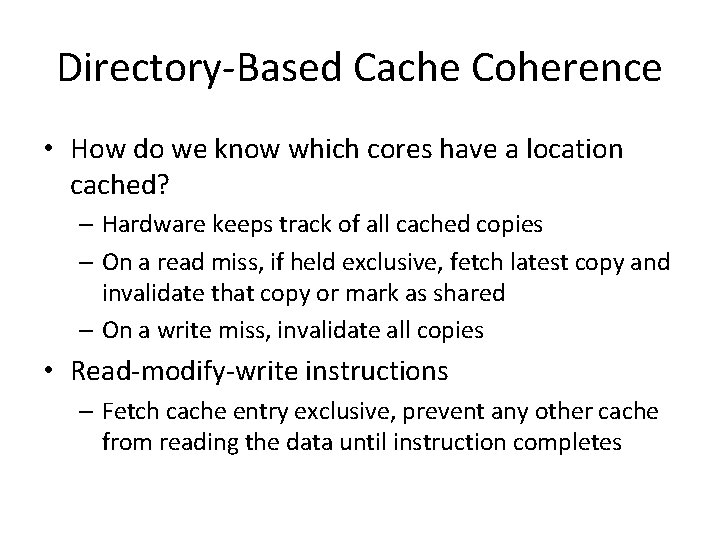
Directory-Based Cache Coherence • How do we know which cores have a location cached? – Hardware keeps track of all cached copies – On a read miss, if held exclusive, fetch latest copy and invalidate that copy or mark as shared – On a write miss, invalidate all copies • Read-modify-write instructions – Fetch cache entry exclusive, prevent any other cache from reading the data until instruction completes
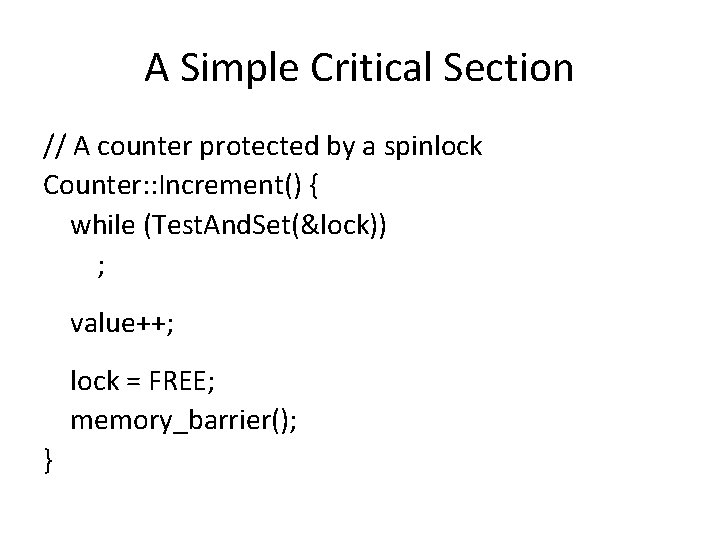
A Simple Critical Section // A counter protected by a spinlock Counter: : Increment() { while (Test. And. Set(&lock)) ; value++; lock = FREE; memory_barrier(); }
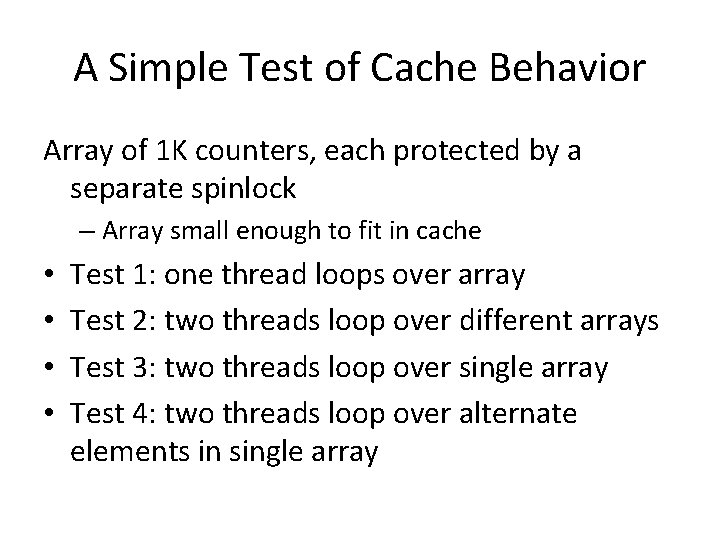
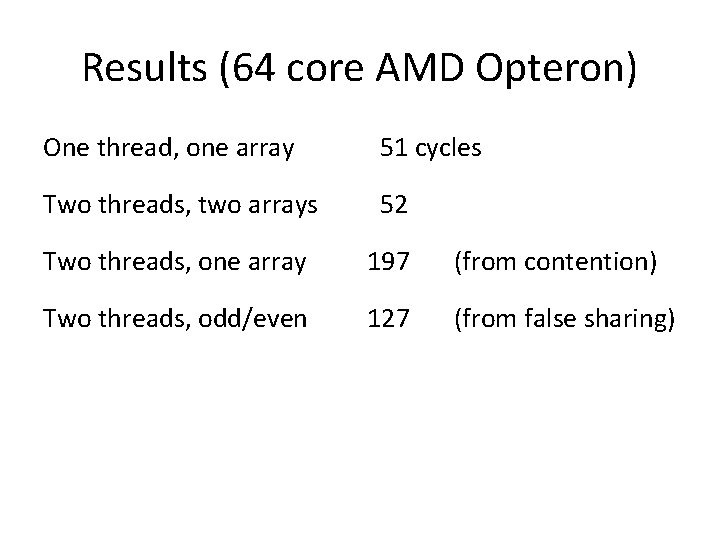
A Simple Test of Cache Behavior Array of 1 K counters, each protected by a separate spinlock – Array small enough to fit in cache • • Test 1: one thread loops over array Test 2: two threads loop over different arrays Test 3: two threads loop over single array Test 4: two threads loop over alternate elements in single array
Results (64 core AMD Opteron) One thread, one array 51 cycles Two threads, two arrays 52 Two threads, one array 197 (from contention) Two threads, odd/even 127 (from false sharing)
False Sharing Diagram is from Tim Mattson, “A ‘Hands On’ Introduction to Open. MP, ” https: //www. openmp. org/wp-content/uploads/Intro_To_Open. MP_Mattson. pdf
Reducing Lock Contention • Fine-grained locking – Partition object into subsets, each protected by its own lock – Example: hash table buckets • Per-processor data structures – Partition object so that most/all accesses are made by one processor – Example: per-processor heap • Ownership/Staged architecture – Only one thread at a time accesses shared data – Example: pipeline of threads
Linus Shares His Opinion You seem to have this blue-eyed belief that locking is simple. It's not. . you talk about the locking cost as if something like a 12 -20 cycles is "free". That's pure [BS]. Even if it's uncontended, you're dirtying cachelines in the L 1. Guess what? If you have finegrained locking for lots of objects, the cost of all that extra cache traffic is really bad, and takes up a valuable resource. End result: very few people actually do fine-grained locking at all. It's damn hard, and it easily eats up 50%+ of your CPU cycles if you do it wrong. You spend years getting it right for anything but the most trivial case. [from realworldtech. com, June 6, 2013]
Locking Design Issues Fine-grained locking comes at a cost, however. In a kernel with thousands of locks, it can be very hard to know which locks you need—and in which order you should acquire them—to perform a specific operation. Remember that locking bugs can be very difficult to find; more locks provide more opportunities for truly nasty locking bugs to creep into the kernel. Fine-grained locking can bring a level of complexity that, over the long term, can have a large, adverse effect on the maintainability of the kernel. Locking in a device driver is usually relatively straightforward; you can have a single lock that covers everything you do, or you can create one lock for every device you manage. As a general rule, you should start with relatively coarse locking unless you have a real reason to believe that contention could be a problem. Resist the urge to optimize prematurely; the real performance constraints often show up in unexpected places. If you do suspect that lock contention is hurting performance, you may find the lockmeter tool useful. This patch (available at http: //oss. sgi. com/projects/lockmeter/) instruments the kernel to measure time spent waiting in locks. By looking at the report, you are able to determine quickly whether lock contention is truly the problem or not. From "Locking Traps, " sec. 5. 6 in J. Corbet, G. Kroah-Hartman, and A. Rubin, Linux Device Drivers, www. makelinux. net/ldd 3/chp-5 -sect-6
What If Locks are Still Mostly Busy? • MCS Locks – Optimize lock implementation for when lock is contended • RCU (read-copy-update) – Efficient readers/writers lock used in Linux kernel – Readers proceed without first acquiring lock – Writer ensures that readers are done • Both rely on atomic read-modify-write instructions
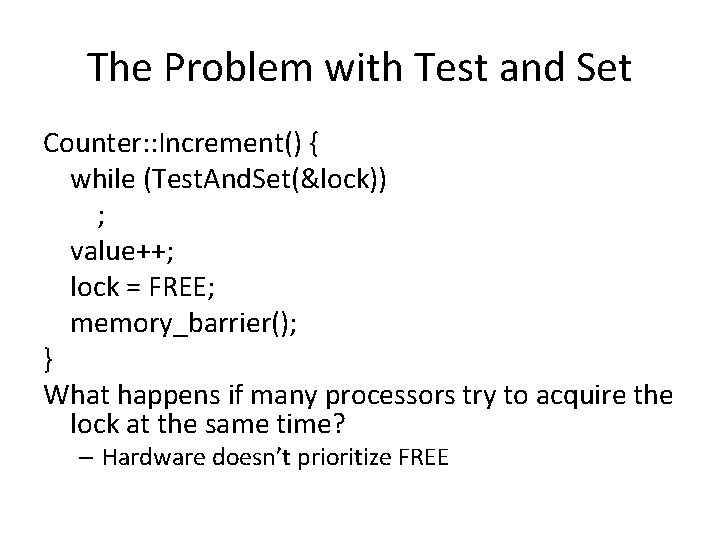
The Problem with Test and Set Counter: : Increment() { while (Test. And. Set(&lock)) ; value++; lock = FREE; memory_barrier(); } What happens if many processors try to acquire the lock at the same time? – Hardware doesn’t prioritize FREE
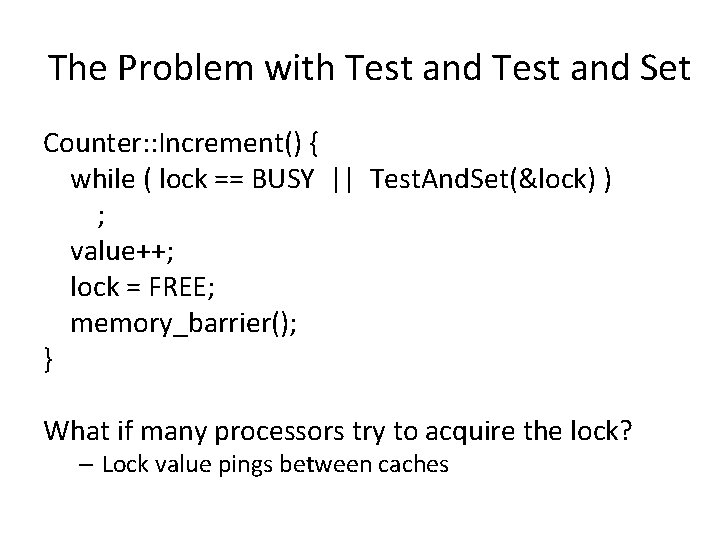
The Problem with Test and Set Counter: : Increment() { while ( lock == BUSY || Test. And. Set(&lock) ) ; value++; lock = FREE; memory_barrier(); } What if many processors try to acquire the lock? – Lock value pings between caches
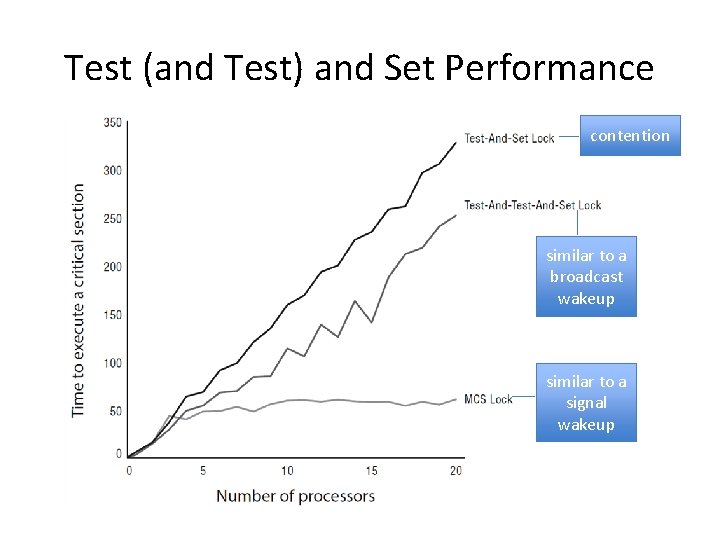
Test (and Test) and Set Performance contention similar to a broadcast wakeup similar to a signal wakeup
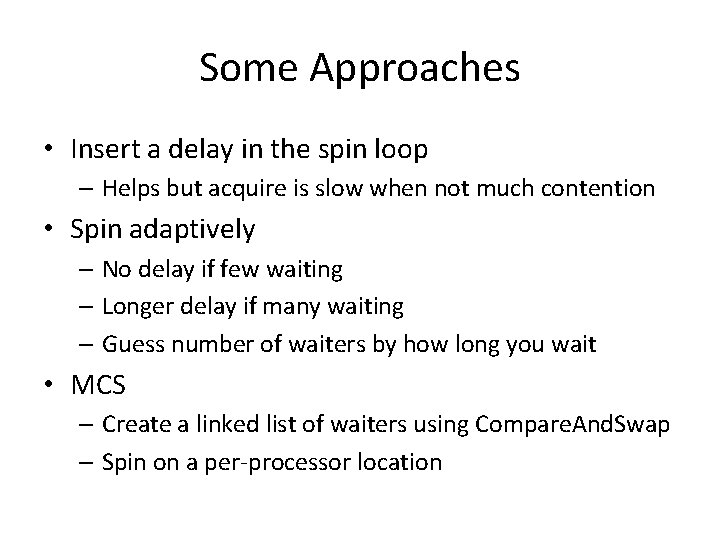
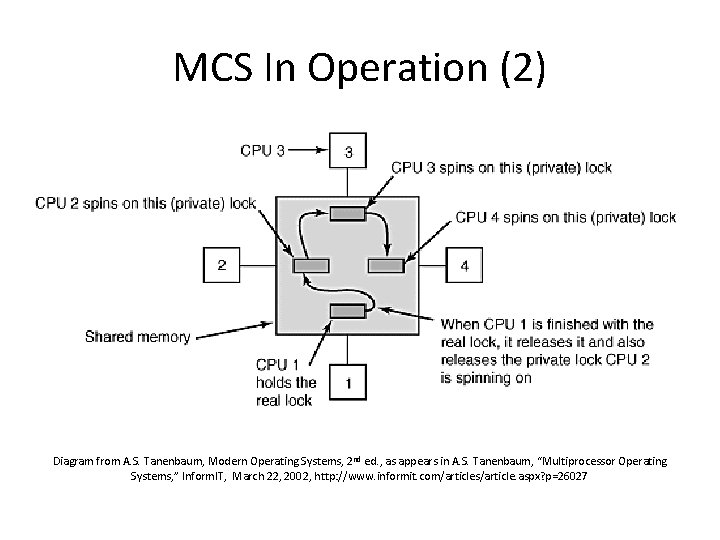
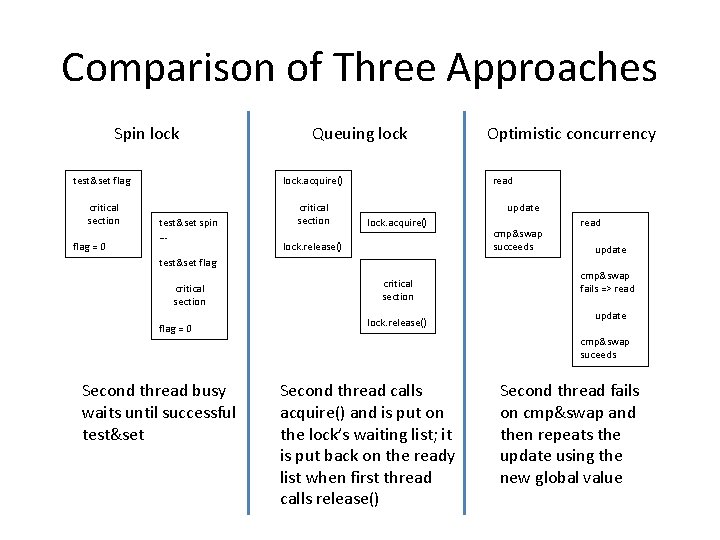
Some Approaches • Insert a delay in the spin loop – Helps but acquire is slow when not much contention • Spin adaptively – No delay if few waiting – Longer delay if many waiting – Guess number of waiters by how long you wait • MCS – Create a linked list of waiters using Compare. And. Swap – Spin on a per-processor location
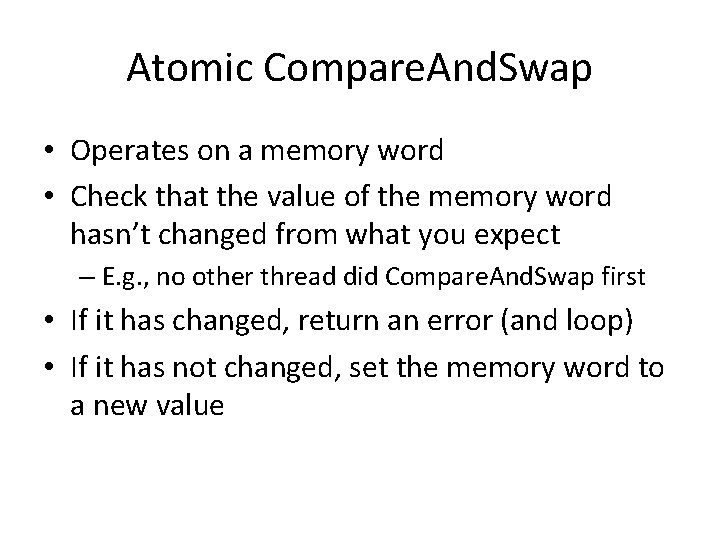
Atomic Compare. And. Swap • Operates on a memory word • Check that the value of the memory word hasn’t changed from what you expect – E. g. , no other thread did Compare. And. Swap first • If it has changed, return an error (and loop) • If it has not changed, set the memory word to a new value
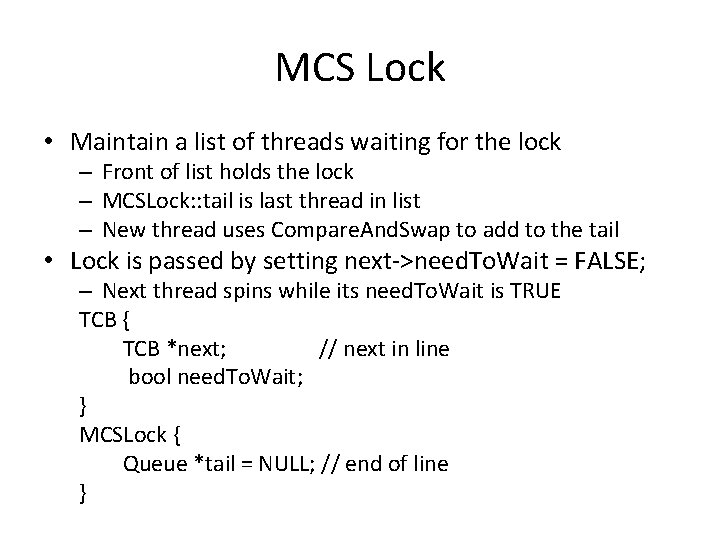
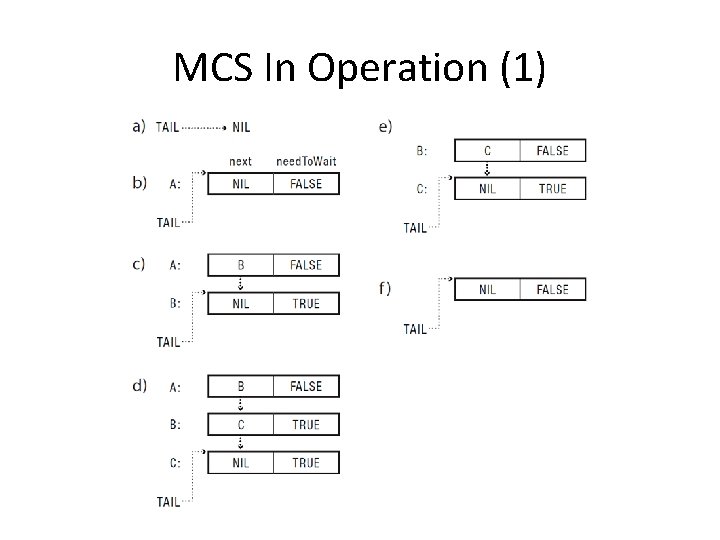
MCS Lock • Maintain a list of threads waiting for the lock – Front of list holds the lock – MCSLock: : tail is last thread in list – New thread uses Compare. And. Swap to add to the tail • Lock is passed by setting next->need. To. Wait = FALSE; – Next thread spins while its need. To. Wait is TRUE TCB { TCB *next; // next in line bool need. To. Wait; } MCSLock { Queue *tail = NULL; // end of line }
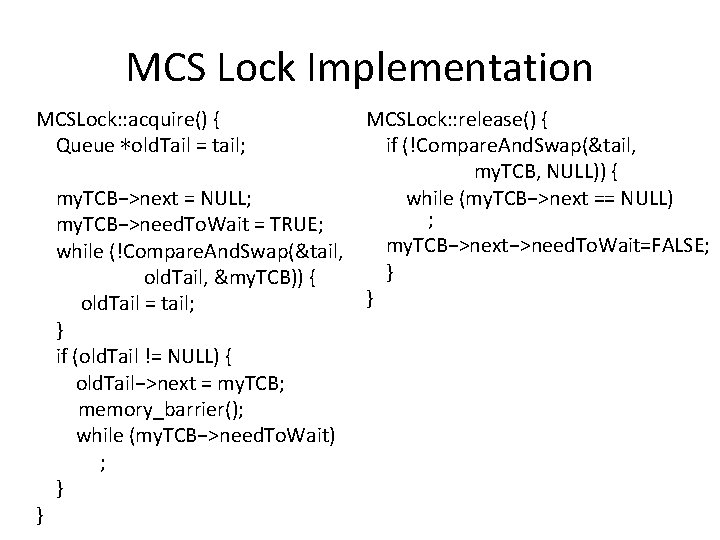
MCS Lock Implementation MCSLock: : acquire() { Queue ∗old. Tail = tail; } my. TCB−>next = NULL; my. TCB−>need. To. Wait = TRUE; while (!Compare. And. Swap(&tail, old. Tail, &my. TCB)) { old. Tail = tail; } if (old. Tail != NULL) { old. Tail−>next = my. TCB; memory_barrier(); while (my. TCB−>need. To. Wait) ; } MCSLock: : release() { if (!Compare. And. Swap(&tail, my. TCB, NULL)) { while (my. TCB−>next == NULL) ; my. TCB−>next−>need. To. Wait=FALSE; } }
MCS In Operation (1)
MCS In Operation (2) Diagram from A. S. Tanenbaum, Modern Operating Systems, 2 nd ed. , as appears in A. S. Tanenbaum, “Multiprocessor Operating Systems, ” Inform. IT, March 22, 2002, http: //www. informit. com/articles/article. aspx? p=26027
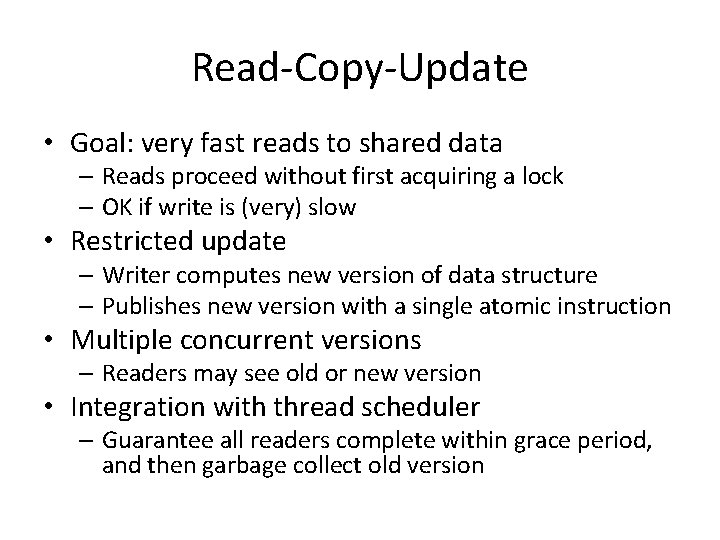
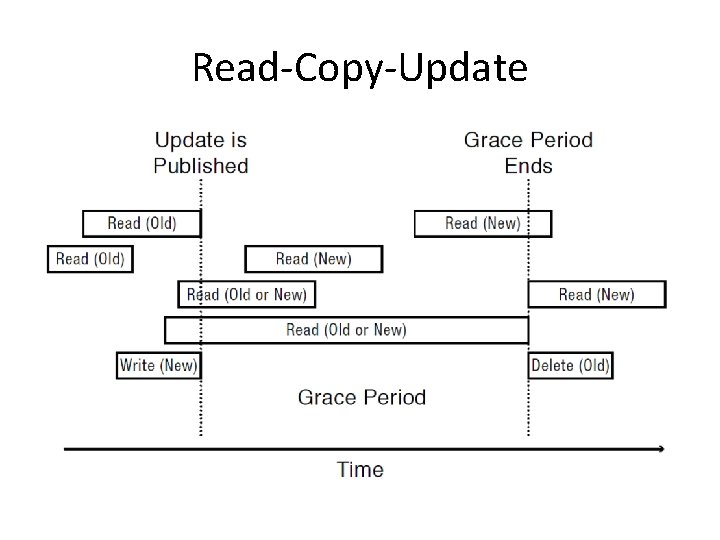
Read-Copy-Update • Goal: very fast reads to shared data – Reads proceed without first acquiring a lock – OK if write is (very) slow • Restricted update – Writer computes new version of data structure – Publishes new version with a single atomic instruction • Multiple concurrent versions – Readers may see old or new version • Integration with thread scheduler – Guarantee all readers complete within grace period, and then garbage collect old version
Read-Copy-Update
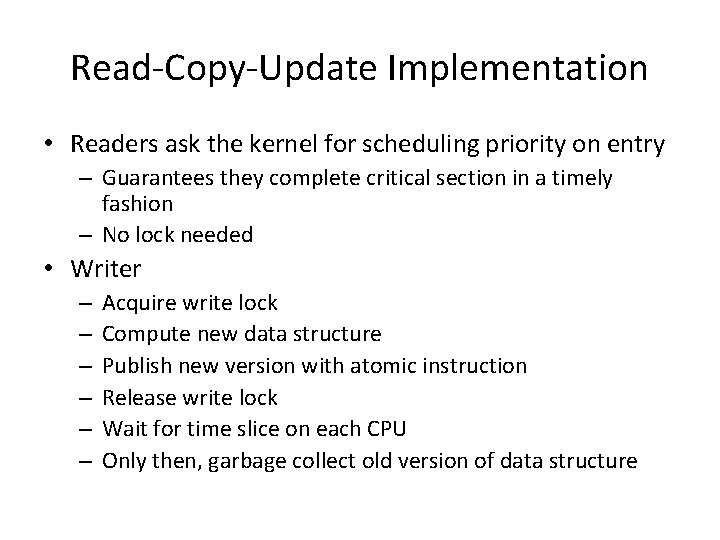
Read-Copy-Update Implementation • Readers ask the kernel for scheduling priority on entry – Guarantees they complete critical section in a timely fashion – No lock needed • Writer – – – Acquire write lock Compute new data structure Publish new version with atomic instruction Release write lock Wait for time slice on each CPU Only then, garbage collect old version of data structure
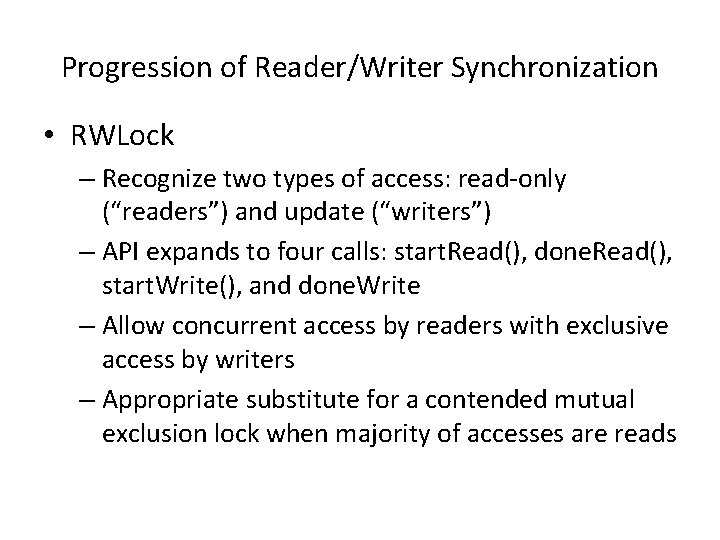
Progression of Reader/Writer Synchronization • RWLock – Recognize two types of access: read-only (“readers”) and update (“writers”) – API expands to four calls: start. Read(), done. Read(), start. Write(), and done. Write – Allow concurrent access by readers with exclusive access by writers – Appropriate substitute for a contended mutual exclusion lock when majority of accesses are reads
Progression of Reader/Writer Synchronization • RCU – Trade space for time by providing multiple versions of the data structure – Allow concurrent readers without acquiring a lock – Readers are not stopped during execution of a writer • Readers are instead given access to an older version of the data structure using the published pointer – Still requires start. Read() and done. Read() system calls by readers • Thread scheduler prioritizes read accesses so that old versions of the data structure aren’t kept indefinitely • End of grace period can be determined
Non-Blocking Synchronization • Goal: data structures that can be read/modified without acquiring a lock – No lock contention! – No deadlock! • General method using Compare. And. Swap – Create copy of data structure – Modify copy – Swap in new version iff no one else has – Restart if pointer has changed
Optimistic Concurrency Control • Allows overlapped execution of updates – With forward progress for at least one thread • If the updates apply to different fields in a protected object, then all can succeed – Gives benefit of fine-grain locking without all the locks – If same field is changed by another thread between the time a threads and writes, then write attempt fails and update has to be restarted using the new value – In essence, a critical section has been moved into the body of a busy wait loop
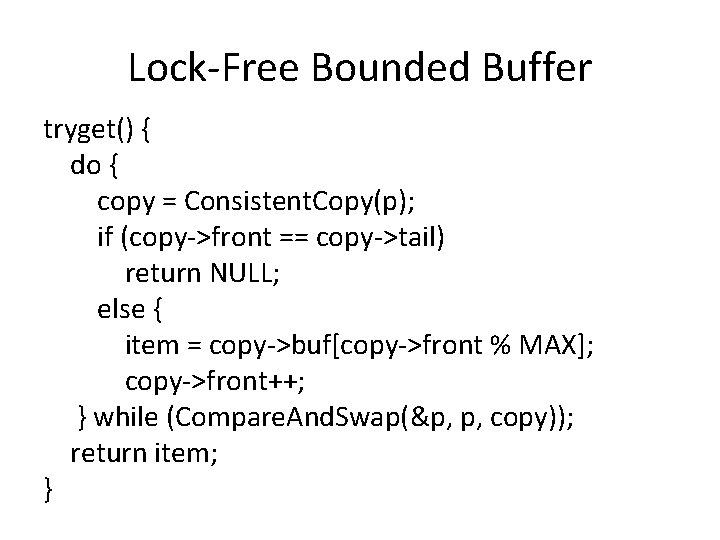
Lock-Free Bounded Buffer tryget() { do { copy = Consistent. Copy(p); if (copy->front == copy->tail) return NULL; else { item = copy->buf[copy->front % MAX]; copy->front++; } while (Compare. And. Swap(&p, p, copy)); return item; }
Comparison of Three Approaches Spin lock Queuing lock test&set flag lock. acquire() critical section flag = 0 test&set spin … read update lock. acquire() lock. release() test&set flag critical section flag = 0 Second thread busy waits until successful test&set Optimistic concurrency critical section lock. release() cmp&swap succeeds read update cmp&swap fails => read update cmp&swap suceeds Second thread calls acquire() and is put on the lock’s waiting list; it is put back on the ready list when first thread calls release() Second thread fails on cmp&swap and then repeats the update using the new global value
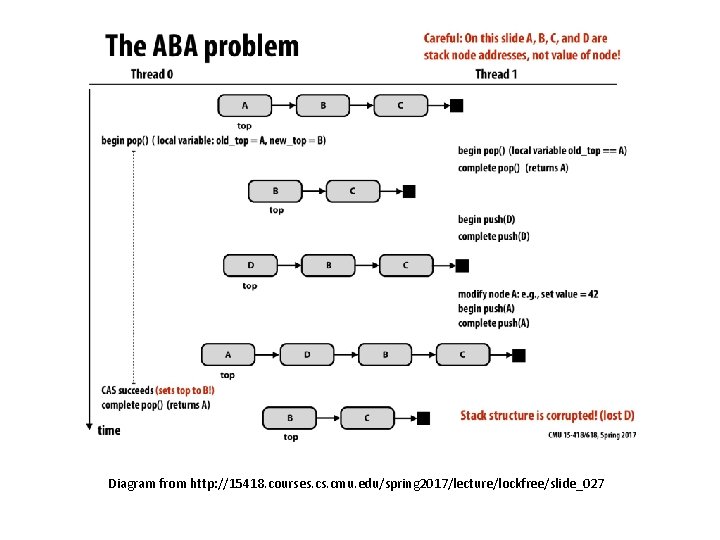
Compare. And. Swap ABA Problem • Intervening actions between copy and update of list head with reuse of an address • Needs a second word to act as a counter – IBM S/370 implemented a single-wide CS and double-wide CDS – Intel x 86 implemented a single-wide CMPXCHG 8 B and double-wide CMPXCHG 16 B
Diagram from http: //15418. courses. cmu. edu/spring 2017/lecture/lockfree/slide_027
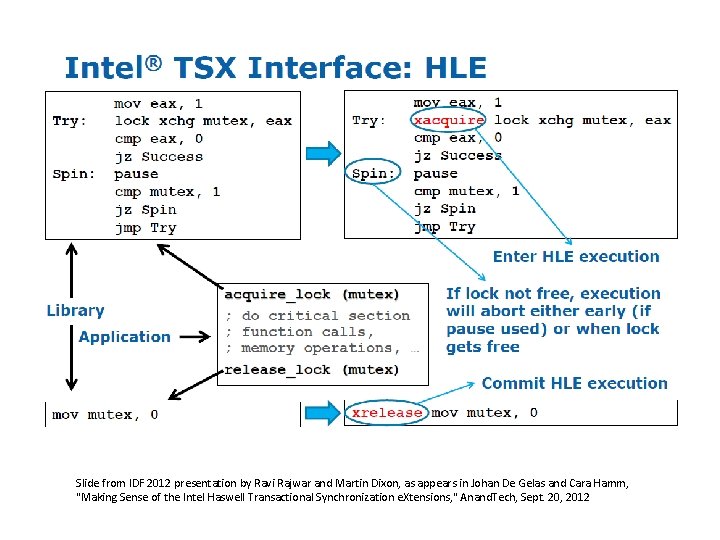
Hardware Transactional Memory • Execute without acquiring a lock and commit all writes at once – Track reads and writes of current processor and any interfering accesses from other processors at cache line granularity – If no interfering accesses, commit all updates in a single transaction – Otherwise abort and follow a non-transactional recovery path
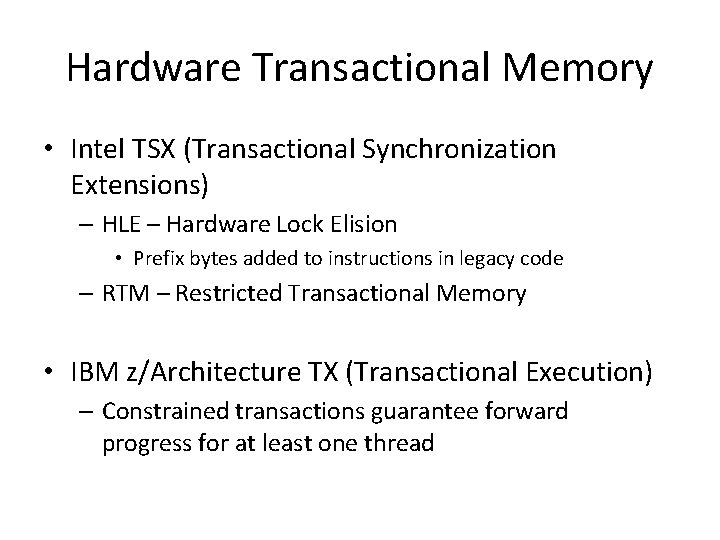
Hardware Transactional Memory • Intel TSX (Transactional Synchronization Extensions) – HLE – Hardware Lock Elision • Prefix bytes added to instructions in legacy code – RTM – Restricted Transactional Memory • IBM z/Architecture TX (Transactional Execution) – Constrained transactions guarantee forward progress for at least one thread
Slide from IDF 2012 presentation by Ravi Rajwar and Martin Dixon, as appears in Johan De Gelas and Cara Hamm, "Making Sense of the Intel Haswell Transactional Synchronization e. Xtensions, " Anand. Tech, Sept. 20, 2012
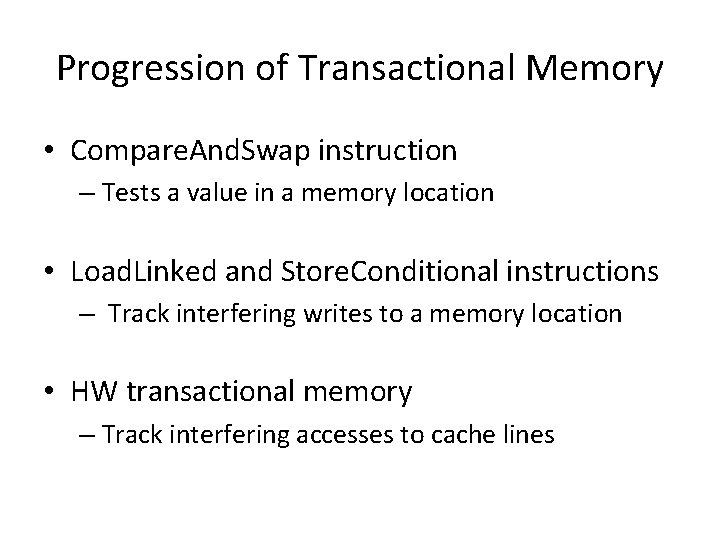
Progression of Transactional Memory • Compare. And. Swap instruction – Tests a value in a memory location • Load. Linked and Store. Conditional instructions – Track interfering writes to a memory location • HW transactional memory – Track interfering accesses to cache lines
(if time permits)
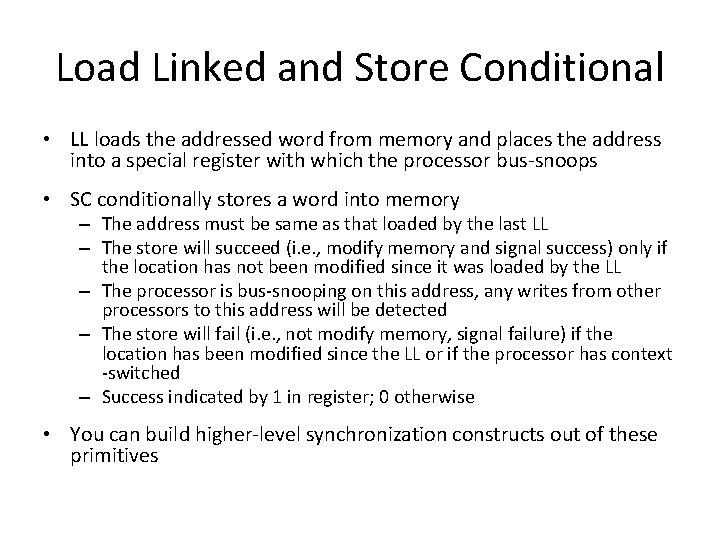
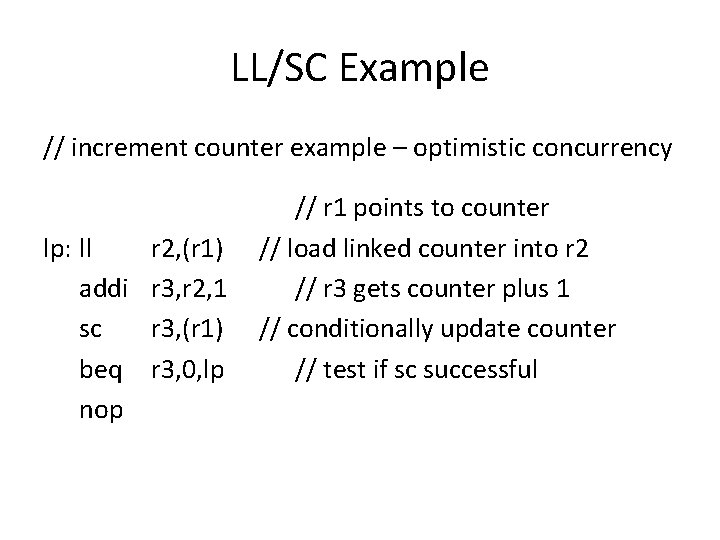
Load Linked and Store Conditional • LL loads the addressed word from memory and places the address into a special register with which the processor bus-snoops • SC conditionally stores a word into memory – The address must be same as that loaded by the last LL – The store will succeed (i. e. , modify memory and signal success) only if the location has not been modified since it was loaded by the LL – The processor is bus-snooping on this address, any writes from other processors to this address will be detected – The store will fail (i. e. , not modify memory, signal failure) if the location has been modified since the LL or if the processor has context -switched – Success indicated by 1 in register; 0 otherwise • You can build higher-level synchronization constructs out of these primitives
LL/SC Example // increment counter example – optimistic concurrency lp: ll addi sc beq nop r 2, (r 1) r 3, r 2, 1 r 3, (r 1) r 3, 0, lp // r 1 points to counter // load linked counter into r 2 // r 3 gets counter plus 1 // conditionally update counter // test if sc successful
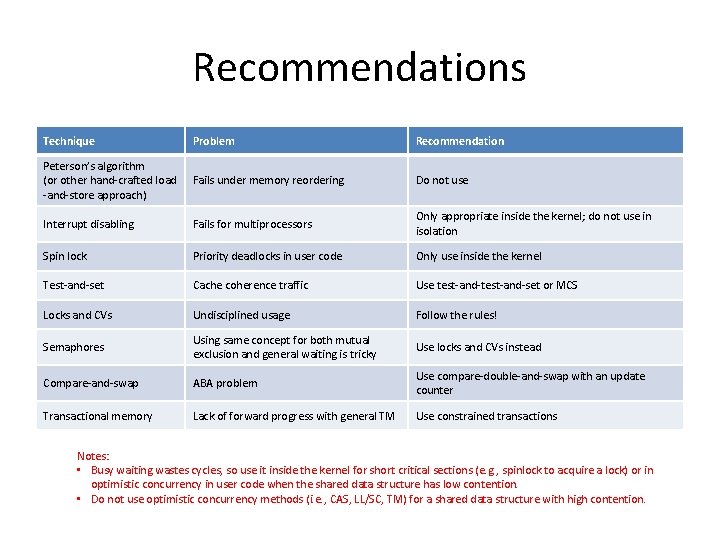
Recommendations Technique Problem Recommendation Peterson’s algorithm (or other hand-crafted load -and-store approach) Fails under memory reordering Do not use Interrupt disabling Fails for multiprocessors Only appropriate inside the kernel; do not use in isolation Spin lock Priority deadlocks in user code Only use inside the kernel Test-and-set Cache coherence traffic Use test-and-set or MCS Locks and CVs Undisciplined usage Follow the rules! Semaphores Using same concept for both mutual exclusion and general waiting is tricky Use locks and CVs instead Compare-and-swap ABA problem Use compare-double-and-swap with an update counter Transactional memory Lack of forward progress with general TM Use constrained transactions Notes: • Busy waiting wastes cycles, so use it inside the kernel for short critical sections (e. g. , spinlock to acquire a lock) or in optimistic concurrency in user code when the shared data structure has low contention. • Do not use optimistic concurrency methods (i. e. , CAS, LL/SC, TM) for a shared data structure with high contention.