
Introduction to Open MP Introduction Open MP basics
Introduction to Open. MP • Introduction • Open. MP basics • Open. MP directives, clauses, and library routines

Motivation • Pthread is too tedious: explicit thread management is often unnecessary – Consider the matrix multiply example • We have a sequential code, we know which loop can be executed in parallel; the program conversion is quite mechanic: we should just say that the loop is to be executed in parallel and let the compiler do the rest. • Open. MP does exactly that!!!
What is Open. MP? • What does Open. MP stands for? – Open specifications for Multi Processing via collaborative work between interested parties from the hardware and software industry, government and academia. • Open. MP is an Application Program Interface (API) that may be used to explicitly direct multithreaded, shared memory parallelism. • API components: Compiler Directives, Runtime Library Routines. Environment Variables • Open. MP is a directive-based method to invoke parallel computations on share-memory multiprocessors
What is Open. MP? • Open. MP API is specified for C/C++ and Fortran. • Open. MP is not intrusive to the original serial code: instructions appear in comment statements fortran and pragmas for C/C++. • Open. MP website: http: //www. openmp. org – Materials in this lecture are taken from various Open. MP tutorials in the website and other places.
Why Open. MP? • Open. MP is portable: supported by HP, IBM, Intel, SGI, SUN, and others – It is the de facto standard for writing shared memory programs. – To become an ANSI standard? • Open. MP can be implemented incrementally, one function or even one loop at a time. – A nice way to get a parallel program from a sequential program.
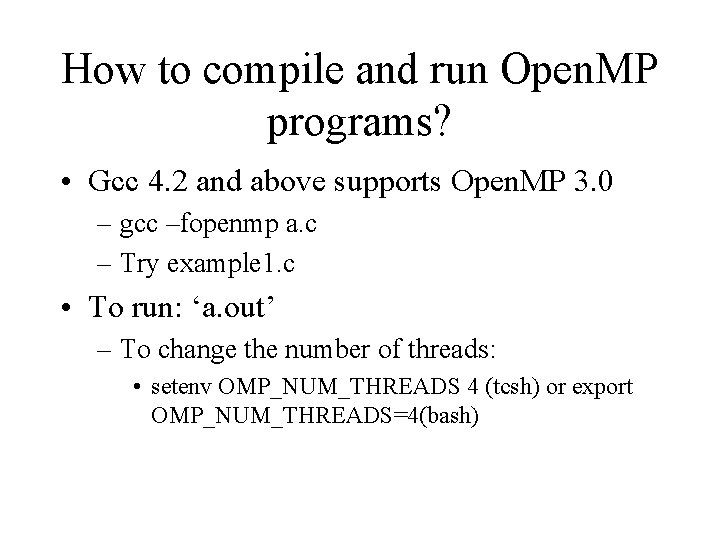
How to compile and run Open. MP programs? • Gcc 4. 2 and above supports Open. MP 3. 0 – gcc –fopenmp a. c – Try example 1. c • To run: ‘a. out’ – To change the number of threads: • setenv OMP_NUM_THREADS 4 (tcsh) or export OMP_NUM_THREADS=4(bash)
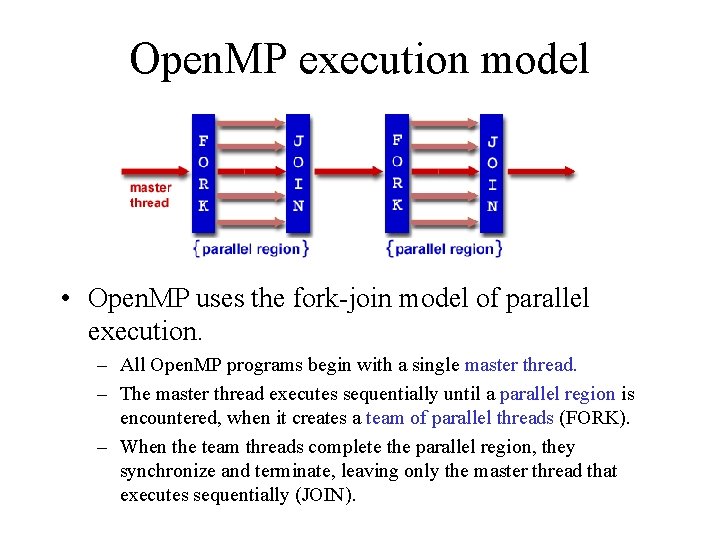
Open. MP execution model • Open. MP uses the fork-join model of parallel execution. – All Open. MP programs begin with a single master thread. – The master thread executes sequentially until a parallel region is encountered, when it creates a team of parallel threads (FORK). – When the team threads complete the parallel region, they synchronize and terminate, leaving only the master thread that executes sequentially (JOIN).
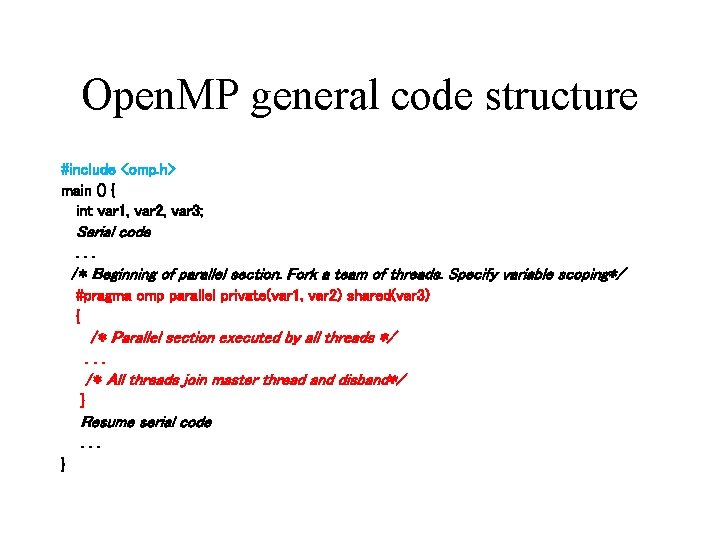
Open. MP general code structure #include <omp. h> main () { int var 1, var 2, var 3; Serial code. . . /* Beginning of parallel section. Fork a team of threads. Specify variable scoping*/ #pragma omp parallel private(var 1, var 2) shared(var 3) { /* Parallel section executed by all threads */. . . /* All threads join master thread and disband*/ } Resume serial code. . . }

Data model • Private and shared variables • Variables in the global data space are accessed by all parallel threads (shared variables). • Variables in a thread’s private space can only be accessed by the thread (private variables) • several variations, depending on the initial values and whether the results are copied outside the region.

#pragma omp parallel for private( priv. Indx, priv. Dbl ) for ( i = 0; i < array. Size; i++ ) { for ( priv. Indx = 0; priv. Indx < 16; priv. Indx++ ) { priv. Dbl = ( (double) priv. Indx ) / 16; y[i] = sin( exp( cos( - exp( sin(x[i]) ) ) + cos( priv. Dbl ); } } Parallel for loop index is Private by default.
![Open. MP directives • Format: #progma omp directive-name [clause, . . ] newline (use](http://slidetodoc.com/presentation_image_h/b7826c91646a1c0bd7554fbeae9bd3c7/image-11.jpg "Open. MP directives • Format: #progma omp directive-name [clause, . . ] newline (use")
Open. MP directives • Format: #progma omp directive-name [clause, . . ] newline (use ‘’ for multiple lines) • Example: #pragma omp parallel default(shared) private(beta, pi) • Scope of a directive is one block of statements { …}

Parallel region construct • A block of code that will be executed by multiple threads. #pragma omp parallel [clause …] { …… } (implied barrier) Clauses: if (expression), private (list), shared (list), default (shared | none), reduction (operator: list), firstprivate(list), lastprivate(list) – if (expression): only in parallel if expression evaluates to true – private(list): everything private and local (no relation with variables outside the block). – shared(list): data accessed by all threads – default (none|shared)

• The reduction clause: Sum = 0. 0; #pragma parallel default(none) shared (n, x) private (I) reduction(+ : sum) { For(I=0; I<n; I++) sum = sum + x(I); } – Updating sum must avoid racing condition – With the reduction clause, Open. MP generates code such that the race condition is avoided. • Firstprivate(list): variables are initialized with the value before entering the block • Lastprivate(list): variables are updated going out of the block.
![Work-sharing constructs • #pragma omp for [clause …] • #pragma omp section [clause …]](http://slidetodoc.com/presentation_image_h/b7826c91646a1c0bd7554fbeae9bd3c7/image-14.jpg "Work-sharing constructs • #pragma omp for [clause …] • #pragma omp section [clause …]")
Work-sharing constructs • #pragma omp for [clause …] • #pragma omp section [clause …] • #pragma omp single [clause …] • The work is distributed over the threads • Must be enclosed in parallel region • No implied barrier on entry, implied barrier on exit (unless specified otherwise)

The omp for directive: example

• Schedule clause (decide how the iterations are executed in parallel): schedule (static | dynamic | guided [, chunk])

The omp session clause - example

![Synchronization: barrier For(I=0; I<N; I++) a[I] = b[I] + c[I]; Both loops are in](http://slidetodoc.com/presentation_image_h/b7826c91646a1c0bd7554fbeae9bd3c7/image-19.jpg "Synchronization: barrier For(I=0; I<N; I++) a[I] = b[I] + c[I]; Both loops are in")
Synchronization: barrier For(I=0; I<N; I++) a[I] = b[I] + c[I]; Both loops are in parallel region With no synchronization in between. What is the problem? For(I=0; I<N; I++) d[I] = a[I] + b[I] Fix: For(I=0; I<N; I++) a[I] = b[I] + c[I]; #pragma omp barrier For(I=0; I<N; I++) d[I] = a[I] + b[I]
![Critical session For(I=0; I<N; I++) { …… sum += A[I]; …… } Cannot be](http://slidetodoc.com/presentation_image_h/b7826c91646a1c0bd7554fbeae9bd3c7/image-20.jpg "Critical session For(I=0; I<N; I++) { …… sum += A[I]; …… } Cannot be")
Critical session For(I=0; I<N; I++) { …… sum += A[I]; …… } Cannot be parallelized if sum is shared. Fix: For(I=0; I<N; I++) { …… #pragma omp critical { sum += A[I]; } …… }
Open. MP environment variables • OMP_NUM_THREADS • OMP_SCHEDULE
Open. MP runtime environment • • • omp_get_num_threads omp_get_thread_num omp_in_parallel Routines related to locks ……
Open. MP example • See pi. c
![Sequential Matrix Multiply For (I=0; I<n; I++) for (j=0; j<n; j++) c[I][j] = 0;](http://slidetodoc.com/presentation_image_h/b7826c91646a1c0bd7554fbeae9bd3c7/image-24.jpg "Sequential Matrix Multiply For (I=0; I<n; I++) for (j=0; j<n; j++) c[I][j] = 0;")
Sequential Matrix Multiply For (I=0; I<n; I++) for (j=0; j<n; j++) c[I][j] = 0; for (k=0; k<n; k++) c[I][j] = c[I][j] + a[I][k] * b[k][j];

Open. MP Matrix Multiply #pragma omp parallel for private(j, k) For (I=0; I<n; I++) for (j=0; j<n; j++) c[I][j] = 0; for (k=0; k<n; k++) c[I][j] = c[I][j] + a[I][k] * b[k][j];

Travelling Salesman Problem(TSP) • The map is represented as a graph with nodes representing cities and edges representing the distances between cities. • A special node (cities) is the starting point of the tour. • Travelling salesman problem is to find the circle (starting point) that covers all nodes with the smallest distance. • This is a well known NP-complete problem.

Sequential TSP Init_q(); init_best(); While ((p = dequeue()) != NULL) { for each expansion by one city { q = addcity (p); if (complete(q)) {update_best(q); } else enqueue(q); } }
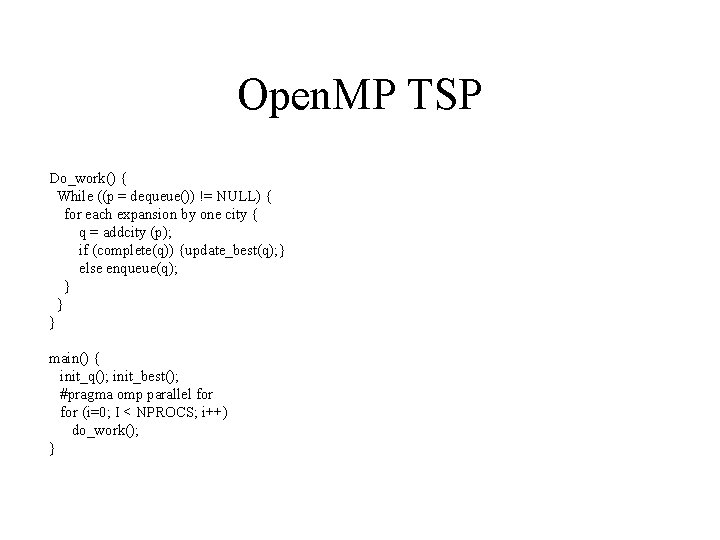
Open. MP TSP Do_work() { While ((p = dequeue()) != NULL) { for each expansion by one city { q = addcity (p); if (complete(q)) {update_best(q); } else enqueue(q); } } } main() { init_q(); init_best(); #pragma omp parallel for (i=0; I < NPROCS; i++) do_work(); }

Sequential SOR • Open. MP version?

• Summary: – Open. MP provides a compact, yet powerful programming model for shared memory programming • It is very easy to use Open. MP to create parallel programs. – Open. MP preserves the sequential version of the program – Developing an Open. MP program: • Start from a sequential program • Identify the code segment that takes most of the time. • Determine whether the important loops can be parallelized – The loops may have critical sections, reduction variables, etc • Determine the shared and private variables. • Add directives

Open. MP discussion • Ease of use – Open. MP takes cares of the thread maintenance. • Big improvement over pthread. – Synchronization • Much higher constructs (critical section, barrier). • Big improvement over pthread. • Open. MP is easy to use!!

Open. MP discussion • Expressiveness – Data parallelism: • MM and SOR • Fits nicely in the paradigm – Task parallelism: • TSP • Somewhat awkward. Use Open. MP constructs to create threads. Open. MP is not much different from pthread.

Open. MP discussion • Exposing architecture features (performance): – Not much, similar to the pthread approach • Assumption: dividing job into threads = improved performance. • How valid is this assumption in reality? – Overheads, contentions, synchronizations, etc – This is one weak point for Open. MP: the performance of an Open. MP program is somewhat hard to understand.
Open. MP final thoughts • Main issues with Open. MP: performance – Is there any obvious way to solve this? • Exposing more architecture features? – Is the performance issue more related to the fundamantal way that we write parallel program? • Open. MP programs begin with sequential programs. • May need to find a new way to write efficient parallel programs in order to really solve the problem.
- Slides: 34