
Introduction to OFDM and the IEEE 802 11

![OFDM Mathematics t º [ 0, Tos] Orthogonality Condition In our case For p](https://slidetodoc.com/presentation_image_h/822aa5cb9ea0698ec106222399c7c6c5/image-7.jpg "OFDM Mathematics t º [ 0, Tos] Orthogonality Condition In our case For p")
![OFDM Signal t º [ 0, Tos] Otherwise K=0, . . N-1 11](https://slidetodoc.com/presentation_image_h/822aa5cb9ea0698ec106222399c7c6c5/image-11.jpg "OFDM Signal t º [ 0, Tos] Otherwise K=0, . . N-1 11")
- Slides: 34
Introduction to OFDM and the IEEE 802. 11 a Standard 1
Motivation • High bit-rate wireless applications in a multipath radio environment. • OFDM can enable such applications without a high complexity receiver. • OFDM is part of WLAN, DVB, and BWA standards and is a strong candidate for some of the 4 G wireless technologies. 2
Multipath Transmission • Fading due to constructive and destructive addition of multipath signals. • Channel delay spread can cause ISI. • Flat fading occurs when the symbol period is large compared to the delay spread. • Frequency selective fading and ISI go together. 3
Delay Spread • Power delay profile conveys the multipath delay spread effects of the channel. • RMS delay spread quantifies the severity of the ISI phenomenon. • The ratio of RMS delay spread to the data symbol period determines the severity of the ISI. 4
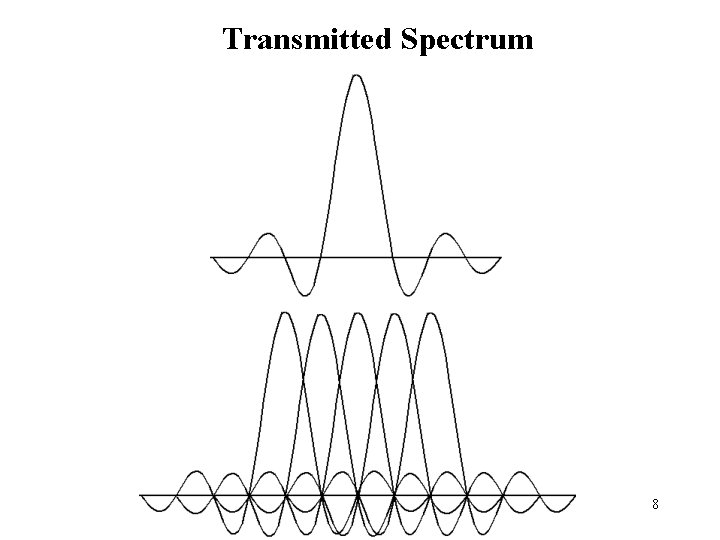
A Solution for ISI channels • Conversion of a high-data rate stream into several low-rate streams. • Parallel streams are modulated onto orthogonal carriers. • Data symbols modulated on these carriers can be recovered without mutual interference. • Overlap of the modulated carriers in the frequency domain different from FDM. 5
OFDM • OFDM is a multicarrier block transmission system. • Block of ‘N’ symbols are grouped and sent parallely. • No interference among the data symbols sent in a block. 6
OFDM Mathematics t º [ 0, Tos] Orthogonality Condition In our case For p ¹ q Where fk=k/T 7
Transmitted Spectrum 8
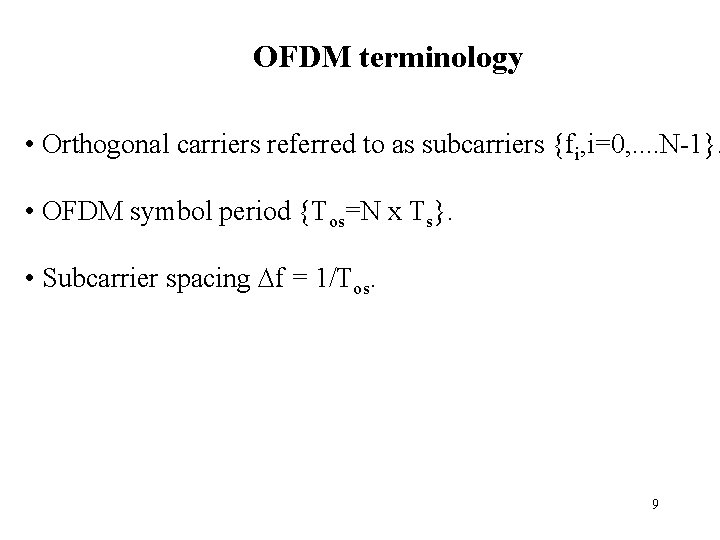
OFDM terminology • Orthogonal carriers referred to as subcarriers {fi, i=0, . . N-1}. • OFDM symbol period {Tos=N x Ts}. • Subcarrier spacing Df = 1/Tos. 9
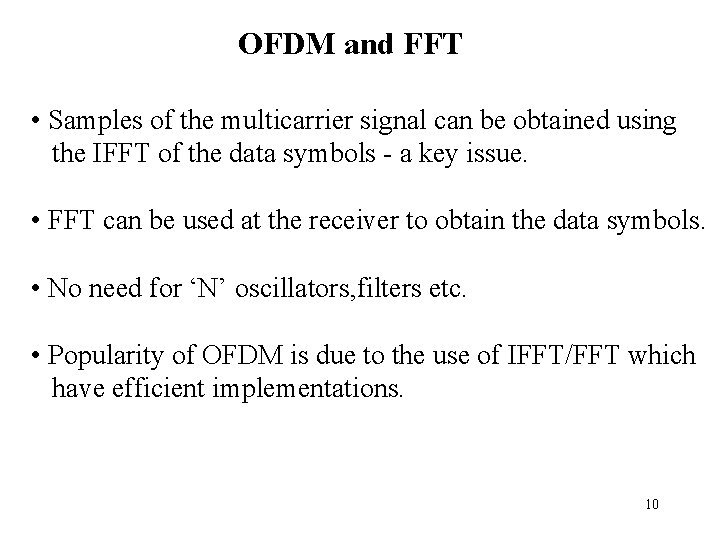
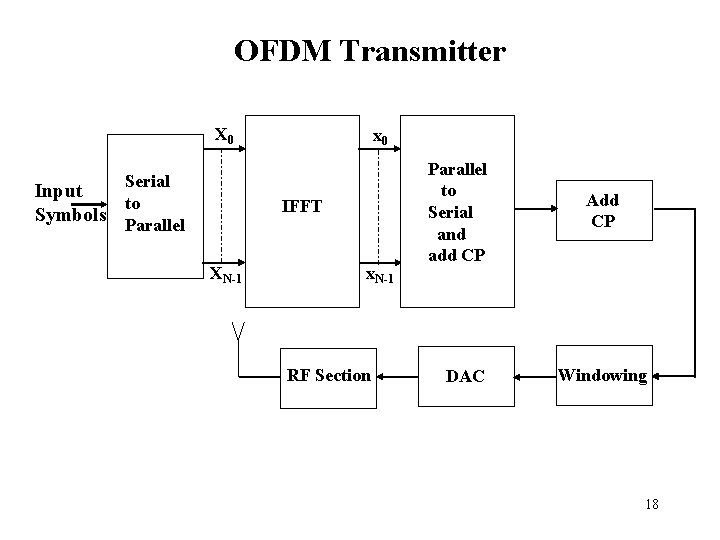
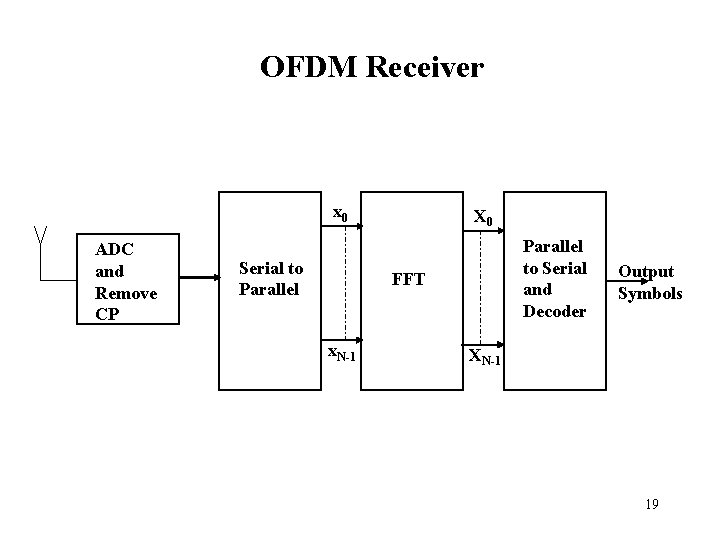
OFDM and FFT • Samples of the multicarrier signal can be obtained using the IFFT of the data symbols - a key issue. • FFT can be used at the receiver to obtain the data symbols. • No need for ‘N’ oscillators, filters etc. • Popularity of OFDM is due to the use of IFFT/FFT which have efficient implementations. 10
OFDM Signal t º [ 0, Tos] Otherwise K=0, . . N-1 11
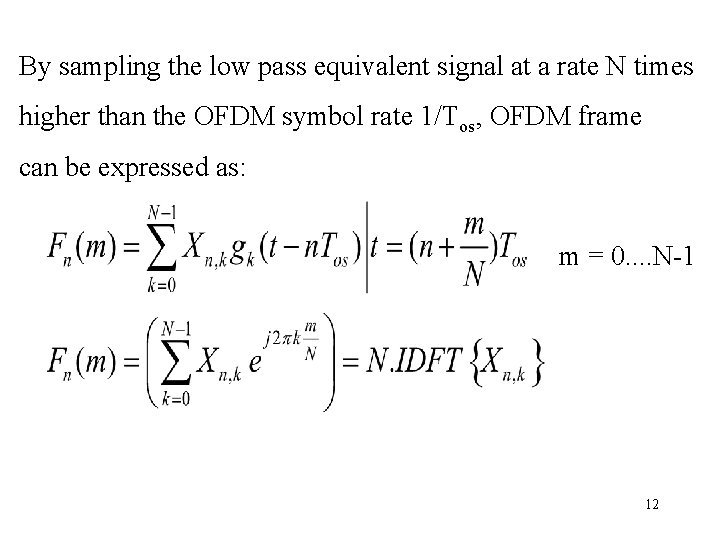
By sampling the low pass equivalent signal at a rate N times higher than the OFDM symbol rate 1/Tos, OFDM frame can be expressed as: m = 0. . N-1 12
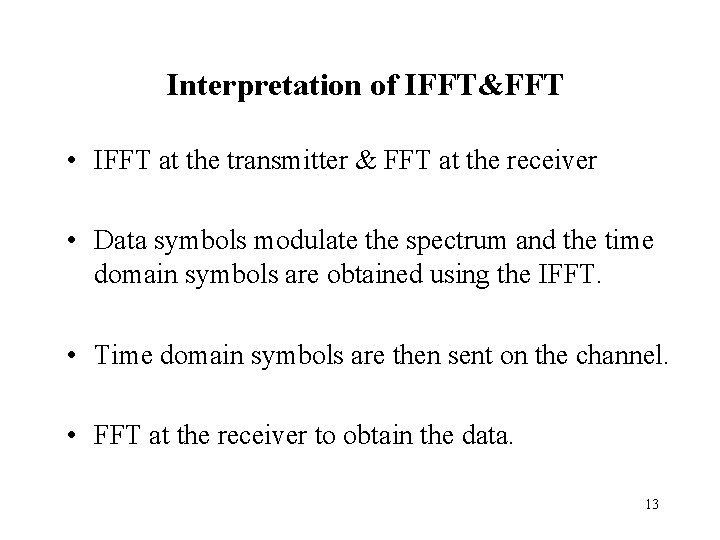
Interpretation of IFFT&FFT • IFFT at the transmitter & FFT at the receiver • Data symbols modulate the spectrum and the time domain symbols are obtained using the IFFT. • Time domain symbols are then sent on the channel. • FFT at the receiver to obtain the data. 13
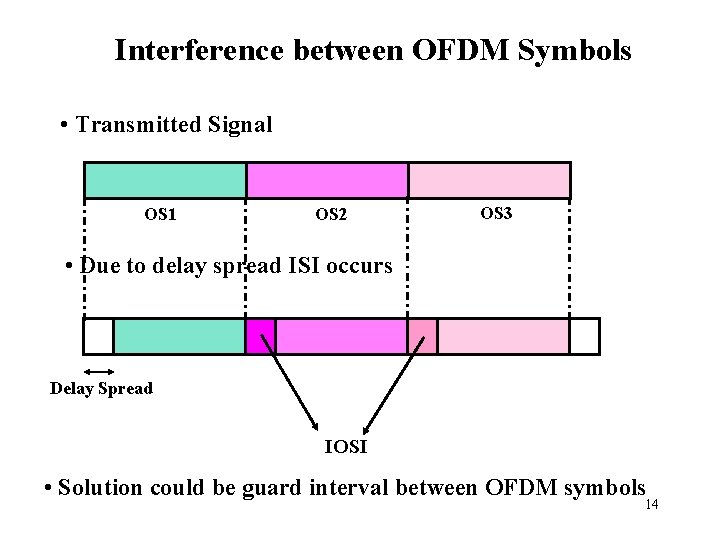
Interference between OFDM Symbols • Transmitted Signal OS 1 OS 2 OS 3 • Due to delay spread ISI occurs Delay Spread IOSI • Solution could be guard interval between OFDM symbols 14
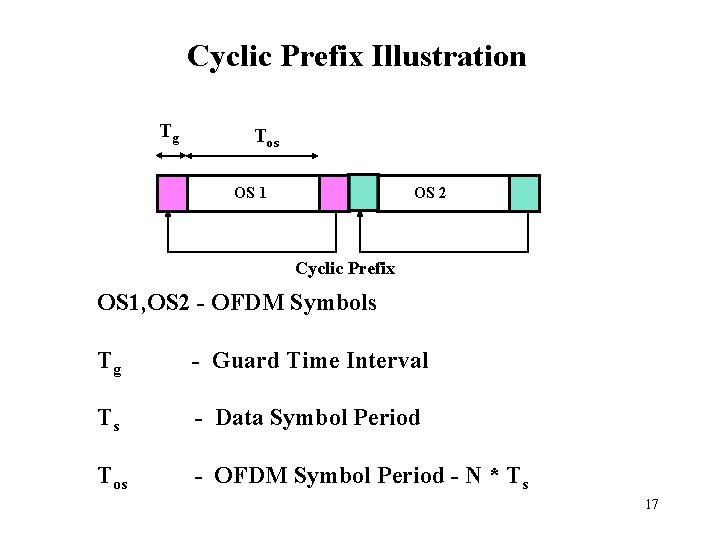
Cyclic Prefix • Zeros used in the guard time can alleviate interference between OFDM symbols (IOSI problem). • Orthogonality of carriers is lost when multipath channels are involved. • Cyclic prefix can restore the orthogonality. 15
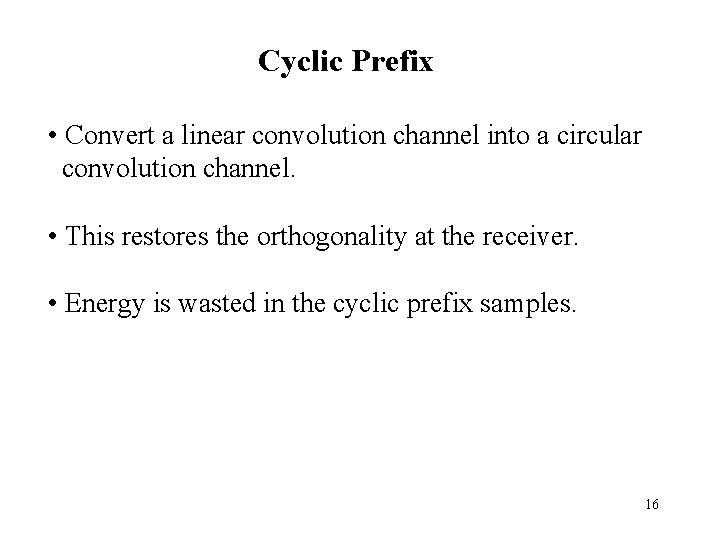
Cyclic Prefix • Convert a linear convolution channel into a circular convolution channel. • This restores the orthogonality at the receiver. • Energy is wasted in the cyclic prefix samples. 16
Cyclic Prefix Illustration Tg Tos OS 1 OS 2 Cyclic Prefix OS 1, OS 2 - OFDM Symbols Tg - Guard Time Interval Ts - Data Symbol Period Tos - OFDM Symbol Period - N * Ts 17
OFDM Transmitter X 0 Input Symbols Serial to Parallel x 0 IFFT XN-1 x. N-1 RF Section Parallel to Serial and add CP DAC Add CP Windowing 18
OFDM Receiver x 0 ADC and Remove CP Serial to Parallel X 0 Parallel to Serial and Decoder FFT x. N-1 Output Symbols XN-1 19
Synchronization • Timing and frequency offset can influence performance. • Frequency offset can influence orthogonality of subcarriers. • Loss of orthogonality leads to Inter Carrier Interference. 20
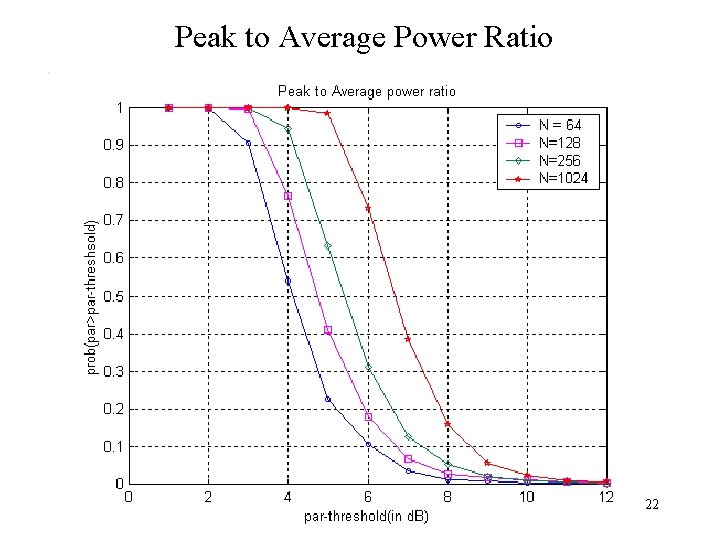
Peak to Average Ratio • Multicarrier signals have high PAR as compared to single carrier systems. • PAR increases with the number of subcarriers. • Affects power amplifier design and usage. 21
Peak to Average Power Ratio 22
The IEEE 802. 11 a Standard • Belongs to the IEEE 802. 11 system of specifications for wireless LANs. • 802. 11 covers both MAC and PHY layers. • Five different PHY layers. • 802. 11 a belongs to the High Speed WLAN category with peak data rate of 54 Mbps • PHY Layer very similar to ETSI’s HIPERLAN Type 2 23
Key Physical Layer Things • Use of OFDM for transmission. • Multiple data rate modes supported using modulation and coding/puncturing. 24
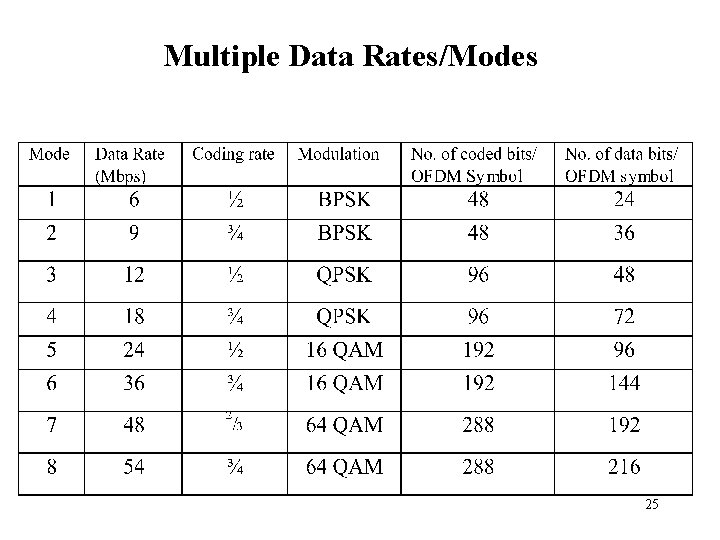
Multiple Data Rates/Modes 25
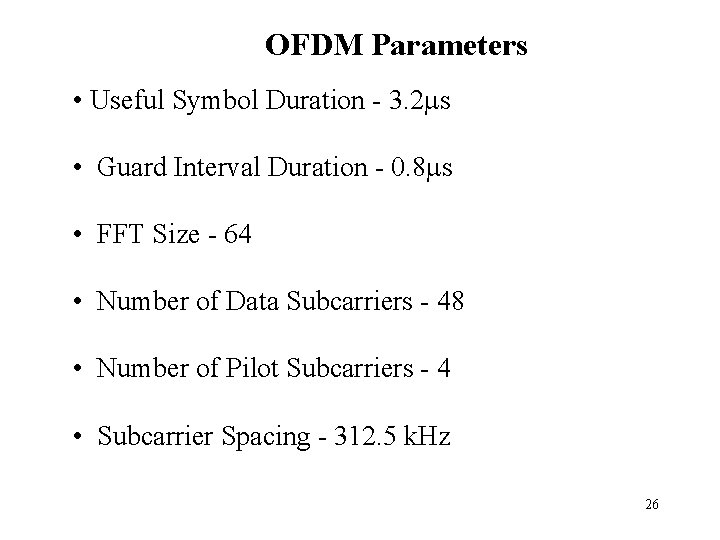
OFDM Parameters • Useful Symbol Duration - 3. 2 s • Guard Interval Duration - 0. 8 s • FFT Size - 64 • Number of Data Subcarriers - 48 • Number of Pilot Subcarriers - 4 • Subcarrier Spacing - 312. 5 k. Hz 26
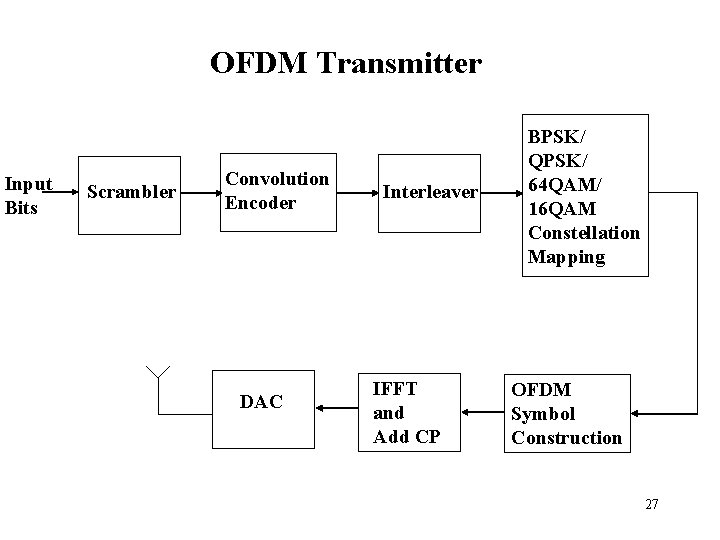
OFDM Transmitter Input Bits Scrambler Convolution Encoder DAC Interleaver IFFT and Add CP BPSK/ QPSK/ 64 QAM/ 16 QAM Constellation Mapping OFDM Symbol Construction 27
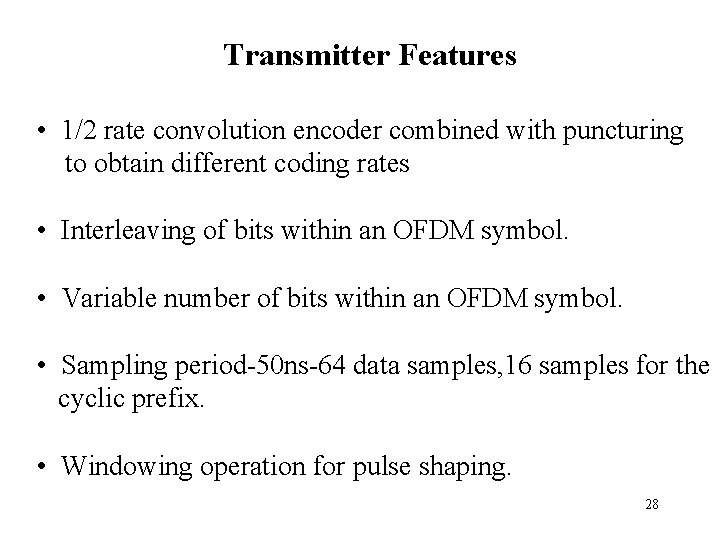
Transmitter Features • 1/2 rate convolution encoder combined with puncturing to obtain different coding rates • Interleaving of bits within an OFDM symbol. • Variable number of bits within an OFDM symbol. • Sampling period-50 ns-64 data samples, 16 samples for the cyclic prefix. • Windowing operation for pulse shaping. 28
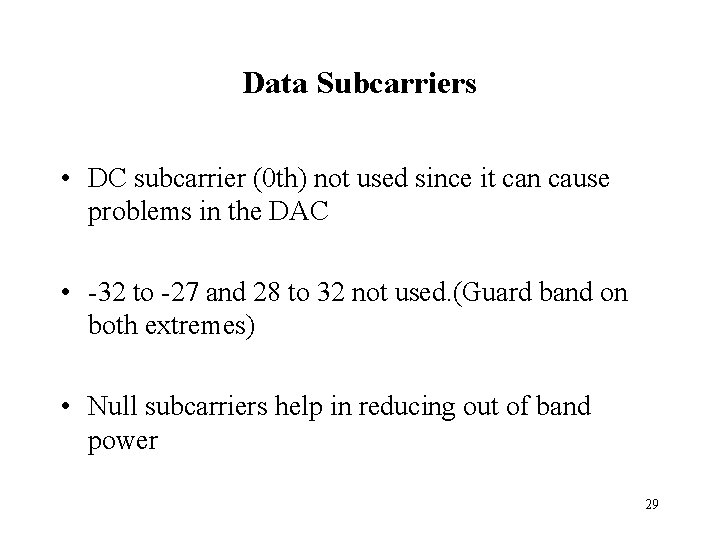
Data Subcarriers • DC subcarrier (0 th) not used since it can cause problems in the DAC • -32 to -27 and 28 to 32 not used. (Guard band on both extremes) • Null subcarriers help in reducing out of band power 29
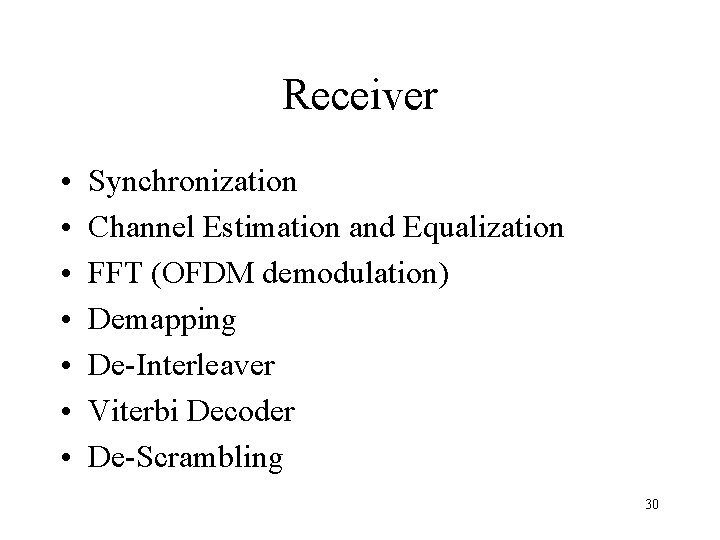
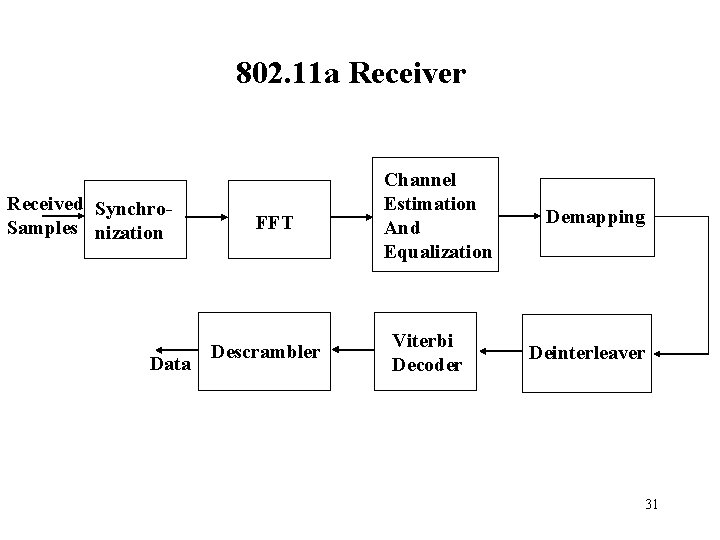
Receiver • • Synchronization Channel Estimation and Equalization FFT (OFDM demodulation) Demapping De-Interleaver Viterbi Decoder De-Scrambling 30
802. 11 a Receiver Received Synchro. Samples nization Data FFT Descrambler Channel Estimation And Equalization Viterbi Decoder Demapping Deinterleaver 31
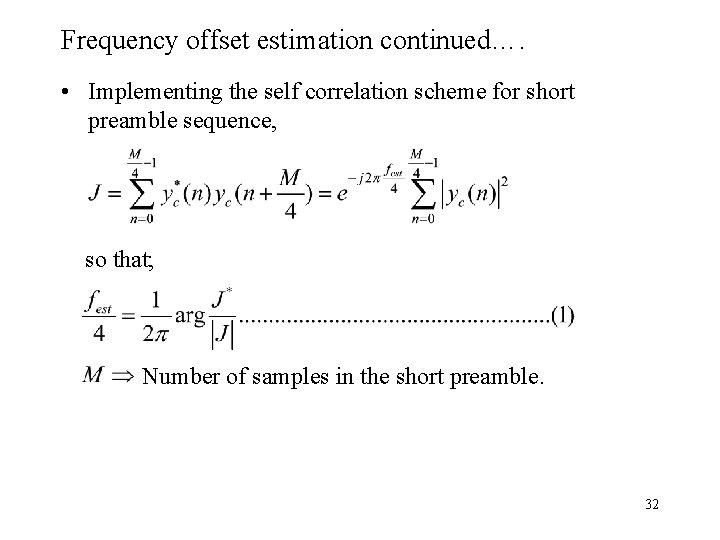
Frequency offset estimation continued…. • Implementing the self correlation scheme for short preamble sequence, so that; Number of samples in the short preamble. 32
33
34