
Introduction to Observational Physical Oceanography 12 808 Class
Introduction to Observational Physical Oceanography 12. 808 Class 5, 24 September, 2009 1: 05 to 2: 25 these slides are online at www. whoi. edu/science/PO/people/jprice/class/miscart/Class 5 -24 Sep 09. ppt
Class 5 • temperature • salinity • pressure • density; the equation of state • potential temperature and potential density last class • static stability (later) • T/S diagrams • water types and masses today
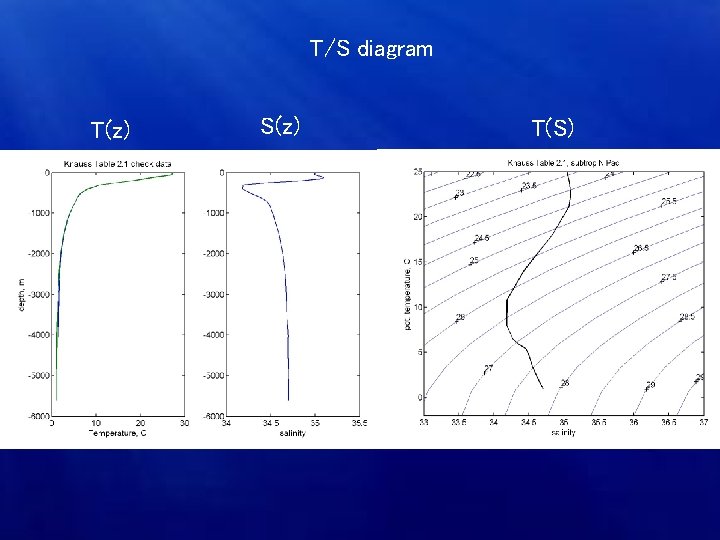
T/S diagram T(z) S(z) T(S)
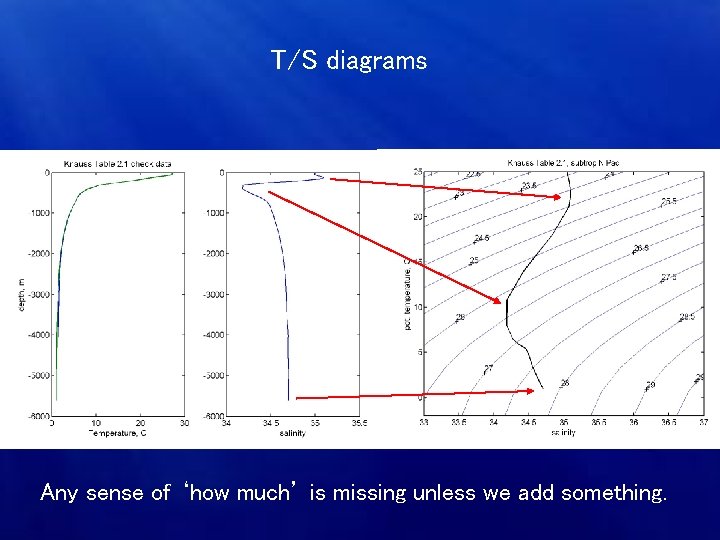
T/S diagrams Any sense of ‘how much’ is missing unless we add something.
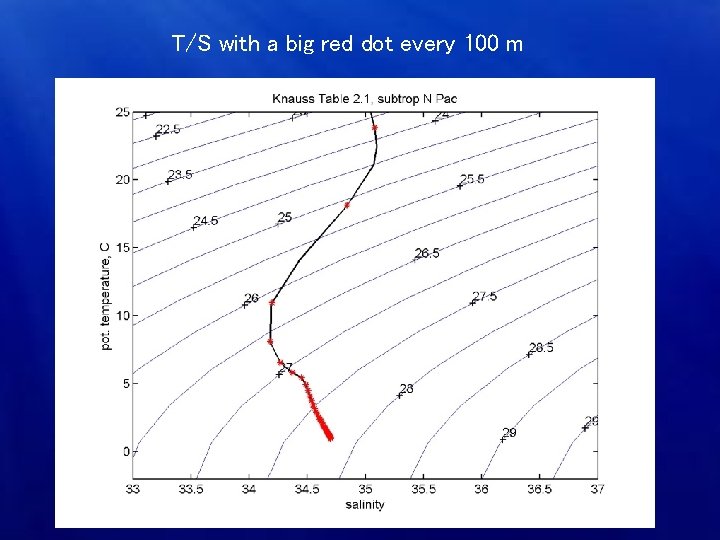
T/S with a big red dot every 100 m
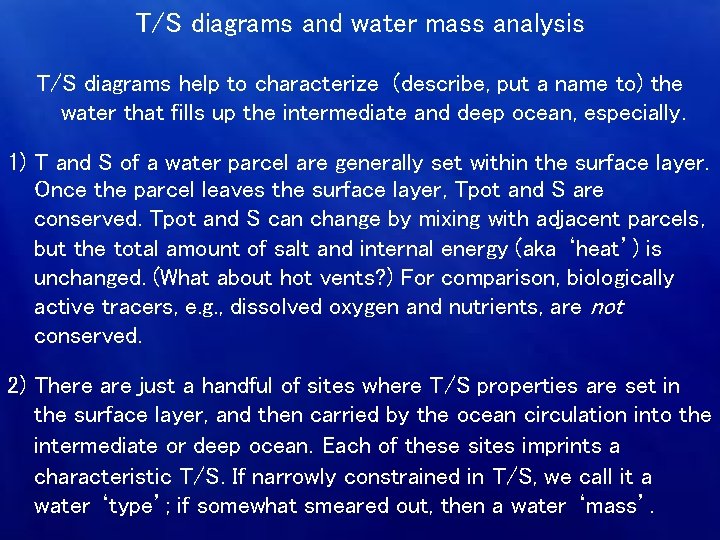
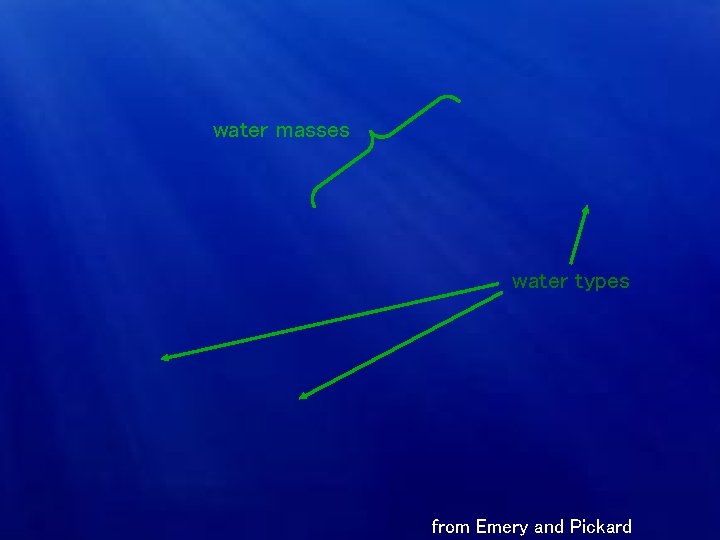
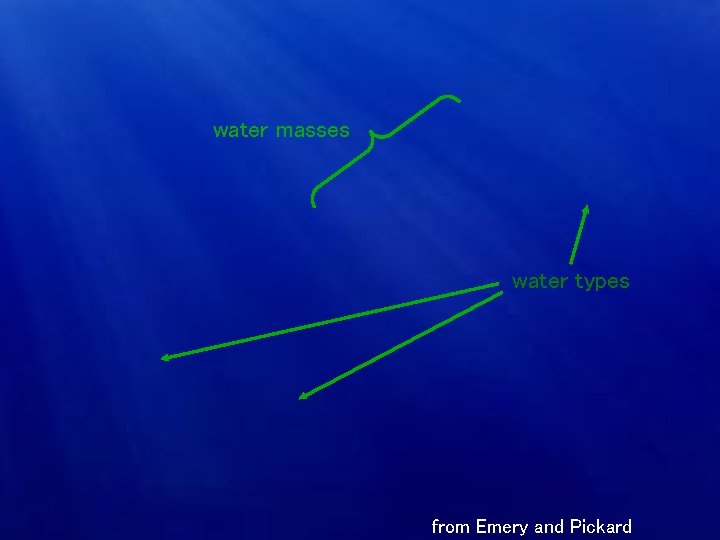
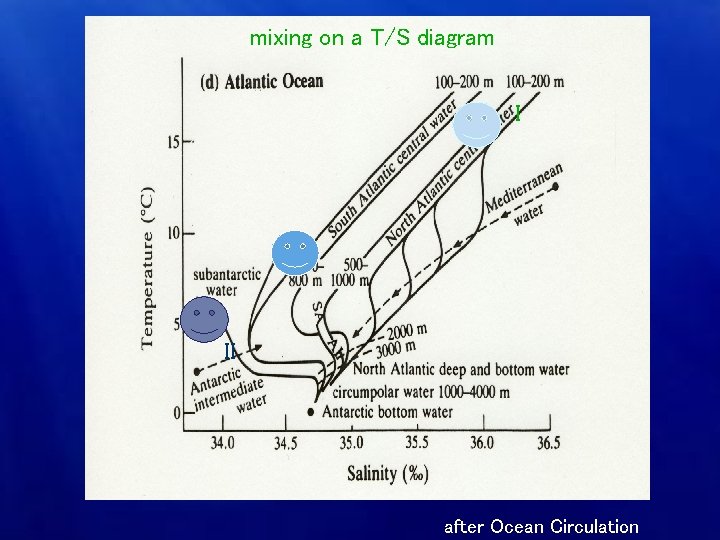
T/S diagrams and water mass analysis T/S diagrams help to characterize (describe, put a name to) the water that fills up the intermediate and deep ocean, especially. 1) T and S of a water parcel are generally set within the surface layer. Once the parcel leaves the surface layer, Tpot and S are conserved. Tpot and S can change by mixing with adjacent parcels, but the total amount of salt and internal energy (aka ‘heat’) is unchanged. (What about hot vents? ) For comparison, biologically active tracers, e. g. , dissolved oxygen and nutrients, are not conserved. 2) There are just a handful of sites where T/S properties are set in the surface layer, and then carried by the ocean circulation into the intermediate or deep ocean. Each of these sites imprints a characteristic T/S. If narrowly constrained in T/S, we call it a water ‘type’; if somewhat smeared out, then a water ‘mass’.
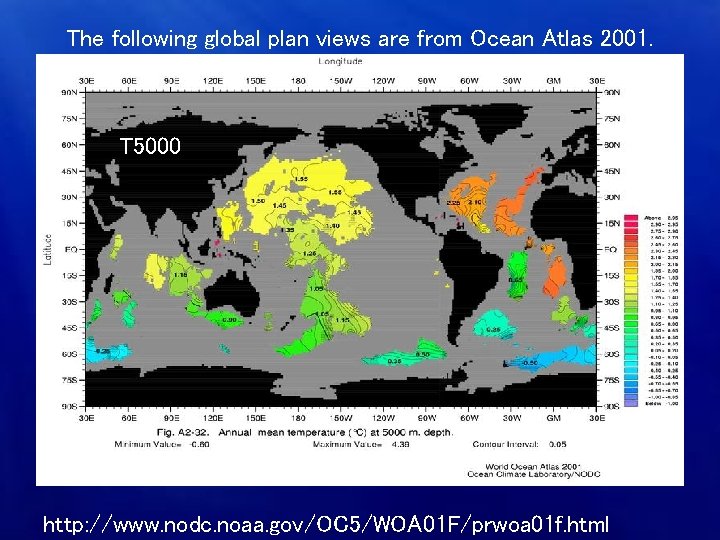
The following global plan views are from Ocean Atlas 2001. T 5000 http: //www. nodc. noaa. gov/OC 5/WOA 01 F/prwoa 01 f. html
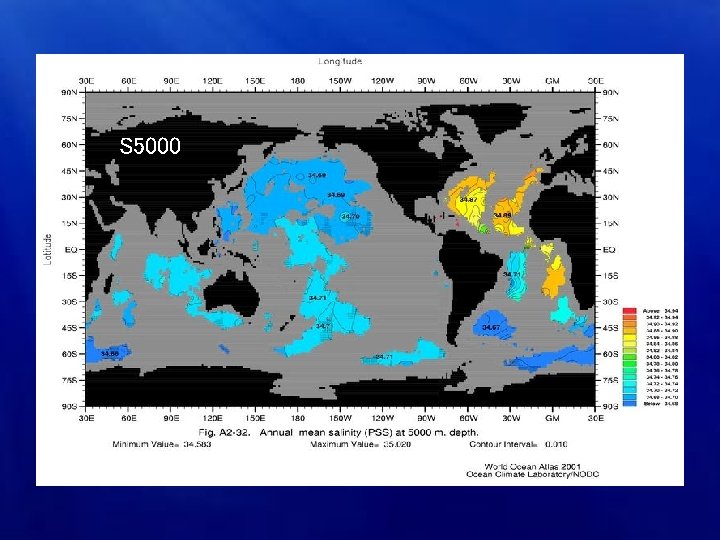
S 5000
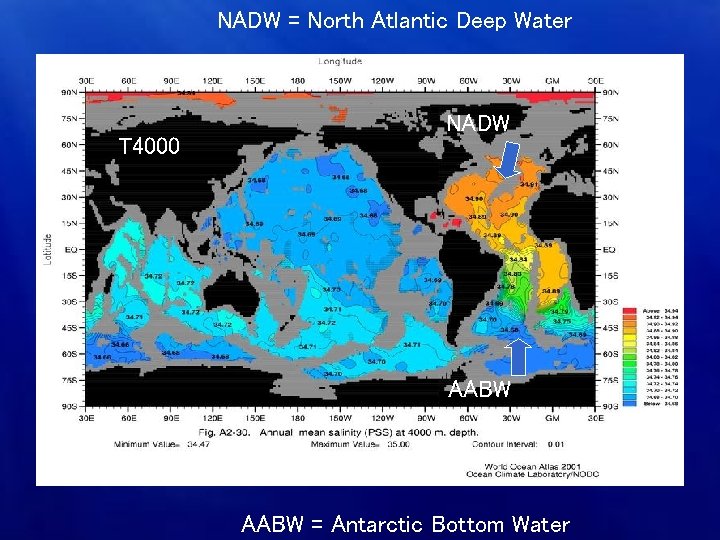
NADW = North Atlantic Deep Water T 4000 NADW AABW = Antarctic Bottom Water
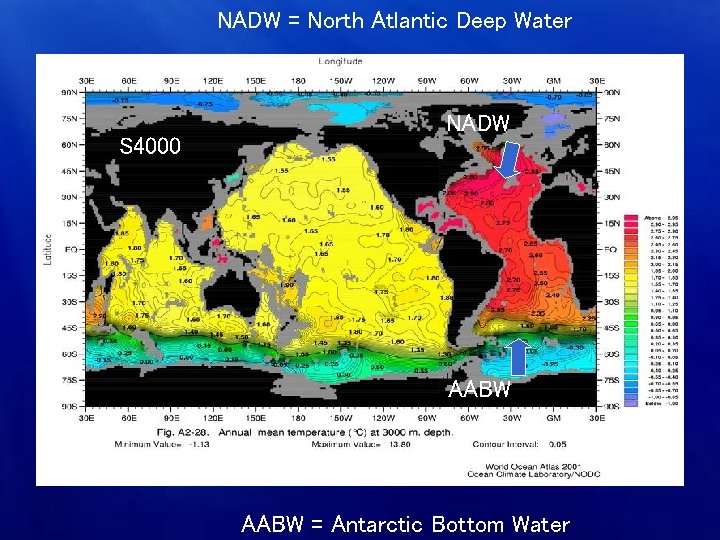
NADW = North Atlantic Deep Water S 4000 NADW AABW = Antarctic Bottom Water

NADW AABW NADW
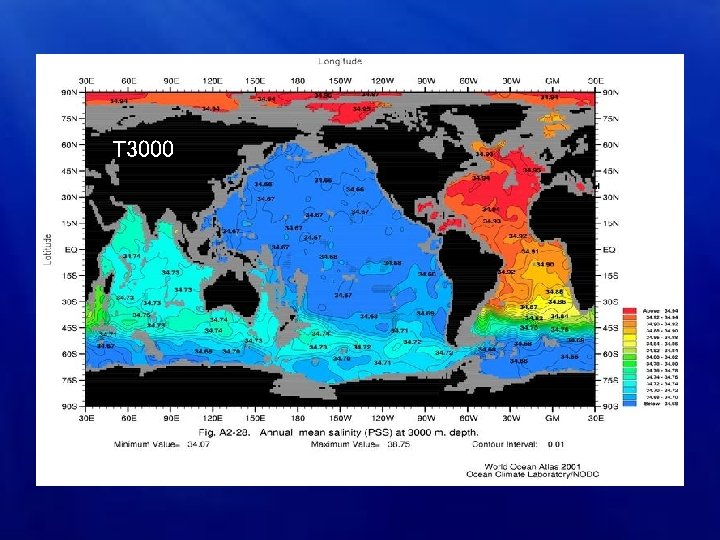
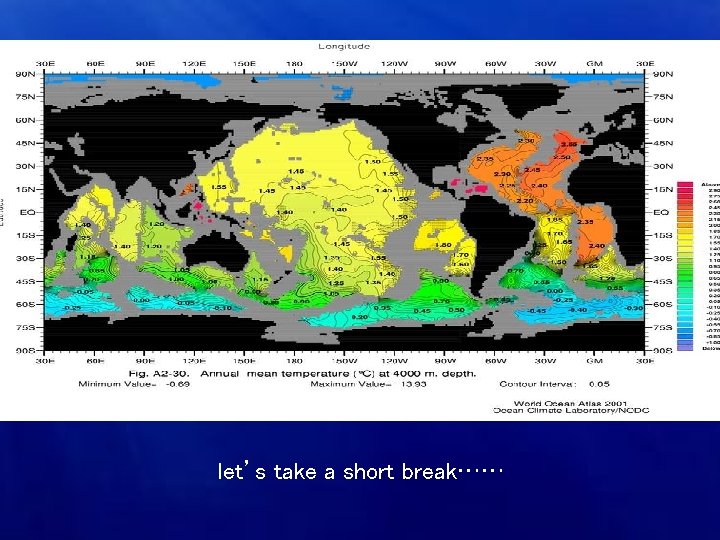
T 3000
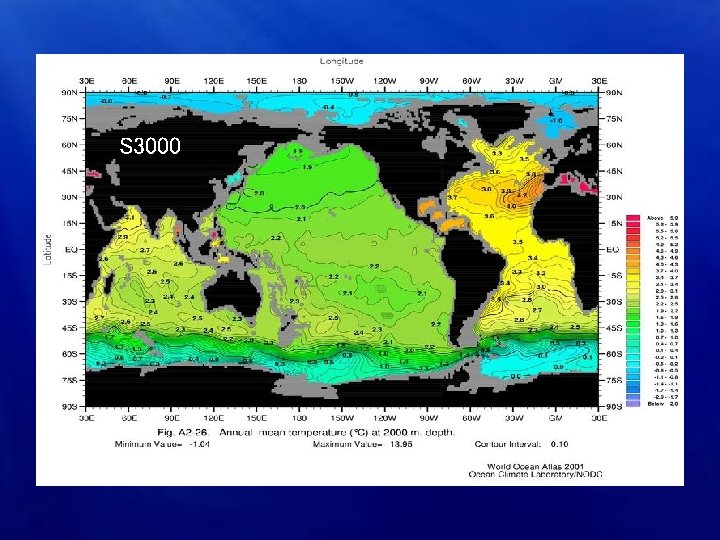
S 3000
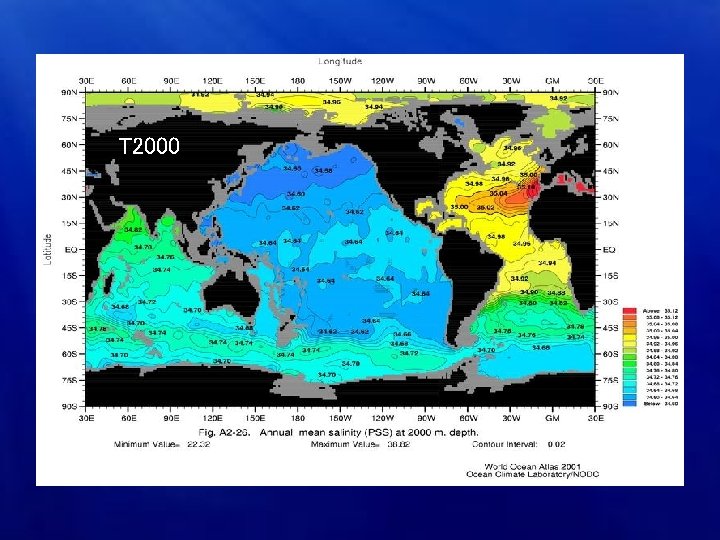
T 2000
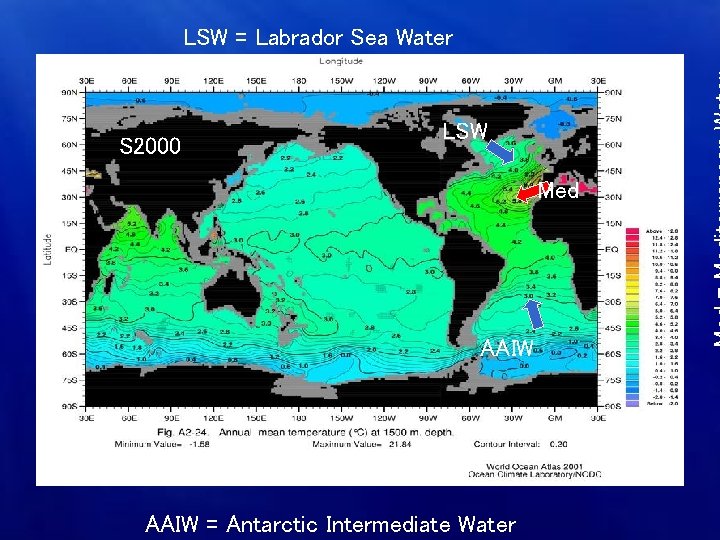
LSW = Labrador Sea Water S 2000 LSW Med AAIW = Antarctic Intermediate Water
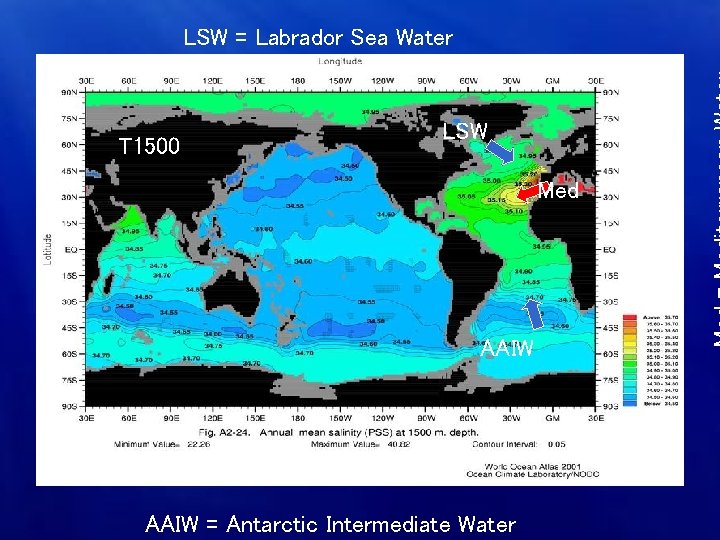
LSW = Labrador Sea Water T 1500 LSW Med AAIW = Antarctic Intermediate Water
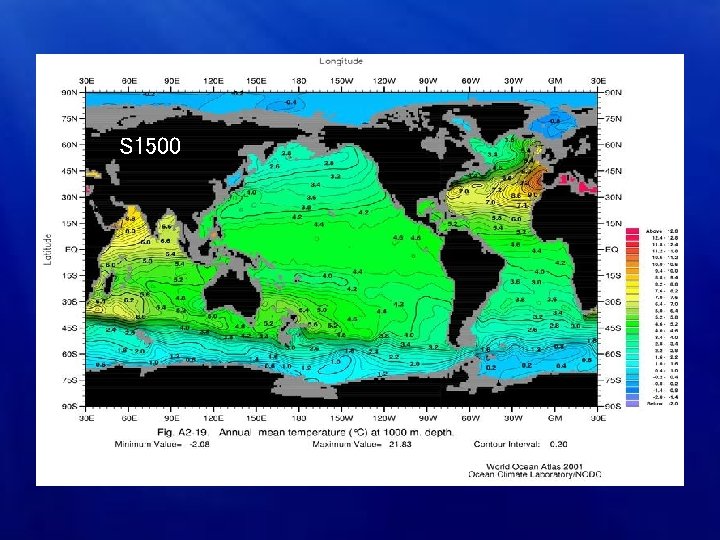
S 1500
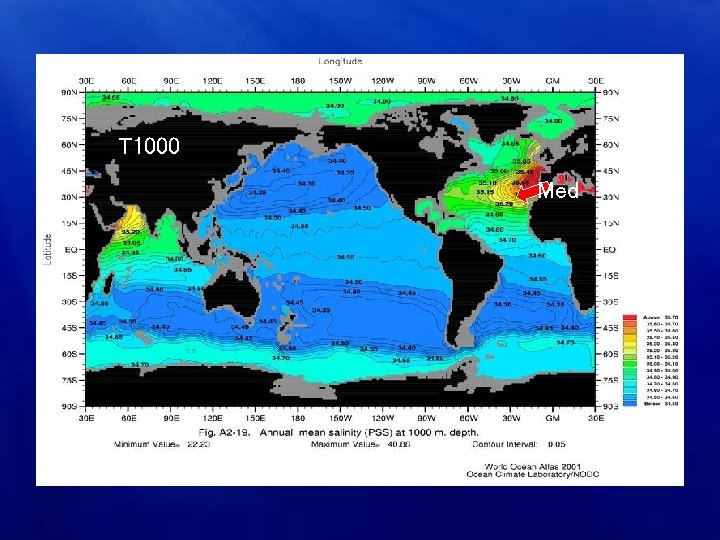
T 1000 Med
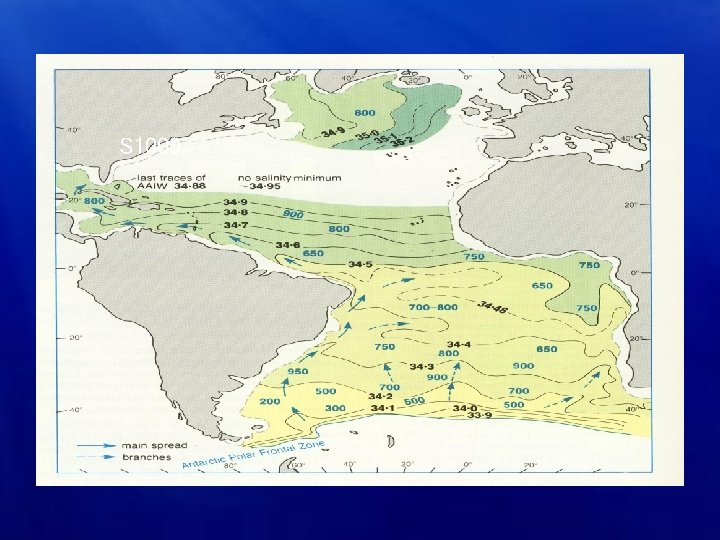
S 1000
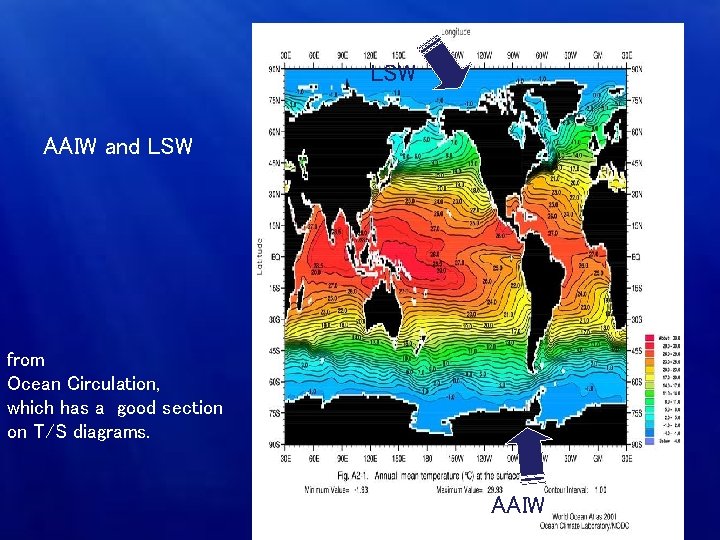
LSW AAIW and LSW from Ocean Circulation, which has a good section on T/S diagrams. AAIW
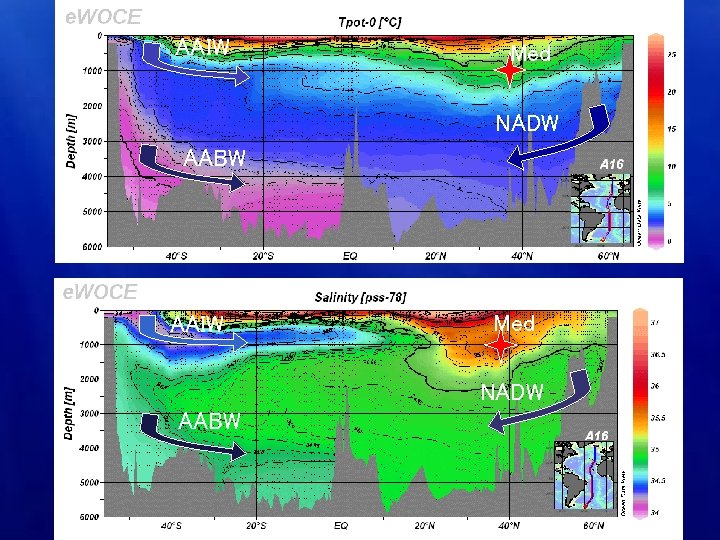
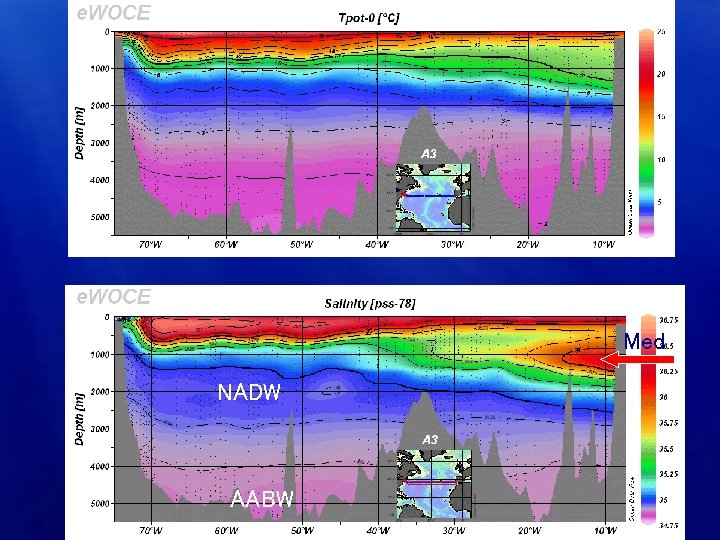
AAIW Med NADW AABW
Med NADW AABW
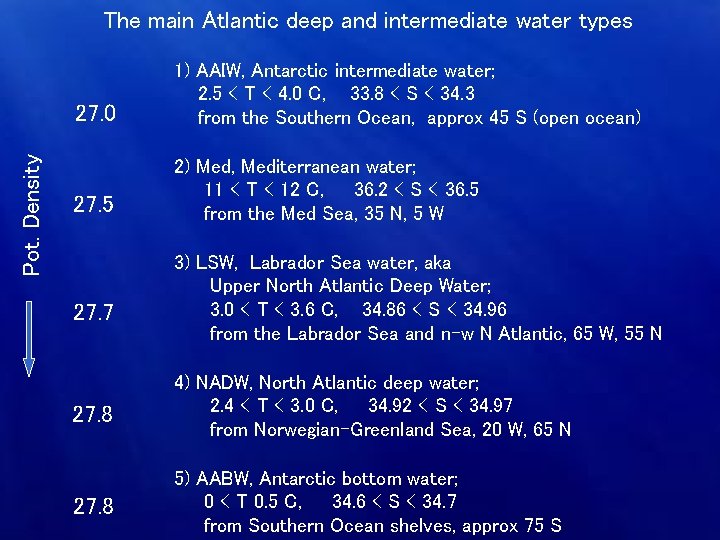
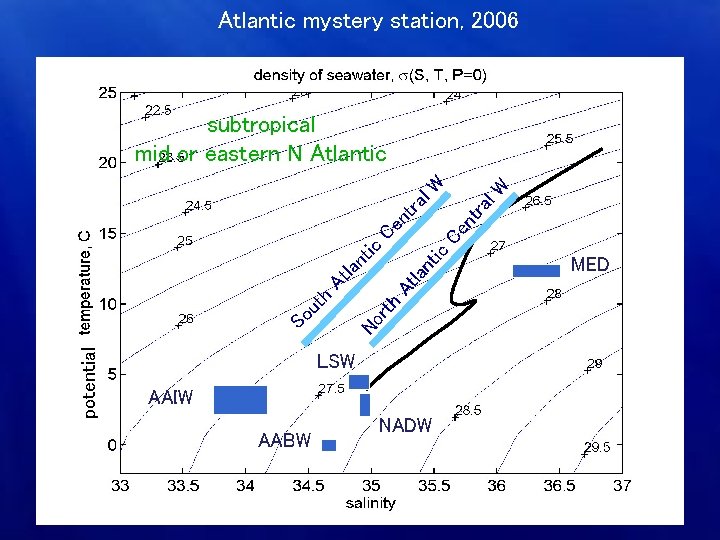
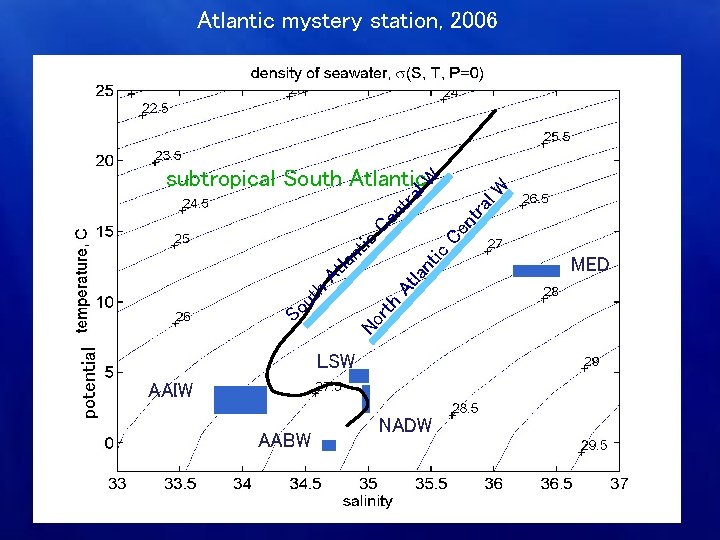
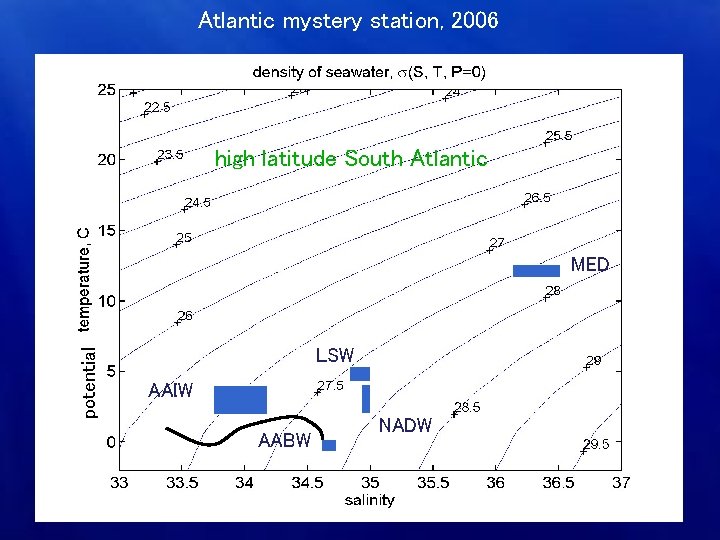
Pot. Density The main Atlantic deep and intermediate water types 27. 0 1) AAIW, Antarctic intermediate water; 2. 5 < T < 4. 0 C, 33. 8 < S < 34. 3 from the Southern Ocean, approx 45 S (open ocean) 27. 5 2) Med, Mediterranean water; 11 < T < 12 C, 36. 2 < S < 36. 5 from the Med Sea, 35 N, 5 W 27. 7 3) LSW, Labrador Sea water, aka Upper North Atlantic Deep Water; 3. 0 < T < 3. 6 C, 34. 86 < S < 34. 96 from the Labrador Sea and n-w N Atlantic, 65 W, 55 N 27. 8 4) NADW, North Atlantic deep water; 2. 4 < T < 3. 0 C, 34. 92 < S < 34. 97 from Norwegian-Greenland Sea, 20 W, 65 N 27. 8 5) AABW, Antarctic bottom water; 0 < T 0. 5 C, 34. 6 < S < 34. 7 from Southern Ocean shelves, approx 75 S
The sea surface and thermocline have a geographically distinctive T/S structure as well, but the T/S values are distributed over a broad range:
water masses water types from Emery and Pickard
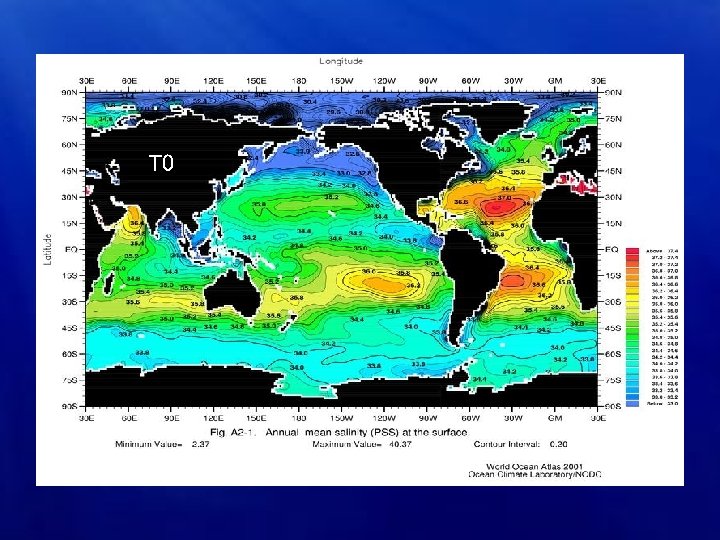
T 0
S 0
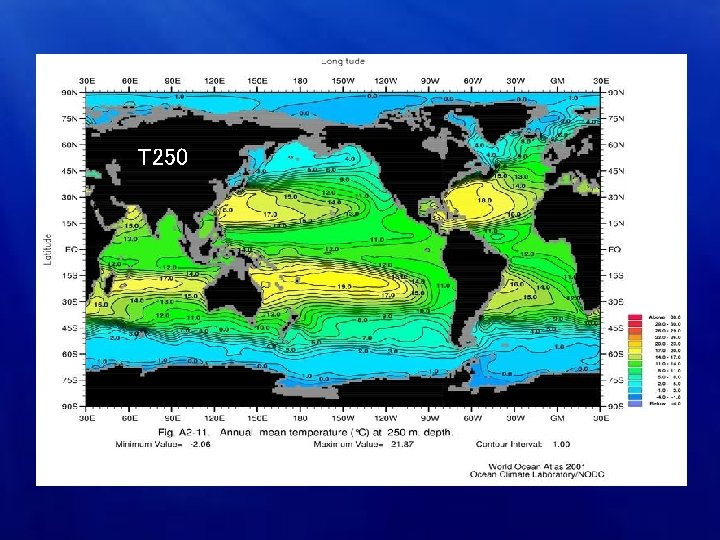
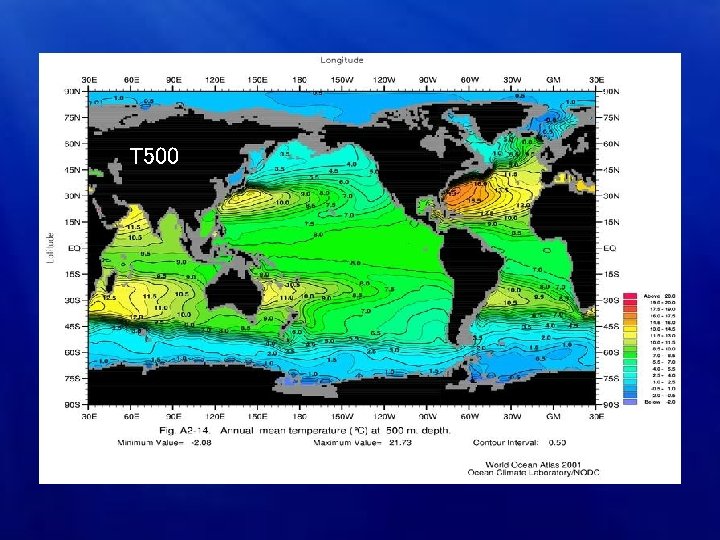
T 250
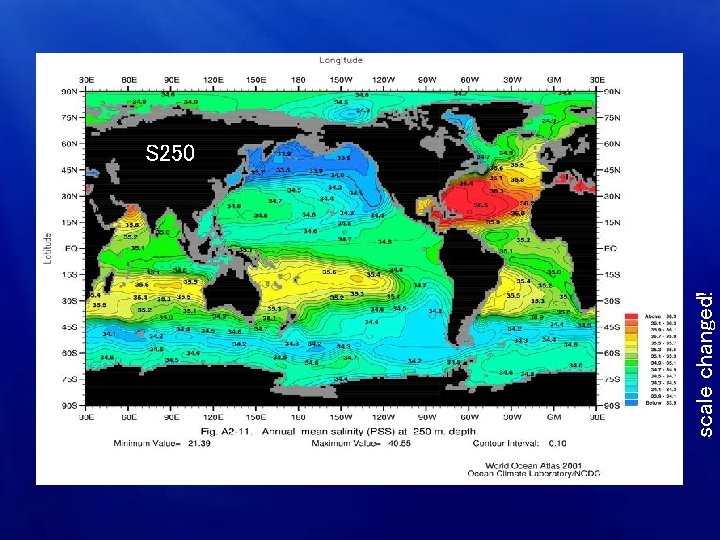
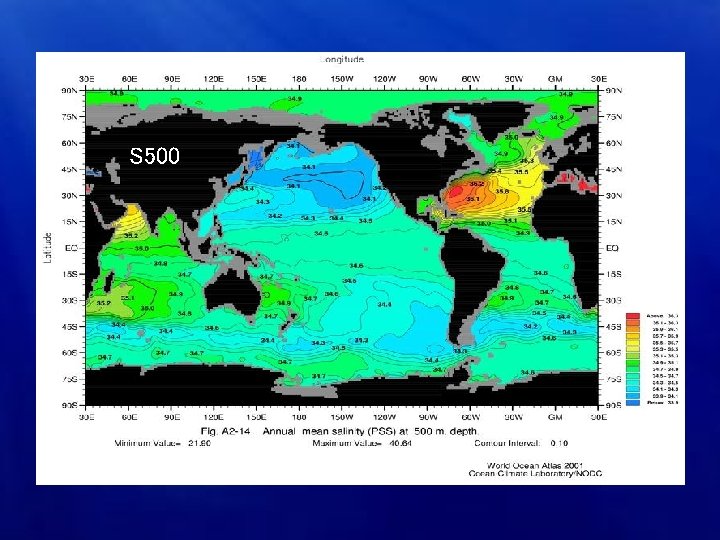
scale changed! S 250
T 500
S 500
water masses water types from Emery and Pickard
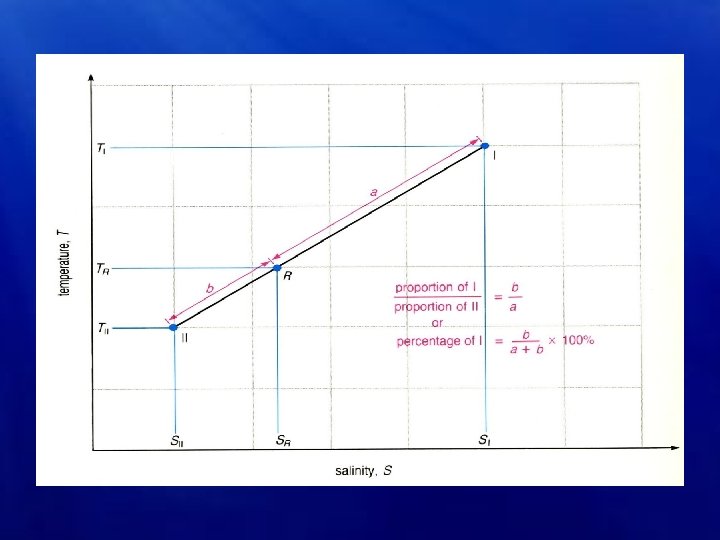
mixing on a T/S diagram I II after Ocean Circulation
Atlantic mystery station, 2006 potential LSW AAIW AABW l. W ra nt Ce tic lan At rth No So ut h At lan tic Ce nt ra l. W subtropical mid or eastern N Atlantic NADW MED
Atlantic mystery station, 2006 potential LSW AAIW AABW ra nt Ce lan At rth No So ut h At lan tic Ce nt ra l. W subtropical South Atlantic NADW MED
Atlantic mystery station, 2006 high latitude South Atlantic potential high latitude South Atlantic LSW AAIW AABW NADW MED
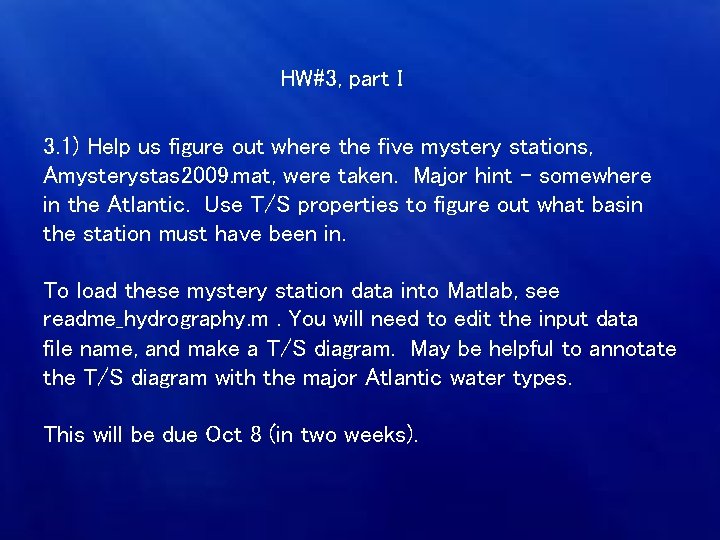
HW#3, part I 3. 1) Help us figure out where the five mystery stations, Amysterystas 2009. mat, were taken. Major hint – somewhere in the Atlantic. Use T/S properties to figure out what basin the station must have been in. To load these mystery station data into Matlab, see readme_hydrography. m. You will need to edit the input data file name, and make a T/S diagram. May be helpful to annotate the T/S diagram with the major Atlantic water types. This will be due Oct 8 (in two weeks).
let’s take a short break……

open Levitus_quiz
the end of class 4
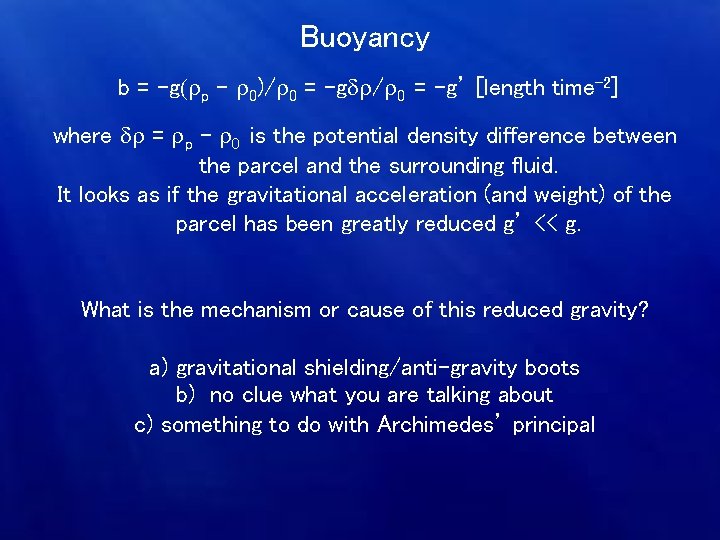
Buoyancy b = -g(rp – r 0)/r 0 = -gdr/r 0 = -g’ [length time-2] where dr = rp – r 0 is the potential density difference between the parcel and the surrounding fluid. It looks as if the gravitational acceleration (and weight) of the parcel has been greatly reduced g’ << g. What is the mechanism or cause of this reduced gravity? a) gravitational shielding/anti-gravity boots b) no clue what you are talking about c) something to do with Archimedes’ principal
![Buoyancy an acceleration, b = -gdr/r 0 [length time-2] where dr = rp –](http://slidetodoc.com/presentation_image/5b3290f10c138cd1e0239bc98d848a07/image-42.jpg "Buoyancy an acceleration, b = -gdr/r 0 [length time-2] where dr = rp –")
Buoyancy an acceleration, b = -gdr/r 0 [length time-2] where dr = rp – r 0 is the potential density difference between the parcel and the surrounding fluid. The surrounding fluid is assumed at rest, of density r 0, and the pressure P is hydrostatic. ez Area = A ey n 1 ex z = -d r = rp r = r 0 z = - (d + h) n 2 h
![Buoyancy an acceleration, b = -gdr/r 0 [length time-2] where dr = rp –](http://slidetodoc.com/presentation_image/5b3290f10c138cd1e0239bc98d848a07/image-43.jpg "Buoyancy an acceleration, b = -gdr/r 0 [length time-2] where dr = rp –")
Buoyancy an acceleration, b = -gdr/r 0 [length time-2] where dr = rp – r 0 is the potential density difference with respect to the surrounding fluid. ez ey ex r = r 0 d+h sea surface d P 1 = g r 0 d Area = A n 1 z = -d r = rp z = - (d + h) P 2 = g r 0 (d + h) n 2 h
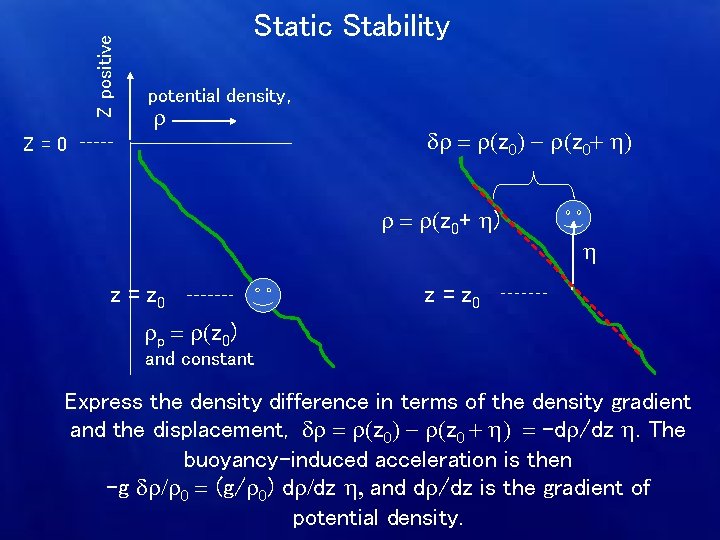
Z positive Static Stability potential density, r Z=0 dr = r(z 0) - r(z 0+ h) r = r(z 0+ h) z = z 0 h z = z 0 rp = r(z 0) and constant Express the density difference in terms of the density gradient and the displacement, dr = r(z 0) - r(z 0 + h) = -dr/dz h. The buoyancy-induced acceleration is then -g dr/r 0 = (g/r 0) dr/dz h, and dr/dz is the gradient of potential density.
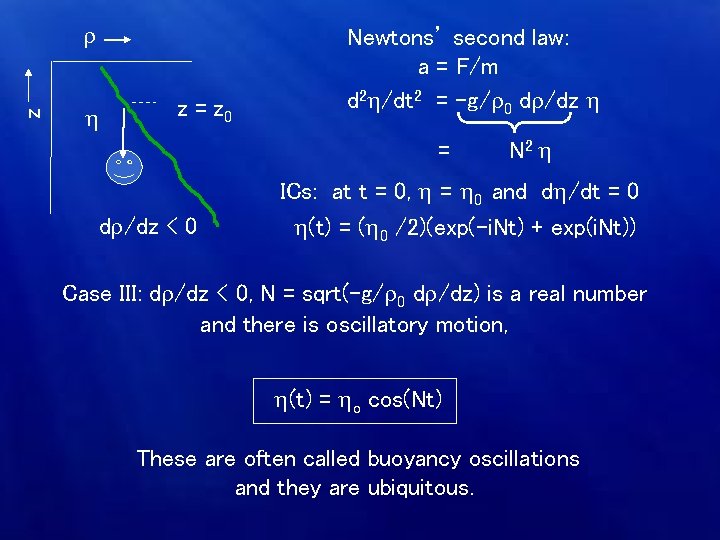
z r h z = z 0 Newtons’ second law: a = F/m d 2 h/dt 2 = -g/r 0 dr/dz h = dr/dz < 0 N 2 h ICs: at t = 0, h = h 0 and dh/dt = 0 h(t) = (h 0 /2)(exp(-i. Nt) + exp(i. Nt)) Case III: dr/dz < 0, N = sqrt(-g/r 0 dr/dz) is a real number and there is oscillatory motion, h(t) = ho cos(Nt) These are often called buoyancy oscillations and they are ubiquitous.
- Slides: 45