
Introduction to Object Identifiers OIDs France Telecom Orange
Introduction to Object Identifiers (OIDs) France Telecom Orange Olivier Dubuisson 15 June 2009
Many Approaches to Object Identification – – – – 2 Bar codes EPCs IP addresses OIDs URLs URNs UUIDs etc. § Some are character-based, some are binary § Some need central allocation, others have various levels of hierarchy § Some are fixed length, others are variable length
Basic Concepts of Object Identifiers (OIDs) 3 § One of many identification schemes § Basically very simple: A tree § Arcs are numbered and may have an associated alphanumeric identifier (beginning with a lowercase) § Infinitely many arcs from each node (except at the root) § Objects are identified by the path (OID) from the root to a node § A Registration Authority (RA) allocates arcs beneath its node to subordinate RAs, and so on, to an infinite depth § The OID tree is a hierarchical structure of RAs § Standardized in the ITU-T X. 660 | ISO/IEC 9834 series (ITU-T SG 17 and ISO/IEC JTC 1/SC 6) § Originated in 1985, still in use!
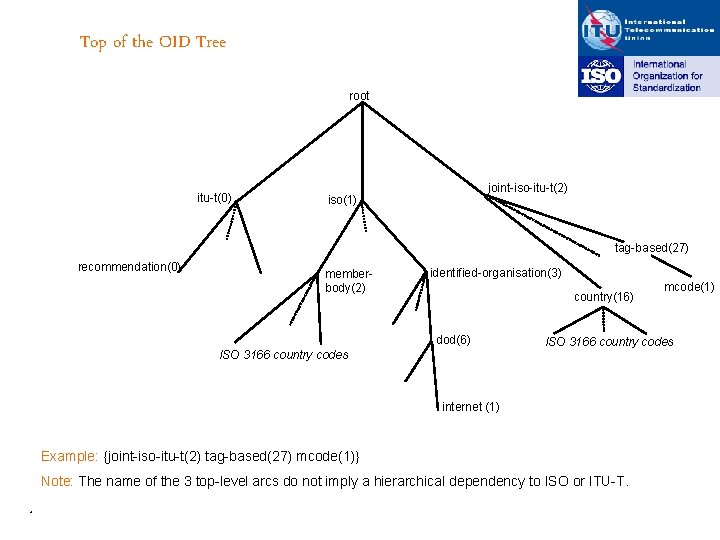
Top of the OID Tree root itu-t(0) joint-iso-itu-t(2) iso(1) tag-based(27) recommendation(0) memberbody(2) identified-organisation(3) country(16) dod(6) ISO 3166 country codes internet (1) Example: {joint-iso-itu-t(2) tag-based(27) mcode(1)} Note: The name of the 3 top-level arcs do not imply a hierarchical dependency to ISO or ITU-T. 4 mcode(1)
What is an "Object"? § "Anything in some world, generally the world of telecommunications and information processing or some part thereof, which is identifiable and may be registered" [Rec. ITU-T X. 660 | ISO/IEC 9834 -1] § OIDs can uniquely and universally identify: – – – § 5 standards (ITU-T Recommendations, ISO International Standards, etc. ) countries, companies, projects certification policies encryption algorithms ASN. 1 modules, ASN. 1 types X. 500/LDAP attributes X. 509 certificates (OIDs are widely deployed in e-commerce) SNMP MIBs ID schemes (incl. RFID, 2 D bar codes, etc. ) HL 7 patient medical information etc. More information at http: //www. oid-info. com/faq. htm
Some Advantages § Compact binary encoding (normally used in all computer communications) § Allows transmission over constrained networks § Human-readable notation: {iso(1) member-body(2) us(840) rsadsi(113549) pkcs(1)} § Dot notation: 1. 2. 840. 113549. 1 § Internationalized notation (IRI): oid: /ISO/Member-Body/US/RSADSI/PKCS 6 § Used in a lot of ISO standards, ITU-T Recommendations and IETF RFCs, but not only! § Very good take up: 95, 000+ OIDs described at http: //www. oid-info. com; much more exist
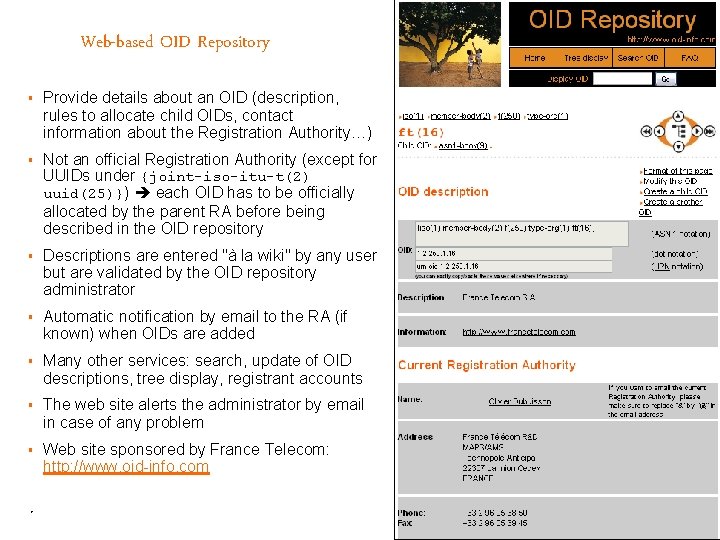
Web-based OID Repository § Provide details about an OID (description, rules to allocate child OIDs, contact information about the Registration Authority…) § Not an official Registration Authority (except for UUIDs under {joint-iso-itu-t(2) uuid(25)}) each OID has to be officially allocated by the parent RA before being described in the OID repository § Descriptions are entered "à la wiki" by any user but are validated by the OID repository administrator § Automatic notification by email to the RA (if known) when OIDs are added § Many other services: search, update of OID descriptions, tree display, registrant accounts § The web site alerts the administrator by email in case of any problem § Web site sponsored by France Telecom: http: //www. oid-info. com 7
Procedures for the operation of a Registration Authority § ITU-T X. 660 | ISO/IEC 9834 -1: Main text which defines general procedures for the operation of an RA and applies to any RA ("the Constitution") § Other standards in the series define procedures for allocation under a specific (high-level) OID arc: – ITU-T X. 662 | ISO/IEC 9834 -3: Registration of areas of joint work with ITU-T and ISO – ITU-T X. 666 | ISO/IEC 9834 -7: Registration of international organizations under {joint-iso-itu-t(2) international-organizations(23)} – ITU-T X. 667 | ISO/IEC 9834 -8: Registration of UUIDs – ITU-T X. 668 | ISO/IEC 9834 -9: Registration of ID schemes for applications and services using tag-based identification 8
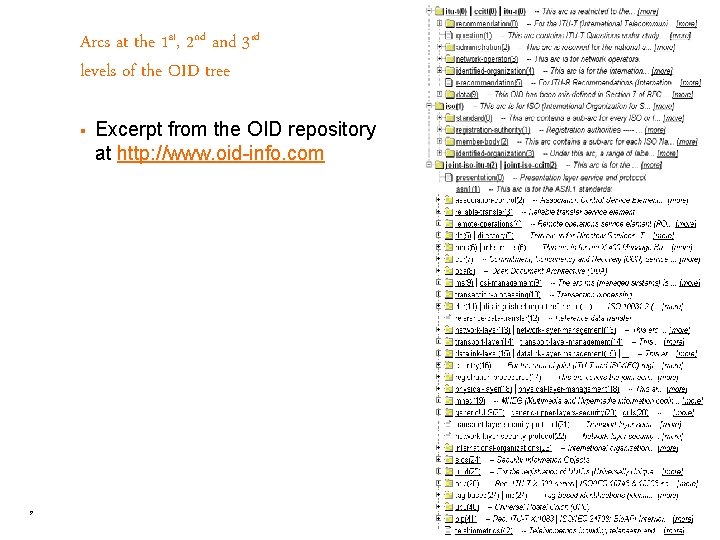
Arcs at the 1 st, 2 nd and 3 rd levels of the OID tree § 9 Excerpt from the OID repository at http: //www. oid-info. com
OID Resolution system § Provides information associated with any object identified by an OID: – access information – child node information – OID-IRI canonical form § Joint work between ITU-T SG 17 and ISO/IEC JTC 1/SC 6 since Oct. 2008 (draft Rec. ITU-T X. oid-res | ISO/IEC 29168) § Will specify: – – – 10 OID resolution architecture OID resolution protocol (probably based on DNS) operation of the OID resolution service security and trust of the OID resolution process etc.
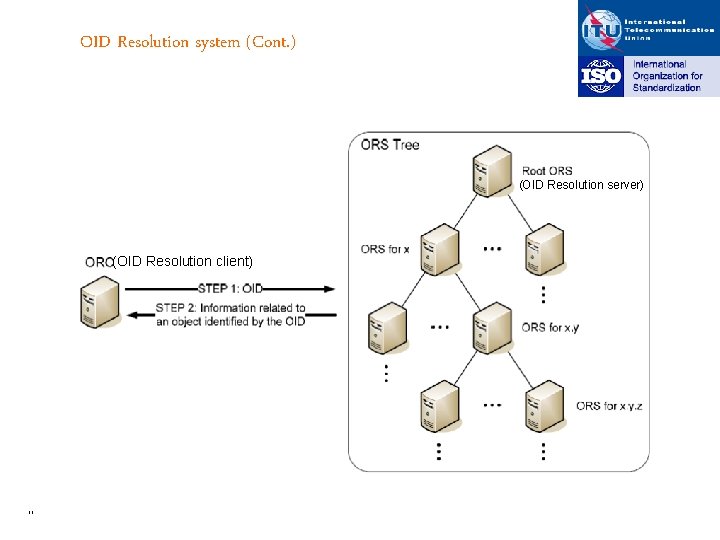
OID Resolution system (Cont. ) (OID Resolution server) (OID Resolution client) 11

thank you Orange, the Orange mark and any other Orange product or service names referred to in this material are trade marks of Orange Personal Communications Services Limited. © Orange Personal Communications Services Limited.
- Slides: 12