
Introduction to Nursing TOPIC 1 Introduction to Nursing

- Slides: 10
Introduction to Nursing TOPIC 1: Introduction to Nursing Learning Goal C: Identify the systems of a healthy body HLT 33115 Unit: HLTAAP 001 - Recognise healthy body systems Related Assessment: Task C
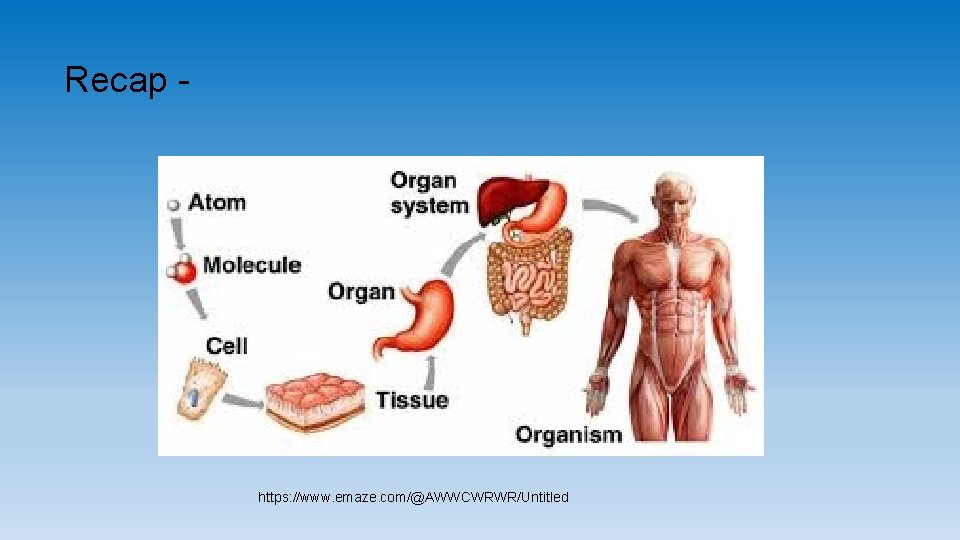
Recap - https: //www. emaze. com/@AWWCWRWR/Untitled
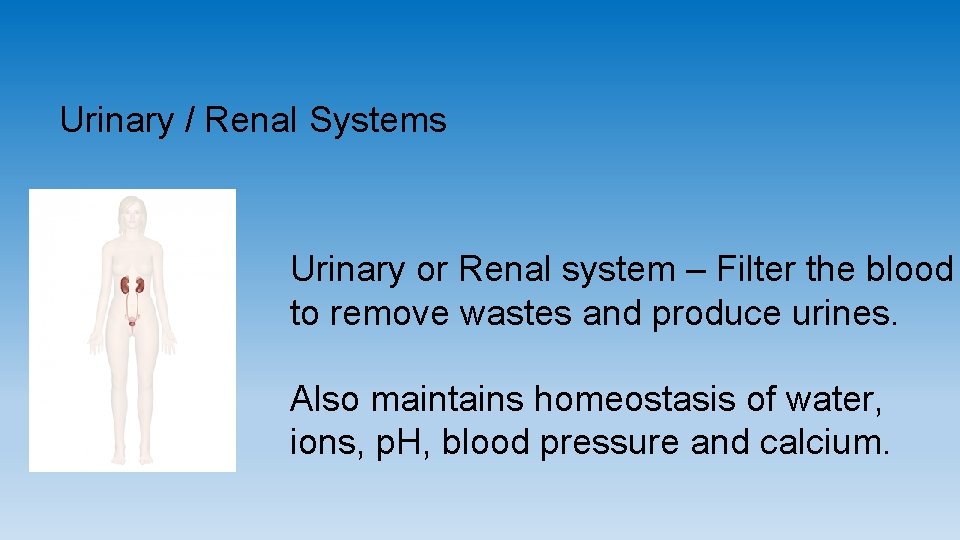
Urinary / Renal Systems Urinary or Renal system – Filter the blood to remove wastes and produce urines. Also maintains homeostasis of water, ions, p. H, blood pressure and calcium.
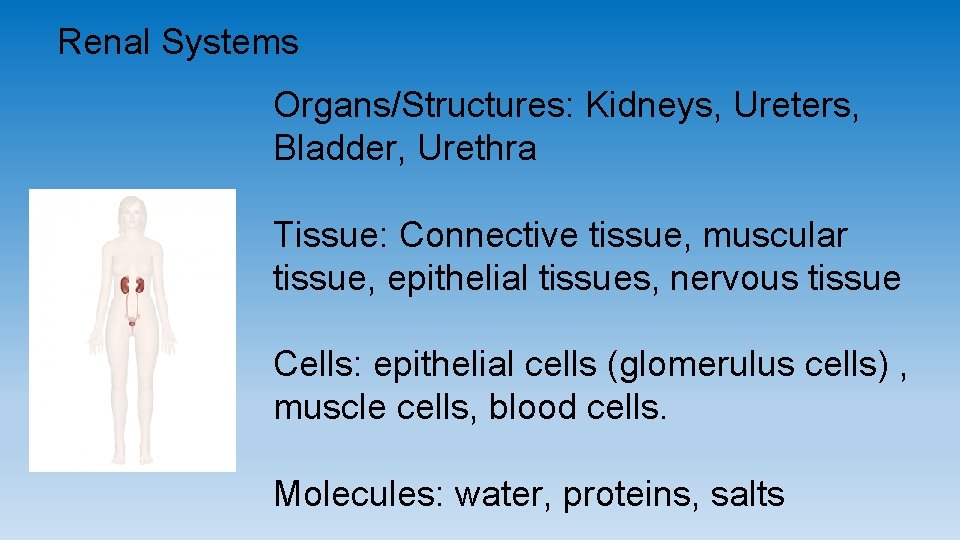
Renal Systems Organs/Structures: Kidneys, Ureters, Bladder, Urethra Tissue: Connective tissue, muscular tissue, epithelial tissues, nervous tissue Cells: epithelial cells (glomerulus cells) , muscle cells, blood cells. Molecules: water, proteins, salts
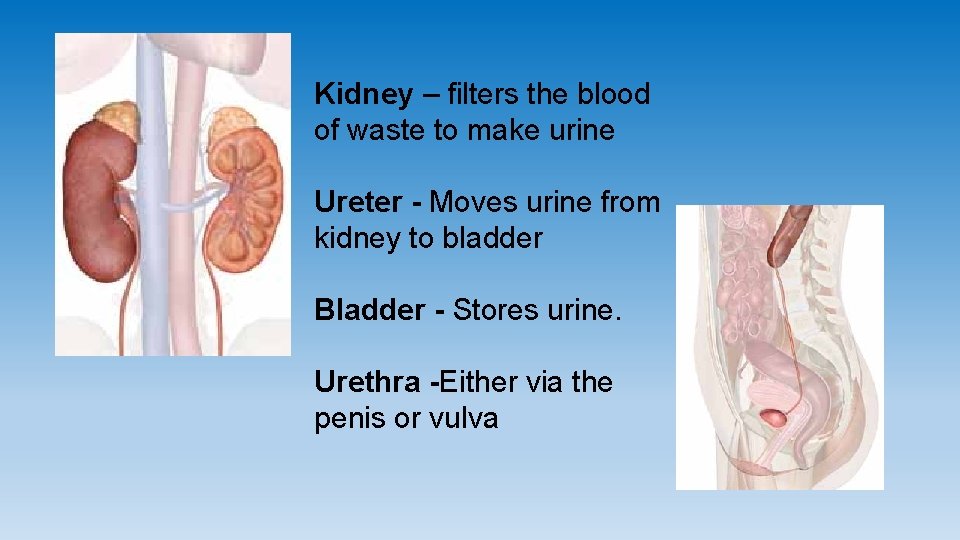
Kidney – filters the blood of waste to make urine Ureter - Moves urine from kidney to bladder Bladder - Stores urine. Urethra -Either via the penis or vulva
Renal system Responsibility for - Filtration, reabsorption and secretion - Excretion of wastes (i. e. ammonia, uric acid, urea and creatinine) - water homeostasis - acid/base homeostasis - Electrolyte homeostasis - Blood Pressure Homeostasis. - Hormone production - to maintain processes blood production and heart pumping
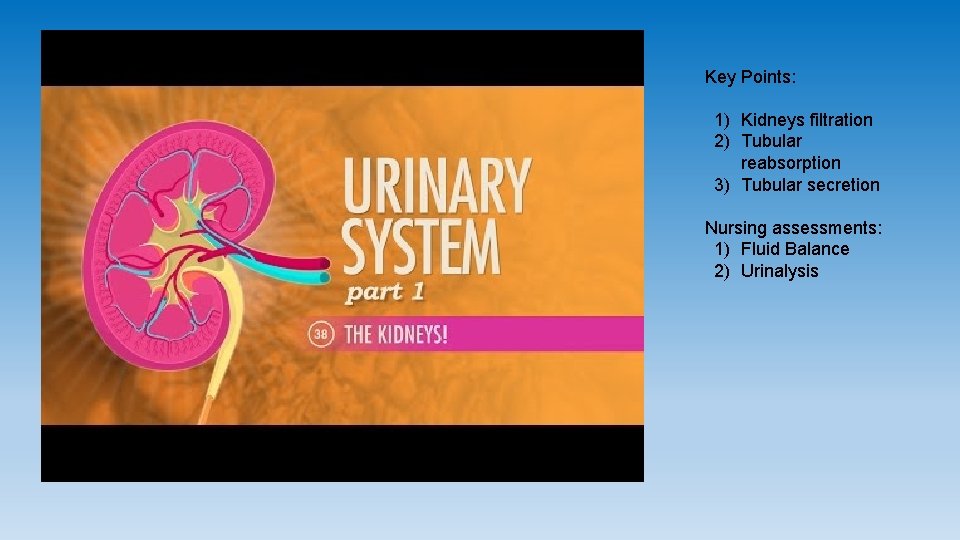
Key Points: 1) Kidneys filtration 2) Tubular reabsorption 3) Tubular secretion Nursing assessments: 1) Fluid Balance 2) Urinalysis
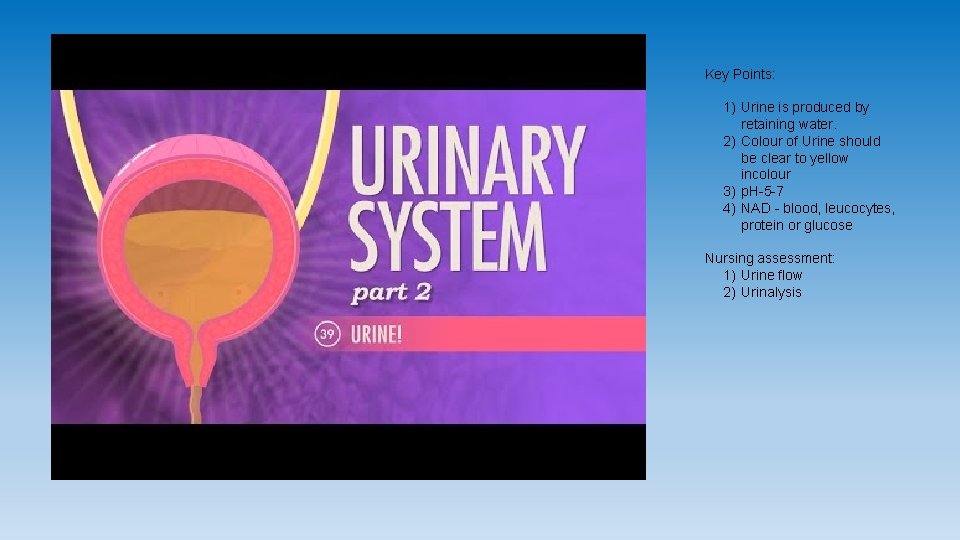
Key Points: 1) Urine is produced by retaining water. 2) Colour of Urine should be clear to yellow incolour 3) p. H-5 -7 4) NAD - blood, leucocytes, protein or glucose Nursing assessment: 1) Urine flow 2) Urinalysis
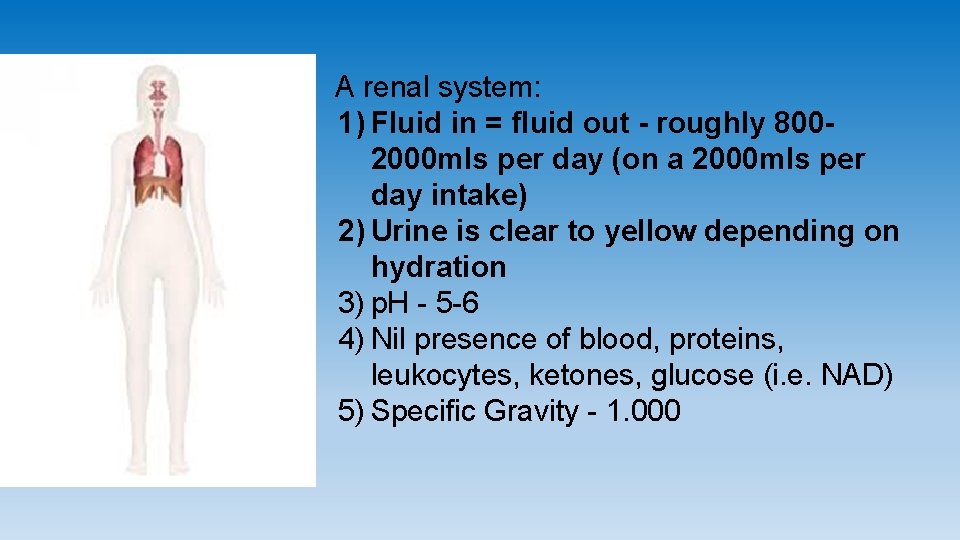
A renal system: 1) Fluid in = fluid out - roughly 8002000 mls per day (on a 2000 mls per day intake) 2) Urine is clear to yellow depending on hydration 3) p. H - 5 -6 4) Nil presence of blood, proteins, leukocytes, ketones, glucose (i. e. NAD) 5) Specific Gravity - 1. 000
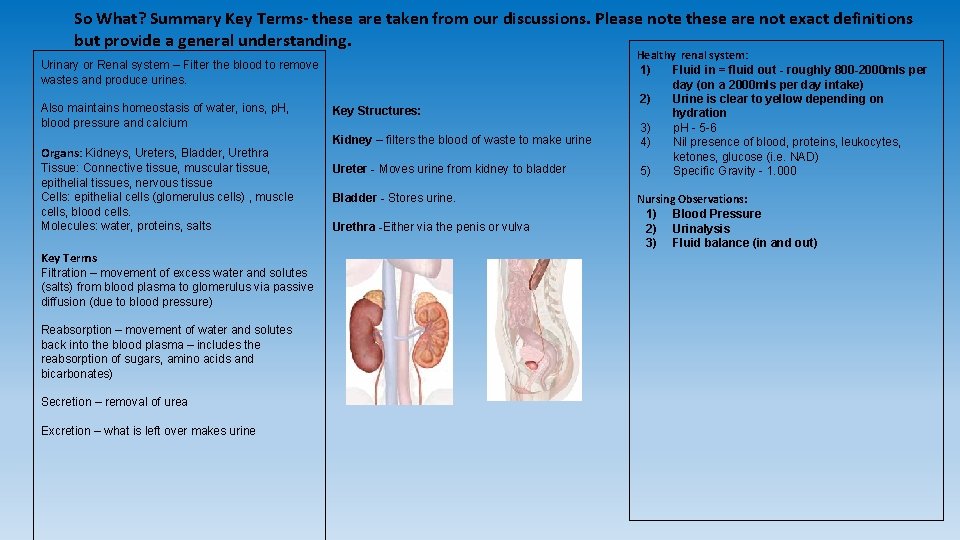
So What? Summary Key Terms- these are taken from our discussions. Please note these are not exact definitions but provide a general understanding. Urinary or Renal system – Filter the blood to remove wastes and produce urines. Also maintains homeostasis of water, ions, p. H, blood pressure and calcium Organs: Kidneys, Ureters, Bladder, Urethra Tissue: Connective tissue, muscular tissue, epithelial tissues, nervous tissue Cells: epithelial cells (glomerulus cells) , muscle cells, blood cells. Molecules: water, proteins, salts Key Terms Filtration – movement of excess water and solutes (salts) from blood plasma to glomerulus via passive diffusion (due to blood pressure) Reabsorption – movement of water and solutes back into the blood plasma – includes the reabsorption of sugars, amino acids and bicarbonates) Secretion – removal of urea Excretion – what is left over makes urine Key Structures: Kidney – filters the blood of waste to make urine Ureter - Moves urine from kidney to bladder Bladder - Stores urine. Urethra -Either via the penis or vulva Healthy renal system: 1) Fluid in = fluid out - roughly 800 -2000 mls per day (on a 2000 mls per day intake) 2) Urine is clear to yellow depending on hydration 3) p. H - 5 -6 4) Nil presence of blood, proteins, leukocytes, ketones, glucose (i. e. NAD) 5) Specific Gravity - 1. 000 Nursing Observations: 1) Blood Pressure 2) Urinalysis 3) Fluid balance (in and out)