
Introduction to nursing theories Dr Murtada Mustafa Gaber
Introduction to nursing theories Dr. Murtada Mustafa Gaber Tia Ph. D, RN University of Bisha- KSA
Learning objectives By the end of this lecture the student should be able to: • Define theory. • Define components of theory. • Identify concepts of nursing theory • State characteristics of theories • Describe types of nursing theories • Classify nursing theories • Identify historical perspectives of nursing theories
Definition of theory • It is a set of concepts, definitions, relationships, and assumptions that project a systematic view of a phenomena.
The components of a theory • Concepts: ideas and mental images that help to describe phenomena. • Definitions: convey the general meaning of the concepts • Assumptions: statements that describe concepts • Phenomenon: aspect of reality that can be consciously sensed or experienced.
Paradigm • A model that explains the linkages of science, philosophy, and theory accepted and applied by the discipline.
Concepts of nursing theory • Nursing has identified its concept in a paradigm that includes four linkages: 1. Person/client 2. Health 3. Environment 4. Nursing
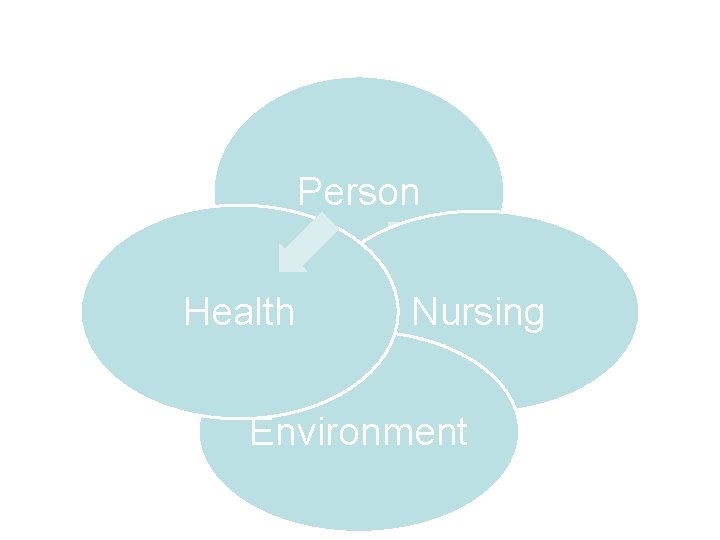
Person Health Nursing Environment
o. Person/client § Recipient of care, including physical, spiritual, psychological, and socio cultural components § Individual, family, or community. o. Environment § All internal and external conditions, circumstances, and influences affecting the person.
o. Health § Degree of wellness or illness experienced by the person o. Nursing § Actions, characteristics and attributes of person giving care.
Purposes of nursing theory • It guides nursing practice and generates knowledge • It helps to describe or explain nursing • Enables nurses to know WHY they are doing WHAT they are doing.
The characteristics of theories § Interrelating concepts. § Logical in nature. § Generalizable. § Bases for hypotheses that can be tested. § Increasing the general body of knowledge within the discipline.
Types of nursing theories • Grand theories – broad and complex • Middle-range theories- address specific phenomena and reflect practice • Descriptive theories – first level of theory development • Prescriptive theories – address nursing interventions and predict their consequences.
Classification of Nursing Theories 1. 2. 3. 4. • Needs theories. Interaction theories. Outcome theories. Humanistic theories These categories indicate the basic philosophical base of theories
1. Needs theories • These theories are based around helping individuals to fulfill their physical and mental needs. “This theories are relying too much on the medical model of health and placing the patient in an overtly dependent position”.
2. Interaction theories • These theories revolve around the relationships nurses form with patients. • “This theories are largely ignoring the medical model of health and not attending to basic physical needs”.
3. Outcome theories • These describe the nurse as the changing force, who enables individuals to adapt to or cope with ill health. • “This theories are too abstract and difficult to implement in practice”.
4. Humanistic Theories • Humanistic theories emphasize a person’s capacity for self actualization. • Humanists believes that the person contains within himself the potential for healthy and creative growth.
Historical perspectives of nursing theories • Nightingale (1860): To facilitate “the body’s reparative processes” by manipulating client’s environment • Peplau 1952: Nursing is; therapeutic interpersonal process. • Henderson 1955: The needs often called Henderson’s 14 basic needs
• Abdellah et al (1960) emphasizes delivering nursing care for the whole person to meet the physical, emotional, intellectual, social, and spiritual needs of the client and family. • Orlando 1962: the client is an individual; with a need; that, when met, diminishes distress, increases adequacy, or enhances well-being.
• Johnson’s Theory 1968: focuses on how the client adapts to illness and how actual or potential stress can affect the ability to adapt. • Orem 1971: Nursing care becomes necessary when client is unable to fulfill biological, psychological, developmental, or social needs.
• King 1971: To use communication to help client reestablish positive adaptation to environment. • Neuman 1972: Stress reduction is goal of system model of nursing practice. • Roy 1979: This adaptation model is based on the physiological, psychological, sociological and dependence-independence adaptive modes.
• X Theory (21 decade): ………………………………………… ……………………. . ? • It generated by each on of believe in yourself. you;
Benefit of nursing theories • It is benefits in nursing include better patient care, improved communication between nurses, and guidance for research and education.

Question? ? ?
Summary • Each theory have four components which are Concepts, Definitions, Assumptions and Phenomenon. • Concept of nursing theory includes Person/client, Health, Environment and Nursing. • Nursing theory classified into Needs; Interaction theories; Outcome theories and Humanistic theories. • Nightingale; Johnson; Orem; King , Neuman and Roy are nursing theorist.

Thanks
- Slides: 26