
Introduction to Numeracy In school education numeracy is

- Slides: 27
Introduction to Numeracy
“In school education, numeracy is a fundamental component of learning, discourse and critique across all areas of the curriculum” (Stephens, 2009) “Maths learned in isolation remains in isolation” (Cockcroft, 1982)
“Numeracy should be an important focus of schooling because numerate students are better able to learn at school and are better equipped for their everyday lives and their lives post schooling” (Kemp and Hogan, 2000)
The evidence (to date) suggests that: Irish performance in mathematics in TIMSS (2011) is significantly above the international scale centre point of 500. However, results show that the percentage of Irish pupils reaching the Advanced Benchmark (9%) is lower than would be expected from overall Irish performance. (Close 2013) The drop to significantly below average in PISA (from 17 to 26) can in part be attributed to the “ comparatively low performance of higher-achieving students” (ERC) 1 in 5 fifteen year olds do not have enough maths to function in day to day living (PISA)
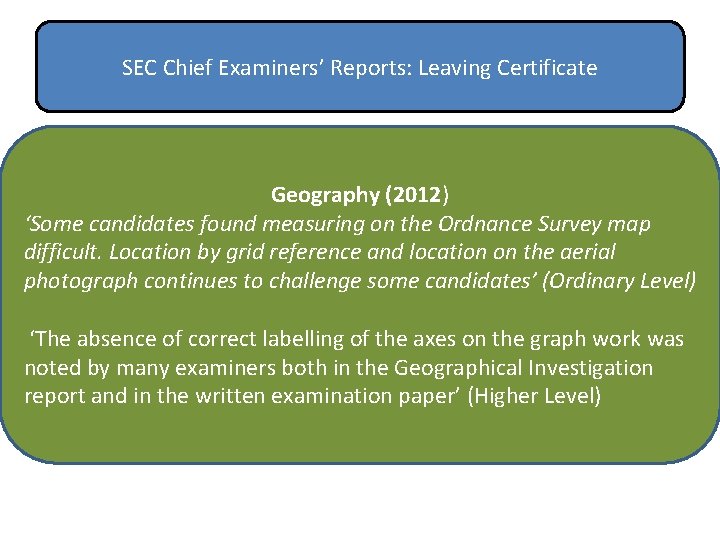
SEC Chief Examiners’ Reports: Leaving Certificate Geography (2012) ‘Some candidates found measuring on the Ordnance Survey map difficult. Location by grid reference and location on the aerial photograph continues to challenge some candidates’ (Ordinary Level) ‘The absence of correct labelling of the axes on the graph work was noted by many examiners both in the Geographical Investigation report and in the written examination paper’ (Higher Level)
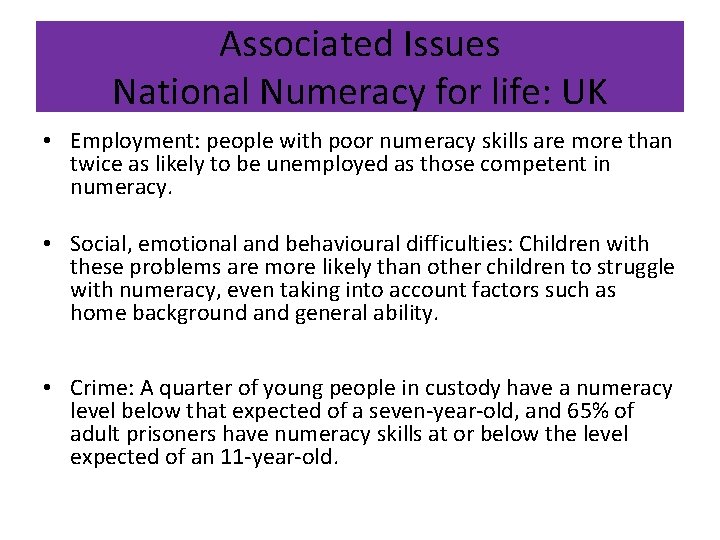
Associated Issues National Numeracy for life: UK • Employment: people with poor numeracy skills are more than twice as likely to be unemployed as those competent in numeracy. • Social, emotional and behavioural difficulties: Children with these problems are more likely than other children to struggle with numeracy, even taking into account factors such as home background and general ability. • Crime: A quarter of young people in custody have a numeracy level below that expected of a seven-year-old, and 65% of adult prisoners have numeracy skills at or below the level expected of an 11 -year-old.
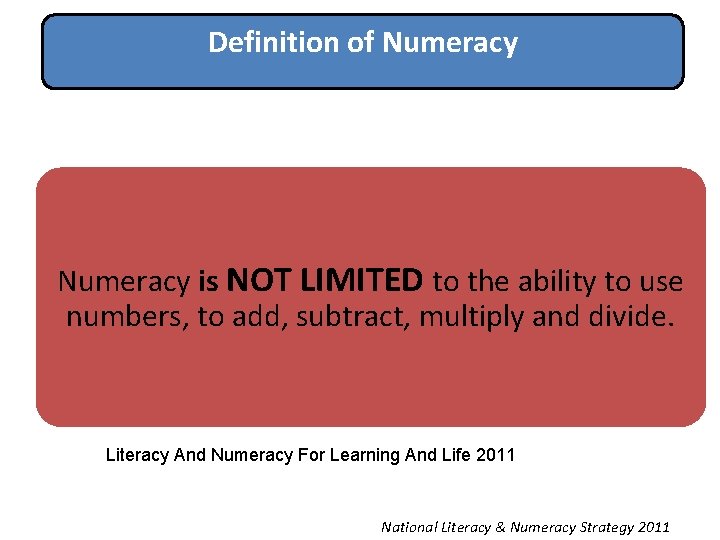
Definition of Numeracy is NOT LIMITED to the ability to use numbers, to add, subtract, multiply and divide. Literacy And Numeracy For Learning And Life 2011 National Literacy & Numeracy Strategy 2011
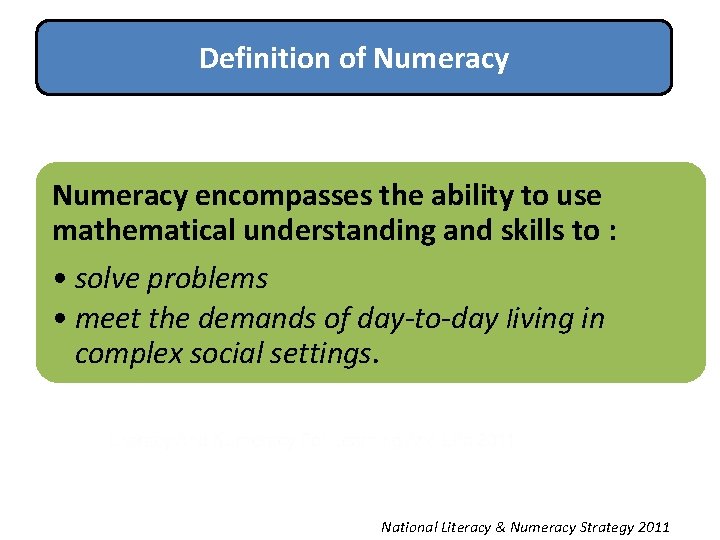
Definition Numeracy Definition of of Numeracy encompasses the ability to use mathematical understanding and skills to : • solve problems • meet the demands of day-to-day living in complex social settings. National Literacy & Numeracy Strategy 2011
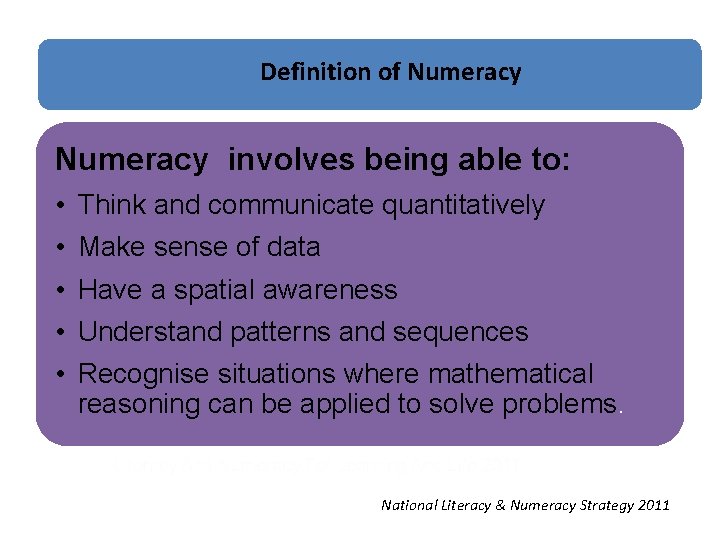
Definition of Numeracy involves being able to: • • • Think and communicate quantitatively Make sense of data Have a spatial awareness Understand patterns and sequences Recognise situations where mathematical reasoning can be applied to solve problems. National Literacy & Numeracy Strategy 2011
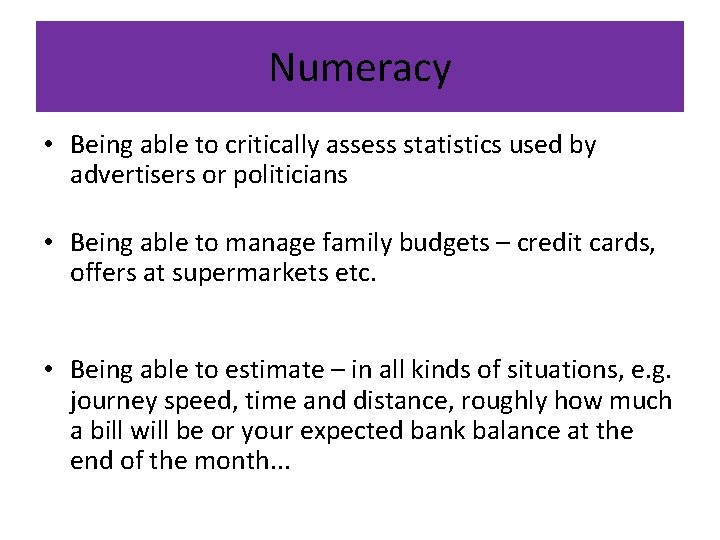
Numeracy • Being able to critically assess statistics used by advertisers or politicians • Being able to manage family budgets – credit cards, offers at supermarkets etc. • Being able to estimate – in all kinds of situations, e. g. journey speed, time and distance, roughly how much a bill will be or your expected bank balance at the end of the month. . .
Key Messages The role of the link teacher is to help promote numeracy in the school Whole-school collaboration is key to consistent approaches to numeracy across subject departments Developing positive attitudes and an awareness of numeracy is the responsibility of the whole school community
Whole-School Approach to Numeracy
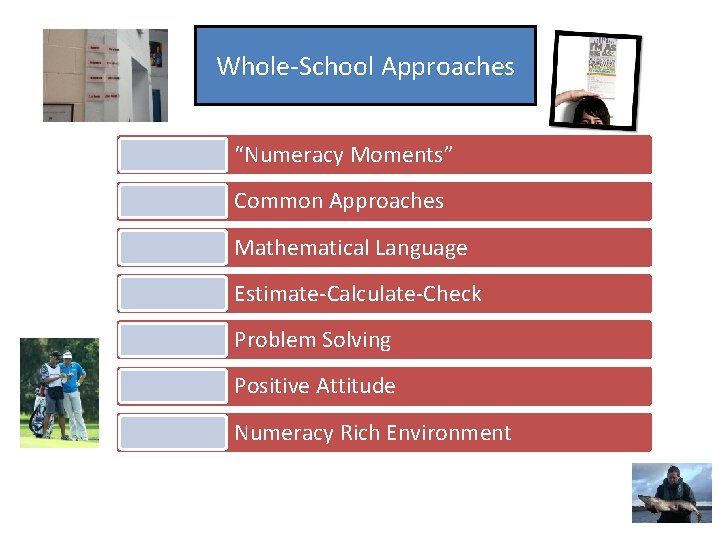
Whole-School Approaches “Numeracy Moments” Common Approaches Mathematical Language Estimate-Calculate-Check Problem Solving Positive Attitude Numeracy Rich Environment
Promotion of Whole School Numeracy • Display numeracy posters throughout the school. • Puzzle of the week. • Signs to office/classrooms should include distance. • Students’ numeracy work displayed in classrooms/corridors.
Promotion of Whole School Numeracy • Maths department to agree common approaches to teaching content and share these with other departments. • Students asked to record where numeracy occurs in each subject over a period of a week/month. • Maths board where notices, puzzles and cartoons can be posted.
Promotion of Whole School Numeracy • A clock should be in every classroom. • When returning students’ work give the mark as a fraction and ask them to convert it to a percentage.
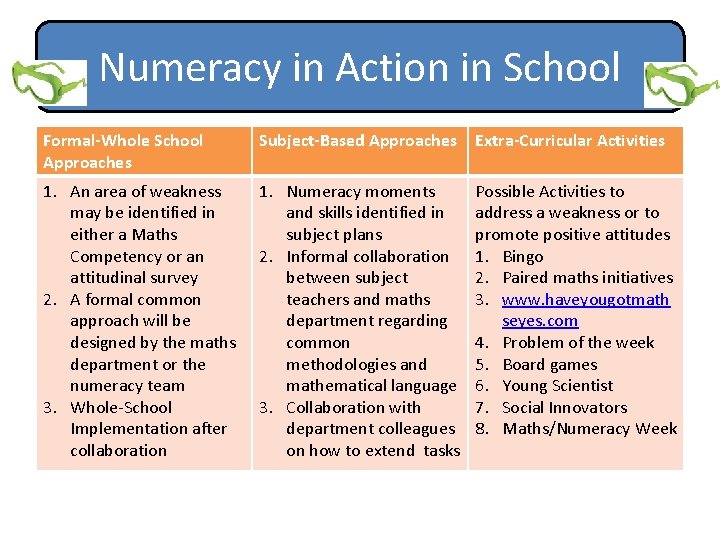
Numeracy in Action in School Formal-Whole School Approaches Subject-Based Approaches Extra-Curricular Activities 1. An area of weakness may be identified in either a Maths Competency or an attitudinal survey 2. A formal common approach will be designed by the maths department or the numeracy team 3. Whole-School Implementation after collaboration 1. Numeracy moments and skills identified in subject plans 2. Informal collaboration between subject teachers and maths department regarding common methodologies and mathematical language 3. Collaboration with department colleagues on how to extend tasks Possible Activities to address a weakness or to promote positive attitudes 1. Bingo 2. Paired maths initiatives 3. www. haveyougotmath seyes. com 4. Problem of the week 5. Board games 6. Young Scientist 7. Social Innovators 8. Maths/Numeracy Week
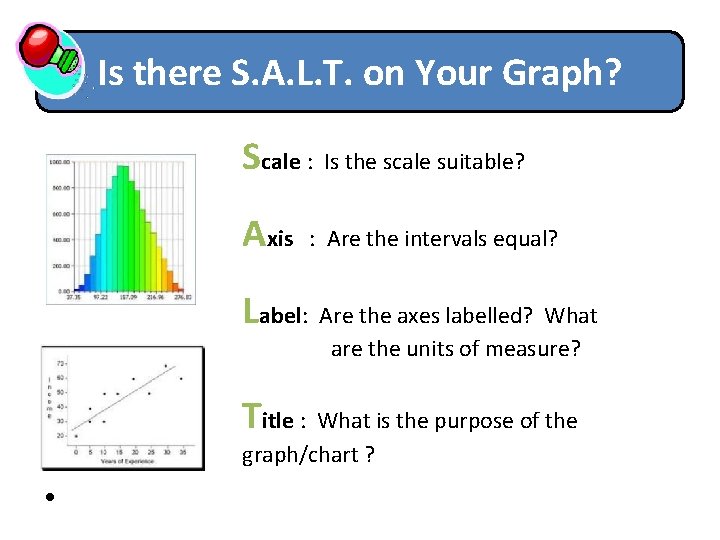
Is there S. A. L. T. on Your Graph? Scale : Is the scale suitable? Axis : Are the intervals equal? Label: Are the axes labelled? What are the units of measure? Title : What is the purpose of the graph/chart ? •
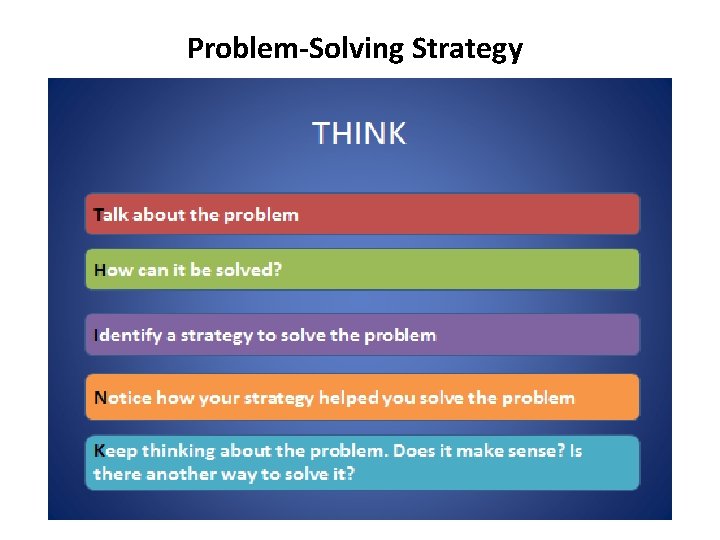
Problem-Solving Strategy
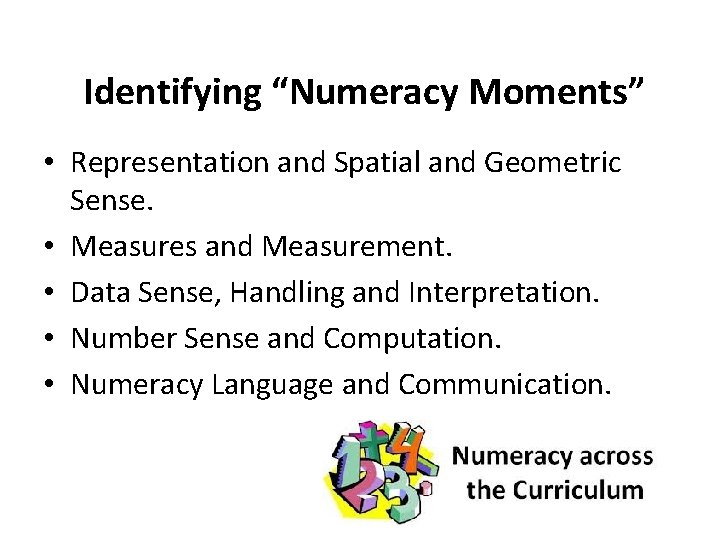
Identifying “Numeracy Moments” • Representation and Spatial and Geometric Sense. • Measures and Measurement. • Data Sense, Handling and Interpretation. • Number Sense and Computation. • Numeracy Language and Communication.
English teachers have opportunities to "enrich all four strands of language - speaking, listening, reading and writing - and these are equally valid aspects of numeracy" (The Rose Report (GB) 2009)
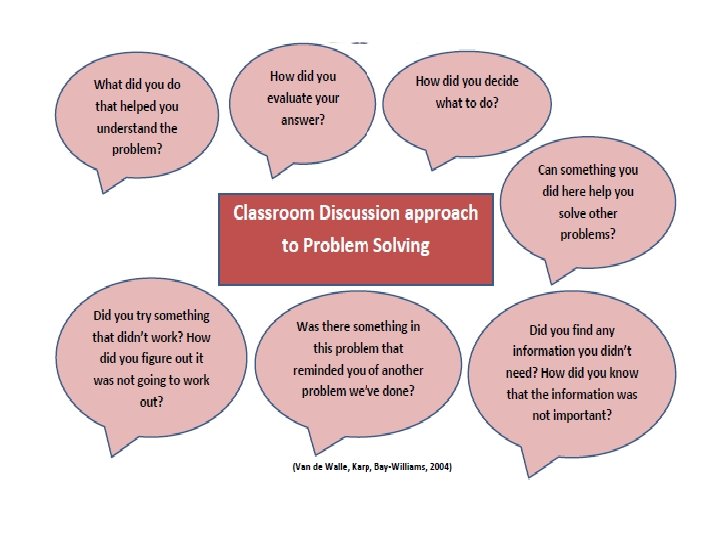
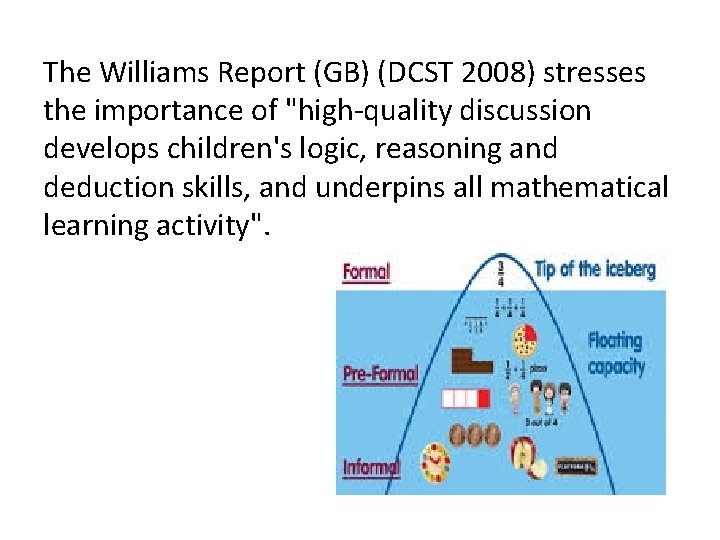
The Williams Report (GB) (DCST 2008) stresses the importance of "high-quality discussion develops children's logic, reasoning and deduction skills, and underpins all mathematical learning activity".
English • Using a graph to track the state of Macbeth’s temper during the play. (time v measure of anger) • Interpretation of graphs and charts from the media. • Organise and undertake a timed debate. • Analyse newspaper articles to find examples of how data can be used to highlight an issue or to support an argument.
• Understand use equivalences between commonly used percentages e. g. design a newspaper page with 25% of the area dedicated to advertisements. • Time lines of famous artists. • Time lines of the events in a novel. • Strategies to cope with and decode word problems.
Moving Forward • Identify the range of “numeracy moments” that occur in each subject area. • Discover what we already do well to support numeracy development. • Identify ways of building on these successes. • Time allocated for Numeracy : Jan staff meeting.