
Introduction to NonArchimedean Physics of Proteins Lecture III
- Slides: 39
Introduction to Non-Archimedean Physics of Proteins. Lecture III p-Adic models of spectral diffusion and CO-rebinding • Spectral diffusion in frozen proteins and first passage time distribution for ultrametric random walk. • CO-rebinding to myoglobin and p-adic equations of the "reaction-diffusion" type. • Concluding remarks: molecular machines, DNA-packing in chromatin, and origin of life.
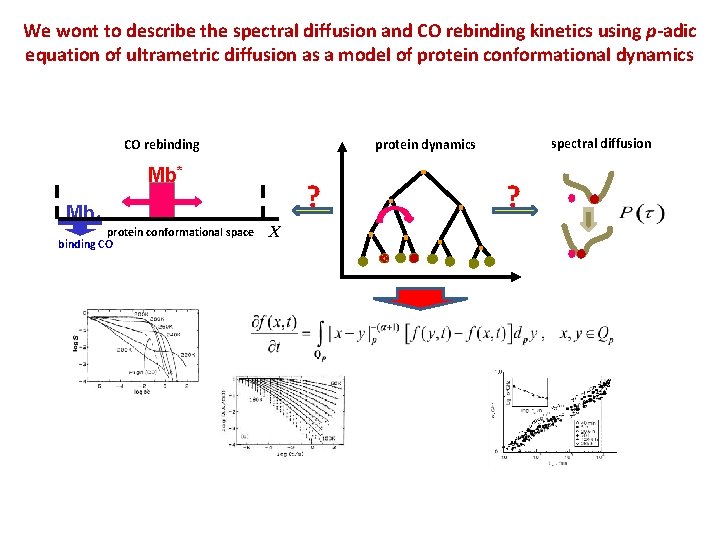
We wont to describe the spectral diffusion and CO rebinding kinetics using p-adic equation of ultrametric diffusion as a model of protein conformational dynamics CO rebinding Mb* Mb 1 protein conformational space binding CO spectral diffusion protein dynamics ? X ?
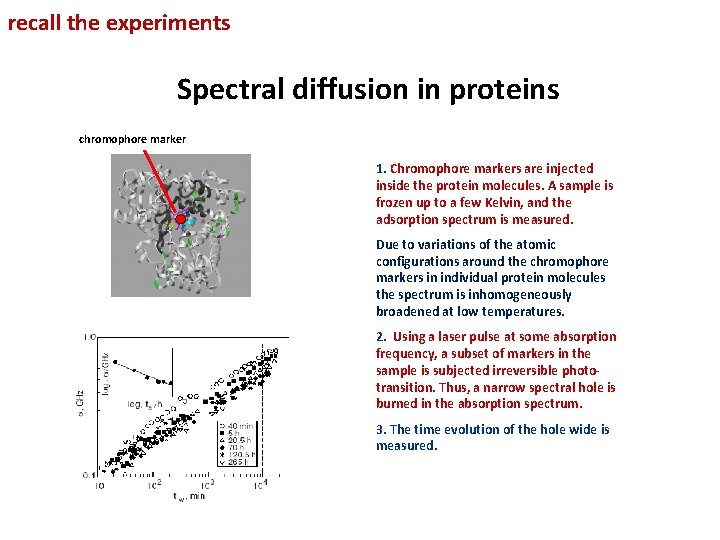
recall the experiments Spectral diffusion in proteins chromophore marker 1. Chromophore markers are injected inside the protein molecules. A sample is frozen up to a few Kelvin, and the adsorption spectrum is measured. Due to variations of the atomic configurations around the chromophore markers in individual protein molecules the spectrum is inhomogeneously broadened at low temperatures. 2. Using a laser pulse at some absorption frequency, a subset of markers in the sample is subjected irreversible phototransition. Thus, a narrow spectral hole is burned in the absorption spectrum. 3. The time evolution of the hole wide is measured.
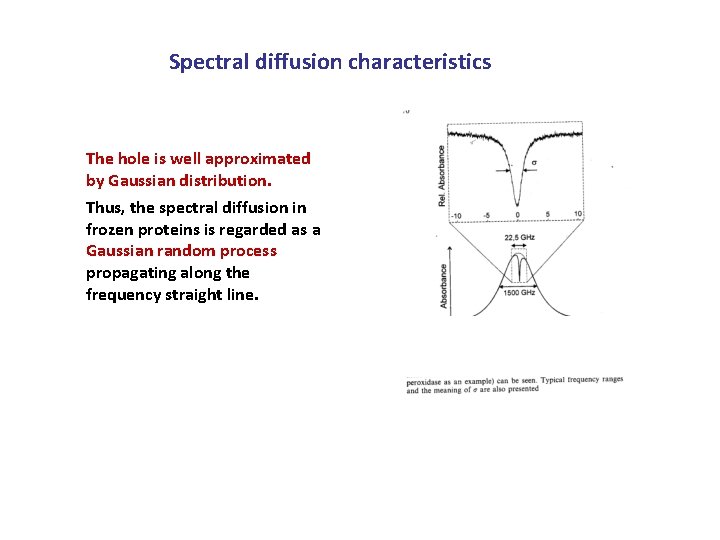
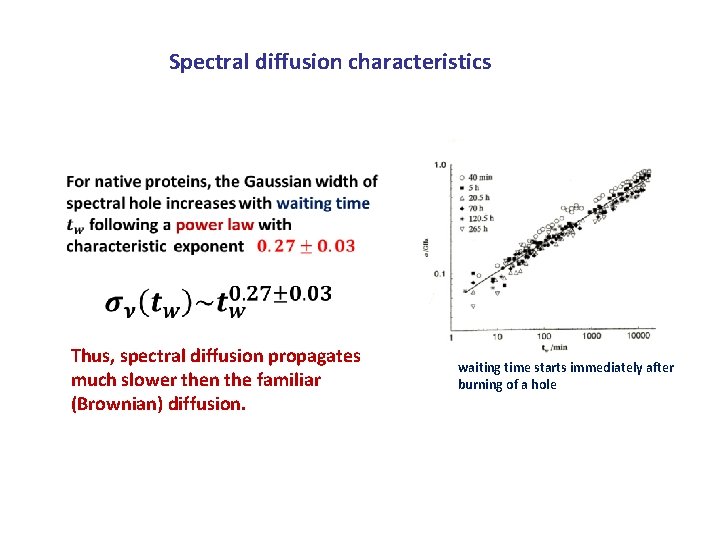
Spectral diffusion characteristics The hole is well approximated by Gaussian distribution. Thus, the spectral diffusion in frozen proteins is regarded as a Gaussian random process propagating along the frequency straight line.
Spectral diffusion characteristics Thus, spectral diffusion propagates much slower then the familiar (Brownian) diffusion. waiting time starts immediately after burning of a hole
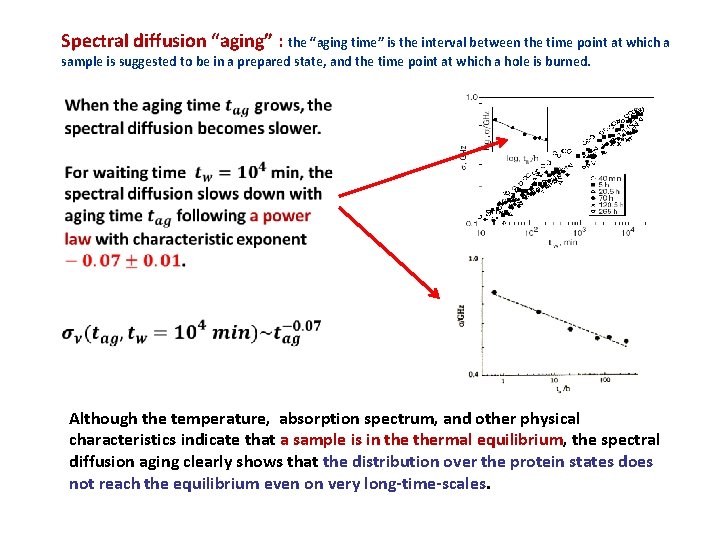
Spectral diffusion “aging” : the “aging time” is the interval between the time point at which a sample is suggested to be in a prepared state, and the time point at which a hole is burned. Although the temperature, absorption spectrum, and other physical characteristics indicate that a sample is in thermal equilibrium, the spectral diffusion aging clearly shows that the distribution over the protein states does not reach the equilibrium even on very long-time-scales.
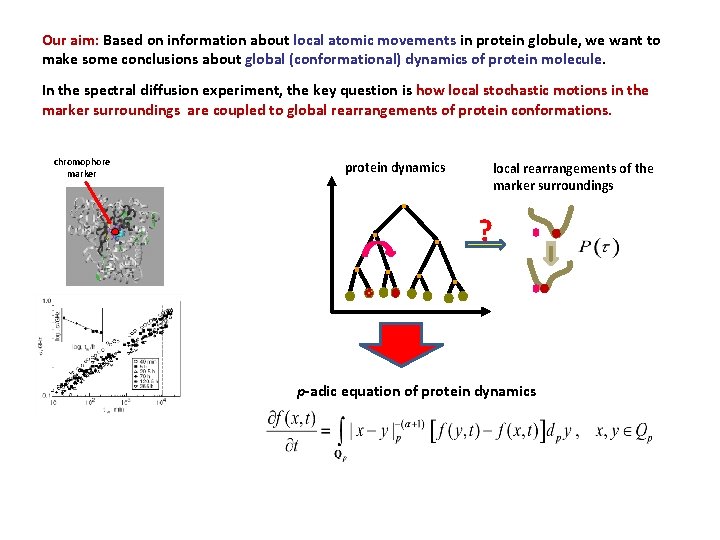
Our aim: Based on information about local atomic movements in protein globule, we want to make some conclusions about global (conformational) dynamics of protein molecule. In the spectral diffusion experiment, the key question is how local stochastic motions in the marker surroundings are coupled to global rearrangements of protein conformations. chromophore marker protein dynamics local rearrangements of the marker surroundings ? p-adic equation of protein dynamics
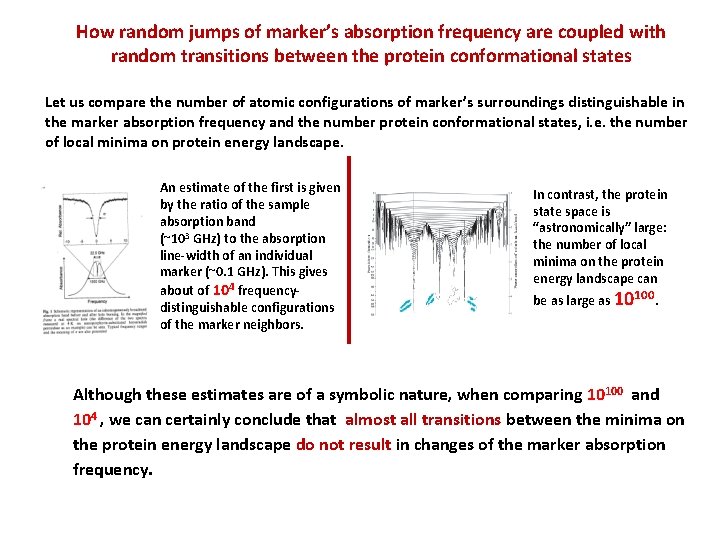
How random jumps of marker’s absorption frequency are coupled with random transitions between the protein conformational states Let us compare the number of atomic configurations of marker’s surroundings distinguishable in the marker absorption frequency and the number protein conformational states, i. e. the number of local minima on protein energy landscape. An estimate of the first is given by the ratio of the sample absorption band (~103 GHz) to the absorption line-width of an individual marker (~0. 1 GHz). This gives about of 104 frequencydistinguishable configurations of the marker neighbors. In contrast, the protein state space is “astronomically” large: the number of local minima on the protein energy landscape can be as large as 10100. Although these estimates are of a symbolic nature, when comparing 10100 and 104 , we can certainly conclude that almost all transitions between the minima on the protein energy landscape do not result in changes of the marker absorption frequency.
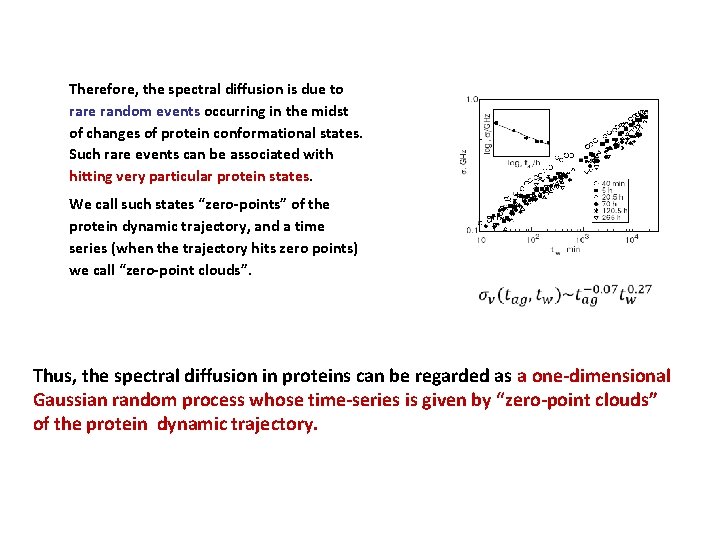
Therefore, the spectral diffusion is due to rare random events occurring in the midst of changes of protein conformational states. Such rare events can be associated with hitting very particular protein states. We call such states “zero-points” of the protein dynamic trajectory, and a time series (when the trajectory hits zero points) we call “zero-point clouds”. Thus, the spectral diffusion in proteins can be regarded as a one-dimensional Gaussian random process whose time-series is given by “zero-point clouds” of the protein dynamic trajectory.
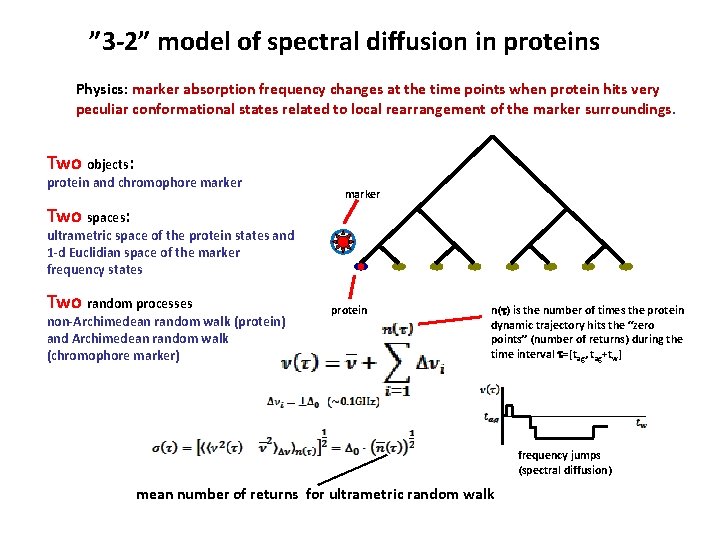
” 3 -2” model of spectral diffusion in proteins Physics: marker absorption frequency changes at the time points when protein hits very peculiar conformational states related to local rearrangement of the marker surroundings. Two objects: protein and chromophore marker Two spaces: ultrametric space of the protein states and 1 -d Euclidian space of the marker frequency states Two random processes non-Archimedean random walk (protein) and Archimedean random walk (chromophore marker) protein n( ) is the number of times the protein dynamic trajectory hits the “zero points” (number of returns) during the time interval =[tag, tag+tw] frequency jumps (spectral diffusion) mean number of returns for ultrametric random walk
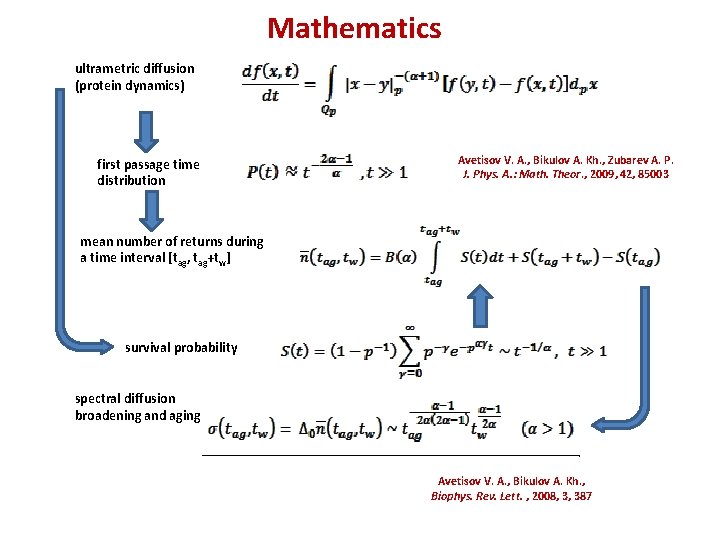
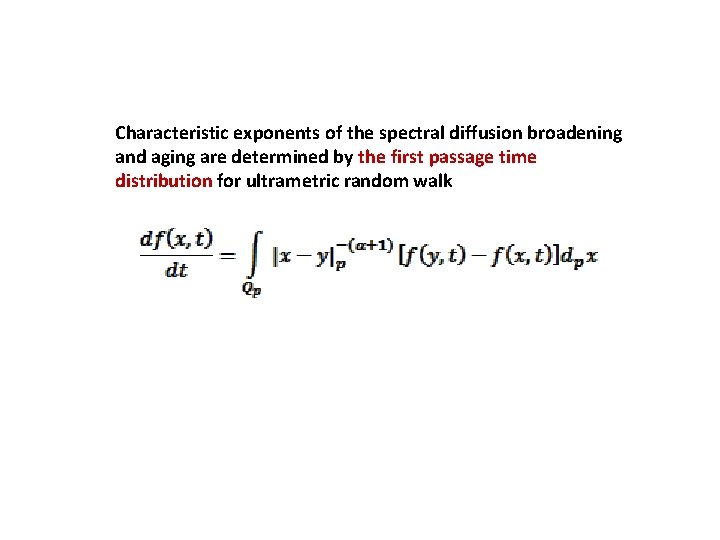
Mathematics ultrametric diffusion (protein dynamics) first passage time distribution Avetisov V. A. , Bikulov A. Kh. , Zubarev A. P. J. Phys. A. : Math. Theor. , 2009, 42, 85003 mean number of returns during a time interval [tag, tag+tw] survival probability spectral diffusion broadening and aging Avetisov V. A. , Bikulov A. Kh. , Biophys. Rev. Lett. , 2008, 3, 387
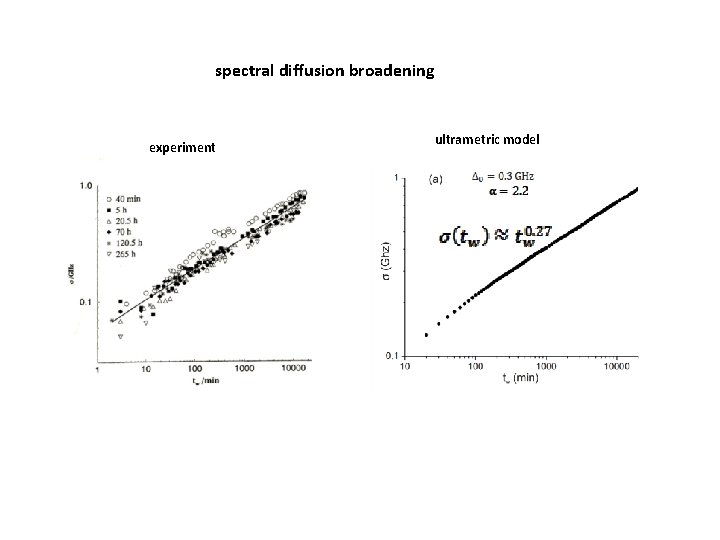
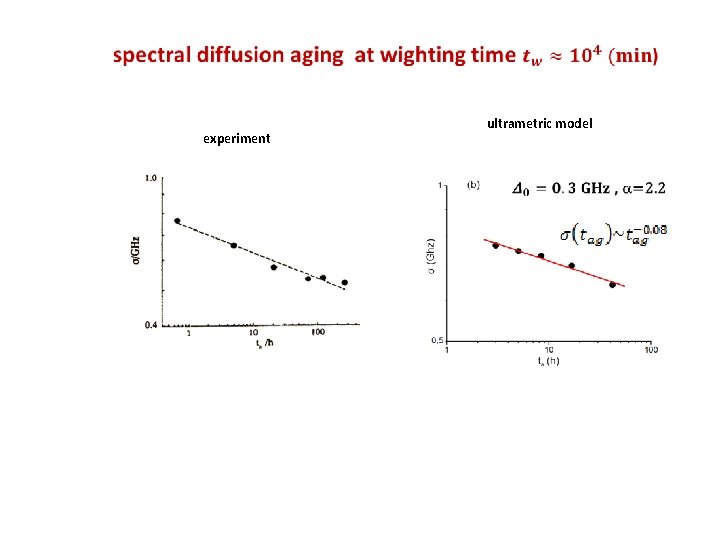
spectral diffusion broadening experiment ultrametric model
experiment ultrametric model
Characteristic exponents of the spectral diffusion broadening and aging are determined by the first passage time distribution for ultrametric random walk
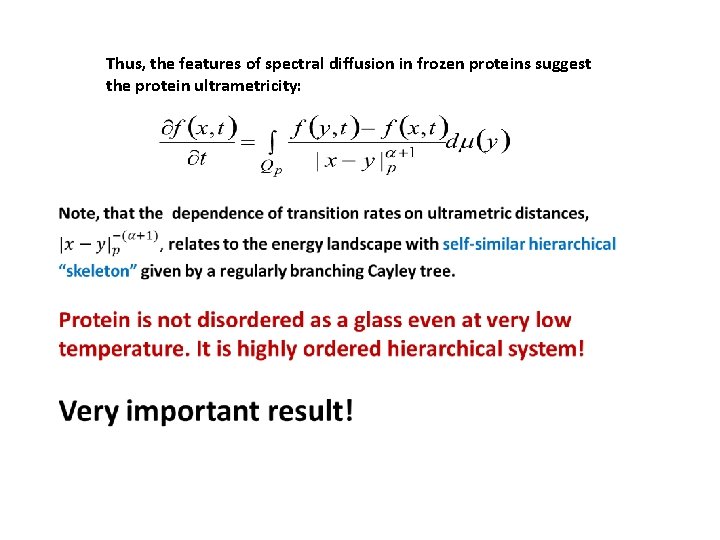
Thus, the features of spectral diffusion in frozen proteins suggest the protein ultrametricity:
CO rebinding kinetics
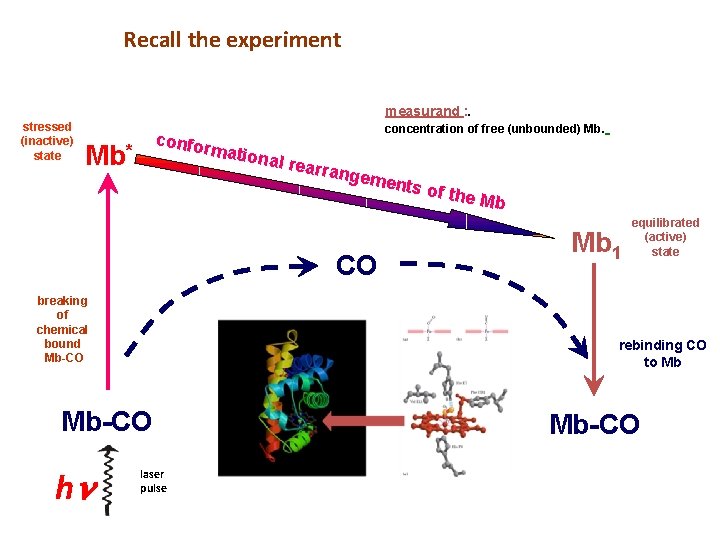
Recall the experiment measurand : . stressed (inactive) state concentration of free (unbounded) Mb. confor mation Mb* al rear rangem ents o CO breaking of chemical bound Mb-CO Mb 1 equilibrated (active) state rebinding CO to Mb Mb-CO h f the M b laser pulse Mb-CO
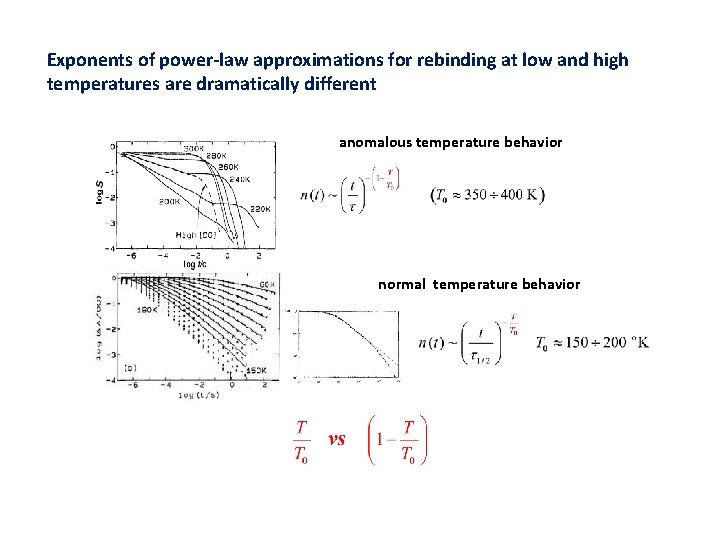
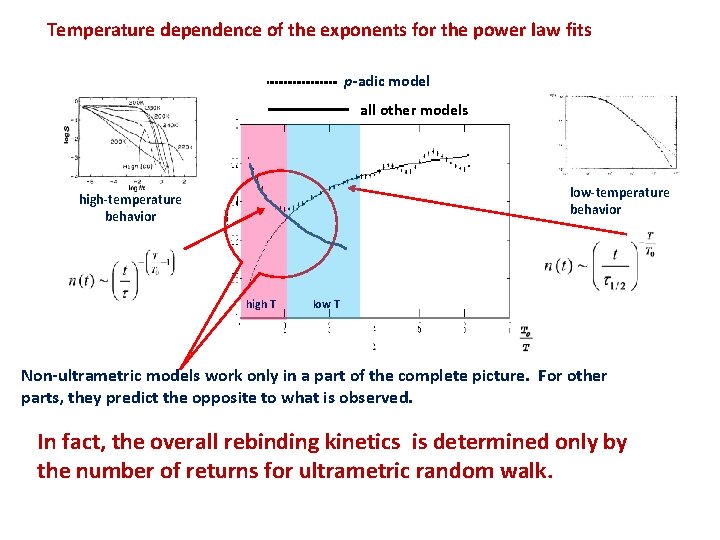
Exponents of power-law approximations for rebinding at low and high temperatures are dramatically different anomalous temperature behavior normal temperature behavior
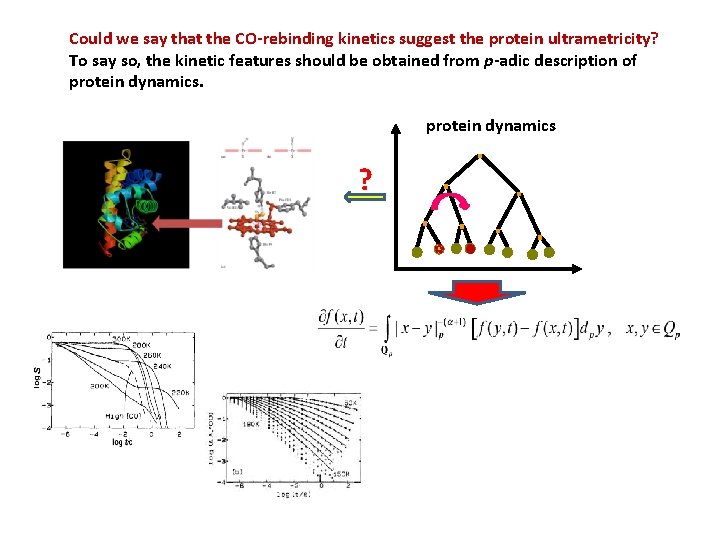
Could we say that the CO-rebinding kinetics suggest the protein ultrametricity? To say so, the kinetic features should be obtained from p-adic description of protein dynamics ?
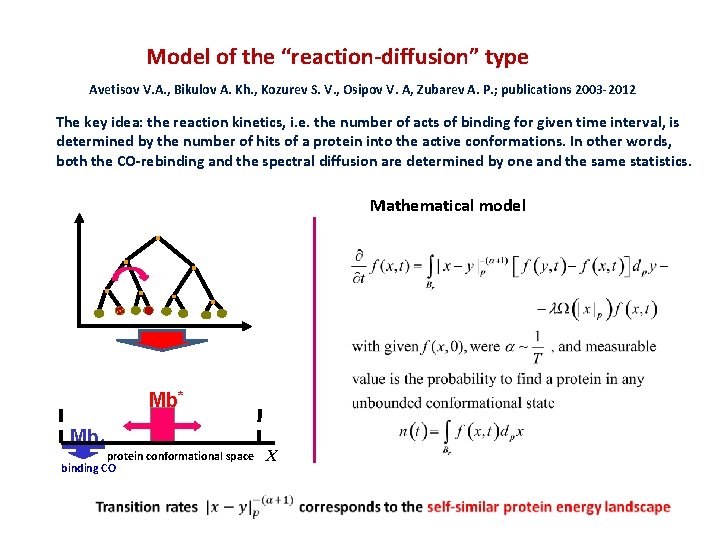
Model of the “reaction-diffusion” type Avetisov V. A. , Bikulov A. Kh. , Kozurev S. V. , Osipov V. A, Zubarev A. P. ; publications 2003 -2012 The key idea: the reaction kinetics, i. e. the number of acts of binding for given time interval, is determined by the number of hits of a protein into the active conformations. In other words, both the CO-rebinding and the spectral diffusion are determined by one and the same statistics. Mathematical model Mb* Mb 1 protein conformational space binding CO X
How are proteins distributed over conformational states just after the laser pulse?
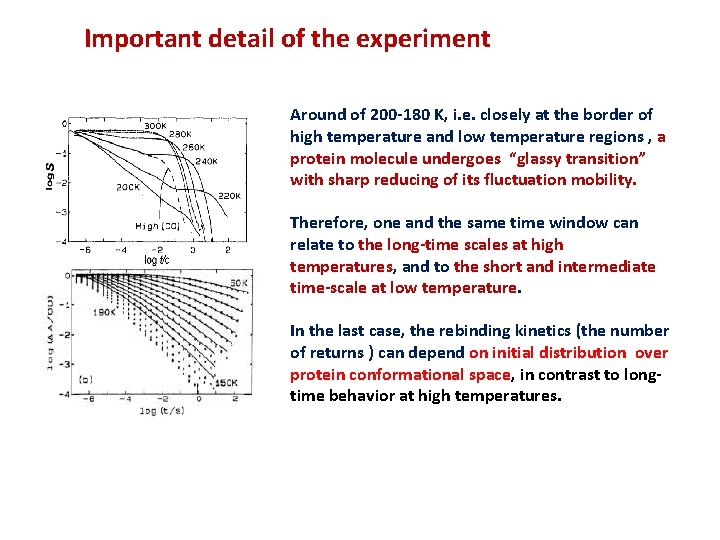
Important detail of the experiment Around of 200 -180 K, i. e. closely at the border of high temperature and low temperature regions , a protein molecule undergoes “glassy transition” with sharp reducing of its fluctuation mobility. Therefore, one and the same time window can relate to the long-time scales at high temperatures, and to the short and intermediate time-scale at low temperature. In the last case, the rebinding kinetics (the number of returns ) can depend on initial distribution over protein conformational space, in contrast to longtime behavior at high temperatures.
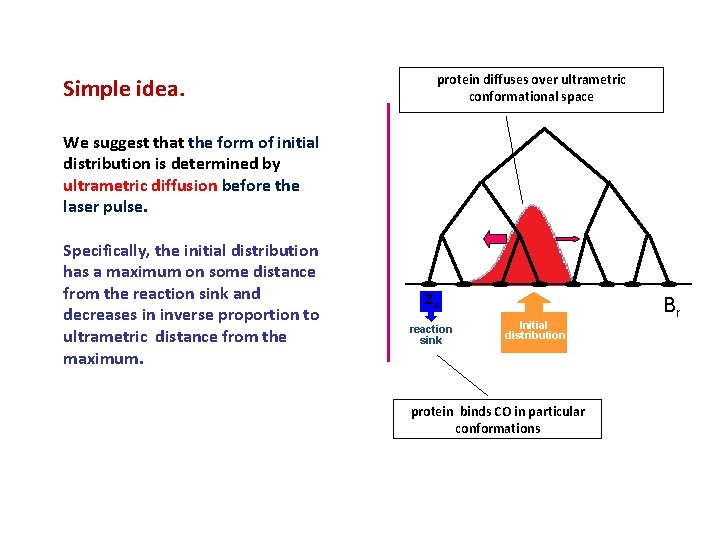
Simple idea. protein diffuses over ultrametric conformational space We suggest that the form of initial distribution is determined by ultrametric diffusion before the laser pulse. Specifically, the initial distribution has a maximum on some distance from the reaction sink and decreases in inverse proportion to ultrametric distance from the maximum. Zp reaction sink Initial distribution protein binds CO in particular conformations Br
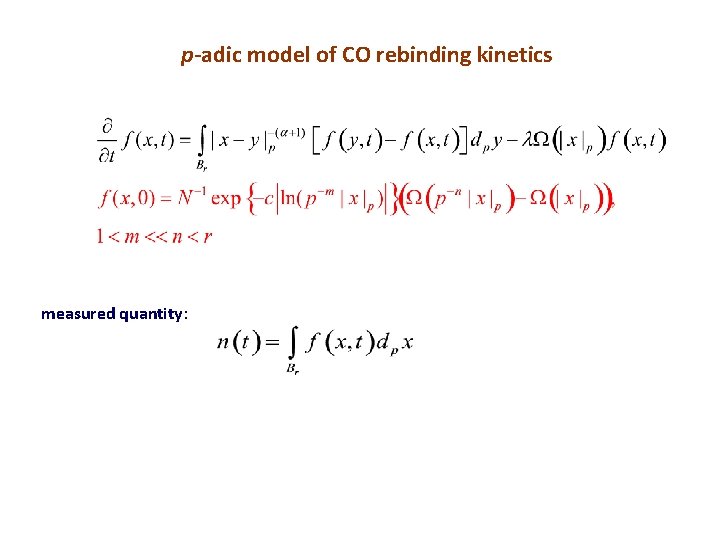
p-adic model of CO rebinding kinetics measured quantity:
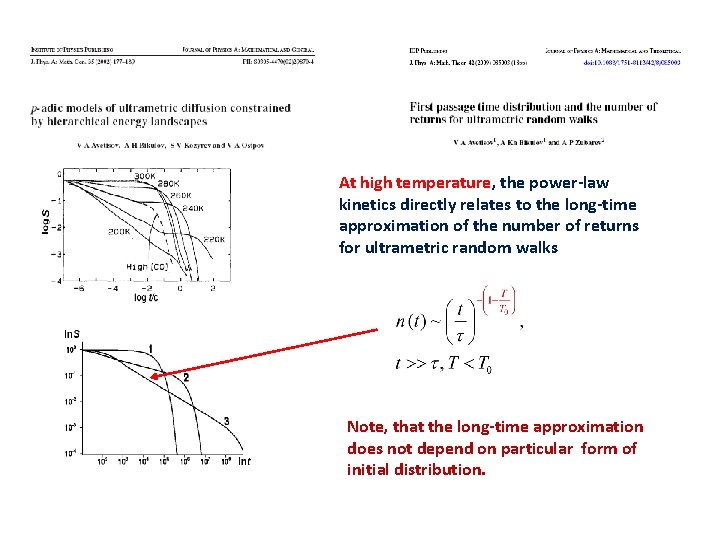
At high temperature, the power-law kinetics directly relates to the long-time approximation of the number of returns for ultrametric random walks Note, that the long-time approximation does not depend on particular form of initial distribution.
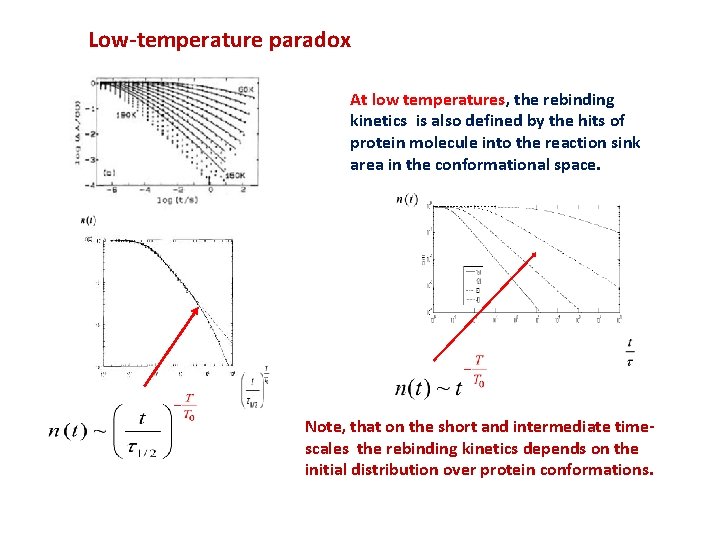
Low-temperature paradox At low temperatures, the rebinding kinetics is also defined by the hits of protein molecule into the reaction sink area in the conformational space. Note, that on the short and intermediate timescales the rebinding kinetics depends on the initial distribution over protein conformations.
Temperature dependence of the exponents for the power law fits p-adic model all other models low-temperature behavior high T low T Non-ultrametric models work only in a part of the complete picture. For other parts, they predict the opposite to what is observed. In fact, the overall rebinding kinetics is determined only by the number of returns for ultrametric random walk.
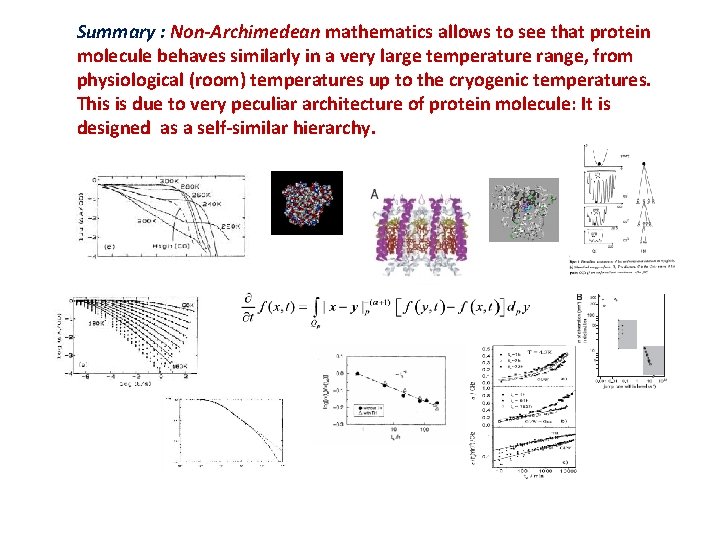
Summary : Non-Archimedean mathematics allows to see that protein molecule behaves similarly in a very large temperature range, from physiological (room) temperatures up to the cryogenic temperatures. This is due to very peculiar architecture of protein molecule: It is designed as a self-similar hierarchy.
Ultrametricity beyond the proteins
Crumpled globule
Crumpled globule is an important example of hierarchically ordered polymer structure A. Y. Grosber, S. K. Nechaev, E. I. Shakhnovich, J. Phys. France 49, 2095 (1988). Adjacency matrix of contacts in a crumpled globule has a block-hierarchical form like the Parisi matrix
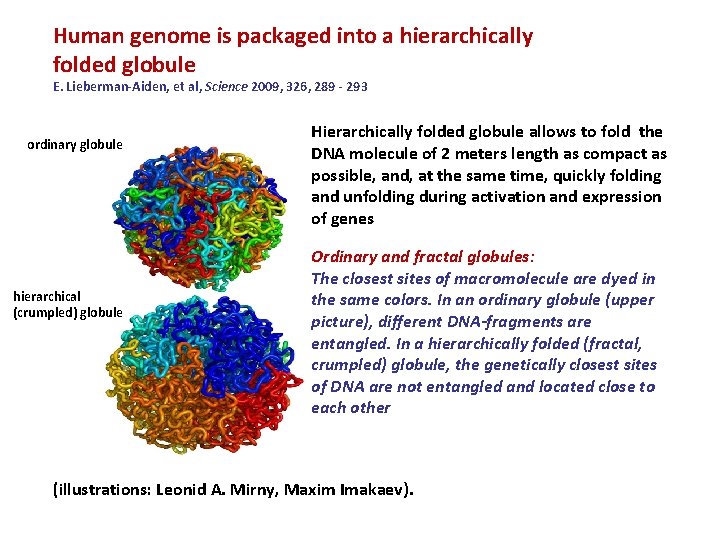
Human genome is packaged into a hierarchically folded globule E. Lieberman-Aiden, et al, Science 2009, 326, 289 - 293 ordinary globule hierarchical (crumpled) globule Hierarchically folded globule allows to fold the DNA molecule of 2 meters length as compact as possible, and, at the same time, quickly folding and unfolding during activation and expression of genes Ordinary and fractal globules: The closest sites of macromolecule are dyed in the same colors. In an ordinary globule (upper picture), different DNA-fragments are entangled. In a hierarchically folded (fractal, crumpled) globule, the genetically closest sites of DNA are not entangled and located close to each other (illustrations: Leonid A. Mirny, Maxim Imakaev).
Molecular machines
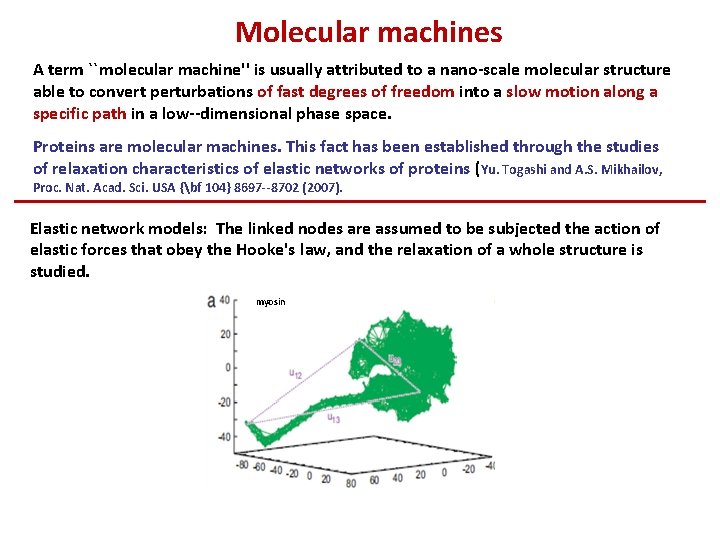
Molecular machines A term ``molecular machine'' is usually attributed to a nano-scale molecular structure able to convert perturbations of fast degrees of freedom into a slow motion along a specific path in a low--dimensional phase space. Proteins are molecular machines. This fact has been established through the studies of relaxation characteristics of elastic networks of proteins (Yu. Togashi and A. S. Mikhailov, Proc. Nat. Acad. Sci. USA {bf 104} 8697 --8702 (2007). Elastic network models: The linked nodes are assumed to be subjected the action of elastic forces that obey the Hooke's law, and the relaxation of a whole structure is studied. myosin
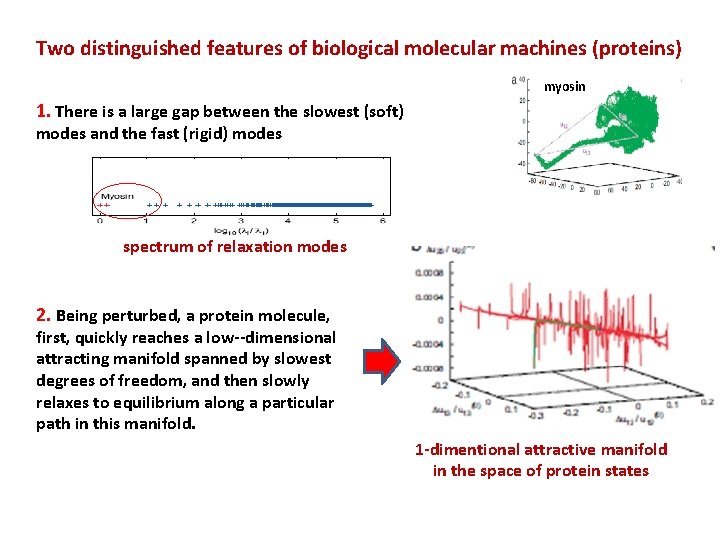
Two distinguished features of biological molecular machines (proteins) myosin 1. There is a large gap between the slowest (soft) modes and the fast (rigid) modes spectrum of relaxation modes 2. Being perturbed, a protein molecule, first, quickly reaches a low--dimensional attracting manifold spanned by slowest degrees of freedom, and then slowly relaxes to equilibrium along a particular path in this manifold. 1 -dimentional attractive manifold in the space of protein states
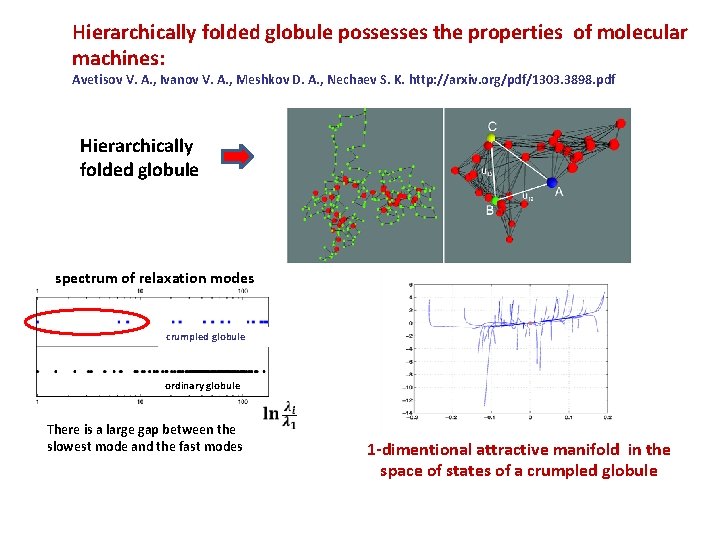
Hierarchically folded globule possesses the properties of molecular machines: Avetisov V. A. , Ivanov V. A. , Meshkov D. A. , Nechaev S. K. http: //arxiv. org/pdf/1303. 3898. pdf Hierarchically folded globule hierarchically folded globule spectrum of relaxation modes crumpled globule ordinary globule There is a large gap between the slowest mode and the fast modes 1 -dimentional attractive manifold in the space of states of a crumpled globule
Ultrametricity is a new intriguing idea in designing of artificial “nanomachines”
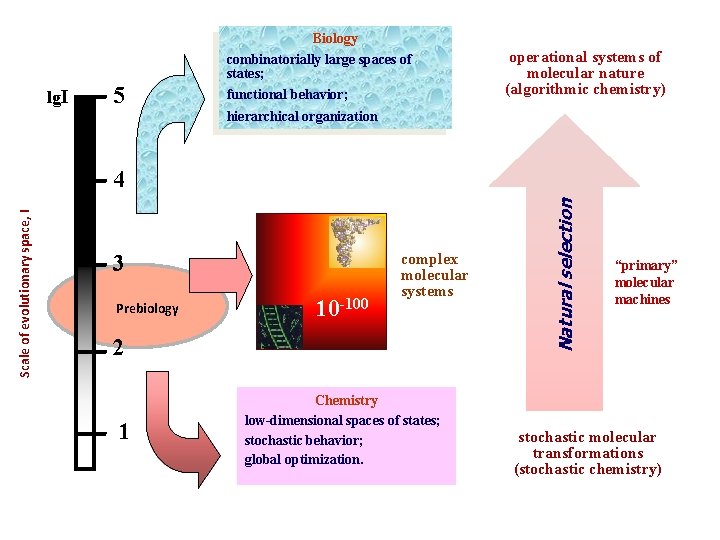
Biology combinatorially large spaces of states; lg. I 5 functional behavior; operational systems of molecular nature (algorithmic chemistry) hierarchical organization 3 Prebiology 10 -100 complex molecular systems 2 1 Chemistry low-dimensional spaces of states; stochastic behavior; global optimization. Natural selection Scale of evolutionary space, I 4 “primary” molecular machines stochastic molecular transformations (stochastic chemistry)
Archimedean mathematics describes nonliving matter, but non-Archimedean mathematics, perhaps, describes the living world. We now are at the very beginning of this way.