
Introduction to NonArchimedean Physics of Proteins Lecture II
- Slides: 40
Introduction to Non-Archimedean Physics of Proteins. Lecture II: p-Adic description of multi-scale protein dynamics. • Tree-like presentation of high-dimensional rugged energy landscapes • Basin-to-basin kinetics • Ultrametric random walk • Eigenvalues and eigenvectors of block- hierarchical transition matrices • p-Adic equation of ultrametric diffusion • p-Adic wavelets
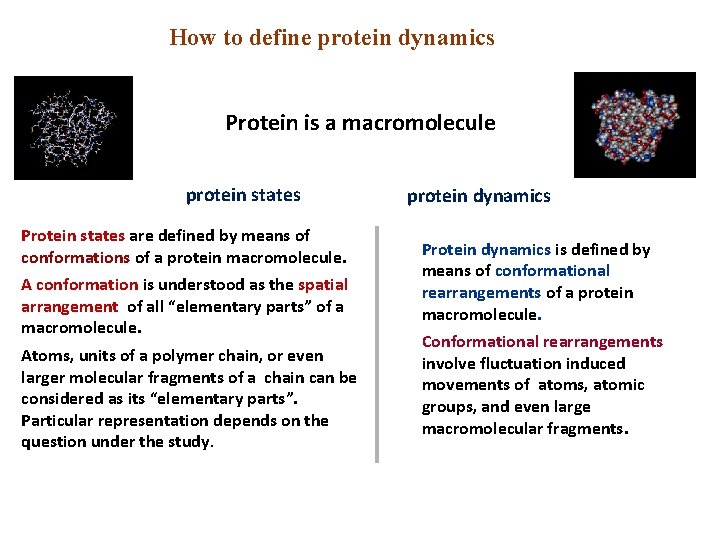
How to define protein dynamics Protein is a macromolecule protein states Protein states are defined by means of conformations of a protein macromolecule. A conformation is understood as the spatial arrangement of all “elementary parts” of a macromolecule. Atoms, units of a polymer chain, or even larger molecular fragments of a chain can be considered as its “elementary parts”. Particular representation depends on the question under the study. protein dynamics Protein dynamics is defined by means of conformational rearrangements of a protein macromolecule. Conformational rearrangements involve fluctuation induced movements of atoms, atomic groups, and even large macromolecular fragments.
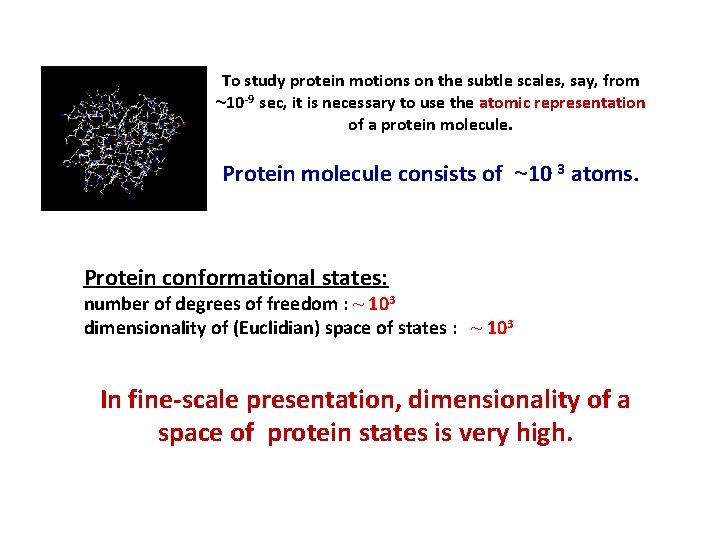
To study protein motions on the subtle scales, say, from ~10 -9 sec, it is necessary to use the atomic representation of a protein molecule. Protein molecule consists of ~10 3 atoms. Protein conformational states: number of degrees of freedom : ~ 103 dimensionality of (Euclidian) space of states : ~ 103 In fine-scale presentation, dimensionality of a space of protein states is very high.
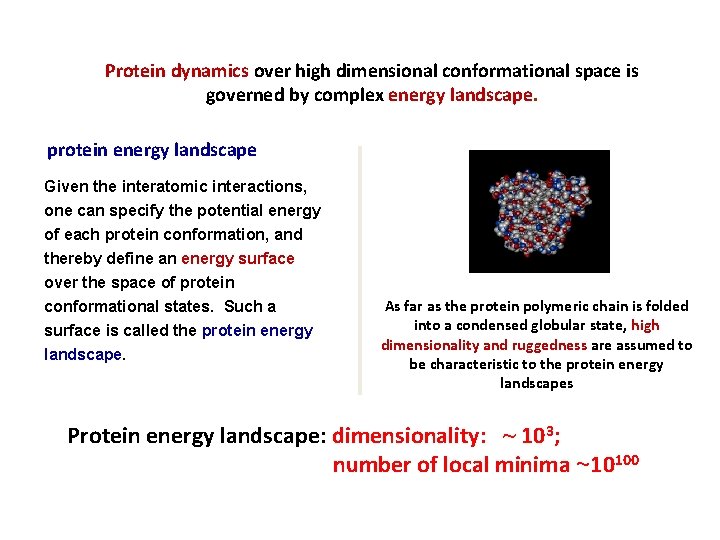
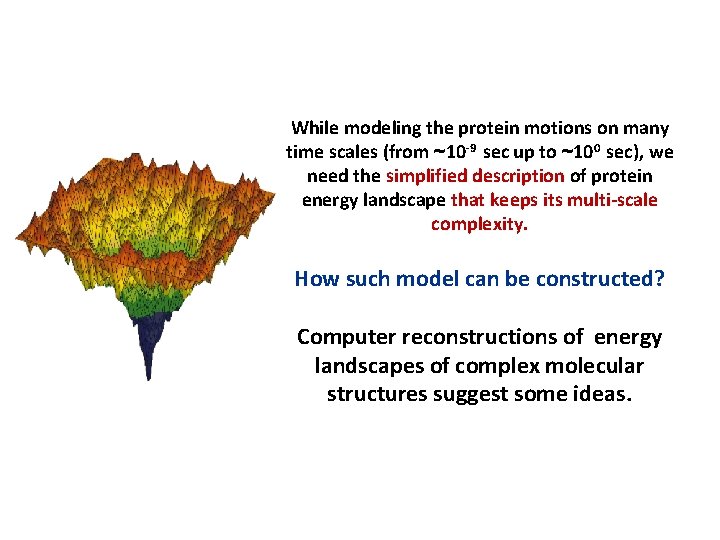
Protein dynamics over high dimensional conformational space is governed by complex energy landscape. protein energy landscape Given the interatomic interactions, one can specify the potential energy of each protein conformation, and thereby define an energy surface over the space of protein conformational states. Such a surface is called the protein energy landscape. As far as the protein polymeric chain is folded into a condensed globular state, high dimensionality and ruggedness are assumed to be characteristic to the protein energy landscapes Protein energy landscape: dimensionality: ~ 103; number of local minima ~10100
While modeling the protein motions on many time scales (from ~10 -9 sec up to ~100 sec), we need the simplified description of protein energy landscape that keeps its multi-scale complexity. How such model can be constructed? Computer reconstructions of energy landscapes of complex molecular structures suggest some ideas.
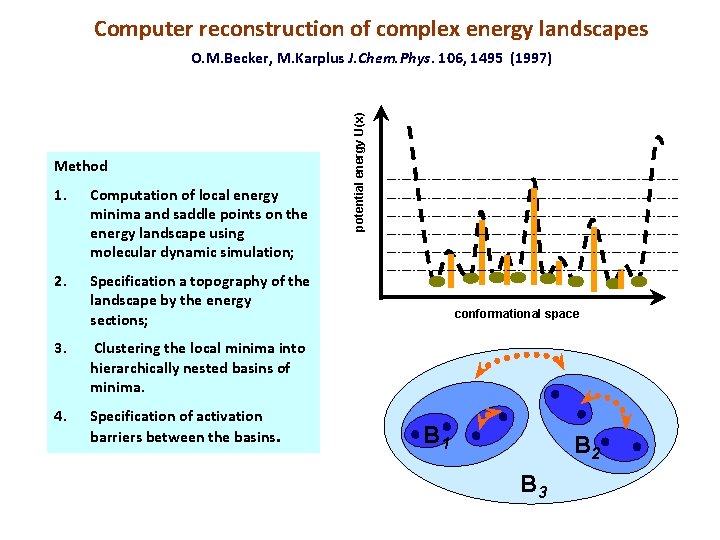
Computer reconstruction of complex energy landscapes Method 1. Computation of local energy minima and saddle points on the energy landscape using molecular dynamic simulation; 2. Specification a topography of the landscape by the energy sections; 3. Clustering the local minima into hierarchically nested basins of minima. 4. Specification of activation barriers between the basins. potential energy U(x) O. M. Becker, M. Karplus J. Chem. Phys. 106, 1495 (1997) conformational space B 1 B 2 B 3
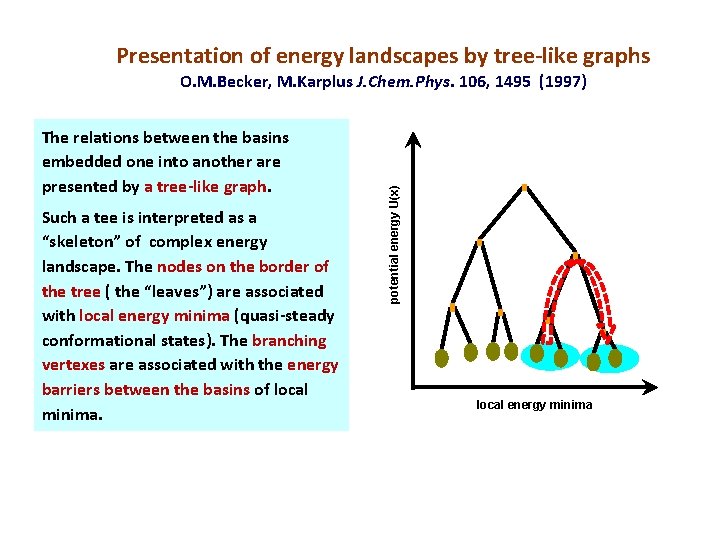
Presentation of energy landscapes by tree-like graphs The relations between the basins embedded one into another are presented by a tree-like graph. Such a tee is interpreted as a “skeleton” of complex energy landscape. The nodes on the border of the tree ( the “leaves”) are associated with local energy minima (quasi-steady conformational states). The branching vertexes are associated with the energy barriers between the basins of local minima. potential energy U(x) O. M. Becker, M. Karplus J. Chem. Phys. 106, 1495 (1997) local energy minima
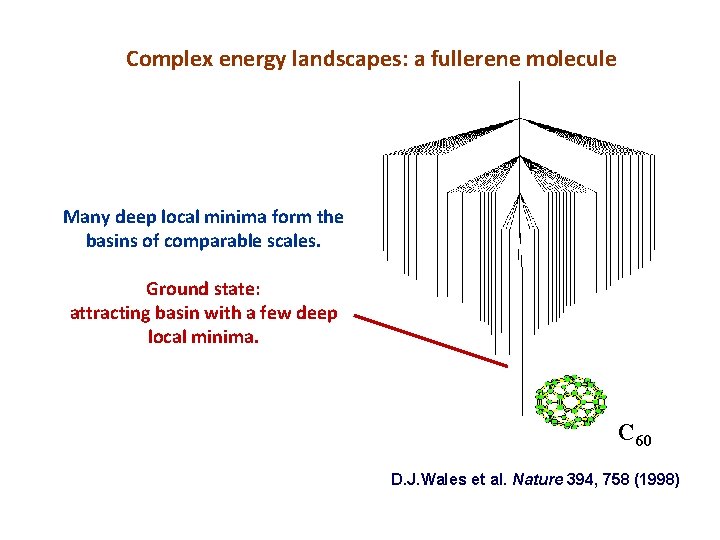
Complex energy landscapes: a fullerene molecule Many deep local minima form the basins of comparable scales. Ground state: attracting basin with a few deep local minima. C 60 D. J. Wales et al. Nature 394, 758 (1998)
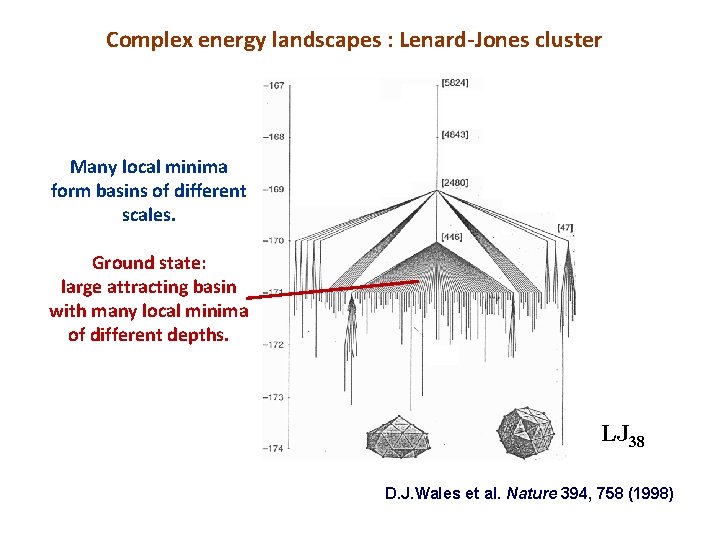
Complex energy landscapes : Lenard-Jones cluster Many local minima form basins of different scales. Ground state: large attracting basin with many local minima of different depths. LJ 38 D. J. Wales et al. Nature 394, 758 (1998)
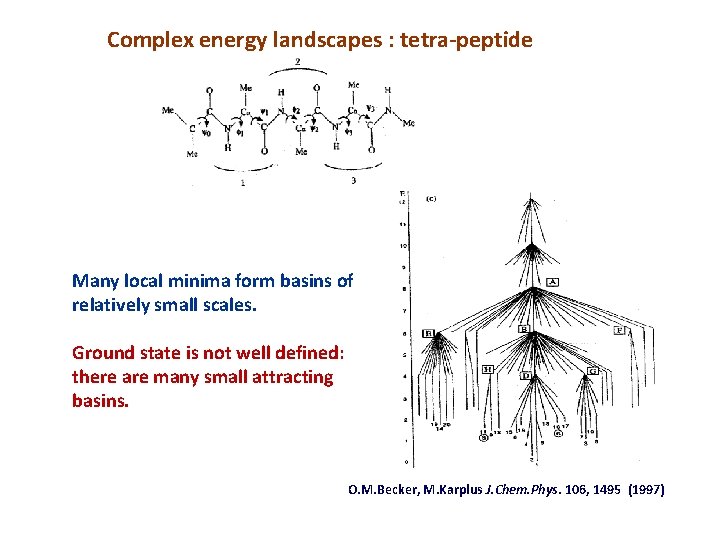
Complex energy landscapes : tetra-peptide Many local minima form basins of relatively small scales. Ground state is not well defined: there are many small attracting basins. O. M. Becker, M. Karplus J. Chem. Phys. 106, 1495 (1997)
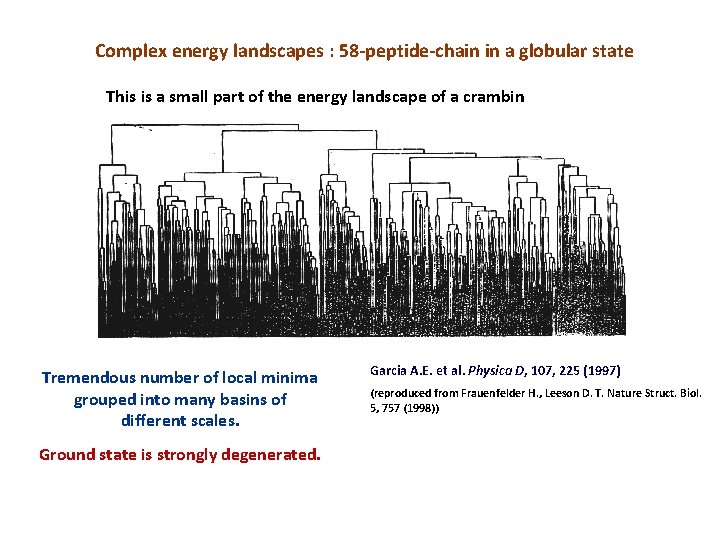
Complex energy landscapes : 58 -peptide-chain in a globular state This is a small part of the energy landscape of a crambin Tremendous number of local minima grouped into many basins of different scales. Ground state is strongly degenerated. Garcia A. E. et al. Physica D, 107, 225 (1997) (reproduced from Frauenfelder H. , Leeson D. T. Nature Struct. Biol. 5, 757 (1998))
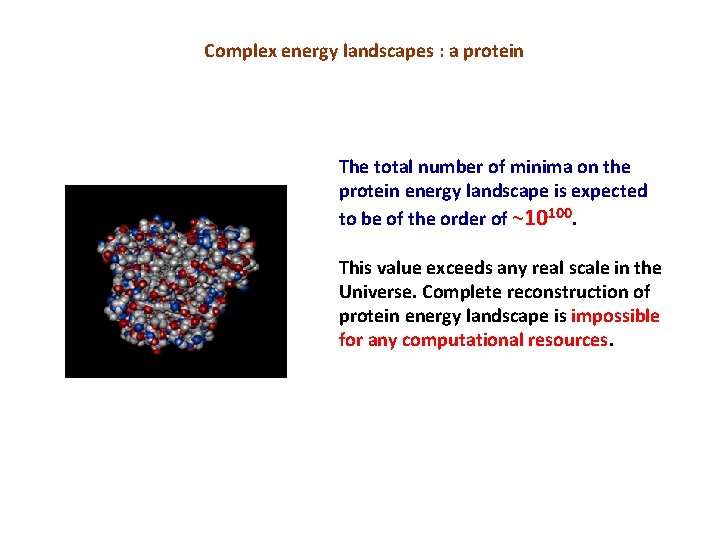
Complex energy landscapes : a protein The total number of minima on the protein energy landscape is expected to be of the order of ~10100. This value exceeds any real scale in the Universe. Complete reconstruction of protein energy landscape is impossible for any computational resources.
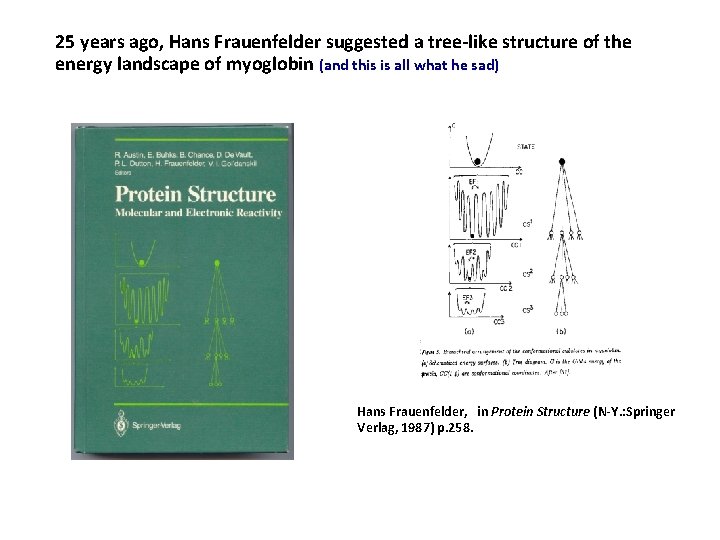
25 years ago, Hans Frauenfelder suggested a tree-like structure of the energy landscape of myoglobin (and this is all what he sad) Hans Frauenfelder, in Protein Structure (N-Y. : Springer Verlag, 1987) p. 258.
10 years later, Martin Karplus suggested the same idea “In <…> proteins, for example, where individual states are usually clustered in “basins”, the interesting kinetics involves basin-to-basin transitions. The internal distribution within a basin is expected to approach equilibrium on a relatively short time scale, while the slower basin-to-basin kinetics, which involves the crossing of higher barriers, governs the intermediate and long time behavior of the system. ” Becker O. M. , Karplus M. J. Chem. Phys. , 1997, 106, 1495 This is exactly the physical meaning of protein ultrameticity !
That is, the conformational dynamics of a protein molecule is approximated by a random process on the boundary of tree-like graph that represents the protein energy landscape.
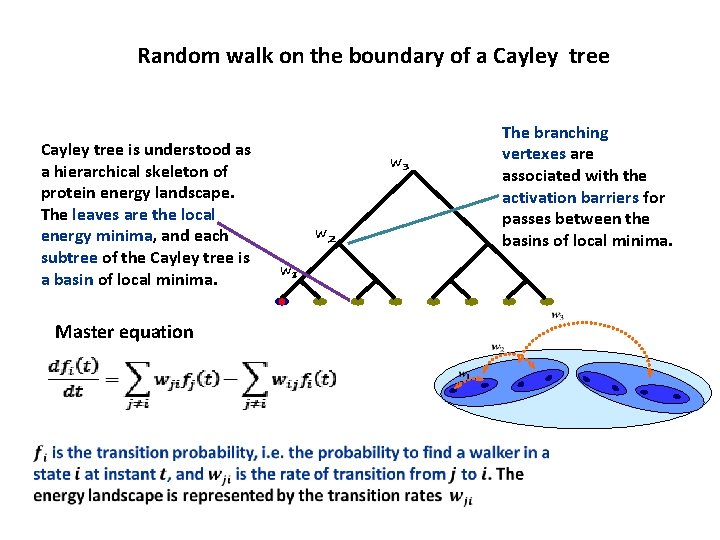
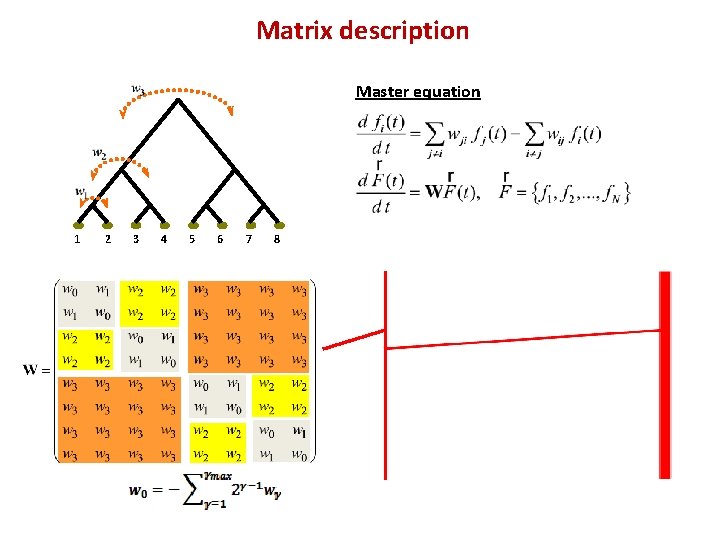
Random walk on the boundary of a Cayley tree is understood as a hierarchical skeleton of protein energy landscape. The leaves are the local energy minima, and each subtree of the Cayley tree is a basin of local minima. Master equation w 3 w 2 w 1 The branching vertexes are associated with the activation barriers for passes between the basins of local minima.
Matrix description Master equation 1 2 3 4 5 6 7 8
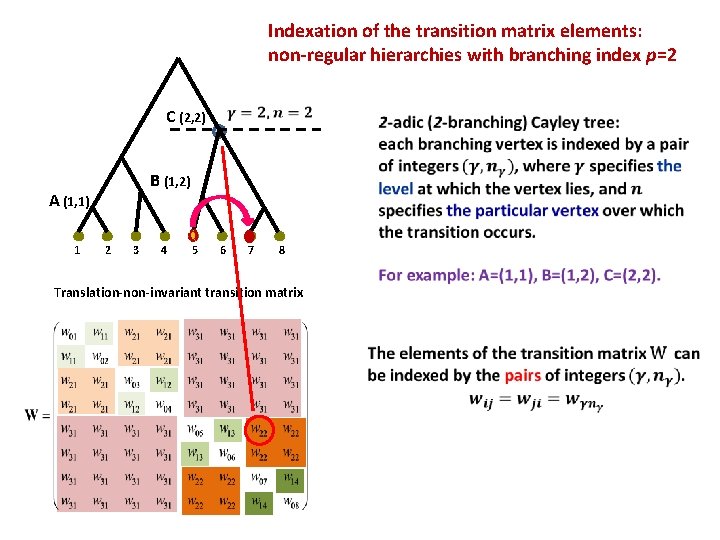
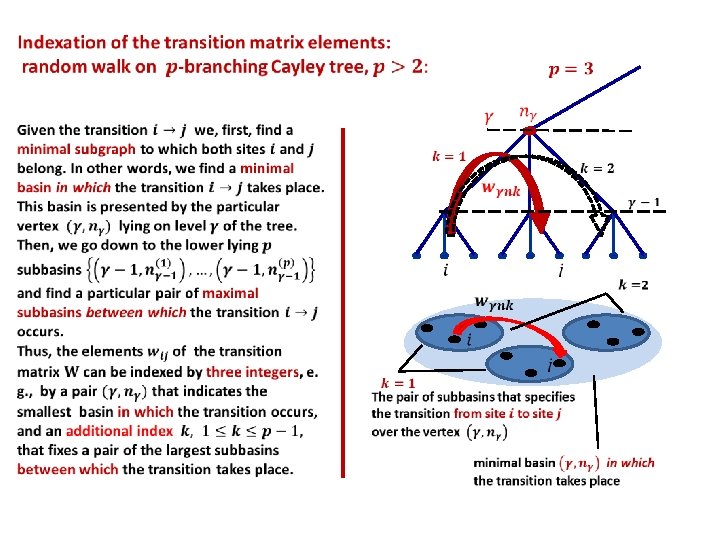
Indexation of the transition matrix elements: non-regular hierarchies with branching index p=2 C (2, 2) B (1, 2) A (1, 1) 1 2 3 4 5 6 7 8 Translation-non-invariant transition matrix
Eigen vectors and eigenvalues of symmetric block-hierarchical transition matrices
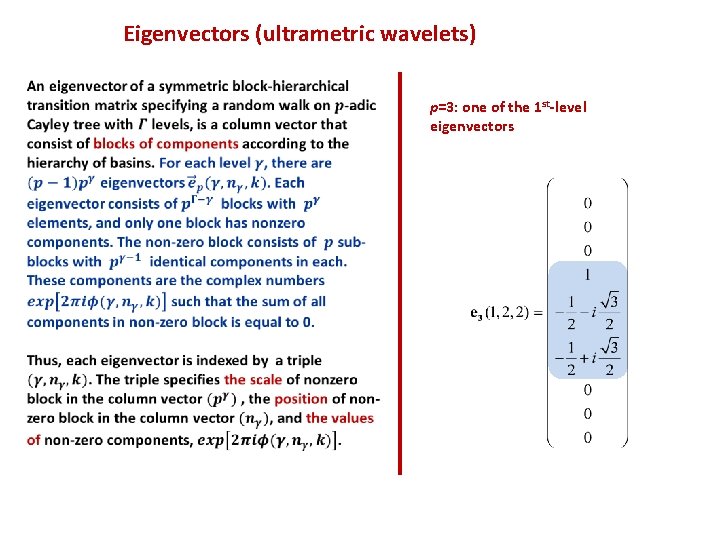
Eigenvectors (ultrametric wavelets) р=3: one of the 1 st-level eigenvectors
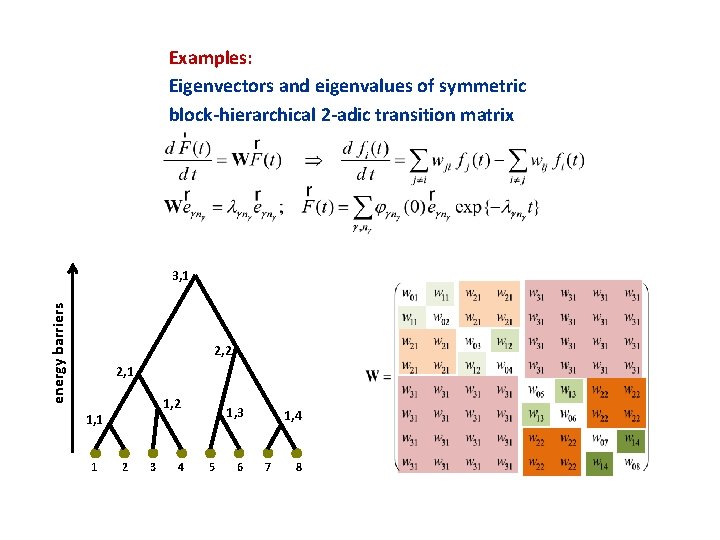
Examples: Eigenvectors and eigenvalues of symmetric block-hierarchical 2 -adic transition matrix energy barriers 3, 1 2, 2 2, 1 1, 2 1, 1 1 2 3 4 1, 3 5 6 1, 4 7 8
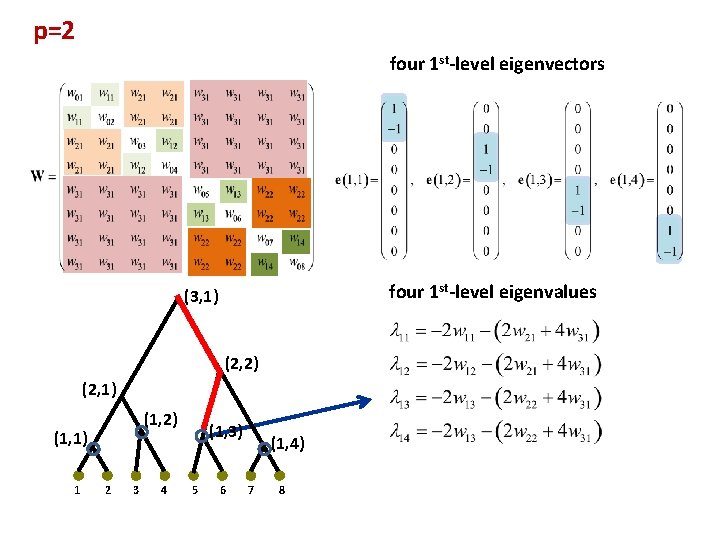
p=2 four 1 st-level eigenvectors four 1 st-level eigenvalues (3, 1) (2, 2) (2, 1) (1, 2) (1, 1) 1 2 3 4 (1, 3) 5 6 (1, 4) 7 8
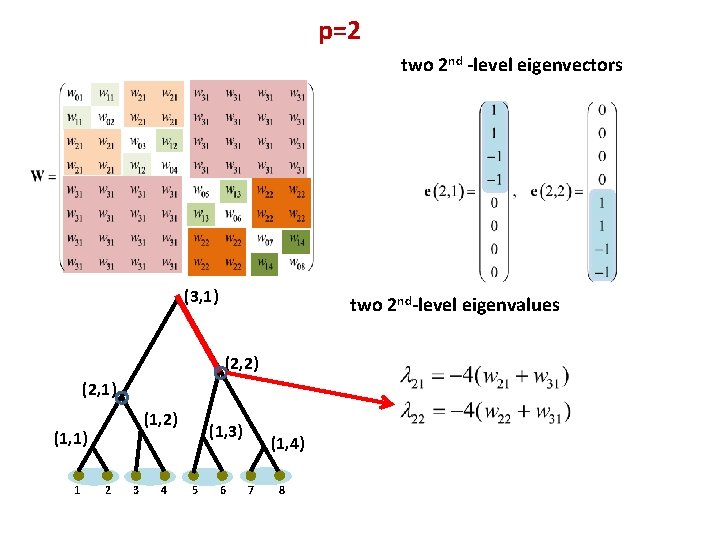
p=2 two 2 nd -level eigenvectors (3, 1) two 2 nd-level eigenvalues (2, 2) (2, 1) (1, 2) (1, 1) 1 2 3 4 (1, 3) 5 6 (1, 4) 7 8
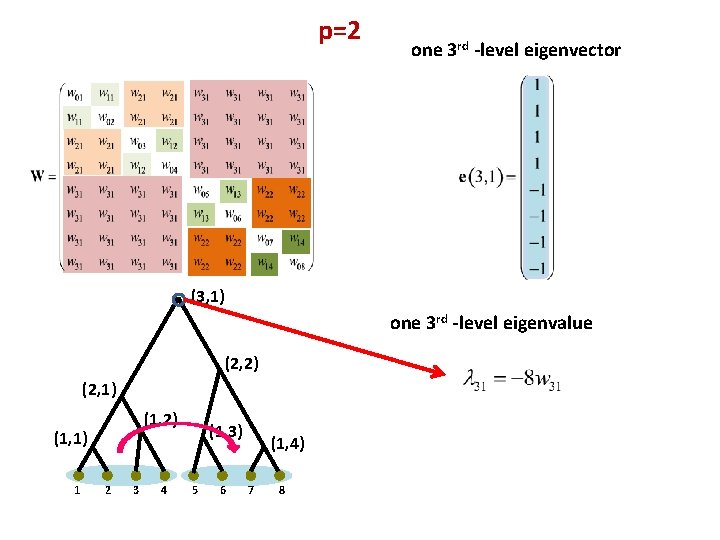
p=2 one 3 rd -level eigenvector (3, 1) one 3 rd -level eigenvalue (2, 2) (2, 1) (1, 2) (1, 1) 1 2 3 4 (1, 3) 5 6 (1, 4) 7 8
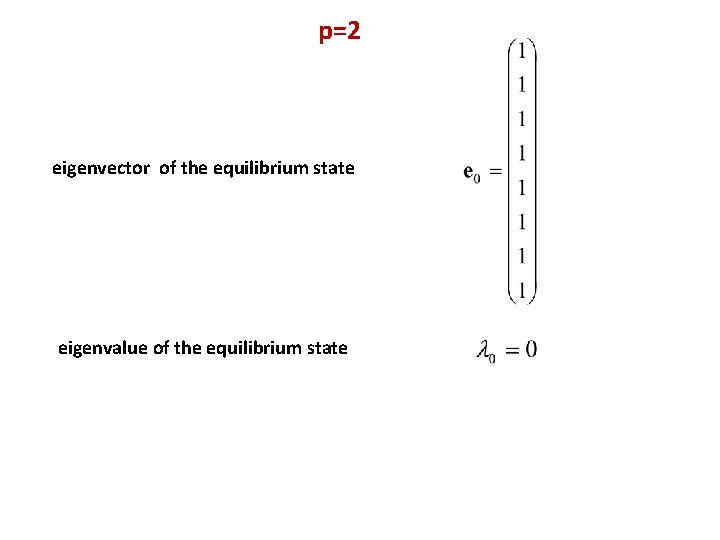
p=2 eigenvector of the equilibrium state eigenvalue of the equilibrium state
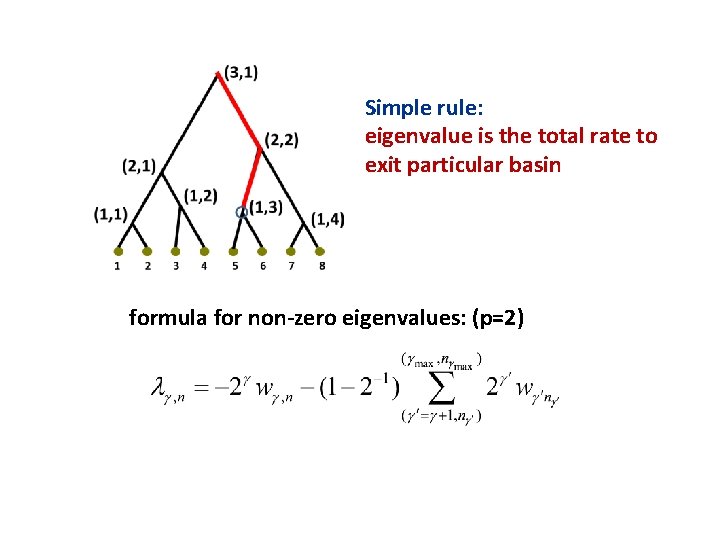
Simple rule: eigenvalue is the total rate to exit particular basin formula for non-zero eigenvalues: (p=2)
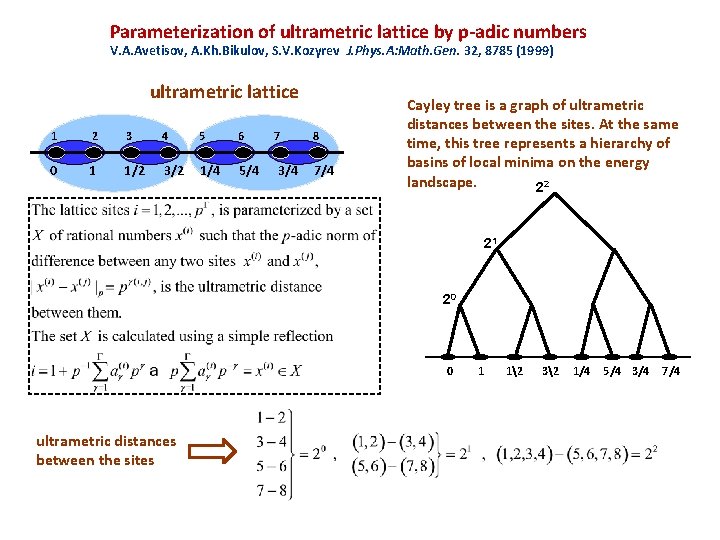
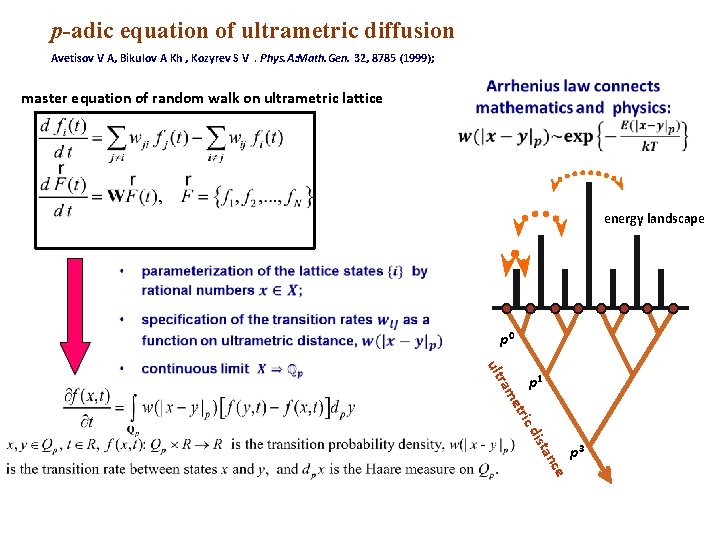
p-Adic description of ultrametric random walk The basic idea: In the basin-to-basin approximation, the distances between the protein states are ultrametric, so they can be specified by the padic numerical norm, and transition rates can be indexed by the p-adic numbers.
Parameterization of ultrametric lattice by p-adic numbers V. A. Avetisov, A. Kh. Bikulov, S. V. Kozyrev J. Phys. A: Math. Gen. 32, 8785 (1999) ultrametric lattice 1 2 3 4 5 6 0 1 1/2 3/2 1/4 5/4 7 3/4 8 7/4 Cayley tree is a graph of ultrametric distances between the sites. At the same time, this tree represents a hierarchy of basins of local minima on the energy landscape. 22 21 20 0 ultrametric distances between the sites 1 12 32 1/4 5/4 3/4 7/4
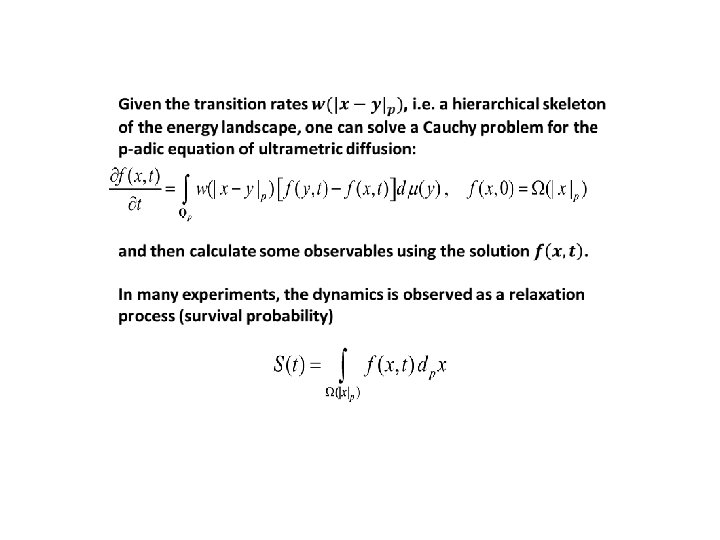
р-adic equation of ultrametric diffusion Avetisov V A, Bikulov A Kh , Kozyrev S V. Phys. A: Math. Gen. 32, 8785 (1999); master equation of random walk on ultrametric lattice energy landscape p 0 ic d etr ram ult p 1 ce an ist p 3
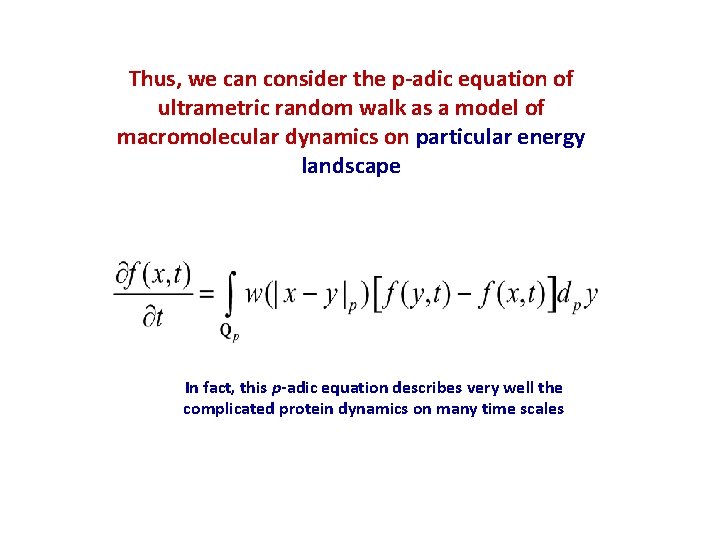
Thus, we can consider the p-adic equation of ultrametric random walk as a model of macromolecular dynamics on particular energy landscape In fact, this p-adic equation describes very well the complicated protein dynamics on many time scales
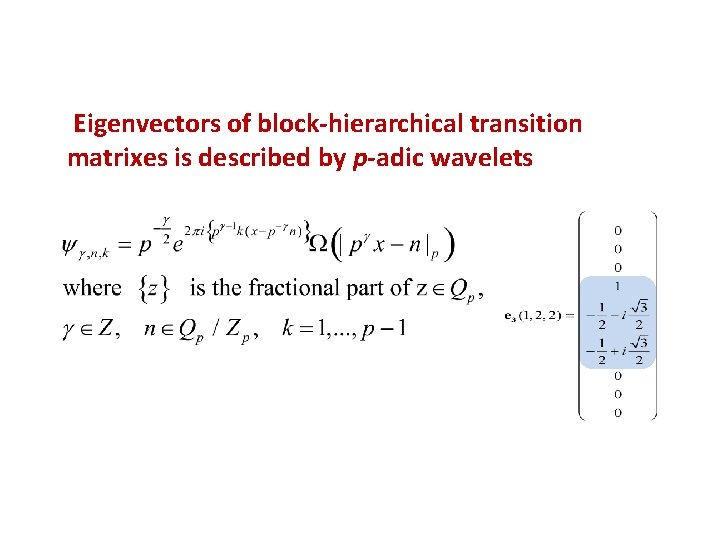
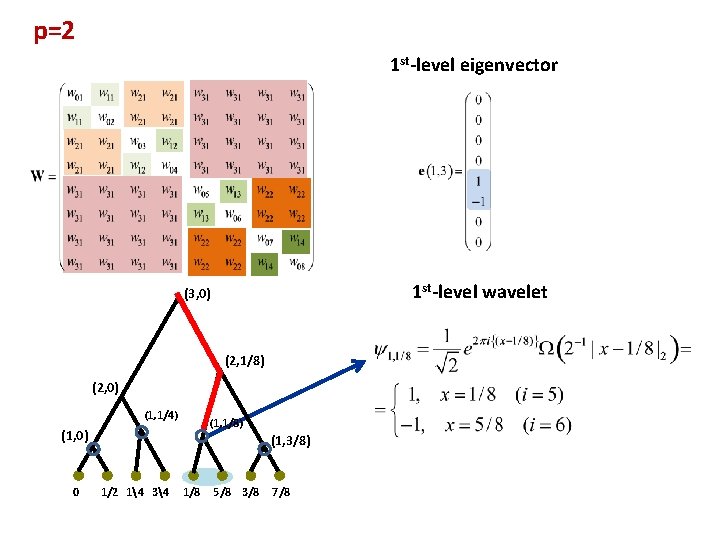
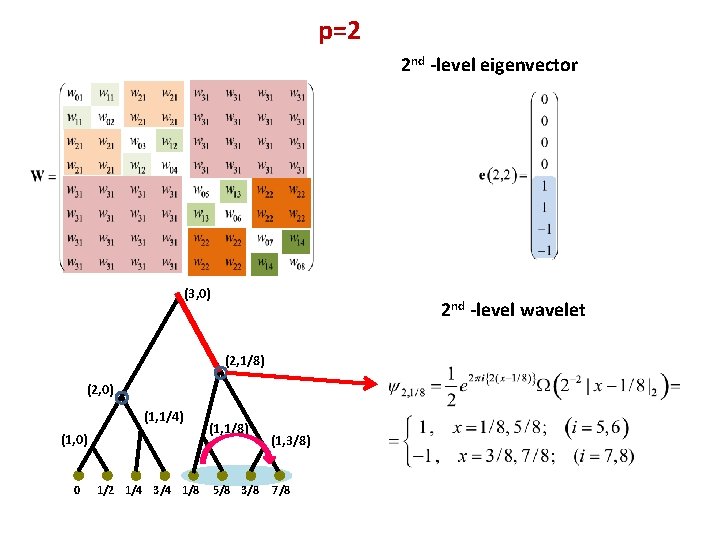
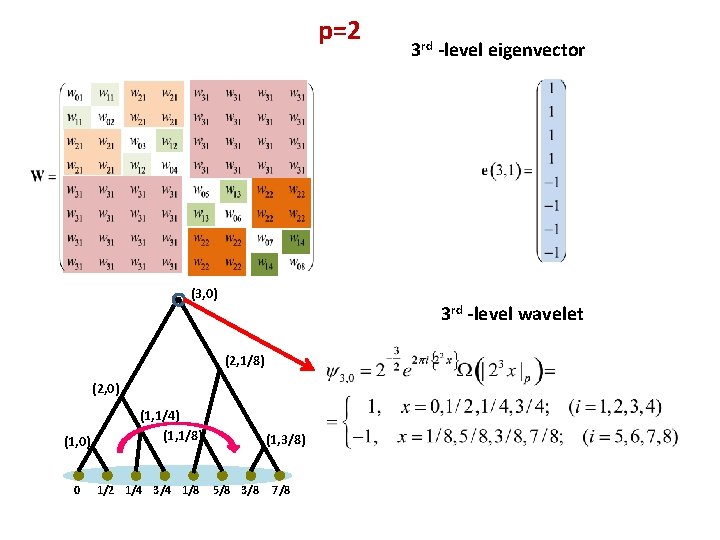
Eigenvectors of block-hierarchical transition matrixes is described by p-adic wavelets
p=2 1 st-level eigenvector 1 st-level wavelet (3, 0) (2, 1/8) (2, 0) (1, 1/4) (1, 1/8) (1, 0) 0 (1, 3/8) 1/2 14 34 1/8 5/8 3/8 7/8
p=2 2 nd -level eigenvector (3, 0) 2 nd -level wavelet (2, 1/8) (2, 0) (1, 1/4) (1, 0) 0 1/2 1/4 3/4 1/8 (1, 1/8) 5/8 3/8 (1, 3/8) 7/8
p=2 (3, 0) 3 rd -level wavelet (2, 1/8) (2, 0) (1, 0) 0 (1, 1/4) (1, 1/8) 1/2 1/4 3/4 1/8 3 rd -level eigenvector (1, 3/8) 5/8 3/8 7/8
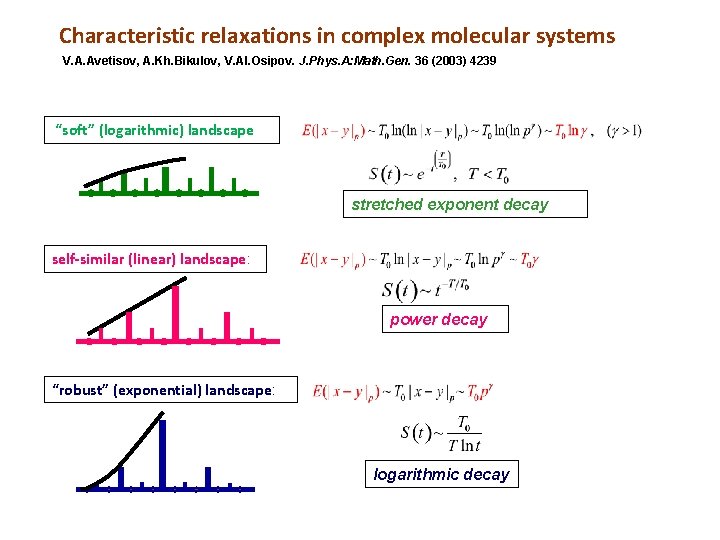
Characteristic relaxations in complex molecular systems V. A. Avetisov, A. Kh. Bikulov, V. Al. Osipov. J. Phys. A: Math. Gen. 36 (2003) 4239 “soft” (logarithmic) landscape stretched exponent decay self-similar (linear) landscape: power decay “robust” (exponential) landscape: logarithmic decay
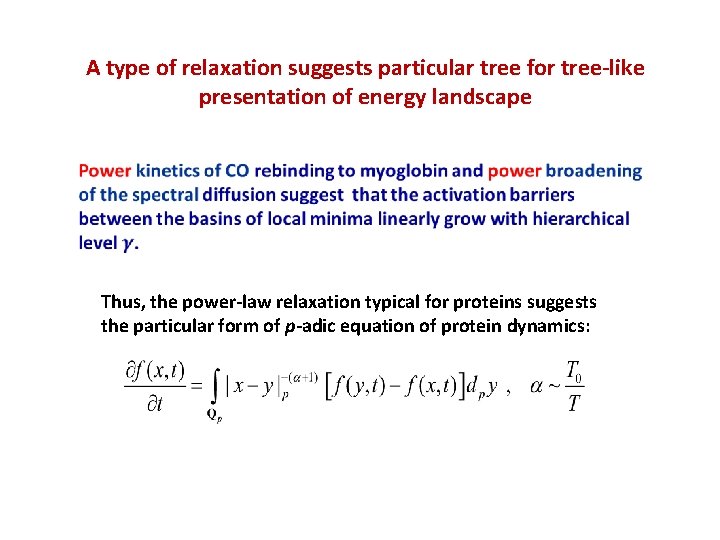
A type of relaxation suggests particular tree for tree-like presentation of energy landscape Thus, the power-law relaxation typical for proteins suggests the particular form of p-adic equation of protein dynamics:
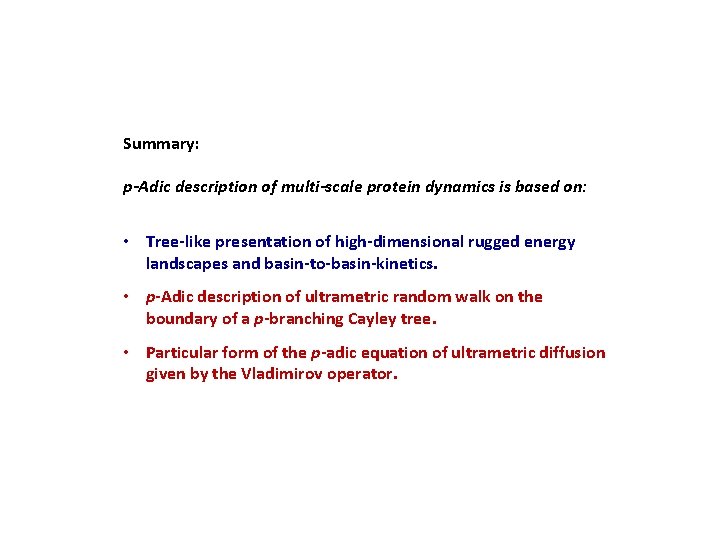
Summary: p-Adic description of multi-scale protein dynamics is based on: • Tree-like presentation of high-dimensional rugged energy landscapes and basin-to-basin-kinetics. • p-Adic description of ultrametric random walk on the boundary of a p-branching Cayley tree. • Particular form of the p-adic equation of ultrametric diffusion given by the Vladimirov operator.
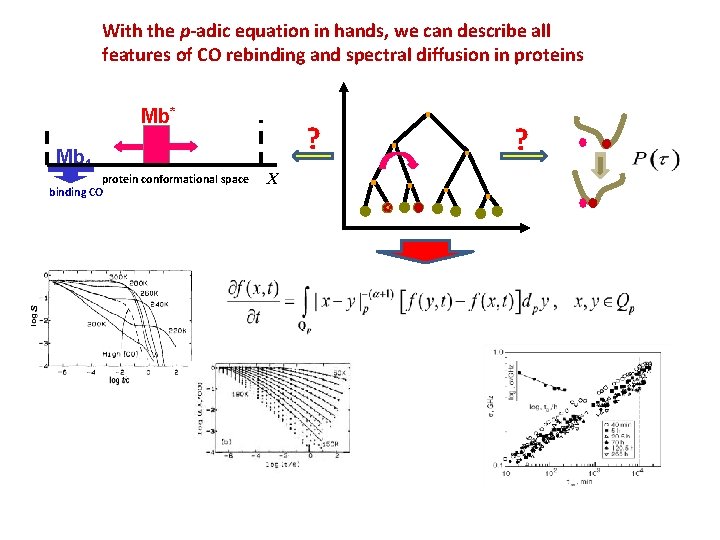
With the p-adic equation in hands, we can describe all features of CO rebinding and spectral diffusion in proteins Mb* Mb 1 protein conformational space binding CO ? X ?