
Introduction to NMMB Dynamics How it differs from
Introduction to NMMB Dynamics: How it differs from WRF-NMM Dynamics Zavisa Janjic NOAA/NWS/NCEP/EMC, College Park, MD Zavisa Janjic
Basic Principles Forecast accuracy Fully compressible equations Discretization methods that minimize generation of computational noise and reduce or eliminate need for numerical filters Computational efficiency, robustness Janjic, Z. , and R. L. Gall, 2012: Scientific documentation of the NCEP nonhydrostatic multiscale model on the B grid (NMMB). Part 1 Dynamics. NCAR Technical Note NCAR/TN-489+STR, DOI: 10. 5065/D 6 WH 2 MZX. http: //nldr. library. ucar. edu/repository/assets/technotes/TECH-NOTE-000 -857. pdf Zavisa Janjic
Nonhydrostatic Multiscale Model on the B grid (NMMB) Wide range of spatial and temporal scales (meso to global, and weather to climate) Built on NWP and regional climate experience by relaxing hydrostatic approximation rather than by extending a cloud model to synoptic scales (Janjic et al. , 2001, MWR; Janjic, 2003, MAP) Further evolution of WRF Nonhydrostatic Mesoscale Model (NMM) (Janjic, 2005, EGU; Janjic & Black, 2007, EGU; Janjic & Gall 2012, NCAR) Add-on nonhydrostatic module Easy comparison of hydrostatic and nonhydrostatic solutions Reduced computational effort at lower resolutions Pressure based vertical coordinate, nondivergent flow remains on coordinate surfaces Zavisa Janjic
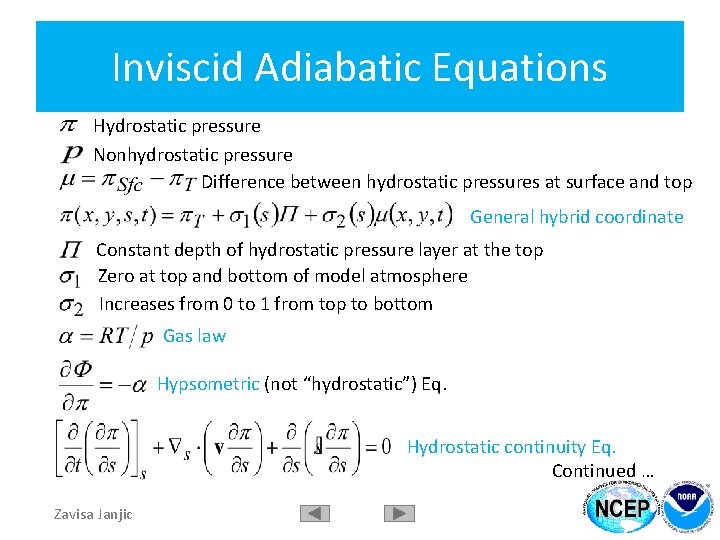
Inviscid Adiabatic Equations Hydrostatic pressure Nonhydrostatic pressure Difference between hydrostatic pressures at surface and top General hybrid coordinate Constant depth of hydrostatic pressure layer at the top Zero at top and bottom of model atmosphere Increases from 0 to 1 from top to bottom Gas law Hypsometric (not “hydrostatic”) Eq. Hydrostatic continuity Eq. Continued … Zavisa Janjic
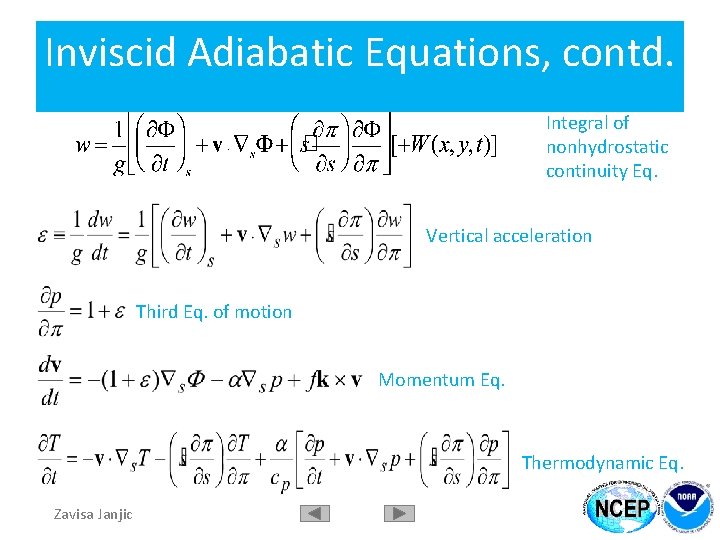
Inviscid Adiabatic Equations, contd. Integral of nonhydrostatic continuity Eq. Vertical acceleration Third Eq. of motion Momentum Eq. Thermodynamic Eq. Zavisa Janjic
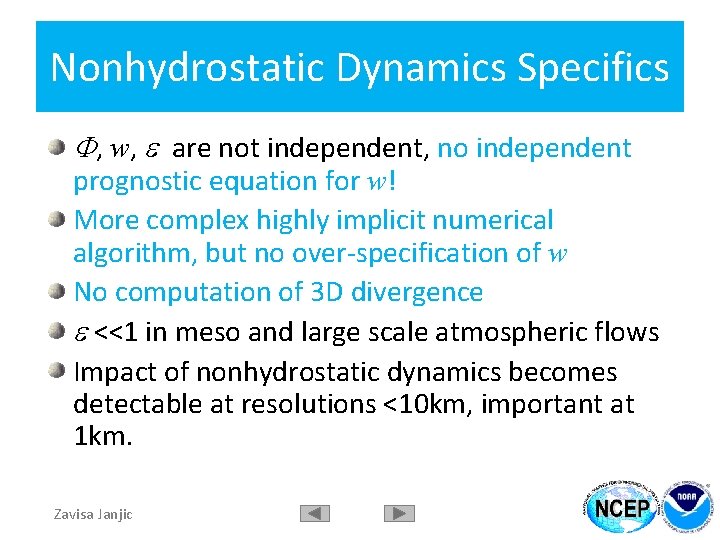
Nonhydrostatic Dynamics Specifics F, w, e are not independent, no independent prognostic equation for w! More complex highly implicit numerical algorithm, but no over-specification of w No computation of 3 D divergence e <<1 in meso and large scale atmospheric flows Impact of nonhydrostatic dynamics becomes detectable at resolutions <10 km, important at 1 km. Zavisa Janjic
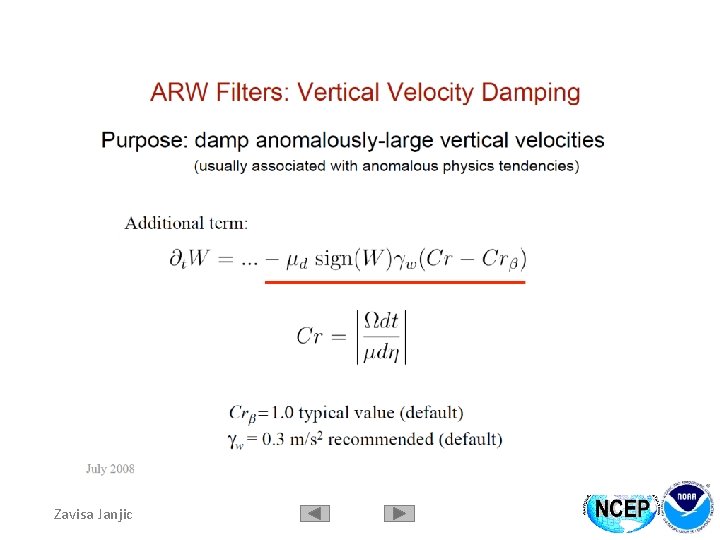
Zavisa Janjic
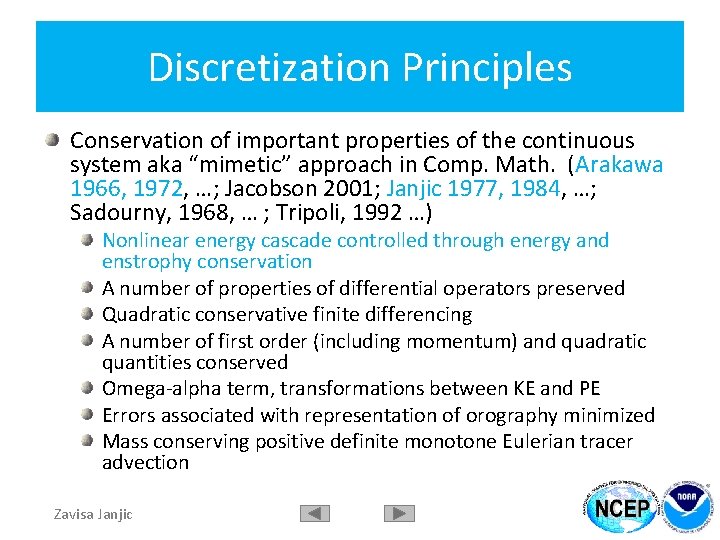
Discretization Principles Conservation of important properties of the continuous system aka “mimetic” approach in Comp. Math. (Arakawa 1966, 1972, …; Jacobson 2001; Janjic 1977, 1984, …; Sadourny, 1968, … ; Tripoli, 1992 …) Nonlinear energy cascade controlled through energy and enstrophy conservation A number of properties of differential operators preserved Quadratic conservative finite differencing A number of first order (including momentum) and quadratic quantities conserved Omega-alpha term, transformations between KE and PE Errors associated with representation of orography minimized Mass conserving positive definite monotone Eulerian tracer advection Zavisa Janjic
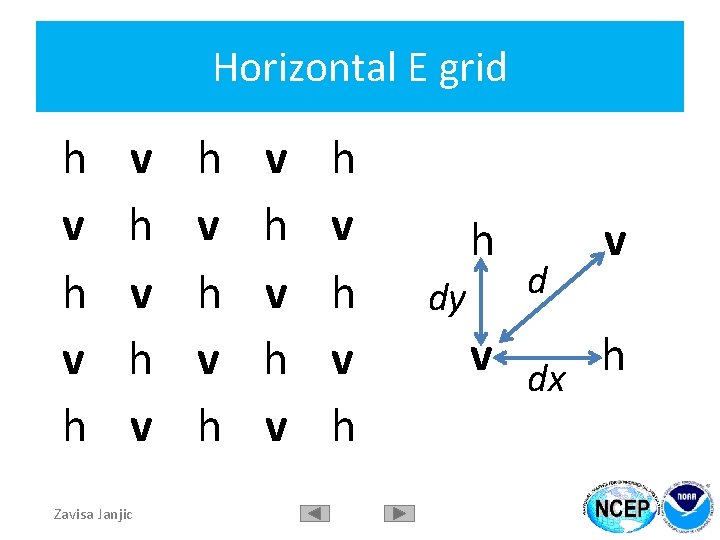
Horizontal E grid h v h v h v Zavisa Janjic h v h v h h dy d v v dx h
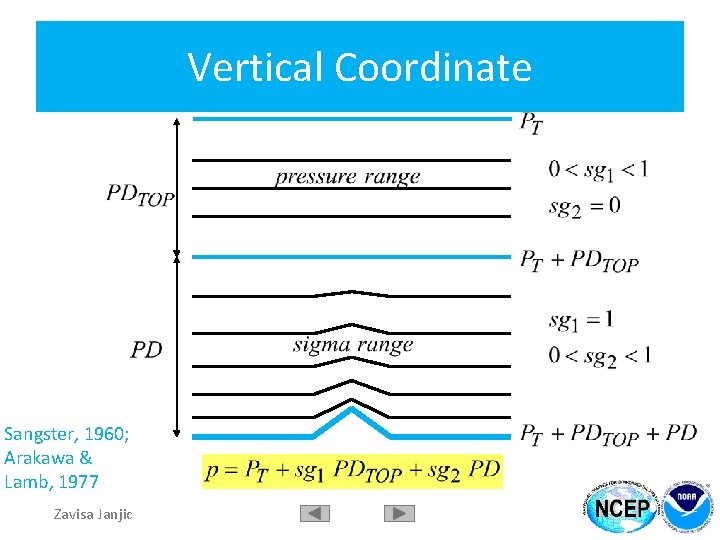
Vertical Coordinate Sangster, 1960; Arakawa & Lamb, 1977 Zavisa Janjic
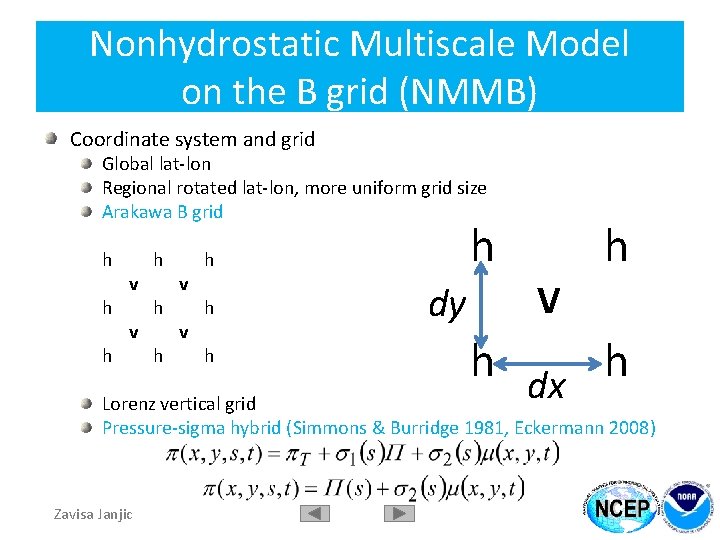
Nonhydrostatic Multiscale Model on the B grid (NMMB) Coordinate system and grid Global lat-lon Regional rotated lat-lon, more uniform grid size Arakawa B grid h h h v v h h dy h V h dx h Lorenz vertical grid Pressure-sigma hybrid (Simmons & Burridge 1981, Eckermann 2008) Zavisa Janjic
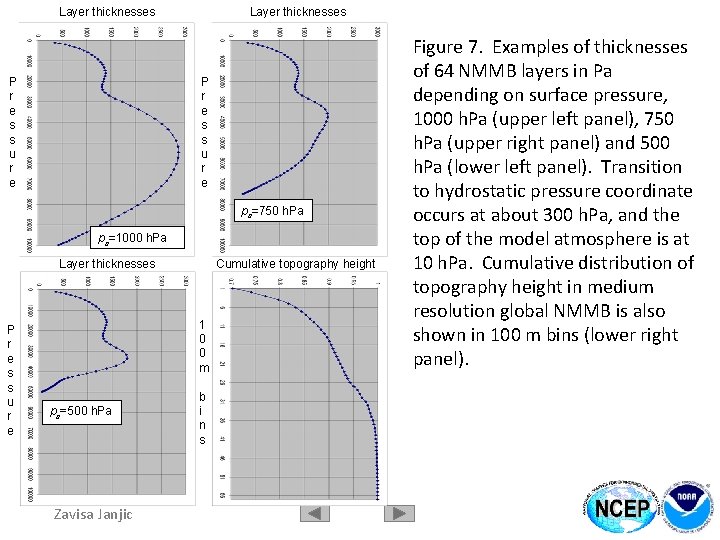
Layer thicknesses P r e s s u r e ps=750 h. Pa ps=1000 h. Pa Layer thicknesses P r e s s u r e Cumulative topography height 1 0 0 m ps=500 h. Pa Zavisa Janjic b i n s Figure 7. Examples of thicknesses of 64 NMMB layers in Pa depending on surface pressure, 1000 h. Pa (upper left panel), 750 h. Pa (upper right panel) and 500 h. Pa (lower left panel). Transition to hydrostatic pressure coordinate occurs at about 300 h. Pa, and the top of the model atmosphere is at 10 h. Pa. Cumulative distribution of topography height in medium resolution global NMMB is also shown in 100 m bins (lower right panel).
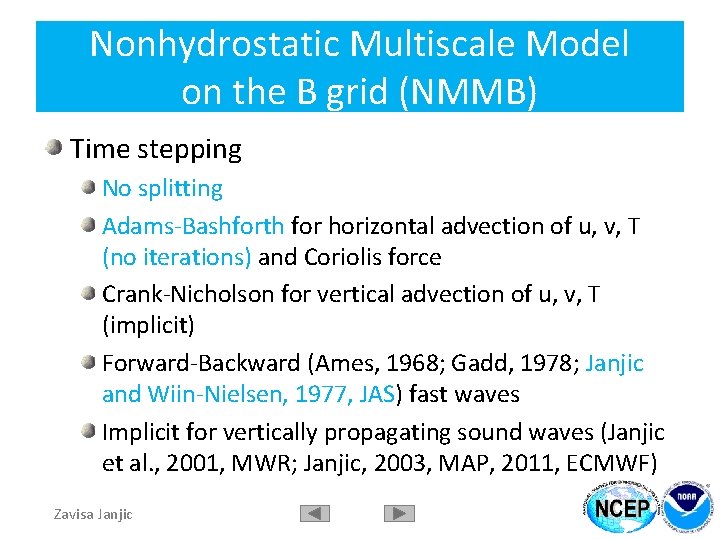
Nonhydrostatic Multiscale Model on the B grid (NMMB) Time stepping No splitting Adams-Bashforth for horizontal advection of u, v, T (no iterations) and Coriolis force Crank-Nicholson for vertical advection of u, v, T (implicit) Forward-Backward (Ames, 1968; Gadd, 1978; Janjic and Wiin-Nielsen, 1977, JAS) fast waves Implicit for vertically propagating sound waves (Janjic et al. , 2001, MWR; Janjic, 2003, MAP, 2011, ECMWF) Zavisa Janjic
WRF NMM Lateral Boundary Conditions Specified from the driving model along external boundaries 4 -point averaging along first internal row (Mesinger and Janjic, 1974; Miyakoda and Rosati, 1977; Mesinger, 1977) Upstream advection area next to the boundaries from 2 nd internal row Advection well posed along the boundaries, no computational boundary condition needed Dissipative HWRF internal nesting discussed elsewhere Zavisa Janjic
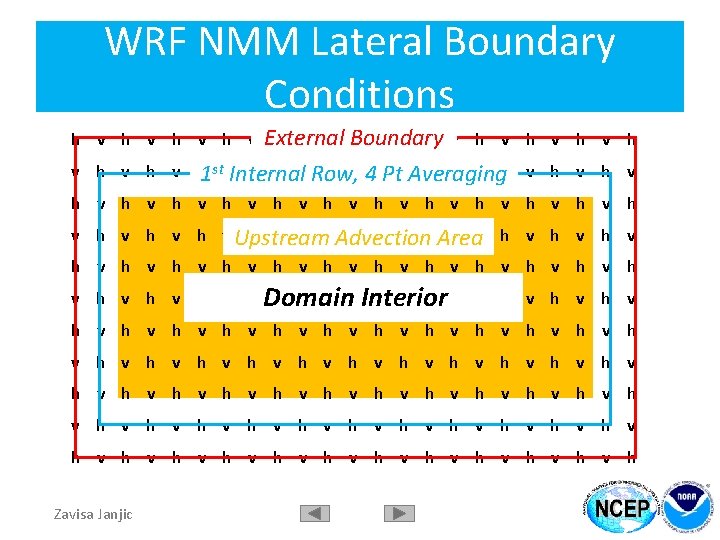
WRF NMM Lateral Boundary Conditions h v h v External h v. Boundary h v h v h 1 stv. Internal h v h Row, v h 4 v. Pth. Averaging v h v h v h v h v h v Upstream h v Advection h v Area h v h v h v h v h v h Domain v h Interior v h v h v h v h v h v h v h v h v h v h v h v h v h v h v h v h Zavisa Janjic
Nonhydrostatic Multiscale Model on the B grid (NMMB) Regional domain lateral boundaries Narrow zone with upstream advection, no computational outflow BC for advection No 4 -point averaging, not needed Blending zone NMMB internal lateral boundaries addressed elsewhere Zavisa Janjic
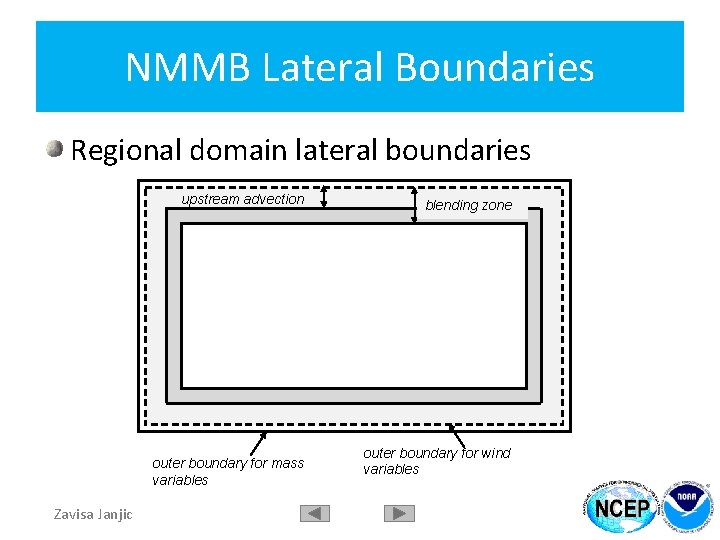
NMMB Lateral Boundaries Regional domain lateral boundaries upstream advection outer boundary for mass variables Zavisa Janjic blending zone outer boundary for wind variables
NMMB Physics Upgraded NCEP WRF NMM “standard” physical package RRTM, GFDL radiation NOAH, LISS land surface models Mellor-Yamada-Janjic turbulence Ferrier microphysics Betts-Miller-Janjic convection Extensions NEMS GFS physics Separate SAS, Zhao, Thompson, GFS PBL, WSM 6. . . Zavisa Janjic
Atmospheric Spectrum Reformulating advection terms from E to B grid was most difficult False nonlinear energy cascade (Phillips, 1954; Arakawa, 1966 … ; Sadourny 1975; …) major generator of excessive small scale noise Other computational errors Historically, problem controlled by: Removing spurious small scale energy by numerical filtering, dissipation Preventing excessive noise generation by enstrophy and energy conservation (Arakawa, 1966 …) Zavisa Janjic
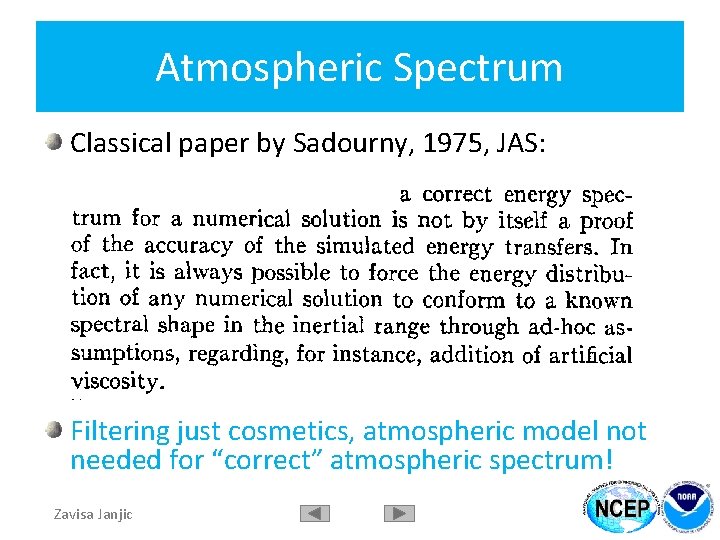
Atmospheric Spectrum Classical paper by Sadourny, 1975, JAS: Filtering just cosmetics, atmospheric model not needed for “correct” atmospheric spectrum! Zavisa Janjic
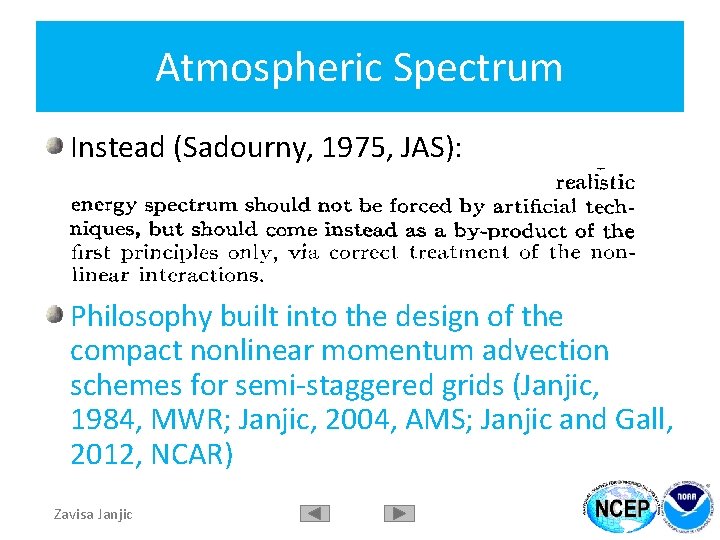
Atmospheric Spectrum Instead (Sadourny, 1975, JAS): Philosophy built into the design of the compact nonlinear momentum advection schemes for semi-staggered grids (Janjic, 1984, MWR; Janjic, 2004, AMS; Janjic and Gall, 2012, NCAR) Zavisa Janjic
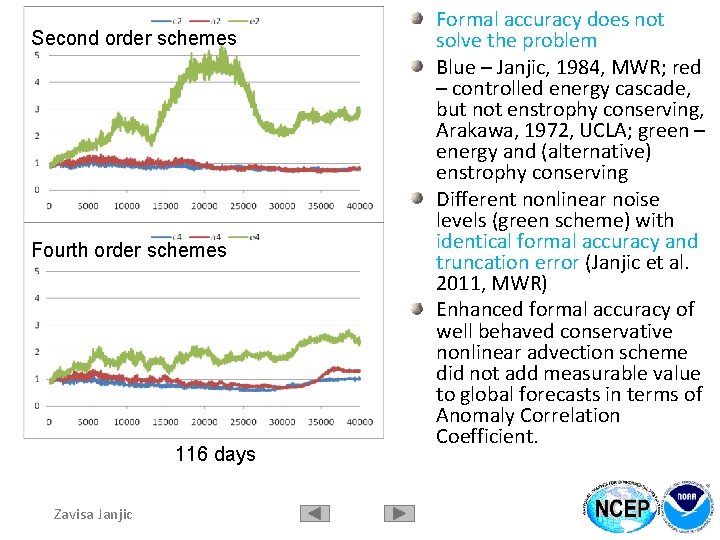
Second order schemes Fourth order schemes 116 days Zavisa Janjic Formal accuracy does not solve the problem Blue – Janjic, 1984, MWR; red – controlled energy cascade, but not enstrophy conserving, Arakawa, 1972, UCLA; green – energy and (alternative) enstrophy conserving Different nonlinear noise levels (green scheme) with identical formal accuracy and truncation error (Janjic et al. 2011, MWR) Enhanced formal accuracy of well behaved conservative nonlinear advection scheme did not add measurable value to global forecasts in terms of Anomaly Correlation Coefficient.
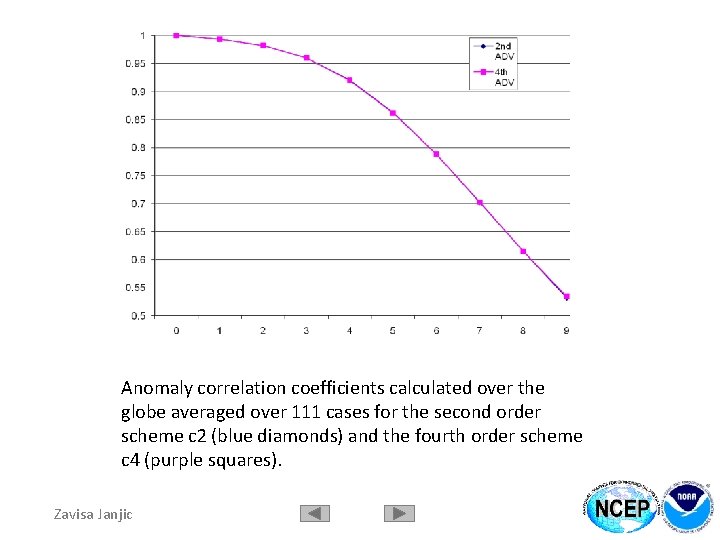
Anomaly correlation coefficients calculated over the globe averaged over 111 cases for the second order scheme c 2 (blue diamonds) and the fourth order scheme c 4 (purple squares). Zavisa Janjic
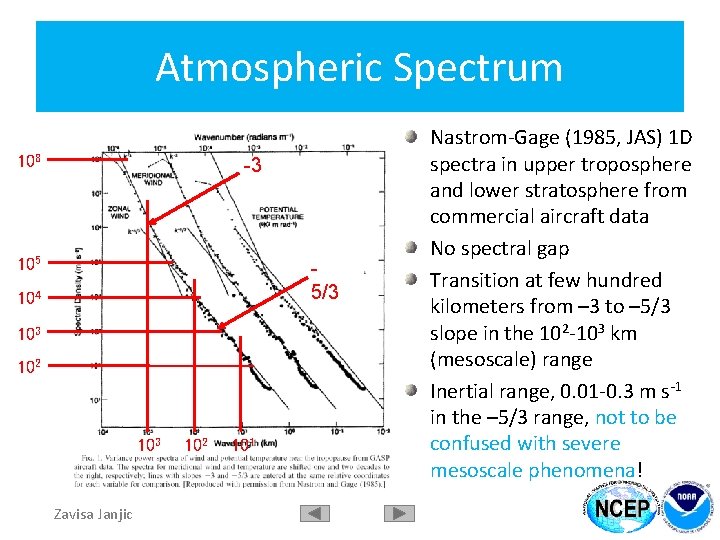
Atmospheric Spectrum 108 -3 105 5/3 104 103 102 103 Zavisa Janjic 102 101 Nastrom-Gage (1985, JAS) 1 D spectra in upper troposphere and lower stratosphere from commercial aircraft data No spectral gap Transition at few hundred kilometers from – 3 to – 5/3 slope in the 102 -103 km (mesoscale) range Inertial range, 0. 01 -0. 3 m s-1 in the – 5/3 range, not to be confused with severe mesoscale phenomena!
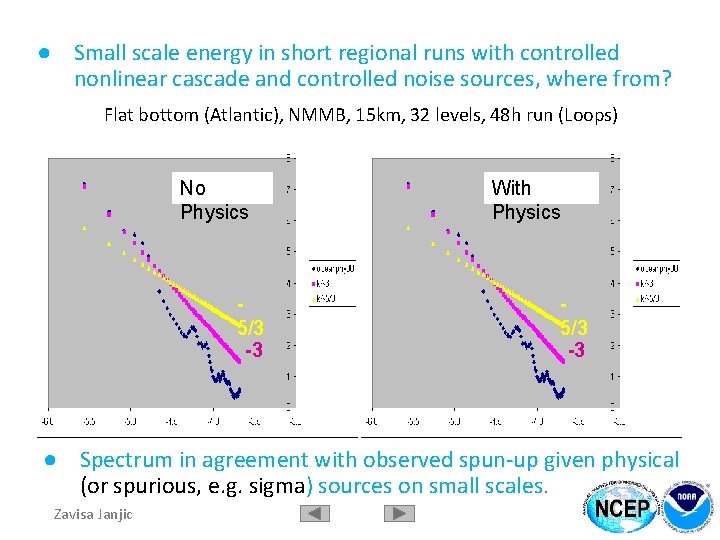
● Small scale energy in short regional runs with controlled nonlinear cascade and controlled noise sources, where from? Flat bottom (Atlantic), NMMB, 15 km, 32 levels, 48 h run (Loops) No Physics 5/3 -3 With Physics 5/3 -3 ● Spectrum in agreement with observed spun-up given physical (or spurious, e. g. sigma) sources on small scales. Zavisa Janjic
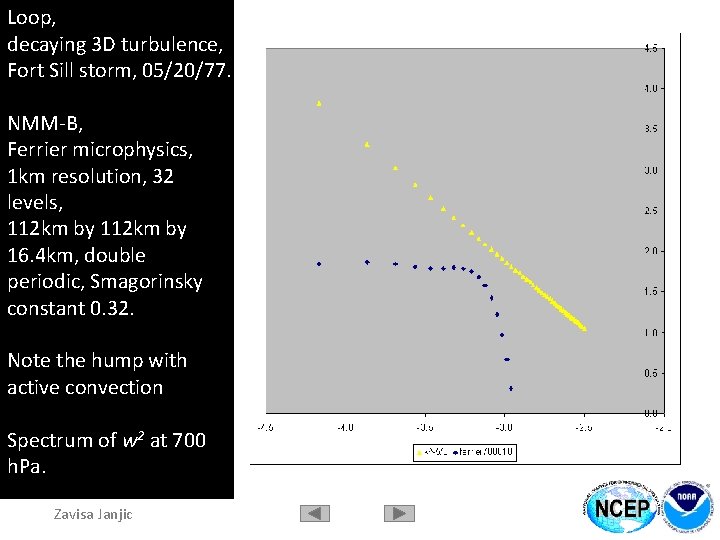
Loop, decaying 3 D turbulence, Fort Sill storm, 05/20/77. NMM-B, Ferrier microphysics, 1 km resolution, 32 levels, 112 km by 16. 4 km, double periodic, Smagorinsky constant 0. 32. Note the hump with active convection Spectrum of w 2 at 700 h. Pa. Zavisa Janjic
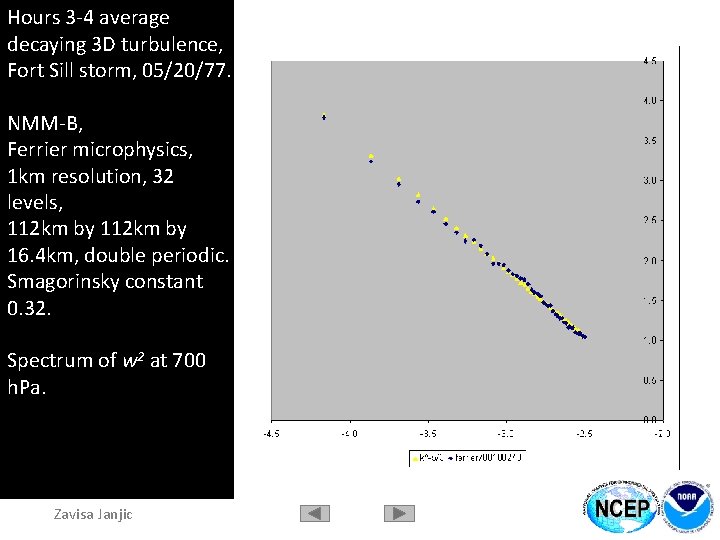
Hours 3 -4 average decaying 3 D turbulence, Fort Sill storm, 05/20/77. NMM-B, Ferrier microphysics, 1 km resolution, 32 levels, 112 km by 16. 4 km, double periodic. Smagorinsky constant 0. 32. Spectrum of w 2 at 700 h. Pa. Zavisa Janjic -5/3
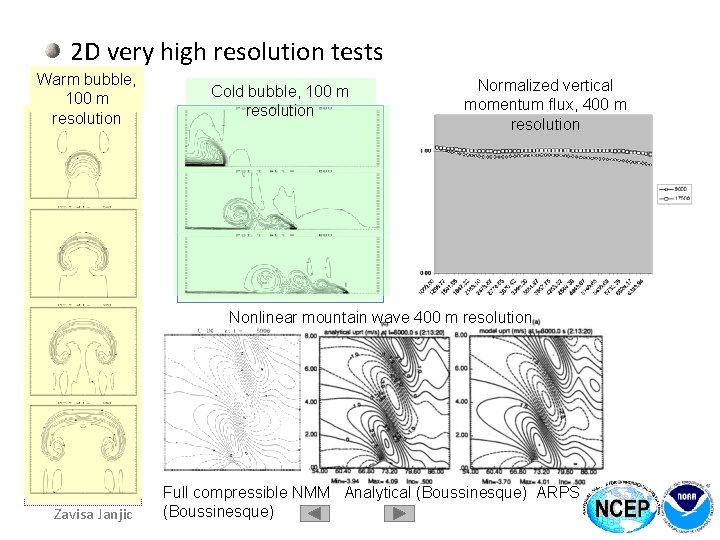
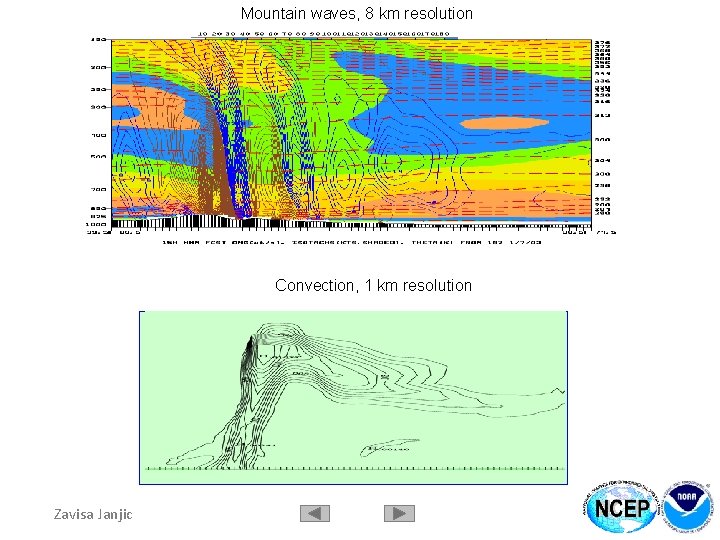
2 D very high resolution tests Warm bubble, 100 m resolution Cold bubble, 100 m resolution Normalized vertical momentum flux, 400 m resolution Nonlinear mountain wave 400 m resolution Zavisa Janjic Full compressible NMM Analytical (Boussinesque) ARPS (Boussinesque)
Mountain waves, 8 km resolution Convection, 1 km resolution Zavisa Janjic
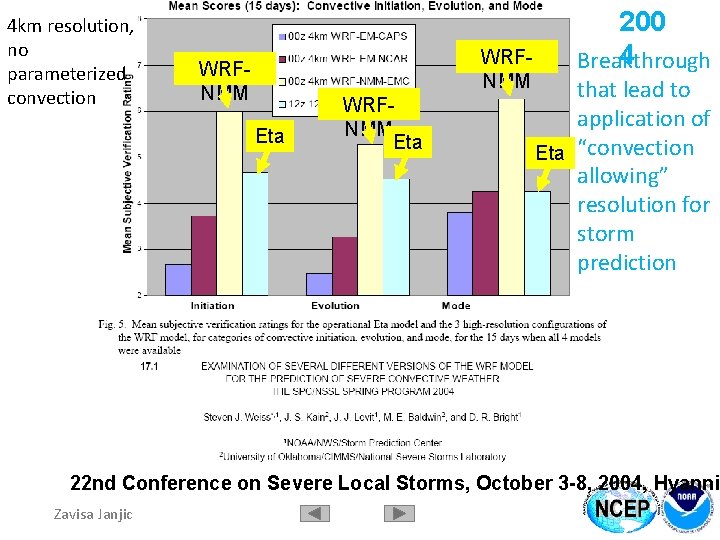
4 km resolution, no parameterized convection WRFNMM Eta 200 4 Breakthrough that lead to application of Eta “convection allowing” resolution for storm prediction 22 nd Conference on Severe Local Storms, October 3 -8, 2004, Hyanni Zavisa Janjic
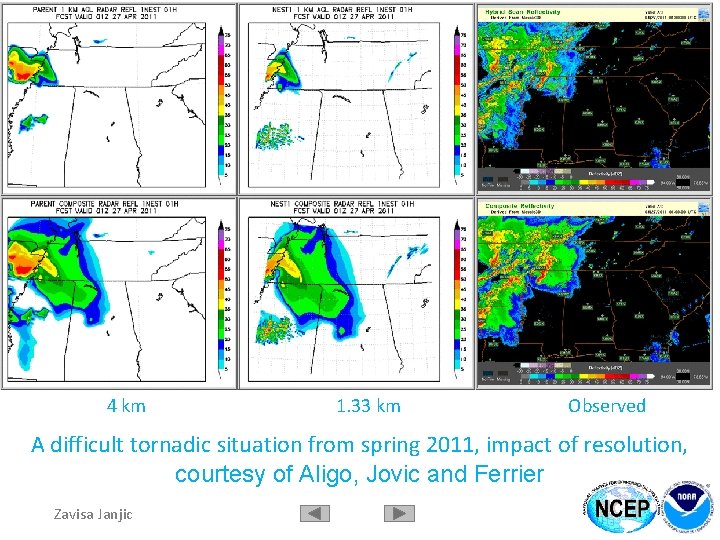
4 km 1. 33 km Observed A difficult tornadic situation from spring 2011, impact of resolution, courtesy of Aligo, Jovic and Ferrier Zavisa Janjic
![Hypothetical NMMB Simultaneous Run Global [with Igor & Julia] and NAM [with CONUS Courtesy](http://slidetodoc.com/presentation_image_h/26944cc5f61ace269f573b48be8e16ee/image-32.jpg "Hypothetical NMMB Simultaneous Run Global [with Igor & Julia] and NAM [with CONUS Courtesy")
Hypothetical NMMB Simultaneous Run Global [with Igor & Julia] and NAM [with CONUS Courtesy nest] of Di. Mego et al. 4 km NAM-nest NMMB 12 km NAM NMMB 27 km Global NMMB Zavisa Janjic 12 km NAM NMMB 9 km Julia NMMB 9 km Igor NMMB 27 km Global NMMB
Meso Scales Regional NMMB replaced WRF NMM in the NAM slot in 2011 Hierarchy of nests running simultaneously, 12 km, 6 km, 4 km, 1. 33 km (fire weather on the fly) resolutions (Di. Mego et al. ) Hurricane runs with NMMB using HWRF setup primarily to test the NMMB infrastructure (initialization, mechanics of nest movements, telescoping and 2 -way interactions …) Zavisa Janjic
Summary and Conclusions Significant improvements of regional forecasts still possible Unified model offers consistency in applications on various scales and reduced development and maintenance effort and cost Limits of deterministic forecasting have not been reached yet Zavisa Janjic
Differences between Global and Regional Versions of NMMB Zavisa Janjic, Ratko Vasic, Tom Black NOAA/NWS/NCEP/EMC, College Park, MD Zavisa Janjic
Differences Coordinate system Regional (“basin scale”): rotated lat-lon Global: lat-lon Polar boundary condition Polar filter Polar points averaging East-west periodicity Zavisa Janjic
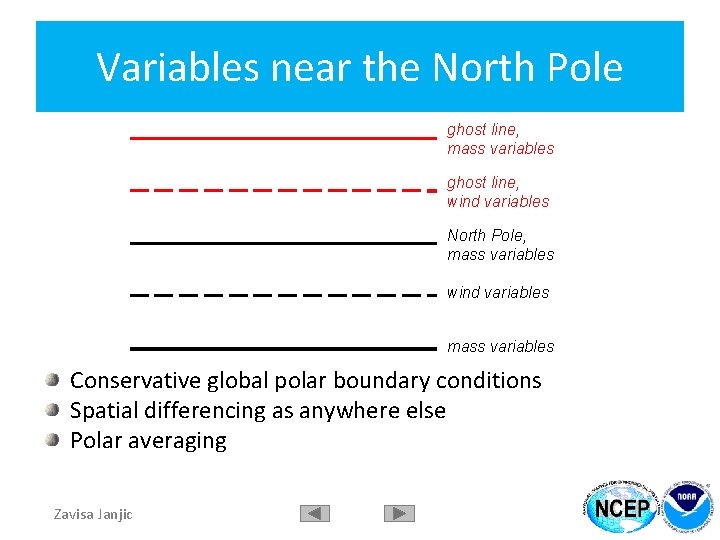
Variables near the North Pole ghost line, mass variables ghost line, wind variables North Pole, mass variables wind variables mass variables Conservative global polar boundary conditions Spatial differencing as anywhere else Polar averaging Zavisa Janjic
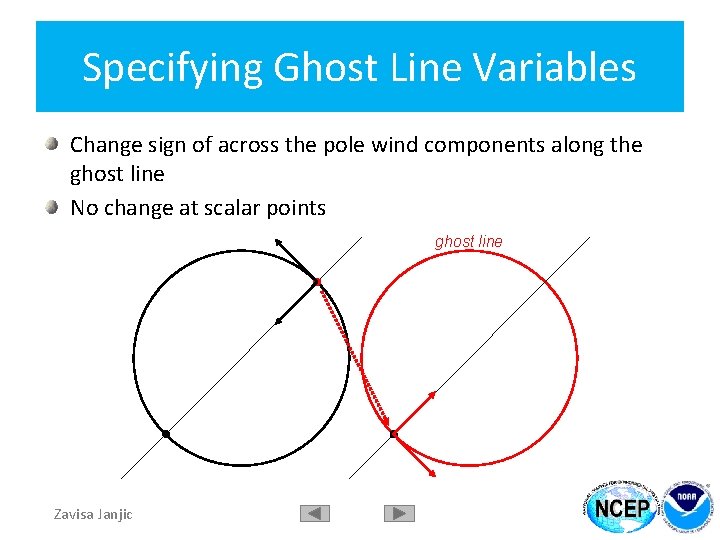
Specifying Ghost Line Variables Change sign of across the pole wind components along the ghost line No change at scalar points ghost line Zavisa Janjic
Polar Filter Polar points singular Convergence of meridians Coriolis force tends to infinity due to curvature terms Polar filter “Decelerator, ” tendencies of T, u, v, Eulerian tracers, divergence, dw/dt Waves in the zonal direction faster than waves with the same wavelength in the latitudinal direction slowed down No impact on amplitudes of basic variables Physics not filtered Zavisa Janjic
Polar Filter Current set-up Filtering north of 450 N and south of 450 S At 450 N and 450 S , considered as representative resolution Can be changed Zavisa Janjic
Physics Unified model offers consistency in applications on various scales and reduced development and maintenance effort and cost Unified physics across the scales desirable Parameterizations depend on scales and have to be differently tuned, but the same parameterization schemes still can be used Zavisa Janjic
Physics Upgraded NCEP WRF NMM “standard” physical package RRTM, GFDL radiation NOAH, LISS land surface models Mellor-Yamada-Janjic turbulence Ferrier microphysics Betts-Miller-Janjic convection Extensions GFS physics Separate SAS, Zhao, Thompson, GFS PBL, WSM 6. . . Zavisa Janjic
Data assimilation Spectral GFS analysis not a good long term choice GFS analysis even more GFS specific with GFS ensemble cross correlations Indigenous NMMB analysis needed Work under way Zavisa Janjic
Computational Considerations Spherical geometry is an issue, no matter which grid topology is chosen ~ 50% waste (compared to regional) Polar filter based on FFT Serial, nonlocal FFT used FFT fast, but requires transposition to take advantage of parallel processing Hindrance for scaling? Zavisa Janjic
Scaling on Zeus Global, nonhydrostatic, full physics Easily satisfies NCEP operational requirements Resolution 1149 x 811 x 64, ~ 24 km 500 processors, 7. 9 wall clock min/day 4000 processors, 1 year of simulation in < 17 hours, climate studies Resolution 2305 x 1623 x 64, ~ 12 km 8 x more work than 1149 x 811 x 64, ~ 24 km 3600 processors, 7. 6 wall clock min/day 7. 2 times more processors for 8 times bigger job in less time! Operational global ~ 10 km resolution forecasts possible Zavisa Janjic
Scaling not critical at present with reasonable resolution and number of cores Depends on size and shape of sub domains Slows down with less than 200 -250 grid points per core Parallel FFT now available, presumably will reduce communications significantly Zavisa Janjic
Clouds and Precipitation Zavisa Janjic
Global Scales Long verification periods needed to obtain robust scores. To save on resources and time, a sample of 105 cases over one year at three and a half day intervals (code maintenance, launcher scripts, verification and graphics courtesy of Vasic) Both 00 Z and 12 Z initial data equally represented Sample cases chosen randomly, results should be reasonably representative for a full year population Zavisa Janjic
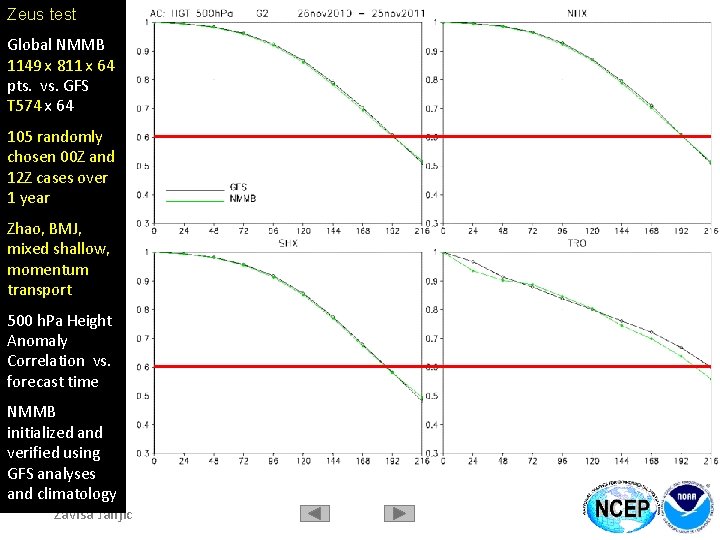
Global NMMB Zeus test 1149 x 811 x 64 Global NMMB pts. vs. GFS 1149 x 811 x 64 T 574 x 64 pts. vs. GFS 105 randomly T 574 x 64 chosen cases 105 randomly from 1 year chosen 00 Z and 12 Z 500 cases h. Pa Height over Anomaly 1 year Correlation Zhao, BMJ, Coefficient vs. mixed shallow, forecast time momentum NMMB transport initialized and 500 h. Pa Height verified using Anomaly GFS analyses Correlation vs. and climatology forecast time NMMB initialized and verified using GFS analyses and climatology Zavisa Janjic
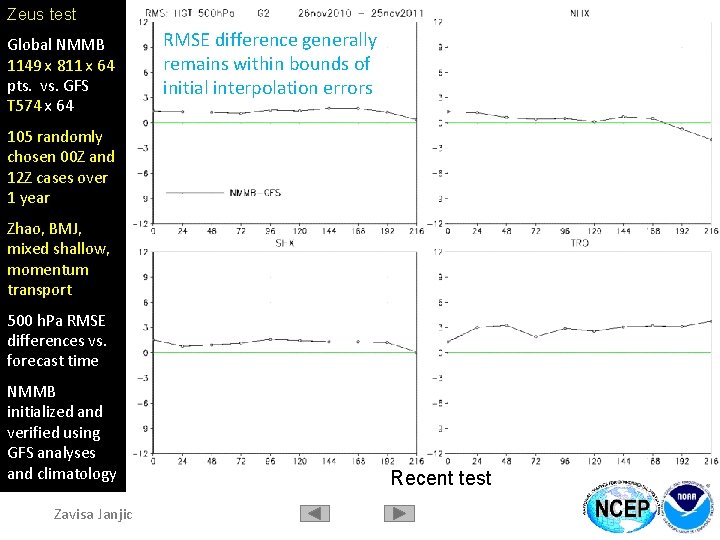
Global NMMB Zeus test 1149 x 811 x 64 Global NMMB pts. vs. GFS 1149 x 811 x 64 T 574 x 64 pts. vs. GFS 105 randomly T 574 x 64 chosen cases 105 randomly from 1 year chosen 00 Z and 12 Z 500 cases h. Pa Height over Anomaly 1 year Correlation Zhao, BMJ, Coefficient vs. mixed shallow, forecast time momentum NMMB transport initialized and 500 h. Pa RMSE verified using differences vs. GFS analyses forecast time and climatology NMMB initialized and verified using GFS analyses and climatology Zavisa Janjic RMSE difference generally remains within bounds of initial interpolation errors Recent test
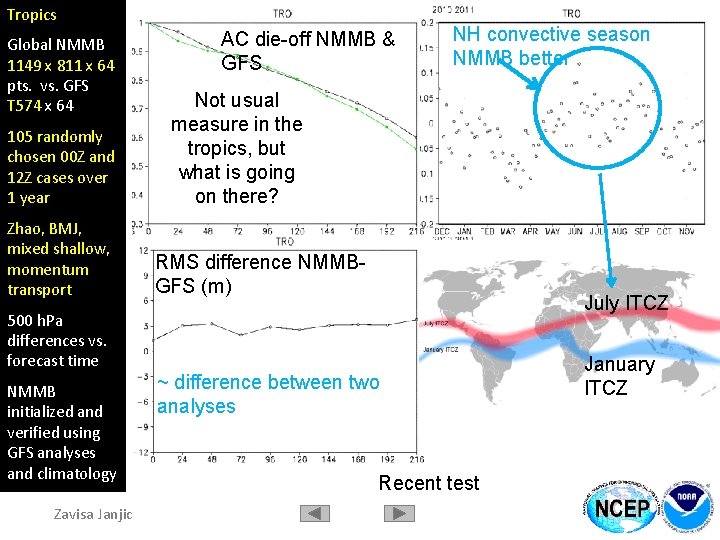
Tropics Global NMMB 1149 x 811 x 64 pts. vs. GFS T 574 x 64 105 randomly chosen 00 Z and 12 Z cases over 1 year Zhao, BMJ, mixed shallow, momentum transport AC die-off NMMB & GFS NH convective season NMMB better Not usual measure in the tropics, but what is going on there? RMS difference NMMBGFS (m) July ITCZ 500 h. Pa differences vs. forecast time NMMB initialized and verified using GFS analyses and climatology Zavisa Janjic ~ difference between two analyses Recent test January ITCZ
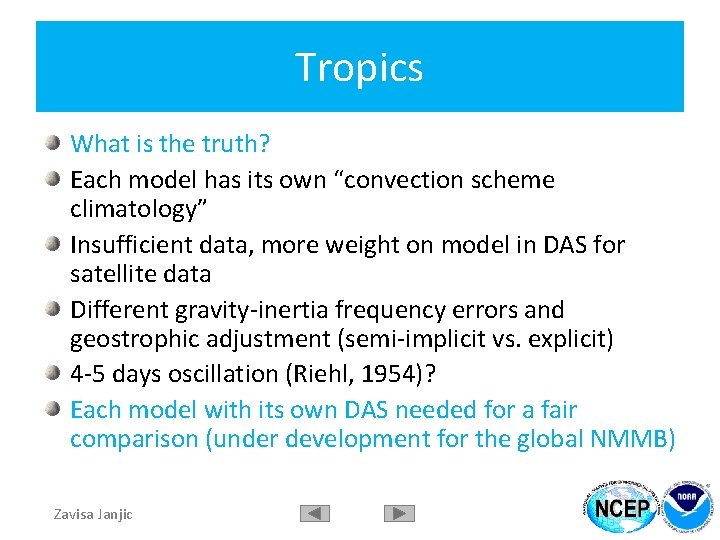
Tropics What is the truth? Each model has its own “convection scheme climatology” Insufficient data, more weight on model in DAS for satellite data Different gravity-inertia frequency errors and geostrophic adjustment (semi-implicit vs. explicit) 4 -5 days oscillation (Riehl, 1954)? Each model with its own DAS needed for a fair comparison (under development for the global NMMB) Zavisa Janjic
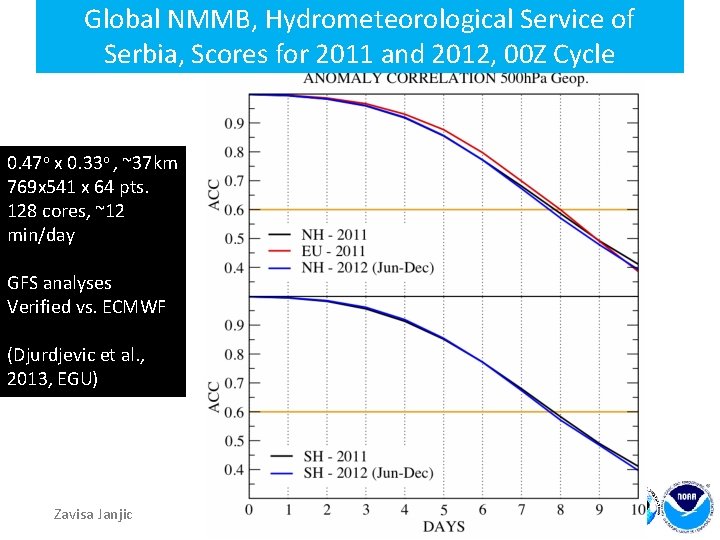
Global NMMB, Hydrometeorological Service of Serbia, Scores for 2011 and 2012, 00 Z Cycle 0. 47 o x 0. 33 o , ~37 km 769 x 541 x 64 pts. 128 cores, ~12 min/day GFS analyses Verified vs. ECMWF (Djurdjevic et al. , 2013, EGU) Zavisa Janjic
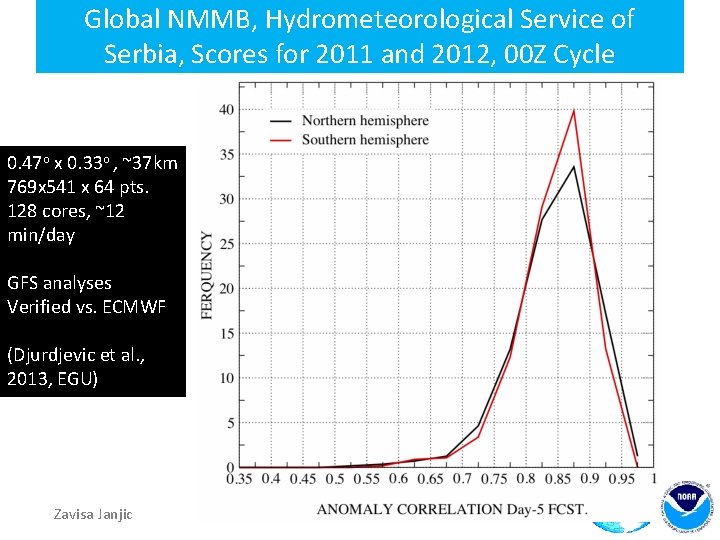
Global NMMB, Hydrometeorological Service of Serbia, Scores for 2011 and 2012, 00 Z Cycle 0. 47 o x 0. 33 o , ~37 km 769 x 541 x 64 pts. 128 cores, ~12 min/day GFS analyses Verified vs. ECMWF (Djurdjevic et al. , 2013, EGU) Zavisa Janjic
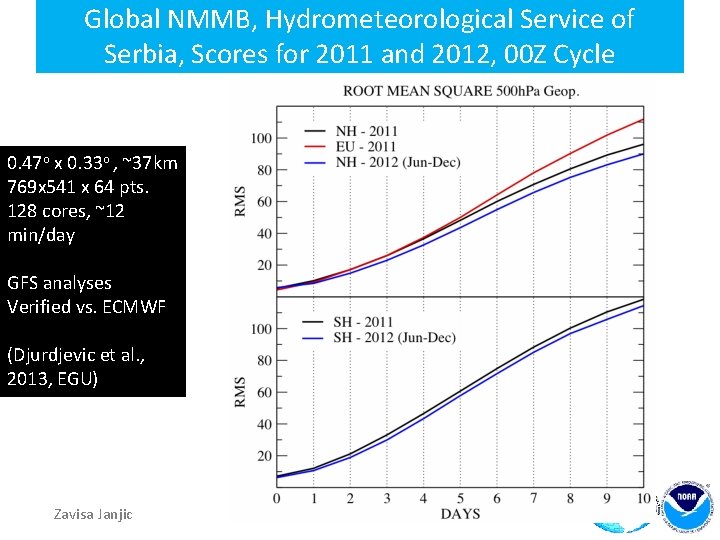
Global NMMB, Hydrometeorological Service of Serbia, Scores for 2011 and 2012, 00 Z Cycle 0. 47 o x 0. 33 o , ~37 km 769 x 541 x 64 pts. 128 cores, ~12 min/day GFS analyses Verified vs. ECMWF (Djurdjevic et al. , 2013, EGU) Zavisa Janjic
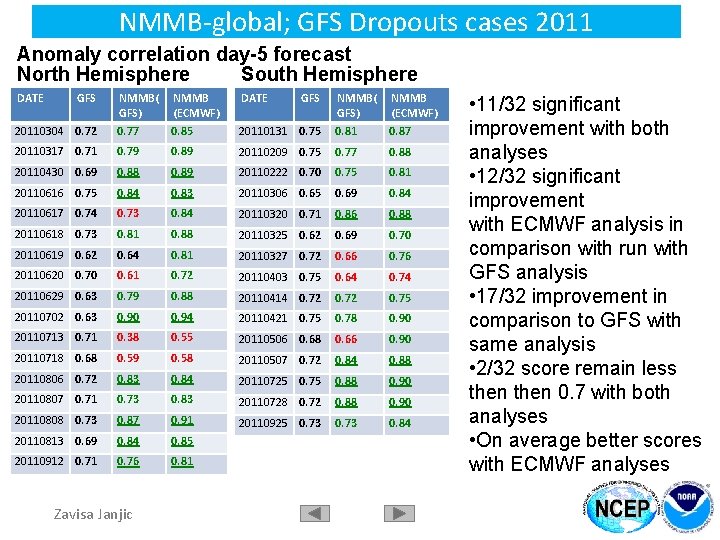
NMMB-global; GFS Dropouts cases 2011 Anomaly correlation day-5 forecast North Hemisphere South Hemisphere DATE GFS NMMB( GFS) NMMB (ECMWF) DATE 20110304 0. 72 0. 77 0. 85 20110317 0. 71 0. 79 20110430 0. 69 NMMB( GFS) NMMB (ECMWF) 20110131 0. 75 0. 81 0. 87 0. 89 20110209 0. 75 0. 77 0. 88 0. 89 20110222 0. 70 0. 75 0. 81 20110616 0. 75 0. 84 0. 83 20110306 0. 65 0. 69 0. 84 20110617 0. 74 0. 73 0. 84 20110320 0. 71 0. 86 0. 88 20110618 0. 73 0. 81 0. 88 20110325 0. 62 0. 69 0. 70 20110619 0. 62 0. 64 0. 81 20110327 0. 72 0. 66 0. 76 20110620 0. 70 0. 61 0. 72 20110403 0. 75 0. 64 0. 74 20110629 0. 63 0. 79 0. 88 20110414 0. 72 0. 75 20110702 0. 63 0. 90 0. 94 20110421 0. 75 0. 78 0. 90 20110713 0. 71 0. 38 0. 55 20110506 0. 68 0. 66 0. 90 20110718 0. 68 0. 59 0. 58 20110507 0. 72 0. 84 0. 88 20110806 0. 72 0. 83 0. 84 20110725 0. 75 0. 88 0. 90 20110807 0. 71 0. 73 0. 83 20110728 0. 72 0. 88 0. 90 20110808 0. 73 0. 87 0. 91 20110925 0. 73 0. 84 20110813 0. 69 0. 84 0. 85 20110912 0. 71 0. 76 0. 81 Zavisa Janjic GFS • 11/32 significant improvement with both analyses • 12/32 significant improvement with ECMWF analysis in comparison with run with GFS analysis • 17/32 improvement in comparison to GFS with same analysis • 2/32 score remain less then 0. 7 with both analyses • On average better scores with ECMWF analyses
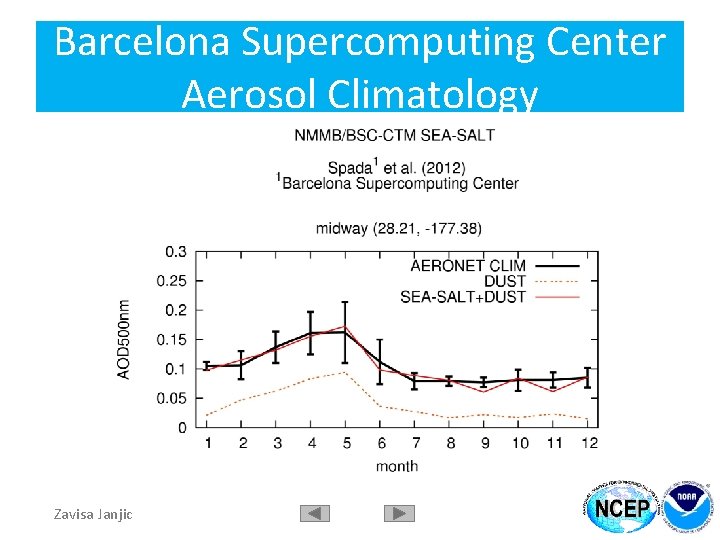
Barcelona Supercomputing Center Aerosol Climatology Zavisa Janjic
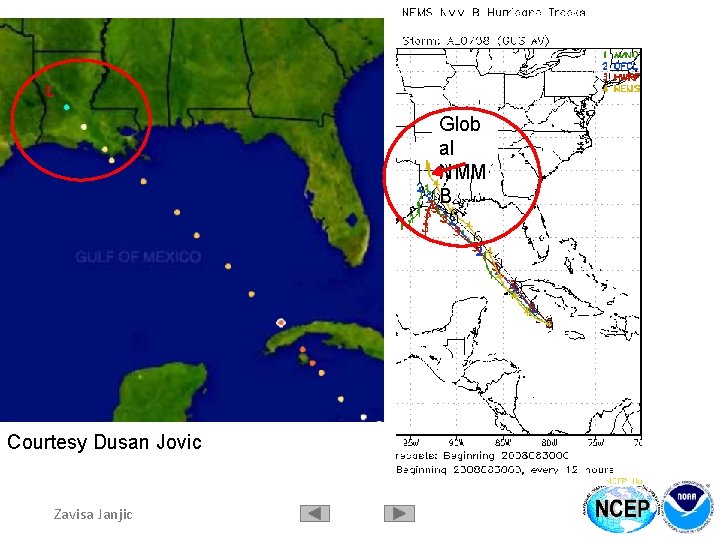
Glob al NMM B Courtesy Dusan Jovic Zavisa Janjic
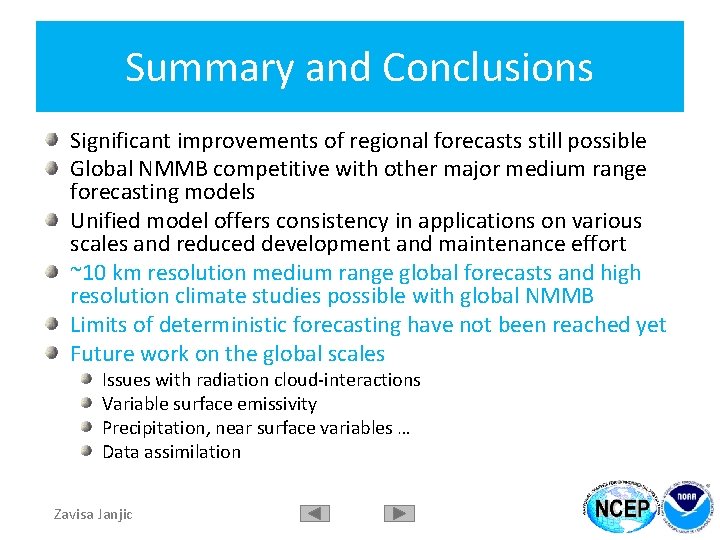
Summary and Conclusions Significant improvements of regional forecasts still possible Global NMMB competitive with other major medium range forecasting models Unified model offers consistency in applications on various scales and reduced development and maintenance effort ~10 km resolution medium range global forecasts and high resolution climate studies possible with global NMMB Limits of deterministic forecasting have not been reached yet Future work on the global scales Issues with radiation cloud-interactions Variable surface emissivity Precipitation, near surface variables … Data assimilation Zavisa Janjic

Zavisa Janjic
- Slides: 60