
Introduction to NLP Evaluation of IR Evaluation Different


![[From Salton’s book]](https://slidetodoc.com/presentation_image_h/1f71977799ab8062fcc2ad3c539e0bbb/image-19.jpg "[From Salton’s book]")


- Slides: 40
Introduction to NLP Evaluation of IR
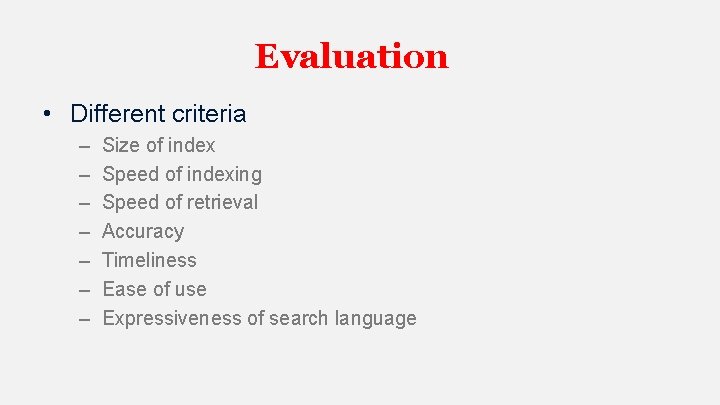
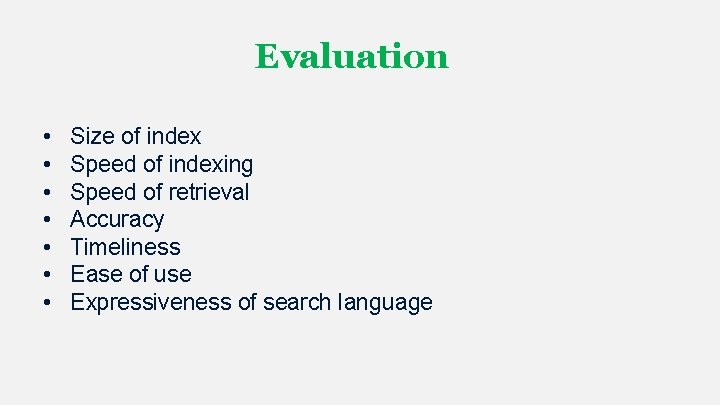
Evaluation • Different criteria – – – – Size of index Speed of indexing Speed of retrieval Accuracy Timeliness Ease of use Expressiveness of search language
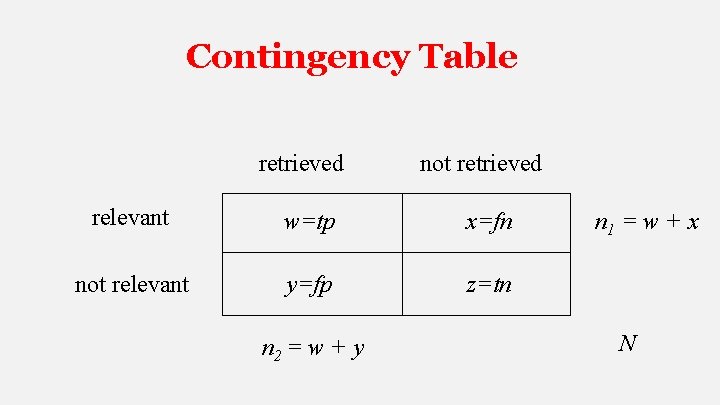
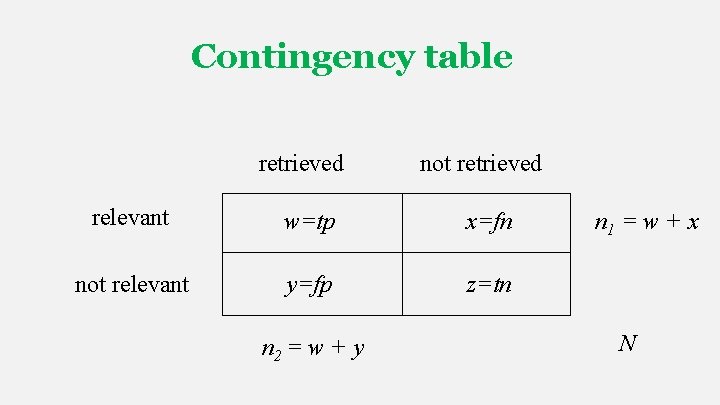
Contingency Table retrieved not retrieved relevant w=tp x=fn not relevant y=fp z=tn n 2 = w + y n 1 = w + x N
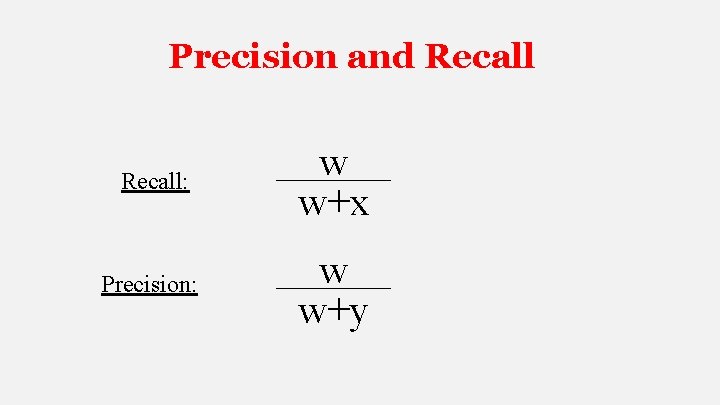
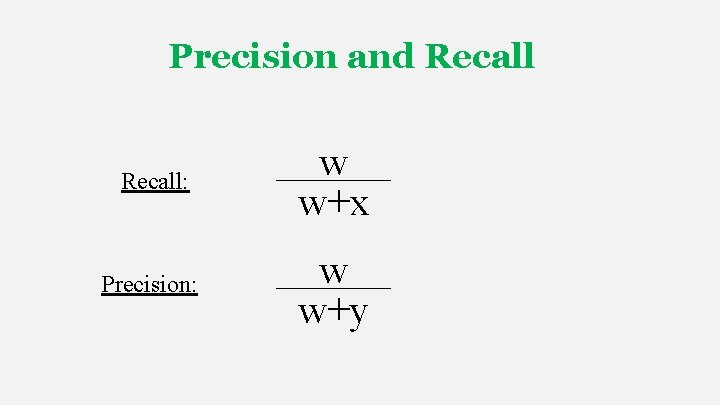
Precision and Recall: w w+x Precision: w w+y
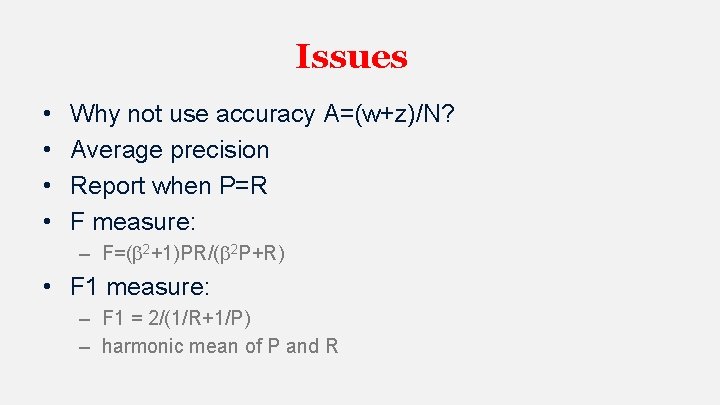
Issues • • Why not use accuracy A=(w+z)/N? Average precision Report when P=R F measure: – F=(b 2+1)PR/(b 2 P+R) • F 1 measure: – F 1 = 2/(1/R+1/P) – harmonic mean of P and R
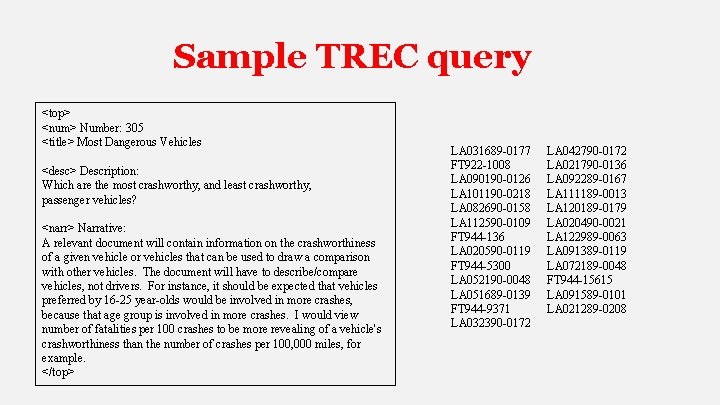
Sample TREC query <top> <num> Number: 305 <title> Most Dangerous Vehicles <desc> Description: Which are the most crashworthy, and least crashworthy, passenger vehicles? <narr> Narrative: A relevant document will contain information on the crashworthiness of a given vehicle or vehicles that can be used to draw a comparison with other vehicles. The document will have to describe/compare vehicles, not drivers. For instance, it should be expected that vehicles preferred by 16 -25 year-olds would be involved in more crashes, because that age group is involved in more crashes. I would view number of fatalities per 100 crashes to be more revealing of a vehicle's crashworthiness than the number of crashes per 100, 000 miles, for example. </top> LA 031689 -0177 FT 922 -1008 LA 090190 -0126 LA 101190 -0218 LA 082690 -0158 LA 112590 -0109 FT 944 -136 LA 020590 -0119 FT 944 -5300 LA 052190 -0048 LA 051689 -0139 FT 944 -9371 LA 032390 -0172 LA 042790 -0172 LA 021790 -0136 LA 092289 -0167 LA 111189 -0013 LA 120189 -0179 LA 020490 -0021 LA 122989 -0063 LA 091389 -0119 LA 072189 -0048 FT 944 -15615 LA 091589 -0101 LA 021289 -0208
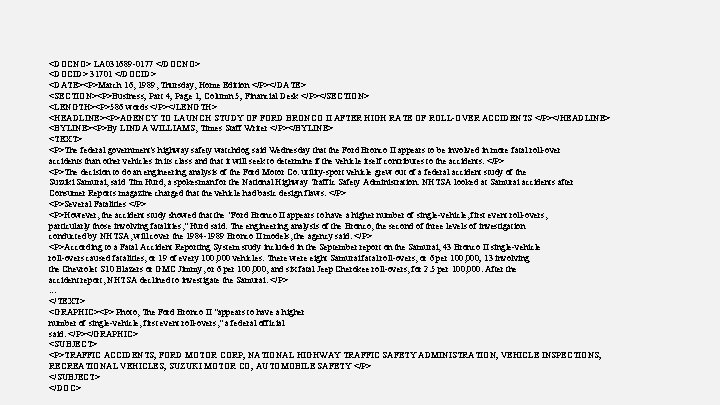
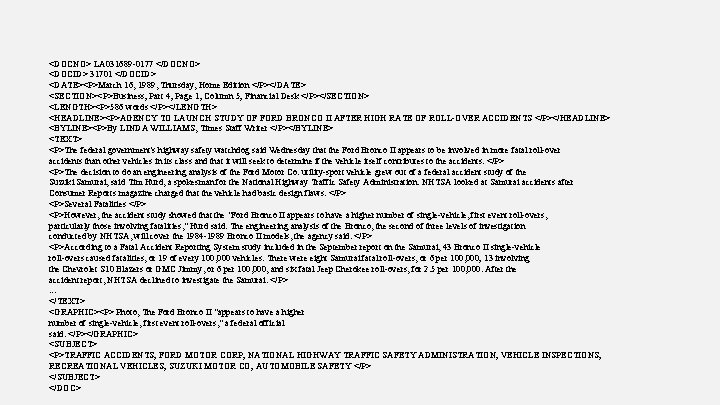
<DOCNO> LA 031689 -0177 </DOCNO> <DOCID> 31701 </DOCID> <DATE><P>March 16, 1989, Thursday, Home Edition </P></DATE> <SECTION><P>Business; Part 4; Page 1; Column 5; Financial Desk </P></SECTION> <LENGTH><P>586 words </P></LENGTH> <HEADLINE><P>AGENCY TO LAUNCH STUDY OF FORD BRONCO II AFTER HIGH RATE OF ROLL-OVER ACCIDENTS </P></HEADLINE> <BYLINE><P>By LINDA WILLIAMS, Times Staff Writer </P></BYLINE> <TEXT> <P>The federal government's highway safety watchdog said Wednesday that the Ford Bronco II appears to be involved in more fatal roll-over accidents than other vehicles in its class and that it will seek to determine if the vehicle itself contributes to the accidents. </P> <P>The decision to do an engineering analysis of the Ford Motor Co. utility-sport vehicle grew out of a federal accident study of the Suzuki Samurai, said Tim Hurd, a spokesman for the National Highway Traffic Safety Administration. NHTSA looked at Samurai accidents after Consumer Reports magazine charged that the vehicle had basic design flaws. </P> <P>Several Fatalities </P> <P>However, the accident study showed that the "Ford Bronco II appears to have a higher number of single-vehicle, first event roll-overs, particularly those involving fatalities, " Hurd said. The engineering analysis of the Bronco, the second of three levels of investigation conducted by NHTSA, will cover the 1984 -1989 Bronco II models, the agency said. </P> <P>According to a Fatal Accident Reporting System study included in the September report on the Samurai, 43 Bronco II single-vehicle roll-overs caused fatalities, or 19 of every 100, 000 vehicles. There were eight Samurai fatal roll-overs, or 6 per 100, 000; 13 involving the Chevrolet S 10 Blazers or GMC Jimmy, or 6 per 100, 000, and six fatal Jeep Cherokee roll-overs, for 2. 5 per 100, 000. After the accident report, NHTSA declined to investigate the Samurai. </P>. . . </TEXT> <GRAPHIC><P> Photo, The Ford Bronco II "appears to have a higher number of single-vehicle, first event roll-overs, " a federal official said. </P></GRAPHIC> <SUBJECT> <P>TRAFFIC ACCIDENTS; FORD MOTOR CORP; NATIONAL HIGHWAY TRAFFIC SAFETY ADMINISTRATION; VEHICLE INSPECTIONS; RECREATIONAL VEHICLES; SUZUKI MOTOR CO; AUTOMOBILE SAFETY </P> </SUBJECT> </DOC>
TREC (cont’d) • http: //trec. nist. gov/tracks. html • http: //trec. nist. gov/presentations. ht ml
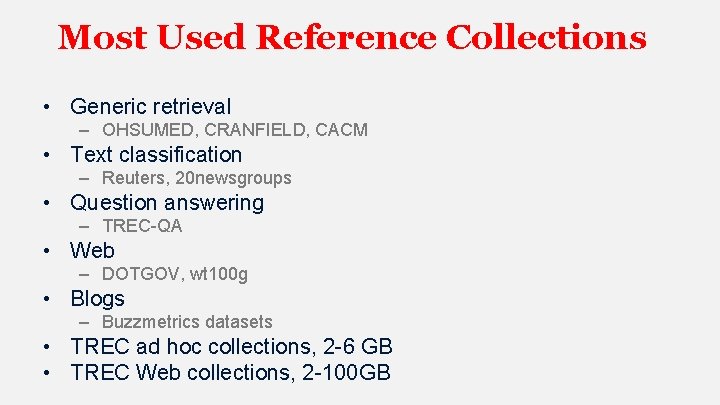
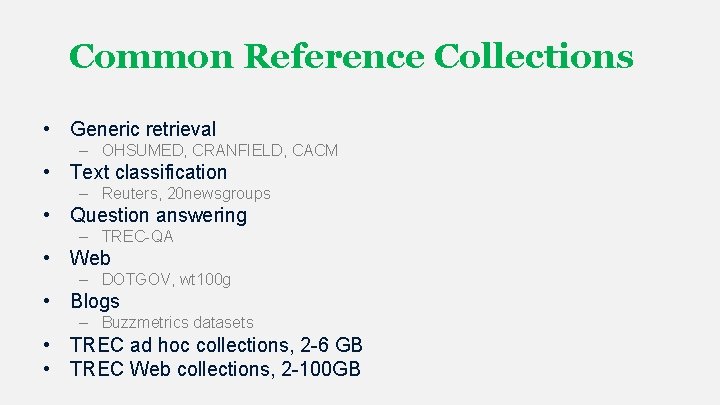
Most Used Reference Collections • Generic retrieval – OHSUMED, CRANFIELD, CACM • Text classification – Reuters, 20 newsgroups • Question answering – TREC-QA • Web – DOTGOV, wt 100 g • Blogs – Buzzmetrics datasets • TREC ad hoc collections, 2 -6 GB • TREC Web collections, 2 -100 GB
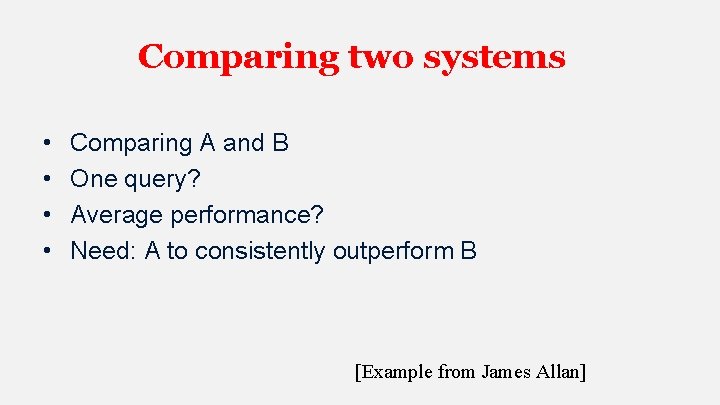
Comparing two systems • • Comparing A and B One query? Average performance? Need: A to consistently outperform B [Example from James Allan]
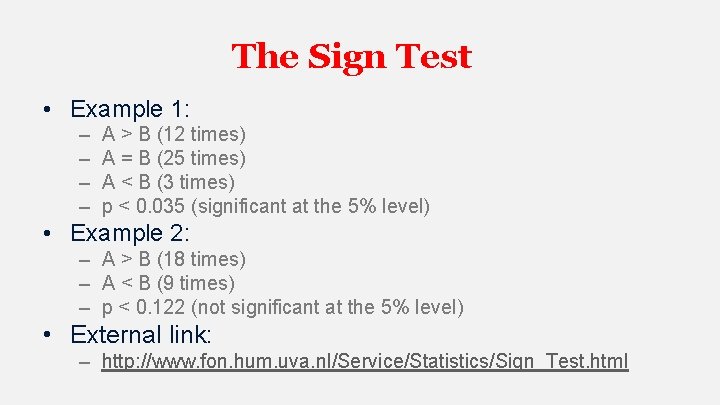
The Sign Test • Example 1: – – A > B (12 times) A = B (25 times) A < B (3 times) p < 0. 035 (significant at the 5% level) • Example 2: – A > B (18 times) – A < B (9 times) – p < 0. 122 (not significant at the 5% level) • External link: – http: //www. fon. hum. uva. nl/Service/Statistics/Sign_Test. html
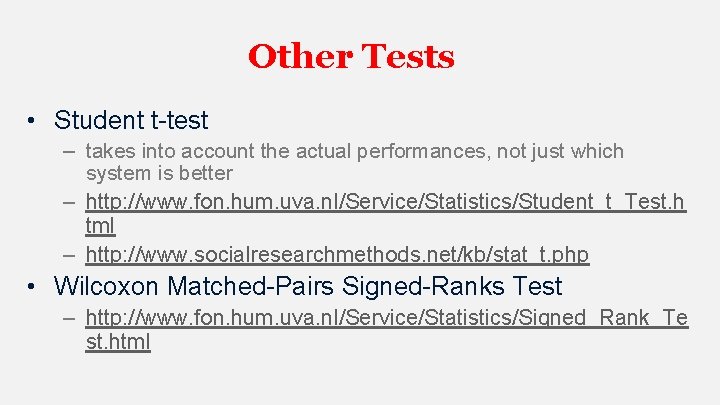
Other Tests • Student t-test – takes into account the actual performances, not just which system is better – http: //www. fon. hum. uva. nl/Service/Statistics/Student_t_Test. h tml – http: //www. socialresearchmethods. net/kb/stat_t. php • Wilcoxon Matched-Pairs Signed-Ranks Test – http: //www. fon. hum. uva. nl/Service/Statistics/Signed_Rank_Te st. html
NLP
Information Retrieval Evaluation of IR
Evaluation • • Size of index Speed of indexing Speed of retrieval Accuracy Timeliness Ease of use Expressiveness of search language
Contingency table retrieved not retrieved relevant w=tp x=fn not relevant y=fp z=tn n 2 = w + y n 1 = w + x N
Precision and Recall: w w+x Precision: w w+y
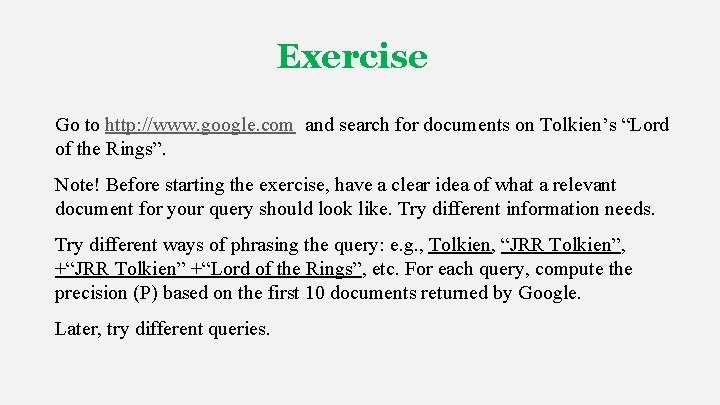
Exercise Go to http: //www. google. com and search for documents on Tolkien’s “Lord of the Rings”. Note! Before starting the exercise, have a clear idea of what a relevant document for your query should look like. Try different information needs. Try different ways of phrasing the query: e. g. , Tolkien, “JRR Tolkien”, +“JRR Tolkien” +“Lord of the Rings”, etc. For each query, compute the precision (P) based on the first 10 documents returned by Google. Later, try different queries.
[From Salton’s book]
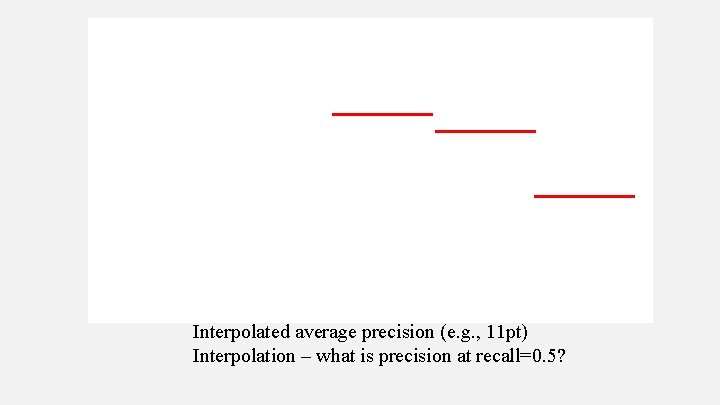
Interpolated average precision (e. g. , 11 pt) Interpolation – what is precision at recall=0. 5?
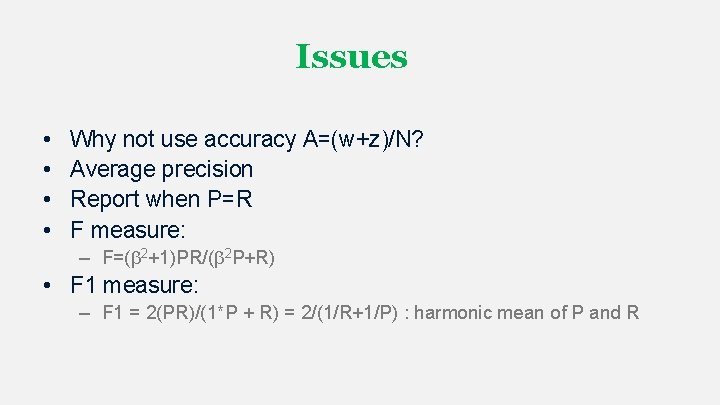
Issues • • Why not use accuracy A=(w+z)/N? Average precision Report when P=R F measure: – F=(b 2+1)PR/(b 2 P+R) • F 1 measure: – F 1 = 2(PR)/(1*P + R) = 2/(1/R+1/P) : harmonic mean of P and R
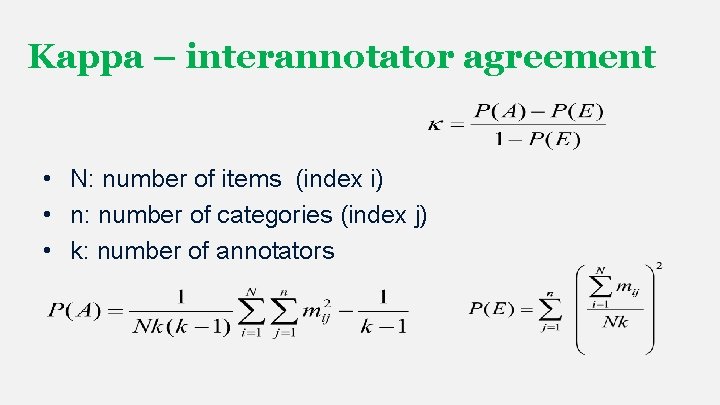
Kappa – interannotator agreement • N: number of items (index i) • n: number of categories (index j) • k: number of annotators
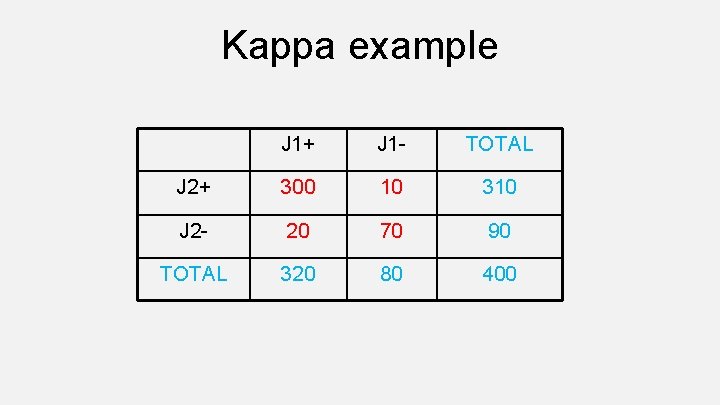
Kappa example J 1+ J 1 - TOTAL J 2+ 300 10 310 J 2 - 20 70 90 TOTAL 320 80 400
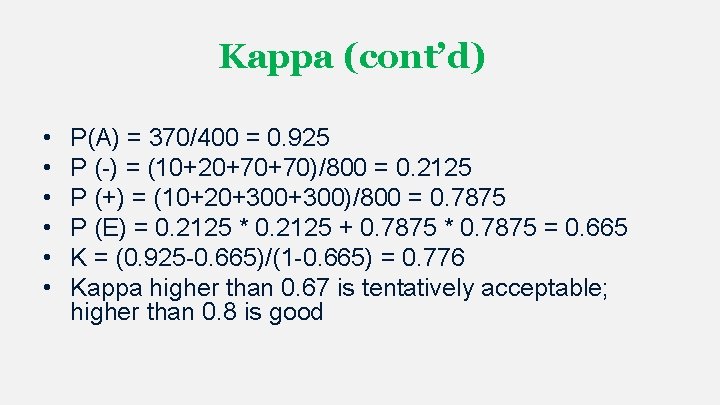
Kappa (cont’d) • • • P(A) = 370/400 = 0. 925 P (-) = (10+20+70+70)/800 = 0. 2125 P (+) = (10+20+300)/800 = 0. 7875 P (E) = 0. 2125 * 0. 2125 + 0. 7875 * 0. 7875 = 0. 665 K = (0. 925 -0. 665)/(1 -0. 665) = 0. 776 Kappa higher than 0. 67 is tentatively acceptable; higher than 0. 8 is good
Comparing two systems • • Comparing A and B One query? Average performance? Need: A to consistently outperform B [Example from James Allan]
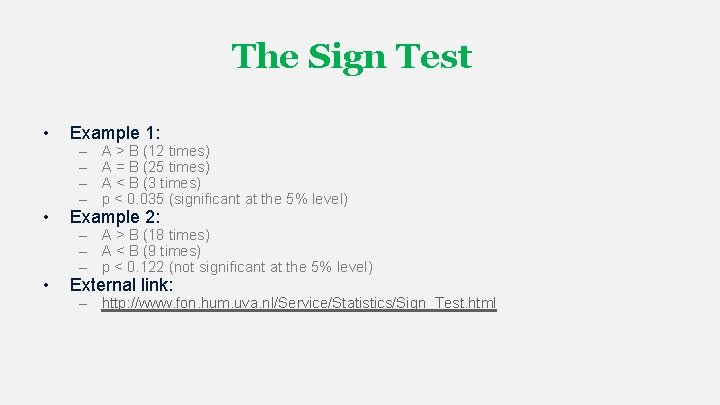
The Sign Test • Example 1: • Example 2: • External link: – – A > B (12 times) A = B (25 times) A < B (3 times) p < 0. 035 (significant at the 5% level) – A > B (18 times) – A < B (9 times) – p < 0. 122 (not significant at the 5% level) – http: //www. fon. hum. uva. nl/Service/Statistics/Sign_Test. html
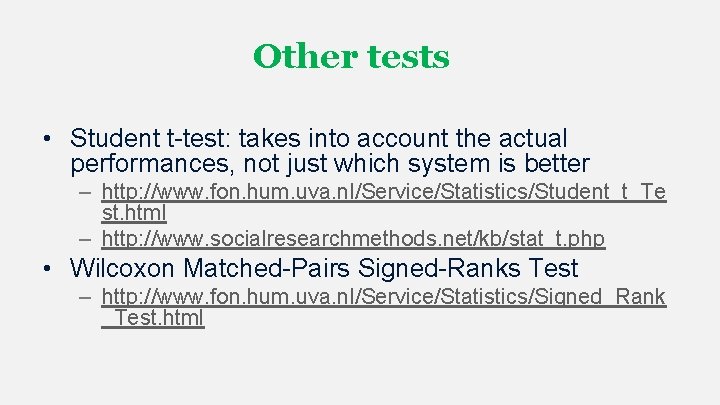
Other tests • Student t-test: takes into account the actual performances, not just which system is better – http: //www. fon. hum. uva. nl/Service/Statistics/Student_t_Te st. html – http: //www. socialresearchmethods. net/kb/stat_t. php • Wilcoxon Matched-Pairs Signed-Ranks Test – http: //www. fon. hum. uva. nl/Service/Statistics/Signed_Rank _Test. html
Information Retrieval System Evaluation
How do I evaluate my system if… • • • The task is new? No benchmark data is available? No real users/real queries yet? No ground truth? No well-established competitors?
The Cranfield Paradigm • Build test collections – Start with creating a document collection that is representative of the task – Usually a sample of the real domain (or the whole thing if affordable) – Size varies from thousands of documents to billions (Trec Clue. Web)
From document collections to test collections • Still need – Test queries – Relevance assessments • Test queries – Must be germane to docs available – Best designed by domain experts – Random query terms generally not a good idea • Relevance assessments – Human judges, time-consuming – Are human panels perfect? - Slide from Pandu Nayak and Prabhakar Raghavan
Two Issues • Too many documents for human annotation – Is sampling the solution? • Too many irrelevant documents – Waste of human annotation effort – Random sampling doesn’t solve this problem… • Trec’s Solution: pooling
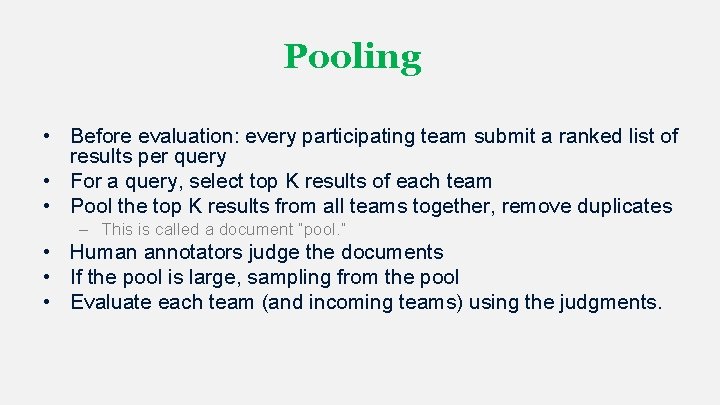
Pooling • Before evaluation: every participating team submit a ranked list of results per query • For a query, select top K results of each team • Pool the top K results from all teams together, remove duplicates – This is called a document “pool. ” • Human annotators judge the documents • If the pool is large, sampling from the pool • Evaluate each team (and incoming teams) using the judgments.
Why It Works • Top-ranked results of a candidate system ensures a good presence of relevant documents in the sample • Multiple (diverse) candidate systems are needed so that the sample isn’t biased. • In your project, you don’t have participating teams… • Employ different (diversity is important!) IR approaches and treat them as candidate teams! – E. g. , boolean & tf-idf; w or w/o feedback; synonym, …
Information Retrieval Evaluation Collections
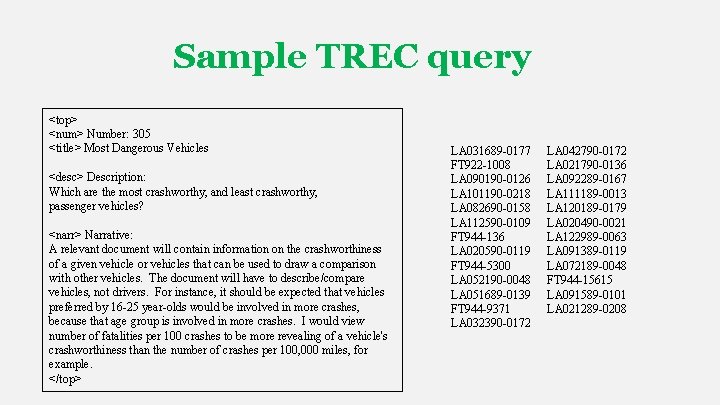
Sample TREC query <top> <num> Number: 305 <title> Most Dangerous Vehicles <desc> Description: Which are the most crashworthy, and least crashworthy, passenger vehicles? <narr> Narrative: A relevant document will contain information on the crashworthiness of a given vehicle or vehicles that can be used to draw a comparison with other vehicles. The document will have to describe/compare vehicles, not drivers. For instance, it should be expected that vehicles preferred by 16 -25 year-olds would be involved in more crashes, because that age group is involved in more crashes. I would view number of fatalities per 100 crashes to be more revealing of a vehicle's crashworthiness than the number of crashes per 100, 000 miles, for example. </top> LA 031689 -0177 FT 922 -1008 LA 090190 -0126 LA 101190 -0218 LA 082690 -0158 LA 112590 -0109 FT 944 -136 LA 020590 -0119 FT 944 -5300 LA 052190 -0048 LA 051689 -0139 FT 944 -9371 LA 032390 -0172 LA 042790 -0172 LA 021790 -0136 LA 092289 -0167 LA 111189 -0013 LA 120189 -0179 LA 020490 -0021 LA 122989 -0063 LA 091389 -0119 LA 072189 -0048 FT 944 -15615 LA 091589 -0101 LA 021289 -0208
<DOCNO> LA 031689 -0177 </DOCNO> <DOCID> 31701 </DOCID> <DATE><P>March 16, 1989, Thursday, Home Edition </P></DATE> <SECTION><P>Business; Part 4; Page 1; Column 5; Financial Desk </P></SECTION> <LENGTH><P>586 words </P></LENGTH> <HEADLINE><P>AGENCY TO LAUNCH STUDY OF FORD BRONCO II AFTER HIGH RATE OF ROLL-OVER ACCIDENTS </P></HEADLINE> <BYLINE><P>By LINDA WILLIAMS, Times Staff Writer </P></BYLINE> <TEXT> <P>The federal government's highway safety watchdog said Wednesday that the Ford Bronco II appears to be involved in more fatal roll-over accidents than other vehicles in its class and that it will seek to determine if the vehicle itself contributes to the accidents. </P> <P>The decision to do an engineering analysis of the Ford Motor Co. utility-sport vehicle grew out of a federal accident study of the Suzuki Samurai, said Tim Hurd, a spokesman for the National Highway Traffic Safety Administration. NHTSA looked at Samurai accidents after Consumer Reports magazine charged that the vehicle had basic design flaws. </P> <P>Several Fatalities </P> <P>However, the accident study showed that the "Ford Bronco II appears to have a higher number of single-vehicle, first event roll-overs, particularly those involving fatalities, " Hurd said. The engineering analysis of the Bronco, the second of three levels of investigation conducted by NHTSA, will cover the 1984 -1989 Bronco II models, the agency said. </P> <P>According to a Fatal Accident Reporting System study included in the September report on the Samurai, 43 Bronco II single-vehicle roll-overs caused fatalities, or 19 of every 100, 000 vehicles. There were eight Samurai fatal roll-overs, or 6 per 100, 000; 13 involving the Chevrolet S 10 Blazers or GMC Jimmy, or 6 per 100, 000, and six fatal Jeep Cherokee roll-overs, for 2. 5 per 100, 000. After the accident report, NHTSA declined to investigate the Samurai. </P>. . . </TEXT> <GRAPHIC><P> Photo, The Ford Bronco II "appears to have a higher number of single-vehicle, first event roll-overs, " a federal official said. </P></GRAPHIC> <SUBJECT> <P>TRAFFIC ACCIDENTS; FORD MOTOR CORP; NATIONAL HIGHWAY TRAFFIC SAFETY ADMINISTRATION; VEHICLE INSPECTIONS; RECREATIONAL VEHICLES; SUZUKI MOTOR CO; AUTOMOBILE SAFETY </P> </SUBJECT> </DOC>
TREC (cont’d) • http: //trec. nist. gov/tracks. html • http: //trec. nist. gov/presentations. ht ml
Common Reference Collections • Generic retrieval – OHSUMED, CRANFIELD, CACM • Text classification – Reuters, 20 newsgroups • Question answering – TREC-QA • Web – DOTGOV, wt 100 g • Blogs – Buzzmetrics datasets • TREC ad hoc collections, 2 -6 GB • TREC Web collections, 2 -100 GB