
Introduction to NIMMS Next Ion Medical Machine Study
- Slides: 12
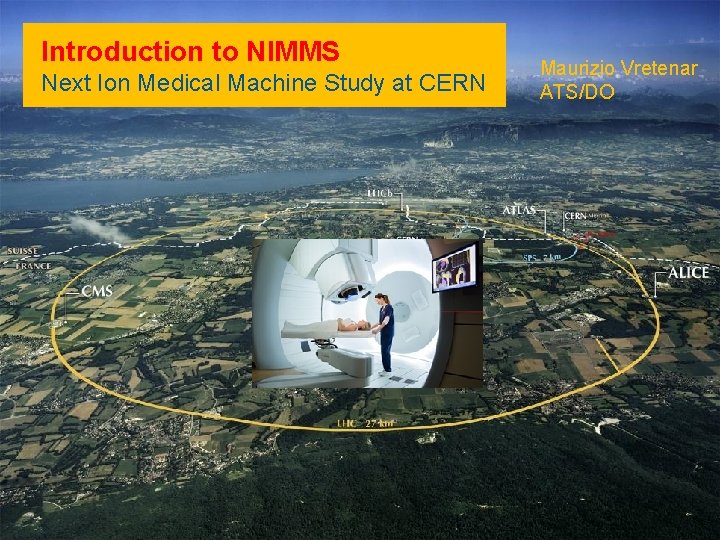
Introduction to NIMMS Next Ion Medical Machine Study at CERN 12/6/2018 Maurizio Vretenar ATS/DO 2
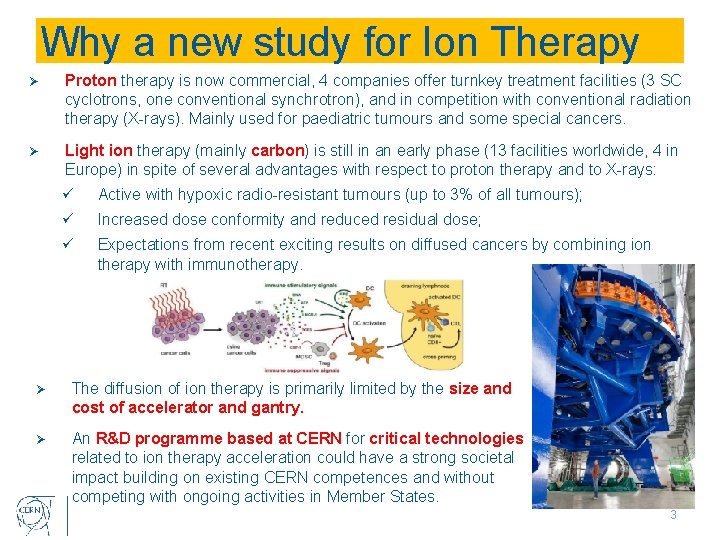
Why a new study for Ion Therapy Ø Proton therapy is now commercial, 4 companies offer turnkey treatment facilities (3 SC cyclotrons, one conventional synchrotron), and in competition with conventional radiation therapy (X-rays). Mainly used for paediatric tumours and some special cancers. Ø Light ion therapy (mainly carbon) is still in an early phase (13 facilities worldwide, 4 in Europe) in spite of several advantages with respect to proton therapy and to X-rays: ü Active with hypoxic radio-resistant tumours (up to 3% of all tumours); ü Increased dose conformity and reduced residual dose; ü Expectations from recent exciting results on diffused cancers by combining ion therapy with immunotherapy. Ø The diffusion of ion therapy is primarily limited by the size and cost of accelerator and gantry. Ø An R&D programme based at CERN for critical technologies related to ion therapy acceleration could have a strong societal impact building on existing CERN competences and without competing with ongoing activities in Member States. 3
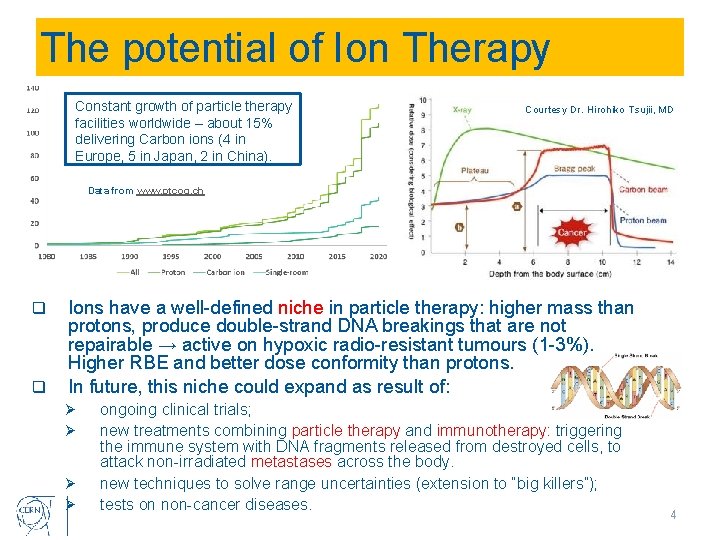
The potential of Ion Therapy Constant growth of particle therapy facilities worldwide – about 15% delivering Carbon ions (4 in Europe, 5 in Japan, 2 in China). Courtesy Dr. Hirohiko Tsujii, MD Data from www. ptcog. ch q q Ions have a well-defined niche in particle therapy: higher mass than protons, produce double-strand DNA breakings that are not repairable → active on hypoxic radio-resistant tumours (1 -3%). Higher RBE and better dose conformity than protons. In future, this niche could expand as result of: Ø Ø ongoing clinical trials; new treatments combining particle therapy and immunotherapy: triggering the immune system with DNA fragments released from destroyed cells, to attack non-irradiated metastases across the body. new techniques to solve range uncertainties (extension to “big killers”); tests on non-cancer diseases. 4
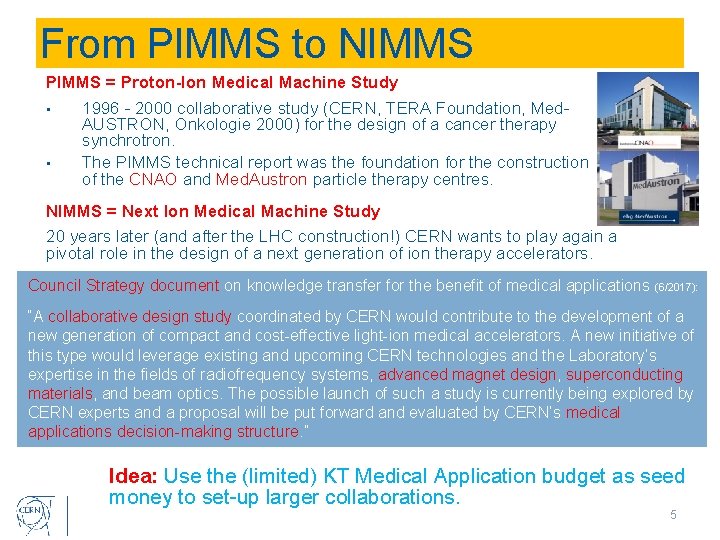
From PIMMS to NIMMS PIMMS = Proton-Ion Medical Machine Study • 1996 - 2000 collaborative study (CERN, TERA Foundation, Med. AUSTRON, Onkologie 2000) for the design of a cancer therapy synchrotron. • The PIMMS technical report was the foundation for the construction of the CNAO and Med. Austron particle therapy centres. NIMMS = Next Ion Medical Machine Study 20 years later (and after the LHC construction!) CERN wants to play again a pivotal role in the design of a next generation of ion therapy accelerators. Council Strategy document on knowledge transfer for the benefit of medical applications (6/2017): “A collaborative design study coordinated by CERN would contribute to the development of a new generation of compact and cost-effective light-ion medical accelerators. A new initiative of this type would leverage existing and upcoming CERN technologies and the Laboratory’s expertise in the fields of radiofrequency systems, advanced magnet design, superconducting materials, and beam optics. The possible launch of such a study is currently being explored by CERN experts and a proposal will be put forward and evaluated by CERN’s medical applications decision-making structure. ” Idea: Use the (limited) KT Medical Application budget as seed money to set-up larger collaborations. 5
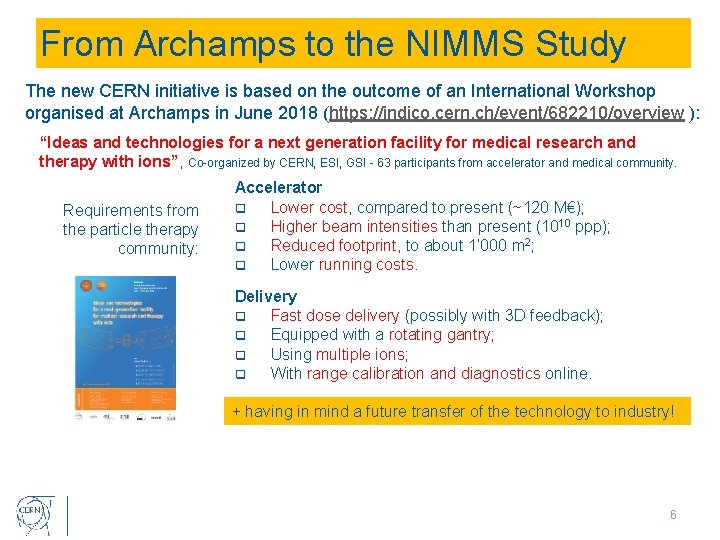
From Archamps to the NIMMS Study The new CERN initiative is based on the outcome of an International Workshop organised at Archamps in June 2018 (https: //indico. cern. ch/event/682210/overview ): “Ideas and technologies for a next generation facility for medical research and therapy with ions”, Co-organized by CERN, ESI, GSI - 63 participants from accelerator and medical community. Requirements from the particle therapy community: Accelerator q Lower cost, compared to present (~120 M€); q Higher beam intensities than present (1010 ppp); q Reduced footprint, to about 1’ 000 m 2; q Lower running costs. Delivery q Fast dose delivery (possibly with 3 D feedback); q Equipped with a rotating gantry; q Using multiple ions; q With range calibration and diagnostics online. + having in mind a future transfer of the technology to industry! 6
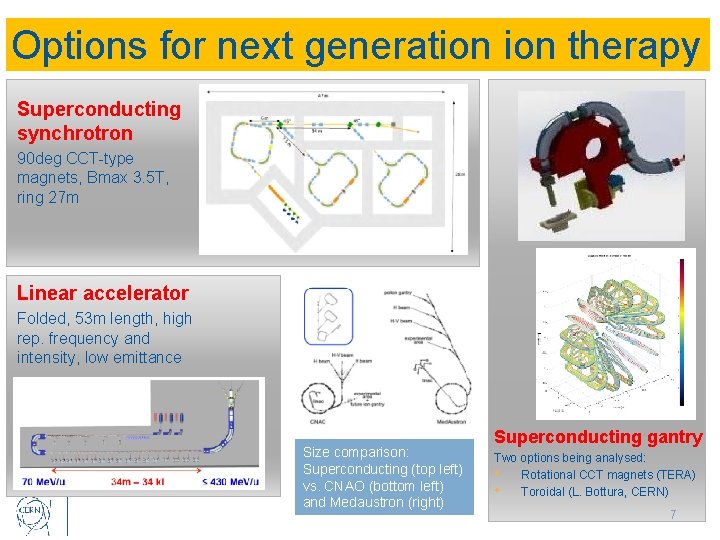
Options for next generation therapy Superconducting synchrotron 90 deg CCT-type magnets, Bmax 3. 5 T, ring 27 m Linear accelerator Folded, 53 m length, high rep. frequency and intensity, low emittance Size comparison: Superconducting (top left) vs. CNAO (bottom left) and Medaustron (right) Superconducting gantry Two options being analysed: • Rotational CCT magnets (TERA) • Toroidal (L. Bottura, CERN) 7
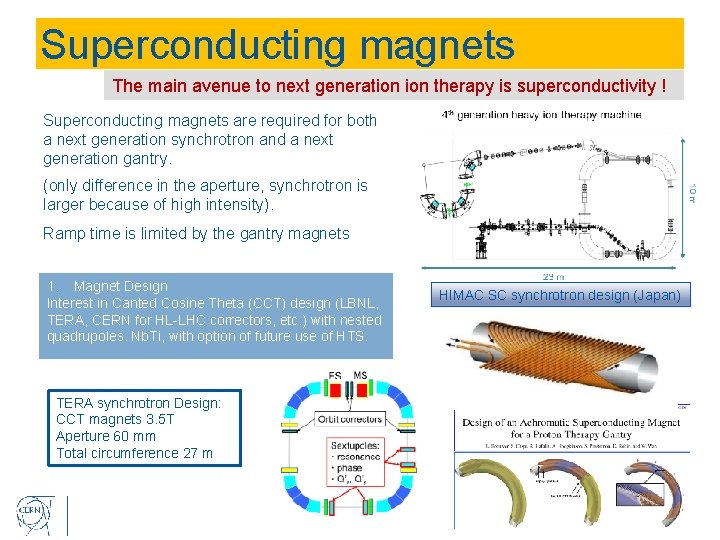
Superconducting magnets The main avenue to next generation therapy is superconductivity ! Superconducting magnets are required for both a next generation synchrotron and a next generation gantry. (only difference in the aperture, synchrotron is larger because of high intensity). Ramp time is limited by the gantry magnets 1. Magnet Design Interest in Canted Cosine Theta (CCT) design (LBNL, TERA, CERN for HL-LHC correctors, etc. ) with nested quadrupoles. Nb. Ti, with option of future use of HTS. TERA synchrotron Design: CCT magnets 3. 5 T Aperture 60 mm Total circumference 27 m HIMAC SC synchrotron design (Japan)
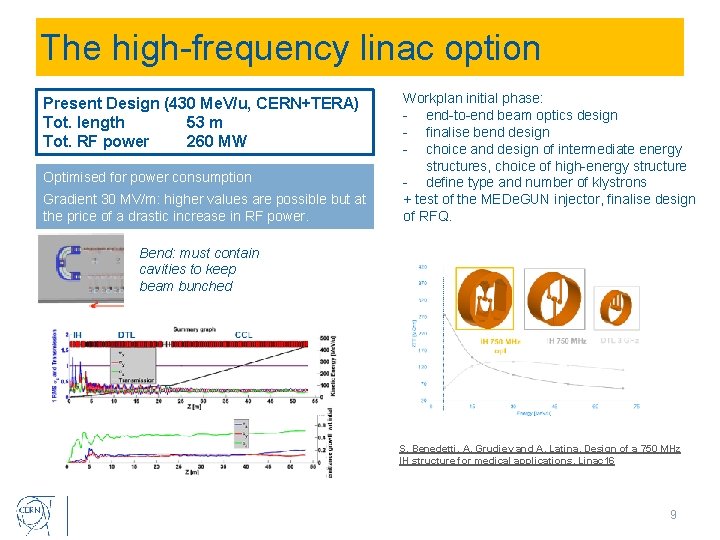
The high-frequency linac option Present Design (430 Me. V/u, CERN+TERA) Tot. length 53 m Tot. RF power 260 MW Optimised for power consumption Gradient 30 MV/m: higher values are possible but at the price of a drastic increase in RF power. Workplan initial phase: - end-to-end beam optics design - finalise bend design - choice and design of intermediate energy structures, choice of high-energy structure - define type and number of klystrons + test of the MEDe. GUN injector, finalise design of RFQ. Bend: must contain cavities to keep beam bunched S. Benedetti, A. Grudiev and A. Latina, Design of a 750 MHz IH structure for medical applications, Linac 16 9
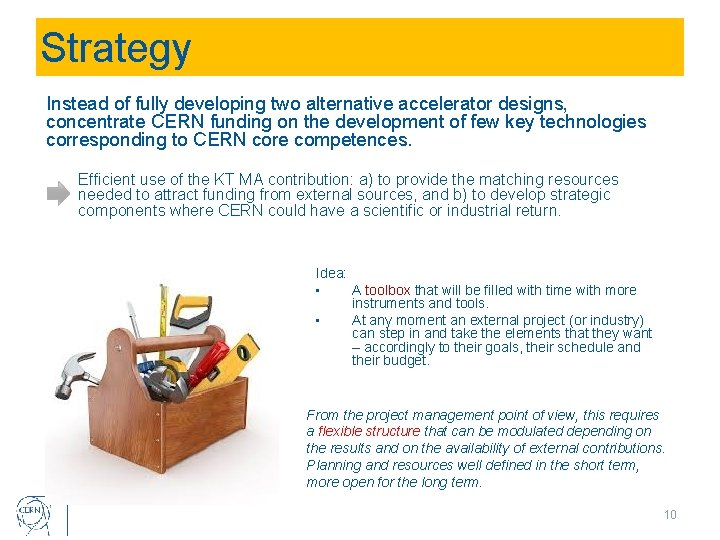
Strategy Instead of fully developing two alternative accelerator designs, concentrate CERN funding on the development of few key technologies corresponding to CERN core competences. Efficient use of the KT MA contribution: a) to provide the matching resources needed to attract funding from external sources, and b) to develop strategic components where CERN could have a scientific or industrial return. Idea: • • A toolbox that will be filled with time with more instruments and tools. At any moment an external project (or industry) can step in and take the elements that they want – accordingly to their goals, their schedule and their budget. From the project management point of view, this requires a flexible structure that can be modulated depending on the results and on the availability of external contributions. Planning and resources well defined in the short term, more open for the long term. 10
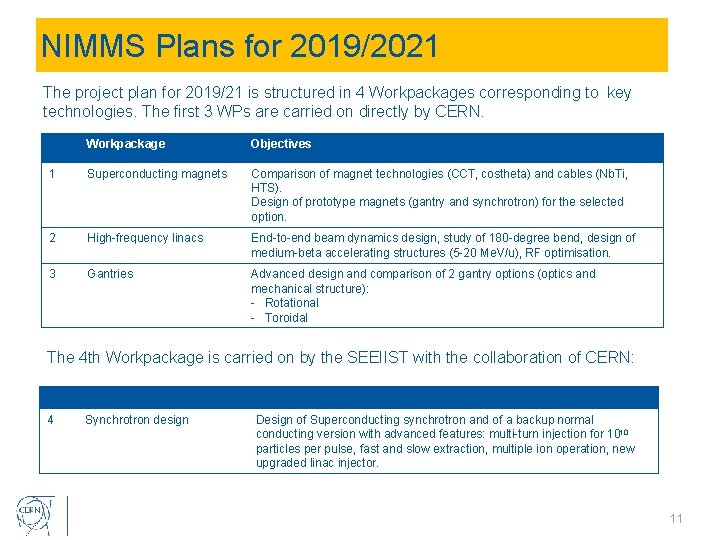
NIMMS Plans for 2019/2021 The project plan for 2019/21 is structured in 4 Workpackages corresponding to key technologies. The first 3 WPs are carried on directly by CERN. Workpackage Objectives 1 Superconducting magnets Comparison of magnet technologies (CCT, costheta) and cables (Nb. Ti, HTS). Design of prototype magnets (gantry and synchrotron) for the selected option. 2 High-frequency linacs End-to-end beam dynamics design, study of 180 -degree bend, design of medium-beta accelerating structures (5 -20 Me. V/u), RF optimisation. 3 Gantries Advanced design and comparison of 2 gantry options (optics and mechanical structure): - Rotational - Toroidal The 4 th Workpackage is carried on by the SEEIIST with the collaboration of CERN: 4 Synchrotron design Design of Superconducting synchrotron and of a backup normal conducting version with advanced features: multi-turn injection for 1010 particles per pulse, fast and slow extraction, multiple ion operation, new upgraded linac injector. 11
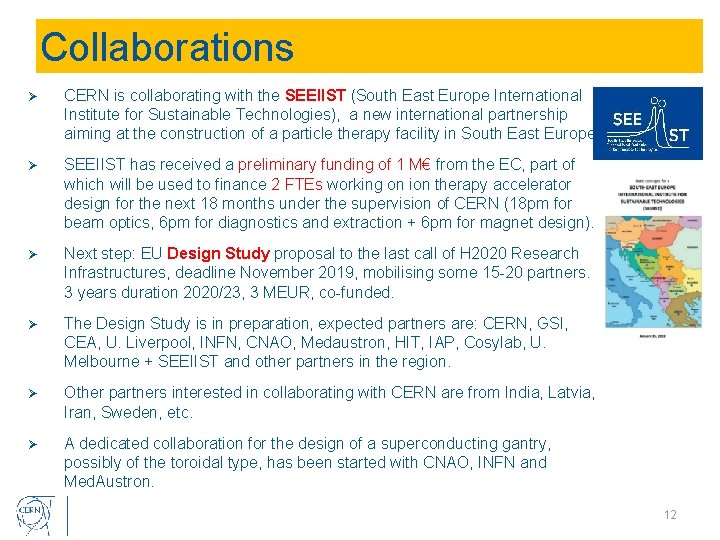
Collaborations Ø CERN is collaborating with the SEEIIST (South East Europe International Institute for Sustainable Technologies), a new international partnership aiming at the construction of a particle therapy facility in South East Europe. Ø SEEIIST has received a preliminary funding of 1 M€ from the EC, part of which will be used to finance 2 FTEs working on ion therapy accelerator design for the next 18 months under the supervision of CERN (18 pm for beam optics, 6 pm for diagnostics and extraction + 6 pm for magnet design). Ø Next step: EU Design Study proposal to the last call of H 2020 Research Infrastructures, deadline November 2019, mobilising some 15 -20 partners. 3 years duration 2020/23, 3 MEUR, co-funded. Ø The Design Study is in preparation, expected partners are: CERN, GSI, CEA, U. Liverpool, INFN, CNAO, Medaustron, HIT, IAP, Cosylab, U. Melbourne + SEEIIST and other partners in the region. Ø Other partners interested in collaborating with CERN are from India, Latvia, Iran, Sweden, etc. Ø A dedicated collaboration for the design of a superconducting gantry, possibly of the toroidal type, has been started with CNAO, INFN and Med. Austron. 12