
Introduction to Nerves and the Nervous System Chapter
- Slides: 27
Introduction to Nerves and the Nervous System Chapter 19 Copyright © 2011 Wolters Kluwer Health | Lippincott Williams & Wilkins
Role of the Nervous System • Controlling the functions of the human body • Analyzing incoming stimuli • Integrating internal and external responses Copyright © 2011 Wolters Kluwer Health | Lippincott Williams & Wilkins
Make Up of the Nervous System • Central Nervous System (CNS) – Composed of the brain and spinal cord • Peripheral Nervous System (PNS) – Sensory receptors bring information into the CNS – Motor nerves carry information away from the CNS • Autonomic Nervous System (ANS) – Uses components of the CNS and PNS to regulate automatic or unconscious responses to stimuli Copyright © 2011 Wolters Kluwer Health | Lippincott Williams & Wilkins
Function of the Cells that Make Up the Nervous System • Allow movement • Allow realization of various sensations • Provide response to internal and external stimuli • Stimulate learning, thinking, and emotions Copyright © 2011 Wolters Kluwer Health | Lippincott Williams & Wilkins
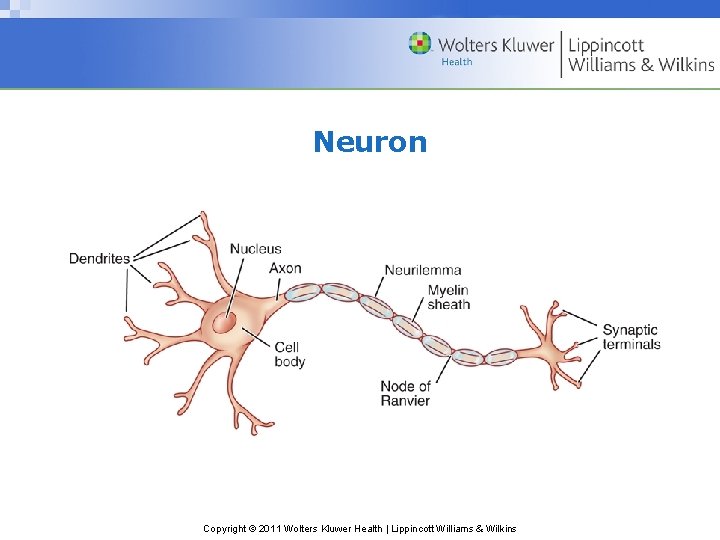
Neuron Copyright © 2011 Wolters Kluwer Health | Lippincott Williams & Wilkins
Types of Axons • Afferent Fibers – Nerve axons that run from peripheral receptors into the CNS • Efferent Fibers – Nerve axons that carry nerve impulses from the CNS to the periphery to stimulate muscles or glands Copyright © 2011 Wolters Kluwer Health | Lippincott Williams & Wilkins
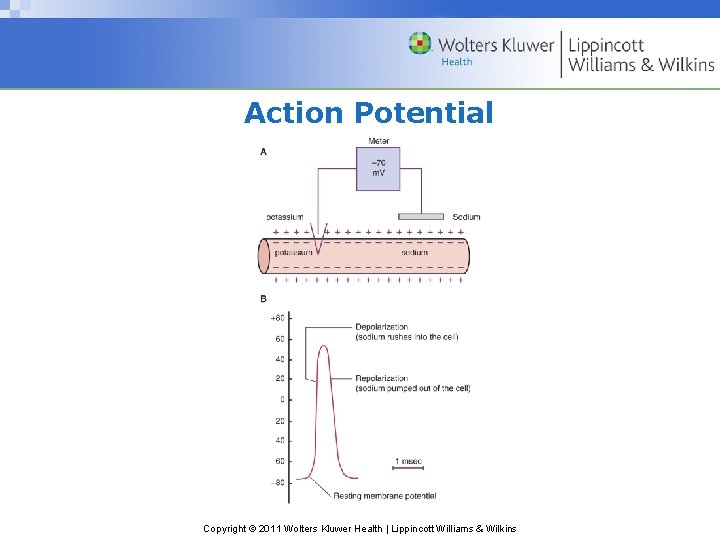
Action Potential Copyright © 2011 Wolters Kluwer Health | Lippincott Williams & Wilkins
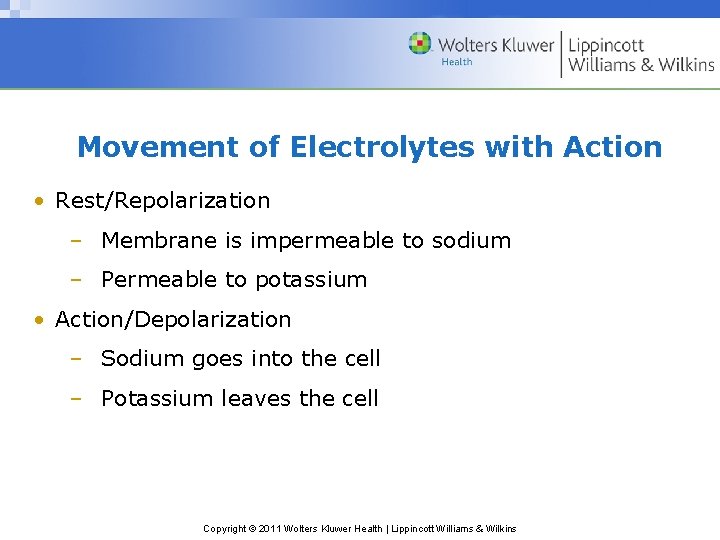
Electrolytes Involved in Nerve Cell Action • Sodium • Potassium • Calcium Copyright © 2011 Wolters Kluwer Health | Lippincott Williams & Wilkins
Movement of Electrolytes with Action • Rest/Repolarization – Membrane is impermeable to sodium – Permeable to potassium • Action/Depolarization – Sodium goes into the cell – Potassium leaves the cell Copyright © 2011 Wolters Kluwer Health | Lippincott Williams & Wilkins
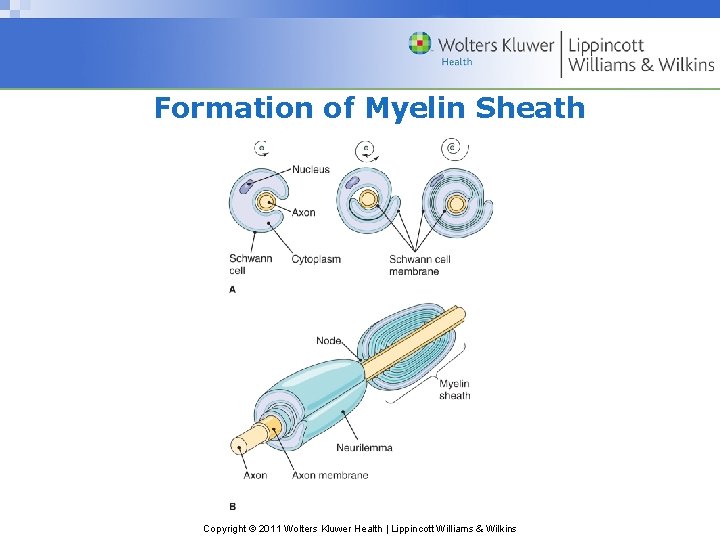
Formation of Myelin Sheath Copyright © 2011 Wolters Kluwer Health | Lippincott Williams & Wilkins
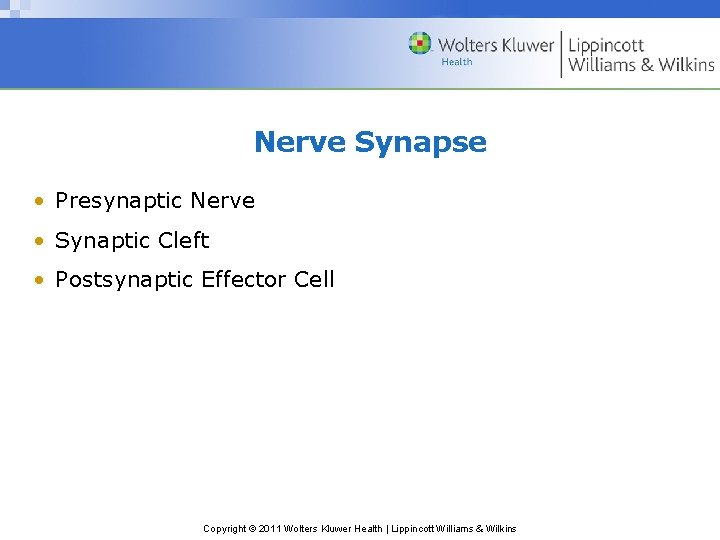
Nerve Synapse • Presynaptic Nerve • Synaptic Cleft • Postsynaptic Effector Cell Copyright © 2011 Wolters Kluwer Health | Lippincott Williams & Wilkins
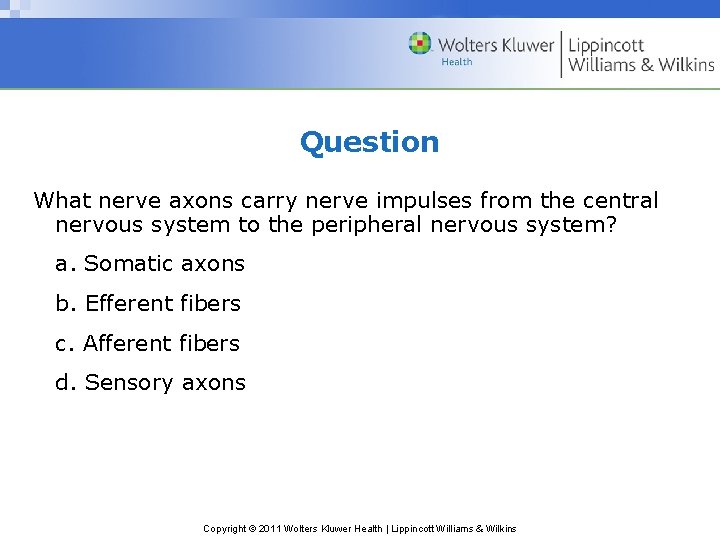
Question What nerve axons carry nerve impulses from the central nervous system to the peripheral nervous system? a. Somatic axons b. Efferent fibers c. Afferent fibers d. Sensory axons Copyright © 2011 Wolters Kluwer Health | Lippincott Williams & Wilkins
Answer b. Efferent fibers Rationale: Efferent fibers: Nerve axons that carry nerve impulses from the CNS to the periphery to stimulate muscles or glands Copyright © 2011 Wolters Kluwer Health | Lippincott Williams & Wilkins
Neurotransmitters • Acetylcholine – Communicates between nerves and muscles • Norepinephrine and Epinephrine – Catecholamines released by nerves in the sympathetic branch of the ANS • Dopamine – Involved in the coordination of impulses and responses Copyright © 2011 Wolters Kluwer Health | Lippincott Williams & Wilkins
Neurotransmitters (cont. ) • Gamma-aminobutyric Acid (GABA) – Inhibits nerve activity and is important in preventing over-excitability or stimulation such as seizure activity • Serotonin – Important in arousal and sleep and in preventing depression and promoting motivation Copyright © 2011 Wolters Kluwer Health | Lippincott Williams & Wilkins
Central Nervous System • Made up of brain and spinal cord • Structures are covered by meninges • Blood brain barrier • Blood supply to the brain Copyright © 2011 Wolters Kluwer Health | Lippincott Williams & Wilkins
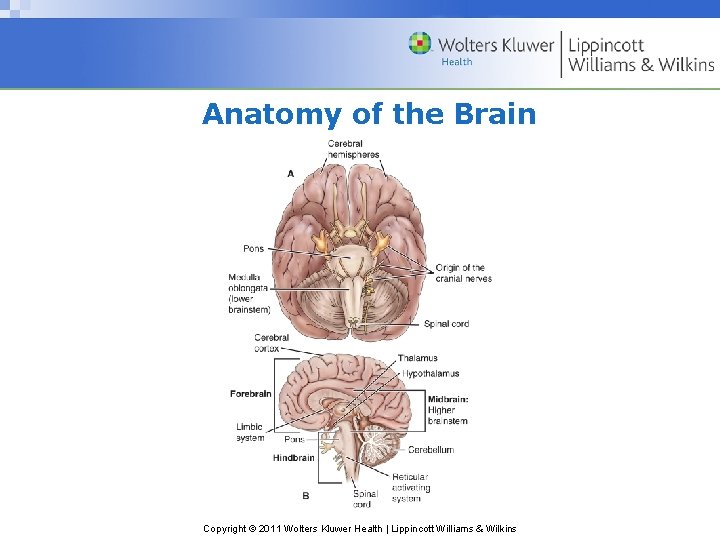
Anatomy of the Brain Copyright © 2011 Wolters Kluwer Health | Lippincott Williams & Wilkins
Hindbrain • Runs from the top of the spinal cord into the midbrain • Most primitive part of the brain - contains the brainstem • Controls basic vital functions: – Breathing – Blood pressure – Swallowing – RAS Copyright © 2011 Wolters Kluwer Health | Lippincott Williams & Wilkins
Midbrain • Contains the thalamus, the hypothalamus, and the limbic system • The thalamus sends direct information into the cerebrum to transfer sensations • Hypothalamus acts as major sensor activity in the body – Temperature regulation – Water balance – Appetite – Endocrine function Copyright © 2011 Wolters Kluwer Health | Lippincott Williams & Wilkins
Limbic System • Contain high levels of the neurotransmitters – Epinephrine – Norepinephrine – Serotonin • Controls expression of emotions Copyright © 2011 Wolters Kluwer Health | Lippincott Williams & Wilkins
Forebrain • Made up of two cerebral hemispheres joined together by the corpus callosum • Receives and sends nerve impulses, coordinates speech and communication, and facilitates learning Copyright © 2011 Wolters Kluwer Health | Lippincott Williams & Wilkins
Spinal Cord • Made up of 31 pairs of spinal nerves • Each spinal nerve has two components or roots – Sensory fiber (dorsal root) • Brings information into the CNS from the periphery – Motor fiber (ventral root) • Causes movement or reaction Copyright © 2011 Wolters Kluwer Health | Lippincott Williams & Wilkins
Function of Central Nervous System • Sensory Functions • Motor Functions • Intellectual and Emotional Functions Copyright © 2011 Wolters Kluwer Health | Lippincott Williams & Wilkins
Intellectual and Emotional Function • Two hemispheres of the brain process information differently • Right Side – Artistic • Left Side – Analytical • When learning takes place and actual change occurs in a neuron Copyright © 2011 Wolters Kluwer Health | Lippincott Williams & Wilkins
Intellectual and Emotional Function (cont. ) • Some degree of stress helps facilitate learning • Increased stress inhibits learning • The limbic system plays a role in learning • Emotions associated with memory as well as the present have an impact on stimulus response. • The placebo effect is a documented effect of the mind on drug therapy: If a person perceives that a drug will be effective, it is much more likely to actually be effective. Copyright © 2011 Wolters Kluwer Health | Lippincott Williams & Wilkins
Question What is a documented phenomenon of the mind affecting drug therapy? a. Action potential b. Placebo effect c. Expectation effect d. Learning Copyright © 2011 Wolters Kluwer Health | Lippincott Williams & Wilkins
Answer b. Placebo effect Rationale: The placebo effect is a documented effect of the mind on drug therapy: If a person perceives that a drug will be effective, it is much more likely to actually be effective. Copyright © 2011 Wolters Kluwer Health | Lippincott Williams & Wilkins