
Introduction to Natural Language Processing AILab 2003 09
Introduction to Natural Language Processing AI-Lab 2003. 09. 03 1
Intro to NLP • Instructor: Jan Hajič (Visiting Assistant Professor) – CS Dept. JHU, office: NEB 324 A – Hours: Mon 10 -11, Tue 3 -4 – preferred contact: by e-mail • Teaching Assistant: Gideon Mann – CS Dept. JHU, office: NEB 332 – Hours: TBA • Room: NEB 36, MTW 2 -3 (50 mins. ) 2
Textbooks you need • Manning, C. D. , Schütze, H. : • Foundations of Statistical Natural Language Processing. The MIT Press. 1999. ISBN 0 -262 -13360 -1. [required - on order] • Allen, J. : • Natural Language Understanding. The Benjamins/Cummins Publishing Co. 1994. ISBN 0 -8053 -0334 -0. [required available] • Wall, L. et al. : • Programming PERL. 2 nd ed. O’Reilly. 1996. ISBN 1 -56592149 -6. [recommended - available (main store)/on order] 3
Other reading • Charniak, E: – Statistical Language Learning. The MIT Press. 1996. ISBN 0 -262 -53141 -0. • Cover, T. M. , Thomas, J. A. : – Elements of Information Theory. Wiley. 1991. ISBN 0 -471 -06259 -6. • Jelinek, F. : – Statistical Methods for Speech Recognition. The MIT Press. 1998. ISBN 0262 -10066 -5 • Proceedings of major conferences: – – ACL (Assoc. of Computational Linguistics) EACL (European Chapter of ACL) ANLP (Applied NLP) COLING (Intl. Committee of Computational Linguistics) 4
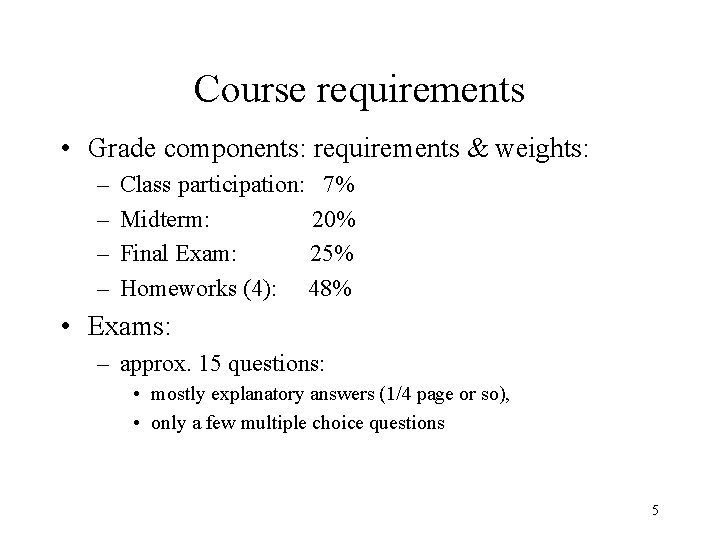
Course requirements • Grade components: requirements & weights: – – Class participation: 7% Midterm: 20% Final Exam: 25% Homeworks (4): 48% • Exams: – approx. 15 questions: • mostly explanatory answers (1/4 page or so), • only a few multiple choice questions 5
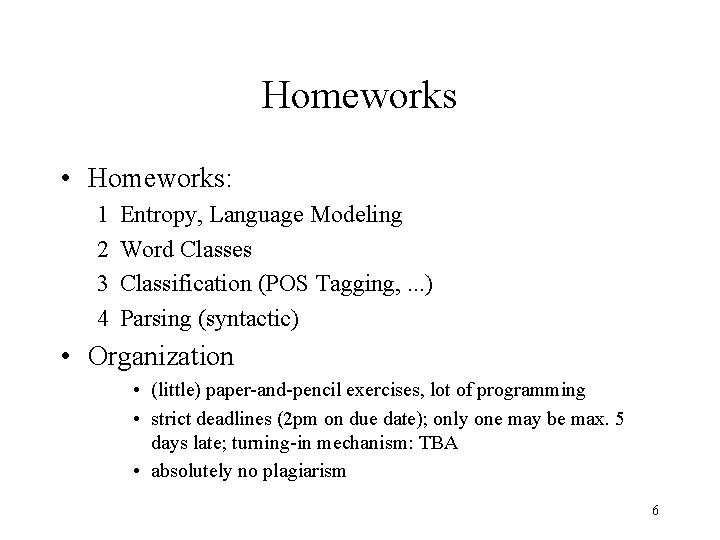
Homeworks • Homeworks: 1 2 3 4 Entropy, Language Modeling Word Classes Classification (POS Tagging, . . . ) Parsing (syntactic) • Organization • (little) paper-and-pencil exercises, lot of programming • strict deadlines (2 pm on due date); only one may be max. 5 days late; turning-in mechanism: TBA • absolutely no plagiarism 6
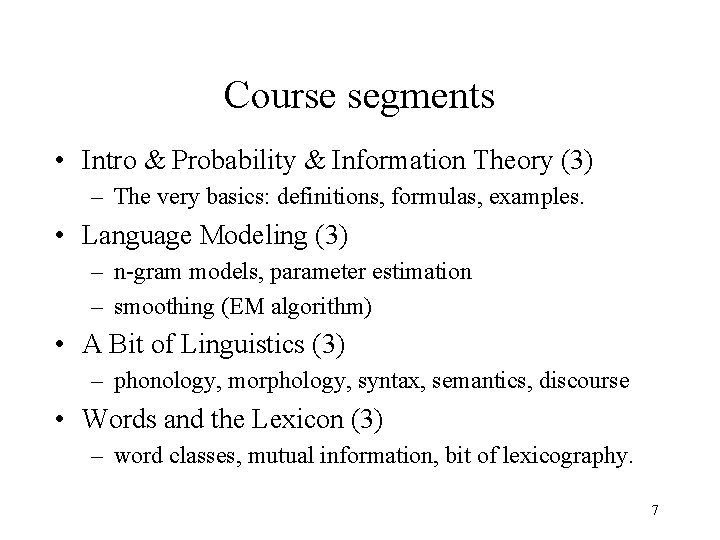
Course segments • Intro & Probability & Information Theory (3) – The very basics: definitions, formulas, examples. • Language Modeling (3) – n-gram models, parameter estimation – smoothing (EM algorithm) • A Bit of Linguistics (3) – phonology, morphology, syntax, semantics, discourse • Words and the Lexicon (3) – word classes, mutual information, bit of lexicography. 7
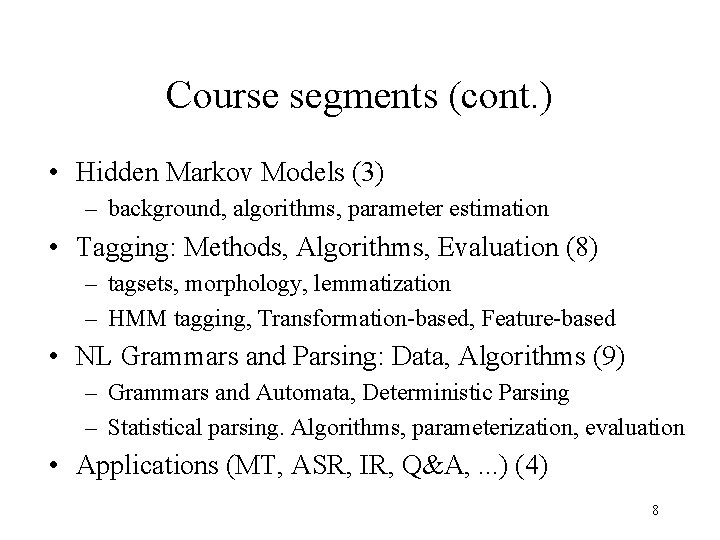
Course segments (cont. ) • Hidden Markov Models (3) – background, algorithms, parameter estimation • Tagging: Methods, Algorithms, Evaluation (8) – tagsets, morphology, lemmatization – HMM tagging, Transformation-based, Feature-based • NL Grammars and Parsing: Data, Algorithms (9) – Grammars and Automata, Deterministic Parsing – Statistical parsing. Algorithms, parameterization, evaluation • Applications (MT, ASR, IR, Q&A, . . . ) (4) 8
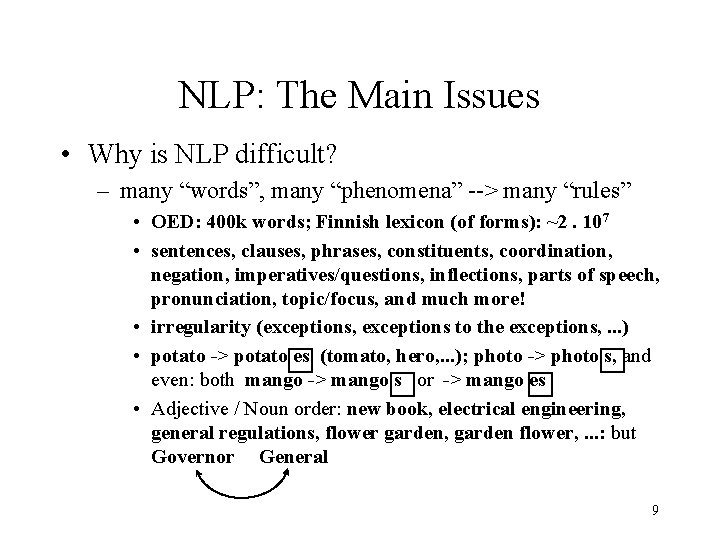
NLP: The Main Issues • Why is NLP difficult? – many “words”, many “phenomena” --> many “rules” • OED: 400 k words; Finnish lexicon (of forms): ~2. 107 • sentences, clauses, phrases, constituents, coordination, negation, imperatives/questions, inflections, parts of speech, pronunciation, topic/focus, and much more! • irregularity (exceptions, exceptions to the exceptions, . . . ) • potato -> potato es (tomato, hero, . . . ); photo -> photo s, and even: both mango -> mango s or -> mango es • Adjective / Noun order: new book, electrical engineering, general regulations, flower garden, garden flower, . . . : but Governor General 9
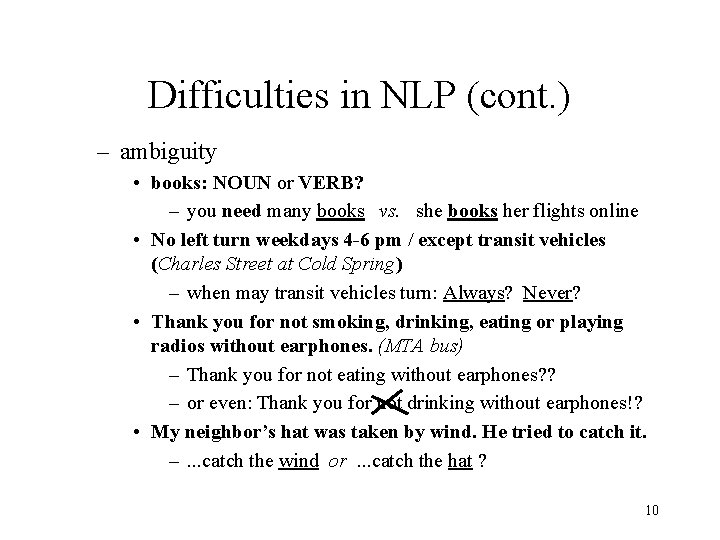
Difficulties in NLP (cont. ) – ambiguity • books: NOUN or VERB? – you need many books vs. she books her flights online • No left turn weekdays 4 -6 pm / except transit vehicles (Charles Street at Cold Spring) – when may transit vehicles turn: Always? Never? • Thank you for not smoking, drinking, eating or playing radios without earphones. (MTA bus) – Thank you for not eating without earphones? ? – or even: Thank you for not drinking without earphones!? • My neighbor’s hat was taken by wind. He tried to catch it. –. . . catch the wind or. . . catch the hat ? 10
(Categorical) Rules or Statistics? • Preferences: – clear cases: context clues: she books --> books is a verb – rule: if an ambiguous word (verb/nonverb) is preceded by a matching personal pronoun -> word is a verb – less clear cases: pronoun reference – she/he/it refers to the most recent noun or pronoun (? ) (but maybe we can specify exceptions) – selectional: – catching hat >> catching wind (but why not? ) – semantic: – never thank for drinking in a bus! (but what about the earphones? ) 11
Solutions • Don’t guess if you know: • • • morphology (inflections) lexicons (lists of words) unambiguous names perhaps some (really) fixed phrases syntactic rules? • Use statistics (based on real-world data) for preferences (only? ) • No doubt: but this is the big question! 12
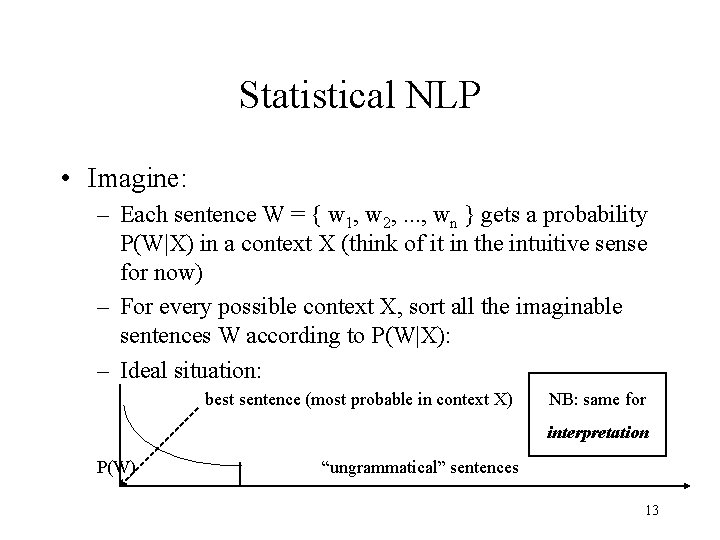
Statistical NLP • Imagine: – Each sentence W = { w 1, w 2, . . . , wn } gets a probability P(W|X) in a context X (think of it in the intuitive sense for now) – For every possible context X, sort all the imaginable sentences W according to P(W|X): – Ideal situation: best sentence (most probable in context X) NB: same for interpretation P(W) “ungrammatical” sentences 13
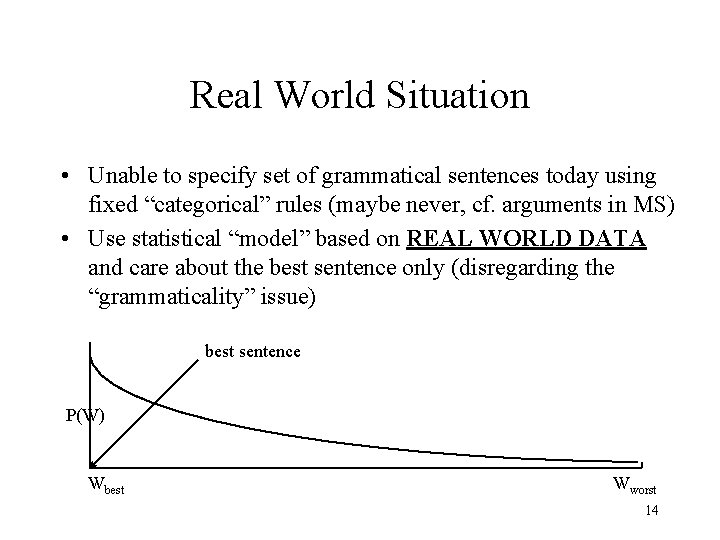
Real World Situation • Unable to specify set of grammatical sentences today using fixed “categorical” rules (maybe never, cf. arguments in MS) • Use statistical “model” based on REAL WORLD DATA and care about the best sentence only (disregarding the “grammaticality” issue) best sentence P(W) Wbest Wworst 14
- Slides: 14