
Introduction To Music Theory Shadi T Kalat and
- Slides: 33
Introduction To Music Theory Shadi T. Kalat and Siamak Faal Session 7 01/22/2016 1
What is music theory? • Is the study of the practices and possibilities of music. • Derives from observation of, and involves hypothetical speculation about how musicians and composers make music. • Study and analysis of fundamental elements of music such as pitch, rhythm, harmony, and form. • Music theory is the consideration of any sonic phenomena, including silence, as it relates to music. 2
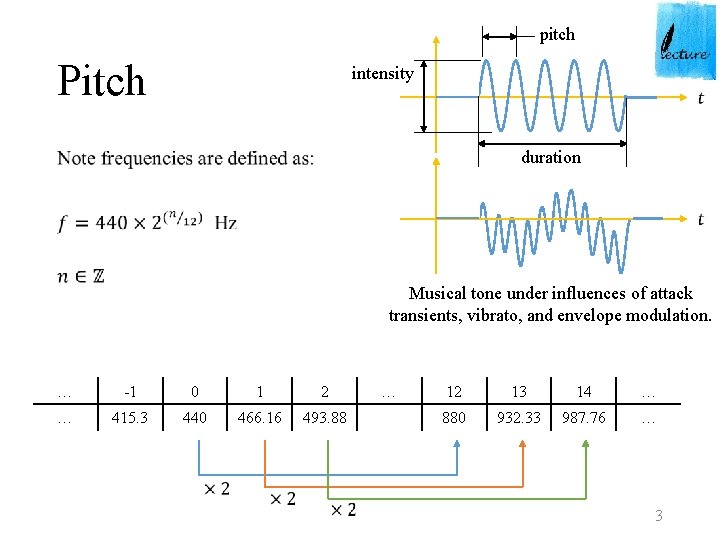
pitch Pitch intensity • duration Musical tone under influences of attack transients, vibrato, and envelope modulation. … -1 0 1 2 … 415. 3 440 466. 16 493. 88 … 12 13 14 … 880 932. 33 987. 76 … 3
Intervals and scales Interval: distance between two notes Scale: is any set of musical notes ordered by fundamental frequency or pitch. Ascending scale: A scale ordered by increasing pitch. Descending scale: A scale ordered by decreasing pitch. Some of the famous scales: • Chromatic: a scale with twelve pitches • Diatonic (heptatonia prima): a scale with seven pitches • Major (Ionian): is one of the Diatonic scales • Minor: heptatonic, natural, harmonic 4
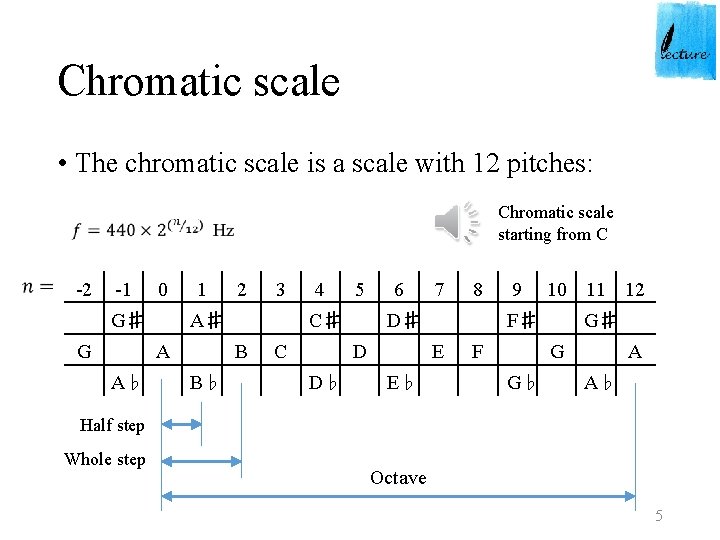
Chromatic scale • The chromatic scale is a scale with 12 pitches: Chromatic scale starting from C -2 -1 0 G♯ G 1 3 A♯ A A♭ 2 5 C♯ B B♭ 4 C 6 8 D♯ D D♭ 7 E E♭ 9 10 11 12 F♯ G♯ F G G♭ A A♭ Half step Whole step Octave 5
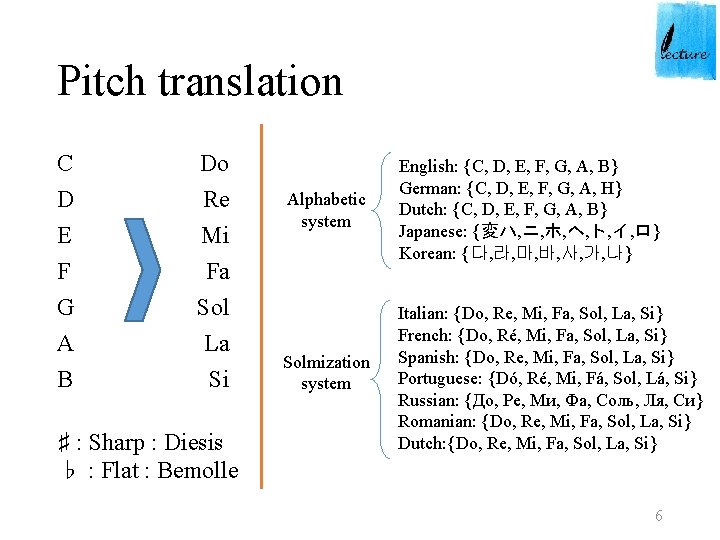
Pitch translation C D E F Do Re Mi Fa G A B Sol La Si ♯ : Sharp : Diesis ♭ : Flat : Bemolle Alphabetic system English: {C, D, E, F, G, A, B} German: {C, D, E, F, G, A, H} Dutch: {C, D, E, F, G, A, B} Japanese: {変ハ, ニ, ホ, ヘ, ト, イ, ロ} Korean: {다, 라, 마, 바, 사, 가, 나} Solmization system Italian: {Do, Re, Mi, Fa, Sol, La, Si} French: {Do, Ré, Mi, Fa, Sol, La, Si} Spanish: {Do, Re, Mi, Fa, Sol, La, Si} Portuguese: {Dó, Ré, Mi, Fá, Sol, Lá, Si} Russian: {До, Ре, Ми, Фа, Соль, Ля, Си} Romanian: {Do, Re, Mi, Fa, Sol, La, Si} Dutch: {Do, Re, Mi, Fa, Sol, La, Si} 6
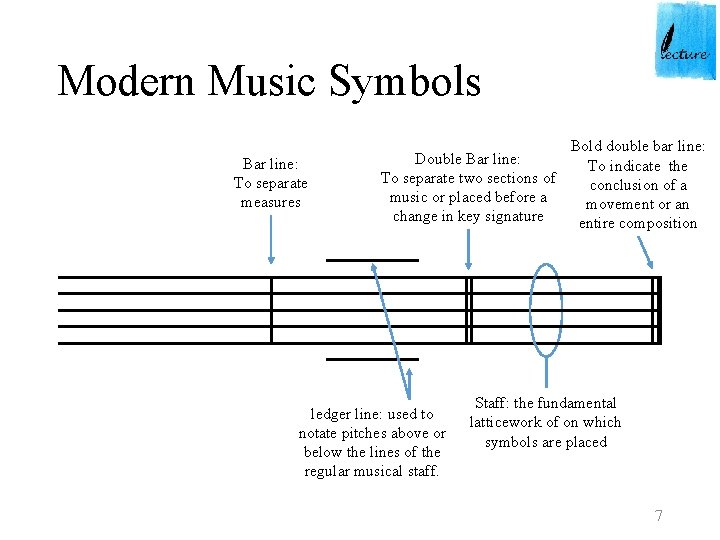
Modern Music Symbols Bar line: To separate measures Double Bar line: To separate two sections of music or placed before a change in key signature ledger line: used to notate pitches above or below the lines of the regular musical staff. Bold double bar line: To indicate the conclusion of a movement or an entire composition Staff: the fundamental latticework of on which symbols are placed 7
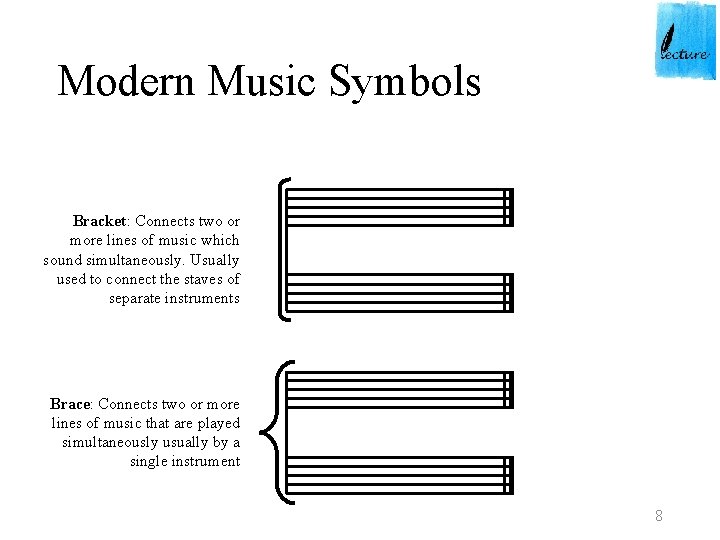
Modern Music Symbols Bracket: Connects two or more lines of music which sound simultaneously. Usually used to connect the staves of separate instruments Brace: Connects two or more lines of music that are played simultaneously usually by a single instrument 8
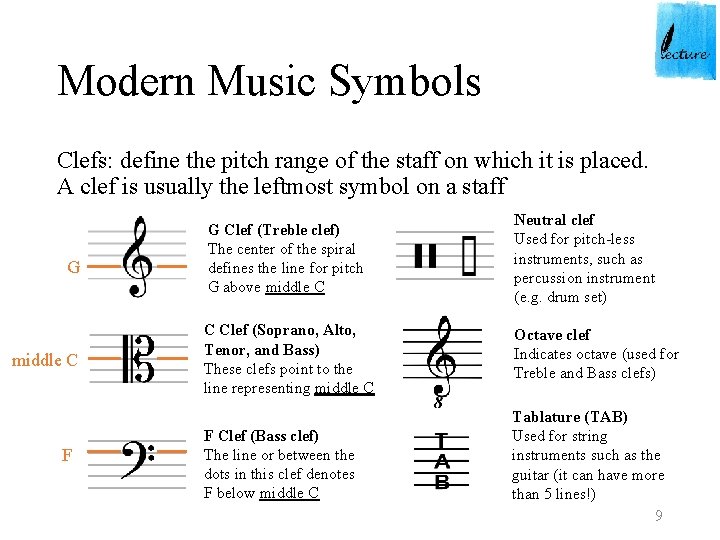
Modern Music Symbols Clefs: define the pitch range of the staff on which it is placed. A clef is usually the leftmost symbol on a staff G middle C F G Clef (Treble clef) The center of the spiral defines the line for pitch G above middle C Neutral clef Used for pitch-less instruments, such as percussion instrument (e. g. drum set) C Clef (Soprano, Alto, Tenor, and Bass) These clefs point to the line representing middle C Octave clef Indicates octave (used for Treble and Bass clefs) F Clef (Bass clef) The line or between the dots in this clef denotes F below middle C Tablature (TAB) Used for string instruments such as the guitar (it can have more than 5 lines!) 9
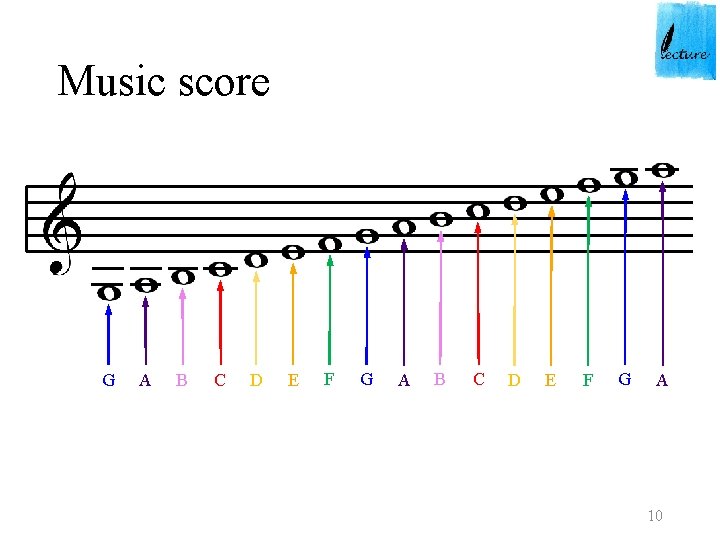
Music score G A B C D E F G A 10
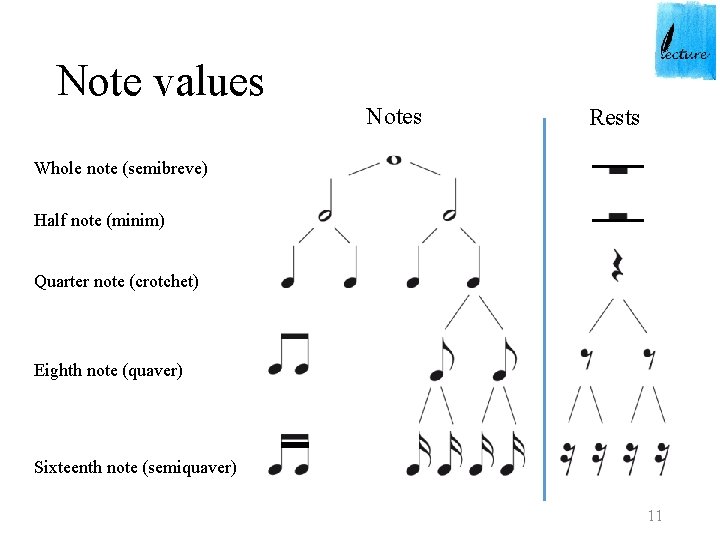
Note values Notes Rests Whole note (semibreve) Half note (minim) Quarter note (crotchet) Eighth note (quaver) Sixteenth note (semiquaver) 11
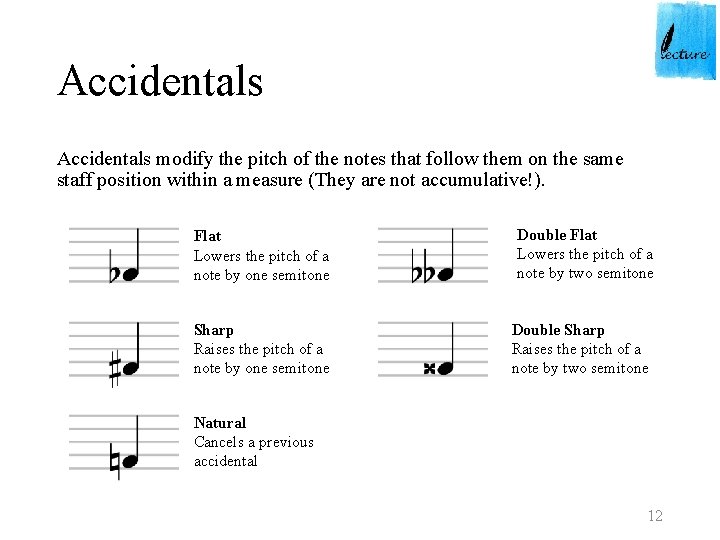
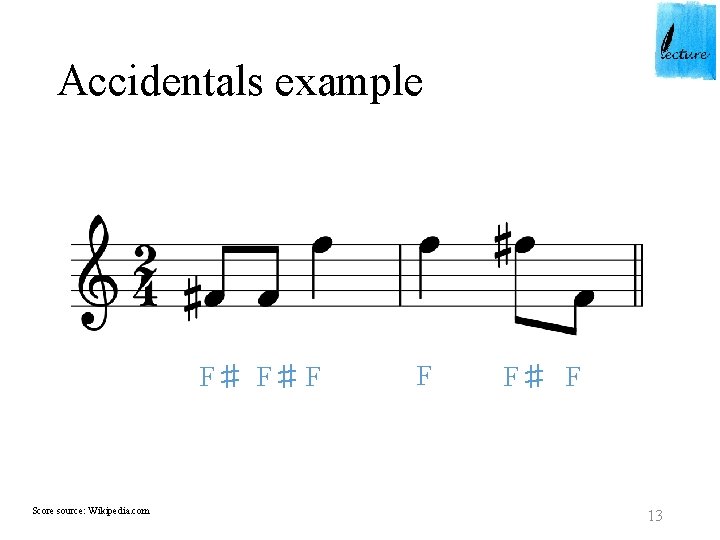
Accidentals modify the pitch of the notes that follow them on the same staff position within a measure (They are not accumulative!). Flat Lowers the pitch of a note by one semitone Sharp Raises the pitch of a note by one semitone Double Flat Lowers the pitch of a note by two semitone Double Sharp Raises the pitch of a note by two semitone Natural Cancels a previous accidental 12
Accidentals example F♯ F♯ F Score source: Wikipedia. com F F♯ F 13
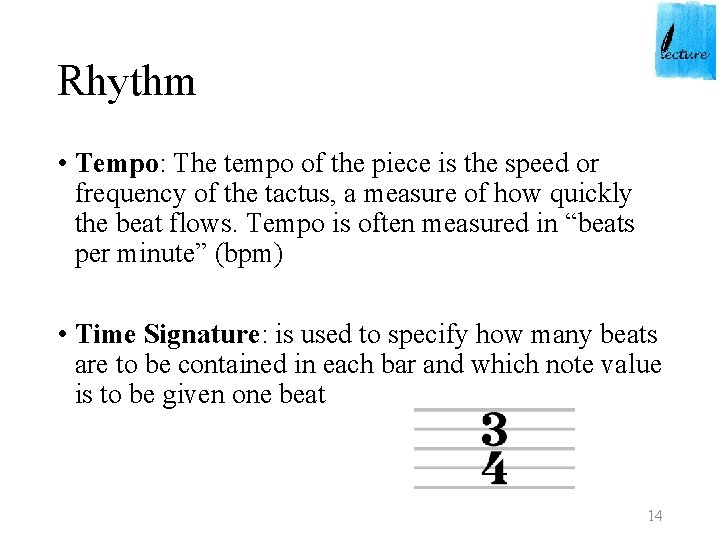
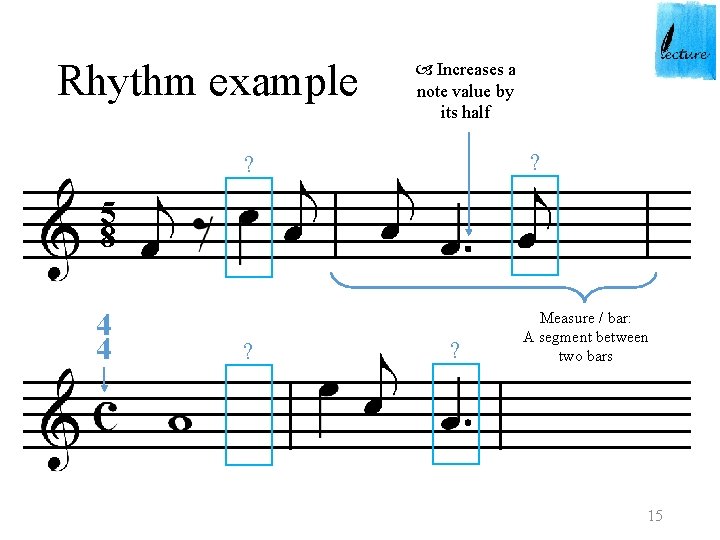
Rhythm • Tempo: The tempo of the piece is the speed or frequency of the tactus, a measure of how quickly the beat flows. Tempo is often measured in “beats per minute” (bpm) • Time Signature: is used to specify how many beats are to be contained in each bar and which note value is to be given one beat 14
Rhythm example Increases a note value by its half ? ? 5 8 4 4 ? ? Measure / bar: A segment between two bars 15
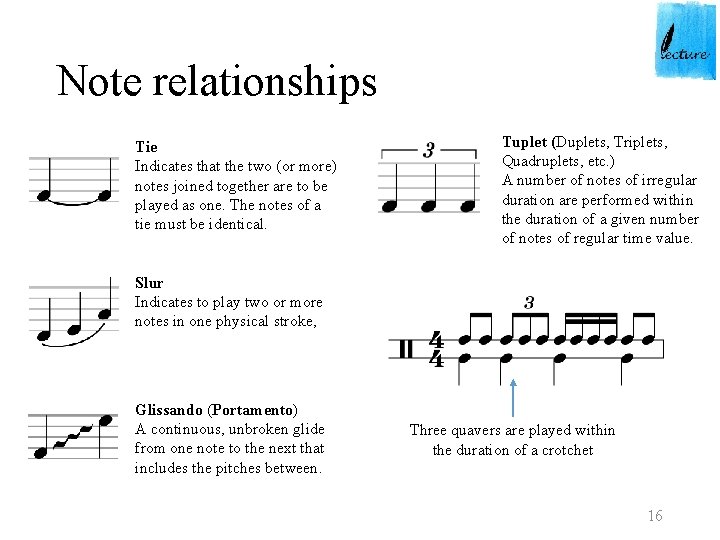
Note relationships Tie Indicates that the two (or more) notes joined together are to be played as one. The notes of a tie must be identical. Tuplet (Duplets, Triplets, Quadruplets, etc. ) A number of notes of irregular duration are performed within the duration of a given number of notes of regular time value. Slur Indicates to play two or more notes in one physical stroke, Glissando (Portamento) A continuous, unbroken glide from one note to the next that includes the pitches between. Three quavers are played within the duration of a crotchet 16
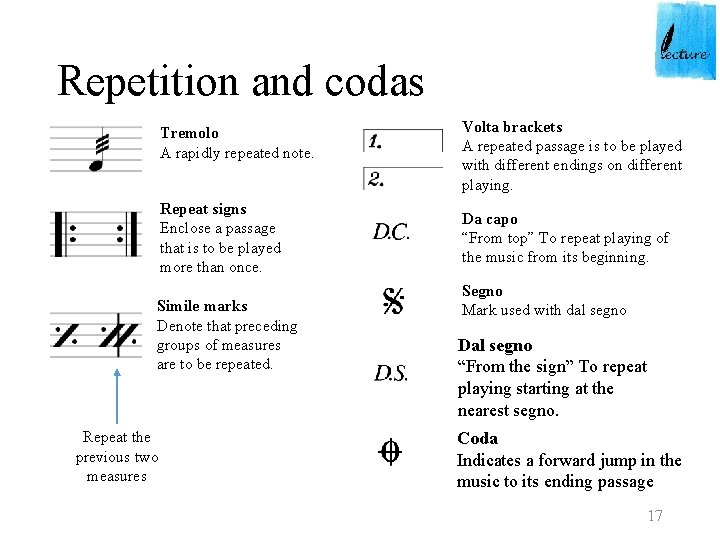
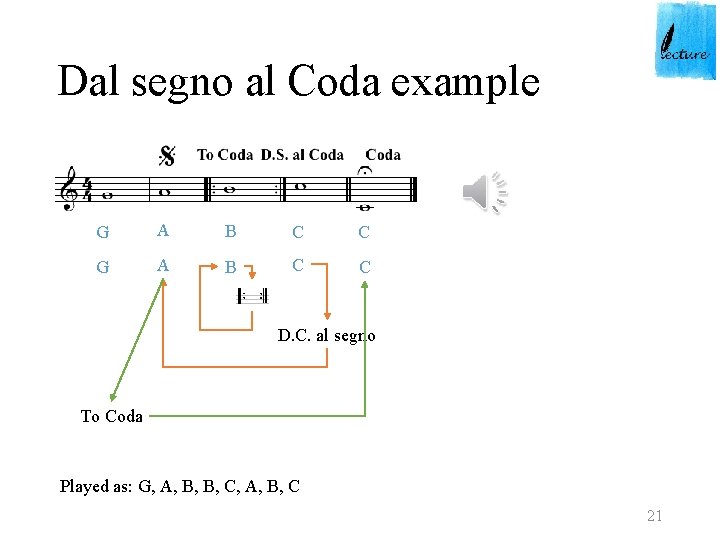
Repetition and codas Tremolo A rapidly repeated note. Repeat signs Enclose a passage that is to be played more than once. Simile marks Denote that preceding groups of measures are to be repeated. Repeat the previous two measures Volta brackets A repeated passage is to be played with different endings on different playing. Da capo “From top” To repeat playing of the music from its beginning. Segno Mark used with dal segno Dal segno “From the sign” To repeat playing starting at the nearest segno. Coda Indicates a forward jump in the music to its ending passage 17
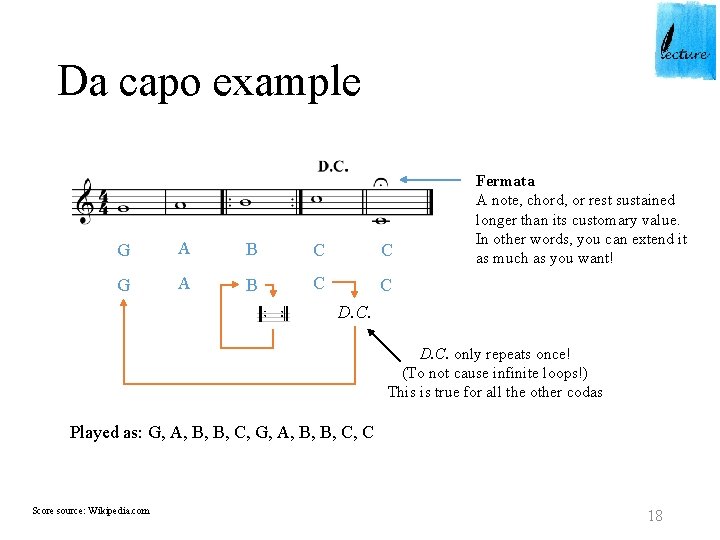
Da capo example G A B C C Fermata A note, chord, or rest sustained longer than its customary value. In other words, you can extend it as much as you want! D. C. only repeats once! (To not cause infinite loops!) This is true for all the other codas Played as: G, A, B, B, C, C Score source: Wikipedia. com 18
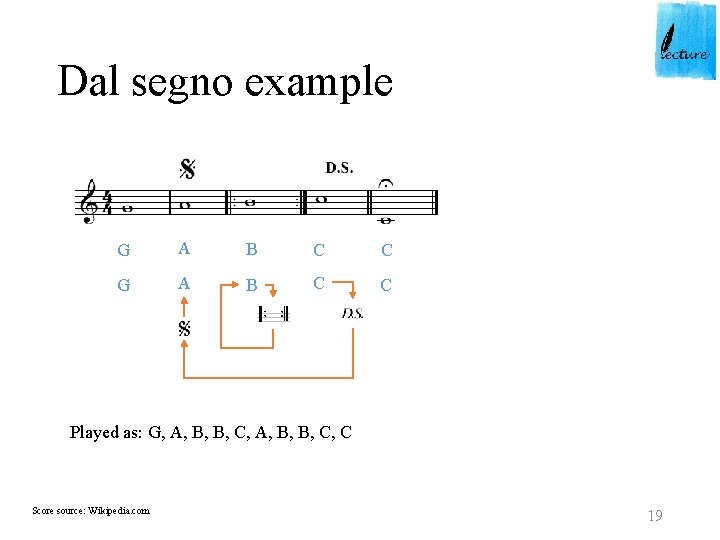
Dal segno example G A B C C Played as: G, A, B, B, C, C Score source: Wikipedia. com 19
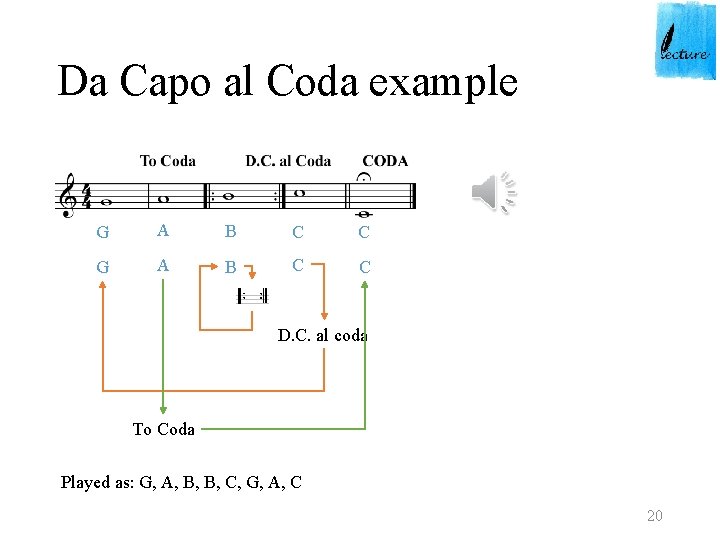
Da Capo al Coda example G A B C C D. C. al coda To Coda Played as: G, A, B, B, C, G, A, C 20
Dal segno al Coda example G A B C C D. C. al segno To Coda Played as: G, A, B, B, C, A, B, C 21
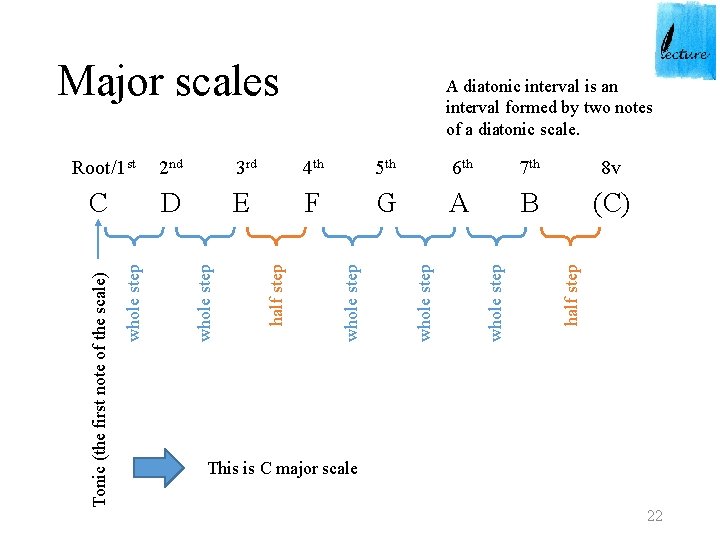
Major scales 6 th 7 th F G A B 8 v (C) half step 5 th whole step 4 th whole step half step E whole step D whole step Tonic (the first note of the scale) C 3 rd whole step Root/1 st 2 nd A diatonic interval is an interval formed by two notes of a diatonic scale. This is C major scale 22
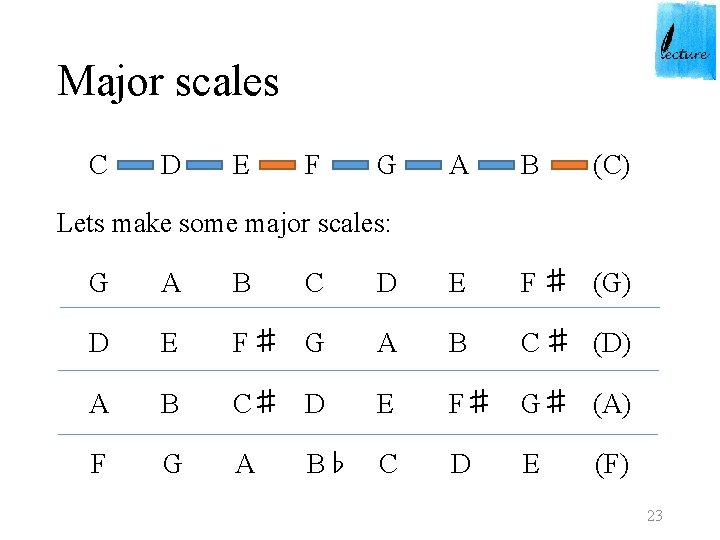
Major scales C D E F G A B (C) Lets make some major scales: G A B C D E F ♯ (G) D E F♯ G A B C ♯ (D) A B C♯ D E F ♯ G ♯ (A) F G A B♭ C D E (F) 23
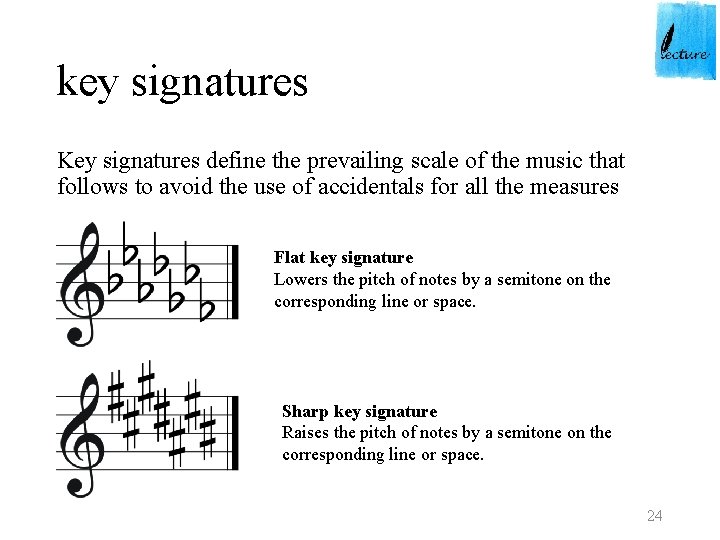
key signatures Key signatures define the prevailing scale of the music that follows to avoid the use of accidentals for all the measures Flat key signature Lowers the pitch of notes by a semitone on the corresponding line or space. Sharp key signature Raises the pitch of notes by a semitone on the corresponding line or space. 24
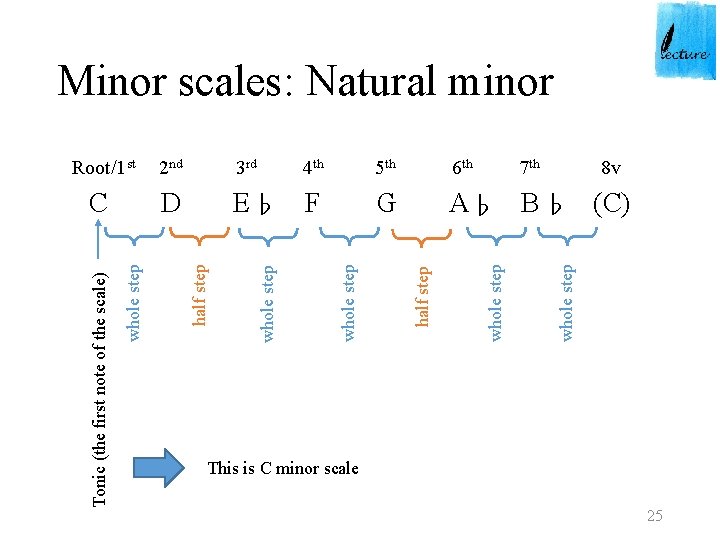
Minor scales: Natural minor G 7 th 8 v A♭ B ♭ (C) whole step E♭ F 6 th whole step 5 th half step 4 th whole step half step D whole step Tonic (the first note of the scale) C 3 rd whole step Root/1 st 2 nd This is C minor scale 25
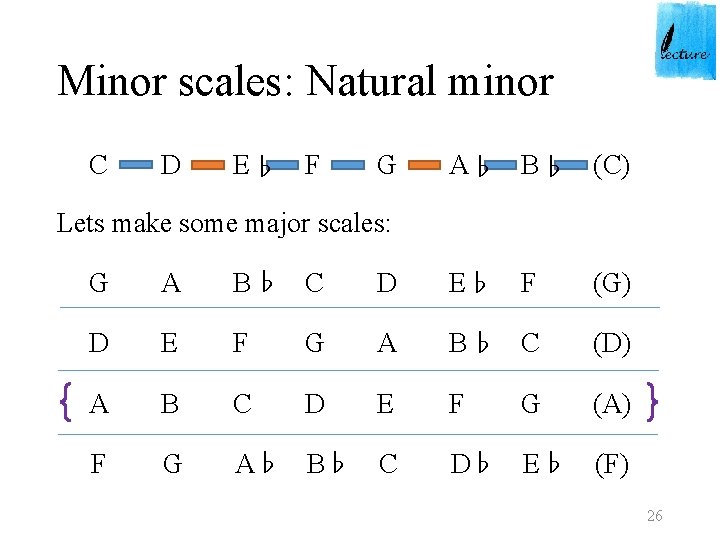
Minor scales: Natural minor C D E♭ F G A♭ B♭ (C) Lets make some major scales: G A B♭ C D E♭ F (G) D E F G A B♭ C (D) A B C D E F (A) F G A♭ B♭ C G D♭ E♭ (F) 26
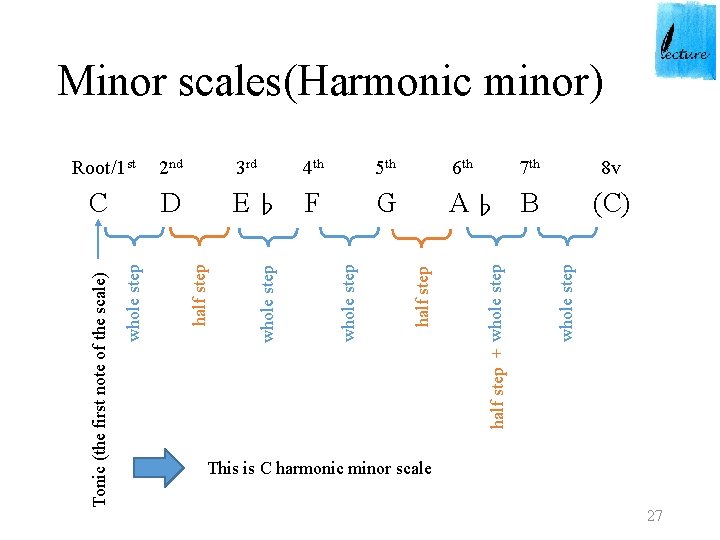
Minor scales(Harmonic minor) G 7 th 8 v A♭ B (C) whole step E♭ F 6 th half step + whole step 5 th half step 4 th whole step half step D whole step Tonic (the first note of the scale) C 3 rd whole step Root/1 st 2 nd This is C harmonic minor scale 27
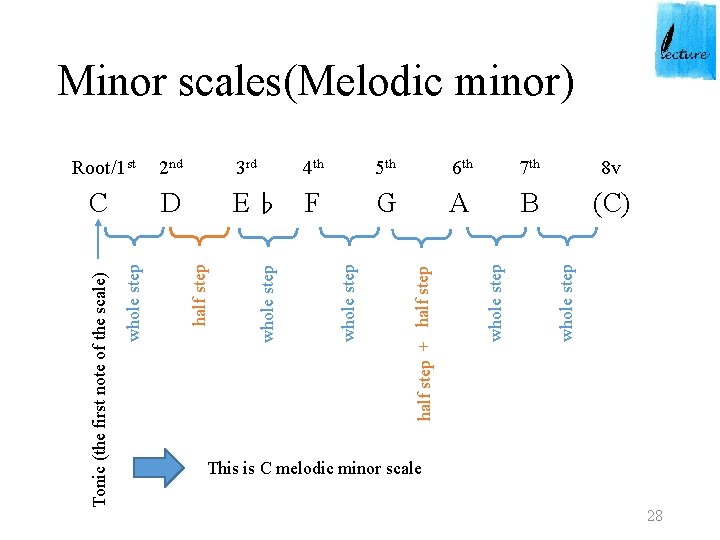
Minor scales(Melodic minor) 7 th E♭ F G A B 8 v (C) whole step 6 th whole step 5 th half step + half step 4 th whole step half step D whole step Tonic (the first note of the scale) C 3 rd whole step Root/1 st 2 nd This is C melodic minor scale 28
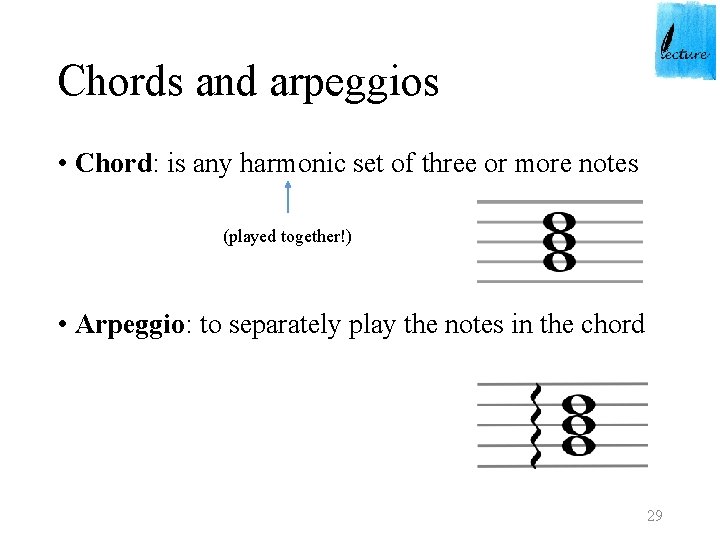
Chords and arpeggios • Chord: is any harmonic set of three or more notes (played together!) • Arpeggio: to separately play the notes in the chord 29
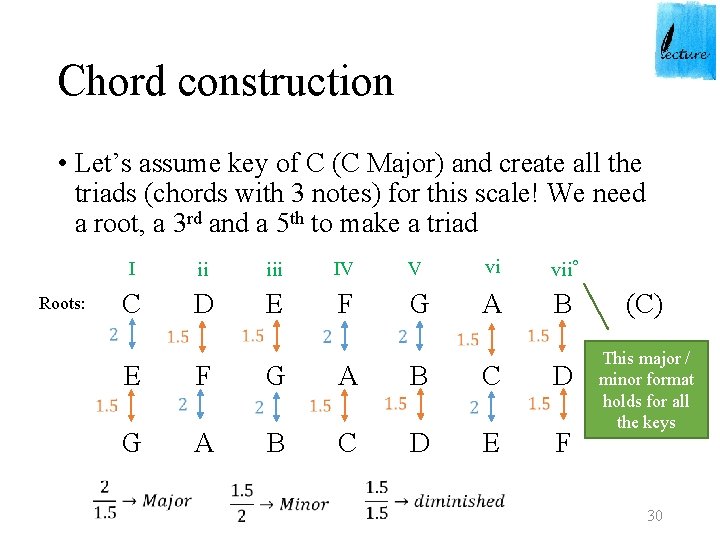
Chord construction • Let’s assume key of C (C Major) and create all the triads (chords with 3 notes) for this scale! We need a root, a 3 rd and a 5 th to make a triad Roots: I ii iii IV V vi vii° C D E F G A B E G F G B A B A C C D D E F (C) This major / minor format holds for all the keys 30
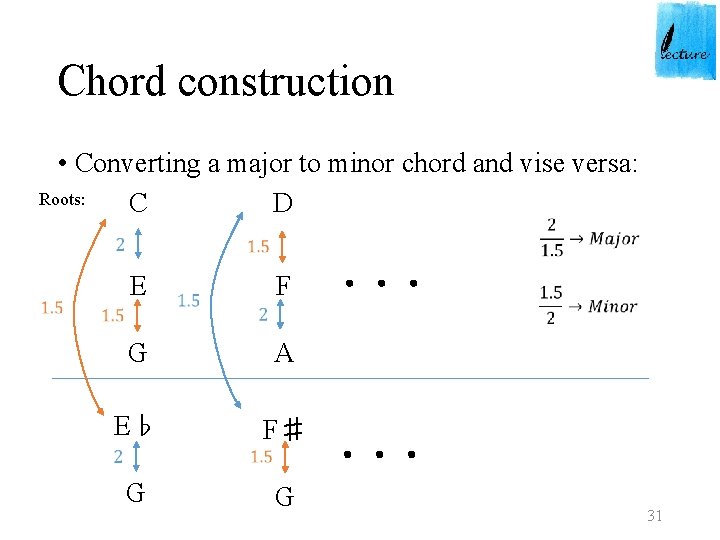
Chord construction • Converting a major to minor chord and vise versa: Roots: C D E F G A E♭ F♯ G G 31
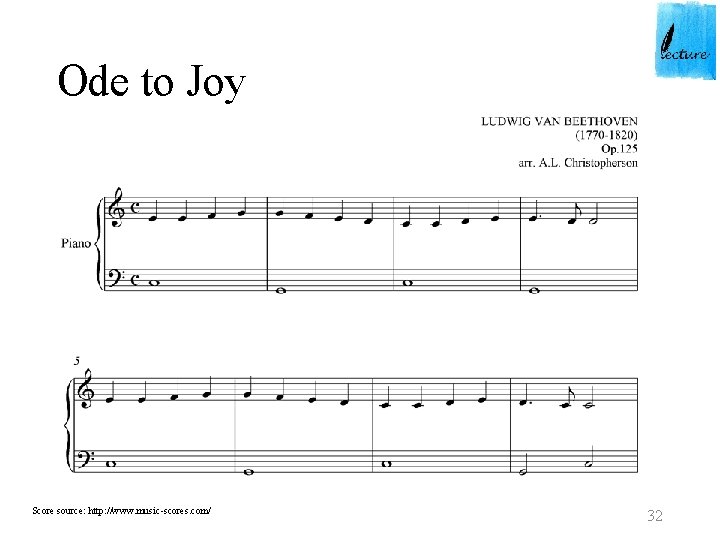
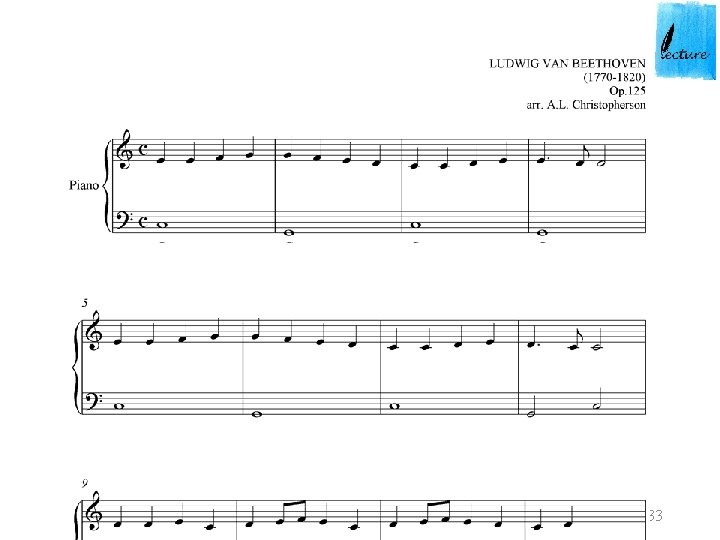
Ode to Joy Score source: http: //www. music-scores. com/ 32
33